Falling rolls in London: much worse than the rest of England

In my last post on this blog, I looked at the worsening of primary PTRs across much of the DfE’s ‘Inner London’ area. Falling Rolls: Is the funding formula making matters worse? | John Howson

This post looks how ‘Inner London boroughs have fare compared with the rest of England over those three years?

I think it is fair to say that London as a whole really has seen a significant downturn in primary pupil numbers. There are 22 local authorities where primary pupil numbers as published by the DfE have reduced by 5% or more between 2023/24 and 2025/26. Of these, 13 are London boroughs, and six – seven if Newham is included – are Inner London boroughs.
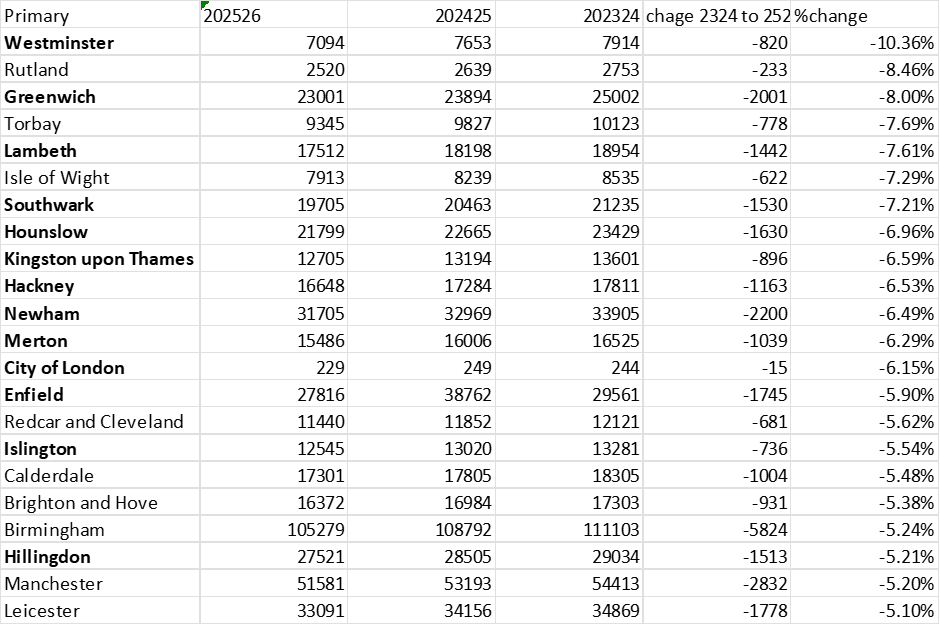
Seven of the top 10 places for the largest percentage decline in primary pupil numbers are filled by London boroughs. The other three places are taken by the Isle of Wight, Rutland and Torbay, three of the smallest unitary authorities in England.

Birmingham, Manchester and Leicester are the only large cities in the table. They fill three of the four bottom places for local authorities with a decline in pupil numbers of five per cent or more, along with Hillingdon in West London.

At the other end of the table, there are few London boroughs with less than a two per cent decline in their primary pupil populations.
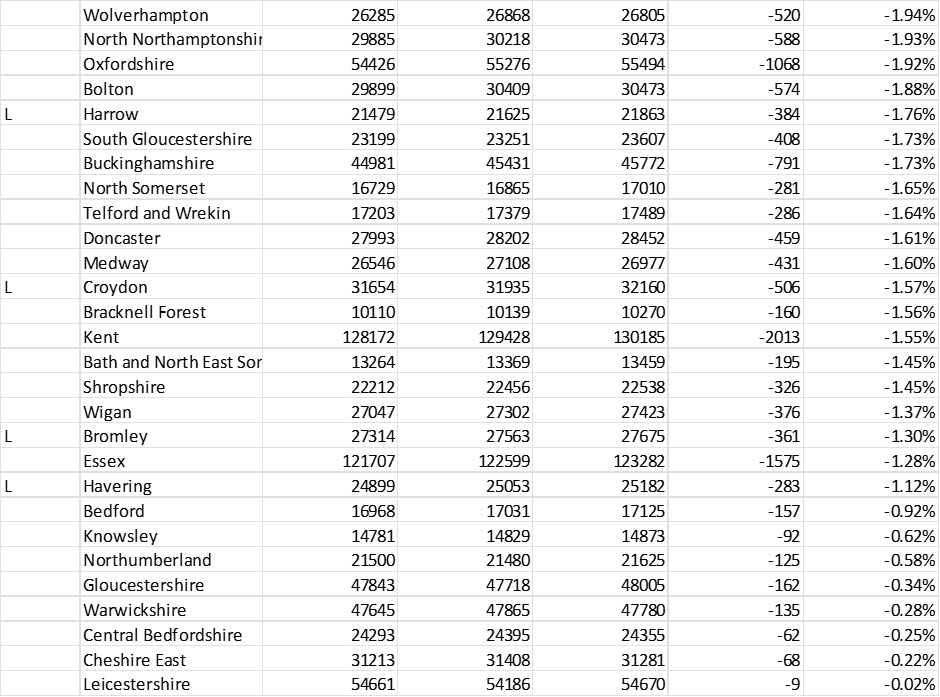

London boroughs at this end of the table seem to be mostly outer London boroughs on the fringe of the metropolitan area. By contrast, there are seven county councils in the list of lowest declines in pupil numbers. This number increases to eight, if the Staffordshire figure, of an increase in pupil numbers, is correct.

The London boroughs will have the numbers in reception for each year, and will know how much worse the decline is likely to become over the next few years. More school closures look inevitable unless the funding model is changed to protect schools with declining rolls.

Not to protect the school estate in London is to assume that there will never be an upturn in pupil numbers. In cities, closing schools and selling off the site for housing means that in any upturn land may not be available for any new schools needed for the extra pupils. This is where thinking for the longer-term is important. During the last downturn of this size, most schools in London remained open, although some, such as Stamford Hill Infant and Junior School in Haringey, where I attended in the 1950s, did eventually close. Interestingly, the one form entry St Anne’s Church of England Primary School, close to Stamford Hill School that wasn’t actually in Stamford Hill, is still open.

However, this is not the post to discuss whether or not, in a more secular society, faith run schools should be closed where an alternative non-faith school can absorb the pupils. But this is an issue to debate, especially in urban areas.

In villages, the church-run school may still be the only school available, and that raises a much larger question about who should run state funded schooling? As the Wesleyan Methodists put it when faced by the 1902 Act, and decisions on whether to open state-funded secondary schools; are our teachers, teachers of children or teachers of Methodist children?
Falling Rolls: Is the funding formula making matters worse?

There has been a lot of discussion recently about falling school rolls in the primary school sector in London. This discussion led me to wonder whether a funding formula that is heavily weighted to a per pupil funding model might mean schools with falling rolls would have to adapt to a decrease in their income.

One possible outcome of less funding could be a worsening of pupil teacher ratios if individual support for pupils with SEND is cut, and also whole classes are amalgamated. My thesis is that Inner London boroughs might be witnessing the worst of the falling rolls problem, partly because they are boroughs with little room for new housing to be built, but also because inner cities have traditionally been the home of new arrivals to a country. Post Brexit, many European families from countries such as Poland and Romania may also have chosen to return home, taking their children with them.

With the release last week of the school workforce data for 2025/26, by the DfE, it is possible to review the pupil teacher ratios (PTRs) for each borough for the three-year period from 2023/24 to 2025/26.

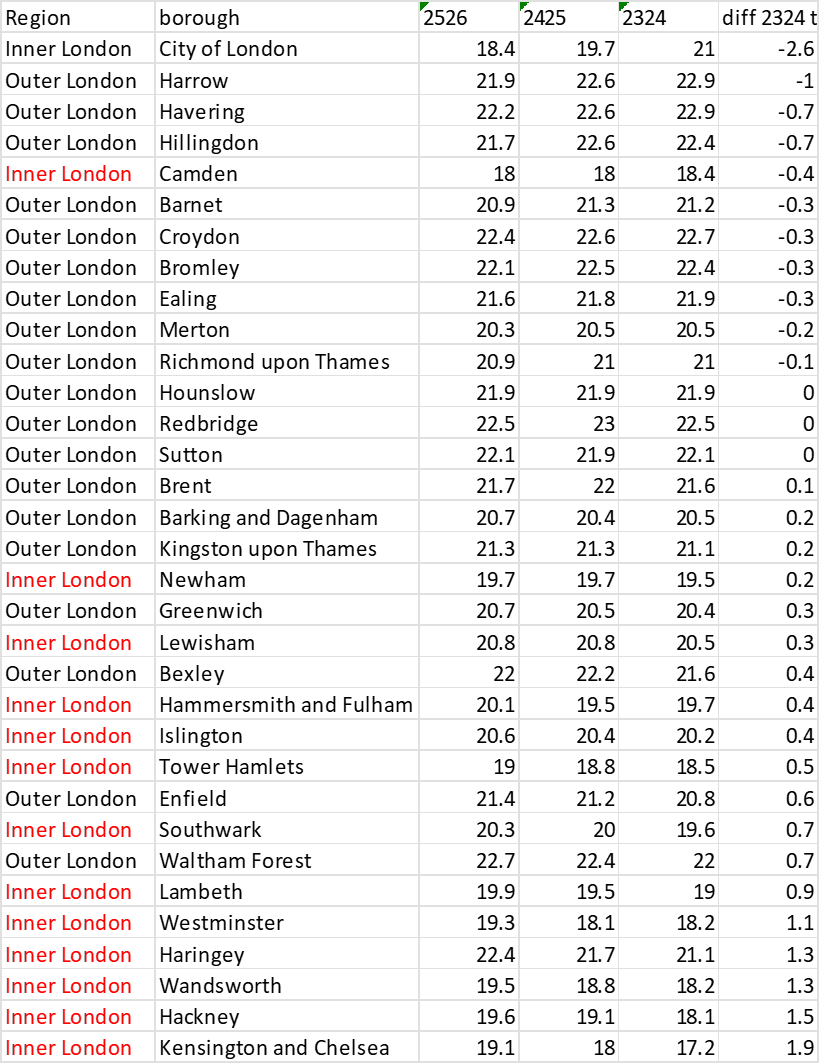
Of the boroughs in London, including the City of London, 11 boroughs improved their primary PTRs between 2023/24 and 2025/26. All but one, Camden, were Outer London boroughs. All the other Inner London boroughs recorded a worsening of their primary PTRS over the three- year period.

In the case of Kensington and Chelesea, albeit a small borough, the change was from 17.2 to 19.1 pupils per teacher over the three years: a decline of some 10%. This is a relatively large change for such a short period of time.

Seven Outer London boroughs also recorded a worsening of their primary PTRs over the same period. Of these boroughs, two, Newham and Greenwich have been classified as Inner London boroughs at sometime in the past.

Apart from the City of London, the boroughs with most improved PTRs are on the edge of London – Harrow, Havering, Hillingdon, Barnet, Croydon and Bromley.

The data in the table does suggest that falling rolls have been accompanied by a worsening of PTRs. Might this be caused in part by the construction of the National Funding formula that is heavily weighted towards a per pupil element? Reduced funding is certainly likely to impact upon class sizes and the use of teachers with small groups. Increasing class sizes and cutting individual teacher support for vulnerable learners is likely to impact upon a school’s PTR. If the reduction in pupil number sis widespread across a borough, then the impact will be seen in the PTRS for all primary schools in the borough.

I think that there is a case to be made that falling rolls are worsening PTRs for the remaining pupils across much of Inner London.

For a longer-term analysis of PTRS in London, and how over time they have been better than in most of England see  (1) (PDF) PTRS OVER TIME: A REVIEW OF PUPIL TEACHER RATIOS BETWEEN 1974 AND 2024 AND TWO PERIODS OF LOCAL GOVERNMENT RE-ORGANISATION PTRS OVER TIME: A REVIEW OF PUPIL TEACHER RATIOS

Music teachers: labour market update

One of the leitmotifs of this blog has been around the labour market for teachers, from numbers entering training, through vacancies for teachers, to the numbers of teachers that are in-service.

This academic year, I have been tracking the data on vacancies for headteachers – a study started more than 40 years ago – and vacancies for teachers of music. This is as a part of my campaign to see the bursary returned to trainee teachers of music, after the Labour government axed it an act of cultural vandalism that I might have expected from other political parties, but not from Labour.

Anyway, enough of my rant. Does the data support my thesis that there are not enough music trainees this year, even with the bursary, and that any reduction in trainee numbers will affect the 2027 labour market, making it more difficult for schools, and especially secondary schools in challenging circumstances, to recruit music teachers? For earlier discussions on this point see:  Music teachers: bring back the bursary | John Howson and Reviving Music Teacher Bursaries: A Necessity | John Howson

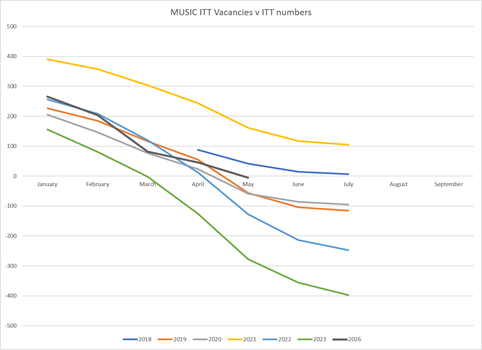
The graph in this post shows recorded 2026 vacancies for main scale teachers of music (no TLR) advertised since the start of January2026, and recorded from both the DfE vacancy site and the tes job board. The 2026 data have been plotted against previous years data, collected by TeachVac from school websites and local authority job boards.

The plotted line is the residual, reached after subtracting the recorded vacancies from number of trainees contained in the DfE’s ITT census published in the December 2025. By Friday 29th May 2026 the residual number had just turned negative; meaning more vacancies recorded than trainees possibly available to enter the labour market.

Two caveats are required at this point: not all trainees will complete their course, and of those that do, not all will enter teaching in state schools – some with not teach, others will teach in Sixth Form Colleges, and yet other will teach in the independent sector that now comprises a significant proportion of ‘A’ Music level entries. The second caveat is that in addition to trainees, there will be other entrants into the music teacher labour market. Some other entrants will be switching schools, but possibly most will be doing for a teaching job with a TLR. Then there will be those returning to state school teaching either from other jobs or a career break. This group will become increasingly important for the job market as the rest of 2026 unfolds, and the new entrants into teaching either find a teaching post in a state school of opt to work elsewhere.

For various reasons TeachVac stopped collecting data in 2023, so the data for 2024 and 2025 is missing. Comparing 2026 with earlier years, shows a trend worse than before covid, but better than in 2022, and the disastrous 2023, when poor recruitment into ITT in 2022 and the number of new schools opening in response to the increase in the secondary school population ensured a higher-than-normal demand for teachers. However, here was my analysis in June 2023 TeachVac’s index shows depth of teacher recruitment crisis | John Howson

For the current market outcome, if you discount the ITT 2025 census total by either 10% or 20%, for numbers in the census not likely to enter mainstream school teaching in the secondary sector, then the current negative residual at the end of May 2026, of -5, worsens to either -41 or -78.

This number assumes that vacancies tracked cover the whole market and that regional or other job boards, such as within large MATs, that are not counted in my survey have not seen many vacancies not placed on either the DfE or tes site.

Some schools may have offered trainees working in their schools a job, and saved on advertising costs. However, without more detailed surveys, such jobs would be difficult to account for.

One issue overcome by direct verification of the DfE and tes sites, is the thorny question of re-advertisements and repeat advertisements. The data used in this report ignores any second or subsequent advertisement by a school for a teacher of music unless it is significantly different to any previous advertised vacancy. Examples include a part-time post when the previous vacancy was for a full-time teachers and a maternity leave temporary post following one for a permanent appointment.

In a future post, I will look into the characteristics of schools that have re-advertised a vacancy.

After weighing the data on vacancies so far, and trends in ITT recruitment – see More thoughts on the ITT round for 2026 | John Howson – I think the removal of the bursary by the DfE was a risk, and that it may damage the future of music in state secondary schools in the future. I look forward to being proved wrong.

School funding: MATs and local government reorganisation

One interesting anomaly thrown up by the division of the 1974 shire counties into more and smaller unitary authorities, is how schools funds will be handled following the break-up of the former county councils. Local government functions around education were an upper tier authority responsibility under the 1974 local government reforms. Some county boroughs and towns that lost control over schooling in 1974, including Oxford City, where I live, never accepted this loss of responsibility, and are looking forward to becoming an upper tier authority once again, this time as a unitary council – effectively a county borough under a new designation.

Much has changed in the governance of schooling since 1974, and local authorities, despite winning a small but important battle over control of in-year admissions in Clause 52 of the recently passed Act of Parliament, have far less direct involvement in schooling than in the past, and certainly than in 1974.

One interesting issue in terms of loss of control over schools is encapsulated in the supplementary question set out below. I asked the question in September 2018 to the then Conservative Cabinet member on Oxfordshire County Council.

Councillor Howson had given notice of the following question to the Cabinet Member of Children’s Services

“Could you list the revenue balances for all maintained primary schools in Oxfordshire at the end of the 2017/8 financial year and show what percentage of revenue income the balance represents and how the percentage has changed since the end of the previous financial year, as well as the latest available number of pupils on the school roll?”

The Cabinet Member replied:

“Please find below the information required for all maintained primary schools in Oxford. This list includes the primary schools maintained as at 31 March 2018 and the data used for the number on roll is at October 2017.”

Supplementary:  Lord Agnew, the Minister of State told Auditors of Multi Academy Trusts (MATs) and committees that they may approve the virements of cash between schools in a Multi Academy Trust or a Multi Academy Committee.  Is the Cabinet Member prepared to ask Multi Academy Trusts or Committees in Oxfordshire not to take money from one school to support another and especially with those Multi Academy Trusts with Headquarters outside Oxfordshire, not to transfer money away from any school in Oxfordshire because we have been a member of the F40 Group and it would be unfair if money was taken from a school in Oxfordshire to support a school in a much better funded part of the Country.  If MATs won’t agree with this, would the Cabinet Member be prepared to write to the Secretary of State, asking for the same virements arrangements that are available to schools in MATs to be available to the State schools and stand-alone academies.”

The Cabinet member responded that she would be very happy to support that as Oxfordshire money should be for Oxfordshire Schools and anything she could do to support that she would be happy to undertake.

Why is this important? Take the example of Surrey County Council, now divided into two unitary councils: East and West Surrey. I guess that some MATs will have schools in both of the new council areas. Under existing rules, even if funding factors are different between schools in the two new authorities, even allowing for similar basic funding under the National Funding Formula for schools, the MATs can move resources between the different authorities.

Such movement is not possible for non-academy schools, even within a council area, let alone between areas. Ther e might not be much difference in surrey, but compare two secondary schools – one in say, in Henley in east Oxfordshire, firmly part of the South East region, and another secondary school in say, Swindon, in the South West region. Both are in the same MAT. Should funds be allowed to be switched between these schools by the MAT? (Note: this is a hypothetical example to illustrate the point)

It has become more of a challenge to understand whether academy trusts do move funds between schools because of the increasing use of pooled reserves in MAT accounts, as opposed to individual school balances, the purpose of my original question way back in 2018.

Local authorities may now be able to create an academy trust and encourage – it cannot seemingly compel – the maintained schools to join the new trust. One wonders why schools would do so if there was a risk of losing complete control over their budgets?

This issue about control over school funds is yet another example of a schooling system lacking coherence and vision, and a government that has missed a great opportunity to demonstrate that it understands the need for coherent and rational planning for the school system as a whole.

The NHS, centrally controlled since 1948 is currently undergoing yet another reorganisation to save money, and improve its effectiveness. I fear the school system in England will end up in the same mess of piecemeal reorganisations if there is not both adequate local oversight and a rationale operational model.

NEETs, schools and teachers

The DfE has recently published an analysis of the factors contributing to the risk of a young person becoming a NEET (Not in Education, Employment or Training) at certain ages. Risk factors for becoming NEET: a statistical analysis using linked data

The key conclusion was that

“At each age group, and when controlling for overlapping risk factors, three factors stand out: persistent absence from school during KS4, having an EHCP, and not attaining 5 good GCSEs including English and maths.” Page 20

Two of these risk factors may have been made worse for some pupils by the fact that for the last decade there has been a shortage of qualified teachers in many subjects. Not all schools have suffered equally from staffing shortages, and within schools, not all pupils may have experienced the same degree of teaching from teachers with less than optimum qualifications and experience in the subjects that they were teaching in the secondary sector.

Might less than excellent teaching be a contributory factor to both absence during KS4, and the failure to attain 5 good GCSEs including English and maths? Perhaps the report would have benefitted from some cases studies linked to schools with high risks factors, but low rates of NEET?

Are there regional differences in the risk factors, perhaps associated with local job markets? Might the consequences of AI on the graduate labour market mean that such a study in a few years’ time might have a different set of risk factors?

Has education policy during the past decade, with an emphasis on the subjects in the English Baccalaureate contributed to some pupils becoming NEETs, perhaps because they found the curriculum, however well taught, not interesting at KS4, even though most will have accepted the need to study English and Mathematics.

In terms of in-school factors, I was surprised not to see anything about valued added from year 7 to 11. Can we trace the likelihood of becoming a NEET back to poor attendance in Reception at the start of formal education?

It seems to me that these are the questions we need to ask if policy decisions are to be made that will reduce the possibility of a young person becoming a NEET. By actions within schools.

However, the big challenge is the extent to which schools recognise the societal risk factors, such a being a young carer, having an ECP, moving school in KS4 and experience of being a Looked After Child.  Teachers are generally form the groups with low risk factors, after all they must have achieved 5 good GCSEs and that probably meant good attendance at KS4. It would also be interesting to know how many teachers had declared special needs at secondary school – perhaps Teachers Tapp could ask that question?

With little experience of risk factors, and, I guess, a training curriculum that devotes little time to how to motivate those at a high risk of becoming a NEET, perhaps we ought not to be surprised that the present labour market offers few opportunities for those without qualifications, especially now that hospitality an retail are sectors shedding jobs not offering opportunities.

Higher Education: markets v planning for the sector

I don’t often write about higher education, as, although I spent more than a decade running a large department in a university, and also writing about activity-based costings in higher education, I don’t consider myself well enough briefed to comment regularly.

There are exceptions to my self-imposed rule, and this post is one of those. What persuaded me to write this post was a link to this article Universities on the brink: Decoding the UK higher education funding crisis and the path forward | The Educationist

Now, for most of this century, and indeed the last decade of the previous century, higher education providers have been free to operate in a market, with limited government intervention, except in areas such as teacher education, and providing courses for both doctors and the professions allied to medicine.

As I discovered when running courses for new heads of departments in universities about how higher education funding worked, most academics had limited knowledge and often less interest in the subject when asked to take on running department: at that time; even Deans were often more interested in course quality than the financial health of the departments they headed.

Regardless of the reasons behind the current financial malaise, should the market be left to bring the sector back to financial equilibrium? Of course, the government could just throw money at the problem, but I guess it hasn’t the funds, and anyway, the DfE might put NEETs and SEND above bailing out universities in any priority list.

However, I don’t think the government should leave everything to the market. After all, it is the largest consumer of graduates: 30,000 teachers per year to be trained; NHS staff; the defence forces; the civil service and local government. These are all consumers of graduates in large numbers.

Allowing the market to solve the financial problems might have unintended consequences. A major concern for me is around the mobility of new graduates. Many years ago, I studied where trainee teachers went to study, and there was a correlation between where a first degree or higher-level courses was studied, and where individuals entered teacher preparation courses. Universities without schools of education provided fewer recruits to teaching.

Well, Teach First helped solve that problem, at least in London, but I am concerned that market driven course closures could leave parts of the country without degree courses in some subject areas vital for the public sector.

For this reason alone, I think the government should ensure some form of course planning for the higher education sector, so that there are not areas without say, music courses or philosophy. Both are degree courses important as part of the pipeline for future teachers of music and religious education. As these are also both subjects that already fail to recruit enough graduates into teaching, reducing the number studying them on degree courses even further would endanger that pipeline even more.

The intervention of the government in place planning, even at a broad level, also makes economic sense to me, as moving students from loans to welfare is also not a good use of public money. How to manage the balance between leaving the future for higher education to the market, and an orderly return to fiscal rectitude might at least be worth a discussion amongst politicians and those that advise them.

An ATOL Scheme for MATs, as DfE finally takes action on MAT with a large deficit

SchoolsWeek are running a story about the breakup by the DfE of a multi-academy trust that was seriously in deficit last August, when it closed its account year for 2024-25. Arthur Terry: Trust with £8m deficit to be broken up

 I suppose this is the sort of story that is best released just before a school holiday – what at one time was known as a ’Jo Moore’ story. Now there’s a surprise | John Howson

The fact that the Aruther Terry Learning Partnership (ATLP) can go from a deficit of £4.5mn in August 2024 to a deficit of £8.3mn in August 2025, and who knows what by May 2026, (page 83 of accounts filed at Companies House) raises serious questions about whether abolishing the Funding Agency and brining its functions back into the DfE has worked? THE ARTHUR TERRY LEARNING PARTNERSHIP filing history – Find and update company information – GOV.UK

The ATLP had 25 schools and a teaching hub under its management in August 2025. I make that a deficit of not far short of £320,000 per school.

SchoolsWeek informs readers that the issue has been around the decision to purchase iPads for all 11,000 staff and children. At current retail process that would amount to expenditure of somewhere between £3.6mn and £12mn, including VAT which would be recoverable.

Assuming some form of education discount, say 10%, the bill would be in the region of £2.5mn to £9mn depending upon the model selected. Opting to pay over a couple of years, would reduce the annual bill even more. As a result, although this might be a contributory cause, it doesn’t look like the whole cause of the crisis – unless I have underestimated their spend on additional software and other extras.

This is a MAT where they haven’t been paying excessive salaries to the senior staff. A top salary of £160,000, although more than any local Director of Children’s Services might have been receiving in August 2025, sadly isn’t way out of line for MAT CEOs.

The DFE has decided to wind up the MAT, and presumably force other MATs to take on schools in their localities. I assume, with some guarantee over any losses transferred with the school.

This is scandalous in terms of the oversight of public money. In my mind it demonstrates that lack of local political scrutiny means all the oversight rests with the civil service. Indeed, there is no reason for MATs not to rack up deficits if all that happens is the schools are transferred to another MAT, and the DfE funds the bill – presumably from the funds that might otherwise go to schools that manage to keep their finances in balance each year.

I wonder whether an ATOL type scheme might be appropriate, levied on all MATs, and used to pay off deficits that cause any MAT to become unviable? Of course, it will only work if the DfE is willing to take swift action. Any MAT with a debt amount of x per school should be wound up. The ATOL scheme, lets call in the MBOS (MAT Bail Out scheme) should have a board comprised equally of finance directors of MATs and finance directors of public companies, overseen by a financially astute, but neutral chair.   

Even if this sort of scheme isn’t attractive to government, there does need to be better oversight of MATs finances, especially as falling rolls will put pressure on all school finances. There might even be a similar scheme for local authorities, especially as local government re-organisation might mean the risk of lax internal audit regimes for a couple of years across large swathes of rural England.

Children’s Wellbeing and Schools Act 2026

Hurrah for Section 61 and 62 of this new Act of Parliament. These two sections extend control over in-year admissions by local authorities to include academies. This has been achieved by inserting new clauses in the existing legislation, in order to widen the reach from just non-academy schools, historically controlled by local authorities, to now include academies and, I assume, free schools.

Regular readers will know that I started a campaign for this change way back in 2017, after I discovered how long it was taking to place children taken into care in a new school on some occasions, if that school was an academy. See Support ‘Looked After’ young people’s education | John Howson and Don’t forget Jacob | John Howson along with various other posts over the years on this blog.

The previous Children’s Commissioner also campaigned on this issue, and I raised it in November 2024 in questions to the Minister of State at the DfE when he spoke to the ADCS conference in Liverpool that year.

I hope the relevant sections of the new Act will be swifty enacted, rather than just sitting on the statute book.

There is then the issue of selective schools and children that would have attended them if taken into care before the selection process took place.

I hope that local authorities with selective schools in their area will ensure that such children are able to be placed in such schools. After all, a child should not go from the top set in a comprehensive school to a school that will not stretch their abilities to the full.

Now that education is expected of all up to eighteen, it is also important to discuss whether local authorities should have similar powers over the 16-18 age-group and education? This would include further education colleges and the 14-18 sector and studio schools and UTCs that might be a bit of anomaly under some readings of the new clauses in the 2023 Act? Hopefully, some one will tell me that I am wrong on this point.

Here is Section 62

62Power to direct admission: extension to Academies

(1) In section 96(8) of the School Standards and Framework Act 1998 (schools subject to local authority powers to direct admission of individual pupils), for “a maintained school” substitute “—

(a)a maintained school, or

(b)an Academy school, other than one specially organised to make special educational provision for pupils with special educational needs.”

So, my thanks to all that have made this change come about. It has taken too long, but hopefully it will help to reduce the break in schooling for those taken into care that have to move school because of the distance of their new placement from their existing school.

There is much else in the Act to welcome, but where is the Curriculum Review and the need to teach citizenship now the government ahs reaffirmed its intention to reduce the voting age from 18 to 16?

Will teachers vote to take industrial action?

The BBC are running a story that suggests a teacher association: the NEU will ask its members about whether they support industrial action that could, presumably, include striking and closing schools? Teachers in England move towards striking over pay – BBC News

My guess is that their members will vote for action: at least in the secondary schools. Whether the larger number of NEU members in primary schools will do so, might be more uncertain. Here’s a link to an early post of this blog, way back from February 2013 February | 2013 | John Howson about what happened then.

Now, we live in different times: a Labour government; many years of pay freezes and pay rises below those in the private sector, but two relatively generous recent settlements, and the possibility of a three-year deal in even more challenging times.

Now factor in, falling rolls leading to job uncertainty in many primary schools, better recruitment to lower targets for new teachers, the need for increased spending on defence and welfare, and an electorate that will judge the government on the length of NHS waiting lists rather than what happens in schools, and the balance between expressing concerns by voting for industrial action, and actually taking action sometime in the autumn, is as the saying goes, a ‘whole different kettle of fish’.

My bet is, shake the big stick now, but think carefully about strike action in the autumn. Or perhaps persuade the government to tweak the pay offer, when it comes from the pay review body, so that both sides can claim victory.

It is interesting that this story is running 100 years after the only real General Strike in British history. This is an anniversary that, unlike Sir David Attenborough’s century, has been largely ignored by the media. I guess nobody wanted to drag it up during a period of local and state elections across the United(!) Kingdom.

One interesting fact from Thursday, is that Labour lost control of Haringey Council. They did so in the 1968 local government debacle. In that period of two-party politics, to the Conservatives. This time the outcome is more complicated. In 1968, the year of revolutions across Europe, Labour in government didn’t sack the Prime minister. Indeed, Harold Wilson led the Party into the 1970 general elections: a much closer race than the 1968 results might have predicted.

The Haringey result is interesting to me, as it meant that in 1971, I started work as a teacher in Tottenham under a Conservative administration. I don’t recall much changing when, in 1972, Labour regained control of the borough. Now the remainder of that decade was a turbulent time in British politics and not only the teachers, but also non-teaching staff. They took industrial action, leading eventually during the ‘Winter of discontent’ in 1979, to all Haringey’s schools being closed, not by the teachers, but by the caretakers going on strike. The Labour administration did not expect anyone, even church schools, to try and break that strike.  These days, with the internet, and remote schooling commonplace, such an outcome in terms of teaching and learning might be much less likely.

For a discussion of the effects in 1979 see my posts from 2020  March | 2020 | John Howson COVID-19 PM’s Suez? | John Howson and The State cannot just abandon children | John Howson and especially from February 2020 Closing schools, but not stopping education | John Howson

Discipline in schools – the latest data around suspensions and exclusions in one area

Now that the local elections are out of the way, it is time to consider other issues – However, I might blog about my thoughts about schooling when all the results have been published and considered.

Earlier this week the DfE published data for exclusion and suspensions by schools for the spring term 202425; i.e. last year. The data came along with time series data for spring terms back to before the covid pandemic, indeed, starting in 2016-2017 school-year; the spring of 2017. Create your own tables on suspensions and permanent exclusions in england – Explore education statistics – GOV.UK

It is worth recalling that during the period under review by the DfE school rolls across the secondary sector have been on the increase, mostly as a result of the earlier rise in the birthrate. Some areas, including the one under consideration have also experienced a significant housebuilding boom for most of the period under review. New housing usually means more pupils.

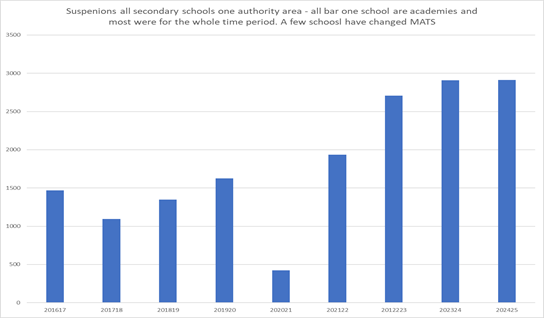
I looked at the data for both suspensions and exclusions for all the secondary schools in one current local authority area. All but one school are currently academies, and most have been for the whole of the time period. Some schools have changed academy trusts during the time period, and three new schools have opened during the period, and one 14-18 school has closed.

The schools already had noticeable numbers of suspensions before the covid pandemic. Since then, the numbers each year have been much higher, than before the pandemic, as shown in the chart.

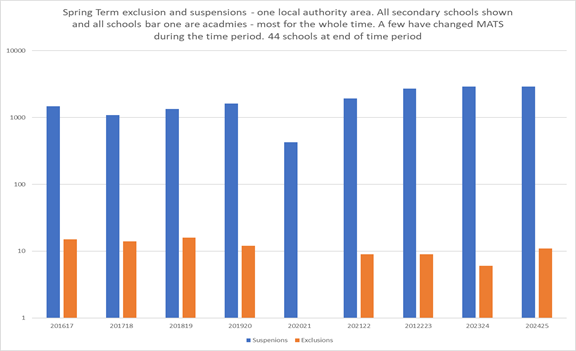
The last three years for which data are available witness record numbers of suspensions, although not all schools have increased suspensions at the same rate. The range in the spring term 202425 was from one school with just 6 suspensions, to another with 291, albeit, this was one of the largest schools in the authority. However, it was not an urban school. Eight schools each recorded more than 100 suspensions in the spring term of 202425.

The picture for exclusions is much more encouraging, as can be seen on the following chart. This uses a logarithmic scale to plot both suspensions and exclusions. Exclusions across the authority have rarely exceeded ten in a spring term.

Of course, the total of suspensions for any one school can include multiple suspensions for the same pupil. The length of the spring term can also be affected by the changing date of Easter each year. This factor might have a small effect on each year’s data.

Of course, some pupils may not be ‘excluded’ at all, and hence not feature in these charts, but may be voluntarily removed to ‘home schooling’ by their parents. Whatever happens to pupils suspended or excluded, not being in school is more likely to see them become involved in a life of crime, often more serious crime than if they were in school on a regular basis.

Do some academy trusts have higher rates of suspension than other trusts among their schools? This is a challenging question to answer because it is clear that there is more likely to be a relationship between suspensions and the IDACI group in which the schools sits than the nature of the controlling MAT. However, it is clear than becoming an academy is not a panacea for solving the discipline issue of a school; at least as far as academies in this authority are concerned.  

Are suspension rates now on the way down? I hope so, but an not yet convinced that is the direction of travel. Time will tell.