
There has been a lot of discussion recently about falling school rolls in the primary school sector in London. This discussion led me to wonder whether a funding formula that is heavily weighted to a per pupil funding model might mean schools with falling rolls would have to adapt to a decrease in their income.
One possible outcome of less funding could be a worsening of pupil teacher ratios if individual support for pupils with SEND is cut, and also whole classes are amalgamated. My thesis is that Inner London boroughs might be witnessing the worst of the falling rolls problem, partly because they are boroughs with little room for new housing to be built, but also because inner cities have traditionally been the home of new arrivals to a country. Post Brexit, many European families from countries such as Poland and Romania may also have chosen to return home, taking their children with them.
With the release last week of the school workforce data for 2025/26, by the DfE, it is possible to review the pupil teacher ratios (PTRs) for each borough for the three-year period from 2023/24 to 2025/26.
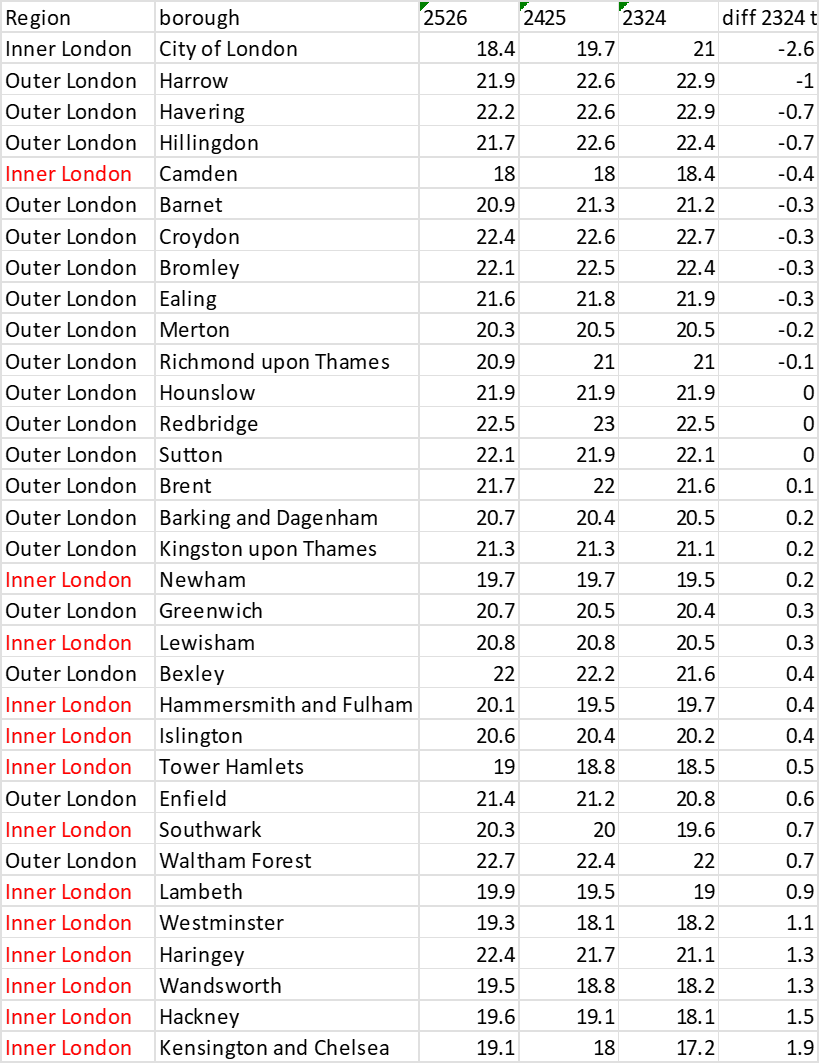
Of the boroughs in London, including the City of London, 11 boroughs improved their primary PTRs between 2023/24 and 2025/26. All but one, Camden, were Outer London boroughs. All the other Inner London boroughs recorded a worsening of their primary PTRS over the three- year period.
In the case of Kensington and Chelesea, albeit a small borough, the change was from 17.2 to 19.1 pupils per teacher over the three years: a decline of some 10%. This is a relatively large change for such a short period of time.
Seven Outer London boroughs also recorded a worsening of their primary PTRs over the same period. Of these boroughs, two, Newham and Greenwich have been classified as Inner London boroughs at sometime in the past.
Apart from the City of London, the boroughs with most improved PTRs are on the edge of London – Harrow, Havering, Hillingdon, Barnet, Croydon and Bromley.
The data in the table does suggest that falling rolls have been accompanied by a worsening of PTRs. Might this be caused in part by the construction of the National Funding formula that is heavily weighted towards a per pupil element? Reduced funding is certainly likely to impact upon class sizes and the use of teachers with small groups. Increasing class sizes and cutting individual teacher support for vulnerable learners is likely to impact upon a school’s PTR. If the reduction in pupil number sis widespread across a borough, then the impact will be seen in the PTRS for all primary schools in the borough.
I think that there is a case to be made that falling rolls are worsening PTRs for the remaining pupils across much of Inner London.
For a longer-term analysis of PTRS in London, and how over time they have been better than in most of England see (1) (PDF) PTRS OVER TIME: A REVIEW OF PUPIL TEACHER RATIOS BETWEEN 1974 AND 2024 AND TWO PERIODS OF LOCAL GOVERNMENT RE-ORGANISATION PTRS OVER TIME: A REVIEW OF PUPIL TEACHER RATIOS


Dear John
A couple of years ago, your data set me off on the campaign trail as it became clear that the number of trainees available to fill vacancies in RE was so few that they’d almost all have secured posts even before the usual rush after the May resignation deadline. I saw this blog on music for this year and wondered if you’d planned one for RE? https://johnohowson.com/2026/05/31/music-teachers-labour-market-update/
I’m also trying understand NFERs (Jack Worth) predictions for this recruitment year. It seems unusual to say the least, to predict recruitment to target in a non-bursary year based on the numbers recruited in a bursary year, especially when the monthly UCAS data makes it very clear that RE is recruiting much less successfully, almost certainly due to the loss of the bursary. Am I missing something?
The other matter that seems contradictory, is the government emphasis in the new White Paper on subject experts / specialists and the failure to recognise that teachers of some subjects are taught by a disproportionately high number of individuals that are not only non- specialist ie with no post A level qualification in the subject, but in the case of RE, mainly by those that spend most of their timetable teaching a different subject entirely.
Surely the TSM should include this factor?
Any thoughts?
Deborah
Deborah,
Thanks for the comment. I am away for the net couple of days, but will reply on my return. The government has reviewed ITT targets in light of falling rolls. Sadly, there doesn’t seem to be any policy assumption for replacing non-qualified teachers with better qualified ones built into the Teacher Supply Model. Jack will be using the latest TSM projections for ITT in his analysis.
The issue of replacement through ITT might be one for an APPG or others at Westminster to raise.
John Howson
Deborah,
Here is the link to my May ITT blog where I say RE is unlikely to fill its revised places this year unless recruitment picks up.
John Howson
Pingback: Falling rolls in London: much worse than the rest of England | John Howson
Pingback: It’s the numbers not the percentages that matter most | John Howson