Will teachers vote to take industrial action?

The BBC are running a story that suggests a teacher association: the NEU will ask its members about whether they support industrial action that could, presumably, include striking and closing schools? Teachers in England move towards striking over pay – BBC News

My guess is that their members will vote for action: at least in the secondary schools. Whether the larger number of NEU members in primary schools will do so, might be more uncertain. Here’s a link to an early post of this blog, way back from February 2013 February | 2013 | John Howson about what happened then.

Now, we live in different times: a Labour government; many years of pay freezes and pay rises below those in the private sector, but two relatively generous recent settlements, and the possibility of a three-year deal in even more challenging times.

Now factor in, falling rolls leading to job uncertainty in many primary schools, better recruitment to lower targets for new teachers, the need for increased spending on defence and welfare, and an electorate that will judge the government on the length of NHS waiting lists rather than what happens in schools, and the balance between expressing concerns by voting for industrial action, and actually taking action sometime in the autumn, is as the saying goes, a ‘whole different kettle of fish’.

My bet is, shake the big stick now, but think carefully about strike action in the autumn. Or perhaps persuade the government to tweak the pay offer, when it comes from the pay review body, so that both sides can claim victory.

It is interesting that this story is running 100 years after the only real General Strike in British history. This is an anniversary that, unlike Sir David Attenborough’s century, has been largely ignored by the media. I guess nobody wanted to drag it up during a period of local and state elections across the United(!) Kingdom.

One interesting fact from Thursday, is that Labour lost control of Haringey Council. They did so in the 1968 local government debacle. In that period of two-party politics, to the Conservatives. This time the outcome is more complicated. In 1968, the year of revolutions across Europe, Labour in government didn’t sack the Prime minister. Indeed, Harold Wilson led the Party into the 1970 general elections: a much closer race than the 1968 results might have predicted.

The Haringey result is interesting to me, as it meant that in 1971, I started work as a teacher in Tottenham under a Conservative administration. I don’t recall much changing when, in 1972, Labour regained control of the borough. Now the remainder of that decade was a turbulent time in British politics and not only the teachers, but also non-teaching staff. They took industrial action, leading eventually during the ‘Winter of discontent’ in 1979, to all Haringey’s schools being closed, not by the teachers, but by the caretakers going on strike. The Labour administration did not expect anyone, even church schools, to try and break that strike.  These days, with the internet, and remote schooling commonplace, such an outcome in terms of teaching and learning might be much less likely.

For a discussion of the effects in 1979 see my posts from 2020  March | 2020 | John Howson COVID-19 PM’s Suez? | John Howson and The State cannot just abandon children | John Howson and especially from February 2020 Closing schools, but not stopping education | John Howson

School Transport- who pays for diesel’s price increases?

Since the start of the conflict in the Middle East, the price of diesel at the pumps has increased from around £1.42 – the average price before the conflict – to £1.90 at the start of May What is happening to UK fuel and petrol prices? – BBC News By comparison, at the height of the concerns over the Ukraine conflict, the price of diesel peaked at just under £2 per litre.

So, could the pump price charged for diesel fuel in 2026 go even higher than the price witnessed in 2022? As I write this, on the 3rd May 2026, it seems quite possible, and even probably that this will be the case: hopefully, I am proved wrong.

The increase in the price of fuel, the rise in the minimum wage, and other cost pressures due to inflation still being above the Bank of England’s target figure of 2%, will be bad news for those local authorities with significant transport bill for conveying pupils to and from schools, either for SEND or because their pupils live in rural areas beyond the two or three mile distance, historically seen as the distance where it is reasonable for parents to pay to ensure children attend their nearest school.  

Although fuel costs are not as high a proportion of total transport costs as are wages, an increase of a third in fuel prices is going to have an impact on transport contracts being negotiated for the new school year starting in September 2026.

A council with a £40 million education transport bill, not unreasonable for a large rural shire county, might see a 5-10% extra charge. This translated to £2-4 million extra across a council’s financial year, and likely even more across a school-year if prices continue to rise further.

 The risk is that some operators might well collapse under the price increase, especially if they are in fixed price contracts with a local authority, leaving a seller’s market, as operators will know that pupils must be transported to school.  Could this outcome drive prices even higher?

How will local authorities cope with these prices increases? Those with reserves, will draw on them until the next round of council tax rate setting in February 2027. However, many local authorities don’t have large reserves, and with local government reorganisation looming for the rural areas, running up a deficit may not be possible.

What remains is either cuts to other services or a government bailout to cover the extra cost of fuel. With social care, and adult social care especially, taking the lion’s share of the budgets of rural counties, there may be few services where cuts are possible, especially since adult social care can involve its own significant fuel costs associated with ‘care in the community’.  

Protecting services such as the youth service and the funding for under-fives could be at risk if local authorities have to bear the brunt of transport related cost increases, especially since the war started just at the wrong time for local government financing, when budgets for 2026-27 were already finalised.

With so many different political parties now in charge, it will be interesting to see how they approach this problem, and who is asked to take the consequences.

Falling rolls -who dictates the outcomes for schools: Parents or planners?

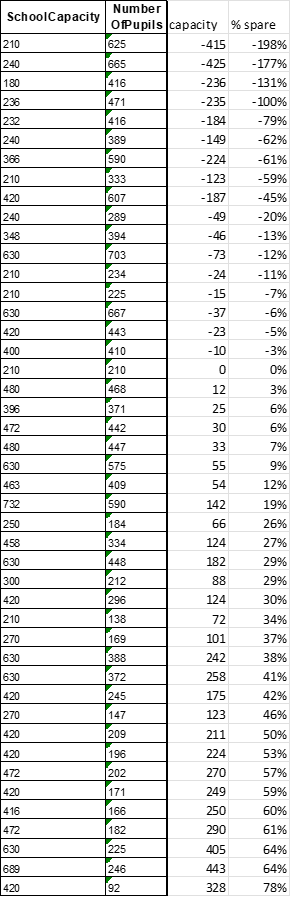
How do you deal with the issue of falling rolls in our schools? A senior politician recently told me that there was no way they would reduce the admission number for a successful school, because the parents wouldn’t stand for it.

Interestingly when Mrs Thatcher widened the concept of parental choice in section 6 of the 1980 Education Act, the civil servants left a ‘get out’ clause allowing local authorities to override their ‘duty to meet the expressed parental preference’ because it was ‘prejudicial to the efficient use of resources’.  Back in those days, the notion of parental power was very much in its early days.

Now the politician I spoke with was only voicing the approach any retailer might take to falling sales; cut out the loss-making branches and strengthen those that make a profit. ‘Let the weakest go to the wall’, a dictum many learnt in school when studying their Skaespeare.

But, should public services operate in the same fashion? It’s worth remembering that parents are required to educate their children, and the State is the default provision for those that don’t, won’t or in most cases cannot do so in any other way.

How the State has responded to that demand from parents for schooling has changed over time. A reader reminded me of the Liberal Democrat position, as expressed by Nick Clegg during the coalition government that perhaps took parent power to the ultimate. I wrote then a blog post entitled Private education, but State Funded? | John Howson This might have been a good idea at the start of a decade of rising school rolls, but does it hold good when rolls are falling?

I guess it depends upon where you live. In a densely packed urban area, with many schools within easy distance of each other, survival of the fittest might seem logical even if the fittest was a Church School and didn’t have many pupils on free School Meals.  However, even in urban areas, change is rarely easy, and often messy, and the current funding formula for schools doesn’t help.

Schools below capacity often run at a deficit, so should academy trusts prop these schools up with cash from other schools that don’t spend all their income?  Perhaps that’s why parent power – or at least parent governors – don’t exist in most academies, in case they rumbled what was happening.

In less urban areas, the issue is more complex. Consider the following case study. Imagine a town and its locality with 5 primary schools where there is little or no house building, and post-covid relatively little movement in the housing market. The current position for one such town

is shown in the table below.

In total, the five schools had 857 pupils on roll, but with a capacity for 1141, so were operating at 75% capacity. Intake for the latest year was lower at 66% of capacity.

 TYPECURRENT ROLLCAPACITY% CAPACITYPlaces offered – latest
SCHOOL 1RC1182105613/30
SCHOOL 2CofE2993159545/45
SCHOOL 3COMMUNITY1782108516/30
SCHOOL 4ACADEMY1301966615/30
SCHOOL 5COMMUNITY1322106318/28

Schools 1-3 are in the town, and schools 4-5 are within easy travelling distance. The obvious answer might be to close one of schools 4-5, but that would create additional transport costs for the local authority; to be paid from Council Tax.

Closing the RC school is not possible, as the exiting pupils cannot be accommodated at the other two schools, as they have insufficient spare capacity, and the need would be for an additional 70 places over the current capacity. Should the RC school numbers fall further to less than 100-110, and intakes not increase at the other two town schools, it would be possible to close the RC school if each of the other two schools in the town could take an extra class. However, the restricted nature of their sites may that possibility unlikely.

What happens if the RC school remains open, and starts to run a deficit budget and, as a consequence, either the diocese eventually decided to turn the school into an academy or it is judged inadequate by ofsted, and forced to become an academy. Could the diocese transfer funds from other schools to keep the school open?

What of the future for schools 4 & 5 if they are faced with the same scenario of starting to operate on deficit budgets, and the risk to the local authority with regard to school 5 at a time of great pressure on the authority’s budget.

Should someone create a plan for the future. If so, who? The local authority, the Regional School Director, the DfE? Or does the desire of the parents for one particular school eventually affect the other four schools, and the market decides? Discuss.

For those that want to consider the issue further, I wrote a play around a school facing falling rolls in its locality to try to tease out some of the issues. You can access it at C:\Users\dataf\OneDrive\Documents\FallingRollsPlay.docx or by requesting a copy by using the comment section

Reader might also like this post from a decade ago. My concern about the future of small schools isn’t new. Are small schools doomed? | John Howson

Demand for SEND places

Yesterday, I wrote about the forecast decline in primary and secondary school places. In the past, less attention has been paid to the need for places for pupils with SEND. However, possibly as a result of the rapid growth in EHCPs, and hence the demand for specialist provision, the DfE has started trying to forecast what it has termed ‘the Local authority pupil forecasts for ‘Local authority specialist provision for pupils’.

This exercise was always going to be something of a challenge since it is taking place against falling pupil numbers, especially in the primary sector, but increasing demand for EHCPs. However, if demand for EHCPs continues to increase, it won’t necessarily mean a demand for more special school places, because some of the increased demand is likely to be met by specialist provision within schools as ‘specialist bases’ are created, often using the spare capacity arising from falling rolls.

At present the DfE data shows that the current stock of special schools is operating at over-capacity by some 10,000 places. At the top of a demographic cycle, such pressure would not be surprising, as schools often take ‘bulge’ classes for a couple of years using temporary buildings rather than built new schools that might not be needed as rolls fall. Whether that is the correct approach in the present circumstances for the special school sector is unclear from the DfE’s data published yesterday. School capacity in England: academic year 2024 to 2025 – GOV.UK

An analysis of local authority data around provision of specialist provision for the period up to the end of the decade reveals large differences across the country in projected need. At one end of the spectrum, three local authorities are projecting grow of in excess of 1,200 places each in the primary sector. At the other end of the spectrum, twenty-four authorities are predicting a reduction in need, with one ‘Reform’ led county predicating a need for 500 fewer places. Interestingly, the adjacent unitary authority is predicting an increase of over 100 places.

Oxfordshire, whose primary and secondary place forecasts were discussed in my previous post is predicting only a very small increase in the number of primary places.

These significant differences don’t seem to be related to either the underlying pupil population or the trend in pupil numbers in the primary sector. This raises issues about how reliable the current forecasting around the demand for SEND places is for policy-makers. Accurate data are important, because of the cost of provision in the SEND sector.

Data on provision of places are also important in helping identify workforce needs. It seems odd that the DfE doesn’t seem to have a unit that brings together trends in pupil numbers and the demand for both places and people to educate the projected school population.

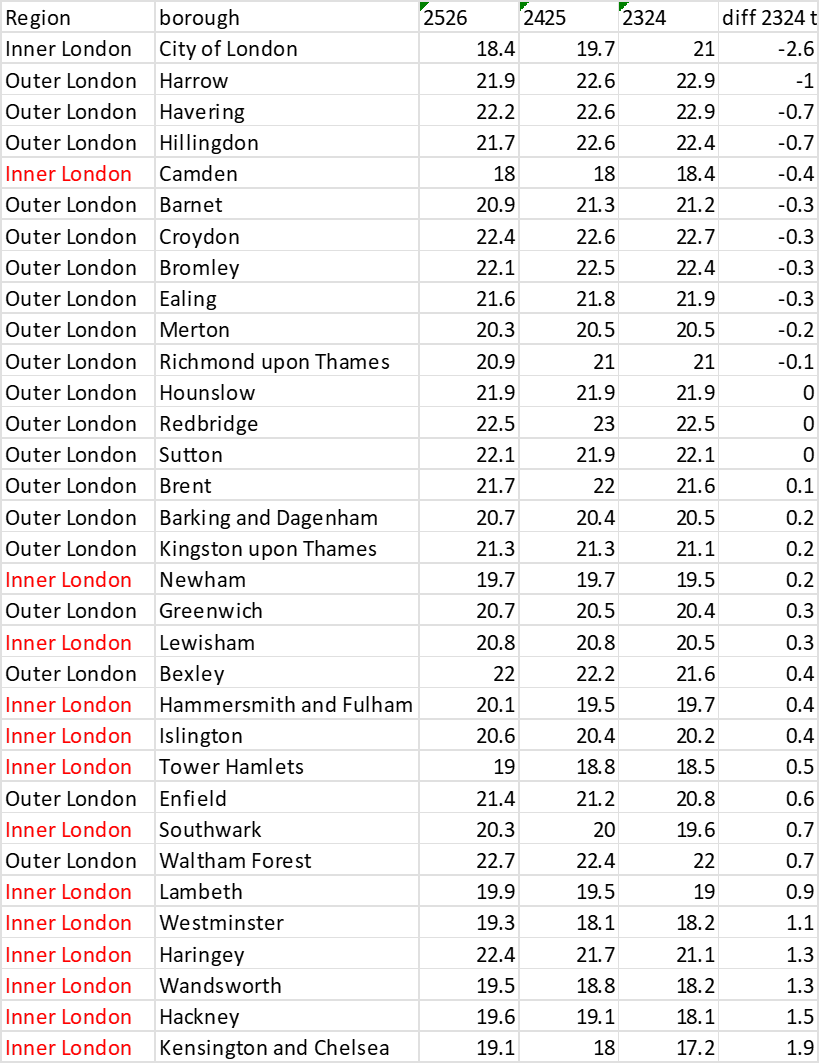
If the DfE did have such a unit then it might look at the costs of small sixth forms and of central overheads by different MATs. It might also look at the issue of small primary schools, and how they might be protected in rural areas, but possibly amalgamated in urban areas. Is a one-from of entry school viable in London?

Hopefully, the data published yesterday will create some debate around the important, but often overlooked, issue of pupil place planning, and the future shape of schooling in the modern age.

Schools: the end of local authority involvement?

When I first started studying the governance of education, way back in 1979, there at that time two popular saying about the school system in England. One was that it was, ‘a partnership between local and national governments’ and the other that it was ‘a national system locally administered.’ A typical examination question was to ask how valid either of these statements were?

That was half a century ago; difficult for me to believe, but true nevertheless. I have witnessed a lot of changes during in the intervening years. Indeed, one of my few academic articles I have published was entitled ‘Variations in local authority provision of education’ and appeared in the Oxford Review of Education way back in the early 1980s. Interestingly, during the Labour government of the period between 1974-79, closing the gap in funding between the best and worst local authorities was a matter of academic interest. Anyone wanting to know more could do worse than read’ Depriving the Deprived’, written by Tunley, Travers and Platt, published in 1979, as it is about the funding of schooling across one London borough over one year.

For a comparison over a longer time period, my review of 50 years of pupil teacher ratios, published last summer and available for download on researchgate at (PDF) PTRS OVER TIME: A REVIEW OF PUPIL TEACHER RATIOS BETWEEN 1974 AND 2024 AND TWO PERIODS OF LOCAL GOVERNMENT RE-ORGANISATION PTRS OVER TIME: A REVIEW OF PUPIL TEACHER RATIOS

During the 50 years between local government reorganisation in 1974 and 2024, school funding decisions have been removed from local authorities, and nationalised; Education Committees have been abolished, in favour of cabinet government; teacher training and new schemes to prepare teachers have been taken over by Westminster; schools have been persuaded to become academies outwith local authority control, but still under church control if faith schools – if the white Paper leaks are correct all schools will now have to become an academy or free school; further and higher education were liberated from local authority oversight and funding in the early 1990s; ultimate control over place planning has remained with the DfE as only the DfE can sanction new schools being built.

What’s left for local authorities? SEND for a couple more years; admissions- including in-year admissions once the current Bill becomes law – and transport. Frankly, I cannot see local authorities, especially newly reorgnised upper tier authorities, wanting either of these functions in the future. And why would they, as these services can often be poisoned chalices.

So, are we moving to an NHS style system for schooling in England, with little local democratic oversight, and few routes for parents to complain about the education their child is receiving. I fear so.

Does it matter? That’s a matter of opinion. The world of 2026 is vastly different to that of sixty years ago, and it should be easier to produce a more level playing field with all the levers of funding and control being exercise from Westminster.

But I remain sceptical. Westminster has been unable to control issues such as MAT chief executive’s pay and the level of school reserves. At present it isn’t equipped to be a fully functioning operational department along the lines of the NHS of MoD.  It will be interesting to see what, if anything, the White Paper has to say about governance when it is published tomorrow.

White Paper: bad news for rural primary schools

Tomorrow, Monday, we will see Labour’s White Paper in full. For now, we have copious leaks and SEND and other matters, such as how to tackle the outcome gaps between the most deprived pupils and their more fortunate fellows either sitting alongside them or in other schools to whet our appetite.

The replacement of Free School Meals as a measure of deprivation has been long overdue, but it will be interesting see, as schooling moves from a local service to a national service, administered in a similar fashion to the NHS, whether the civil service will be any better than local politicians at managing the performance of the school system.

Making all schools academies will be the final nail in local government’s interest in schooling. Once SEND is handled nationally, it will just leave admissions, mainly on-line these days, to be removed from local management.

However, the changes already foreshadowed in the leaks mean that there will be winners and losers. Assuming that H M Treasury might fund some of the SEND changes, there is unlikely to be any new money to support schools to improve.

The present Funding Formula is heavily biased towards pupil numbers. Great when rolls are rising, but bad news for small schools when rolls fall. If the formula is altered to move more money towards schools with significant numbers of pupils not achieving expected standards, where will the cash come from?

Might small rural primary schools with good attendance and excellent results see their funding cut in real terms? If so, what are the consequences likely to be?  Trusts will be reluctant to keep schools that cost more to run than they bring in through funding open, and will have no incentive to do so. Afterall, any travel costs will be paid for from the local authority under present arrangements.

I can see the local government organisations saying that if local authorities don’t run schools, then they shouldn’t have to pay any transport costs. Taking £46 million off Oxfordshire County Council’s budget would pay for an awful lot of pothole repairs, not to mention bolstering other services.

For those local authorities currently receiving little funding from central government, removing schooling entirely from local government would be an unexpected bonus. On the other hand, there would, as with the NHS, be no local democratic accountability. Education rarely features during general elections.  

One bonus of a national school system is that the government might feel able to create a universal system for secondary schools, some 61 years after Circular 10/65 and on the 50th Anniversary of the 1976 Education Act.

Without democratic oversigh,t ignoring the 2006 rules about closing small rural primary schools will be much easier. Small one form entry faith schools in urban areas with good results have even less protection. It is worth studying the results for primary schools in Haringey to see the parts of the borough that might be winners and those that might be losers if funding doesn’t increase overall.

As someone that started teaching in Tottenham in 1971, when we had ‘areas of exceptional difficulty’ payments introduced into ‘Education Priority Areas’ it is interesting to see how stark the divide between schools on opposite sides of the railway line north from Kings Cross still remains.

So, will the government close that divide? But will it be at a cost to rural primary schools in Oxfordshire, my current home?

Winners and losers

How have my blog posts fared since I restarted this blog in May of 2025? Some new posts were well received, some old favourites from previous years continued to attract readers, and some of this year’s posts languished unread, according to WordPress’s dashboard.

So, as of today, 29th December 2025, what have been the most read posts for 2025 and when were they written?

How much holiday do teachers have?645
150-year-old Committee system to be abolished75
Too many teachers?73
Headteacher vacancies: even in August68
Windfall profits and SEND58
‘Stuck’ schools – who teaches in these schools?55
Less than 400 teachers of physics entered service in 2023/2454
DfE wasting money on ITT51
Labour’s determination to recruit new teachers doesn’t include music53
The governance of our schools – does pay matter?51
most viewed posts in 2025

By far and away the most read post was the one originally posted on the 20th May 2022 about how much holiday teachers in England have and how their relative position compared to other graduate occupations has been eroded since I started teaching in 1971. I expect changes over the next few years, not least because AI has the potential to seriously disrupt the way schooling is organised.

At present termtime recorded working hours are no longer compensated for by the employer-driven flexitime of ‘school holidays’: an oxymoron of a term for most teachers if ever there was one.

All the other posts in the 2025 top 10 viewed posts were written this year. They can be read either by using the search facility or by clicking on the different months since May 2025.

As might be expected, workforce issues dominate the most frequently viewed posts of 2025., although second place was achieved by a comment about the abolition of what was once a cornerstone of local democracy – the committee system – before Tony Blair’s Labour government encouraged local authorities to move to cabinet government and oversight of schooling through a scrutiny function, thus leaving most councillors out in the cold over local education, even before the advent of academies.  

On the down side, many posts have been viewed by fewer than ten people since they were written. This is partly a function of the decline in viewing of blogs, as communication has switched to more modern methods, such as podcasts. Perhaps, I might start a podcast or even a YouTube video recording in 2026; comment welcome on either possibility.

Readership from around the world has once again started to pick up, but has a long way to go to the halcyon days of 2015, and the 22,000 views that year. In 2025, allowing for the fact that the blog only restarted in May, perhaps 6,500 views will be a credible outcome.

So, how many posts have there been in 2025? Including this one, there have been 122 posts, and some 69,000 words.

For those that want to read my 2013 posts, these have now been published on Amazon as an e-book or a paperback.

TEACHERS, SCHOOLS AND VIEWS ON EDUCATION: How 2013 unfolded as viewed from my blog eBook : HOWSON, JOHN: Amazon.co.uk: Kindle Store

Finally, it just remains for me to wish all my readers the very best for 2026 and my thanks for reading the blog.

Do we need local democracy in our schooling system?

Should local elected politicians have a say about schooling in their local areas? An alternative to that system is the NHS model of provision, a service run by professionals and managers, with little or no local democratic involvement, other than in public health.

As someone that has been involved in politics (for the Liberal Democrats) since the 1960s, I have strong views on this topic, especially as I have spent my whole adult life working in the education sector, as a teacher, lecturer, civil servant – albeit briefly – columnist and blogger, and entrepreneur. For me, local democracy is important. For others, it seems the need for local democracy has been declining in importance over the decades.

When I was at university, local authorities ran local education; they trained and appointed the teachers – often in association with the main Christian denominations – set the level of spending on schooling, and built and ran the buildings.

After the Robbins Report into Higher Education in the 1960s, local authorities grip on education began to weaken, and central government began to take more control over decision-making about schools and how they were managed.

First, the training of teachers was removed form local authorities into higher education, so by 1992 when all public sector high education became centrally managed, local authorities no longer controlled this vital resource.

At the same time, the consequences of the 1988 Education Reform Act saw a National Curriculum introduced. Funding was devolved to schools, significantly reducing the power of Education Committees to decide local funding priorities. The Blair government then effectively abolished Education Committees, putting power over schooling in the hands of a single Cabinet member, often with only weak scrutiny of the service.

However, notionally schools were still mostly community schools, except where they were under the control of charities and the churches.

The creation of academies by the Labour government of Gordon Brown, and their subsequent enthusiastic uptake by the coalition government of 2010-15 by Michael Gove, removed almost all the remaining powers of locally elected councils over the running of schools, while allowing the churches to retain their control over voluntary aided schools that had become academies.

By the present time, most councils now have children’s services, almost always run by a social work professional, with the lead officer in charge of schools being a second or even third tier position. The national funding formula left councils with few choices to make about schools, except over poisoned chalices like SEND and home to school transport.

Councils taking children into care could not even direct academies to provide a place for the child, but on the other hand were forced to deal with decisions on exclusion of pupils made by schools.

 Is the system better run now than in the 1960s. The big test currently facing much of England is how local areas will deal with falling school rolls. Who will decide on which schools close or take reduced intakes? Should there be local democratic debate about this issue, or, in our fast-moving modern worlds, are local views irrelevant?

I am on the side of those that still believe there is a role for local communities in the management of schooling, and do not like the NHS style model that is increasingly commonplace.  However, because education never polls highly as an issue during general elections, I fear we will have a schooling system designed and run by professionals, and with little or no scrutiny or oversight. We will be the poorer for this outcome.

This post was written for the University of Liverpool’s School of Education blog in November. however, the link has been broken, so i am reposting my thoughts here on my own blog.

Will local government reorganisation pose a risk to Children’s Services?

I don’t often comment on Children’s Services in local government, preferring to stick to education about which I hopefully know more. However, having served a period of time as a Cabinet member for Children’s Services in a shire county, I couldn’t resist reading the report published last week by the DfE from the commissioner put into Devon County Council to oversee the improvement oft heir Children’s services.

There were two interesting comments from that report caught my eye.

The first deal with the issue of local government re-organisation: not strictly part of the Commissioner’s brief, but an interesting and thoughtful comment

Although not in the remit of this particular piece of work it would be wrong not to highlight a second significant risk. The current round of Local Government Reorganisation (LGR) consultations is already consuming large amounts of political and operational time. However, that isn’t the main risk. The bigger concern would be for any recommendation which leads to the break up and fragmentation of Devon CC and the existing arrangements for children’s services. Given the positive improvement trajectory I have seen and identified in this report and the critical importance of having a well led and well functioning children’s services for the local population anything that breaks that model would risk stopping the existing work in its tracks with an even bigger risk that things would quickly slip backwards. As stated, this is not strictly in my brief to comment on, but the potential impact of LGR on services that are now showing signs of improvement should be appropriately considered by government as part of their decision making process.”

The second comment was, of course, interesting to me as a Liberal Democrat.

Following the recent local elections Devon now has new political leadership. The Lib Dem group have made an impressive ‘fresh start’ and they are very clear that they will be judged on the improvements they are determined to see in Children’s Services. Children’s services are undoubtedly the top priority for Devon County Council. Three cabinet members (including the Leader) hold portfolios across Children’s services – Education, Lead Member and SEND. My observations of two cabinet meetings and scrutiny alongside additional face to face meetings assures me that the Leader and his team are very serious about bringing about the improvements needed.”

Commissioner’s report on children’s services

Managing a Children’s Services is probably a much more complex task than managing adult social services in local authorities, as Children’s Services encompasses not only the whole of the remaining education functions of a local authority, but also children in care or at risk, plus youth justice, and youth services, as well as relationships with the NHS over SEND. This wide range of activities may be why so many local authorities have received adverse reports over the past few years.

Indeed, an analysis of the reports by the size of the authority may well help to support the view of Devon’s commissioner about local government review. Is there a minimum size for a Children’s Service to function effectively, and does it need good political oversight?

SEND: we know the issue – but we still won’t say how it will be solved

Buried in the OBR Review in Chapter 5 is the following CP 1439 – Office for Budget Responsibility – Economic and fiscal outlook – November 2025

Correction to Chapter 5, paragraph 5.19, second bullet Text currently reads: If it were fully funded within the Department for Education’s £69 billion RDEL core schools budget in 2028-29, this would imply a 1.7 per cent real fall in mainstream school spending per pupil rather than the 2.4 per cent increase planned by Government.

Text should read: If it were fully funded within the Department for Education’s £69 billion RDEL core schools budget in 2028-29, this would imply a 4.9 per cent real fall in mainstream school spending per pupil rather than the 0.5 per cent real increase planned by Government.

5.19 Special educational needs and disabilities: As set out in more detail in Box 5.1, the Government has announced that from 2028-29 the cost of SEND provision will be fully absorbed within the existing RDEL envelope. The Government has not set out any specific plans on how this pressure, which we estimate at £6 billion in 2028-29, would be accommodated within the existing RDEL envelope. If it were fully funded within the Department for Education’s £69 billion RDEL core schools budget in 2028-29, this would imply a 4.9 per cent real fall in mainstream school spending per pupil rather than the 0.5 per cent real increase planned by Government. The Government has stated that it will set out proposed reforms to SEND provision early in the new year.

So, another function disappears from local authorities, presumably to the DfE as SEND funding will be handled at a national level. Will it include management of transport as well as granting of EHCPs? Who knows, the OBR don’t, but warn that funding per pupil could fall by 4.9%. For many schools, this will be on top of any loss of income from falling rolls. Start planning now for such an outcome.

More to come when the White Paper finally emerges sometime in 2026