
In my last post on this blog, I looked at the worsening of primary PTRs across much of the DfE’s ‘Inner London’ area. Falling Rolls: Is the funding formula making matters worse? | John Howson
This post looks how ‘Inner London boroughs have fare compared with the rest of England over those three years?
I think it is fair to say that London as a whole really has seen a significant downturn in primary pupil numbers. There are 22 local authorities where primary pupil numbers as published by the DfE have reduced by 5% or more between 2023/24 and 2025/26. Of these, 13 are London boroughs, and six – seven if Newham is included – are Inner London boroughs.
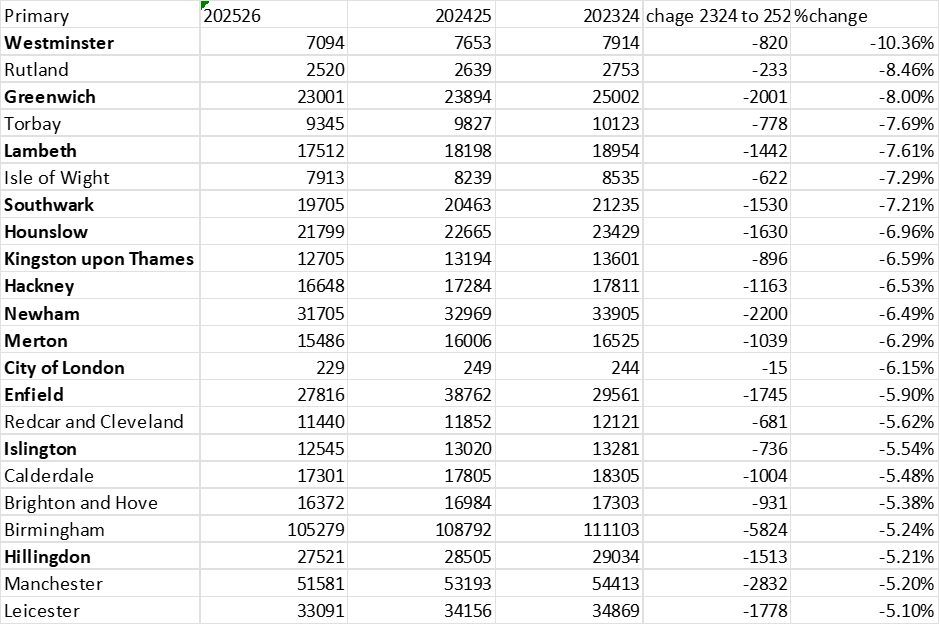
Seven of the top 10 places for the largest percentage decline in primary pupil numbers are filled by London boroughs. The other three places are taken by the Isle of Wight, Rutland and Torbay, three of the smallest unitary authorities in England.
Birmingham, Manchester and Leicester are the only large cities in the table. They fill three of the four bottom places for local authorities with a decline in pupil numbers of five per cent or more, along with Hillingdon in West London.
At the other end of the table, there are few London boroughs with less than a two per cent decline in their primary pupil populations.

London boroughs at this end of the table seem to be mostly outer London boroughs on the fringe of the metropolitan area. By contrast, there are seven county councils in the list of lowest declines in pupil numbers. This number increases to eight, if the Staffordshire figure, of an increase in pupil numbers, is correct.
The London boroughs will have the numbers in reception for each year, and will know how much worse the decline is likely to become over the next few years. More school closures look inevitable unless the funding model is changed to protect schools with declining rolls.
Not to protect the school estate in London is to assume that there will never be an upturn in pupil numbers. In cities, closing schools and selling off the site for housing means that in any upturn land may not be available for any new schools needed for the extra pupils. This is where thinking for the longer-term is important. During the last downturn of this size, most schools in London remained open, although some, such as Stamford Hill Infant and Junior School in Haringey, where I attended in the 1950s, did eventually close. Interestingly, the one form entry St Anne’s Church of England Primary School, close to Stamford Hill School that wasn’t actually in Stamford Hill, is still open.
However, this is not the post to discuss whether or not, in a more secular society, faith run schools should be closed where an alternative non-faith school can absorb the pupils. But this is an issue to debate, especially in urban areas.
In villages, the church-run school may still be the only school available, and that raises a much larger question about who should run state funded schooling? As the Wesleyan Methodists put it when faced by the 1902 Act, and decisions on whether to open state-funded secondary schools; are our teachers, teachers of children or teachers of Methodist children?
 John Howson
Pingback: Is Labour wrecking London’s Schools? | John Howson