Discipline in schools – the latest data around suspensions and exclusions in one area

Now that the local elections are out of the way, it is time to consider other issues – However, I might blog about my thoughts about schooling when all the results have been published and considered.

Earlier this week the DfE published data for exclusion and suspensions by schools for the spring term 202425; i.e. last year. The data came along with time series data for spring terms back to before the covid pandemic, indeed, starting in 2016-2017 school-year; the spring of 2017. Create your own tables on suspensions and permanent exclusions in england – Explore education statistics – GOV.UK

It is worth recalling that during the period under review by the DfE school rolls across the secondary sector have been on the increase, mostly as a result of the earlier rise in the birthrate. Some areas, including the one under consideration have also experienced a significant housebuilding boom for most of the period under review. New housing usually means more pupils.

I looked at the data for both suspensions and exclusions for all the secondary schools in one current local authority area. All but one school are currently academies, and most have been for the whole of the time period. Some schools have changed academy trusts during the time period, and three new schools have opened during the period, and one 14-18 school has closed.

The schools already had noticeable numbers of suspensions before the covid pandemic. Since then, the numbers each year have been much higher, than before the pandemic, as shown in the chart.

The last three years for which data are available witness record numbers of suspensions, although not all schools have increased suspensions at the same rate. The range in the spring term 202425 was from one school with just 6 suspensions, to another with 291, albeit, this was one of the largest schools in the authority. However, it was not an urban school. Eight schools each recorded more than 100 suspensions in the spring term of 202425.

The picture for exclusions is much more encouraging, as can be seen on the following chart. This uses a logarithmic scale to plot both suspensions and exclusions. Exclusions across the authority have rarely exceeded ten in a spring term.

Of course, the total of suspensions for any one school can include multiple suspensions for the same pupil. The length of the spring term can also be affected by the changing date of Easter each year. This factor might have a small effect on each year’s data.

Of course, some pupils may not be ‘excluded’ at all, and hence not feature in these charts, but may be voluntarily removed to ‘home schooling’ by their parents. Whatever happens to pupils suspended or excluded, not being in school is more likely to see them become involved in a life of crime, often more serious crime than if they were in school on a regular basis.

Do some academy trusts have higher rates of suspension than other trusts among their schools? This is a challenging question to answer because it is clear that there is more likely to be a relationship between suspensions and the IDACI group in which the schools sits than the nature of the controlling MAT. However, it is clear than becoming an academy is not a panacea for solving the discipline issue of a school; at least as far as academies in this authority are concerned.  

Are suspension rates now on the way down? I hope so, but an not yet convinced that is the direction of travel. Time will tell.

David Attenborough at 100

This week the BBC has being paying tribute to Sir David Attenborough, ahead of his 100th birthday later this month. There is no doubting that Sir David has had a great deal of influence on many people through his television documentaries, at first in shades of grey, and then in colours that have improved as television screens have become ever more sophisticated in replicating the colours of the real world.

But who influenced Sir David Attenborough in his choice of career? Way back in 1997, the then Teacher Training Agency decided to commission two cinema advertisements. One, that received all the attention was called ‘talking heads’, and featured head and shoulder shots of a range of celebrities just saying a name to the camera. The trap line at the end was ‘no one forgets a good teacher’.

The other, far less well-known advertisement commissioned by the Teacher Training Agency in 1997 featured a teacher called Horace Lacey and a pupil called David Attenborough. You can see it here. Teacher Training Commercial: Horace Lacey | Catalogue | History of Advertising Trust My thanks to the History of Advertising Trust.

Both adverts were placed in cinemas, and because it was before the general use of websites and urls, postcards were placed in cinema foyers to provide the contact details for anyone interested in teaching. After all, it was impossible to write down a phone number in the dark of a cinema at the time when the advert was actually being played.

At the same time, the agency produced a famous poster with the stap line ‘the dog ate my homework. a phrase that passed into common parlance for a period of time.

After a few years, advertisements for teaching as a career started to reappear on TV screens, albeit at the wrong time of year to make any significant short-term difference to recruitment. I made an oblique comment about the effects of TV advertising in this post Do TV adverts work? | John Howson However, I am afraid the title is a bit of a misnomer.

So, my very best wishes to Sir David Attenborough. I hope that all the publicity surrounding his 100th birthday will help inspire the next generation of young people, and the present generation of undergraduates, to take up teaching as a career.  I also hope that the attention to Sir David’s birthday also encourages us to honour the memory of Horace Lacy, and countless hundreds of thousands of other teachers like him that have inspired their pupils down the generations.

Thank a teacher, it is an inspiring job that is like no other. And, although I may not have inspired many of my pupils, I did recognise those around me, both in school and higher education that changed lives and careers. My personal thanks to them.

Labour market for music teachers: update to end of April 2026

Regular readers will know that I am tracking two parts of the labour market for teachers in state schools across England during the 2025-26 school-year: vacancies for headteachers and vacancies for teachers and middle leaders of music.

Regular readers of this blog will also know that one of the reasons that I selected music as my subject to track was the government’s removal of the training bursary for those applying for postgraduate teacher preparation courses starting in the autumn of 2026.

By tracking vacancies this year, I have a baseline for next year, if, as seems likely, the removal of the bursary reduces interest in teaching music. However, the government has also slashed its published number of trainees needed – see ITT Offers – public money being wasted? | John Howson and my more recent post on the situation after the report on April offers was published.

Anyway, back to the update on published vacancies for teachers of music, and how these vacancies compare with the expected output from this year’s preparation courses.

By the end of April, I had recorded some 389 vacancies for teachers of music. 86 of these were for promoted posts, with an allowance attached. It could be assumed that these vacancies were not intended for teachers straight out of their preparation courses. However, in some smaller secondary schools, this might be the only full—time post and include responsibility for choirs, orchestras and ensembles. However, for the purpose of this exercise, such posts have been eliminated.

After removing the promoted posts, this leaves some 303 vacancies suitable for new entrants into the teaching profession advertised between January and the end of April 2026.

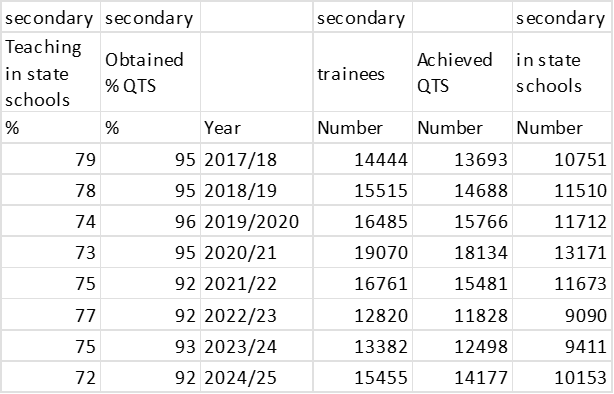
The DfE’s ITT census recorded some 367 trainees on preparation courses in December 2025; mostly for entry into the labour market in September 2026. Assuming all 367 entered the labour market for teachers in state schools, there are still sufficient to fill another 64 vacancies.

However, we know that not all trainees last the courses, and of those that complete the course, not all start teaching in state schools. Some entre the private sector; some further education; some music services and some don’t enter teaching at all.

As a result, the chart shows the remaining trainees available if 10% and 20% of trainees aren’t available to state schools. This approach reduces the remaining number of trainees to little more than 50 trainees. With around 75 vacancies a month so far in 2026, if May’s vacancies follow the pattern of the first four months of 2026, then the remaining total of trainees will be exhausted before the end of May, and resignation deadline day.

Of course, not all basic vacancies are filled by new entrants from teacher preparation courses: some are filled by returners – we can ignore school switchers as we can assume that leaving one school to fill a similar vacancy at another school is neutral in terms of jobs. However, if the move is for promotion, the there is a new vacancy.

Returners would need to fill around 30% of vacancies across the whole year – they are generally the only source of teachers for January appointments, so for September it looks as if schools will struggle to fill any late appointment resulting from resignations close to the 31st May deadline.  However, the picture will be clearer at the time of next month’s update.

Finally, although I do not track vacancies posted by private schools, both in England and abroad, I do survey the market. Generally, this market has twice as many vacancies as posted in any one month by schools in England.

One wonders whether the current cohort of new graduates might have missed out on gap year travelling because of the after-shocks from the covid pandemic and might, therefore be more willing to teach overseas? This has the advantage of not losing income to student loan repayment, and the bursary isn’t repayable.

On the negative side, the conflict in the Middle East may well be deterring some teachers from working in that part of the world, and may have increased the number of returners once more seeking a teaching post in England. We shall see.

UK graduates not yet rushing into teaching

There has been a lot of talk about how challenging graduates are finding the job market at present. Is this ‘difficult’ job market for graduates showing up in renewed graduate interest in teaching as a career? The DfE has published the latest (April 2026) data about application to teacher preparation courses as a 20th April 2026. Initial teacher training application statistics for courses starting in the 2026 to 2027 academic year – Apply for teacher training – GOV.UK

While there has been a modest increase in applications to be a teacher for most areas of the United Kingdom – the North East, Northen Ireland and Wales excepted – the biggest increase continues to be from the ‘rest of the world’ grouping, up by a massive 42% on April 2025. Only three regions in England have percentage increases in double figures: the East Midlands, London and the North West. The South East, South West and Yorkshire and The Humber regions have increases in applicants of less than five per cent.

AreaApr-26Apr-25Difference% Diff
EM2427206236515%
EE283126302017%
LON6504571179312%
NE10681108-40-4%
NW4106359551112%
SE397538171584%
SW216720661015%
WM336231202427%
YH28082720883%
292482682924198%
  
EEA582528549%
NI447473-26-6%
RoW122517096515542%
SCOT20319673%
WALES384418-34-9%
UNKNOWN106120-14-13%
139738831514237%

Increases at this level do not yet suggest a significant switch to teaching in large numbers. Indeed, the increase in England as a whole is just 2,419 extra applicants, or 8%.

One significant increase is that of male applicants, up from 13,234 to 18,111. However, it is impossible to know how many of these extra male applicants have come from the ‘Rest of the world’ pool?

There are also large differences in the increases from ‘new 2026’ graduates and older graduate. However, the ‘Rest of the world’ effect may be skewing this data

AgeApr-26Apr-25Difference% Diff
21312629941324%
22425639682887%
23368233693139%
24282826132158%
25-29102877824246324%
30-3467634618214532%
35-3951443899124524%
40-443524286066419%
45-492012175625613%
50-54956919374%
55-59446455-9-2%
60-64158145138%
65+3733411%
unknown47-3-75%
4322335460776318%

Total applicants at 43,221 remains well below the record of 67,269 applicants for similar courses recorded by the UCAS GTTR scheme in the 2009/2010 round during the aftermath of the 2008 economic crisis. To that number must be added those that applied for school-based courses, such s the GTTP that did not recruit through UCAS, as well as the Open University, that also did not recruit through UCAS.

Higher Education – up from 24,028 to 30,104 has borne the brunt of the extra applications. SCITTs have shown little growth, up from 11,293 to 11,544, perhaps because overseas applicants are less familiar with this toute into teaching. This might also explain the lack of any increase in the ‘partner-led’ courses. Apprenticeships are on the increase, up from 4,783 to 7,894, but ‘salaried route remains static at 5,883 compared with 5,389 last year in April 2025.

Even before the DfE announcement of the ‘needs’ numbers for 2026, ‘offers were down at 20th April at 17,880, compared with 18,297 in April 2025.

I have written a separate post about the state of play with regard to ’offers’ in secondary subjects. In the primary phase, applicant numbers are up from 12,502 to 14,797, but ‘offers’ for primary courses are little changed, up from 6,992 to 7,106. However, as the DfE ‘need’ has reduced ‘need’ from 7,650 to just 5,520 for 2026, there are likely to be few if any more offers, as the ‘need’ figure is already some 1,500 below the ‘offer’ number.

So, there is no great rush towards teaching as a career from United Kingdom graduates. Whether that will change over the next couple of months as final examinations are completed, and the reality of the job market hits home, only time will tell. But, for would-be primary teachers, I expect that the  ‘bus has now left the stop’ and it was already fully laden.

Celebrating 100,000 Blog Visitors: A Thank You to Readers

Yesterday evening this blog received its 100,000 visitor, according to WordPress statistics. I would like to say a very big thank you to everyone that has read a post on this blog since I started it, way back in early 2013. According to Chat GPT, only 5% of blogs started in that year still survive. This blog not only survives, but is also thriving.

From time to time, WordPress suggest I make a charge to visitors to read previous posts. I have steadfastly ignored those blandishments in favour of open access for all. I am sure that policy has helped gain me extra visitors.

However, writing a blog does take time and effort, and if you know a library that might like to book of the 2013 posts, some of which WordPress no longer allows access to, please suggest they buy the book either as a e-book from Amazon or as a paperback from myself through the email at: dataforeducation@gmail.com

Once this book has covered its costs, I will publish another on the 100 most read posts – with a bit of commentary as to why they might have received so much attention. To date, posts about teachers’ holiday entitlements lead by a long way. It seems like the myth of long holidays is deeply engrained in the public’s psyche.

As someone that failed their English Language examination at age 16, I never thought that I would write a column for the TES between 1997 and 2010, and this blog since 2013. Sub-editors taught me a lot, and on-line software has helped. Interestingly, I have experimented recently with turning the text of a blog post into a webinar conversation. If you ae interested, I will leave you to search the 2026 posts for an example.   

In the past, comments were more frequent that they are these days, although ‘likes’ still seem to crop up from time to time. My thanks to those that ‘like’ every post I write. I am not used to having such a fan base.

My especially thanks to, Janet D, Frank S and Sue B for their many comments. Along with teachingbattleground, they make up the most frequent commentators over the years on my posts. Frank was at school with me, and I still remember his part in TCS plays.

Where now for the blog? Well, I hope to keep it going for some time yet, as there is certainly plenty of material to write about. My special field is the labour market for teachers and, especially, headteachers, where I have more than 40 years of data from my research. Later today, I will post, as my next blog post, about how my findings compare with a report that was published yesterday. AI can do some things, but it still has much to be taught to make it even more useful as a research tool.

So, once again, thank you to my audience, whether you have just read one post, have delved into the archive as part of research for a project, or are one of the small number of regular readers.  

30th April update

A, my thanks to you, the readers for the best April ever for the blog. 2,000 readers over the courses of the month!

Thank you.

Holiday advice – no use for teachers

Teachers are returning to school after the pupils’ Easter Break. I doubt whether most teachers will have enjoyed a completely school-free break, and some may even have been running revision classes for their Year 11 and Year 13 pupils. However, the break is a period for some down time away from the routine of classroom life. Perhaps some teachers will also have been told how fortunate they are to have such long holidays, and what a ’cushy’ job they have.

As I pointed out in my most popular blog post ever, teacher don’t have long holidays, and they don’t have control over them either. How much holiday do teachers have? | John Howson

Additionally, teachers’ terms and conditions, with regard to holiday entitlement, have not really changed since I started teaching way back in 1971.

As a result, this extract from a news site would rile me if I were still a teacher.

The Government states on the website : “If a bank holiday is on a weekend, a ‘substitute’ weekday becomes a bank holiday, normally the following Monday. Your employer does not have to give you paid leave on bank or public holidays. Bank holidays might affect how and when your benefits are paid.”

So, if you want to swindle extra time off, booking December 29-31 off work will result in 10 days off in 2026, with just three days booked as holiday. Across 2026, careful planning allowed workers to turn 28 days of annual leave into as many as 63 days off by aligning bookings with weekends and bank holidays

These leave strategies are becoming increasingly popular among employees, particularly as more workers look to maximise rest without exceeding their allowance. The key, however, is acting early. UK will get a 3-day working week at the end of the year – here’s when and why

None of this advice is of any use to teachers or their support staff colleagues on term-time only contracts. Now they are not alone in have fettered holiday times, but I think the days when large numbers of workers had to take their annual holiday during ‘wakes weeks’ has declined over time, as a manufacturing base has become a less important part of national life.

I have long believed that at some point there will need to be a review of teachers’ pay and working conditions. This will become more urgent if AI doesn’t remove jobs from the workplace, but allows exiting workers to work fewer hours each week.

Of course, teachers that don’t like the current contracts can either look for work overseas or turn to tutoring where one’s working hours are very much a matter of personal choice: easier to do if you are a mathematics teacher, possibly less so if you teach history?

If I was a union rep in a school, I might ask about the holidays the professional staff of the Association are entitled to, and compare it with my own experience.  

What’s in a name?

I was recently surprised to find that a school called John Spence Community High School in North Shields was in really an academy. I am sure the school serves its community, but I wondered how common is it for schools that are academies to use the term ‘community in their name? Well, there is Barnhill Community High School in Hillingdon, part of the Middlesex Learning Trust – itself a name that represent little more than the name of a county council abolished in the 1960s. There is also the Abbeywood Community School’ part of the Olympus Academy Trust in the Bristol area.

So, it seems that is not uncommon for schools to retain their existing name when converting to an academy. Other confusing names for schools that might catch out unwary parents, and even employers reading references include – grammar schools that aren’t selective schools – Enfield Grammar school springs to mind, but it is not alone. Indeed, Enfield is also the home of Enfield County School, located in Enfield that was once part of the county of Middlesex, and a selective school for girls while a Middlesex County Council School.  Again, it is not the only school to retain the term ‘county’ in its name. At least the ‘county’ schools in Essex and Surrey can at present claim to be part of a county. Post-local government reorganisation means that they will eventually join Enfield and Edmonton County Schools as representing areas that no longer exist in any local government sense.

High School is another meaningless term for a school. Such schools can be 11-16 or 11-18, selective or comprehensive, depending on where they are located. Even more confusing to anyone moving to the Derby area could be Risley Lower Grammar CE (VC) Primary School. What on earth is a ‘lower grammar school’? Like First school, lower schools are usually school taking pupils up to the ages of eight or nine, when they are not the used to describe a site for the first few year groups of a secondary school, or even, in the case of The Basildon Lower Academy in Essex, a school for pupils in Years 7-9.

If school types are confusing, then hopefully one can assume that all schools named after saints are church schools. Sadly, no. One of my favourite exceptions is a primary school in Watford. The school’s prospectus tell parents how the school acquired its name as follows:

St Meryl School was built in 1951 and is situated on a large attractive site in a central position within Carpenders Park. The name of the school, St Meryl, does not indicate any affiliation with a particular religion or religious denomination; in fact, “Meryl” was the name of the builder’s wife!” st-meryl-school-prospectus-2025-2026.pdf

I made use of this idea when naming he school in my recent play about falling rolls.

However, it is now the name of schools that worries me most, but that the term ‘teacher’ is not a reserved occupation term like ‘engineer’ or ‘accountant’. Anyone can call themselves a teacher, regardless of whether they have any qualifications.

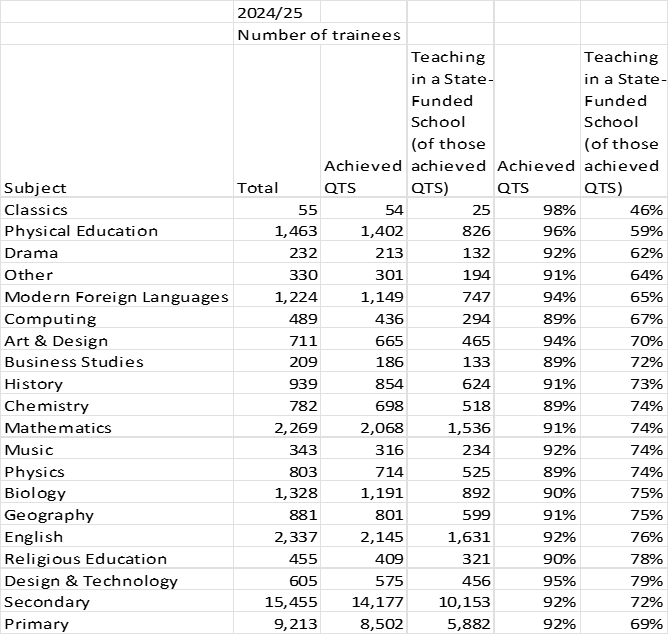
To me that is an insult to the many thousands of teachers that gave gained QTS, often at great personal expense. There is still time to insert a clause in the Bill before parliament to remedy this oversight and grant legal status for qualified teachers.


The Future of Education – a talk from 2024

In the summer of 2024, I was asked to lecture on the future of education. Two years on, it is interesting to see how even more relevant today the content of the talk is. Sadly, there are still no answers to many of the questions posed in my talk.

Thank you for inviting me to talk to you this evening. I arrived in Oxfordshire some 45 years ago, about the same time as the late Sir Tim Brighouse. This was only a couple of years after Prime Minister Sir Jim Callagham’s visit to Oxford, and his famous Ruskin College speech that started The Great Debate about education and schooling in England. A debate that has ultimately led us to where we are today.

Starting this talk with a look back at history reminds me that if this were a sermon, I would start with a text. Perhaps, ‘Acts Chapter 2 Verse 17’. I won’t read it out, as those that want to know what it says can look it up on their phones.

However, what I want to talk briefly about this evening is RATS -I have to say that thankfully you are spared the PowerPoint picture at this point.

However, RATS stands for:

Responsibility

Accountability

Technology

And

Schooling

RATs or ARTS is better, even if the order is wrong.

First Responsibility

Who is responsible for what in education

People still cheerfully talk of ‘Oxfordshire’s schools’ but in reality, as cabinet member, I deal with only a limited number of functions these days:

-Admissions to school, but not in-year admissions to academies

-Transport to school, but not for over 16s, as this is discretionary and there is no cash, despite raising the learning leaving age to 18, except for SEND pupils where we still support those where we can. So, a young person can receive free transport from Years 7-11 and then nothing.

-School building – we have built more new schools in the past decade than the previous 50 years. But as ever this area is highly regulated.

HR for maintained schools – this means small primary schools have to pay the Apprenticeship Levy – a tax by any other name.

School Improvement – although the £400,000 annual DfE grant ends this month and next year we are funding it from Council Tax.

-SEND – and we will spend £20 million more than the government provides us with funds in this area and end this financial year some £60 million overspent.

That overspend lead me nicely into considering Accountability

If there is confusion over responsibility, is there any clarity over accountability for our school system?

As I mentioned, Oxfordshire has overspent on SEND and by 2026 this may be as much as £140 million

Schools receive their budgets calculated on formulas where Oxfordshire as a local authority has no vote, and merely acts as the banker. Schools may end the year in surplus or in deficit

If you look at academy chains in Oxfordshire, several have schools with balances of £1 million and other have deficits nearing the same figure.

Who is accountable for these outcomes and how will they be dealt with?

If the RSD is prepared to accept academies in deficit that they add to each year, why should Oxfordshire as a local authority wipe out deficits on schools transferring to become an academy: perhaps we will explore issuing an IOU to be paid when there are no deficits in the academy sector.

Last year, council tax payer transferred £200,000 for a school becoming an academy to wipe out is deficit: that’s a lot of potholes we could have filled. At the end of this month, I expect deficits in maintained schools to top the £3 million mark: enough to mend most of our roads.

Let’s consider some other accountability issues:

Who is responsible for ensuring there are enough teachers for Oxfordshire schools? Is it schools; MATs and the dioceses; the LA or the government at Westminster?

Who is responsible for school improvement, so when ofsted comes knocking a school can be judged outstanding, as a primary school in the north of the county has been recently.

Who will deal with the digital divide?

This last question is one that that neatly brings me onto the third theme for this evening:

Technology

Since I came to Oxfordshire at the end of the 1970s there have been three waves of new technology

The microprocessor revolution of the late 1970s and early 1980s that brough BBC B, turtles, and eventually the Apple/PC dominance of our interface with IT. Indeed, my MSc thesis in 1980 was the first produced on a word processer for any course at Norham Gardens.

The second technology revolution started in the early 1990s, and became part of our lives in the first decade of this century when we all embraced the internet and started exchanging emails. 

This revolution had a second phase when the phones in our pockets suddenly became mini computers in their own right, and a whole new set of challenges opened up for education. This saw the surge in new social media platforms, and the current heads-down culture that pervades so much of society these days. I won’t ask how many have already googled my suggested text for this talk.

Although schools have made adaptations to accommodate these changes in technology over the past 5 decades, we still rely upon a teaching and learning strategy that has many elements that would be familiar when state education began more than 150 years ago.

In passing, I am sorry that the covid pandemic didn’t allow us to celebrate the 150th anniversary of the 1870 Education Act in a manner that I think would have been fitting.

The 2x4x8 model of learning may not be as rigid as it once was, but secondary school ‘timetablers’ are great fans of it as a strategy.

Anyway, so much for the first two waves of technological change: what of the third and developing wave, currently described by many as the AI revolution?

Does a knowledge rich curriculum meet the needs of a generation that started school last September and possibly won’t retire from employment until the last decade of this century. Those that started school 100 years ago, around the time of the birth of the BBC and radio, retired just as the internet was becoming a viable communication strategy: what will the class of 2024 experience in their lifetimes, and how will we prepare them for adult life?

This is not to decry the role of knowledge in schooling, and especially the building blocks of literacy and numeracy. Technology has almost made handwriting redundant, except as an art form. Can technology help us deal with the learning gap at Key Stage 1 between children on Free School Meals and those whose parents have a higher degree?

If so, to return to my themes of accountability and responsibility, where does the impetus for change lie? At school or Trust level; at local authority level or nationally?

We have seen initiatives such as the Oak Academy created nationally post-covid. We also saw how Oxfordshire as a local authority dealt with covid in acting as a conduit for information.

How will the system take change forward. Who has the vision.

Perhaps parents will dictate change for us as educators?

Home schooling has increased significantly: a passing phase or signs of a new order?

I saw this week suggestions that teachers will need to be paid more if they have to work a five-day week when four days becomes the norm. It is worth noting that teachers, as a group have seen no change in their holiday entitlement over the past 50 years while all other workers have benefitted from increased time off.

So let me conclude by asking whether one might one view a model where technology, and indeed any other approach to teaching and learning, is like a table top resting on the twin legs of responsibility and accountability.

Wobbly legs can mean an insecure platform for learning, and certainly for the development in an orderly manner of how technology can change the landscape of education.

I started with the term ARTS, so my final word must be about schools.

It is right that schools and their staff must be at the heart of the landscape, but the challenge that is currently keeping me awake at night is the relationship between a national funding formula created during a period of increasing school rolls, and the current situation of falling rolls faced by many primary schools.

How will hard decisions on whether all schools survive be taken, if pupil numbers continue to decline? For instance, who decides on whether we keep primary schools in local communities or face competition between schools for pupils to keep their own school open?

What part can technology play in solving this dilemma? I don’t know, but I do know the relationship between falling rolls and school funding is not one we can duck going forward.

But let me finish on a brighter note. This week, I met with three young entrepreneurs interested in working with schools on drone technology. Indeed, they have started a series of books that might be the 21st century version of Thomas the tank engine.

Let me introduce you to Ruby Rescue and the big fire – a tale from Drone City and possible future firefighting techniques.

I started my teaching career in Tottenham with the stewardship of 16 mm projectors; reel to reel tape recorders; an epidiascope, and little other technology but in a certain landscape for schooling.

I don’t want to dream of a past, but rather to challenge us all to set out a vision for the future landscape of education that can work for the good of all.

Thak you for listening.

Are small sixth forms a good idea?

In a post in January, I mused about the issue of how falling rolls might affect schools particularly if it meant less funding, where school funding is based upon a per pupil funding model. Fewer pupils = less cash. Accountability and falling school rolls. Was it different in the past? | John Howson

One of the possible solutions discussed in that post was a reform of post-16 education. In a cash-strapped school system, is it possible to justify schools with small sixth forms? Are such sixth forms in the best interest of the students?

In order to think more deeply about this issue, I have looked at the ‘A’ Level results from one local authority, as published on the DfE’s website. 11-16 schools are excluded, as are schools that will eventually expect to have a sixth form, but aren’t currently at that stage, and also colleges. What’s is left are the details for the outcomes on ‘A’ Level results for 34 schools, as shown in the table below

pupils enteredbest 3 scoreprogress scoreaverage or above
31239.880.2AA
21135.750.08A
12540.77-0.13
11741.680.02A
11031.45-0.30
10733.240.00A
9634.340.00A
9438.30.17AA
9036.330.19AA
8935.51-0.12A
8731.530.08A
8239.150.80AA
8236.420.07A
7934.57-0.33
6929.47-0.21
6635.10.26AA
6632.37-0.10A
6535.640.03A
6433.39-0.15
6235.70.20AA
5934.69-0.09
5732.520.06A
4634.57-0.33
4233.65-0.11A
4131.14-0.46
3014.67-0.69
2836.310.21A
2525.07-0.02
2234.850.70A
1424.52-0.83A
1318.21-0.75
924.52-0.83
937.780.35A

For comparison purposes, the average score for state schools in England was -0.03 for Progress and 35.76 for the best 3 ‘A’ Levels score. There are other measures that could be used, but these are three I chose to use for this blog post.

Nine out of the 34 schools beat the national average for ‘best score’, although another couple of schools narrowly missed the national average, so it might be better to conclude that 14 schools were either close to or exceeded the national average for ‘best score’, leaving 20 schools that were below the national average.

Progress score is a more contentious measure. Here 15 schools did less well than average. The same schools often feature in both lists. Most of these schools entered less than 100 pupils for three subjects at ‘A’ level. Some pupils might have taken either two subjects and a vocational qualification or just two subjects at ‘A’ Level.

Schools that entered more pupils for 3 ‘A’ Levels were more likely to receive an ‘average’ or ‘above average’ grade.

The data forces me to ask the question – is the current arrangements for ‘A’ Level study across these schools producing the best outcomes for students? Two subsidiary questions are; if this is the outcome close to the top of the demographic cycle, what might happen to sixth form sizes in these schools once rolls start to fall in a few years’ time? The second question is, what is the cost of tuition per pupil under the present arrangements.

To answer the latter question, let’s assume a Year 7 class of 30 for mathematics taught by a newly qualified teacher on the bottom of the Main Scale for five period a week for 40 week, and an ‘A’ Level group taught for 5 periods a week by the Head of Department, on the top of the Upper Pay spine, and with a TLR 2A in addition.

The newly qualified teacher teaches 6 classes per week for 40 weeks, while the Head of Department teaches two ‘A’ Level sets, one of which has 10 weeks examination leave in Year 13. In addition, the Head of Department teaches four classes of 30, one of which has exam leave in Year 11.

 Using this data, and ignoring any other time spent on non-teaching duties, the Main Scale Teacher costs work out at 0.91p per pupil, while the Head of Department costs are £2.33p per pupil.

If the ’A’ Level groups were smaller than 15 in each year, as they well might be in some schools, then the cost per pupil increases unless the Head of Department receives a lesser amount in TLR.

In an 11-16 school, where the Head of Department might teach five classes for 40 weeks and one for 30 to allow for examination leave, the cost per pupil for the Head of Department reduces to below £2 per pupil. If the school has only long-serving teachers then the per pupil for teachers increases to nearer £1.50 per pupil.

For small schools with settled staffrooms, the difference in cost between the cost of teaching Years 7-11 and Years 11-13 may be marginal. The issue then becomes one of teaching and learning. Do small sixth forms produce as good examination results as larger sixth forms? The evidence from the table would suggest they are less likely to do so.

What of the student experience? Is it better to be either ‘a big fish in a small pool’ or ‘a small fish in a larger pool’? Has anyone ever asked students their views?

I think that there is a debate to be had about school organisation and size of school sixth forms when rolls fall, especially if school funding comes under pressure from increased government spending on both defence and welfare, and especially if we are in a recession.

As my colleagues in Haringey found out in the 1970s, such debates about changes to sixth forms can be fraught with political pitfalls for anyone suggesting change. But, is that a good enough reason not to at least discuss changes?

Note: I have only used salary costs in the modelling and not included on-costs from National Insurance and Pensions. I have also ignored premises and other staffing costs, as I assumed the to be low in a subject such as mathematics.  

My 2016 post on Geopolitics and macroeconomics

Sometimes it is worth re-posting something I have written before on this blog rather than writing a new post. Recently, I wrote about my thoughts about how education, and schools in particular might be affected by the current global war. In 2016, well before the AI revolution, I wrote a wider-ranging piece about macroeconomics and geopolitics that also considered advancements in technology, without actually referencing AI. I thought it worth re-publishing the post that first appeared on:

So here it is in full and unedited.

Whether the world is a more dangerous place this January isn’t for me to say. However, to balance my short-term views about teacher supply problems I thought it worth thinking about what the combined effects of a downturn in China; tensions in the Middle East; falling oil prices and the possibility of rising interest rates might do to the longer-term teacher supply position.

An analysis of data over the past fifty years suggests teacher supply problems ease when the economy is subdued or in recession. Whether there is a direct link between these two facts may be arguable, but while there is a need to educate children there will be a need for teachers. Again, over the past fifty years, there have been massive strides in technology since the famous BBC programme of the late 1970s ‘The chips are down’ about the microprocessor revolution. Classrooms have adapted to make use of the new technology, but there has been no seismic shift away from traditional patterns of pupil teacher numbers. Indeed, in secondary schools over the past decade, pupil-teacher ratios have even improved, according to DfE data.

The recently reported growth in home schooling may be the first signs of a coming revolution, driven by parents no longer satisfied with the current model of schooling. Tablets, TVs and computers can provide more learning power than any school library of a couple of decades ago. What is needed is the means of instruction and the method of motivation to keep youngsters on task. How much more likely is that in a home environment than when youngsters are faced with the distractions caused by 25 or 30 other children: could learning me more focused and take less time in the home than the classroom?

No doubt, parents would still want children to socialise in order to learn team games, sing together and undertake risky science experiments under the control of a qualified person. However, that might mean only sending your child to school for a couple of days a week. Such a shift might also boost the market for tutors as parents just buy in specific skills where their offspring are facing issues with learning.

As the BBC recently highlighted, the spirit of enterprise is abroad in Britain at the present time. I am sure that there are many developers in both large companies and small start-ups eying what could be a lucrative market that has world-wide potential; some of which will be on display at BETT.

Such a shift in technology from a labour intensive to a technology driven learning process could have a profound effect on both the need for teachers and the spending by the State on education. However, in the short-term, the geopolitical and macroeconomic signals might suggest that if a downturn is coming then teaching might benefit from renewed interest as a career choice.

As I have said at several conferences recently, I am one of the only people that might see benefits from a slowdown in China, even if it only reduces the inflow to that country of UK teachers to work in the growing international school market.

However, with the allocations for 2016 entry into teacher preparation courses set and fewer places available on non-EBacc subjects than in 2015, none of this will matter before 2017 unless, as in 2009, any downturn in the world’s economy bring back greater numbers of returners into teaching: such an effect could dramatically alter the picture of teacher supply, even for 2016, were it to come about.