ITT: subjects recruiting from UK graduates still in trouble

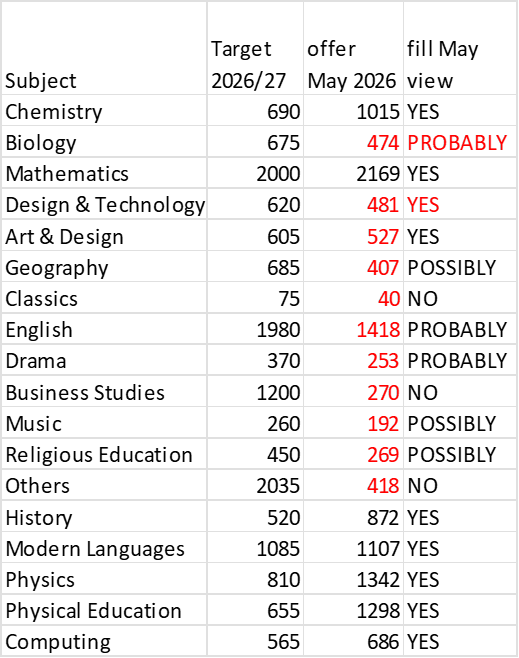
The DfE’s June data on the current round of applications and offers for postgraduate ITT courses still revels that the 2026 round is separating into two distinct sections. Subjects where applications are likely to come from anywhere in the world are either already meeting their Teacher Supply Model target for 2026 entry, or should do so on the current trajectory. Subjects where home recruitment is likely to dominate applications seem more at risk of missing their targets.

SubjectTarget 2026/27offer May 2026Fill: May viewJune offersFill: June view
Chemistry6901015YES1199YES
Biology675474PROBABLY542POSSIBLY
Mathematics20002169YES2495YES
Design & Technology620481YES562YES
Art & Design605527YES601YES
Geography685407POSSIBLY455NO
Classics7540NO43NO
English19801418PROBABLY1586POSSIBLY
Drama370253PROBABLY283PROBABLY
Business Studies1200270NO301NO
Music260192POSSIBLY215PROBABLY
Religious Education450269POSSIBLY308NO
Others2035418NO456NO
History520872YES974YES
Modern Languages10851107YES1214YES
Physics8101342YES1466YES
Physical Education6551298YES1405YES
Computing565686YES794YES

Based upon ‘offer’ recorded in the June update from the DfE, and with just three more reports to come before courses commence, I have made four downgrades and one upgrade to my expected outcomes for the current recruitment round.

I have downgraded expected outcomes for, biology, geography, English and Religious Education, including reducing Religious Education to a ‘No’. however, I am aware that there is a vigorous advertising campaign currently underway by the Religious Education sector, reminiscent of the RETRI initiative led by Dr John Gay a quarter of a century ago. Success in attracting new applicants could mean that it would be possible to hit the target for Religious Education. I do wonder why more subject groups don’t invest in advertising the benefits of becoming a teacher.

If science graduates discover there is space for those with some biology, then that subject might reach its target. Music looks likely to meet the target, but that target, in my opinion, has been set far too low to meet demand from schools, especially with the DfE’s latest initiative on extra-curricular activities for all, including within the scope, music. It will be difficult to achieve success in music without more teachers. However, meeting the low target will justify the removal of the bursary for music ITT.

Applications from outside of the United Kingdom represented 25% of all applications this June compared with 18% in the data for June 2025. If all non-Uk applicants had applied for secondary sector courses, then they would currently account for more than a third of applicants across all subjects, compared with a quarter in June 2025.

More evidence of the lack of interest in teaching from hone-based students comes from the fact that the number of graduates in the age group ’21 and under’ applying for courses is only 115 higher this June at 3,685 compared with an increase in applications of nearly 2,000 from the ’30 to 34’ age grouping.

The increasing interest in teaching from men continues, with applications up from 16,796 in June 2025 to 21,774 this June! It would be useful to know more about where this increase is focussed, and what the implications might be for the sector.

As ever, the DfE continues not to share ethnicity data with the sector. With so many overseas applicants at present, is that a helpful omission from the dataset?

Higher Education continues to bear the brut of the increase in applications, with ‘partner led’ and ‘salaried’ routes static, and only a small increase in applications to SCITT courses. However, PG teaching apprenticeships have seen a healthy increase in applications from 6,328 to 10, 493. However, offers are little changed at 1,066, compared with 966 in June 2025.

Perhaps because of the arrival of the postgraduate apprenticeship route, offers for the ‘salaried route was only 266 this June, compared with 518 in June 2025. Mr Gove’s brave new world of 15 years ago now looks like a distant dream, as higher education continues to take the bulk of applications, proving the resilience of the sector in the face of determined onslaughts during the coalition government to remove its dominance from the training of new graduate teachers.

With the end of the school term rapidly approaching, the next three months traditionally see relatively few new offers: will this year be any different, especially given the press comments about graduates unable to find work, or does teaching still look like an unattractive carer to debt strapped UK graduates?

With falling rolls affecting job prospects after training  and the acquisition of more student debt, and a possible below inflation pay settlement, the signs for increased interest in teaching as a career during the rest of the recruitment round are not good.

More thoughts on the ITT round for 2026

Yesterday, although a bank holiday in England, more people listed as from the United Kingdom than listed as from the United States viewed this blog. It’s been a while since that has happened.

I guess it was because of the post about the May ITT numbers I posted yesterday. Yesterday also looks like a bank holiday that higher education ignores. I am not surprised as there can be too many bank holidays on Mondays in May, and that fact can play havoc with timetabling.

Anyway, thanks for viewing, as, wherever you are from, your support is much appreciated.

After producing my prediction table in yesterday’s post MayDay for some ITT subjects: joy for others? | John Howson

I thought that I would delve a bit more deeply into possible outcomes. Looking at 2025 data between May and September, and ignoring all applicants not from England, there were 11,773 more candidates in 2024 and 13,387 more candidates recorded in 2025 between May and September.

At 18th May 2026, there were 33,344 candidates, so it seems likely that candidate numbers will be up on the past two years in terms of candidates from England. However, as this also contains candidates for the primary sector, that factor needs to be taken into account. This year, with a low ‘target’ for primary, I would be surprised to see many more candidates applying for primary sector courses, as most courses will presumably be showing as ‘full’.  

However, what about the subjects listed as anything other than ‘Yes’ will fill in the previous table? How do they fare?

The following table is based upon ‘offers’ not ‘candidates’ numbers between May and September for 2025.

subjectMay-25Sep-25difference% increase offers May to September
Others4185008220%
Classics44541023%
Physical Education1395177538027%
History832113230036%
Physics1246169845236%
Mathematics2169314297345%
Religious Education34750816146%
English1467216169447%
Drama23434911549%
Music27641614051%
Art & Design709108637753%
Business Studies21232911755%
Geography731113540455%
Modern Languages1089170962057%
Biology1094173363958%
Chemistry682109140960%
Design & Technology46678331768%
Computing53794240575%
  
Total Secondary1353020043651348%

There is no doubt that had the DfE output from the Teacher Supply Model remained the same as I 2025, this table might have looked very different.

I think that I might upgrade Geography from ‘possibly’ to probably’ on this data. As music had a bursary last year, I am not yet prepared to upgrade that subject to ‘probably’, at least until after July numbers, and the applications from 2026 graduates have been taken into account. The same is true for Religious Education.

Another area of uncertainty remains around the sciences. The total target had been reached by the end of May, but biology numbers were below target. Will providers top up with students to make courses viable? My guess is, yes, as there seems to be no penalty to the provider for doing so. The risk is all carried by the trainee.

In the future, I think that the DfE needs to consider disaggregating the 2,035 places listed as for ‘other’ subjects. Not to do so makes the data increasingly meaningless, especially once the fact that more than a third of applicants come from outside of England is also taken into account.

Finally, as we know for the annual DfE’s ITT census, not all offers turn into students counted in the census. I might try and look at what level of over-recruitment might be sensible to ensure 100% of the DfE’s target by the time of the ITT census, after allowing for the fact the TSM target should include a percentage of in-course wastage.

Afterall, the aim is to ensure the labour market has the qualified teachers it needs for all students to be taught by properly qualified teachers.  

Higher Education: markets v planning for the sector

I don’t often write about higher education, as, although I spent more than a decade running a large department in a university, and also writing about activity-based costings in higher education, I don’t consider myself well enough briefed to comment regularly.

There are exceptions to my self-imposed rule, and this post is one of those. What persuaded me to write this post was a link to this article Universities on the brink: Decoding the UK higher education funding crisis and the path forward | The Educationist

Now, for most of this century, and indeed the last decade of the previous century, higher education providers have been free to operate in a market, with limited government intervention, except in areas such as teacher education, and providing courses for both doctors and the professions allied to medicine.

As I discovered when running courses for new heads of departments in universities about how higher education funding worked, most academics had limited knowledge and often less interest in the subject when asked to take on running department: at that time; even Deans were often more interested in course quality than the financial health of the departments they headed.

Regardless of the reasons behind the current financial malaise, should the market be left to bring the sector back to financial equilibrium? Of course, the government could just throw money at the problem, but I guess it hasn’t the funds, and anyway, the DfE might put NEETs and SEND above bailing out universities in any priority list.

However, I don’t think the government should leave everything to the market. After all, it is the largest consumer of graduates: 30,000 teachers per year to be trained; NHS staff; the defence forces; the civil service and local government. These are all consumers of graduates in large numbers.

Allowing the market to solve the financial problems might have unintended consequences. A major concern for me is around the mobility of new graduates. Many years ago, I studied where trainee teachers went to study, and there was a correlation between where a first degree or higher-level courses was studied, and where individuals entered teacher preparation courses. Universities without schools of education provided fewer recruits to teaching.

Well, Teach First helped solve that problem, at least in London, but I am concerned that market driven course closures could leave parts of the country without degree courses in some subject areas vital for the public sector.

For this reason alone, I think the government should ensure some form of course planning for the higher education sector, so that there are not areas without say, music courses or philosophy. Both are degree courses important as part of the pipeline for future teachers of music and religious education. As these are also both subjects that already fail to recruit enough graduates into teaching, reducing the number studying them on degree courses even further would endanger that pipeline even more.

The intervention of the government in place planning, even at a broad level, also makes economic sense to me, as moving students from loans to welfare is also not a good use of public money. How to manage the balance between leaving the future for higher education to the market, and an orderly return to fiscal rectitude might at least be worth a discussion amongst politicians and those that advise them.

Religious Education – the need for qualified teachers

In a recent post on this blog about the DfE’s modelling of trainee teacher needs, I wrote that

‘However, has this re-assessment of need gone too far? Based on … my own current research into vacancies for teachers of music, I think the DfE has been realistic in its approach. ‘

While, I stand by that judgement, I have also been reminded by Deborah Weston, championing on behalf of those concerned with the teaching of religious education in schools that the cutback in trainee numbers probably allows little room for the replacement of the ‘under’ or even ‘un-qualified’ teachers currently teaching religious education in our schools.

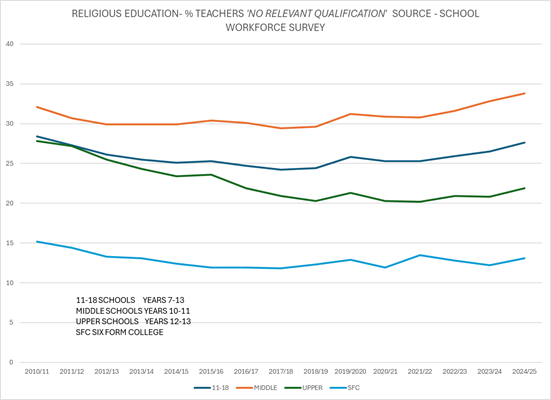
Prompted by Deborah, I looked at the trends from the Teacher Workforce surveys concerning the use of those with ‘no qualification in the subject’ teaching religious education over the period between the end of the Blair/Brown Labour government and the end of the Conservative period of government. Of course, recent years have been impacted by the covid pandemic, and its consequences, but there is a clear trend that is observable.

The chart shows the four key types of secondary schools, of which the 11-18 school line is probably the most significant.

At the end of the Labour government, partly I expect as a result of the economic crisis of 2008, the percentage of teachers of religious education with ‘no qualification in the subject’ was reducing. However, the percentage levelled out as school rolls began to increase again, and teacher supply entered into an extended period of years when teacher preparation programmes missed their targets.

There was a brief respite as a result of covid, but in the most recent years, as trainee numbers have fallen, so the percentage of teachers with ‘no qualification in the subject’ has reached levels not seen since well before 2010.

As a result, the question now is, was the DfE right to cut trainee targets for religious education from 780 last year to 450 this year? On the basis that including unfilled places from previous recruitment rounds was a mistake, as I have always maintained, then the answer is clearly, yes, the DfE have taken the correct decision.

However, in subjects such as religious education, where most pupils only study the subject for a limited period of time each week, managing recruitment is easier for schools, if qualified staff are available.

I would add that in my opinion, religious education when taught by well-prepared and knowledgeable teachers can be a really valuable subject, especially at this time in the history of our multi-cultural society, where both many different faiths are practiced, and a growing minority profess to having no faith in religion at all.

If the government cannot see their way to increase the stated need for trainee religious education teachers, providers can always over-recruit, at least to higher education courses, where government funding isn’t an issue.

In addition to pre-entry training, the DfE might also like to consider another approach to the issue of shortage of religious education teachers: upskilling those presently teaching the subject, but without an appropriate qualification.  If it is important that a subject be offered on the curriculum, it beholds government to ensure it is taught properly.  

Spending cash on upskilling will no doubt help retention, and thus save on recruitment and training costs. However, apart from in mathematics and the sciences, it hasn’t really featured as a policy objective for many years: surely that’s a mistake.

I hope that the religious affairs lobby is able to persuade the government that significantly reducing the percentage of inappropriately qualified teachers of religious education should be a key policy objective.

ITT Offers – public money being wasted?

The DfE has today published the April data on postgraduate ITT courses, as at 20th April 2026. Initial teacher training application statistics for courses starting in the 2026 to 2027 academic year – Apply for teacher training – GOV.UK

This is the first month where offers can be compared with the DfE’s required need for each subject for September 2026 courses. I have previously posted about the draconian changes to the demand in many subjects as required by the DfE that have resulted from a different approach to unfilled vacancies. ITT Numbers for 2026 – brutal realism from DfE or big risk? | John Howson

Here is my assessment of possible outcomes for September, when courses commence, based upon current offers and past trends. It will be interesting to see how my view compares with that of Jack Worth at NfER.

SubjectTarget 2026/27offer April 2026DfE identified needFILL?
Chemistry690829-139YES
Biology675398277YES
Mathematics20001752248YES
Design & Technology620382238POSSIBLY
Art & Design605449156YES
Geography685353332POSSIBLY
Classics753639NO
English19801176804PROBABLY
Drama370207163PROBABLY
Business Studies1200224976NO
Music26016199POSSIBLY
Religious Education450339111POSSIBLY
Others20353721663NO
History520736-216YES
Modern Languages1085946139YES
Physics8101140-330YES
Physical Education6551175-520YES
Computing56553926YES

In some subjects, such as history, physics!, physical education and chemistry, providers have already made more offers than required ‘need’.  This demonstrates the danger of leaving it so late in the recruitment cycle to announce estimated demand.

In the past, these numbers used to appear before Christmas. With a rolling offer system in place, rather than a defined closing date, leaving the announcement of ‘need’ until April is likely to cost someone money. Will the DfE pay bursaries to all students offered a place, even if recruitment is above the stated ‘need’? If so, that could be seen as a waste of money.

However, of more concern are the subjects where, even with the new numbers for ‘need’, there are unlikely to be enough applicants to fill all the places. Based on previous trends, classics, business studies and the ’others’ grouping will not meet their ‘need’ number. I think it is time that the ‘other’ category, with 2,035 places is disaggregated into different subjects, after all, it is now by far the largest group in the subject’s table.

I have some concern about where design and technology, geography, music and religious education will produce enough offers to meet the revised ‘need’. However, I can now see why the bursary was removed from music. I still think that was a serious error of judgement, as this is a subject where only those with appropriate subject knowledge are accepted onto courses. Music has one of the highest applications to offer ratios of any subject. Current offers are the second lowest April ‘offer’ number since 2018.

What happens in the wider economy, and graduate job market, will determine the outcome of this recruitment round. I suspect there will be a summer surge in applications, as new graduates discover how tough the job market has become. This should mean a good year for teaching course. However, many applicants may now have found they have left it too late to secure a place for this autumn. This year will really be a case of ‘the early bird that catches the worm’.

I will now delve deeper into the data for another post about the nature of applicants and applications as revealed in this month’s data.

ITT January 2026: lots to ponder

On the face of it, the January 2026 data around postgraduate ITT applications and offers looks good news for the DfE, and for schools Initial teacher training application statistics for courses starting in the 2026 to 2027 academic year – Apply for teacher training – GOV.UK

By the 19th January 2026, there had been applications from 26,217 candidates. This compared with 20,771 at the January data point in 2025. Candidates applying for primary courses were up from 7,283 to 8,676: a modest increase.

For secondary courses candidate numbers this year were, 19,232 compared with 14,862 at last January’s datapoint. That looks like very good news, perhaps worthy of a Statement in Parliament.

However, it is worth delving a bit deeper into the data before putting out too much bunting. Applications from the ‘Rest of the world’ account for 8,353 of this January’s total, compared with 5,088 last January. That means that this group now account for a whopping 30% of candidates. This compares with 23% of candidates from this grouping in last January’s data.

Of even more concern, is that the numbers of candidates from the United Kingdom haven’t kept pace with the growth in overseas applicants. The growth in applicant numbers from the North of England has been especially weak; only 90 more compared with last year from the Yorkshire and The Humber region, and only 71 more from the North East.

Admittedly, the North West has seen an increase of over 400 applicants, and London, over 500 more. However, the South East only has around 140 more applicants than last year. This is around 7% more, but this percentage pales into insignificance compared to the more than two thirds increase in applicants for ‘the Rest of the World’.

The dominance of the ‘Rest of the World’ applicants as a share of the total makes commenting upon the data challenging. Normally at this time of year, I might be happy to predict those subjects likely to miss their ITT targets, based upon more than 30 years of data collection. Not knowing how the ‘Rest of the world’ applicants are spread both between primary and secondary phase, and within secondary phase by subjects adds a unique challenge to any predictions this year.

However, based upon ‘offers’, and the outcome of the 2025 ITT census, and assuming no significant change in the pattern of applications over the rest of the cycle – such as a significant weakening of the demand for new graduates or another pandemic – I am happy to make some suggestions for the outcomes based upon current trends.

I expect that Religious Education, Modern Foreign Languages, Music, Classics and the ‘other’ group will all miss their target this year.

I am not sure about biology, where offers are down by 194, but the subject reached 151% of target last year. I am also, as yet, uncertain about Geography, where offers are down, but the subject surpassed its target last year.

Despite the increase in offers, I still don’t expect Physics, Design & Technology, Business Studies and Drama to meet their targets, although on this showing they might do better than last year, assuming those with offers actually turn up when courses start: always a worry this early in the recruitment round.

On the current data, Physical Education and History, as ever, will surpass their targets. Mathematics, computing and Chemistry, should also meet their targets. I am unsure about English, where offers are down, and the subject only just beat its target in 2025.

Overall, I think that the DfE needs to consider how the statistics are presented, if a nearly a third of applicants might need a visa to train. How does this fit in with other government policies? Perhaps we can set up training courses overseas, so that these new would-be teachers from the ‘Rest of the world’ can work in the new State Schools to be established as a part of the DfE’s export drive, announced last week.  

Love, charity and reading

2026 marks the National Year of Reading, sponsored by the National Literacy Trust and the DfE. There is a somewhat odd logo of ’GO ALL IN’ for the year that I am afraid leaves me cold. This is despite the fact that as an author, blog writer and general supporter of words, in visual as well as spoken form, I fully support the aim of the Year, to see more people reading for pleasure; especially young people.

Of course, reading can be for purposes other than pleasure, although, for many, reading for research can itself be a great pleasure. This was brought home to me earlier today when I was listening to the BBC4 radio programme at 0815 that used to be a service of Sunday worship. These days, the format is more catholic in nature.

Today’s programme celebrated the 500th anniversary in 2026 of the publication of William Tyndale’s New Testament. This was the first part of the bible to be published, by the still relatively new printing process, in the vernacular English, rather than the Vulgate Latin, used in the Mass by the churches of the day.

What sent me off on research of the printed word was the extract from 1 Corinthians Chapter 13 used in the programme, where the reader used the word ‘love’.

As someone brought up before the publication in the 1960s of the New English Bible, this well-known passage has always been associated with the words of the Authorised or King Jame’s version of the bible. In that version, the word ‘charity’ not ‘love’ is used to describe the Greek ‘agape’.

Was this a Trump moment for the BBC Religious Affairs department, where the modern word ‘love’ was substituted in the reading for ‘charity’, or did Tyndale use the word ‘love’?

As the radio programme suggested that 80% of the Authorised Version used the text of Tyndale’s translation, this was a point worth clarification. Reading the text seemed to be the best way to allay my concerns, as the programme didn’t mention this change of wording between the two versions.

Happily, these days we can both read a version of Tyndale’s Testament and the King James version on-line. We can even ask AI – in my case, copilot – to do the heavy lifting of finding websites online with the text of both versions, and why the words were changed.

Here is what copilot told me

Why “charity” in the KJV instead of Tyndale’s “love”?

The decision was deliberate, not accidental. The KJV translators knew Tyndale had used “love,” but they chose “charity” because they believed it captured a more specific, more theological, and more communal nuance of the Greek word ἀγάπη (agapē).

And here are the links to sites I used before asking copilot why the change was made

1 Corinthians 13 – TYN – Bible Study Tools | Bible Study Tools

1 CORINTHIANS CHAPTER 13 KJV

This simple exercise remined me why I value reading so much, and helped me see the BBC used the correct words in their programme, even though a bit of explanation for this key difference might have saved my research, but also prevented this blog from being written. Thanks to the producer of the programme for stimulating my interest.

Finally, a somewhat tenuous link between Tyndale’s testament and this blog’s early days. In October 2013, in the post No time for God | John Howson I wrote of the fact that Michael Gove, as Secretary of State for Education,  has ordered a copy of the King James Bible to be sent to every school.

The BBC programme remined me that nearly 500 years ago, Thomas Cromwell had ordered a copy of Tyndale’s New Testament to be sent to every parish church in England. I wonder whether Michael Gove had that act in mind when he made his decision to send the King James Version to every school.

Certainly, for those of us schooled before the 1960s, the language of the Tyndale and King James testaments is both archaic in places, but is also wonderful, especially when read aloud.

Verily, verily, I say unto you’, may be as archaic as much of Shakespeare, but it rolls of the tongue.

So, whether it is reading for purpose, reading for meaning or just reading for enjoyment, let us all support 2026 and the National Year of Reading.

Too many teachers?

Earlier today the DfE published their Annual Census of ITT trainees. Published each December, the census identifies the numbers on the various teacher perpetration routes and some background information about their gender, ethnicity, degree class and routes into teaching. Initial teacher training: trainee number census 2025 to 2026 – GOV.UK

The census provides a helpful indication to schools about the labour market for the following September recruitment. In this case, September 2026.

In recent years, apart for during 2020 and the response to the pandemic, trainees number in many secondary subjects have been lees than the DfE predicted numbers needed to fill vacancies. In the primary sector, falling rolls and erratic recruitment numbers have meant there has been less of a coherent pattern about the balance between supply and likely demand for teachers. Of course, much depends upon assumptions about the turnover in the labour market, and the behaviour of possible ‘returners’ to teaching when reviewing recruitment patterns.

So, what of the current 2025/26 cohort?

subject2024/252025/26
Percentage of Target at census date%%
Physical Education213202
Biology116151
Art & Design64128
Primary88126
History116125
Chemistry62118
Mathematics72113
Geography91111
English99106
Modern Languages4493
All Secondary6188
Computing3780
Physics3077
Classics24573
Design & Technology4070
Music4065
Religious Education7962
Drama4741
Business Studies1530
Other1514

The government can be pleased with some of the best recruitment levels to their targets in almost a generation – covid years excepted – but challenges still remain. Nine secondary subjects didn’t meet their target number, with business studies still recruiting poorly to teaching, along with drama and religious studies where the target was missed by a larger percentage than last year.

On the good news side, mathematic exceeded its target for the first time in a long while, and the increase to 77% of target in physics teachers is very welcome news.

There will be too many primary school teachers looking for jobs come September, and although course providers will be happy to have recruited 202% of the target for physical education trainees, this over-recruitment does beg the question as to whether recruitment controls should be once again considered as a deterrent to such significant over-recruitment?

Taken with the news, highlighted in my previous post, about attitudes to pay by serving teachers, the government can probably stop worrying abut teacher recruitment for the first time since 2012.

However, all is not good news, if the Curriculum Review is to be implemented in full, attention to recruitment in some subjects will be needed. In that respect, as already suggested by this blog in a previous post, removing the bursary from music seems like a daft idea. Yes, there was a 25% increase in outcome against target, but that still left a third of places unfilled. Music departments in schools are often small and cannot be easily covered by non-specialists, such as the spare PE teachers. Time to think again on the basis of these figures.

Is Labour making mistakes on ITT bursaries?

Yesterday, the government announced the bursaries for trainee graduate teachers and support for school training through the Post Graduate Apprenticeship route (PGTA). As might be expected, the subjects covered by these inducements to train as a teacher are mostly STEM subjects, plus some other subjects, but not the arts and humanities subjects, except for geography for some reason.

SubjectBursaryScholarship
Biology£5,000
Chemistry£29,000£31,000
Computing£29,000£31,000
Design and technology£20,000
Geography£5,000
Languages£20,000£22,000
(French, German and Spanish only)
Languages£20,000
(all other languages, including ancient languages)                          
Maths£29,000
Physics£29,000£31,000

Teacher training bursaries | Get Into Teaching GOV.UK

The bursaries are paid for by the government, and the scholarships mostly by the subject associations. While I can understand the government’s desire to increase training numbers up to target in these subjects, the list does raise two important questions about what seems like a continuation of the policy of the previous Conservative government.

Firstly, are these now the subjects where targets will not be met in 2025 when the ITT census is published in December. If there are other subjects not likely to meet their ITT target, why are they not included in the list?

I produced this table for an earlier blog, but it is worth repeating here.

SubjectTarget2025/26% increase Sept on Juneaccepted Sept 25over/under target
Total Secondary19,27026%16843-2,427
Primary7,65034%98802,230
Chemistry73049%909179
Biology98536%1397412
Mathematics2,30035%2617317
Design & Technology96533%678-287
Art & Design68033%902222
Geography93533%98146
Classics6032%42-18
English1,95031%1760-190
Drama62030%273-347
Business Studies90029%235-665
Music56528%343-222
Religious Education78028%418-362
Others2,52025%360-2,160
History79023%936146
Modern Languages1,46021%1428-32
Physics1,41019%1313-97
Physical Education72517%1491766
Computing8955%761-134

Why are subjects such business studies – a perennial ITT target failure – and music and religious education not included in the bursary list? Does a Labour government not believe these subjects are worth supporting?

The second issue is around whether there will be the jobs available for trainees recruited into training in September 2026, and entering the labour market in September 2027, if on a traditional course. The more the PGTA route is funded, the fewer advertised vacancies there may be if the schools convert PGTA trainees into qualified teachers doing the same job.

The government announcement contains no discussion about the labour market for teachers, and whether ITT trainees, faced with a secondary sector where pupil numbers will be at best flat, and at worst in decline, if the decline in the birthrate together with government policies on immigration or even the threat of them help to reduce the secondary school population.

From my perspective, this announcement like a sloppy piece of work by the DfE, in what could be a rapidly changing labour market, if the intention is to ensure all subjects receive sufficient new entrants into the labour market in 2026.

However, if there is a rapid decline in graduate level entry posts as a result of AI, then the government’s stance may be vindicated, even if says nothing about equality of opportunity.

ITT: less good than hoped for

The September data on postgraduate ITT curses was published by the DfE yesterday. Initial teacher training application statistics for courses starting in the 2023 to 2024 academic year – Apply for teacher training – GOV.UK (apply-for-teacher-training.service.gov.uk) Sadly, there was no last-minute surge in offers for teaching. Although offers for primary courses should be sufficient to meet the number of places on offer, the same cannot be said for the secondary sector.

Amongst secondary courses, only English, history, geography and physical education seem likely to meet their DfE targets. Offers in mathematics this September are less than 2,000 for the first time in over a decade. In music and religious education, it is necessary to delve further back in the archives to find offer levels of 480 across the two subjects. There will be real issues with the supply of new teachers in these two subjects next year.

Although physics and design and technology have seen better offer levels than in recent years, in neither subject will the DfE’s suggested recruitment level be met. I suspect that the numbers actually starting courses this year will only be above last year’s dismal total for all secondary subjects if those with conditions pending are able to convert these conditions into recruited students, otherwise the total may be little different to the seriously low number recorded last year.

In mathematics, the number ‘recruited this year is just 1,340 compared with 1,482 last year. However, there are 516 applications listed as ‘conditions pending’ compared with only 300 in this category last year. Should these ‘conditions pending’ relate to visas and right to enter the country it is possible that the number that transfer into the ‘recruited’ column may be smaller than wished for.

The number of new graduates aged 24 or younger is considerably down on last year, a worrying sign for future leadership recruitment. Less than 5,00o men have been ‘recruited’ this year despite the total number of applicants being 16,470 compared with 11,819 last year. This means that those ‘recruited’ has dropped from 46% of applicants to just 30% this year. Such a dramatic decline must merit some form of investigation to allow providers to understand the cause of the change.

The answer may lie with ‘rest of the world applicants, where only 6% have been accepted this year, compared with 13% last year.

The final outcome for recruitment that will include Teach first must await the publication of the ITT Census, early in December. Although this may show a small improvement over last year’s total, there will not be enough trainees to allow the government to be able to say that it has hit its target and STEM has now really become STEAM in terms of recruitment into teacher preparation.

These figures are such as to warn schools to think carefully about recruitment for September 2024 and especially January 2025. Retention may become an important watchword in the corridors of power.