Is the DfE’s Teacher Supply Model outdated?

For most of my adult life, the government department responsible for the supply of teachers, whether it was called the DfE, DES, DfEE or by another name, has used a version of the Teacher Supply Model to calculate future teacher needs, and presumably to ensure the government doesn’t waste money training too many teachers.

Training too few teachers, not as a result of the Model, but because of under-recruitment into training, has been a problem for the Teacher Supply Model (TSM) during periods of teacher shortage. Do you either add the under-recruitment to the TSM target in any one year to the next year’s TSM total, thus making it even harder to reach, or do you accept every school starts each new school year in September fully staffed, so there are no vacancies to be filled, even if additional trainees just happened to be recruited. Over the past forty years, both approaches have been tried: neither really works.

I first came across the TSM in the late 1980s when, in response to a Select Committee Report, a technical document explaining the working of the TSM at that time was published. Between the late 1980s, and a seminal announcement, also to a Select committee, by David Laws when he was the Minister of State that the TSM would be part of open government, the TSM remained largely secret, apart from one other document published in the late 1980s in repose to yet another two Select Committee reports.

Why were successive government keen to keep the TSM under wraps? Possibly because the workings allowed for an understanding of future government policy. There are three obvious areas where changes in policy can have consequences for schools and society that might create political debate: reactions to future pupil numbers, whether up or down; changes in education funding that might allow more or less funds for schools; policy changes such as extending the learning leaving age or the introduction of a new subject, such as citizenship or computing. All impact on the TSM

Governments often don’t want to signal policy changes ahead of time, especially if they might be controversial. In the first decade of this century, the secrecy around the TSM almost caught out the ITT sector when falling rolls together with improved ITT recruitment made a reduction in ITT numbers inevitable for secondary subjects, especially as there was no policy around improving staffing levels in the secondary sector, partly because of the decision over the introduction of non-contact time in the primary sector.

Planning is an essential too of any organisation, including governments, whatever extreme free-market thinkers may say. After years of following the consequences of the TSM decisions on the outcomes for the teacher labour market, I have some concerns about what happens when the TSM has been run for any particular year. The elements of the TSM have changed over the years, as explained above in relation to under-recruitment as an example. That’s not an issue for me, although the discussions with the sector may have helped prevent some changes to the TSM in mor recent times.

What is at the core of my concerns about the TSM is the length of time between the collection of the data for input into the TSM and the consequences for the real-time labour market for any September recruitment round, let alone the needs for teachers to fill any January vacancies.

I acknowledge that improved and faster data collection over time thanks to better computing capabilities has helped reduce the time taken between data collection and the effect on the labour market of the TSM output for any recruitment round. Currently, data from the 2025 School Workforce Survey, collected in November 2025, will probably influence the TSM run for the 2027 entry into training, and hence, the 2028 labour market.

At least with most trainees now on a one-year postgraduate training route, there is no longer the issue of a four-year undergraduate course to add into the mix. The November 2025 data collected, if such courses were still a significant part of the ITT scene, would not affect the labour market until 2031. A lot can happen in the intervening years.

Even with the shorter training period, there is still a time lag between data collection and the consequences of that data on the labour market.

My question is, should a further check be added once the TSM has been used to calculate ITT targets, in order to allow the comparison between the TSM target and the current reality of the labour market?

The DfE now has excellent data from several years of operating its own vacancy platform, and there are also private operators monitoring the labour market with useful vacancy data in real time. This data can be compared with the TSM output target to allow a discussion about the validity of the TSM target to current labour market needs.

Now, it may well be that the TSM number is the best fit for training needs, but as my previous post that considered the labour market data for teachers of music alongside the ITT target cut that presumably emerged from the TSM output has suggested, the addition of vacancy data does allow for a debate about whether the TSM target under or over estimates demand. Music ITT: has the government made a mistake? | John Howson

Such use of vacancy data also allows for a consideration of policy changes, such as how schools react to a change in a market where QTS still allows any teacher to teach any subject to any child, and ‘permits the use of unqualified staff. where nobody with QTS is either available or considered sufficiently expert at delivering the curriculum.  

The TSM isn’t outdated, just, in my opinion, no longer enough by itself to ensure an orderly labour market for teachers.

Why is this important, it is because the market does play a part in determining how shortages are dealt with. Where are the qualified teachers of physics teaching? How much more do schools with high levels of free school meals have to spend on recruitment than a school with fewer such pupils? Important questions around the staffing of the nation’s schools.

I read the Fed report on education issued yesterday National Education Report 2026 – FED and believe that the supply of teachers and school leaders is still at the heart of any effective system of education.

How any government determines teacher supply is a vital decision affecting the lives of many young people. Ensuring every child has the best possible teachers throughout their whole school-life is equally as important as whether or not they are banned from social media, but much less often discussed.

I think that teacher supply issues should be much higher up the education agenda, but I would, wouldn’t I, having spent a career worrying about teacher supply matters.   

Music ITT: has the government made a mistake?

New entrants to postgraduate teacher preparation courses in music in 2026 will not receive a bursary. Instead, they will be need to rely upon either student loans or other funding. How has this change affected applications to train as a music teacher?

The news is not good. The June data for applications is the second worst number since the 2013/14 round more than a decade ago. Only the 2023/23 round post covid that was a terrible round across all subjects, has recorded a lower figure for applications than June 2025. In context, the June number of offers, a better measure than applications, is not far short of half the level seen in the covid year of 202/2, and around 25% below what might be expected in a usual round.

Worry, not because the government has decided that falling rolls over the next few years will mean fewer teachers of music need to be trained. Reducing the target from a requirement of 565 teachers of music in 2024/25 to just a requirement of 260 new trainees in 2025/26 suggests either the previous targets were way out of line or a need to justify the removal of the bursary by setting a target that can be met. After all, it would be unfortunate to remove the bursary as unnecessary, but still miss the target.

So, what of demand from state schools for music? Since January, and the start of the recruitment round for September 2026, I have recorded some 530 schools advertising for a teacher or music. Allowing for the fact that perhaps 100 had a TLR attached, so were not ideal for newly qualified teachers, this suggests 400 posts for newly qualified teachers so far. Add in perhaps another 100 autumn term vacancies and overall demand might be in the range of 400-500 posts or 500-600 posts overall.

The DfE expects about half of vacancies to be taken by existing teachers or returners each year. The exact number depends upon where the demand is and how it relates to supply. But, sticking with the 50% figure means a demand for around 250 to 300 new entrants each year.

Now, with falling rolls be might reduce that number by 10% to 225 to 270 as a requirement. On the face of it, the new target of 260 look risky but manageable. However, it must include two assumptions: all those that are offered eventually complete their courses and of ‘completers’, all join the state secondary school sector.

Both, based upon past trends are unrealistic assumptions. Being generous, 90% of those offered places complete the course. This suggests an output of 236 against a target of 260. Rounding up to 240 new entrants, this mean the new target is still not way of demand.

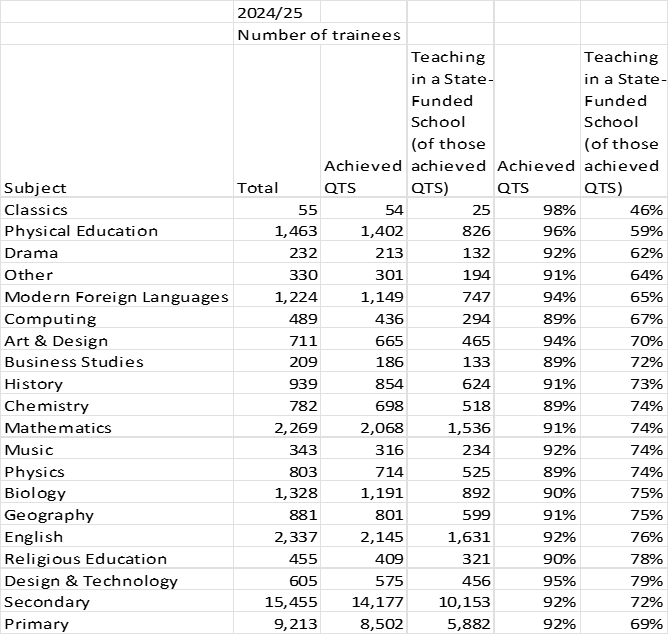
However, not all ‘completer’s join state schools. Some don’t enter teaching at all; some join Sixth Form Colleges or primary schools; some join the independent sector and some may decide to work overseas in the growing international school market. The 2025 data Less than 400 teachers of physics entered service in 2023/24 | John Howson based upon 2023/24 entry patterns showed that 80% of those gaining a QTS on a music ITT course entered teaching in a state-funded school. This includes both primary, secondary and special schools.

Assuming the 80% as a baseline – the next set of data should be out next month – our total of 240 reduced to less than 200. That number is starting to look as if the cut to music ITT places has been too savage.

A cynic might suggest, but I never could, the target was reduced to ensure it would be met and to save face over the removal of the bursary.

Whatever the reason, the DfE has now risked demand continuing to outstrip supply and this to affect the teaching of music in the nation’s secondary schools. With the recent announcement of the programme to ensureEvery child to get access to enriching activities to build skills and confidence for life’, the new target looks even less sensible  Every child to get access to enriching activities to build skills and confidence for life – GOV.UK.

I haven’t seen any campaign from the sector asking the government to revisit the target, but perhaps there should be in light of these numbers unless falling rolls are going to affect the demand for teachers of music more than I have calculated.

I would welcome any comments on the data.

ITT: subjects recruiting from UK graduates still in trouble

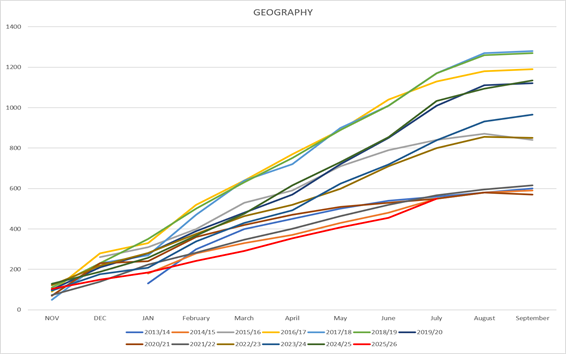
The DfE’s June data on the current round of applications and offers for postgraduate ITT courses still revels that the 2026 round is separating into two distinct sections. Subjects where applications are likely to come from anywhere in the world are either already meeting their Teacher Supply Model target for 2026 entry, or should do so on the current trajectory. Subjects where home recruitment is likely to dominate applications seem more at risk of missing their targets.

SubjectTarget 2026/27offer May 2026Fill: May viewJune offersFill: June view
Chemistry6901015YES1199YES
Biology675474PROBABLY542POSSIBLY
Mathematics20002169YES2495YES
Design & Technology620481YES562YES
Art & Design605527YES601YES
Geography685407POSSIBLY455NO
Classics7540NO43NO
English19801418PROBABLY1586POSSIBLY
Drama370253PROBABLY283PROBABLY
Business Studies1200270NO301NO
Music260192POSSIBLY215PROBABLY
Religious Education450269POSSIBLY308NO
Others2035418NO456NO
History520872YES974YES
Modern Languages10851107YES1214YES
Physics8101342YES1466YES
Physical Education6551298YES1405YES
Computing565686YES794YES

Based upon ‘offer’ recorded in the June update from the DfE, and with just three more reports to come before courses commence, I have made four downgrades and one upgrade to my expected outcomes for the current recruitment round.

I have downgraded expected outcomes for, biology, geography, English and Religious Education, including reducing Religious Education to a ‘No’. however, I am aware that there is a vigorous advertising campaign currently underway by the Religious Education sector, reminiscent of the RETRI initiative led by Dr John Gay a quarter of a century ago. Success in attracting new applicants could mean that it would be possible to hit the target for Religious Education. I do wonder why more subject groups don’t invest in advertising the benefits of becoming a teacher.

If science graduates discover there is space for those with some biology, then that subject might reach its target. Music looks likely to meet the target, but that target, in my opinion, has been set far too low to meet demand from schools, especially with the DfE’s latest initiative on extra-curricular activities for all, including within the scope, music. It will be difficult to achieve success in music without more teachers. However, meeting the low target will justify the removal of the bursary for music ITT.

Applications from outside of the United Kingdom represented 25% of all applications this June compared with 18% in the data for June 2025. If all non-Uk applicants had applied for secondary sector courses, then they would currently account for more than a third of applicants across all subjects, compared with a quarter in June 2025.

More evidence of the lack of interest in teaching from hone-based students comes from the fact that the number of graduates in the age group ’21 and under’ applying for courses is only 115 higher this June at 3,685 compared with an increase in applications of nearly 2,000 from the ’30 to 34’ age grouping.

The increasing interest in teaching from men continues, with applications up from 16,796 in June 2025 to 21,774 this June! It would be useful to know more about where this increase is focussed, and what the implications might be for the sector.

As ever, the DfE continues not to share ethnicity data with the sector. With so many overseas applicants at present, is that a helpful omission from the dataset?

Higher Education continues to bear the brut of the increase in applications, with ‘partner led’ and ‘salaried’ routes static, and only a small increase in applications to SCITT courses. However, PG teaching apprenticeships have seen a healthy increase in applications from 6,328 to 10, 493. However, offers are little changed at 1,066, compared with 966 in June 2025.

Perhaps because of the arrival of the postgraduate apprenticeship route, offers for the ‘salaried route was only 266 this June, compared with 518 in June 2025. Mr Gove’s brave new world of 15 years ago now looks like a distant dream, as higher education continues to take the bulk of applications, proving the resilience of the sector in the face of determined onslaughts during the coalition government to remove its dominance from the training of new graduate teachers.

With the end of the school term rapidly approaching, the next three months traditionally see relatively few new offers: will this year be any different, especially given the press comments about graduates unable to find work, or does teaching still look like an unattractive carer to debt strapped UK graduates?

With falling rolls affecting job prospects after training  and the acquisition of more student debt, and a possible below inflation pay settlement, the signs for increased interest in teaching as a career during the rest of the recruitment round are not good.

It’s the numbers not the percentages that matter most

Each year, the DfE publishes details about the workforce in schools. The data about teacher numbers are collected in the School Workforce Survey, conducted every November.

Included in the data are details about teacher retention in state funded schools. Interestingly, although the DfE provided the actual number of NQTs each year, the retention data is shown as a percentage of that base number. Release home – School workforce in England – Explore education statistics – GOV.UK as demonstrated in the following table.

The picture is obvious, despite some late arrivals after qualifying, the percentage falls for each extra year of service, so that of the 2010 cohort, only 59.2% were still in service after 10 years.

 Over the past few years, the percentage in service after one year has fluctuated from a low of 85.1 for the 2016 cohort to a high of 89.9 for 2023 cohort, with the 2024 cohort still doing well, with a retention rate of 89.7% at year 2. This looks like good news for the government.

However, there is less good news for the cohort that joined during covid in 2020 and 2012. For these two cohorts, retention after four and five years is poor, and back to levels last seen in 2014 for the 2021 cohort.

So, good news, retention is improving. Might the government even meet its target of of 6,500 extra teachers? Now it is time to change the percentages into numbers.

Here the picture is different. I have projected an extra year for the 2024 cohort and two years for the 2023 cohort just to show what might happen. The behaviour of those two cohorts is very important as they represent the lowest intakes of NQTs since 2010. Sadly, the government doesn’t publish the table by sectors. This is important because it is the key secondary subjects that already start with shortages where retention really matters for the performance of the school system, and especially for the outcomes for children in schools with high percentages of pupils on Free School Meals.

The current ten-year loss numbers show a worrying trend.

Hopefully, this loss of experienced teachers will reduce over the next few years, as the cohorts following the 2015 cohort have better retention numbers and percentages. The real concern is the 2020 and 2021 cohorts.

However, with falling rolls, starting to appear in the secondary sector, and already seriously affecting the primary sector in London, the retention rates for teachers may well improve, if schools can continue to afford the same number of teachers.

As my previous posts have made clear, the relationship between the National Funding Formula and pupil numbers will be crucial to future size of the teaching force. Falling Rolls: Is the funding formula making matters worse? | John Howson

When is a pledge not a pledge?

When is a pledge not a pledge? Change Labour Party Manifesto 2024

The headline in Labour’s 2024 General Election Manifesto said:

“Recruit 6,500 new teachers in key subjects to prepare children for life, work and the future, paid for by ending tax breaks for private schools.”

Note, nothing about lecturers and further education, and key subjects weren’t defined

In the text of the manifesto the promise or pledge was slightly different. The commitment was to recruit an additional 6,500 new expert teachers. Again, no mention of lecturers and further education and ‘key subjects’ didn’t appear, but ‘shortage subjects’ did. Page 82

“The factor that makes the biggest difference to a child’s education is high-quality teaching; but there are shortages of qualified teachers across the country. Labour will recruit an additional 6,500 new expert teachers. We will get more teachers into shortage subjects, support areas that face recruitment challenges, and tackle retention issues. The way bursaries are allocated, and the structure of retention payments, will be reviewed.”

Interestingly, there was also mention of ‘support areas that face recruitment challenges, and tackle retention issues.’

In the review of the 2025 Workforce, the DfE comment that

“The government, in its opportunity mission, has set a pledge to recruit 6,500 additional teachers. Further information on this ambition can be found in the 6,500 additional teachers delivery plan (opens in new tab). Latest figures show an increase of 3,000 secondary and special teachers since 2023/24 which contributes to this target. Combined statistics across schools and further education show an increase of 4,654 against this 6,500 target.” Release home – School workforce in England – Explore education statistics – GOV.UK

There doesn’t seem to be any mention of how these additional teachers ‘support areas that face recruitment challenges, and tackle retention issues.’  According to the DfE, The pledge is for mainstream secondary schools, special schools, further education (FE) colleges, and FE school based providers; it does not include primary schools. Latest figures show an increase of 3,000 secondary and special teachers since 2023/24 which contributes to this target.

However, much of the increase may well be down to improved retention rather than increased recruitment. Sadly, the headcount for both physics and chemistry teachers for all years 7-13 are still below the 2020/21 figure

Physics

2020/21 6,693

2024/25 6,465

2025/26 6,127

Chemistry

Physics

2020/21 5,886

2024/25 5,602

2025/26 5,357

So, there must be some questions to ask about the number of teachers in these subjects, and the aim to ‘get more teachers into shortage subjects’.

Still, perhaps the percentage of hours taught by those with qualifications has increased. Sadly, not since 2020/21

Percentage of hours taught by teachers with qualification for ‘Subjects taught and Specialist teachers and hours’ for 7 to 13

Chemistry

2020/21 48.9%

2024/25 45.7%

2025/26 44/7%

Physics

2020/21 45.2%

2024/25 42.8%

2025/26 41.2%

So, increased ITT numbers and better retention has yet to feed through to the teaching of physics and chemistry. Perhaps it is because of the way teaching in years 7-9 is arranged in most schools. What about teaching in sixth forms of Years 12 and 13?

Percentage of hours taught by teachers with qualification for ‘Subjects taught and Specialist teachers and hours’ for Years 12 to 13, Chemistry, PGCE, PGDE, ProfGCE, or ProfGDE, Physics and Qualified teacher in England between 2020/21 and 2025/26

Chemistry

2020/21 52.6%

2024/25 49.5%

2025/26 49.1%

Physics

2020/21 52.4%

2024/25 49.4%

2025/26 47.4%

I find this decrease disappointing.

Overall, there is some way to go to meet the manifesto wording, and with static rolls and funding for schools likely to be challenging, I wonder whether the proliferation of small sixth forms is helping or hindering the teaching of these subjects. Perhaps the DfE can identify whether there is any link between the sixth of sixth form groups and the qualifications of those teaching Years 12 and 13?

Demand for music teachers: where were the jobs in early 2026?

This post follows on from my previous post, written yesterday, and looks in more detail at the vacancies for music teachers tracked since January 1st 2026. Music teachers: labour market update | John Howson

Due to further data cleansing, the numbers may slightly differ from yesterday in some respects after mis-allocations in certain fields have been corrected.

Vacancies are generally either for a main scale/Upper Pay Spine post or for a promoted post.

In terms of the ratio of promoted posts with a TLR, or in a few cases a Leadership Scale offer, to posts without any additional allowance, the East Midlands region tops the list at 37% of advertised posts with a TLR.  At the other end of the scale, no promoted posts have been recorded for the North East. It may be that schools in the North East use regional job boards for promoted posts. Those boards are currently out of scope of my survey.

The East of England region also had a lower-than-average percentage of promoted posts in the total of advertised vacancies. However, this may be partly due to the larger than average number of posts advertised without any additional pay supplement dragging down the percentage of promoted posts.

Most promoted post are TLRs advertised as a 2b.

In terms of the need to re-advertise vacancies for teachers of music, there are three clear regional groups: the East Midland and East of England with well above average levels of schools re-advertising; Yorkshire and The Humber region where, to date, no re-advertisements have been recorded, along with the West Midlands, North East and South West, regions with well below average levels of re-advertisements.

The remaining regions have re-advertisement rates broadly in line with the national average. Of course, there is still time for other schools to re-advertise before the end of the summer term. However, as they would only be attracting ITT completers or returners, this might be something of a futile exercise, only worthwhile if at no cost, such as using the DfE vacancy website.

Interesting questions that arise from the data are: how well does ITT provision map with demand and are there any characteristics of schools that re-advertise vacancies – high free school meal percentages; excellent music departments; high-cost housing areas; long distance from ITT provision no recent history of schools being used by trainees?

Other interesting questions to research include: the balance of full-time versus part-time vacancies and between permanent and temporary vacancies; and how many of the latter are as a result of a teacher taking maternity leave? Fortunately this data has been collected along with whether or not the school is an academy and if the post is eligible for visa sponsorship: most are not.

If I have the time, I will try and address some of these questions in the round-up after the end of the summer term in August. Meantime, any views would be welcome in the comments section.

Music teachers: labour market update

One of the leitmotifs of this blog has been around the labour market for teachers, from numbers entering training, through vacancies for teachers, to the numbers of teachers that are in-service.

This academic year, I have been tracking the data on vacancies for headteachers – a study started more than 40 years ago – and vacancies for teachers of music. This is as a part of my campaign to see the bursary returned to trainee teachers of music, after the Labour government axed it an act of cultural vandalism that I might have expected from other political parties, but not from Labour.

Anyway, enough of my rant. Does the data support my thesis that there are not enough music trainees this year, even with the bursary, and that any reduction in trainee numbers will affect the 2027 labour market, making it more difficult for schools, and especially secondary schools in challenging circumstances, to recruit music teachers? For earlier discussions on this point see:  Music teachers: bring back the bursary | John Howson and Reviving Music Teacher Bursaries: A Necessity | John Howson

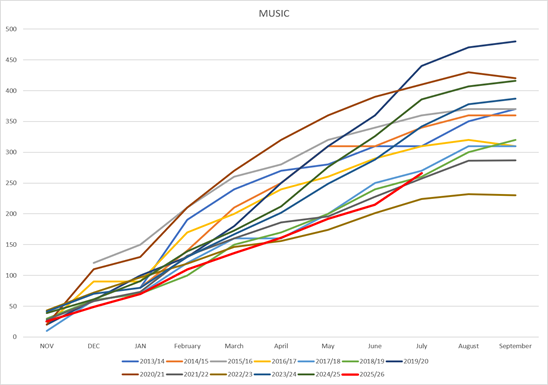
The graph in this post shows recorded 2026 vacancies for main scale teachers of music (no TLR) advertised since the start of January2026, and recorded from both the DfE vacancy site and the tes job board. The 2026 data have been plotted against previous years data, collected by TeachVac from school websites and local authority job boards.

The plotted line is the residual, reached after subtracting the recorded vacancies from number of trainees contained in the DfE’s ITT census published in the December 2025. By Friday 29th May 2026 the residual number had just turned negative; meaning more vacancies recorded than trainees possibly available to enter the labour market.

Two caveats are required at this point: not all trainees will complete their course, and of those that do, not all will enter teaching in state schools – some with not teach, others will teach in Sixth Form Colleges, and yet other will teach in the independent sector that now comprises a significant proportion of ‘A’ Music level entries. The second caveat is that in addition to trainees, there will be other entrants into the music teacher labour market. Some other entrants will be switching schools, but possibly most will be doing for a teaching job with a TLR. Then there will be those returning to state school teaching either from other jobs or a career break. This group will become increasingly important for the job market as the rest of 2026 unfolds, and the new entrants into teaching either find a teaching post in a state school of opt to work elsewhere.

For various reasons TeachVac stopped collecting data in 2023, so the data for 2024 and 2025 is missing. Comparing 2026 with earlier years, shows a trend worse than before covid, but better than in 2022, and the disastrous 2023, when poor recruitment into ITT in 2022 and the number of new schools opening in response to the increase in the secondary school population ensured a higher-than-normal demand for teachers. However, here was my analysis in June 2023 TeachVac’s index shows depth of teacher recruitment crisis | John Howson

For the current market outcome, if you discount the ITT 2025 census total by either 10% or 20%, for numbers in the census not likely to enter mainstream school teaching in the secondary sector, then the current negative residual at the end of May 2026, of -5, worsens to either -41 or -78.

This number assumes that vacancies tracked cover the whole market and that regional or other job boards, such as within large MATs, that are not counted in my survey have not seen many vacancies not placed on either the DfE or tes site.

Some schools may have offered trainees working in their schools a job, and saved on advertising costs. However, without more detailed surveys, such jobs would be difficult to account for.

One issue overcome by direct verification of the DfE and tes sites, is the thorny question of re-advertisements and repeat advertisements. The data used in this report ignores any second or subsequent advertisement by a school for a teacher of music unless it is significantly different to any previous advertised vacancy. Examples include a part-time post when the previous vacancy was for a full-time teachers and a maternity leave temporary post following one for a permanent appointment.

In a future post, I will look into the characteristics of schools that have re-advertised a vacancy.

After weighing the data on vacancies so far, and trends in ITT recruitment – see More thoughts on the ITT round for 2026 | John Howson – I think the removal of the bursary by the DfE was a risk, and that it may damage the future of music in state secondary schools in the future. I look forward to being proved wrong.

Are there now two classes of NEETS: traditional and Modern?

Most of the comments about yesterday’s report on NEETs (not in Education, Employment or Training) Young people and work: interim report – GOV.UK by Alan Milburn,  focused on the outcomes, especially the rising percentage of NEETs in the population. Fewer commentators delved deeper into the report to look at some of root causes that are likely to increase the chances off someone becoming a NEET.

I think there are now two groups of NEETs. The long-standing group, discussed below, and a newer second group of university graduates, unemployed or underemployed by age 25. This second group requires different approaches to the first group, but could be disproportionally affected by the increasing importance of AI in the labour market, and especially the loss of entry level jobs that is akin to the loss of manual labour jobs over the past half century. I will reflect upon this issue in another post.

For the first group, the following extracts from yesterday’s Report once again tell us everything we need to know: fail early, fail often.

4.2 Early years: where the trajectory begins

302. The system knows, from the moment a child arrives at school, who is most likely to fail. It has the data, and the unambiguous evidence. A study of over 8,000 young people in Bradford found that children who were not school-ready at ages 4 to 5 were nearly three times as likely to be NEET at ages 16 to 17 years old. 11% of those who did not reach a Good Level of Development at reception were later NEET, compared with just 4% of those who did.[footnote 273] Research tracking children from school entry through to their late teens shows that most of this effect operates through academic attainment.[footnote 274] A child who falls behind at 5 years old is on average still behind at 16 years old. Missing early building blocks propagates forward through every key stage. Around 65% of the relationship between school readiness and later NEET status runs through this academic pathway.[footnote 275]

4.3 Schooling

The attainment gradient

309. Taken on its own terms, much of the schools system looks relatively strong. In England, those aged 15 perform above the OECD average in reading, maths and science.[footnote 287] Level 2 attainment in English and maths by age 19 reached 76.1% in 2023 to 2024, the second highest on record,[footnote 288] although it has fallen back slightly to 73.2% in 2024 to 2025.[footnote 289] Those aged 16 to 19 score above the OECD average in literacy and adaptive problem solving, with significant improvements in literacy and numeracy since 2012.[footnote 290] Only around 5% of non-disadvantaged young people fail to enter a sustained destination after Key Stage 4.[footnote 291]

310. And yet the relationship between social background and educational attainment in England is unbroken. It has survived every reform of the past three decades. Disadvantaged children still perform substantially worse at every stage of education. The gap does not close as children move through the system. It widens.

311. At age 7, the most disadvantaged pupils are 16 percentiles behind their most advantaged peers. By age 18 or 19, the same young people are 29 percentiles behind.[footnote 292] 12 years of schooling, and the gap has nearly doubled.

312. The damage begins early and locks in at primary school. At Key Stage 2, just 47% of disadvantaged pupils reached the expected standard in reading, writing and maths, compared with 69% of their peers, a 22 percentage point gap.[footnote 293]

313. Primary schools do not receive the same level of attention in the public debate on education as secondary schools.  Perhaps that is why the ambitions that have been set for primary school children are surprisingly low.  On the face of it, it is astonishing for example that successive governments have set targets for primary schools to only have 75% of their pupils leaving with the age-appropriate level of numeracy and literacy skills.  In other words, the State assumes that one in four will never achieve that standard.

As I wrote about an earlier Social Mobility Commission Report, Education counts, but so does the family | John Howson

[This report] “raises a number of interesting questions. Most are not new, but they are none the worse for restating.

Life changes, at least as far as incomes are concerned, seem to be a combination of education, local labour markets, soft skills and parental ability to offer support for life chances.” John Howson Blog 15th September 2020

We have also known for a long time the importance of ‘soft skills. Here is an extract from my blog written after an earlier Social Mobility Commission Report

In 2009, I concluded that ‘the activities relating to having fun and socialising are the key activities of out-of-school activities.’ The Social Mobility Commission chairman has concluded that

“It is shocking that so many children from poorer backgrounds never get the chance to join a football team, learn to dance or play music. The activity either costs too much, isn’t available or children just feel they won’t fit in. As a result, they miss out on important benefits – a sense of belonging, increased confidence and social skills which are invaluable to employers. It is high time to level the playing field.”  Blog July 19th 2019 The importance of soft skills and those that miss out | John Howson

Even earlier, after a Social Mobility Commission of 2017, I commented that

“Of most concern in the report is the fact that there is still general acceptance that educational opportunity is still shaped by background, with those from poor backgrounds having least opportunities and that the level of opportunity deteriorates between school and university.” June 15th 2017  Class rules: not OK | John Howson

Go even further back to 2014, and an early post on this blog commented about social mobility that

“The Commission also discuss parental involvement and the poor quality of career advice that is often linked to low expectations. More must be done to encourage parents that the education system failed not to let the same thing happen with the next generation. Breaking the cycle of hopelessness is a vital component to raising standards as the Commission acknowledges. How to disseminate best practice rather than ritual nods to devolving training to schools and Teach First might have allowed for discussion about the content of both initial training and professional development of teachers.

Where I do agree with the Commission is in the vital role played by primary schools and the need to focus more attention on success in the early years. Regular attendance and strategies to help pupils that miss school are important moves in helping all pupils achieve success as last week’s publication of the EYFS profiles showed.

For anyone interested in the issue of social mobility this is an important but at times challenging and even depressing Report to read. It can be found at” https://www.gov.uk/government/uploads/system/uploads/attachment_data/file/364979/State_of_the_Nation_Final.pdf

 Blog post 21st October 2014.

So, way back in 2014, much the same comments were being made as in Section 4.2 of the current report, quoted at the start of this post.

We have a lost generation after what happened to those in early years after 2014, including and the slaughter of the Children’s Centres, the banishment of vocational skills from the curriculum, and a decade of teacher shortages leaving many disadvantaged pupils floundering at school in a system that was more interested in tacking organisation issues than creating a school system for all.

Sir John Newsom must be turning in his grave. Half Our Future: A tribute | John Howson

More thoughts on the ITT round for 2026

Yesterday, although a bank holiday in England, more people listed as from the United Kingdom than listed as from the United States viewed this blog. It’s been a while since that has happened.

I guess it was because of the post about the May ITT numbers I posted yesterday. Yesterday also looks like a bank holiday that higher education ignores. I am not surprised as there can be too many bank holidays on Mondays in May, and that fact can play havoc with timetabling.

Anyway, thanks for viewing, as, wherever you are from, your support is much appreciated.

After producing my prediction table in yesterday’s post MayDay for some ITT subjects: joy for others? | John Howson

I thought that I would delve a bit more deeply into possible outcomes. Looking at 2025 data between May and September, and ignoring all applicants not from England, there were 11,773 more candidates in 2024 and 13,387 more candidates recorded in 2025 between May and September.

At 18th May 2026, there were 33,344 candidates, so it seems likely that candidate numbers will be up on the past two years in terms of candidates from England. However, as this also contains candidates for the primary sector, that factor needs to be taken into account. This year, with a low ‘target’ for primary, I would be surprised to see many more candidates applying for primary sector courses, as most courses will presumably be showing as ‘full’.  

However, what about the subjects listed as anything other than ‘Yes’ will fill in the previous table? How do they fare?

The following table is based upon ‘offers’ not ‘candidates’ numbers between May and September for 2025.

subjectMay-25Sep-25difference% increase offers May to September
Others4185008220%
Classics44541023%
Physical Education1395177538027%
History832113230036%
Physics1246169845236%
Mathematics2169314297345%
Religious Education34750816146%
English1467216169447%
Drama23434911549%
Music27641614051%
Art & Design709108637753%
Business Studies21232911755%
Geography731113540455%
Modern Languages1089170962057%
Biology1094173363958%
Chemistry682109140960%
Design & Technology46678331768%
Computing53794240575%
  
Total Secondary1353020043651348%

There is no doubt that had the DfE output from the Teacher Supply Model remained the same as I 2025, this table might have looked very different.

I think that I might upgrade Geography from ‘possibly’ to probably’ on this data. As music had a bursary last year, I am not yet prepared to upgrade that subject to ‘probably’, at least until after July numbers, and the applications from 2026 graduates have been taken into account. The same is true for Religious Education.

Another area of uncertainty remains around the sciences. The total target had been reached by the end of May, but biology numbers were below target. Will providers top up with students to make courses viable? My guess is, yes, as there seems to be no penalty to the provider for doing so. The risk is all carried by the trainee.

In the future, I think that the DfE needs to consider disaggregating the 2,035 places listed as for ‘other’ subjects. Not to do so makes the data increasingly meaningless, especially once the fact that more than a third of applicants come from outside of England is also taken into account.

Finally, as we know for the annual DfE’s ITT census, not all offers turn into students counted in the census. I might try and look at what level of over-recruitment might be sensible to ensure 100% of the DfE’s target by the time of the ITT census, after allowing for the fact the TSM target should include a percentage of in-course wastage.

Afterall, the aim is to ensure the labour market has the qualified teachers it needs for all students to be taught by properly qualified teachers.  

Labour market for music teachers: update to end of April 2026

Regular readers will know that I am tracking two parts of the labour market for teachers in state schools across England during the 2025-26 school-year: vacancies for headteachers and vacancies for teachers and middle leaders of music.

Regular readers of this blog will also know that one of the reasons that I selected music as my subject to track was the government’s removal of the training bursary for those applying for postgraduate teacher preparation courses starting in the autumn of 2026.

By tracking vacancies this year, I have a baseline for next year, if, as seems likely, the removal of the bursary reduces interest in teaching music. However, the government has also slashed its published number of trainees needed – see ITT Offers – public money being wasted? | John Howson and my more recent post on the situation after the report on April offers was published.

Anyway, back to the update on published vacancies for teachers of music, and how these vacancies compare with the expected output from this year’s preparation courses.

By the end of April, I had recorded some 389 vacancies for teachers of music. 86 of these were for promoted posts, with an allowance attached. It could be assumed that these vacancies were not intended for teachers straight out of their preparation courses. However, in some smaller secondary schools, this might be the only full—time post and include responsibility for choirs, orchestras and ensembles. However, for the purpose of this exercise, such posts have been eliminated.

After removing the promoted posts, this leaves some 303 vacancies suitable for new entrants into the teaching profession advertised between January and the end of April 2026.

The DfE’s ITT census recorded some 367 trainees on preparation courses in December 2025; mostly for entry into the labour market in September 2026. Assuming all 367 entered the labour market for teachers in state schools, there are still sufficient to fill another 64 vacancies.

However, we know that not all trainees last the courses, and of those that complete the course, not all start teaching in state schools. Some entre the private sector; some further education; some music services and some don’t enter teaching at all.

As a result, the chart shows the remaining trainees available if 10% and 20% of trainees aren’t available to state schools. This approach reduces the remaining number of trainees to little more than 50 trainees. With around 75 vacancies a month so far in 2026, if May’s vacancies follow the pattern of the first four months of 2026, then the remaining total of trainees will be exhausted before the end of May, and resignation deadline day.

Of course, not all basic vacancies are filled by new entrants from teacher preparation courses: some are filled by returners – we can ignore school switchers as we can assume that leaving one school to fill a similar vacancy at another school is neutral in terms of jobs. However, if the move is for promotion, the there is a new vacancy.

Returners would need to fill around 30% of vacancies across the whole year – they are generally the only source of teachers for January appointments, so for September it looks as if schools will struggle to fill any late appointment resulting from resignations close to the 31st May deadline.  However, the picture will be clearer at the time of next month’s update.

Finally, although I do not track vacancies posted by private schools, both in England and abroad, I do survey the market. Generally, this market has twice as many vacancies as posted in any one month by schools in England.

One wonders whether the current cohort of new graduates might have missed out on gap year travelling because of the after-shocks from the covid pandemic and might, therefore be more willing to teach overseas? This has the advantage of not losing income to student loan repayment, and the bursary isn’t repayable.

On the negative side, the conflict in the Middle East may well be deterring some teachers from working in that part of the world, and may have increased the number of returners once more seeking a teaching post in England. We shall see.