Is the DfE’s Teacher Supply Model outdated?

For most of my adult life, the government department responsible for the supply of teachers, whether it was called the DfE, DES, DfEE or by another name, has used a version of the Teacher Supply Model to calculate future teacher needs, and presumably to ensure the government doesn’t waste money training too many teachers.

Training too few teachers, not as a result of the Model, but because of under-recruitment into training, has been a problem for the Teacher Supply Model (TSM) during periods of teacher shortage. Do you either add the under-recruitment to the TSM target in any one year to the next year’s TSM total, thus making it even harder to reach, or do you accept every school starts each new school year in September fully staffed, so there are no vacancies to be filled, even if additional trainees just happened to be recruited. Over the past forty years, both approaches have been tried: neither really works.

I first came across the TSM in the late 1980s when, in response to a Select Committee Report, a technical document explaining the working of the TSM at that time was published. Between the late 1980s, and a seminal announcement, also to a Select committee, by David Laws when he was the Minister of State that the TSM would be part of open government, the TSM remained largely secret, apart from one other document published in the late 1980s in repose to yet another two Select Committee reports.

Why were successive government keen to keep the TSM under wraps? Possibly because the workings allowed for an understanding of future government policy. There are three obvious areas where changes in policy can have consequences for schools and society that might create political debate: reactions to future pupil numbers, whether up or down; changes in education funding that might allow more or less funds for schools; policy changes such as extending the learning leaving age or the introduction of a new subject, such as citizenship or computing. All impact on the TSM

Governments often don’t want to signal policy changes ahead of time, especially if they might be controversial. In the first decade of this century, the secrecy around the TSM almost caught out the ITT sector when falling rolls together with improved ITT recruitment made a reduction in ITT numbers inevitable for secondary subjects, especially as there was no policy around improving staffing levels in the secondary sector, partly because of the decision over the introduction of non-contact time in the primary sector.

Planning is an essential too of any organisation, including governments, whatever extreme free-market thinkers may say. After years of following the consequences of the TSM decisions on the outcomes for the teacher labour market, I have some concerns about what happens when the TSM has been run for any particular year. The elements of the TSM have changed over the years, as explained above in relation to under-recruitment as an example. That’s not an issue for me, although the discussions with the sector may have helped prevent some changes to the TSM in mor recent times.

What is at the core of my concerns about the TSM is the length of time between the collection of the data for input into the TSM and the consequences for the real-time labour market for any September recruitment round, let alone the needs for teachers to fill any January vacancies.

I acknowledge that improved and faster data collection over time thanks to better computing capabilities has helped reduce the time taken between data collection and the effect on the labour market of the TSM output for any recruitment round. Currently, data from the 2025 School Workforce Survey, collected in November 2025, will probably influence the TSM run for the 2027 entry into training, and hence, the 2028 labour market.

At least with most trainees now on a one-year postgraduate training route, there is no longer the issue of a four-year undergraduate course to add into the mix. The November 2025 data collected, if such courses were still a significant part of the ITT scene, would not affect the labour market until 2031. A lot can happen in the intervening years.

Even with the shorter training period, there is still a time lag between data collection and the consequences of that data on the labour market.

My question is, should a further check be added once the TSM has been used to calculate ITT targets, in order to allow the comparison between the TSM target and the current reality of the labour market?

The DfE now has excellent data from several years of operating its own vacancy platform, and there are also private operators monitoring the labour market with useful vacancy data in real time. This data can be compared with the TSM output target to allow a discussion about the validity of the TSM target to current labour market needs.

Now, it may well be that the TSM number is the best fit for training needs, but as my previous post that considered the labour market data for teachers of music alongside the ITT target cut that presumably emerged from the TSM output has suggested, the addition of vacancy data does allow for a debate about whether the TSM target under or over estimates demand. Music ITT: has the government made a mistake? | John Howson

Such use of vacancy data also allows for a consideration of policy changes, such as how schools react to a change in a market where QTS still allows any teacher to teach any subject to any child, and ‘permits the use of unqualified staff. where nobody with QTS is either available or considered sufficiently expert at delivering the curriculum.  

The TSM isn’t outdated, just, in my opinion, no longer enough by itself to ensure an orderly labour market for teachers.

Why is this important, it is because the market does play a part in determining how shortages are dealt with. Where are the qualified teachers of physics teaching? How much more do schools with high levels of free school meals have to spend on recruitment than a school with fewer such pupils? Important questions around the staffing of the nation’s schools.

I read the Fed report on education issued yesterday National Education Report 2026 – FED and believe that the supply of teachers and school leaders is still at the heart of any effective system of education.

How any government determines teacher supply is a vital decision affecting the lives of many young people. Ensuring every child has the best possible teachers throughout their whole school-life is equally as important as whether or not they are banned from social media, but much less often discussed.

I think that teacher supply issues should be much higher up the education agenda, but I would, wouldn’t I, having spent a career worrying about teacher supply matters.   

Music ITT: has the government made a mistake?

New entrants to postgraduate teacher preparation courses in music in 2026 will not receive a bursary. Instead, they will be need to rely upon either student loans or other funding. How has this change affected applications to train as a music teacher?

The news is not good. The June data for applications is the second worst number since the 2013/14 round more than a decade ago. Only the 2023/23 round post covid that was a terrible round across all subjects, has recorded a lower figure for applications than June 2025. In context, the June number of offers, a better measure than applications, is not far short of half the level seen in the covid year of 202/2, and around 25% below what might be expected in a usual round.

Worry, not because the government has decided that falling rolls over the next few years will mean fewer teachers of music need to be trained. Reducing the target from a requirement of 565 teachers of music in 2024/25 to just a requirement of 260 new trainees in 2025/26 suggests either the previous targets were way out of line or a need to justify the removal of the bursary by setting a target that can be met. After all, it would be unfortunate to remove the bursary as unnecessary, but still miss the target.

So, what of demand from state schools for music? Since January, and the start of the recruitment round for September 2026, I have recorded some 530 schools advertising for a teacher or music. Allowing for the fact that perhaps 100 had a TLR attached, so were not ideal for newly qualified teachers, this suggests 400 posts for newly qualified teachers so far. Add in perhaps another 100 autumn term vacancies and overall demand might be in the range of 400-500 posts or 500-600 posts overall.

The DfE expects about half of vacancies to be taken by existing teachers or returners each year. The exact number depends upon where the demand is and how it relates to supply. But, sticking with the 50% figure means a demand for around 250 to 300 new entrants each year.

Now, with falling rolls be might reduce that number by 10% to 225 to 270 as a requirement. On the face of it, the new target of 260 look risky but manageable. However, it must include two assumptions: all those that are offered eventually complete their courses and of ‘completers’, all join the state secondary school sector.

Both, based upon past trends are unrealistic assumptions. Being generous, 90% of those offered places complete the course. This suggests an output of 236 against a target of 260. Rounding up to 240 new entrants, this mean the new target is still not way of demand.

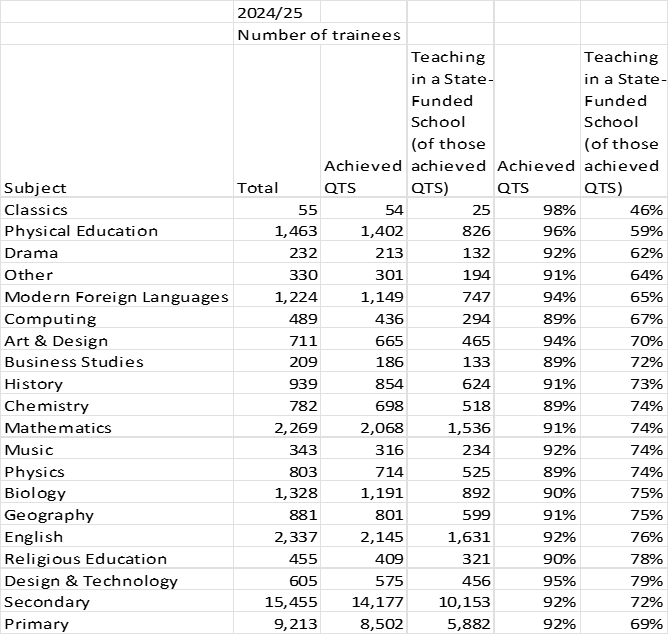
However, not all ‘completer’s join state schools. Some don’t enter teaching at all; some join Sixth Form Colleges or primary schools; some join the independent sector and some may decide to work overseas in the growing international school market. The 2025 data Less than 400 teachers of physics entered service in 2023/24 | John Howson based upon 2023/24 entry patterns showed that 80% of those gaining a QTS on a music ITT course entered teaching in a state-funded school. This includes both primary, secondary and special schools.

Assuming the 80% as a baseline – the next set of data should be out next month – our total of 240 reduced to less than 200. That number is starting to look as if the cut to music ITT places has been too savage.

A cynic might suggest, but I never could, the target was reduced to ensure it would be met and to save face over the removal of the bursary.

Whatever the reason, the DfE has now risked demand continuing to outstrip supply and this to affect the teaching of music in the nation’s secondary schools. With the recent announcement of the programme to ensureEvery child to get access to enriching activities to build skills and confidence for life’, the new target looks even less sensible  Every child to get access to enriching activities to build skills and confidence for life – GOV.UK.

I haven’t seen any campaign from the sector asking the government to revisit the target, but perhaps there should be in light of these numbers unless falling rolls are going to affect the demand for teachers of music more than I have calculated.

I would welcome any comments on the data.

No, No, No, please do not impose a GCSE test on university applicants

There was a discussion this morning on the BBC radio Today programme about a suggestion from Whitehall that everyone claiming a student loan should have a pass in English at GCSE. By English, I assume they mean English Language. I am vehemently opposed to such an idea. Let me explain why.

In the 1960s, when I was in the third year of my sixth form career, with ‘A’ Level grades of BBC in History, Geography and Economics, and a merit in what was then the special Paper, I still didn’t have a pass in English. (After six attempts, I finally succeeded in the following January examination).

Looking to universities where I could apply to study, some of whom had only recently dropped Latin as a compulsory requirement for many subjects, I struggled to find six courses that I could apply for without a pass in English Language.

In the end, LSE, a university with large number of mature students with non-standard entry requirements, Leicester, and a couple of then new universities were my only options. Eventually, I joined my twin brother to study at LSE, following in our father’s footstep, although he studied as a part-time mature student, and I was a full-time day student with both a grant and a scholarship.

So, I oppose any move to ration university places by such an arbitrary measure as a pass in GCSE English, just as I oppose the idea of a sudden death all or nothing Baccalaureate – even the IB, with its many good points.

However, I don’t just rest my opposition on the basis of my personal testimony.  As previous posts on this blog have demonstrated, the education offered to pupils that put their trust in the State to educate them varies significantly from place to place, and over time.

After a period of teacher shortages, lasting more than a decade, the nation may now be moving towards a period when becoming a teacher becomes more difficult and everyone can be taught by teachers qualified in their subject.

But, should those teaching music, art, parts of design, and other subjects be restricted by a requirement to be proficient in English before taking a degree course?

Well, of course, they already are if they want to be a teacher, as ITT has minimum standards. When undergraduate teaching degrees were still commonplace, universities used to set approved tests for those without the paper qualifications in English. I guess such local tests would be a way around any new requirement. However, if the government mandated that access to student loans required either a pass in English or any other such approach, individual institutions might find circumventing the new rule more of a challenge.

The figure of 33,000 students without a pass in English was mentioned in the radio piece. However, we weren’t told what subjects they were studying. There may well be a debate about the numbers going to university, but as a society I would hope that we had moved beyond such an arbitrary rule: then I look at requirements for entry into school sixth forms, and know that today, I would not even have made it to ‘A’ Level, and those grades I acquired, in far too many schools.

We may need more cash for defence, but not at the expense of the education of late developers, those brought up in the wrong geographical area, and those facing the many other barriers already in place for our young people considering higher education and a degree.

It’s the numbers not the percentages that matter most

Each year, the DfE publishes details about the workforce in schools. The data about teacher numbers are collected in the School Workforce Survey, conducted every November.

Included in the data are details about teacher retention in state funded schools. Interestingly, although the DfE provided the actual number of NQTs each year, the retention data is shown as a percentage of that base number. Release home – School workforce in England – Explore education statistics – GOV.UK as demonstrated in the following table.

The picture is obvious, despite some late arrivals after qualifying, the percentage falls for each extra year of service, so that of the 2010 cohort, only 59.2% were still in service after 10 years.

 Over the past few years, the percentage in service after one year has fluctuated from a low of 85.1 for the 2016 cohort to a high of 89.9 for 2023 cohort, with the 2024 cohort still doing well, with a retention rate of 89.7% at year 2. This looks like good news for the government.

However, there is less good news for the cohort that joined during covid in 2020 and 2012. For these two cohorts, retention after four and five years is poor, and back to levels last seen in 2014 for the 2021 cohort.

So, good news, retention is improving. Might the government even meet its target of of 6,500 extra teachers? Now it is time to change the percentages into numbers.

Here the picture is different. I have projected an extra year for the 2024 cohort and two years for the 2023 cohort just to show what might happen. The behaviour of those two cohorts is very important as they represent the lowest intakes of NQTs since 2010. Sadly, the government doesn’t publish the table by sectors. This is important because it is the key secondary subjects that already start with shortages where retention really matters for the performance of the school system, and especially for the outcomes for children in schools with high percentages of pupils on Free School Meals.

The current ten-year loss numbers show a worrying trend.

Hopefully, this loss of experienced teachers will reduce over the next few years, as the cohorts following the 2015 cohort have better retention numbers and percentages. The real concern is the 2020 and 2021 cohorts.

However, with falling rolls, starting to appear in the secondary sector, and already seriously affecting the primary sector in London, the retention rates for teachers may well improve, if schools can continue to afford the same number of teachers.

As my previous posts have made clear, the relationship between the National Funding Formula and pupil numbers will be crucial to future size of the teaching force. Falling Rolls: Is the funding formula making matters worse? | John Howson

When is a pledge not a pledge?

When is a pledge not a pledge? Change Labour Party Manifesto 2024

The headline in Labour’s 2024 General Election Manifesto said:

“Recruit 6,500 new teachers in key subjects to prepare children for life, work and the future, paid for by ending tax breaks for private schools.”

Note, nothing about lecturers and further education, and key subjects weren’t defined

In the text of the manifesto the promise or pledge was slightly different. The commitment was to recruit an additional 6,500 new expert teachers. Again, no mention of lecturers and further education and ‘key subjects’ didn’t appear, but ‘shortage subjects’ did. Page 82

“The factor that makes the biggest difference to a child’s education is high-quality teaching; but there are shortages of qualified teachers across the country. Labour will recruit an additional 6,500 new expert teachers. We will get more teachers into shortage subjects, support areas that face recruitment challenges, and tackle retention issues. The way bursaries are allocated, and the structure of retention payments, will be reviewed.”

Interestingly, there was also mention of ‘support areas that face recruitment challenges, and tackle retention issues.’

In the review of the 2025 Workforce, the DfE comment that

“The government, in its opportunity mission, has set a pledge to recruit 6,500 additional teachers. Further information on this ambition can be found in the 6,500 additional teachers delivery plan (opens in new tab). Latest figures show an increase of 3,000 secondary and special teachers since 2023/24 which contributes to this target. Combined statistics across schools and further education show an increase of 4,654 against this 6,500 target.” Release home – School workforce in England – Explore education statistics – GOV.UK

There doesn’t seem to be any mention of how these additional teachers ‘support areas that face recruitment challenges, and tackle retention issues.’  According to the DfE, The pledge is for mainstream secondary schools, special schools, further education (FE) colleges, and FE school based providers; it does not include primary schools. Latest figures show an increase of 3,000 secondary and special teachers since 2023/24 which contributes to this target.

However, much of the increase may well be down to improved retention rather than increased recruitment. Sadly, the headcount for both physics and chemistry teachers for all years 7-13 are still below the 2020/21 figure

Physics

2020/21 6,693

2024/25 6,465

2025/26 6,127

Chemistry

Physics

2020/21 5,886

2024/25 5,602

2025/26 5,357

So, there must be some questions to ask about the number of teachers in these subjects, and the aim to ‘get more teachers into shortage subjects’.

Still, perhaps the percentage of hours taught by those with qualifications has increased. Sadly, not since 2020/21

Percentage of hours taught by teachers with qualification for ‘Subjects taught and Specialist teachers and hours’ for 7 to 13

Chemistry

2020/21 48.9%

2024/25 45.7%

2025/26 44/7%

Physics

2020/21 45.2%

2024/25 42.8%

2025/26 41.2%

So, increased ITT numbers and better retention has yet to feed through to the teaching of physics and chemistry. Perhaps it is because of the way teaching in years 7-9 is arranged in most schools. What about teaching in sixth forms of Years 12 and 13?

Percentage of hours taught by teachers with qualification for ‘Subjects taught and Specialist teachers and hours’ for Years 12 to 13, Chemistry, PGCE, PGDE, ProfGCE, or ProfGDE, Physics and Qualified teacher in England between 2020/21 and 2025/26

Chemistry

2020/21 52.6%

2024/25 49.5%

2025/26 49.1%

Physics

2020/21 52.4%

2024/25 49.4%

2025/26 47.4%

I find this decrease disappointing.

Overall, there is some way to go to meet the manifesto wording, and with static rolls and funding for schools likely to be challenging, I wonder whether the proliferation of small sixth forms is helping or hindering the teaching of these subjects. Perhaps the DfE can identify whether there is any link between the sixth of sixth form groups and the qualifications of those teaching Years 12 and 13?

Are there now two classes of NEETS: traditional and Modern?

Most of the comments about yesterday’s report on NEETs (not in Education, Employment or Training) Young people and work: interim report – GOV.UK by Alan Milburn,  focused on the outcomes, especially the rising percentage of NEETs in the population. Fewer commentators delved deeper into the report to look at some of root causes that are likely to increase the chances off someone becoming a NEET.

I think there are now two groups of NEETs. The long-standing group, discussed below, and a newer second group of university graduates, unemployed or underemployed by age 25. This second group requires different approaches to the first group, but could be disproportionally affected by the increasing importance of AI in the labour market, and especially the loss of entry level jobs that is akin to the loss of manual labour jobs over the past half century. I will reflect upon this issue in another post.

For the first group, the following extracts from yesterday’s Report once again tell us everything we need to know: fail early, fail often.

4.2 Early years: where the trajectory begins

302. The system knows, from the moment a child arrives at school, who is most likely to fail. It has the data, and the unambiguous evidence. A study of over 8,000 young people in Bradford found that children who were not school-ready at ages 4 to 5 were nearly three times as likely to be NEET at ages 16 to 17 years old. 11% of those who did not reach a Good Level of Development at reception were later NEET, compared with just 4% of those who did.[footnote 273] Research tracking children from school entry through to their late teens shows that most of this effect operates through academic attainment.[footnote 274] A child who falls behind at 5 years old is on average still behind at 16 years old. Missing early building blocks propagates forward through every key stage. Around 65% of the relationship between school readiness and later NEET status runs through this academic pathway.[footnote 275]

4.3 Schooling

The attainment gradient

309. Taken on its own terms, much of the schools system looks relatively strong. In England, those aged 15 perform above the OECD average in reading, maths and science.[footnote 287] Level 2 attainment in English and maths by age 19 reached 76.1% in 2023 to 2024, the second highest on record,[footnote 288] although it has fallen back slightly to 73.2% in 2024 to 2025.[footnote 289] Those aged 16 to 19 score above the OECD average in literacy and adaptive problem solving, with significant improvements in literacy and numeracy since 2012.[footnote 290] Only around 5% of non-disadvantaged young people fail to enter a sustained destination after Key Stage 4.[footnote 291]

310. And yet the relationship between social background and educational attainment in England is unbroken. It has survived every reform of the past three decades. Disadvantaged children still perform substantially worse at every stage of education. The gap does not close as children move through the system. It widens.

311. At age 7, the most disadvantaged pupils are 16 percentiles behind their most advantaged peers. By age 18 or 19, the same young people are 29 percentiles behind.[footnote 292] 12 years of schooling, and the gap has nearly doubled.

312. The damage begins early and locks in at primary school. At Key Stage 2, just 47% of disadvantaged pupils reached the expected standard in reading, writing and maths, compared with 69% of their peers, a 22 percentage point gap.[footnote 293]

313. Primary schools do not receive the same level of attention in the public debate on education as secondary schools.  Perhaps that is why the ambitions that have been set for primary school children are surprisingly low.  On the face of it, it is astonishing for example that successive governments have set targets for primary schools to only have 75% of their pupils leaving with the age-appropriate level of numeracy and literacy skills.  In other words, the State assumes that one in four will never achieve that standard.

As I wrote about an earlier Social Mobility Commission Report, Education counts, but so does the family | John Howson

[This report] “raises a number of interesting questions. Most are not new, but they are none the worse for restating.

Life changes, at least as far as incomes are concerned, seem to be a combination of education, local labour markets, soft skills and parental ability to offer support for life chances.” John Howson Blog 15th September 2020

We have also known for a long time the importance of ‘soft skills. Here is an extract from my blog written after an earlier Social Mobility Commission Report

In 2009, I concluded that ‘the activities relating to having fun and socialising are the key activities of out-of-school activities.’ The Social Mobility Commission chairman has concluded that

“It is shocking that so many children from poorer backgrounds never get the chance to join a football team, learn to dance or play music. The activity either costs too much, isn’t available or children just feel they won’t fit in. As a result, they miss out on important benefits – a sense of belonging, increased confidence and social skills which are invaluable to employers. It is high time to level the playing field.”  Blog July 19th 2019 The importance of soft skills and those that miss out | John Howson

Even earlier, after a Social Mobility Commission of 2017, I commented that

“Of most concern in the report is the fact that there is still general acceptance that educational opportunity is still shaped by background, with those from poor backgrounds having least opportunities and that the level of opportunity deteriorates between school and university.” June 15th 2017  Class rules: not OK | John Howson

Go even further back to 2014, and an early post on this blog commented about social mobility that

“The Commission also discuss parental involvement and the poor quality of career advice that is often linked to low expectations. More must be done to encourage parents that the education system failed not to let the same thing happen with the next generation. Breaking the cycle of hopelessness is a vital component to raising standards as the Commission acknowledges. How to disseminate best practice rather than ritual nods to devolving training to schools and Teach First might have allowed for discussion about the content of both initial training and professional development of teachers.

Where I do agree with the Commission is in the vital role played by primary schools and the need to focus more attention on success in the early years. Regular attendance and strategies to help pupils that miss school are important moves in helping all pupils achieve success as last week’s publication of the EYFS profiles showed.

For anyone interested in the issue of social mobility this is an important but at times challenging and even depressing Report to read. It can be found at” https://www.gov.uk/government/uploads/system/uploads/attachment_data/file/364979/State_of_the_Nation_Final.pdf

 Blog post 21st October 2014.

So, way back in 2014, much the same comments were being made as in Section 4.2 of the current report, quoted at the start of this post.

We have a lost generation after what happened to those in early years after 2014, including and the slaughter of the Children’s Centres, the banishment of vocational skills from the curriculum, and a decade of teacher shortages leaving many disadvantaged pupils floundering at school in a system that was more interested in tacking organisation issues than creating a school system for all.

Sir John Newsom must be turning in his grave. Half Our Future: A tribute | John Howson

MayDay for some ITT subjects: joy for others?

Such are the wonders of modern technology that the DfE is now able to publish the monthly ITT data on a bank holiday. The data for May was generated on the 18th May, so is already a week out of date. However, it is good to see civil servants managing to keep to the regular publication date for these statistics, even though it falls on a bank holiday.

With the downgrading by the DfE in their analysis of the Teacher Supply model outputs of requirements for the number of trainees needed in many subjects, some admissions tutors can look for an easy final three months of the current recruitment round.

For others, the remainder of the time until courses start in September will still be take up with encouraging more people into teaching as a career. Worries about AI and graduate careers have not yet seemed to have driven graduates in many subjects towards teaching as a career in larger numbers than in the past.

However, there is a concern, registered by this blog in previous posts, about the dominance of certain subjects in the monthly ‘offers’ table.

Three subjects, mathematics, physics and computing make up 32% of all the offers in secondary sector subjects on the 18th May. Three other subjects (Classics, Business Studies and ‘other subjects’) have made so few offers that these subjects almost certainly won’t fill all the places available this year, based on the DfE target number for these subjects.

Another three subjects are at risk of not filling places this year unless recruitment improves after graduation in June. (Geography, Music and Religious Education). Although Biology almost certainly will fill the places on offer, I have downgraded it to PROBABLY from YES, as overall science ’offers’ already exceed the target.

The likelihood of those offered places in mathematics, physics and computing actually taking up their places needs to be closely monitored, because of this extreme distortion of the overall data by the number of offers made in these subjects.  

Looking at applications, the growth in applications is mostly from career switchers in the 25 to 49 age groups. The under 25 have only seen an increase of 1,078 in applications, compared with 2,465 for the 25-29 age group. Indeed, the youngest age group of new graduates have seen an increase of only 166 on May last year.

There has been a significant increase in male applicants, up from 14,992 to 20,003, when comparing May 2025 with May 2006. This must be the first time in many years that the increase in applications from men has been greater than the increase in applications from women.

So, where has this growth in male applicants come from? It seems likely that the ‘Rest of the World’ grouping has provided many of these applicants, as applications from the ’Rest of the World’ increased from 7,727 in May 2025 to 12,909 in May 2026. London, where the increase has been from 6,708 to 7,534, is the only other region with a significant increase.

Perhaps, surprisingly, considering the wider job market, applications from candidates in the North East, from Wales and from Northern Ireland are all below their May 2025 levels.

The majority of applicants are for secondary subjects, so much so that there are now more than twice as many applicants for secondary subjects as for the primary sector as a whole. Candidates may be perceiving that falling rolls will make finding a post as a primary school teacher more of a challenge, and avoiding that career option.

Higher Education has been the key beneficiary, if you can use that term, of the increase in applications, up from 26,876 candidates in May 2025 to 33,0325 in May 2026. Post graduate apprenticeships, up from 5,505 to 9,184 was the only other route with a significant increase in candidate numbers. Teacher degree apprenticeships increased from 677 candidate in May 2025 to 1,534 in May 2026, not an overwhelming vote of confidence for this route into the profession.

These monthly numbers are becoming so distorted that at the headline level, used by many, they are possibly now misleading. A review of how the data are presented seems overdue.

Finally, I still think the removal of the bursary from music was a mistake. The following chart, although busy, shows ‘offers’ over the past decade. This year, is towards the bottom of the range.

NEETs, schools and teachers

The DfE has recently published an analysis of the factors contributing to the risk of a young person becoming a NEET (Not in Education, Employment or Training) at certain ages. Risk factors for becoming NEET: a statistical analysis using linked data

The key conclusion was that

At each age group, and when controlling for overlapping risk factors, three factors stand out: persistent absence from school during KS4, having an EHCP, and not attaining 5 good GCSEs including English and maths.” Page 20

Two of these risk factors may have been made worse for some pupils by the fact that for the last decade there has been a shortage of qualified teachers in many subjects. Not all schools have suffered equally from staffing shortages, and within schools, not all pupils may have experienced the same degree of teaching from teachers with less than optimum qualifications and experience in the subjects that they were teaching in the secondary sector.

Might less than excellent teaching be a contributory factor to both absence during KS4, and the failure to attain 5 good GCSEs including English and maths? Perhaps the report would have benefitted from some cases studies linked to schools with high risks factors, but low rates of NEET?

Are there regional differences in the risk factors, perhaps associated with local job markets? Might the consequences of AI on the graduate labour market mean that such a study in a few years’ time might have a different set of risk factors?

Has education policy during the past decade, with an emphasis on the subjects in the English Baccalaureate contributed to some pupils becoming NEETs, perhaps because they found the curriculum, however well taught, not interesting at KS4, even though most will have accepted the need to study English and Mathematics.

In terms of in-school factors, I was surprised not to see anything about valued added from year 7 to 11. Can we trace the likelihood of becoming a NEET back to poor attendance in Reception at the start of formal education?

It seems to me that these are the questions we need to ask if policy decisions are to be made that will reduce the possibility of a young person becoming a NEET. By actions within schools.

However, the big challenge is the extent to which schools recognise the societal risk factors, such a being a young carer, having an ECP, moving school in KS4 and experience of being a Looked After Child.  Teachers are generally form the groups with low risk factors, after all they must have achieved 5 good GCSEs and that probably meant good attendance at KS4. It would also be interesting to know how many teachers had declared special needs at secondary school – perhaps Teachers Tapp could ask that question?

With little experience of risk factors, and, I guess, a training curriculum that devotes little time to how to motivate those at a high risk of becoming a NEET, perhaps we ought not to be surprised that the present labour market offers few opportunities for those without qualifications, especially now that hospitality an retail are sectors shedding jobs not offering opportunities.

Higher Education: markets v planning for the sector

I don’t often write about higher education, as, although I spent more than a decade running a large department in a university, and also writing about activity-based costings in higher education, I don’t consider myself well enough briefed to comment regularly.

There are exceptions to my self-imposed rule, and this post is one of those. What persuaded me to write this post was a link to this article Universities on the brink: Decoding the UK higher education funding crisis and the path forward | The Educationist

Now, for most of this century, and indeed the last decade of the previous century, higher education providers have been free to operate in a market, with limited government intervention, except in areas such as teacher education, and providing courses for both doctors and the professions allied to medicine.

As I discovered when running courses for new heads of departments in universities about how higher education funding worked, most academics had limited knowledge and often less interest in the subject when asked to take on running department: at that time; even Deans were often more interested in course quality than the financial health of the departments they headed.

Regardless of the reasons behind the current financial malaise, should the market be left to bring the sector back to financial equilibrium? Of course, the government could just throw money at the problem, but I guess it hasn’t the funds, and anyway, the DfE might put NEETs and SEND above bailing out universities in any priority list.

However, I don’t think the government should leave everything to the market. After all, it is the largest consumer of graduates: 30,000 teachers per year to be trained; NHS staff; the defence forces; the civil service and local government. These are all consumers of graduates in large numbers.

Allowing the market to solve the financial problems might have unintended consequences. A major concern for me is around the mobility of new graduates. Many years ago, I studied where trainee teachers went to study, and there was a correlation between where a first degree or higher-level courses was studied, and where individuals entered teacher preparation courses. Universities without schools of education provided fewer recruits to teaching.

Well, Teach First helped solve that problem, at least in London, but I am concerned that market driven course closures could leave parts of the country without degree courses in some subject areas vital for the public sector.

For this reason alone, I think the government should ensure some form of course planning for the higher education sector, so that there are not areas without say, music courses or philosophy. Both are degree courses important as part of the pipeline for future teachers of music and religious education. As these are also both subjects that already fail to recruit enough graduates into teaching, reducing the number studying them on degree courses even further would endanger that pipeline even more.

The intervention of the government in place planning, even at a broad level, also makes economic sense to me, as moving students from loans to welfare is also not a good use of public money. How to manage the balance between leaving the future for higher education to the market, and an orderly return to fiscal rectitude might at least be worth a discussion amongst politicians and those that advise them.

UCET’s changing of leadership: a rare event

I have been rather tardy in posting my appreciation of the work of James Noble-Rogers, as executive director of UCET (The Universities Council for the Education of Teachers). James was only the second Executive Director the organisation has had so far, taking over from Mary Russell, its first director, after she had presided over the coming together of UCET and PCET, the universities high education teacher training organisation that merged with the polytechnics and colleges organisation, after those institutions became universities in the 1990s to form UCET as it is currently constructed.

James was recruited to his post at UCET from the civil service. I first knew him when I served at the then Teacher Training Agency between 1996 and 1997, in the role of advisor on teacher supply, an interest I retain until this day. James was working on ITT numbers in the DfE, and was a natural fit to take over from Mayr on her retirement. However, I suspect that many were surprised to see a civil servant, and not an academic, appointed to the role. Appointing James was an inspired move.

Afte leaving the TTA in 1997, I worked closely with UCET, and James, for about a decade while he steered UCET through the problems of firstly, falling interest in teaching as a career, and then the boom after the 2008 economic crisis that lead to, in my view, the mis-guided decision by Ministers to axe the training grant and require the payment of tuition fees for graduates when Michael Gove became Secretary of State. These moves contributed to the teacher supply crisis that I foreshadowed on this blog in my 2013 posts (see Howson: Teachers, Schools and views on Education – available from Amazon as an eBook).

The early years of the coalition were a challenging time for colleagues working higher education preparing new teachers and providing INSET. Some will recall the ‘blob’; others, the issue of recruitment controls that nearly caused several universities to consider pulling out of ITT/ITE.

James remained resolute in supporting the higher education community’s central involvement in teacher preparation and development, the position it still holds today, while recognising the emerging partnership with schools that through SCITTS were providing their own version of teacher preparation. At the same time, Teach First was creating another route into teaching.

The last decade after 2016, brought new changes, the effect of the covid pandemic, plunging interest in teaching from home students and the growth, in recent years, of applicants from around the world.

As I became more involved in local government politics after 2013, I lost regular contact with UCET, and stooped attending their annual conference.

Even to, I am delighted to be able to recall my association with James, and the long service he rendered to UCT over more than a quarter of a century. I hope that as with his predecessor, his work will be acknowledged formally by the State.

I enjoyed the time when I worked with James, and wish him well in the next stage of his life. I am delighted to see that he is still offering his support, advice and knowledge that few others can rival.