DfE Vacancy website: two irritations

For years one of the features of the DfE’s vacancy website that has irritated me is the seemingly random repeating of vacancies. The example below, seen this morning, is an extreme example of this tendency, with the two adverts for the same vacancy appearing next to each other on the same page. I never know whether this is either a coding glitch that has existed since the site became active or a deliberate attempt to ensure some vacancies are repeated in case viewers missed them on their first appearance in the listing or search. Either way, putting the two versions next to each other doesn’t seem to me to be sensible.

Headteacher

Bordesley Green Girls’ School & Sixth Form, Birmingham, B9 4TR

Full-time equivalent salary

L33 to L39

School type

Local authority maintained school, ages 11 to 18

Working pattern

Full time

Closing date

30 June 2026 at 9am

Visa sponsorship

Visas cannot be sponsored

Headteacher

Bordesley Green Girls’ School & Sixth Form, Birmingham, B9 4TR

Pay scale

L33 to L39

School type

Local authority maintained school, ages 11 to 18

Working pattern

Full time

Closing date

30 June 2026 at 9am

Visa sponsorship

Visas cannot be sponsored

Another irritation of the DfE vacancy site, as far as I am concerned, is that a search on the term ‘headteacher’ can result in random vacancies for other posts appearing in the search, such as this on today for an ‘assistant principal’. This is not an issue at this time of year when there are few vacancies on the site, but is more of an issue when there are a couple of hundred vacancies to consider.

Assistant Principal – Behaviour and Alternative Provision

More than one location, Archway Learning Trust

Full-time equivalent salary

From £67,898 to £75,049 per annum

School type

1 academy, None, ages 11 to 19

Working pattern

Full time

Closing date

6 July 2026 at 9am

Visa sponsorship

Visas cannot be sponsored

Both the issues mentioned here may cause problems for AI generated searches aimed at counting the number of vacancies for particular post.  The search mechanism would need to be very sophisticated to cope with such anomalies.

This is the reason why, at present, I still spend a couple of hours a week studying the list of vacancies. I would be delighted if anyone would provide me with a foolproof automated regime to collect vacancies, because forty years of collecting headteacher vacancies has taught me that it is not a straightforward exercise.

Later next month, when I come to write my annual report of the 2025/26 school-year and headteacher vacancies, I will discuss some of those issues in more detail, including ‘what is an Executive headteacher’ and do we need a definition?

Meanwhile, I have collected data on just under 1,400 nursery, primary, secondary and special schools that are state-funded and located in England and have advertised for a head teacher since 1st August 2025.

Since January, I have also been collecting data about vacancies for teachers of music in state-funded secondary schools. Next year, I might expand that to include private schools so that I can understand the completion for teachers across both sectors.

Watch our for the report that will be published either in Late July or August this year.

Music teachers: labour market update

One of the leitmotifs of this blog has been around the labour market for teachers, from numbers entering training, through vacancies for teachers, to the numbers of teachers that are in-service.

This academic year, I have been tracking the data on vacancies for headteachers – a study started more than 40 years ago – and vacancies for teachers of music. This is as a part of my campaign to see the bursary returned to trainee teachers of music, after the Labour government axed it an act of cultural vandalism that I might have expected from other political parties, but not from Labour.

Anyway, enough of my rant. Does the data support my thesis that there are not enough music trainees this year, even with the bursary, and that any reduction in trainee numbers will affect the 2027 labour market, making it more difficult for schools, and especially secondary schools in challenging circumstances, to recruit music teachers? For earlier discussions on this point see:  Music teachers: bring back the bursary | John Howson and Reviving Music Teacher Bursaries: A Necessity | John Howson

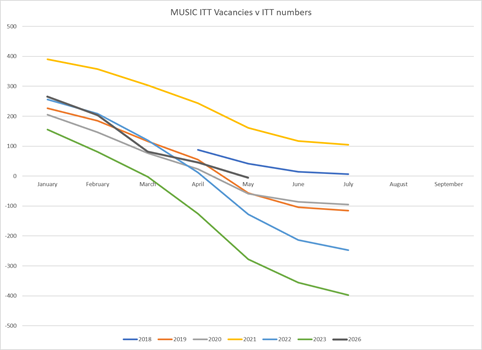
The graph in this post shows recorded 2026 vacancies for main scale teachers of music (no TLR) advertised since the start of January2026, and recorded from both the DfE vacancy site and the tes job board. The 2026 data have been plotted against previous years data, collected by TeachVac from school websites and local authority job boards.

The plotted line is the residual, reached after subtracting the recorded vacancies from number of trainees contained in the DfE’s ITT census published in the December 2025. By Friday 29th May 2026 the residual number had just turned negative; meaning more vacancies recorded than trainees possibly available to enter the labour market.

Two caveats are required at this point: not all trainees will complete their course, and of those that do, not all will enter teaching in state schools – some with not teach, others will teach in Sixth Form Colleges, and yet other will teach in the independent sector that now comprises a significant proportion of ‘A’ Music level entries. The second caveat is that in addition to trainees, there will be other entrants into the music teacher labour market. Some other entrants will be switching schools, but possibly most will be doing for a teaching job with a TLR. Then there will be those returning to state school teaching either from other jobs or a career break. This group will become increasingly important for the job market as the rest of 2026 unfolds, and the new entrants into teaching either find a teaching post in a state school of opt to work elsewhere.

For various reasons TeachVac stopped collecting data in 2023, so the data for 2024 and 2025 is missing. Comparing 2026 with earlier years, shows a trend worse than before covid, but better than in 2022, and the disastrous 2023, when poor recruitment into ITT in 2022 and the number of new schools opening in response to the increase in the secondary school population ensured a higher-than-normal demand for teachers. However, here was my analysis in June 2023 TeachVac’s index shows depth of teacher recruitment crisis | John Howson

For the current market outcome, if you discount the ITT 2025 census total by either 10% or 20%, for numbers in the census not likely to enter mainstream school teaching in the secondary sector, then the current negative residual at the end of May 2026, of -5, worsens to either -41 or -78.

This number assumes that vacancies tracked cover the whole market and that regional or other job boards, such as within large MATs, that are not counted in my survey have not seen many vacancies not placed on either the DfE or tes site.

Some schools may have offered trainees working in their schools a job, and saved on advertising costs. However, without more detailed surveys, such jobs would be difficult to account for.

One issue overcome by direct verification of the DfE and tes sites, is the thorny question of re-advertisements and repeat advertisements. The data used in this report ignores any second or subsequent advertisement by a school for a teacher of music unless it is significantly different to any previous advertised vacancy. Examples include a part-time post when the previous vacancy was for a full-time teachers and a maternity leave temporary post following one for a permanent appointment.

In a future post, I will look into the characteristics of schools that have re-advertised a vacancy.

After weighing the data on vacancies so far, and trends in ITT recruitment – see More thoughts on the ITT round for 2026 | John Howson – I think the removal of the bursary by the DfE was a risk, and that it may damage the future of music in state secondary schools in the future. I look forward to being proved wrong.

DfE Vacancy site – some more thoughts

The DfE vacancy site has now been in operation since 2018. During that time, it has altered little in appearance. Right from the start of the site, I was critical of its features. I felt then that TeachVac and other sites could have done a better job for much less money. I posted my frustration about the site in both January and March of this year.

After another infuriating day working on the headteacher vacancies listed on the DfE’s vacancy site yesterday, I though I would take a further look at what was on offer in terms of headteacher vacancies.

First off, the DfE site told me there were, in total, 122 vacancies, if I used their pre-defined key word of ‘headteacher’. The vacancies are presented in a list order covering 13 pages. However, there are not 122 vacancies for a headteacher.  10 of the posted vacancies are either for Executive Headships of more than one school (2) or posts below a headship (8 vacancies). Indeed, one vacancy isn’t even a teaching post. So, the real total of headteacher vacancies is 112?

No, sorry, that is not correct either. This is because 10 of the vacancies, including one non-teaching vacancy, appear twice on the site. As a result, the actual number of schools advertising for a new headteacher on the DfE vacancy site at 0900 on the 25th April 2026 was actually 102. That’s 20% below that stated figure.

Now, I have nothing against multiple listings. After all, a person might miss the vacancy the first time it appeared: but why only a few random vacancies? I believe such double listings should either be removed from the site – it just requires a simple piece of coding – or the rules about the same vacancy being listed more than once at the same time should be made clear.

Where I do quibble with the DfE, is with the inclusion of posts not for a headteacher vacancy in the listings under the ‘headteacher’ category, and, as a result, their inclusion in the overall total. This is just mis-leading, and schools should be prevented from uploading such vacancies under the ‘headteacher’ listing. Again, this should not be a difficult coding exercise.

The other question is: does the vacancy site meet the needs of schools and candidates? Well, some schools still advertise their vacancy for a headteacher elsewhere. Local authority job boards for non-academy schools; the ‘tes’ as well, or in a small number of cases instead of the DfE site. Some vacancies also appear on regional websites, such as in the North East or South West.

The DfE vacancy site doesn’t accept vacancies from non-state funded schools. Candidates considering both state and private schools have to look at more than one vacancy site. Is this a good idea? I don’t think it matters at the level of headteacher posts, except perhaps for special needs schools, where the private sector is playing an increasingly important role. However, for entry level jobs, some form of aggregation might be useful, especially as candidates begin to outnumber vacancies for the first time in many years.

Does the DfE have a board or committee that reviews its vacancy site? If not, perhaps the teacher association might ask for a review. After all, they would serve their members better by operating such a site themselves. Not only would they have better data on vacancy trends to argue their case with the STRB, but they could also earn some extra income. When I suggested this to the associations in 2013, when I created TeachVac, sadly they weren’t interested.

How to measure headteacher turnover?

I have been reading the interim report on teacher turnover in 2026 from Timo Hannay et all. The survey is supported by The Gatsby foundation. Teacher Recruitment and Retention 2026 The details about headteacher turnover can be found on pages 10 and 11.

Overall, teacher vacancies are in decline. This doesn’t surprise me. A combination of falling school rolls, especially in the primary sector; better ITT recruitment meaning fewer temporary ‘out-of-field’ appointments, and the war in the Middle East possibly reducing the number of teachers thinking of moving overseas could all be contributory factors to any decline. MATs might also be offering vacancies internally before bothering to pay for external advertising. Finally, cutbacks in leadership roles as budgets come under pressure and rolls are falling may also help to explain the downturn, if indeed it is actually a downturn. In addition, some schools and MATs might have stopped the use of rolling vacancy adverts for talent banking when there was no real job.

For headteacher turnover the approach Report’s approach is slightly different. The report states:

We draw on Department for Education records to track changes in headteacher appointments across the academic year. SchoolDash monitors whether the named headteacher at each school has changed, providing a direct measure of headteacher turnover that complements the survey and job advertisement data presented elsewhere in this report.’ Teacher Recruitment and Retention 2026 Page 10

Not the interesting thing is the date a school notifies the DfE of a change of headteacher. Assuming the departing head’s contract expires on 31st August, the school will possibly still have that headteacher on 1st September, so two names may be recorded for the year. If the school changes the name on 31st August, the following year may only record one name.

A further complication arises when there is an acting or temporary headteacher during an interregnum. This could add an extra name to the total for the year.

The alternative way of measuring headteacher turnover is to record and count actual vacancies. This isn’t as easy as it one was, as headteacher posts don’t need to be advertised nationally. However, it is a fair bet that between them, the DfE vacancy site and the ‘tes’ probably pick up almost all state school headships. Those these two sites miss are either only advertised within MATs or placed on regional job boards, as in the North East.

I started tracking headteacher vacancies in the 1980s, and for my latest analysis see the post Headteacher vacancies – a changing trend in advertising date? | John Howson and the two posts that follow that one. Recording vacancies can offer a wealth of data that just recording changes in names misses. I recall a meeting with Mr Hannay when I was running TeachVac.  Our method visually looked at the vacancies our AI located and input the information. What we learnt, and it still holds true, is that for real monitoring each vacancy needs a unique identifier that stays with the vacancy from the start of the recruitment process to the person appointed joining the school staff. I remain ever hopeful of such a change.

DfE Vacancy site – some thoughts

A great deal of research can be boring to do. That’s certainly true of my research into the labour market for teachers that I first started way back in the early1980s. Currently, I am tracking advertisements for headteacher vacancies in England.

The DfE is running a series of adverts on platforms such as LinkedIn extolling the virtue of advertising on their free vacancy site and claiming almost complete coverage of vacancies.

It is certainly true that the DfE site contains the majority of the headteacher vacancies in state schools in England, but I am not sure whether it has as complete a coverage as it maintains. One wonders what the Advertising Regulatory Body would make of such an unsubstantiated claim? It certainly would be allowed for beauty products.

The DfE site also has a number of idiosyncrasies. For headteacher vacancies, the most significant is the repetition of certain vacancies, a factor that inflates the total number of vacancies.  For instance, today, the DfE site suggests that there are 185 vacancies listed (1130 on 22.3.26). In reality there are only 160 schools advertising for a headteachers on the site. The other listings are repeats, or in one case a double repeat, with the vacancy appearing three times in all.

Does this repetition matter? It does if anyone is just counting the total of vacancies listed, as that would inflate the turnover of headteachers. Such simple counting would also need to also take into account the length of times each vacancy is listed. This can range from four weeks to a couple of days. Why some vacancies only appear for a short length of time is an interesting question. Do these schools have a candidate in mind, and hence don’t want other applicants?

Then there is the issue of genuine re-advertisements, where a school advertised, but failed to make an appointment. If counting the number of schools seeking a headteacher, then these re-advertisements need to be discarded.  To do so, needs a regular analysis of the whole list of vacancies, as there is no easier way to identify such schools. There is also an irritating practice from some MATs of not identifying the school where the vacancy has occurred. Some MATs also avoid information about the starting salary: I think that this is a mistake, since their idea of generous, may not be the same to MATs as to candidates, and it is embarrassing to find this out at interview stage.  

What of the schools whose headteacher vacancies appear more than once in the same list? Many are newly advertised vacancies; some are re-advertisements, but in each of these groups there seem little logic to the schools listed. At present, there are no schools in either the West Midlands or London regions with double entries. However, of the 25 schools with double entries, six each are in the South East and East of England.  

At the end of the school-year it will be interesting to see whether some MATs, local authorities or dioceses fare worse when it comes to making an appointment of a headteacher. There are some obvious candidates already appearing after just six months of the school-year.

What the first 1,000 headteacher adverts tell us

Between the DfE vacancy site – the DfE claims 98% of schools now use their site – and other leading job boards, I have collected details of 1,000 vacancies for headteacher posts advertised since the start of August 2025.

In the past, the three months from January to March were the most active months for headteacher vacancies, and that may well prove to be the case in the 2025/26 school year.

If the present level of vacancies continues as expected, then the annual total for headteacher vacancies will be around the 1,500 mark for 2025/26. The exact number will depend upon the number of schools that fail to make an appointment after advertising a vacancy and re-advertise.

To some, extent the degree of re-advertising that occurs will depend upon the mix of schools seeking a new headteacher, and the size of that sub-pool. However, the larger the number in the pool, the easier it is to predict trends.

What can be deduced from the first 1,000 vacancies this school year?

As expected, primary schools dominate the list, accounting for 628 of the first time vacancies, and 64 of the re-advertisements – a re-advertisement rate of 10%. Secondary schools accounted 182 first time vacancies, and 16 re-advertisements, a rate of nine per cent, and higher than I would have expected.

In view of the concerns over SEND, it is unfortunate that the 72 first time vacancies for headteachers of special schools have already produced some 21 re-advertisements, a rate of 29%, including a couple of schools that have re-advertised twice.

Interestingly, none of the 13 First schools, and none of the 21 infant schools with a recorded vacancy has seen a re-advertisement to date. In the past such vacancies have proved challenging to fill. This is still the case for junior schools headteacher vacancies, where the 38 vacancies have already generated four re-advertisements.

Nationally, the re-advertisement rate overall stands at 11%. However, that percentage already masks some regional differences.

Region RE-ADVERTISENTS 1ST ADVERT % RE-ADVERTISMENTS

SE7997%
SW81038%
WM91088%
YH1311811%
NW1512512%
EM119412%
L159915%
EE1911017%
NE43113%
ENGLAND10188711%

The percentage for the North East is affected by two special schools that have re-advertised. London, and the area to the north and east of the capital has seen the highest level of re-advertisements so far, although re-advertisement rates for schools to the south and west of the capital are, to date, much lower.

Faith schools have found recruiting a new headteacher more challenging than non-faith schools. Church of England schools have a re-advertisement rate of 13%, and Roman Catholic schools, one of 16%, compared with the overall rate of 11%.

I had wondered, with vacancies being viewed on-line these days, whether it was a smart move to advertise a vacancy in December, as perhaps candidates might use the holiday period to start job-hunting.

An analysis of the 136 vacancies tracked as appearing for the first time in December, shows that 19 schools, or 14%, have had to readvertise their vacancy, so although no longer expensive in terms of placing a vacancy on the DfE website, ‘the early bird does not always seem to catch the worm’.

Finaly, the highest starting salary recorded so far is £140,000, and 90 schools have offered a starting salary of more than £100,000. At the other end of the scale, the lowest starting salary in an advertisement for a headteacher was £51,773.

Despite staring salaries in excess of £100,00, some 14 of these schools have re-advertised their vacancy for a headteacher. Money, it seems may not be enough to attract a suitable applicant for some schools.

Are teacher vacancy rates slowing?

Were there really more teacher vacancies this May than during May 2022? There have been some suggestions that the answer is yes. I have seen an increase of seven per cent suggested. However, I am more cautious in suggesting any overall increase in vacancies.

Yes, there have been increases in some subjects, in some regions of England, but measuring a basket of 11 secondary subjects, no region recorded across the board increases in all subjects. In the primary sector, only the North West recorded any increase in vacancies, with a decline compared with the May 2022 number of vacancies in all other regions.

The North West and West Midlands recorded the largest number of secondary subjects with an increase in vacancies. The South East and Yorkshire & The Humber regions, the largest number of subjects where there was a decline on the May 2022 number of recorded advertisements for a classroom teacher or promoted post, according to TeachVac www.teachvac.co.uk where the data was compiled from their database of recorded vacancies.

So, why might there be a discrepancy in views about vacancies? One reason may be the treatment of repeat advertisements. I have long advocated a unique job number for each vacancy that accompanies it until it is either replaced by a different vacancy or the post is filled. Schools can be tardy at removing vacancies after the closing date, even when the post has been filled. TeachVac considers each vacancy it records and uses its own AI to decide whether to ask a human to review the vacancy, record it as a new vacancy, or discard it. This may account for some of the difference with other commentators.

TeachVac as a job board looks at teaching vacancies across both state and private schools. There is more work to be undertaken to see whether the slowdown has affected private schools more than state schools? The South East, a region with a high proportion of private schools, does seem to have seen more of a decline in vacancies than other regions. The Yorkshire and The Humber region had a strong year in 2022, so the decline in vacancies across that region may be a reaction to the number of vacancies recorded last year.

There is another possible explanation for any slowing of vacancies or even a downturn. In some subjects, notably design and technology, schools may finally have accepted that there is no point in advertising vacancies in the traditional manner, and either stopped advertising or moved to using an agency – hopefully on a no find no fee basis – or resorting to social media and other methods of recruitment advertising.

Of course, the uncertainty about pay levels for September may also now be causing schools, especially in areas where pupil rolls are not rising as fast as they have been, to become more cautious in their attitude to recruitment for September. Better to have unfilled vacancies and offer existing staff a new role than look forward to possible redundancies because of a lack of cash.

Looking at the TeachVac data for the first half of June, our recorded vacancies are still below those of 2022, except in England and Music, two subjects that largely resisted the downward trend in May.

There is more research to be undertaken, but perhaps the rise in mortgage rates is affecting the number of teachers either leaving the profession or in a position to take a maternity leave break that would require their job to be covered. Time will tell.

Bad news for January vacancies

The May 31st date for teacher resignations has come and gone. This year it has excited some interest in the press, as they have finally caught on to the thread this blog has been running ever since the DfE’s ITT census was published last September: namely, this this was going to be brutal recruitment round, and that there would not be enough teachers to meet the demands from schools seeking to fill vacancies for September 2023.

So far this week TeachVac has provided data for both tes and schoolsweek, and had calls on the subject from national newspapers as well. One group that has been conspicuously silent has been the House of Commons Select committee on Education that instituted an inquiry into teacher recruitment and retention on the 20th March, and required evidence by the 21st April: since when silence. I know that the Committee normally meets on a Monday, and that there have been a lot of Monday bank holidays, but not to even have considered whether any of the evidence was worth publishing for more than a month does seem a little strange.

Anyway, this blog isn’t about the Select Committee, but about schools faced with unexpected January vacancies. Last year, between the 1st November 2022 and the end of December, secondary schools posted 7,857 vacancies according to TeachVac www.teachvac.co.uk That was a 53% increase in the number of vacancies recorded during this period when compared with the same period in 2021. Geography teachers were particularly in demand.

Whether in the autumn of 2023 it is the 7,857 vacancies of 2022 or just the 5,136 of 2021, schools will struggle to fill these vacancies, regardless of the subject. Some schools will struggle more than others. Indeed, previous analysis by TeachVac of the data, as reported on this blog, has shown that secondary schools with high percentages of pupils on free school meals tend to place more adverts for teachers than either private schools or state schools with low numbers of pupils claiming free school meals.

What can be done to help? If, as seems likely to be the case, there are more primary school teachers looking for jobs this year than there are posts available, could there be a one-term conversion course established for the autumn term, along the lines of the subject conversion courses for those lacking the full qualifications to enter ITT in a particular subject.

The primary to secondary course would be different in that the teachers would be qualified.  For such a course to work the teachers would probably need to be paid a salary that made it worth their while taking part in the course. If the DfE wanted to recoup their costs they could offer schools a teacher that completed the course for the price of a recruitment advert or the amount a school would spend with an agency to find a teacher.

Such teachers could teach Key Stage 3 based upon their A level subjects and release existing teachers to cover Key Stages 4 & 5, and examination groups left without a teacher by the vacancy created or indeed left unfilled from September.

There is little time to organise such a programme, but the alternative is to saddle schools with the need to spend lots of cash chasing teachers that aren’t there in vain attempts to fill their vacancies.

Note: As a director of TeachVac www.teachvac.co.uk I am an interested party in the operation of the recruitment market. However, TeachVac’s £500 offer for listings of all vacancies for 15 months until August 2024 is substantially cheaper than other sites, especially for non-state schools that cannot access the DfE’s job board.

Are schools wasting £30 million pounds of public money?

TES Global, the largest supplier of paid-for teacher recruitment advertising in the field of education has just published their accounts for the year ending 31st August 2020. Those so far published are for TES Global Limited. Those for TES topco are yet to appear. The published accounts can be found on the Companies House page, by searching under TES Global.

The accounts for the year to 31st August 2020 included almost six months of the pandemic, so it is not surprising that turnover from continuing operations fell by around £2 million to £59.2 million. Thanks to interest receivable and other income of £25.3 million, the Group made an overall profit of £22.3 million. Without that income there would have been a loss of around £3 million; this despite cutting the wages and salary bill from just under £14 million to around £9.5 million, and slashing headcount from 235 to 191.

The sale of the TES owned Teacher Supply Business in December 2020, for a total consideration of £27 million including upfront cash of £12.5 million, will no doubt further help to strengthen the balance sheet. However, the income from those businesses were, presumably, included in these accounts.

Of interest to me, as Chair of TeachVac, and no doubt civil servants at the DfE running the DfE teacher vacancy site, was how the TES was doing serving the teacher recruitment market, and how much cash was it securing from state-funded schools for recruitment advertising, all of which is now on-line, like both TeachVac and the DfE sites.

As the TES has been pursuing a policy of persuading schools to pay an annual subscription for several years now, rather than point of sale advertising, the TES Group income has been less affected by the downturn in vacancies during the pandemic than it would have been if each advert had been paid for individually. A quick calculation from the published accounts suggests that while overall revenue fell by 4%, advertising revenue continued to benefit from the switch to subscriptions. Such income rose from £37.6 million the previous year to £42.4 million in 2019-2020. Traditional advertising income fell from £17.7 million to £10.9 million during the same period.

The TES has some 1,000 international schools and presumably schools elsewhere in the United Kingdom, as well as non- state-funded schools that contributed to the £42.4 million of revenue. A generous estimate might suggest perhaps £35 million was paid by state-funded schools in England in subscription income in 2019-2020 to the TES.

It is interesting to compare this with the DfE evidence to the STRB earlier this year, where at paragraph 45 they stated that:

With schools spending in the region of £75m on recruitment advertising and not always filling vacancies, there are very significant gains to be made in this area. Over 75% of schools in England 14 are now signed up to use the service and over half a million jobseekers visited Teaching Vacancies in 2020. https://assets.publishing.service.gov.uk/government/uploads/system/uploads/attachment_data/file/967761/STRB_Written_Evidence_2021.pdf

According to the latest DfE announcement, some 78% of schools have now signed up to the service https://www.publicsectorexecutive.com/articles/councils-encouraged-sign-dfes-free-teaching-vacancies-service?utm_source=Public%20Sector%20Executive&utm_medium=email&utm_campaign=12340062_Newsletter%2027%20Apr&dm_i=IJU,7CHNI,AUR327,TT9F6,1

I wonder where the other £30 million of so is going – surely not to the local press or eteach and The Guardian?

Either way, that is still a lot of cash schools are spending because they don’t have enough confidence in either TeachVac or the DfE sites to allow them to take the risk of not signing up to the TES. Or is it just inertia?

If the government is serious about helping schools save this money spent on recruitment advertising for other purposes, and the cash will surely be needed in the post-pandemic world, however speedy the recovery, given the amount of public cash spent in the past twelve months. There must be a campaign to encourage teachers to use the free sites, and for schools to always ask where applicants either received notice of the vacancy or saw the vacancy that they applied for. This will allow schools to evaluate the effect of paid-for advertising and the TES subscription compared with the use of the free sites instead.

Interestingly, TeachVac reached a new high of 6,000,000 hits in twelve months at the end of April. This was despite the fall in vacancies on the site during the past twelve months as schools cut the number of teaching post advertised.

May 2021 should be the first 1,000,000 hit month for TeachVac, with corresponding highs in visitors and vacancies matched as schools return to a more normal recruitment pattern, as explained in a previous post on this blog.

DfE and Teacher Vacancies: Part Two

The DfE is spending more money supporting their latest venture into the teacher recruitment market. Schoolsweek has uncovered the latest moves by the government to challenge existing players in this market https://schoolsweek.co.uk/dfe-leans-on-mats-to-boost-teacher-job-vacancies-website-take-up/ in an exclusive report.

The current DfE foray into the recruitment market follows the failure of the Fast Track Scheme of two decades ago and the Schools Recruitment Service that fizzled out a decade ago. The present attempt also came on the heels of the fiasco around a scheme to offer jobs in challenging schools in the north of England that never progressed beyond the trial phase.

The present DfE site rolled out nationally two years ago this month. How successful it has been was the subject of a Schoolsweek article earlier this year. https://schoolsweek.co.uk/dfes-teacher-job-website-carries-only-half-of-available-positions/  This blog reviewed the market for vacancy sites for teachers last December, in a post entitled Teacher Vacancy Platforms: Pros and Cons that was posted on December 7, 2020.

In that December post, I looked at the three key sites for teacher vacancies in England. TeachVac; the DfE Vacancy site and The TES. As I pointed out, this was not an unbiased look, because I am Chair of the company that owns TeachVac. Indeed, I said, it might be regarded as an advertisement, and warned readers to treat it in that way.

There is an issue with how much schools spend on recruitment of teachers. After all, that was why TeachVac was established eight years ago. The DfE put the figure in their evidence to the STRB this year at around £75 million; a not insubstantial figure.

Will TeachVac be squeezed out in a war between the DfE backed by unlimited government funding and the TES with a big American backer? At the rate TeachVac is currently adding new users, I don’t think so. After all, the DfE site doesn’t cover independent schools, and in the present market I believe that most teachers want a site that allows access to all teaching jobs and not just some. That benefits both TeachVac and the TES as well as other players in the market, such as The Guardian and Schoolsweek, as well as recruitment agencies.

How much the DfE will need to spend on ensuring they cover the whole of the state-funded job market in terms of acquiring vacancies by the ‘school entering vacancies’ method is another interesting question? As is, how much will it also cost to drive teachers to using the DfE site and not TeachVac or the TES?

A view of TeachVac’s account reveals that Teachvac provides access to more jobs for teachers at less than the DfE is going to spend on promoting their site over the next few months. Such spending only makes good commercial sense if you want to remove a player from the market.

So here’s a solution. Hire TeachVac to promote the DfE site and use the data TeachVac already generates to monitor the working of the labour market. After all, that was also one of the suggestions from the Public Accounts Committee Report that spurred the DfE into action and the creation of their present attempt at running a vacancy site.