
Discipline in schools – the latest data around suspensions and exclusions in one area

Now that the local elections are out of the way, it is time to consider other issues – However, I might blog about my thoughts about schooling when all the results have been published and considered.

Earlier this week the DfE published data for exclusion and suspensions by schools for the spring term 202425; i.e. last year. The data came along with time series data for spring terms back to before the covid pandemic, indeed, starting in 2016-2017 school-year; the spring of 2017. Create your own tables on suspensions and permanent exclusions in england – Explore education statistics – GOV.UK

It is worth recalling that during the period under review by the DfE school rolls across the secondary sector have been on the increase, mostly as a result of the earlier rise in the birthrate. Some areas, including the one under consideration have also experienced a significant housebuilding boom for most of the period under review. New housing usually means more pupils.

I looked at the data for both suspensions and exclusions for all the secondary schools in one current local authority area. All but one school are currently academies, and most have been for the whole of the time period. Some schools have changed academy trusts during the time period, and three new schools have opened during the period, and one 14-18 school has closed.

The schools already had noticeable numbers of suspensions before the covid pandemic. Since then, the numbers each year have been much higher, than before the pandemic, as shown in the chart.
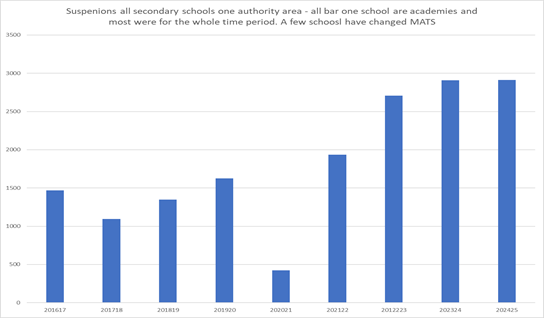
The last three years for which data are available witness record numbers of suspensions, although not all schools have increased suspensions at the same rate. The range in the spring term 202425 was from one school with just 6 suspensions, to another with 291, albeit, this was one of the largest schools in the authority. However, it was not an urban school. Eight schools each recorded more than 100 suspensions in the spring term of 202425.

The picture for exclusions is much more encouraging, as can be seen on the following chart. This uses a logarithmic scale to plot both suspensions and exclusions. Exclusions across the authority have rarely exceeded ten in a spring term.
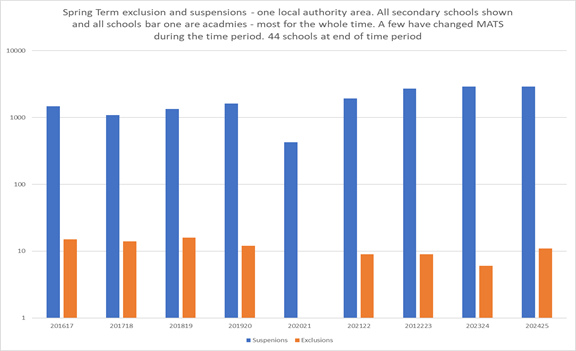
Of course, the total of suspensions for any one school can include multiple suspensions for the same pupil. The length of the spring term can also be affected by the changing date of Easter each year. This factor might have a small effect on each year’s data.

Of course, some pupils may not be ‘excluded’ at all, and hence not feature in these charts, but may be voluntarily removed to ‘home schooling’ by their parents. Whatever happens to pupils suspended or excluded, not being in school is more likely to see them become involved in a life of crime, often more serious crime than if they were in school on a regular basis.

Do some academy trusts have higher rates of suspension than other trusts among their schools? This is a challenging question to answer because it is clear that there is more likely to be a relationship between suspensions and the IDACI group in which the schools sits than the nature of the controlling MAT. However, it is clear than becoming an academy is not a panacea for solving the discipline issue of a school; at least as far as academies in this authority are concerned.  

Are suspension rates now on the way down? I hope so, but an not yet convinced that is the direction of travel. Time will tell.

Is discipline worse in schools?

It was interesting to hear Laura McInerney and Tom Bennett on the ‘Today’ programme on BBC Radio 4 this morning discussing whether or not behaviour was worse in schools these days than in the past. Both are experienced commentators, and Tom led a review in 2017 for the then government, about behaviour in schools. It is also interesting to see the BBC taking an interest in schools. The World at One last Sunday (also BBC Radio 4) devoted the whole of the programme to an analysis of the SEND issue. Interestingly, there was no government spokesperson available on Sunday, so they had to make do with the chair of the Education Select Committee.

The discussion this morning was around whether or not behaviour had worsened in schools, and if so, why? The usual suspects, covid and mobile phones were trotted out in support of discipline being worse in schools, along with families facing multiple challenges, but there were precious few facts.

One way of measuring the state of discipline in schools is by looking at the number of permanent exclusions each year by schools.  The largest single reason each year for these exclusions is always ‘persistent disruptive behaviour’. So, this might be seen as a good proxy measure for how schools are faring in relation to discipline in the classrooms. Of course, this measure doesn’t pick up low level disruptive behaviour, but it is reasonable to assume that there is a correlation between the different levels of behaviour in schools.

Looking back over the past 30 years, the level of recorded permanent exclusions was 10,440 in 1998/99. The level fell to 5,040 in 2010/11. In the latest year, 2023/24 there were 10,885 permanent exclusions. On the face of it, discipline is getting worse again, but is only back to levels last seen at the end of the last century.

I would like to suggest to causes not mentioned on the ‘Today’ programme: teacher supply and school funding. Is there a causal relationship between the fact that permanent exclusions were at their lowest when schools were fully staffed, and had experienced a period of several years of significant funding by government.  By contract, permanent exclusions seem to rise when there is difficulty staffing schools, and when funding is less than might be expected in a civilised society.

So, is the answer as simple as proper funding and staffing if you want fewer exclusions? The age and experience of the teaching force might also play a part. More experienced teachers, as I can testify from personal experience, are much less likely to face discipline issues then new entrants, especially if they are unqualified.

In the latest statistics on exclusions, 13 of the 25 local authorities with the lowest rates of permanent exclusions were London boroughs. This just adds more evidence to my thesis that if the rest of the country were funded like London, schooling would be in a much better place across the country.  Although I was also pleased to see Oxfordshire in 10th place overall for the lowest rate of permanent exclusions.

Support Youth Justice

One of the success stories of the past decade has been the reduction in the number of young people held in custody, both on remand and after sentencing. Sadly, with the present increase in ‘knife’ crime that trend may well be reversed over the coming few months.

Perhaps the increase in violent crime might have been reduced in scale had the Funding to help local authorities keep young people away from crime and re-offending not been halved since 2010. Youth justice grants, which fund council youth offending teams, have been reduced from £145m in 2010-11 to £71.5m in 2018-19, according to the Local Government Association. Furthermore, even though councils have already set their budgets for 2019-20, they are still awaiting their allocations for youth justice grants, thus, according to the Local Government Association, making it “extremely difficult” to plan services aimed at preventing gangs and violent crime.

Now it stands to reason that although the number of young people entering the youth Justice system is sharply down on the terrible days of the Labour government – by some 86% for the drop in first time entrants to the youth justice system – again according to the Local Government Association, many already in the system may be continuing to reoffend. . https://www.publicfinance.co.uk/news/2019/03/youth-offending-team-funding-halved?utm_source=Adestra&utm_medium=email&utm_term=

Cutting the grant for Youth Justice Services seems like another short-sighted attempt to save cash, where it may have actually had the opposite result in practice. Youth offending teams cannot devise schemes to held reduce re-offing, especially among what used to be termed ‘persistent young offenders’ if they no longer have the funds to do their work.

So, here is a suggestion. Any secondary school with more than 8% of its current annual revenue grant held in reserves and also with an above average figure for permanent exclusions across years 10 and 11 and any off-rolling of pupils in those years for pupils with SEND should have 50% of the excess of their reserves above the 8% level removed by the government and reallocated to the local Youth Offending Team.

Yes, the suggestion is crude, and if it catches any genuine cases, then the local Youth Offending Team can work with those schools to reallocate the funds to appropriate programmes.

This is a one-off short-term solution to allow government, in this time of policy paralysis, to find a better long-term solution to the increase in crime among teenagers and the cash to support new programmes over the longer-term.

At present, although more schools are reporting deficits, some have put money aside for a rainy day in a prudent manner, these latter group of schools would only be affected under these proposals if they had also shifted the burden of educating some challenging pupils onto others.

Cash in reserves is sterile public money, and with a need to deal with the present increase in violent crime, something needs to be done and quickly. Of course, if the government can find new cash in the Spring Statement my solution won’t be necessary.


Schools need to support not exclude adopted children

Some months ago I raised concerns about children being taken into care having to wait for long periods of time before being offered a school place when their foster placements ws some distance from any previous school. Such treatment of vulnerable children is not a good reflection on our education system. Sadly, this is still happening.

Now the BBC has published the results of a survey by Adoption UK into exclusions of adopted children, another vulnerable group of young people. This report makes for grim reading as well. http://www.bbc.co.uk/news/education-41915775

Adoption UK’s research estimates adopted children can be up to 20 times more likely to be permanently excluded than their peers.

The charity surveyed 2,084 of its members and found that of those with adopted children at school in 2015-16, 12% had had a fixed-term and 1.63% a permanent exclusion.

This compares with a rate of 4.29% for fixed and 0.08% for permanent exclusions across all state schools in England.

Adoption UK says that while its survey is indicative rather than scientific, it raises serious concerns.

Their web site is at: https://www.adoptionuk.org/  but I couldn’t find the survey when I looked.

The fact that there is a Minister of State for Children and Families should be a help in terms of government policy, but what is needed is a commitment to take action to support the education of vulnerable children at traumatic stages in their lives and a recognition that the effects can be long-lasting.

The dual and increasingly separate maintained and academy systems aren’t working for these children in many cases, as one group doesn’t have the money needed to offer effective help and the other often doesn’t seem to have the will, even though it has the ability to raise the cash.

I trust schools to do the best for ‘nice’ children supported by their parents, but I want them also to be supported to handle the more challenging of our young people as they set out on their lives. Exclusion and wiping your hands of the problem isn’t the answer.

If Paddington Bear can be thought of as a metaphor for an adopted child and can be falsely accused in the latest film of a crime he didn’t commit, then let us all pause for a moment and reflect upon not just our judgement, but also our treatment of adopted children. Sometimes being excluded must feel like being treated as a criminal and having done something wrong.

The adoption process in England is now being reorganised into larger regional agencies, but local authorities will still have to deal with the on-going responsibilities that result. From April 2018 the Virtual Schools will take on extra responsibilities for adopted children, on top of their already heavy workloads. But, as Adoption UK say, school staff should have better training around the needs of adopted children and for better support for these children throughout their schooling.

There is a further worry that the true extent of problem of exclusion is being masked because schools are regularly asking adoptive parents to take their children home and keep them out of school, without recording them as exclusions.

This is an area that Ofsted needs to inspect across a range of schools to uncover exactly what is happening.