Falling rolls in London: much worse than the rest of England

In my last post on this blog, I looked at the worsening of primary PTRs across much of the DfE’s ‘Inner London’ area. Falling Rolls: Is the funding formula making matters worse? | John Howson

This post looks how ‘Inner London boroughs have fare compared with the rest of England over those three years?

I think it is fair to say that London as a whole really has seen a significant downturn in primary pupil numbers. There are 22 local authorities where primary pupil numbers as published by the DfE have reduced by 5% or more between 2023/24 and 2025/26. Of these, 13 are London boroughs, and six – seven if Newham is included – are Inner London boroughs.

Seven of the top 10 places for the largest percentage decline in primary pupil numbers are filled by London boroughs. The other three places are taken by the Isle of Wight, Rutland and Torbay, three of the smallest unitary authorities in England.

Birmingham, Manchester and Leicester are the only large cities in the table. They fill three of the four bottom places for local authorities with a decline in pupil numbers of five per cent or more, along with Hillingdon in West London.

At the other end of the table, there are few London boroughs with less than a two per cent decline in their primary pupil populations.


London boroughs at this end of the table seem to be mostly outer London boroughs on the fringe of the metropolitan area. By contrast, there are seven county councils in the list of lowest declines in pupil numbers. This number increases to eight, if the Staffordshire figure, of an increase in pupil numbers, is correct.

The London boroughs will have the numbers in reception for each year, and will know how much worse the decline is likely to become over the next few years. More school closures look inevitable unless the funding model is changed to protect schools with declining rolls.

Not to protect the school estate in London is to assume that there will never be an upturn in pupil numbers. In cities, closing schools and selling off the site for housing means that in any upturn land may not be available for any new schools needed for the extra pupils. This is where thinking for the longer-term is important. During the last downturn of this size, most schools in London remained open, although some, such as Stamford Hill Infant and Junior School in Haringey, where I attended in the 1950s, did eventually close. Interestingly, the one form entry St Anne’s Church of England Primary School, close to Stamford Hill School that wasn’t actually in Stamford Hill, is still open.

However, this is not the post to discuss whether or not, in a more secular society, faith run schools should be closed where an alternative non-faith school can absorb the pupils. But this is an issue to debate, especially in urban areas.

In villages, the church-run school may still be the only school available, and that raises a much larger question about who should run state funded schooling? As the Wesleyan Methodists put it when faced by the 1902 Act, and decisions on whether to open state-funded secondary schools; are our teachers, teachers of children or teachers of Methodist children?

Falling Rolls: Is the funding formula making matters worse?

There has been a lot of discussion recently about falling school rolls in the primary school sector in London. This discussion led me to wonder whether a funding formula that is heavily weighted to a per pupil funding model might mean schools with falling rolls would have to adapt to a decrease in their income.

One possible outcome of less funding could be a worsening of pupil teacher ratios if individual support for pupils with SEND is cut, and also whole classes are amalgamated. My thesis is that Inner London boroughs might be witnessing the worst of the falling rolls problem, partly because they are boroughs with little room for new housing to be built, but also because inner cities have traditionally been the home of new arrivals to a country. Post Brexit, many European families from countries such as Poland and Romania may also have chosen to return home, taking their children with them.

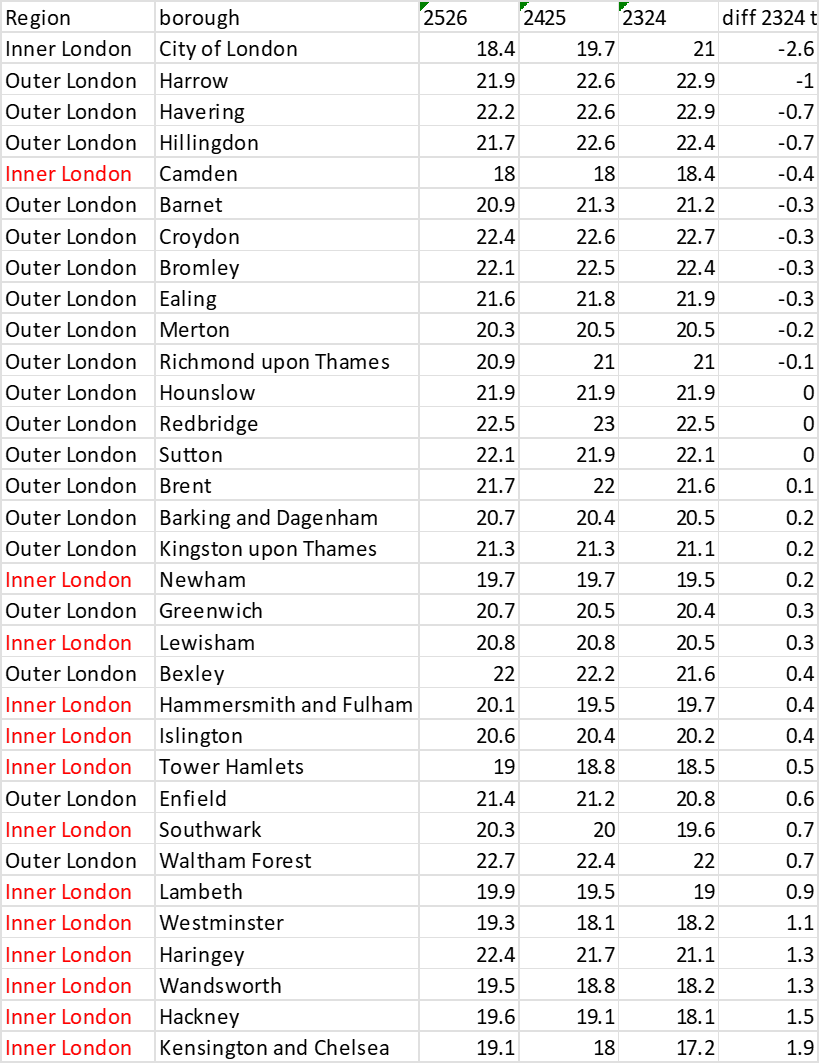
With the release last week of the school workforce data for 2025/26, by the DfE, it is possible to review the pupil teacher ratios (PTRs) for each borough for the three-year period from 2023/24 to 2025/26.

Of the boroughs in London, including the City of London, 11 boroughs improved their primary PTRs between 2023/24 and 2025/26. All but one, Camden, were Outer London boroughs. All the other Inner London boroughs recorded a worsening of their primary PTRS over the three- year period.

In the case of Kensington and Chelesea, albeit a small borough, the change was from 17.2 to 19.1 pupils per teacher over the three years: a decline of some 10%. This is a relatively large change for such a short period of time.

Seven Outer London boroughs also recorded a worsening of their primary PTRs over the same period. Of these boroughs, two, Newham and Greenwich have been classified as Inner London boroughs at sometime in the past.

Apart from the City of London, the boroughs with most improved PTRs are on the edge of London – Harrow, Havering, Hillingdon, Barnet, Croydon and Bromley.

The data in the table does suggest that falling rolls have been accompanied by a worsening of PTRs. Might this be caused in part by the construction of the National Funding formula that is heavily weighted towards a per pupil element? Reduced funding is certainly likely to impact upon class sizes and the use of teachers with small groups. Increasing class sizes and cutting individual teacher support for vulnerable learners is likely to impact upon a school’s PTR. If the reduction in pupil number sis widespread across a borough, then the impact will be seen in the PTRS for all primary schools in the borough.

I think that there is a case to be made that falling rolls are worsening PTRs for the remaining pupils across much of Inner London.

For a longer-term analysis of PTRS in London, and how over time they have been better than in most of England see  (1) (PDF) PTRS OVER TIME: A REVIEW OF PUPIL TEACHER RATIOS BETWEEN 1974 AND 2024 AND TWO PERIODS OF LOCAL GOVERNMENT RE-ORGANISATION PTRS OVER TIME: A REVIEW OF PUPIL TEACHER RATIOS

School funding: MATs and local government reorganisation

One interesting anomaly thrown up by the division of the 1974 shire counties into more and smaller unitary authorities, is how schools funds will be handled following the break-up of the former county councils. Local government functions around education were an upper tier authority responsibility under the 1974 local government reforms. Some county boroughs and towns that lost control over schooling in 1974, including Oxford City, where I live, never accepted this loss of responsibility, and are looking forward to becoming an upper tier authority once again, this time as a unitary council – effectively a county borough under a new designation.

Much has changed in the governance of schooling since 1974, and local authorities, despite winning a small but important battle over control of in-year admissions in Clause 52 of the recently passed Act of Parliament, have far less direct involvement in schooling than in the past, and certainly than in 1974.

One interesting issue in terms of loss of control over schools is encapsulated in the supplementary question set out below. I asked the question in September 2018 to the then Conservative Cabinet member on Oxfordshire County Council.

Councillor Howson had given notice of the following question to the Cabinet Member of Children’s Services

“Could you list the revenue balances for all maintained primary schools in Oxfordshire at the end of the 2017/8 financial year and show what percentage of revenue income the balance represents and how the percentage has changed since the end of the previous financial year, as well as the latest available number of pupils on the school roll?”

The Cabinet Member replied:

“Please find below the information required for all maintained primary schools in Oxford. This list includes the primary schools maintained as at 31 March 2018 and the data used for the number on roll is at October 2017.”

Supplementary:  Lord Agnew, the Minister of State told Auditors of Multi Academy Trusts (MATs) and committees that they may approve the virements of cash between schools in a Multi Academy Trust or a Multi Academy Committee.  Is the Cabinet Member prepared to ask Multi Academy Trusts or Committees in Oxfordshire not to take money from one school to support another and especially with those Multi Academy Trusts with Headquarters outside Oxfordshire, not to transfer money away from any school in Oxfordshire because we have been a member of the F40 Group and it would be unfair if money was taken from a school in Oxfordshire to support a school in a much better funded part of the Country.  If MATs won’t agree with this, would the Cabinet Member be prepared to write to the Secretary of State, asking for the same virements arrangements that are available to schools in MATs to be available to the State schools and stand-alone academies.”

The Cabinet member responded that she would be very happy to support that as Oxfordshire money should be for Oxfordshire Schools and anything she could do to support that she would be happy to undertake.

Why is this important? Take the example of Surrey County Council, now divided into two unitary councils: East and West Surrey. I guess that some MATs will have schools in both of the new council areas. Under existing rules, even if funding factors are different between schools in the two new authorities, even allowing for similar basic funding under the National Funding Formula for schools, the MATs can move resources between the different authorities.

Such movement is not possible for non-academy schools, even within a council area, let alone between areas. Ther e might not be much difference in surrey, but compare two secondary schools – one in say, in Henley in east Oxfordshire, firmly part of the South East region, and another secondary school in say, Swindon, in the South West region. Both are in the same MAT. Should funds be allowed to be switched between these schools by the MAT? (Note: this is a hypothetical example to illustrate the point)

It has become more of a challenge to understand whether academy trusts do move funds between schools because of the increasing use of pooled reserves in MAT accounts, as opposed to individual school balances, the purpose of my original question way back in 2018.

Local authorities may now be able to create an academy trust and encourage – it cannot seemingly compel – the maintained schools to join the new trust. One wonders why schools would do so if there was a risk of losing complete control over their budgets?

This issue about control over school funds is yet another example of a schooling system lacking coherence and vision, and a government that has missed a great opportunity to demonstrate that it understands the need for coherent and rational planning for the school system as a whole.

The NHS, centrally controlled since 1948 is currently undergoing yet another reorganisation to save money, and improve its effectiveness. I fear the school system in England will end up in the same mess of piecemeal reorganisations if there is not both adequate local oversight and a rationale operational model.

Fine the accountants

Both stand-alone academies and Multi Academy Trusts use private sector accountants to audit their accounts.  Each year, a number of MATs and academies are tardy in publishing their accounts at Companies House, where anyone can view the school or MATs handling of public money.

In my experience, it is the same MATs and schools that keep everyone waiting each year and this delay prevents any useful analysis of how schools are using their funds in particular geographical areas.

As usual, I am still waiting to see the accounts for seven sets of accounts for the schools in the geographical area where I track all non-community schools. These missing accounts are mostly the accounts from the same set of schools that were slow in appearing last year and the year before.

I think it is high time that the DfE, now responsibly directly for the funding of academies after the closure of the EFSA, takes some action to ensure all accounts, save those where there are legitimate queries, are posted by the end of January each year. That’s five months after the end of the accounting year, and should provide sufficient time for all accounts to be prepared.

How to deal with those accountants that don’t file by the required date: fine them. The notion of fining for late delivery of documents is well known and accepted. After all, HMRC will happily fine anyone not delivering their tax return by the due date, so why not fine private sector accountants for not filing these accounts on time.

The consequences would be that either the fine was passed on to the school or MAT or the accountants declined to continue handling the accounts in future years. Either way, the fine should help to instal financial discipline in those schools in the non-community part of the state school sector that are either being ignoring or possibly even flaunted the deadlines at present.

With the recent White Paper once again raising the spectre of all schools becoming academies – one wonders how foundation Schools view that prospect – installing financial discipline from day one should be something the National Audit Office needs to confirm with the DfE is not just a nice thing to have, but a necessity. The NAO might well decide to qualify the DfE’s accounts if it cannot see the accounts for all directly funded state schools within the prescribed time frame.

In my next post, I will consider how salaries for the top earners in MATs within one area have changed between the 2024 and 2025 accounts. With secondary schools now regularly advertising their headship with a starting salary of more than £100,000, and some on even more than £150,000, it is important to know whether Chief Executives of MATs, and executive headteachers are now regularly earning more than the Directors’ of Children’s Service in local authorities.

I guess that they are also earning more than the civil servants that have the ultimate power over the school sector. One wonders what should be the multiple between the salary of the lowest full-time worker in a school and the headteacher? In many case, it cases the multiple is now more than a factor of ten, between the lowest and highest paid staff members in a school: is this too great a gap?

Trends in academy accounts

The 2024-25 accounts for academy trusts, covering the year up to the 31st August 2025, are now being posted at Companies House, for anyone to view. Not all Trusts have yet published their accounts. Some Trusts are large and complex, and others may not want to be in the first groups that might draw attention to their results.

This analysis is for 86 schools in one geographical area, and where the school has been in the Trust for at least two reporting periods. Two indicators are considered: the pay of the highest-ranking employee – often the Chief Executive, but in single academy trusts, normally it is the headteacher, and changes in declared reserves held by the school. This latter indicator is complicated, as some MATs pool reserves, while all others hold both reserves at the school level and for central services.

Salary Trends

So far, of the 13 Trusts reporting, there have been no really significant changes. The highest salary band reported band was £200,000-210,000, up by £10,000, the same increase of £10,000 as seen in 5 other trusts; one trust saw a £10,000 decrease; two trusts no change, and four increases in the £20,000 range. The lowest salary for the year was £100,000, for a trust with four schools.

Trusts with headquarters outside the geographical area tended to have higher salary bands for their highest paid employee than those headquartered in the local area. This might take into account the complexity of London weightings for salaries.

Changes in reserves

Here, two-year’s worth of data is available for 72 of the 86 schools in the area. The other 14 schools changed trusts, so the data for the two years is incomplete. Of the 72 schools with data for both years:

29 ended the 2025 reporting period with a deficit

43 ended with reserves

Of those schools in deficit at the end of the reporting period

14 increased their deficits over the year

5 schools went from surplus to deficit

Of schools with reserves

10 reduced the amounts of their reserves.

The other 33 increased their reserves.

The largest deficit reported in 2025 account, so far is £1,060,000 – an increase of £232,000 in one year, or more than 20%.

The largest reported surplus held by a school was £2,641,000 – up by £290,000 over the year. Another school in a MAT, but located outside the area reviewed, also had a balance of £2,400,000.

Comment

From the data on salaries, it seems that seven MATs had increases to their salary bands for the highest paid employee that were less than 10%; one MAT saw the incoming employee on a lower band than their predecessor. Five had increases in the band of the highest paid employee of more than 10%.

Four of the MATs surveyed paid their highest paid employee in a band above the salary of the local authority’s Director of Children’s Services. This is not surprising, since nationally, the highest starting salary for a headteacher in an advertised vacancy in 2026 has been £123,000.

On the issue of reserves, some schools are facing pressures while others are still adding to their reserves. I have always maintained that revenue funding should be spent in the year in which was provided, including up to 10% for a sensible reserve, based upon the profile of the past five years of expenditure where the reserve is not excessive.

Why do schools hold more than £2 million pounds of public money in their reserves? Schools in deficit, often seem to struggle to clear their deficit, and if they don’t attract pupils, then it is a challenge to ever return to a surplus without damaging the education of their pupils.

I will return to this topic when I have processed the data from the remaining MATs yet to file their accounts.

KS2: The London effect?

Earlier this year, I produced a report looking at the changes in pupil teacher ratios over the past fifty years as between London boroughs and the rest of England’s local authorities that have remained on the same boundaries since 1974. London boroughs generally have had some of the ‘best’ PTRs throughout the past 50 years. As a result, it was no surprise to see how well schools in the London boroughs performed in the KS2 results for 2025, published by the DfE yesterday.

It is interesting to look at just one measure, the percentage of pupils achieving the higher standard in Reading, and the percentage change in this measure over the past decade or so.

2015/162024/25
higherhigherdifference
LAReadingReading
Waltham Forest15%44%29%
Redbridge19%45%26%
Westminster18%43%25%
Haringey20%43%23%
Newham18%41%23%
Hammersmith and Fulham24%46%22%
Luton11%33%22%
Merton22%44%22%
Barking and Dagenham15%37%22%
Enfield15%37%22%
Sutton25%47%22%
Hackney21%42%21%
Brent16%37%21%
Barnet24%44%20%
Bexley20%40%20%
Lewisham19%39%20%
Southwark19%39%20%
Slough19%39%20%
Tower Hamlets18%38%20%
Birmingham14%34%20%
Leicester11%31%20%
Trafford27%47%20%
Solihull20%39%19%
Hillingdon19%38%19%
Ealing18%37%19%
Wolverhampton14%33%19%
Barnsley13%32%19%
Thurrock13%32%19%
Doncaster11%30%19%
Camden23%42%19%
Greenwich22%41%19%
Croydon17%36%19%
Richmond upon Thames36%54%18%
Kingston upon Hull, City of15%33%18%
Kensington and Chelsea30%48%18%
Blackburn with Darwen13%31%18%
Walsall13%31%18%
Knowsley12%30%18%
North East Lincolnshire11%29%18%
Lambeth23%40%17%
Stockport22%39%17%
Warrington21%38%17%
Stockton-on-Tees16%33%17%
Bromley27%44%17%
Wandsworth25%42%17%
Harrow24%41%17%
Milton Keynes19%36%17%
Sandwell13%30%17%

Leaving aside the City of London, with its one primary school that has been excluded form the dataset, 28 of the London boroughs appear in the table. This compares with 20 local authorities outside of London. None of the latter are ‘shire’ counties. Not even the Home Counties of Surrey or Hertfordshire make it into the list.

Looking at the other end of the table, there is a preponderance of counties authorities in the list

Tameside15%28%13%
Southend-on-Sea20%33%13%
South Gloucestershire20%33%13%
Telford and Wrekin19%32%13%
St. Helens18%31%13%
Rochdale14%27%13%
Portsmouth14%27%13%
Blackpool13%26%13%
Oldham13%26%13%
Rutland23%36%13%
Cheshire East22%35%13%
Cambridgeshire22%35%13%
Lancashire17%30%13%
Bedford16%29%13%
Cheshire West and Chester22%34%12%
Havering22%34%12%
Herefordshire, County of21%33%12%
Nottingham15%27%12%
Gateshead20%32%12%
Cornwall20%32%12%
Torbay20%32%12%
East Sussex19%31%12%
South Tyneside18%30%12%
Derbyshire18%30%12%
Suffolk18%30%12%
Swindon18%30%12%
Derby14%26%12%
Warwickshire23%35%12%
Oxfordshire23%35%12%
Gloucestershire23%35%12%
Southampton17%29%12%
Hampshire23%34%11%
Devon23%34%11%
Bristol, City of22%33%11%
North Somerset22%33%11%
Lincolnshire17%28%11%
Central Bedfordshire17%28%11%
County Durham20%31%11%
Calderdale20%31%11%
Shropshire20%31%11%
Sefton18%29%11%
Norfolk18%29%11%
East Riding of Yorkshire18%28%10%
Wiltshire23%33%10%
Darlington22%32%10%
West Berkshire25%34%9%
Bath and North East Somerset27%36%9%
Brighton and Hove26%35%9%
Northumberland21%29%8%
Isle of Wight16%23%7%

Even among the unitary authorities in the list, some, such as the East riding of Yorkshire and West Berkshire might be considered predominantly rural in nature.

So, what might be deduced from this data? Parental help does make a difference. Has the ‘gentrification’ of Walthamstow help propel it to the top of the table? To consider the issue of parental support versus government funding for schools it is worth considering the present percentage of achievement at this higher grade by schools in two parliamentary constituencies that I am familiar with; Tottenham, where I started my teaching career, and Oxford East, part of the city where I have lived and worked for the past 45 years.

SCHOOL Higher Grade RWM in KS” 2025TOTENHAMOXFORD EAST
A35
B27
C23
D1818
E1717
F15
G15
H15
I1414
J1313
K1313
L13
M12
N1111
O1010
P99
Q9
R8
S8
T77
U77
V77
W77
X6
Y6
Z55
AA5
AB5
AC44
AD44
AE33
AF3
AG23
AH2
AI2
AJ00
AK0
total322193
schools2827
average11.57.1

Both might be seen as constituencies with significant pockets of deprivation, but also areas subject to ‘gentrification’ in recent years. Schools in Oxford East have a profile with lower percentages than schools in Tottenham. How much of the difference can be ascribed to parents, and how much to better funding for London schools? Of course, class sizes also matter. But, as both are urban areas, the issue of small rural schools doesn’t really arise as it would if one compared Oxford East with its neighbouring constituency of Henley.

This work is at an early stage, but it does pose the question about the deep structure of school funding and, especially, the use of average salary data in any calculations in the funding of schools.

SEND, fuel duty and the Apprenticeship Levy  

SEND was identified as one of their 3 top priorities by 60% of a random sample of 100 delegates at the recent Lib Dem Conference. 45% ranked it first and 15% second, often behind funding in general.

This result isn’t a surprise to anyone in education, although falling rolls doesn’t yet seem to have worked its way up the political agenda to be a top priority for councillors and activists. I am sure that will change.

Anyway, as regular readers know, before the summer break I expressed concerns about the SEND deficit many local authorities are facing, only to have the end date for the ‘statutory override’ kicked down the road from March 2026 to March 2028 two days after my blog appeared. I m sure there is no link between the two, just great timing on my part.

So, what might local authorities do. Two suggestions, one possible and one for consideration. Local authorities need to check that they are spending all the Apprenticeship Levy raise by them in its present form. They should not be returning any unspent cash, raised from maintained schools to HM Treasury. Apprenticeships across the SEND landscape can be a good investment, and certainly a better use of the cash than sending it back to Westminster. Hopefully, all local authorities are now making full use of the Levy cash collected.

My second suggestion needs some work. At present, SEND transport is a massive cost to many local authorities. The recent NI hike won’t have helped, and should be recognised in the funding for the High Needs Block. If not, it is a tax on SEND, and indeed education as a whole.

The other tax is Fuel Duty. Unlike VAT, I don’t think it is recoverable by local authorities, despite making up around 50% of the price of fuel at the pump. Assume a taxi does two journeys a day for 190 days a year, and uses a litre of diesel for each journey with a SEND young person. That’s around 380 litres a year. As 400 is an easier number to use, let’s round it up to that number. To compensate, let’s say diesel is £1.30 per litre. This puts the fuel cost at £520 per taxi per year. Ten taxis, £5,200; 100 taxis: £52,000. Now assume 50% fuel duty and the possible saving mount up.

Agriculture has long had a red diesel scheme to cut fuel costs.  Education should not be paying income from the High Needs block back to HM Treasury in tax. Like business rates, a fuel rebate scheme should be in place where local authorities certify fuel purchased, and receive a rebate of the duty.

However, this might incentivise the use of fuel-inefficient vehicles, so the scheme should be predicated on a growing percentage of vehicles being electric, and thus not requiring the rebate. Vehicles could also be required to be less than five years old, and with a minimum miles per litre outcome.

Such a scheme won’t solve the problem, but every little helps, and it might encourage the use of electric taxis that are both cleaner for the environment and, until the government changes the rules, less costly in tax paid by local authorities.

Special Needs – is nothing new?

Serendipity is defined as a fortunate finding of something unexpected. The origin of the term is credited to Horace Walpole. Earlier this afternoon, while waiting for some data on ITT statistics from the early 1990s that were being brought up from the reserve stacks of a library, I browsed through a bound volume of the TES for March 1991 that happened to be available.

The TES for the 22nd March 1991 contained a report of the annual conference of educational psychologist, the spring being education conference season even then. The report contained the following report

The government confirmed that there has been a widespread increase in the number of children referred for special help to support the claims of educational psychologists who believe that their numbers have increased by 50%. … Anthea Millett HMI for special needs said many local authorities reported an increase in referrals for assessment by educational psychologists.’ (TES 22/3/91 page 3)

One reason suggested was that as schools were becoming liable for their own budgets under local management of schools that had been set out in the 1988 Education Reform Act, schools were more anxious to obtain the statutory help that a statement of special needs brought with it.

Interestingly, in 1990, over 100 MPs had signed an Early Day motion in the House of Commons to the effect that ‘many children in urgent need of help and advice from an educational psychologist are waiting unacceptable lengths of time’.  (TES 22/3/91 P3)

In an editorial in the same edition as the news item referred to above, it was claimed that devolution of funds to schools had exposed the crudeness of existing formula for special needs that had made proper funding for children with special needs a lottery for schools, and that the 1988 Education Reform Act had not paid attention to the needs of children with special needs. The prediction that children with special needs would be a casualty of the Act was now coming true.

All of this seems very reminiscent of the current situation of a growth in demand and concerns over the funding for that growth, as does the analysis in the editorial that devolving funds to schools had allowed schools to identify many children with needs not being met that required extra funding.

As the editorial concluded, ‘The pre-LMS discretionary targeting of resources by LEAs according to putative need was often little more than a system of rationing inadequate funds. Those with the most efficient advocates or most obvious handicaps (sic) got first pickings. The rest got little or nothing – often not even a proper assessment.’ (TES 22/3/91 P21)

Reading this bit of history, reminded me of the present explosion in demand for EHCPs as schools struggled with demand they felt was not funded. This time around, local authorities faced with the 2014 Act opted for running up deficits rather than rationing, except that is by using the NHS favoured outcome of rationing by waiting time for assessments.

One wonders what the government has learnt about special needs funding over the past 35 years, and what the White Paper will do? Will it just tell schools to devote more of their resources to dealing with the issue? Or, will there by more cash – this seems unlikely, but one can but hope.

When are deficits called reserves?

Local authorities are currently starting to put together their budgets for 2023/24. Upper Tier Authorities with responsibility for the High Needs block of the Direct School Gant that deals with expenditure on pupils with special needs will be looking at a year-end overspend in many cases that will need to be added to the amount already sitting off-balance sheet in a temporary solution to the problem of how to pay for this expenditure. The money has been spent by the local authority, but not paid for by central government, so it sits awkwardly in an account waiting for a solution.

At some point, if the DfE or The Treasury deems that the local authority should no longer carry the deficit, but fund it from reserves, this would be a major headache for, I suspect, many local authorities, regardless of their political control. In the present financial climate, the solution is more challenging than it might have been a year ago. As a result, I expect the government to ‘kick the can’ further down the road extending the current arrangement until March 2024, and leaving local authorities with even bigger numbers to worry about.

How might the issue be solved? Before devolved budgets came into being for schools in the 1990s, authorities might just have top sliced their education budget. I cannot see Schools Forum, the body that discusses education funding at a local authority level, agreeing to such a move these days, although the DfE could no doubt mandate it somehow.

An alternative would be to use the precept method, as has been used for social care funding, by allowing local authorities to increase Council Tax by an amount to cover the deficit they have incurred that is not on their balance sheet, but in ‘reserves’. This passes the problem to local taxpayers, despite schooling now being a centrally financed activity.

The government at Westminster could just pay off the figure authorities have in their reserves, either in one lump sum or more likely over a period of several years. But, with their demands for cuts in public expenditure to finance tax cuts, this seems an unlikely option.

Increasing pupil numbers, better healthcare and the acceptance of new medical conditions was always going to put increased demand upon a school system and its funding for pupils with special needs, and especially one that both had not always planned for the changes and was required to do more after the switch to EHCPs from Statements of Need following the 2014 Education Act. A good example of worthy legislation that doesn’t seem to have been fully costed as to its on-gong effects.

Meanwhile, parents probably see declines in service locally, as officers struggle to keep the costs of running the service within bounds. These parents often carry a heavy burden caring for their offspring and fighting a local government system is not something they want to do, but sometimes are forced to undertake. There must be a solution that puts the needs of these young people first.

Some still do better than others

The DfE has published an interesting report on outcomes by ethnicity and Free School Meals. It might have been even more useful with a section on gender added and also some regional breakdown to see if the additional funding in the London area makes any difference to outcomes. Outcomes by ethnicity in schools in England – GOV.UK (www.gov.uk)

For many, the inclusion of Traveller children and their performance will come as a shock as these groups don’t regularly appear in most tables. Funding for the education of traveller children hasn’t been high on anyone’s agenda for many years. Perhaps now it the time to reassess how we offer education to the children in the travelling community.

The Report makes clear the poor outcomes for certain sections of some communities, especially those pupils on Free school Meals.  

According to the DfE report there were over 8 million pupils recorded in the school census in 2021. Ethnicity responses in the report are grouped into 17 options or “Any other” as a catch-all category. I guess some South American children might fall into this group.

The DfE points out that it is important to consider variation within groups, especially when aggregated into larger groups such as “White” or “Asian”.  When aggregated 72% of pupils (5.9 million) described their ethnicity as White, 11% (900,000) Asian excluding Chinese, and around 6% each as Mixed (520,000) or Black (460,000). 2% of pupils described themselves as belonging to ethnic groups not captured in the census (170,000), and 0.5% of pupils identify as Chinese (37,000).

An important finding is that the proportion of White British pupils meeting the expected standard falls at each stage in their education.

Other groups also see fluctuations across stages, but the effect is most pronounced in the White British Group. As seen in figure 2, White British pupils fall from 5th of 18 groups in younger groups to 10th later in school. This is reflected in the average Progress 8 score of a White British GCSE entrant being negative (-0.14) where 0 represents average progress through secondary school. The DfE comment that since Progress 8 is a relative metric, we cannot say whether this trajectory represents “catch-up” of some non-White British groups or a “falling behind” effect.

However, some other groups also fare badly according to the report

‘Black Caribbean, Mixed White and Black Caribbean and Other Black pupils are all less likely to meet the expected standard at all stages than White British pupils, and the size of this gap doubles between 4- to 5-year-olds and GCSE pupils.

Comparing between a class of 30 White British pupils and a class of 30 pupils from these 3 groups, on average 1 or 2 more pupils in the Black and Mixed class would be below the expected standard at 4 to 5 years-old, whereas 3 to 5 fewer pupils would receive a strong pass in English and Maths GCSE. 11. The average progress 8 scores of Black Caribbean (-0.30) and Mixed White/Black Caribbean (-0.37) pupils are more negative than the White British group. Pupils selecting Black Other (+0.08) have slightly positive average progress 8 score.

Gypsy/Roma, and Irish Traveller pupils have the consistently lowest levels of attainment of any ethnic group, and the most negative progress 8 scores.’

The report notes that five groups made below average progress throughout secondary school. These groups are – White British, Black Caribbean, Mixed White/Black Caribbean, and Gypsy/Roma, Irish Traveller pupils. These groups start with lower attainment scores following primary school, so low progress scores represent a confounding effect where these groups are falling further behind their peers. Controlling for FSM, only White and Black Caribbean groups have below average progress among non-FSM recipients. White FSM recipients have the lowest progress among all aggregated groups, and Mixed and Black groups have below average progress.

This report is powerful evidence for the levelling up agenda discussion and also for the discussion on the hard National Funding Formula currently being discussed as part of the Schools Bill before parliament. Once again, it raises the question over the degree of hypothecation required in funding schools and how the money is both used and evaluated. Interestingly, there is nothing in this report about the use of Pupil Premium monies as a hypothecated grant.