Falling rolls in London: much worse than the rest of England

In my last post on this blog, I looked at the worsening of primary PTRs across much of the DfE’s ‘Inner London’ area. Falling Rolls: Is the funding formula making matters worse? | John Howson

This post looks how ‘Inner London boroughs have fare compared with the rest of England over those three years?

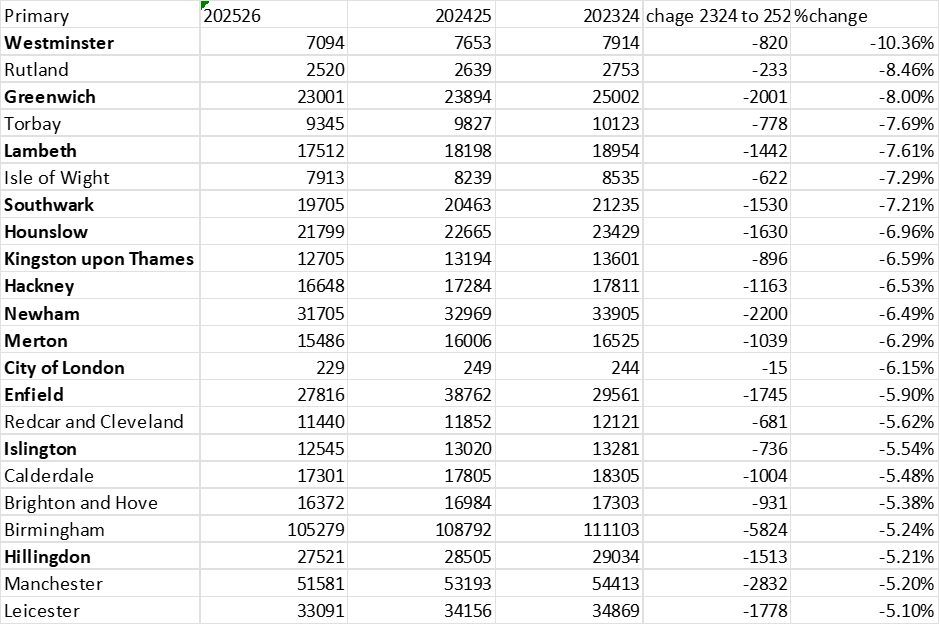
I think it is fair to say that London as a whole really has seen a significant downturn in primary pupil numbers. There are 22 local authorities where primary pupil numbers as published by the DfE have reduced by 5% or more between 2023/24 and 2025/26. Of these, 13 are London boroughs, and six – seven if Newham is included – are Inner London boroughs.

Seven of the top 10 places for the largest percentage decline in primary pupil numbers are filled by London boroughs. The other three places are taken by the Isle of Wight, Rutland and Torbay, three of the smallest unitary authorities in England.

Birmingham, Manchester and Leicester are the only large cities in the table. They fill three of the four bottom places for local authorities with a decline in pupil numbers of five per cent or more, along with Hillingdon in West London.

At the other end of the table, there are few London boroughs with less than a two per cent decline in their primary pupil populations.


London boroughs at this end of the table seem to be mostly outer London boroughs on the fringe of the metropolitan area. By contrast, there are seven county councils in the list of lowest declines in pupil numbers. This number increases to eight, if the Staffordshire figure, of an increase in pupil numbers, is correct.

The London boroughs will have the numbers in reception for each year, and will know how much worse the decline is likely to become over the next few years. More school closures look inevitable unless the funding model is changed to protect schools with declining rolls.

Not to protect the school estate in London is to assume that there will never be an upturn in pupil numbers. In cities, closing schools and selling off the site for housing means that in any upturn land may not be available for any new schools needed for the extra pupils. This is where thinking for the longer-term is important. During the last downturn of this size, most schools in London remained open, although some, such as Stamford Hill Infant and Junior School in Haringey, where I attended in the 1950s, did eventually close. Interestingly, the one form entry St Anne’s Church of England Primary School, close to Stamford Hill School that wasn’t actually in Stamford Hill, is still open.

However, this is not the post to discuss whether or not, in a more secular society, faith run schools should be closed where an alternative non-faith school can absorb the pupils. But this is an issue to debate, especially in urban areas.

In villages, the church-run school may still be the only school available, and that raises a much larger question about who should run state funded schooling? As the Wesleyan Methodists put it when faced by the 1902 Act, and decisions on whether to open state-funded secondary schools; are our teachers, teachers of children or teachers of Methodist children?

Falling Rolls: Is the funding formula making matters worse?

There has been a lot of discussion recently about falling school rolls in the primary school sector in London. This discussion led me to wonder whether a funding formula that is heavily weighted to a per pupil funding model might mean schools with falling rolls would have to adapt to a decrease in their income.

One possible outcome of less funding could be a worsening of pupil teacher ratios if individual support for pupils with SEND is cut, and also whole classes are amalgamated. My thesis is that Inner London boroughs might be witnessing the worst of the falling rolls problem, partly because they are boroughs with little room for new housing to be built, but also because inner cities have traditionally been the home of new arrivals to a country. Post Brexit, many European families from countries such as Poland and Romania may also have chosen to return home, taking their children with them.

With the release last week of the school workforce data for 2025/26, by the DfE, it is possible to review the pupil teacher ratios (PTRs) for each borough for the three-year period from 2023/24 to 2025/26.

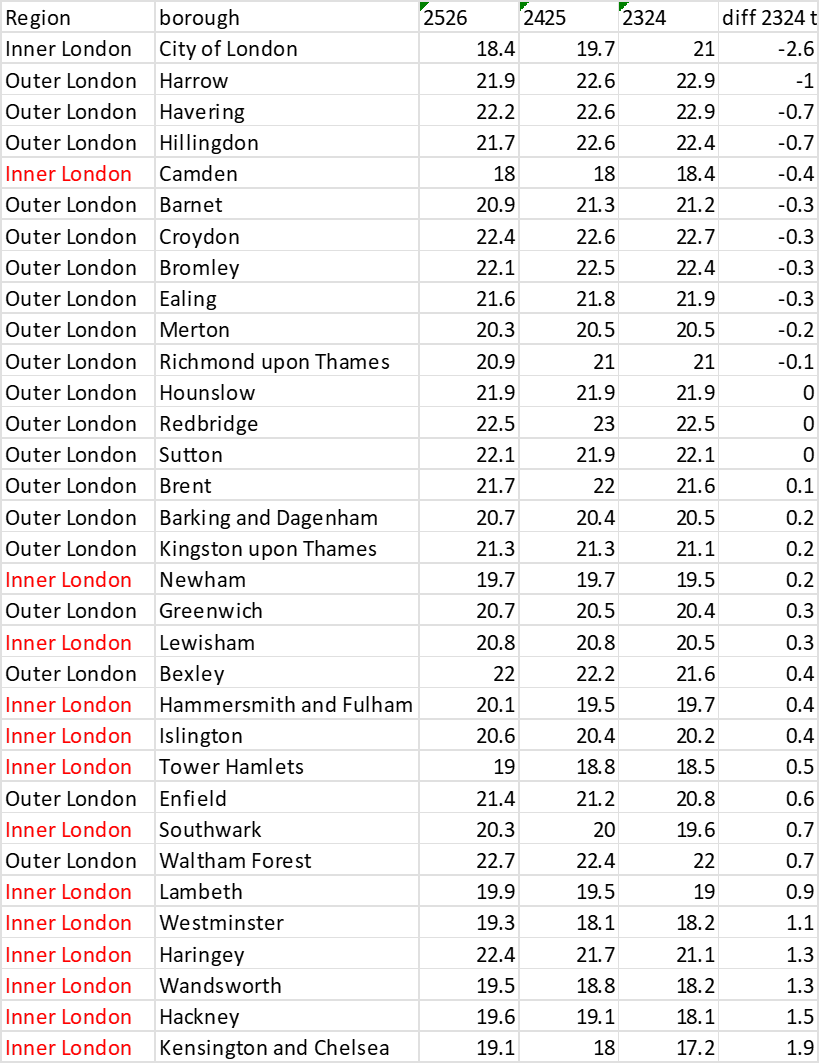
Of the boroughs in London, including the City of London, 11 boroughs improved their primary PTRs between 2023/24 and 2025/26. All but one, Camden, were Outer London boroughs. All the other Inner London boroughs recorded a worsening of their primary PTRS over the three- year period.

In the case of Kensington and Chelesea, albeit a small borough, the change was from 17.2 to 19.1 pupils per teacher over the three years: a decline of some 10%. This is a relatively large change for such a short period of time.

Seven Outer London boroughs also recorded a worsening of their primary PTRs over the same period. Of these boroughs, two, Newham and Greenwich have been classified as Inner London boroughs at sometime in the past.

Apart from the City of London, the boroughs with most improved PTRs are on the edge of London – Harrow, Havering, Hillingdon, Barnet, Croydon and Bromley.

The data in the table does suggest that falling rolls have been accompanied by a worsening of PTRs. Might this be caused in part by the construction of the National Funding formula that is heavily weighted towards a per pupil element? Reduced funding is certainly likely to impact upon class sizes and the use of teachers with small groups. Increasing class sizes and cutting individual teacher support for vulnerable learners is likely to impact upon a school’s PTR. If the reduction in pupil number sis widespread across a borough, then the impact will be seen in the PTRS for all primary schools in the borough.

I think that there is a case to be made that falling rolls are worsening PTRs for the remaining pupils across much of Inner London.

For a longer-term analysis of PTRS in London, and how over time they have been better than in most of England see  (1) (PDF) PTRS OVER TIME: A REVIEW OF PUPIL TEACHER RATIOS BETWEEN 1974 AND 2024 AND TWO PERIODS OF LOCAL GOVERNMENT RE-ORGANISATION PTRS OVER TIME: A REVIEW OF PUPIL TEACHER RATIOS

Schools: the end of local authority involvement?

When I first started studying the governance of education, way back in 1979, there at that time two popular saying about the school system in England. One was that it was, ‘a partnership between local and national governments’ and the other that it was ‘a national system locally administered.’ A typical examination question was to ask how valid either of these statements were?

That was half a century ago; difficult for me to believe, but true nevertheless. I have witnessed a lot of changes during in the intervening years. Indeed, one of my few academic articles I have published was entitled ‘Variations in local authority provision of education’ and appeared in the Oxford Review of Education way back in the early 1980s. Interestingly, during the Labour government of the period between 1974-79, closing the gap in funding between the best and worst local authorities was a matter of academic interest. Anyone wanting to know more could do worse than read’ Depriving the Deprived’, written by Tunley, Travers and Platt, published in 1979, as it is about the funding of schooling across one London borough over one year.

For a comparison over a longer time period, my review of 50 years of pupil teacher ratios, published last summer and available for download on researchgate at (PDF) PTRS OVER TIME: A REVIEW OF PUPIL TEACHER RATIOS BETWEEN 1974 AND 2024 AND TWO PERIODS OF LOCAL GOVERNMENT RE-ORGANISATION PTRS OVER TIME: A REVIEW OF PUPIL TEACHER RATIOS

During the 50 years between local government reorganisation in 1974 and 2024, school funding decisions have been removed from local authorities, and nationalised; Education Committees have been abolished, in favour of cabinet government; teacher training and new schemes to prepare teachers have been taken over by Westminster; schools have been persuaded to become academies outwith local authority control, but still under church control if faith schools – if the white Paper leaks are correct all schools will now have to become an academy or free school; further and higher education were liberated from local authority oversight and funding in the early 1990s; ultimate control over place planning has remained with the DfE as only the DfE can sanction new schools being built.

What’s left for local authorities? SEND for a couple more years; admissions- including in-year admissions once the current Bill becomes law – and transport. Frankly, I cannot see local authorities, especially newly reorgnised upper tier authorities, wanting either of these functions in the future. And why would they, as these services can often be poisoned chalices.

So, are we moving to an NHS style system for schooling in England, with little local democratic oversight, and few routes for parents to complain about the education their child is receiving. I fear so.

Does it matter? That’s a matter of opinion. The world of 2026 is vastly different to that of sixty years ago, and it should be easier to produce a more level playing field with all the levers of funding and control being exercise from Westminster.

But I remain sceptical. Westminster has been unable to control issues such as MAT chief executive’s pay and the level of school reserves. At present it isn’t equipped to be a fully functioning operational department along the lines of the NHS of MoD.  It will be interesting to see what, if anything, the White Paper has to say about governance when it is published tomorrow.

No High Needs Block data in NFF announcement

Yesterday, the DfE announced the National Funding Formula (NFF) for 2026/27 The national funding formula for schools The formula covers schools and local authority delivered central services

Unlike last year, there is no section on the High Needs Block that deals with SEND funding. The details will be announced later, at some unspecified time. One other small change seems to be in the calculation of the sparsity index, where the footnote from the 2025/26 NFF document seems to be missing from the main document this year.

Last year, there as a footnote that stated in a footnote on page 26 – paragraphs were not numbered last year – that “6 A compatible school means one of the relevant phases which a pupil could attend. Selective grammar schools are not considered when identifying the second nearest compatible school, but faith schools are included.”

This year, paragraph 25 states that “Eligibility for sparsity funding depends on the distance the pupils living closest to the school would have to travel to their next nearest compatible school, and the average number of pupils per year group.”  However, there is no comment about what is a compatible school.

So, no change, apart from the lack of a definition of a ‘compatible school’. This footnote has now been relocated to the Technical Manual, and appears as footnote 9 on page 19 of the manual. Schools block national funding formula 2026 to 2027: technical note

Overall, the minimum per pupil funding for primary pupils increases from £4955 to £5115, and for secondary pupils up to year 11, from £6,455 to £6,640. Schools

in IDACI band G will, as before, receive no additional funding through that factor. If they don’t qualify for additional funds through other factors, and some schools won’t, as 62.5% of LSOAs are in IDACI Band G, this could be a challenging year for them.

Many of these schools will no doubt turn to parents for support, or perhaps more will follow the north London school, and look to bring in additional income from operating overseas alongside the many private schools that already have overseas campuses?

With the budget next week, and the local government settlement not being announced any earlier than last year, plus the delay in the High Needs Block announcement, this is going to be a tough budget setting time for schools and local authorities between now and February, when the upper tier local authorities responsible for the NFF must set their council budgets.

Perhaps the High Needs block will feature as a rabbit in the Chancellor’s budget speech to make everyone feel better that the government has found a solution to the massive deficits protected by the override that was extended to March 2027.

Reading the document, I was also struck by the fact that there are more references to local authorities than to the ‘schools forum’. Has the latter run its course as a decision-making body? Is it time to review its future, and certainly its membership?  

Per Pupil Funding set to fall

Last week, the DfE released data on the change in per pupil funding for 5-16 year olds between 2010-11 and 2023/-24

One the face of it, this is a good news story. Funding per pupil has increased in cash terms from £5,180 in 2010-11 to £7,460 in 2023-24. After falling in the first few years, per pupil funding increased from 2018-19 onwards, according to the DfE data. School funding statistics: 2022 to 2023 financial year – GOV.UK (www.gov.uk)

Looking at the same data using 2022-23 prices reveals a similar picture up to the projections for 2023-24 funding per pupil where, using 2022-23 cash prices, the increase for 2023-24 is not currently enough to allow for the effects of inflation, and funding per pupil falls below funding in cash terms. After taking into account the extra funds received by schools to deal with the pandemic that have either ended already or are likely to do so soon, and weren’t incorporated into the headline figure to ensure the integrity of the time series data, it is possible to see why some schools, especially in the primary sector may be facing a real funding dilemma once again.

According to the DfE, the figures for 2023-24 are based on a combination of published funding allocations, the budget settlements agreed at the 2021 Spending Review and 2022 Autumn Statement, and some estimates of small grant and high needs spending. Of course, the final outturn might prove to be different, in part depending upon how the government and the STRB deal with the issue of teachers’ pay and pay levels for non-teaching staff.

Will the DfE add funds to cover the eventual pay settlement that will recognise the effects of high inflation or will they expect schools to handle the additional costs within the presently agreed funding envelope?

As I have remarked before, the Pay Review body system worked relatively well in times of low inflation and the date for reporting became decoupled from the pay year. The STRB’s 2022 report was published in January of that year, well in time for the new funding cycle to be adjusted to mee the cost of the settlement.

I guess the political shambles at Westminster in the early autumn, and the revolving door of ministers, prevented both the Treasury and spending departments from making the case for bringing Pay Review body Reports forward once it was clear inflation was going to reach a 40-year high.  

The DfE data aggregates all 5-16 spending, so these data don’t show the potential differential impact on the primary sector of the current Funding formula, high fixed costs and in many cases falling rolls. The policy for handing demographic decline doesn’t seem clear to me. Is the government willing to see large numbers of small schools close or will it expect academy trusts to cross-subsidise between sectors as a means of forcing the remaining primary schools to become part of a MAT in order to survive, since local authorities cannot vire funds between schools as MATs are able to do.

Memo to incoming PM

Despite the record levels of tax receipts, the present economic situation does suggest that genuine economies should be looked for in the public sector. So, here are a few from the school sector that might be worth investigating.

First, sort out the cost of the failed middle tier experiment. Overall, the national leadership costs from academy chains are way too high. This has been recognised in the dreadful Bill working its way through parliament. Maybe there is a need for more than 150 Directors of Children’s Services, but do we need all these additional Chief Officers with their associated costs? Much of the inflated costs stretch back to failure to get grip on Executive Headships by the Labour government under Tony Blair. Sort out the shape of the school system and save money.

Recruiting teachers: axe the DfE jobsite in its present form and put the cost out to tender. As this blog has consistently pointed out, the present DfE site fails on several fronts, and probably isn’t even as cost effective as local authority jobsites.

Encourage central procurement. Delegated budget to schools is a great idea, but so is central purchasing. Do more to facilitate such outcomes across Trusts and local authorities.

Axe the Apprenticeship Levy for small primary schools, or at least reform it so that there can be a benefit. At present it is just a tax on schools.

Dump the tax on Insurance. This would help more than schools, and, at present, taxes the virtuous while encouraging others to avoid protecting themselves and their possessions.

Introduce a fund for investment in renewable energy that schools can use to spread the cost of introducing new energy sources over several years. Target the fund first at small schools in rural areas where the school can act as a community energy hub if the grid fails in a storm or for other reasons.

Regular readers will know my feelings about making use of playgrounds in supporting energy procurement. Where is the research programme

Longer-term, evaluate how teacher preparation programmes can meet the needs of the school sector in the most cost-effective manner, especially as school rolls start to reduce and fewer new teachers may be needed.

Review the National Funding Formula, and whether it meets its aims? In its present form, will it lead to wholesale closure of small schools as unviable financially, and what will be the costs of such closures and who will bear them?

The National Funding formula doesn’t take any account of whether schools can top-up income by lettings; from wealthy parents or by selling resources. As such, it is a crude instrument for school funding and needs a rethink.  Schools in pockets of disadvantage in otherwise wealthy areas are especially vulnerable unless in a MAT that is prepared to switch funds between schools. Much depends upon what the school system is trying to achieve and how the financing can be used to help. Equality based on superficial equal shares of the funds available has its consequences.

So, Prime minister, we need a world-beating school system for all. Over to you.  

School Uniforms: Good idea or extra cost burden?

This September, schools will have had to update their websites to take account of the Education (Guidance about costs of School Uniforms) Act 2021. This was a Private Members Bill, passed last year. The provisions, although requiring more work from schools, are no doubt timely for parents where schools have taken the new Act’s sentiment and coupled it with dealing with the effects of the present cost of living crisis.

In one location I know well, one academy is offering a free blazer to every child entering Year 7. However, another academy that is changing its name this September is requiring all pupils to have the full new uniform. Blazer, tie and PE T-shirt must be purchased from the nominated supplier. For those without access to the internet, the supplier’s shop is probably two bus rides away across town. Although a faith school, the school’s website doesn’t make any obvious reference to assistance, especially for families with more than one child at the school: not much evidence of Christian Charity, although the same school has support for Ukrainian refugees.

The need for charity to start at home is emphasised by the fact that many local authorities have scrapped grants for uniforms that were once commonplace. Authorities can still make grants of up to £300, but few can afford to do so.

As a twin, I well recall the costs of kitting out two boys for secondary school at the same time. That summer, our holiday was with relatives, perhaps to save for the cost of uniforms plus accessories.

One school site I viewed recently even required a calculator priced at £16.99. no doubt it is useful for every pupil to use the same one; but it does erode the concept of ‘free education’, especially when the school’s accounts for 2021 revealed a balance of over £1 million pounds, partly helped by the delay in constructing new facilities. Might this be a case of my old bugbear, transferring revenue into capital and expecting parents to make up the deficit?

Of even more concern than the cost of school unforms to many families in rural areas is the cost of actually reaching school each day, especially if the school is just under the three-mile limit for free transport or the child is aged 16-18. The situation is compounded where there is now no local bus service or convenient rail station.

For any young person wanting to attend a further education college or be faced with a mandatory change of school in an 11-16 plus sixth form set-up, the cost can be serious. Whether it is enough to put-off some young people from studying expensive courses, where students required to purchase expensive equipment to take the course, we just don’t know.

Free school meals have received a lot of publicity, the other costs to families associated with schools, especially in rural area, where wages are often lower than the average, and some workers must live in tied-accommodation, has received less consideration.  Swop shops and second-hand stores may help, but governing bosies should be mindful of the costs of attending their schools, especially for families where several children are attending at the same time. And, then there is the in-year costs to consider, such as school trips.

Depriving the deprived

Levelling up is not just an issue for the north of England. Ahead of their Spring Conference, the Liberal Democrats obtained data about reading levels at Key Stage 2 and the percentage of pupils not achieving the expected standard at Key Stage 2 in 2019, the last set of data because of the pandemic. The most revealing data are that for the parliamentary constituencies in England – education is a devolved activity, so the data only covers constituencies in England – of which there are some 533.

My especial interest is, of course Oxford. The west of the city is in the Oxford West and Abingdon constituency that ranks 91st worst in the list at the same place in the table with Henley constituency. However, the Oxford East constituency is ranked 502nd worst out of the 533 constituencies in England. This is a really significant difference between the two parts of Oxford.

One issue that this brings into sharp focus is the problems associated with a national funding formula model for schools; a formula that is based upon the needs of a random collection of local authorities responsible for special education and although budgets go to schools not divorced from the way the overall formula is calculated. If you level up by authority, then you miss pockets of need, such as those parts of Oxford East contributing to the outcome for the Oxford East constituency as a whole.

To be fair to teachers in Oxford, way back in 2011, the City as a whole ranked as the worst local authority for Key Stage 1 outcomes, so this looks like an improvement, albeit on different data.

Nevertheless, children in East Oxford need to be able to access the required degree of resources to allow them to reach parity with their peers across the city and elsewhere in England.

London boroughs are disproportionally represented in the list of constituencies with the lowest percentages of pupils failing to reach the expected standard, whereas both rural and urban areas outside of London are to be found among those constituencies with the worst outcomes.

Oxford as a university city – with two universities – has a proportion of children with English as their second languages, but it is not clear that these pupils are disproportionally located in the east of the city, since university accommodation can be found across the city as a whole.

The Conservatives adapted from Labour ideas by inventing Opportunity Areas to offer extra support to areas needing it, but I have not seen any analysis of the outcomes for such areas. Oxford East seemingly didn’t qualify.

It is worth comparing Oxford with Blackpool for reading outcomes, as both are areas with two different parliamentary constituencies. Blackpool’s constituencies are ranked 73rd and 340th while Oxford’s rank 91st and 502nd. Blackpool is, of course, an Opportunity Area: Oxford isn’t. One might well ask why Oxford is not an opportunity Area on the basis of these figures?

Perhaps it is a matter of perception rather than hard evidence. Blackpool isn’t a wealthy university town and has high levels of unemployment. Oxford is viewed as affluent and successful, and a great place to live. To live, but not, at least as far as the East of the City is concerned, to learn.

The dilemmas of teaching

I regularly come across posts from The Teacher Toolkit on my LinkedIn page. Today there was a post from them about the moral dilemmas teachers face in the classroom. Fortunately, they rarely, if ever are issues of life and death. However, every day, in every classroom across the country, teachers make hundreds of decisions that can affect the lives of those they teach. Do we remember as ‘good teachers’ those that noticed us?

When I started lecturing in the 1980s, there was a course for First year students on BEd courses, in their first term at university that challenged these would-be teachers to consider some of the dilemmas of teaching. The set book for the module was’ Dilemmas of Schooling’ by Ann and Harold Berlak. The couple were two Americans that spent time in British primary schools in the 1970s, a world away from now. However, some of the dilemmas that they raised for discussion seem as appropriate today. I kept my copy of the book and here are a few of their questions aimed at primary school teachers:

Whole child v child as a student? What is the responsibility of a teacher towards the whole child or are we only interested in them as students for learning?

Who controls the use of time in a classroom, the teacher or the child?

For instance, how specific are tasks defined and how much freedom are pupils allowed in selecting aspects of tasks?

How far are standards used to control performance? Remember this was originally raised in the 1970s when central standards didn’t exist except at eleven for all and sixteen and eighteen for some.

There were the dilemmas of control

At that time there was no National Curriculum, so the dilemmas around the curriculum must be understood in that context.

Personal knowledge v public knowledge. Today this might well be discussed in terms of how much of say, history, includes the views of minority groups in the history of Empires, as opposed to that set down in books written from a particular perspective.

This is also an issue for Monday, as teachers decide how far to ditch their prepared lessons to talk about the war in Ukraine. Each child will bring some personal knowledge, as they have done about the last two years of the pandemic. Schools and teachers will decide how to deal with this on an individual basis. Interestingly, the DfE has already put out some resources. https://educationhub.blog.gov.uk/2022/02/25/help-for-teachers-and-families-to-talk-to-pupils-about-russias-invasion-of-ukraine-and-how-to-help-them-avoid-misinformation/

Knowledge as content v knowledge as process. Asking closed questions tends to treat knowledge as content, encouraging questioning allows for debate.

Knowledge as given v knowledge as problematical. We all know that the earth isn’t flat. Until recently we taught how many planets there were, but as our knowledge of the universe has expanded so our knowledge has altered as well. Of course, two plus two is four, except in binary maths.

Intrinsic v extrinsic motivation. For control reasons most of the time teachers tend towards extrinsic motivation. I motivated challenging classes in my early teaching days as a geography teacher with a treat at the end of a lesson for work completed, such as, in extreme cases, running a film backwards through the 16mm projector. As I became more experienced, such behaviour on my part diminished. But, do we offer different levels of motivation to different groups of children?

Learning is holistic v learning is molecular. I suppose the teaching of phonics – mandated by a politician, not a teacher – is a supreme example of molecular leaning. There is only one way to learn and this is it.

Each child is unique v children have shared characteristics. I’m pretty sure we all know the answer to that dilemma.

Learning is social v learning is individual. In a sense all learning is individual, but how far do we allow the individuality to interact with the demands of the class of pupils?

Child as a person v child as a client? Teachers are there to help children learn. It is what makes them different from childminders or babysitters. But what makes ‘teachers’ different from tutors? For a tutor, a child is a client, but for a teacher is the relationship wider than that, but there must still be boundaries and these are policed in the realm of inter-personal relationships by the Teacher Regulation Agency.

Finally, there are the societal dilemmas of Berlak

Childhood continuous v childhood unique? Is childhood a special period in ones’ life or is it just different in a degree that has been compartmentalised by society as something different? Of course, there is ‘growing up’ physically, mentally and emotionally, but when does one become an adult. A century ago, the school leaving age was 14, now it is 18. In parts of the world – think the Water Aid adverts – childhood includes the tasks of adulthood. In the past, physical maturing rarely if ever started in the primary school, but now such developments are commonplace in many primary schools, especially for girls.

Equal allocation of resources v differential allocation?

This is an easy dilemma to understand. But as the Pupil Premium makes clear by its very existence there may be cases where equal doesn’t mean that is the appropriate approach. Put another way, are we striving for equality of output: for instance, the aim that all children should be able to read by a certain age, and be provided with the resources to achieve such an outcome? At the classroom level, how does a teacher allocate time between pupils?

Equal justice under law v ad hoc application of rules?

Another relatively easy dilemma to appreciate. Pupils always say that they like ‘fairness’ in teachers and that new teachers lacking control often apply rules in an ad hoc manner. Everyone gets a go or only those that put their hands up? When did you last ask that child a question? I used to ask my students to name all the children in a class. Those that stood out were easy, but the group in the middle were often a struggle to recall. Did they receive equal justice?

Finally, Common culture v sub-group consciousness?

We are much more aware of this dilemma nowadays than we were in the 1970s. But, new areas such as transgender rights are always appearing, to revive the debate in a different light.

As a policymaker, each dilemma is important, but the societal dilemmas resonate especially with me. The debate about levelling up goes to the heart of the resource allocation dilemma, as it always has done in education.

Keep rural primary schools open

Two years ago, I wrote a blog about rural schools. Update on rural schools | John Howson (wordpress.com) Recently, the DfE published a new update of their list of maintained primary schools in rural areas. Rural primary schools designation – GOV.UK (www.gov.uk) The designation of ‘rural’ means more stringent rules have to be followed before a case for closing such a ‘maintained’ school can be made out. However, as the Order dealing with closures was made before academies were created, I assume that such procedures don’t apply to such schools.

In the recently published DfE list, there appeared t be only one school ‘proposed for closure. The school was located in North Yorkshire, a county with a large number of small rural primary schools.

As in previous lists there were four ‘greenbelt’ schools in the London boroughs, including two in Enfield. Both of those schools are Church of England schools, as indeed are many in the whole list. This reveals something of the history of the development of education in England and the reluctance of the State to become involved in what was seen as a responsibility of families. As the philosopher J. S. Mill put it “the role of the State is to see that its citizens are educated, not to educate them itself.”

There are echoes in Mill’s statement of the dilemma facing the government today over its approach to covid. The term ‘medical socialism’ a modern take on the phrase ‘nanny state’ has begun to appear in the media to explain the demands for no more restrictions on liberties that many Conservatives at Westminster are championing in the face of rules sought to reduce the speed of the spread of covid through the population.

It is interesting that the rules on rural school closures, and the need for a list of such schools, were made by a Labour government. Whether by inertia or a recognition that many such schools are located in constituencies with Conservative MPs, no government has challenged the rules even though they interfere in the workings of the market for school places.

Of course, other policies have impact on the future of rural schools. On the one hand there are the additional cost to the taxpayer locally of providing ‘free’ transport to another more distant school if more than three miles away or reached by an ‘unsafe’ route. On the other hand, the formula for funding schools may make some rural schools financially unviable unless they are part of a larger grouping where excess costs may be subsidized.

However, the funding formula does have some ‘fudge’ factors. In the previous blog the case of Holy Island First School was cited. The latest DfE data shows the cost per pupil as £91,000 compared with £4,292 for St Philip and St James Primary School in North Oxford. Find a school (skillsfunding.service.gov.uk)

Keeping school in their communities comes at a cost, especially in rural areas, but surely that is a cost worth bearing for the sake of these communities.