Labour market for music teachers: update to end of April 2026

Regular readers will know that I am tracking two parts of the labour market for teachers in state schools across England during the 2025-26 school-year: vacancies for headteachers and vacancies for teachers and middle leaders of music.

Regular readers of this blog will also know that one of the reasons that I selected music as my subject to track was the government’s removal of the training bursary for those applying for postgraduate teacher preparation courses starting in the autumn of 2026.

By tracking vacancies this year, I have a baseline for next year, if, as seems likely, the removal of the bursary reduces interest in teaching music. However, the government has also slashed its published number of trainees needed – see ITT Offers – public money being wasted? | John Howson and my more recent post on the situation after the report on April offers was published.

Anyway, back to the update on published vacancies for teachers of music, and how these vacancies compare with the expected output from this year’s preparation courses.

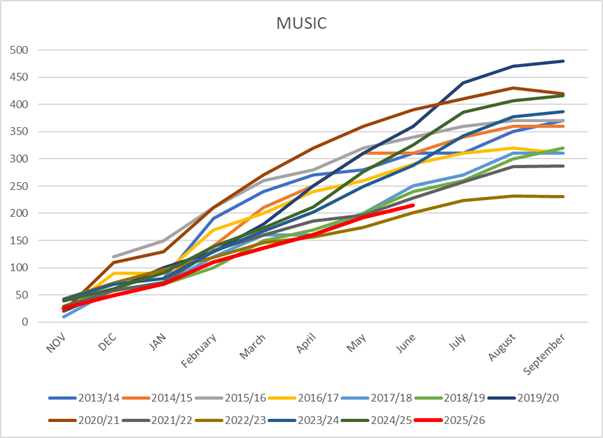
By the end of April, I had recorded some 389 vacancies for teachers of music. 86 of these were for promoted posts, with an allowance attached. It could be assumed that these vacancies were not intended for teachers straight out of their preparation courses. However, in some smaller secondary schools, this might be the only full—time post and include responsibility for choirs, orchestras and ensembles. However, for the purpose of this exercise, such posts have been eliminated.

After removing the promoted posts, this leaves some 303 vacancies suitable for new entrants into the teaching profession advertised between January and the end of April 2026.

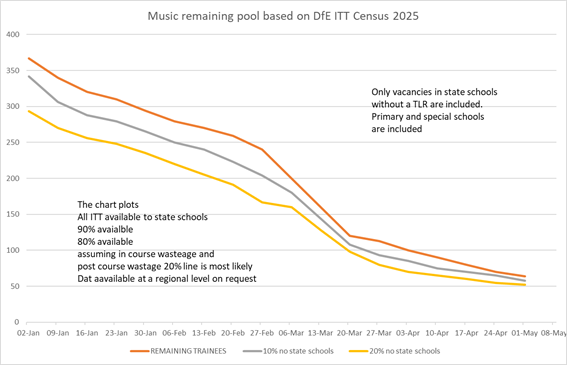
The DfE’s ITT census recorded some 367 trainees on preparation courses in December 2025; mostly for entry into the labour market in September 2026. Assuming all 367 entered the labour market for teachers in state schools, there are still sufficient to fill another 64 vacancies.

However, we know that not all trainees last the courses, and of those that complete the course, not all start teaching in state schools. Some entre the private sector; some further education; some music services and some don’t enter teaching at all.

As a result, the chart shows the remaining trainees available if 10% and 20% of trainees aren’t available to state schools. This approach reduces the remaining number of trainees to little more than 50 trainees. With around 75 vacancies a month so far in 2026, if May’s vacancies follow the pattern of the first four months of 2026, then the remaining total of trainees will be exhausted before the end of May, and resignation deadline day.

Of course, not all basic vacancies are filled by new entrants from teacher preparation courses: some are filled by returners – we can ignore school switchers as we can assume that leaving one school to fill a similar vacancy at another school is neutral in terms of jobs. However, if the move is for promotion, the there is a new vacancy.

Returners would need to fill around 30% of vacancies across the whole year – they are generally the only source of teachers for January appointments, so for September it looks as if schools will struggle to fill any late appointment resulting from resignations close to the 31st May deadline.  However, the picture will be clearer at the time of next month’s update.

Finally, although I do not track vacancies posted by private schools, both in England and abroad, I do survey the market. Generally, this market has twice as many vacancies as posted in any one month by schools in England.

One wonders whether the current cohort of new graduates might have missed out on gap year travelling because of the after-shocks from the covid pandemic and might, therefore be more willing to teach overseas? This has the advantage of not losing income to student loan repayment, and the bursary isn’t repayable.

On the negative side, the conflict in the Middle East may well be deterring some teachers from working in that part of the world, and may have increased the number of returners once more seeking a teaching post in England. We shall see.

Reviving Music Teacher Bursaries: A Necessity

Regular readers of this blog will know of my campaign to see the music bursary restored to graduates training to be teachers of music. Recruitment to ITT is well below the same level as last year, when there was a bursary.

Music teacher shortage: the situation worsens | John Howson and more recently ITT – 9 subjects with fewer offers than March last year | John Howson

I was therefore delighted to see this speech by a Labour peer in a debate in the house of Lords on Thursday.

 Baroness Keeley (Lab) 

The review found that inequalities in music education are substantial, with music showing the widest disadvantage attainment gap of any subject, driven by unequal access to instrumental tuition and wider inequities in school and community resources. I have also raised with Ministers the fact that music teacher supply is a related problem. Since 2010, we have seen persistently high vacancy rates for music teachers. In fact, in 2023-24, that vacancy rate was among the highest of all subjects, and the Department for Education has missed its music teacher recruitment target in 12 of the past 13 years. There was a small increase in recruitment during 2024-25, after the brief return of the £10,000 bursary, but recruitment still reached only around 40% of target.

The conclusion is clear. The music teacher bursary must be restored. The Government’s opportunity mission makes it clear that we want high-quality music and arts education for every child in all state-funded schools. The curriculum review has recentred music and arts as core to a rounded education, not as optional extras, and it has challenged the narrowing of the curriculum that has squeezed music out of timetables, particularly in disadvantaged areas.
Debate: Curriculum and Assessment Review – 26th Mar 2026 my highlighting

I would also welcome the comments in that debate by both Baroness Sue Garden and Tim Clement-Jones, Liberal Democrat Peers.

Despite the pressure on government finances, there really is a need to find a way to attract more graduates into training as music teachers. Any failure to do so will risk a Labour government committing the sin of removing music from out state schools, and leaving the subject residing just in the independent sector and international schools staffed by teachers trained in England.

Not only does music give great pleasure to many, it is also a major expert industry that the government ought to be nurturing. Two good reasons to reintroduce the bursary.

Of course, as Chair of the Oxfordshire Music Service Board, I have an interest to declare, but that interest isn’t contradicted by the evidence of declining enrolment, re-advertised vacancies and an apparent lack of interest in the DfE about the training of teachers of music for state schools. Presumably, they see this as a DCMS issue, since funding for music services is via the Arts Council.

Funding for teachers is, however, very much the brief of the DfE, and if they cannot find the cash for the bursary the they should urgently start work with the Arts Council to devise a scholarship scheme, such as already exists in certain other subjects. To do nothing is not an option if music is to survive in our state schools.

ITT – more applicants doesn’t always mean more offers

In my previous post, I noted the increase of nearly 6,000 I the number of candidates applying for a place on a graduate teacher preparation course. Up from 21,436 in March 2025 to 27,352 in March 2026. This post explores the relationship, both this March and last march, between candidates and places offered to those candidates.

Firstly, the number of candidates and the number of ‘offers’ to candidates in each secondary subject.

candidatesoffers
2025202620252026
BIOLOGY21612044713332
ART&DESIGN9601026451366
MFL18762246821733
PE1988221911491043
PHYSICS33296522825918
COMPUTING12702394341420
GEOGRAPHY1089843476292
OTHERS9261342281310
CLASSICS67623427
D&T661861273295
RE699693255208
MUSIC311275173136
MATHEMATICS4006534612771398
ENGLISH256128301032990
HISTORY11421281592624
BUS STUDIES607923132173
DRAMA336384162176
CHEMISTRY16622207441675

Note, not all subjects have seen increased candidate numbers within the overall increase.

Secondly, the next table shows the percentage of candidates so far ‘offered’ a place for 2026.

20252026Change
BIOLOGY33%16%-17%
ART&DESIGN47%36%-11%
MFL44%33%-11%
PE58%47%-11%
PHYSICS25%14%-11%
COMPUTING27%18%-9%
GEOGRAPHY44%35%-9%
OTHERS30%23%-7%
CLASSICS51%44%-7%
D&T41%34%-7%
RE36%30%-6%
MUSIC56%49%-6%
MATHEMATICS32%26%-6%
ENGLISH40%35%-5%
HISTORY52%49%-3%
BUS STUDIES22%19%-3%
DRAMA48%46%-2%
CHEMISTRY27%31%4%

Only in Chemistry, where because of the reduction in the size of the bursary to those applying for biology courses it seems likely that those with a choice between the two subjects have opted to apply for chemistry with its higher bursary for 2026. As a result, biology, with a 17% fall in offers this March when compared with March 2025, is the big loser.

Despite the change in candidate numbers, the percentages offered places in March 2026 follows a similar ranking to March 2025.

% offered
20252026
MUSIC56%49%
HISTORY52%49%
PE58%47%
DRAMA48%46%
CLASSICS51%44%
ART&DESIGN47%36%
ENGLISH40%35%
GEOGRAPHY44%35%
D&T41%34%
MFL44%33%
CHEMISTRY27%31%
RE36%30%
MATHEMATICS32%26%
OTHERS30%23%
BUS STUDIES22%19%
COMPUTING27%18%
BIOLOGY33%16%
PHYSICS25%14%

Music is such a specialist subject that it generally only attracts candidates likely to be accepted. However, current ‘offer’ levels are still well below those recorded in the first four years of the century when the number accepted ranged between 68% (2001) and 78% (2003). (Source: John Howson’s collection of GTTR Annual Reports). 2003 was after graduates training to be teachers received a training grant and were also exempt from tuition fees.

Of course, the most interesting percentage of ‘offers’ is that for physics, where only 14% of candidates have so far been made an offer. It looks as if the better candidates for biology are those that have opted to apply for chemistry in 2026, resulting in a significant fall in ‘offers’ in biology.

For subjects such as history and physical education, it is wise for candidates to apply early in the recruitment round since places fill quickly.

Finally, is the present system fit for purpose? Should there be a closing date by which all applicants will be considered,  rather than the drip feed approach as a present?

ITT – 9 subjects with fewer offers than March last year

Despite the increase in applicants for secondary ITT courses, from 21,436 in March 2025, to 27,352 this March, ‘offers’ from course providers are down in nine different subjects this March when compared with March 2025. The subjects with fewer offer so far this year are:

SubjectOffer March 2026Offer March 2025% change
Art & Design36645119%
Biology33271353%
Classics273421%
English99010324%
Geography29247639%
Modern Foreign Languages73382111%
Music13617321%
Physical Education104311499%
Religious Education20825518%

 I think one can discount both Physical Education and English from subjects where the declines are of concern. Elsewhere, the changes in bursary support are obviously having an effect. Those biologists that can do so are now applying for Chemistry – where there is still a bursary, and offers are up from 441 last march to 675 this March – but the overall offer across the two subjects are still below last March at 997, compared with 1,154 last March.

It is the arts subjects that seem to have been most badly hit. This is not surprising given the changes to the bursary scheme that saw the bursary axed completely for music and religious education, and reduced for biology from £26,000 to just £5,000, while it increased to £29,000 for chemistry.  French and Spanish also lost their £26,000 bursaries. The reduction in ’offers’ in geography, down by 39% may also be due to the cut in the bursary from £26,000 to just £5,000.

Given the need for fewer teachers in the future, as secondary school rolls start to fall, these changes to bursaries do look like a gamble. How much of a gamble will be clear when the DfE finally announces the ITT training targets. But my hunch is that music and religious education along with geography will join the list of subjects not hitting their targets unless the current global war affects graduate recruitment in the summer. Will there be a late surge of new graduates looking to teaching, similar to that during the early months of the pandemic in 2020? The jury is out for the moment, but such a surge would not surprise me. However, as a precaution, reinstating a scholarship in the arts subjects might be a wise precaution. This might make it look less like a -U- turn than a reinstatement of the bursary.

Elsewhere in the data, candidates form the ‘Rest of the World’ accounted for 30% of all candidates this March, compared with 21% last March.  The DfE really does need to show how this increase affects different subjects and how many of these candidates will be likely to receive a visa to both learn and then teach in England? Can we afford to waste funds on those with no prospect of teaching in England, while depriving potential home candidates of bursaries.

As expected at this time of year, there has been more interest from career changers than university students, with those under 24 showing an increase over last year of just 1,000 compared with an increase of more than 4,900 from those in the 25-39 age groupings.

Music teacher shortage: the situation worsens

Regular readers will know that I have been pursuing a return of the ITT bursary for postgraduates enrolling to train as a music teacher on courses starting in the autumn of 2026. This is a very small -U- turn for the government, but a necessary one for the subject, and its future in our schools and universities.

Previous posts on this blog have demonstrated that the removal of the bursary has already affected ‘offers’ to music courses, with a reduction of around 20 ‘offers’ in January 2026 compared with January 2025. Traditionally, any reduction in early-bird offers is not recovered later in the annual application cycle. Music ITT will miss its target: my reasoning | John Howson

This post looks at competition for teachers of music. There are three main areas for teachers to seek work as a teacher of music in a school: the state sector- including sixth form colleges; independent schools in England; private schools across the globe that seek to employ teachers trained in England.

Our starting point this year is the 367 trainees in music identified by the DfE’s annual census taken in December 2025. Add in Teach First and any late arrivals, and the overall total might be 380 – being generous.

Take of 10% for non-completes and those not choosing teaching as a career, and the labour market might have a supply of 342 trainees seeking work.

By mid-February, there had been 100 advertised vacancies by state schools for teachers of music without a TLR – i.e. classroom teacher posts. A well-used job board recorded 15 classroom teacher vacancies from independent schools in England on a single day in mid-February.

On the same date, the same job board, recorded 99 vacancies for teachers of music from schools across the world.  This was made up of 40 vacancies in The Gulf, primarily in Dubai and the other Emirates, but there were 13 vacancies from schools in China, and 46 from schools elsewhere in the world.

Now I don’t expect nearly qualified teachers to apply for these vacancies, but to the extent that these posts are not filled by teachers already working overseas, then these vacancies will take teachers away from schools in England, and create new vacancies.

Assuming only a third of these vacancies are filled by teachers leaving schools in England, and the rest filled in other ways that would be an extra 33 vacancies at present.

Adding together the 100 state school vacancies so far in 2026 to the 15 already recorded private schools in England plus the 33 overseas schools currently seeking a new teacher that might recruit from schools in England that produces a total of 148 vacancies by mid-February, or 43% of the available total of trainees. Increase the take by overseas schools to half of their current vacancies, and not far off half the available pool for September and January could have been offered a job.

Now, some of the vacancies in Egland will be filled by existing teachers changing jobs or returners to the profession, but most experienced teachers will probably be looking for a post with a TLR if seeking a move to another school.

With three months to go to the summer resignation date, and six months until terms start, the pool of available teachers already looks stretched, and this is with trainees that have enjoyed the bursary.

If the lack of a bursary shrinks the 2027 pool, because there are fewer trainees, is removing the bursary a sensible move? In my opinion, it is not, and the government should reintroduce the bursary for trainees starting preparation courses in autumn 2026 to be a teacher of music.

 We will continue to monitor the situation and report back through future blogs as the recruitment round unfolds.

Music teachers: bring back the bursary

Previous posts in this blog have drawn attention to the removal of the bursary for trainee teachers of music starting courses in September 2026.  Music is a subject that is short of qualified teachers. As a result, removing the bursary is not going to increase interest in teaching as a career, especially while the current debate about student loans and repayment issues is raging. As trainee teachers mostly pay fees, this could become an issue for intending teachers.

A previous post has shown that the number of ‘offers’ made in January 2026 to applicants for music teacher preparation courses was down from 91 in January 2025, to just 70 in January 2026 Why Music Teacher Bursaries Matter for Education | John Howson

Now, those teachers recruited for September 2026 courses will enter the teacher labour market in time for appointment as a teacher in September 2027. What is happening in the labour market for teachers now?

An analysis of some 57 vacancies advertised nationally in either the TES or on the DfE job board with a closing date between the 1st January 2026 and the 2nd February 2026, by state secondary schools, revealed a total of 57 posts advertised. Most were for ‘teachers of music’, with a few promoted posts either titled as head/director of music or some similar phraseology. By the 5th February, seven of these posts has already re-appeared with a new closing date: basically, if they were genuine vacancies, then they had not been filled, and were being re-advertised.

Should we be surprised that 14% of vacancies advertised in January were not filled. Perhaps not as it is really too early for most trainees to have commenced their search for a teaching post. However, it also suggests that there is not a pool of ‘returners’ waiting to pounce on a job as soon as it was advertised: at least in some parts of the country.

Perhaps even more disturbing, is that two of the vacancies are for Easter appointment: normally, a rare occurrence. There are also some other vacancies with April 2026 start dates still to reach their closing dates. The presence of these vacancies surprises me, as in the past such advertisements would have been a rare sight.

The data on vacancies, albeit from a small sample so far, suggests a market where some schools are struggling to recruit a teacher of music

This analysis of advertisements doesn’t tell the full picture, as it excludes advertisements by the independent sector schools, special schools and those larger primary schools seeking to appoint a music specialist.  Add those in and the number of vacancies already advertised this year is probably in excess of 100.

Then there are the posts for teachers of music in international schools that will take teachers out of schools in England. I am not sure whether anyone is keeping track of those numbers, but with the Labour government sanctioning a State School to open branches in India and The Gulf, in support of UK plc’s export drive, that factor will need to be taken into consideration when surveying the labour market as a whole.

In my view, there is now more than enough evidence to persuade any rational government to reinstate bursary for trainee teachers of music. But, does this government take rational decisions? Answers please, on a postcard or in the comment section.

Music bursary: a recurring theme

Earlier today, when I was turning out some old papers about teacher supply issues, I came across a draft for a paper I wrote more than 30 years ago on the subject of failing to meet the demand for music teachers.

Interestingly, in the notes, I compared the data for the shortage subject receiving a bursary in 1990 and 1991, with music that wasn’t a bursary subject.

As you might expect, music stood out, even in the early 1990s as an anomaly.

Take Table 31 from the Interim Advisory Committee report of January 1991. This table lists the percentage of unfilled teacher vacancies recorded in a joint union survey.  Music ranked 6th worst in the list. In the DES Press notice on vacancies, issued on 25th August 1991, music was third worst as a percentage of teachers in post, with a vacancy rate of 2.4%. This placed music behind only, ‘other languages’ at 7.2% and German, at 2.5%.

In a DFES document ‘Projecting the Supply and Demand of Techers’, published in December 1990, the Department accepted that projections suggested a shortfall of teachers of music. Interestingly, music was the only subject with a shortfall across all four scenarios modelled in the document. Even so, music did not at that time join the list of subjects entitled to a bursary.

Another DES press notice, of 27th November 1990 (382/90), probably associated with the census of ITT trainees, normally published about that time of year, also showed a deterioration in ITT places filled from 88.9% in 1889, to 71.0% in 1990, although the actual number of trainees had increased from 282 to 340. In 1990, only mathematics, at 63.3% of places filled had a lower percentage of filled places than music.

So, what do I deduce from the data about both recruitment into ITT, and teacher vacancies, from nearly 40 years ago? Perhaps that attitudes in the civil service towards certain subjects in the curriculum don’t change very much.

Maybe the turnover of civil servants with responsibility for ITT bursaries is so frequent that it doesn’t allow for them to start afresh each year in considering the data and trends in each subject.

However, even that approach doesn’t really explain the dropping of the bursary from music for 2026 entry. I think the profession needs an explanation. Otherwise, the axing of the bursary for music can be seen as a cynical ploy to say money in a subject Ministers don’t fully appreciate in terms of its contribution to both society and the growth agenda.

I think that the Arts Council, DCMS, and the music lobby have a right to know why music lost its bursary, and to ask that it be replaced.

 However, having seen how both the DfE and DCMS have recently handled the physical education grants, I am not holing out much hope unless there is a real campaign to reinstate the bursary for music, perhaps with some scholarships provided by private funders. Don’t let us lose music from our state secondary schools.

Music: the podcast on the case for a bursary

I have asked notebookLM to create a podcast of the previous post about advocating for the return of the bursary for ITT music courses in England. Save for a slight misunderstanding about ‘returners’, I think it is an interesting podcast. The docx mentioned isn’t where the absence of the music bursary is shown. The announcement is at https://www.gov.uk/government/publications/funding-initial-teacher-training-itt/funding-initial-teacher-training-itt-academic-year-2026-to-2027

As this is a new use of AI to amplify my text in the blog, feedback is welcome through the comments.

The podcast is at https://drive.google.com/file/d/1WlmxPOKsyNcG1rkUVARwx6kqLW_rtAj_/view?usp=drive_web

Why Music Teacher Bursaries Matter for Education

What is the point of bursaries for trainee teachers not on routes into teaching that pay a salary? The assumption must be that an inducement, such as a bursary would help recruit more trainees, or at least keep those that want to be a teacher on their teacher preparation programme. 

Each year, the Department for Education decides which subjects will be allocated bursaries. In some subjects, the DfE also works with other bodies, such as subject associations, to offer alternative higher amounts of funding through scholarships. Both bursaries and scholarships have the advantage of being tax free to the recipients.

In the days when the Conservative government championed the Baccalaureate subjects above all others, it was understandable that subjects not included in the Baccalaureate might be regarded of less concern than those that made up the Baccalaureate, and thus that these subjects did not need bursaries, even if an insufficient number of trainees were recruited.

However, for courses operating in 2024/25 and 2025/26, the DfE did pay a bursary of £10,000 to those training to become teachers of music.

The bursary for music was not included within the list of eligible subjects for the courses operating in 2026/27. No reason was provided by the DfE for the removal of the bursary.

However, recruitment targets for music have been missed in six of the last seven years including for the current trainee group (2019/20–2025/26).

The failure to recruit to target has meant fewer music teachers in schools, and a drop in entries to public examinations. Between 2010/11, and the start of the coalition government, and 2022/23, entries for A Level music declined from 8,709 to 4,910. Interestingly, the percentage of A* and A grades increased from 24.3% to 41.6%. This might suggest that it was State schools, with their wider range of pupil abilities that saw the biggest fall in entries, as schools struggling to recruit music teachers axed examination courses that they could no longer staff.

Interestingly, a by-produce of the break-up of schools into many academy trusts might have meant that opportunities for collaboration between schools also declined after 2010, and the Academies Act.

How bad has the challenge of recruiting teachers of music been over the past few years? Were the ITT targets set by the DfE, and based upon the DfE’s own Teacher Supply Model accurate or over-optimistic in the need for teachers of music in state schools?

Pool 
MusicJanFebMarchAprilMayJuneSeptOctNovDec
251201922718511655-57-104-253-172-196-215
25620202051467724-59-86-117-144-162-171
4162021390358303243161117784514-9
315202225620811912-128-214-305-352-395-422
228202315681-3-126-278-356
2024
2025
3302026265  

Data from TeachVac and dataforeducation

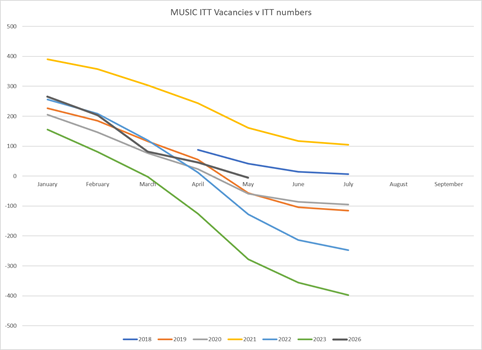
The table starts with the ‘pool’ of music trainees likely to be available to state schools that year and reduces it by one for every vacancy recorded during the year. The minus number is the excess of vacancies over the ‘pool ‘number

Between 2018 and 2023, only the cohort of trainees recruited during Covid, and entering the labour market in 2021, provided sufficient trainee numbers to have allowed schools to be secure in filling vacancies for September.

Of course, in addition to new entrants to teaching there are those returning to teaching or entering from other sectors, such as further education or independent schools.

As a rule of thumb, perhaps half of vacancies might be filled by new entrants, and the other half from other sources. The data in the table would suggest that in most years, if demand from private schools was also taken into account, the labour market would need to have ensured a steady supply of ‘returners’ to fill all the advertised vacancies for music teacher posts.

Each year, for January appointments, returners would have been critical for schools seeking to make an appointment, including those teachers returning to England from teaching in schools in the southern hemisphere, with a December year-end. Normally, somewhere around 100 vacancies for a January start were advertised each year between 2019 and 2022.

So, why, if there is a shortage of teachers, and the Teacher Supply Model did not seem to have been overestimated demand, was the bursary axed? Could it have been the age-old HM Treasury view that if there is a base number that would enter teacher training under any circumstances, then why pay them a bursary?

In the absence of any other explanation, it is difficult to think of any other reason than this cynical approach for the axing of the bursary for music. Put another way, Ministers just didn’t care enough about music, and weren’t aware of the contribution of all forms of music to the national wealth and our export drive to keep the bursary when it was suggested it be axed.

Sadly, the music lobby hasn’t yet changed the government’s mind. However, there is still time to do so for this recruitment round. The data showing the difference in ‘offers’ for ITT courses, between the January 2025 and January 2026 data points should, by itself, be enough to force a rethink, or a -U- turn, if you prefer it.

 2026 ENTRY TO PG ITT
 MUSIC
2025 TARGET565
OFFERS JANUARY 202670
OFFERS JANUARY 202591
TOTAL OFFERS 2025416
DIFFERENCE 2025 TOTAL AND 2025 January OFFERS325
PROJECTION for 2026395
ESTIMATED SHORTFALL170

A decline in ‘offers’ from 91 to 70 is of serious concern, as these are the group most likely to be prepared to become a music teacher at whatever cost. My advice to Ministers: announce the bursary for music has been added to the list for entry in 2026 or watch the subject decline even further.