Are rainy day savings by schools affecting outcomes?

Is there any relationship between the reserves a school holds and the outcomes for its pupils? One thesis might be that schools that spend more of their revenue budgets, and don’t add to their reserves each year, do better for their pupils than those schools more concerned with ‘saving for a rainy day’ or adding to their reserves for some other reason. Of course, this thesis only really works with a funding model that funds schools appropriately. Nevertheless, it is question worth asking.

This post looks at the evidence around the relationship between the quoted reserves of the primary schools across three multi-academy trusts (MATs) of differing sizes. The schools are in a range of different locations, and have a range of pupil numbers, but are all located within the boundaries of a single local authority.

KS2 achievement Percentage %No of KS2 Pupils 24/25 reserves per KS2 pupil
4230 £        24,333
6916 £        16,313
6422 £        16,273
3625 £        14,480
2711 £        12,364
9111 £        12,249
4715 £        10,600
3429 £        10,172
6913 £        10,077
5016 £          9,375
5016 £          8,688
3327 £          7,667
5645 £          7,267
5648 £          6,896
6916 £          6,813
6939 £          6,692
9315 £          5,933
5831 £          5,484
8318 £          5,287
8211 £          5,091
7218 £          5,000
6531 £          4,258
5022 £          4,182
5531 £          4,129
4821 £          4,098
7359 £          3,847
5028 £          3,536
7315 £          3,467
7528 £          3,214
4827 £          3,111
7061 £          2,738
6758 £          2,535
9123 £          2,531
5657 £          2,509
8323 £          2,087
5944 £          1,864
7131 £          1,677
5770 £          1,614
9212 £          1,362
5260 £              950
7629 £              862
7260 £              700
5618 £              611
4529-£         1,655
8614-£         1,714
7919-£         2,474
5831-£         3,084
867-£         3,295
8938-£         4,756
5315-£         8,667
4825-£       11,040

The range of reserves, as taken from the reserves in the accounts filed at Companies House by the MAT, vary per KS2 pupil from a high of £24,333 per pupil, to £611 for schools with those schools with reserves. Eight schools are shown as having deficits

Leaving aside, at this point for schools with deficits, it is worth comparing the other schools in the table with the average outcome for all pupils in the local authority of 62%.

The schools in the table, are of different sizes. In the schools in the table the range of KS2 pupils extends from schools with just 11 KS2 pupils, to one with 70 KS2 pupils. Where a school has a stable intake, the KS2 reserves per pupil is easy to spread across the schools, although some schools still start pupils, at age 5, many at age 4 and a few even younger and with a nursery class, and this may make a difference to reserves.

In this era of falling rolls, allied to parental choice, some school’s KS2 numbers would overestimate the school population if grossed up across all year groups. For that reason, I have just used the KS2 pupil number for this exercise.

Six of the top 10 schools with the highest reserves per pupil had achievements below the local authority level of 62%. This compares with four of the ten schools with the lowest reserves (not with a deficit).

It is interesting to note that one MAT has 12 schools in the top 15 schools with the largest reserves per KS2 pupil, and 15 in the top 20 schools. Of the other two MATS, one has three schools in the top 20 schools by reserves per KS2 pupil, and the other just two schools.

I suspect that both these MATs more actively work with their schools than the other MAT in terms of making use of their cashflow. All the schools in this latter MAT in the top 20 by reserves are also well above average for performance levels. The position is more mixed for the other smaller MAT, but I suspect its policy is evolving as it has acquired more schools.

How much does parental choice, and falling rolls play a part in determining reserves? Certainly, primary schools that have no spare places across all year groups will do better with a funding model that is weighted towards pupil numbers than schools unable to make full classes even by mixing year groups together. In another post, I will look at school size and reserves.

It would be interesting to conduct this exercise across all schools in a local authority. However, pooling of reserves by some MATs, and a lack of visibility for the reserves of maintained and voluntary schools makes that task effectively impossible.

No doubt the DfE could ask the question about why there is so much difference in reserves per pupil between schools, and could ask if some schools could achieve more for their pupils if they kept less in their reserves? School governors, MAT trustees and the teacher associations, as well as local politicians, might also like to ask this question.

Teacher Turnover- Is England doing better than the USA?

An interesting report crossed my desk a the end of last week. Teacher Turnover in the United States: Who Moves, Who Leaves, and Why | Learning Policy Institute This study, by Tiffany Tan, Wesley Wei, Desiree Carver-Thomas, and Emma García was produced the Learning Policy Institute, and first appeared in mid-March.

Key findings were that;

Teacher turnover remains high nationally. Between 2020–21 and 2021–22, 15.1% of U.S. teachers moved schools or left the profession: 8.0% moved schools, and 7.1% left teaching. Turnover rates have been largely stable over the past 2 decades but are now about 27% higher than in the early 1990s—an increase driven primarily because the rates of teachers leaving the profession increased by more than 50%.

Most teacher turnover was voluntary and preretirement. Nearly 3 in 4 teachers (74%) who moved or left did so voluntarily for reasons other than retirement. This percentage is higher than it was 10 years ago, when 67% of teachers left their schools voluntarily and preretirement.

Nearly half of teachers who moved schools stayed within the same district, and almost 40% of those who left teaching remained in the education sector. Among movers, 36.5% of teachers moved to a different district in the same state, while 17.3% moved to a different state. Of those who left teaching, 31.2% retired, whereas 13.1% took jobs in other sectors.

Teacher turnover rates vary across groups of teachers. 

It is interesting to compare this survey with the NfER’s recent Report on the School Workforce in England

School teacher retention has improved slightly in recent years, with the leaving rate falling from 10.6 per cent in 2016/17 to 9.5 per cent in 2021/22 and nine per cent in the most recent data. This has contributed to lower ITT recruitment targets and increased teacher numbers overall. The exit rate of first-year early career teachers who left within one year between 2023/24 and 2024/25 was 10.3 per cent, the lowest rate since the data began. (page 11)

The NfER conclusion seems much more optimistic than that of the US Report from LPI.

In contrast to previous NFER reports on the teacher workforce, the flows of teachers into and out of the labour market look reasonably healthy for the future of teacher supply. Recruitment is improving, even in some subjects which have seen persistent shortages. Teachers were less likely to leave the workforce last year compared to any year since 2010/11, outside of the pandemic. The early career teacher retention rate is the best on record. Teachers’ working hours are steadily coming down on average and the proportion of teachers who report having an acceptable workload has improved somewhat. Some progress has also been made in the competitiveness of teachers’ pay. Most teachers’ have received a pay increase of at least four per cent for each of the last four years, which has been higher than inflation over the period and even closed the gap – albeit only partially – that had opened up between teacher pay growth and average earnings growth since 2010/11. The increase in job insecurity and slowdown of job opportunities in the wider labour market is also likely to be a key factor driving recent trends (page 24) https://www.nfer.ac.uk/media/idcdsseo/the_school_teacher_workforce_in_england_annual_report_2026.pdf

This may be because the pupil population in England is in decline. The consequences are that there are fewer opportunities for teachers to move to different schools, and more teachers stay put. There is also less pressure on training numbers, so teaching looks like a more competitive occupation. While the economy and technology changes, such as the fear of the AI effect on graduate jobs may also be working to make teaching look more attractive as a career path in a more challenging graduate labour market.

However, I wonder whether many of the issues reported in depth in the LPI Report, such as the higher turnover of Black teachers; more turnover of teachers in certain subjects, and in certain types of school, may also be features of the labour market for teachers in Egland.  Certainly, we know that teachers from ethnic minority backgrounds fare less well in teaching than those from the majority ethnic community, as I have discussed in past posts. I suspect many of the other concerns raised by the LPI Report may also have credence in England were the data to be examined in that level of detail.

For issues around ethnicity and teachers in England, see my previous blog posts

Ethnicity issues remain for new teachers | John Howson

Ethnicity issues remain for new teachers | John Howson

Slow progress on ethnic minority headteacher numbers | John Howson

Falling rolls -who dictates the outcomes for schools: Parents or planners?

How do you deal with the issue of falling rolls in our schools? A senior politician recently told me that there was no way they would reduce the admission number for a successful school, because the parents wouldn’t stand for it.

Interestingly when Mrs Thatcher widened the concept of parental choice in section 6 of the 1980 Education Act, the civil servants left a ‘get out’ clause allowing local authorities to override their ‘duty to meet the expressed parental preference’ because it was ‘prejudicial to the efficient use of resources’.  Back in those days, the notion of parental power was very much in its early days.

Now the politician I spoke with was only voicing the approach any retailer might take to falling sales; cut out the loss-making branches and strengthen those that make a profit. ‘Let the weakest go to the wall’, a dictum many learnt in school when studying their Skaespeare.

But, should public services operate in the same fashion? It’s worth remembering that parents are required to educate their children, and the State is the default provision for those that don’t, won’t or in most cases cannot do so in any other way.

How the State has responded to that demand from parents for schooling has changed over time. A reader reminded me of the Liberal Democrat position, as expressed by Nick Clegg during the coalition government that perhaps took parent power to the ultimate. I wrote then a blog post entitled Private education, but State Funded? | John Howson This might have been a good idea at the start of a decade of rising school rolls, but does it hold good when rolls are falling?

I guess it depends upon where you live. In a densely packed urban area, with many schools within easy distance of each other, survival of the fittest might seem logical even if the fittest was a Church School and didn’t have many pupils on free School Meals.  However, even in urban areas, change is rarely easy, and often messy, and the current funding formula for schools doesn’t help.

Schools below capacity often run at a deficit, so should academy trusts prop these schools up with cash from other schools that don’t spend all their income?  Perhaps that’s why parent power – or at least parent governors – don’t exist in most academies, in case they rumbled what was happening.

In less urban areas, the issue is more complex. Consider the following case study. Imagine a town and its locality with 5 primary schools where there is little or no house building, and post-covid relatively little movement in the housing market. The current position for one such town

is shown in the table below.

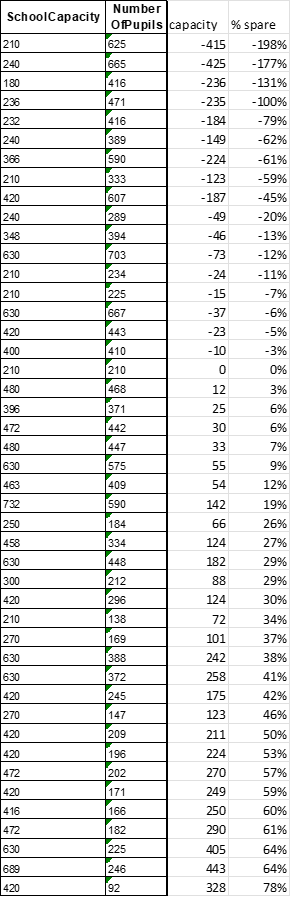
In total, the five schools had 857 pupils on roll, but with a capacity for 1141, so were operating at 75% capacity. Intake for the latest year was lower at 66% of capacity.

 TYPECURRENT ROLLCAPACITY% CAPACITYPlaces offered – latest
SCHOOL 1RC1182105613/30
SCHOOL 2CofE2993159545/45
SCHOOL 3COMMUNITY1782108516/30
SCHOOL 4ACADEMY1301966615/30
SCHOOL 5COMMUNITY1322106318/28

Schools 1-3 are in the town, and schools 4-5 are within easy travelling distance. The obvious answer might be to close one of schools 4-5, but that would create additional transport costs for the local authority; to be paid from Council Tax.

Closing the RC school is not possible, as the exiting pupils cannot be accommodated at the other two schools, as they have insufficient spare capacity, and the need would be for an additional 70 places over the current capacity. Should the RC school numbers fall further to less than 100-110, and intakes not increase at the other two town schools, it would be possible to close the RC school if each of the other two schools in the town could take an extra class. However, the restricted nature of their sites may that possibility unlikely.

What happens if the RC school remains open, and starts to run a deficit budget and, as a consequence, either the diocese eventually decided to turn the school into an academy or it is judged inadequate by ofsted, and forced to become an academy. Could the diocese transfer funds from other schools to keep the school open?

What of the future for schools 4 & 5 if they are faced with the same scenario of starting to operate on deficit budgets, and the risk to the local authority with regard to school 5 at a time of great pressure on the authority’s budget.

Should someone create a plan for the future. If so, who? The local authority, the Regional School Director, the DfE? Or does the desire of the parents for one particular school eventually affect the other four schools, and the market decides? Discuss.

For those that want to consider the issue further, I wrote a play around a school facing falling rolls in its locality to try to tease out some of the issues. You can access it at C:\Users\dataf\OneDrive\Documents\FallingRollsPlay.docx or by requesting a copy by using the comment section

Reader might also like this post from a decade ago. My concern about the future of small schools isn’t new. Are small schools doomed? | John Howson

Reviving Music Teacher Bursaries: A Necessity

Regular readers of this blog will know of my campaign to see the music bursary restored to graduates training to be teachers of music. Recruitment to ITT is well below the same level as last year, when there was a bursary.

Music teacher shortage: the situation worsens | John Howson and more recently ITT – 9 subjects with fewer offers than March last year | John Howson

I was therefore delighted to see this speech by a Labour peer in a debate in the house of Lords on Thursday.

 Baroness Keeley (Lab) 

The review found that inequalities in music education are substantial, with music showing the widest disadvantage attainment gap of any subject, driven by unequal access to instrumental tuition and wider inequities in school and community resources. I have also raised with Ministers the fact that music teacher supply is a related problem. Since 2010, we have seen persistently high vacancy rates for music teachers. In fact, in 2023-24, that vacancy rate was among the highest of all subjects, and the Department for Education has missed its music teacher recruitment target in 12 of the past 13 years. There was a small increase in recruitment during 2024-25, after the brief return of the £10,000 bursary, but recruitment still reached only around 40% of target.

The conclusion is clear. The music teacher bursary must be restored. The Government’s opportunity mission makes it clear that we want high-quality music and arts education for every child in all state-funded schools. The curriculum review has recentred music and arts as core to a rounded education, not as optional extras, and it has challenged the narrowing of the curriculum that has squeezed music out of timetables, particularly in disadvantaged areas.
Debate: Curriculum and Assessment Review – 26th Mar 2026 my highlighting

I would also welcome the comments in that debate by both Baroness Sue Garden and Tim Clement-Jones, Liberal Democrat Peers.

Despite the pressure on government finances, there really is a need to find a way to attract more graduates into training as music teachers. Any failure to do so will risk a Labour government committing the sin of removing music from out state schools, and leaving the subject residing just in the independent sector and international schools staffed by teachers trained in England.

Not only does music give great pleasure to many, it is also a major expert industry that the government ought to be nurturing. Two good reasons to reintroduce the bursary.

Of course, as Chair of the Oxfordshire Music Service Board, I have an interest to declare, but that interest isn’t contradicted by the evidence of declining enrolment, re-advertised vacancies and an apparent lack of interest in the DfE about the training of teachers of music for state schools. Presumably, they see this as a DCMS issue, since funding for music services is via the Arts Council.

Funding for teachers is, however, very much the brief of the DfE, and if they cannot find the cash for the bursary the they should urgently start work with the Arts Council to devise a scholarship scheme, such as already exists in certain other subjects. To do nothing is not an option if music is to survive in our state schools.

ITT – more applicants doesn’t always mean more offers

In my previous post, I noted the increase of nearly 6,000 I the number of candidates applying for a place on a graduate teacher preparation course. Up from 21,436 in March 2025 to 27,352 in March 2026. This post explores the relationship, both this March and last march, between candidates and places offered to those candidates.

Firstly, the number of candidates and the number of ‘offers’ to candidates in each secondary subject.

candidatesoffers
2025202620252026
BIOLOGY21612044713332
ART&DESIGN9601026451366
MFL18762246821733
PE1988221911491043
PHYSICS33296522825918
COMPUTING12702394341420
GEOGRAPHY1089843476292
OTHERS9261342281310
CLASSICS67623427
D&T661861273295
RE699693255208
MUSIC311275173136
MATHEMATICS4006534612771398
ENGLISH256128301032990
HISTORY11421281592624
BUS STUDIES607923132173
DRAMA336384162176
CHEMISTRY16622207441675

Note, not all subjects have seen increased candidate numbers within the overall increase.

Secondly, the next table shows the percentage of candidates so far ‘offered’ a place for 2026.

20252026Change
BIOLOGY33%16%-17%
ART&DESIGN47%36%-11%
MFL44%33%-11%
PE58%47%-11%
PHYSICS25%14%-11%
COMPUTING27%18%-9%
GEOGRAPHY44%35%-9%
OTHERS30%23%-7%
CLASSICS51%44%-7%
D&T41%34%-7%
RE36%30%-6%
MUSIC56%49%-6%
MATHEMATICS32%26%-6%
ENGLISH40%35%-5%
HISTORY52%49%-3%
BUS STUDIES22%19%-3%
DRAMA48%46%-2%
CHEMISTRY27%31%4%

Only in Chemistry, where because of the reduction in the size of the bursary to those applying for biology courses it seems likely that those with a choice between the two subjects have opted to apply for chemistry with its higher bursary for 2026. As a result, biology, with a 17% fall in offers this March when compared with March 2025, is the big loser.

Despite the change in candidate numbers, the percentages offered places in March 2026 follows a similar ranking to March 2025.

% offered
20252026
MUSIC56%49%
HISTORY52%49%
PE58%47%
DRAMA48%46%
CLASSICS51%44%
ART&DESIGN47%36%
ENGLISH40%35%
GEOGRAPHY44%35%
D&T41%34%
MFL44%33%
CHEMISTRY27%31%
RE36%30%
MATHEMATICS32%26%
OTHERS30%23%
BUS STUDIES22%19%
COMPUTING27%18%
BIOLOGY33%16%
PHYSICS25%14%

Music is such a specialist subject that it generally only attracts candidates likely to be accepted. However, current ‘offer’ levels are still well below those recorded in the first four years of the century when the number accepted ranged between 68% (2001) and 78% (2003). (Source: John Howson’s collection of GTTR Annual Reports). 2003 was after graduates training to be teachers received a training grant and were also exempt from tuition fees.

Of course, the most interesting percentage of ‘offers’ is that for physics, where only 14% of candidates have so far been made an offer. It looks as if the better candidates for biology are those that have opted to apply for chemistry in 2026, resulting in a significant fall in ‘offers’ in biology.

For subjects such as history and physical education, it is wise for candidates to apply early in the recruitment round since places fill quickly.

Finally, is the present system fit for purpose? Should there be a closing date by which all applicants will be considered,  rather than the drip feed approach as a present?

School building boom is over

The DfE has published its latest estimates of school capacity for 2024/25, together with estimates for places needed up to 2029/30 School capacity in England: academic year 2024 to 2025 – GOV.UK

There are two sets of numbers. One looks at both need and places available and calculates what might be regarded as a raw score. This looks at all spare places, regardless of location within the authority and measures that number against expected additional need. The second set just looks at additional need.

During the period between 2025/26 and 2029/30, most additional need is likely to come from changes in the housing stock, with little, if any, growth from the increase in the number of pupils in the relevant age groups. As a result, most local authorities show either no need for additional primary places or only small increases in numbers. Wandsworth is the only Inner London borough with any additional need for primary school places during the period 2025/26 and 2029/30.

The table balancing existing places with additional need shows only a handful of local authorities with a reduction in the spare capacity in the primary sector between 2025/26 and 2029/30. For most authorities, the spare place problem is expected to be worse in 2029/30 than it is in 2025/26

net spare places
OxfordshirePrimarySecondary
2025/26-11,052-6,321
2026/27-11,557-6,449
2027/28-13,117-6,959
2028/29-13,865-7,143
2029/30-14,601-7,336
Change-3,549-1,015

The table shows the estimates for Oxfordshire. Several factors could mean these data are not going to be accurate. In recent years, Oxfordshire has seen significant housebuilding, and if the construction of new housing continues, and attracts families from outside the county, then the spare places may be an overestimate.

Oxfordshire is also home to several military bases for both the army and the RAF. Although defence planning has projected the closure of some of the army bases, the current defence review and increased spending on defence might either slowdown or reverse the closure of some of the bases. If closures slow down, then this might mean pupil numbers don’t fall as expected.

The problem for both the local authority, the dioceses and the academy trusts is that Oxfordshire has many small primary schools located in villages. Often the school is the only facility left in the community. The present funding formula that is heavily biased towards pupil numbers poses a potential problem for small schools. Academy trusts can ‘vire’ funds between schools to help such schools through any temporary downturn in pupil numbers. At present local authorities do not have this ability: they should be given the power to support small village schools in the same way as MATs can.

However, as with many other rural areas, school closures look likely over the next few years if schools are not to run up deficit budgets. Such deficits would be paid off by depriving future pupils of some of their funding. With education spending likely to be squeezed to accommodate the increase in defence spending, and a greater proportion of the school funding going toward SEND pupils, there may well be some hard decisions to make.

With declining interest in established faiths, how will the dioceses react to falling rolls, if their schools are no longer viable?

One certainty is that if any school closures require additional free transport to the next nearest school, the current£20 million Oxfordshire council tax payers contribute to fund mainstream school transport will not be enough, even if fuel and other costs remain stable.

Local government reorganisation may offer a way out for politicians in areas such as Oxfordshire, but politicians in urban areas, and especially in London will not be so lucky. Time to dust off my review of falling rolls in Haringey in the 1970,s and the lessons to be learnt from those battles.

The war: bad news for schools?

The longer the current conflict, centred around Iran, continues, the more anxiety there must be within the DfE. After all, the DfE is the second largest spending department, after spending on the NHS and Social Care. The Ministry of Defence (MoD) ranks as the third largest spending department.

Recent trends within the DfE have included increased expenditure on special needs, and post 16 schemes to reduce the number of NEETS. I assume there is also monitoring the implications of falling rolls in the school sector under way.

I guess that there might have been some hope that one trend – more spending on SEND – might be balanced by less spending on the core school grant as a result of falling rolls. By abolishing a separate High Needs Block, the additional SEND spending could disappear into the core grant, leaving schools to sort out the mess on the ground.

This is not the post to discuss the relationship between DfE and NHS spending on SEND, and how the 2014 Act, unless amended, could be used by parents to hobble school’s discretion on how they meet the education requirements of pupils with EHCPs, especially if the Tribunal Service remains as it currently is. Suffice to say, there will become a point where SEND funding starts to impact on the rest of the DfE’s budget that is, if the total spend doesn’t increase.

Digression aside, my main concern is the extent to which increased spending on defence could hit the DfE’s budget? Spending on schools’ accounts for the lion’s share of the DfE’s budget, and I cannot see how it can remain unaffected as spending on the MoD increases, as it now inevitably will do, however short-lived the current war is.

There are also pressures from within the school system as a result of the White Paper’s non-SEND initiatives to be taken into account. I don’t know whether anyone has worked out the full cost of every school becoming an academy. But replacing 150 with 160+ local authorities after local government reorganisation, with perhaps ten times than number of academy trusts won’t come cheap.

Using civil servants to administer the system will be more expensive than using local government officers. One only has to look at the £38mn it cost to run the EFSA, and the £14mn it costs to run the Teacher Regulation Agency to wonder whether anyone in Whitehall has done the maths on full academisation of schools?

However, it is the military situation that must be the real concern for schools. Let’s assume that going forward the MoD needs an extra £15bn per year in expenditure in order to meet is 5% target of government expenditure: possibly even more if conscription is again on the agenda, after being through ruled out during the 2024 election campaign.

Increase defence spending, and unless the government has spare revenue to play with, and it seems likely that other budgets will be hit. Ring fence SEND spending, and what might be the consequences?

As staffing is the biggest item in any school’s budget, in the end any further slowdown in spending may well leave schools facing a choice between cutting low paid non-teaching staff or high paid teachers, burdened with student loan debt.

So, what might we see.

MATs closing schools that cost more to run than they bring in from funding steams and ‘unofficial’ parent support. At present, any transport costs will be incurred by local authorities, so that won’t deter closures.

Schools axing courses that cost more to run than the share of pupil funding they generate. On the wider scale, this might affect small sixth forms. After all, these are often staffed by the most expensive teachers, and can be a financial drain on the resources for Key Stages 3 and 4.

Will MATs be more ruthless than local authorities when it comes to closing small sixth forms, because they have no councillors worried about re-election demanding a school retain its sixth from? This is likely to be a real issue for Reform in the south of England where 11-18 schools are the norm. If Reform want a return to selective schools that also will come at a price.

If SEND spending is ring-fenced, and demand for EHCPs for mental health issues continues to grow, at some point it will eat into the funding for other pupils. At what point will there be a pushback?

Of course, a quick war, and peace in the Middle East, plus a less bellicose Russia, might mean there will be no threat to funding for schools. And government income might rise to cover the extra spending. Who knows, but it is better to hope for the best, and plan for the worst.

If I use Pupi Teacher Ratios as a measure of what might happen, then the unwinding of the benefits of the peace dividend since the late 1990s might have a more profound effect on the primary school sector than on secondary schools, although my guess is that neither sector will be unaffected. (PDF) PTRS OVER TIME: A REVIEW OF PUPIL TEACHER RATIOS BETWEEN 1974 AND 2024 AND TWO PERIODS OF LOCAL GOVERNMENT RE-ORGANISATION PTRS OVER TIME: A REVIEW OF PUPIL TEACHER RATIOS

The other interesting question is what will happened to salaries, and how far the outcome of national salary discussions will fetter schools spending choices? Perhaps one for another blog to discuss in more detail.