Discipline in schools – the latest data around suspensions and exclusions in one area

Now that the local elections are out of the way, it is time to consider other issues – However, I might blog about my thoughts about schooling when all the results have been published and considered.

Earlier this week the DfE published data for exclusion and suspensions by schools for the spring term 202425; i.e. last year. The data came along with time series data for spring terms back to before the covid pandemic, indeed, starting in 2016-2017 school-year; the spring of 2017. Create your own tables on suspensions and permanent exclusions in england – Explore education statistics – GOV.UK

It is worth recalling that during the period under review by the DfE school rolls across the secondary sector have been on the increase, mostly as a result of the earlier rise in the birthrate. Some areas, including the one under consideration have also experienced a significant housebuilding boom for most of the period under review. New housing usually means more pupils.

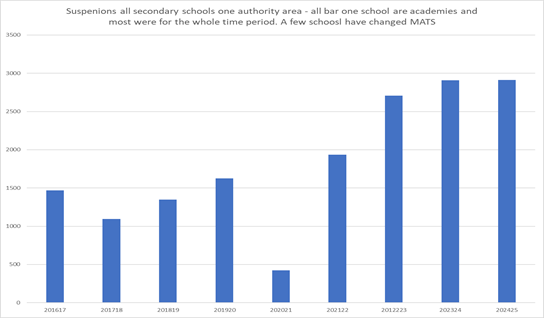
I looked at the data for both suspensions and exclusions for all the secondary schools in one current local authority area. All but one school are currently academies, and most have been for the whole of the time period. Some schools have changed academy trusts during the time period, and three new schools have opened during the period, and one 14-18 school has closed.

The schools already had noticeable numbers of suspensions before the covid pandemic. Since then, the numbers each year have been much higher, than before the pandemic, as shown in the chart.

The last three years for which data are available witness record numbers of suspensions, although not all schools have increased suspensions at the same rate. The range in the spring term 202425 was from one school with just 6 suspensions, to another with 291, albeit, this was one of the largest schools in the authority. However, it was not an urban school. Eight schools each recorded more than 100 suspensions in the spring term of 202425.

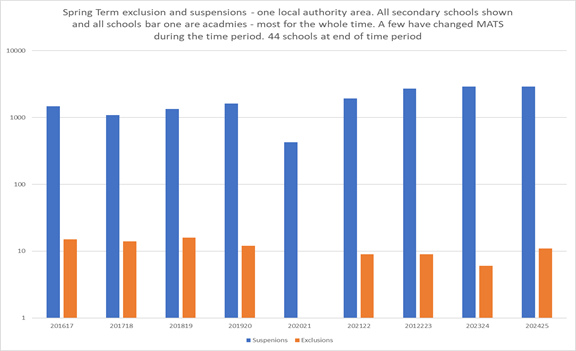
The picture for exclusions is much more encouraging, as can be seen on the following chart. This uses a logarithmic scale to plot both suspensions and exclusions. Exclusions across the authority have rarely exceeded ten in a spring term.

Of course, the total of suspensions for any one school can include multiple suspensions for the same pupil. The length of the spring term can also be affected by the changing date of Easter each year. This factor might have a small effect on each year’s data.

Of course, some pupils may not be ‘excluded’ at all, and hence not feature in these charts, but may be voluntarily removed to ‘home schooling’ by their parents. Whatever happens to pupils suspended or excluded, not being in school is more likely to see them become involved in a life of crime, often more serious crime than if they were in school on a regular basis.

Do some academy trusts have higher rates of suspension than other trusts among their schools? This is a challenging question to answer because it is clear that there is more likely to be a relationship between suspensions and the IDACI group in which the schools sits than the nature of the controlling MAT. However, it is clear than becoming an academy is not a panacea for solving the discipline issue of a school; at least as far as academies in this authority are concerned.  

Are suspension rates now on the way down? I hope so, but an not yet convinced that is the direction of travel. Time will tell.

Celebrating 100,000 Blog Visitors: A Thank You to Readers

Yesterday evening this blog received its 100,000 visitor, according to WordPress statistics. I would like to say a very big thank you to everyone that has read a post on this blog since I started it, way back in early 2013. According to Chat GPT, only 5% of blogs started in that year still survive. This blog not only survives, but is also thriving.

From time to time, WordPress suggest I make a charge to visitors to read previous posts. I have steadfastly ignored those blandishments in favour of open access for all. I am sure that policy has helped gain me extra visitors.

However, writing a blog does take time and effort, and if you know a library that might like to book of the 2013 posts, some of which WordPress no longer allows access to, please suggest they buy the book either as a e-book from Amazon or as a paperback from myself through the email at: dataforeducation@gmail.com

Once this book has covered its costs, I will publish another on the 100 most read posts – with a bit of commentary as to why they might have received so much attention. To date, posts about teachers’ holiday entitlements lead by a long way. It seems like the myth of long holidays is deeply engrained in the public’s psyche.

As someone that failed their English Language examination at age 16, I never thought that I would write a column for the TES between 1997 and 2010, and this blog since 2013. Sub-editors taught me a lot, and on-line software has helped. Interestingly, I have experimented recently with turning the text of a blog post into a webinar conversation. If you ae interested, I will leave you to search the 2026 posts for an example.   

In the past, comments were more frequent that they are these days, although ‘likes’ still seem to crop up from time to time. My thanks to those that ‘like’ every post I write. I am not used to having such a fan base.

My especially thanks to, Janet D, Frank S and Sue B for their many comments. Along with teachingbattleground, they make up the most frequent commentators over the years on my posts. Frank was at school with me, and I still remember his part in TCS plays.

Where now for the blog? Well, I hope to keep it going for some time yet, as there is certainly plenty of material to write about. My special field is the labour market for teachers and, especially, headteachers, where I have more than 40 years of data from my research. Later today, I will post, as my next blog post, about how my findings compare with a report that was published yesterday. AI can do some things, but it still has much to be taught to make it even more useful as a research tool.

So, once again, thank you to my audience, whether you have just read one post, have delved into the archive as part of research for a project, or are one of the small number of regular readers.  

30th April update

A, my thanks to you, the readers for the best April ever for the blog. 2,000 readers over the courses of the month!

Thank you.

Think Tank weighs in on SEND

Policy Exchange, the Think Tank that describes itself as ‘the UK’s leading think tank’, and ‘an independent, non-partisan educational charity whose mission is to develop and promote new policy ideas that will deliver better public services, a stronger society and a more dynamic economy.’ Has published a new report on SEND, with a foreword by a former Conservative Chancellor of the Exchequer.

The report contains a great deal of interesting evidence, much of which will already be know to anyone that has been involved with the emerging crisis in SEND that was already apparent from well before the covid crisis hit in 2020. Policy Exchange – Out of Control

A telling paragraph in the report lays bare the need for action

The SEND system established by the Children and Families Act 2014 and the 2015 SEND Code of Practice is inefficient, ineffective and has failed to deliver improved outcomes for children with SEND. Fundamental flaws have created perverse incentives for actors in the system. The current SEND regime was designed to support a much smaller number of acute cases. It has failed to adapt to changing social definitions of SEND that have widened demand. Instead, the concentration of resources and bespoke support at the top end of the spectrum has prompted an escalation of needs which has overwhelmed the system and undermined its long term sustainability. (Page 66).

The paragraph leaves one wondering why the Conservative government that was responsible for the 2014 Act didn’t take action to deal with the problem when in office?

In December 2018, I wrote a blog SEND on the agenda again | John Howson drawing attention to a report from the Local Government Association. There was already concern in local government circles about what was happening in SEND. It is worth repeating the key points from the LGA report.

Addressing the points raised in paragraph 17 of the Report would go a long way to creating a sustainable and successful system for young people with SEND.

  1. To create a more sustainable funding settlement going forward there may be merit in considering some key questions around how incentives in the system might be better aligned to support inclusion, meet needs within the local community of schools, and corral partners to use the high needs block to support all young people with SEND as a collective endeavour. These might include
  2. setting much clearer national expectations for mainstream schools;
  3. rethinking how high stakes accountability measures reflect the achievements of schools which make good progress with children and young people with SEND or at risk of exclusion;
  4. correcting the perverse funding incentives that mean that it can be cheaper to pass the cost of an EHCP or a permanent exclusion onto the high needs block than making good quality preventative support available in-school;
  5. looking again at the focus and content of EHCPs to afford greater flexibility to schools in how they arrange and deliver the support needed;
  6. providing ring-fenced investment from government designed explicitly to support new and evidence-based approaches to early intervention and prevention at scale;
  7. providing additional capital investment and flexibility about how that can be deployed by local government;
  8. issuing a national call for evidence in what works for educating children and young people with these needs, backed up by sufficient funding to then take successful approaches to scale and a new focus for teacher training and ongoing professional development;
  9. more specific advice for Tribunals, parents and local authorities on how the test on efficient use of resources can be applied fairly when comparing state and non-state special school placements; and
  10. reaffirming the principle around the equitable sharing of costs between health and education where these are driven by the health needs of the child or young person.   

https://www.local.gov.uk/have-we-reached-tipping-point-trends-spending-children-and-young-people-send-england

Failures by the conservative government up to 2024 to provide enough educational psychologists to meet the growing demand, and to not index-link the basic grant to schools helped produced a system where the explosion in demand broke the system.

While any report with an analysis of the problem and suggestions for how to tackle it, ahead of the present government’s White Paper, is welcome, we should not have reached the current position.  

One final point, the report seems light on the issue of training for all staff from TAs to teachers to school leaders. The lack of an appreciation of the needs of those that work in schools has been another feature of the long period of Conservative government.

I look forward to see what the Labour government’s White Paper will suggest when it appears.

Is discipline worse in schools?

It was interesting to hear Laura McInerney and Tom Bennett on the ‘Today’ programme on BBC Radio 4 this morning discussing whether or not behaviour was worse in schools these days than in the past. Both are experienced commentators, and Tom led a review in 2017 for the then government, about behaviour in schools. It is also interesting to see the BBC taking an interest in schools. The World at One last Sunday (also BBC Radio 4) devoted the whole of the programme to an analysis of the SEND issue. Interestingly, there was no government spokesperson available on Sunday, so they had to make do with the chair of the Education Select Committee.

The discussion this morning was around whether or not behaviour had worsened in schools, and if so, why? The usual suspects, covid and mobile phones were trotted out in support of discipline being worse in schools, along with families facing multiple challenges, but there were precious few facts.

One way of measuring the state of discipline in schools is by looking at the number of permanent exclusions each year by schools.  The largest single reason each year for these exclusions is always ‘persistent disruptive behaviour’. So, this might be seen as a good proxy measure for how schools are faring in relation to discipline in the classrooms. Of course, this measure doesn’t pick up low level disruptive behaviour, but it is reasonable to assume that there is a correlation between the different levels of behaviour in schools.

Looking back over the past 30 years, the level of recorded permanent exclusions was 10,440 in 1998/99. The level fell to 5,040 in 2010/11. In the latest year, 2023/24 there were 10,885 permanent exclusions. On the face of it, discipline is getting worse again, but is only back to levels last seen at the end of the last century.

I would like to suggest to causes not mentioned on the ‘Today’ programme: teacher supply and school funding. Is there a causal relationship between the fact that permanent exclusions were at their lowest when schools were fully staffed, and had experienced a period of several years of significant funding by government.  By contract, permanent exclusions seem to rise when there is difficulty staffing schools, and when funding is less than might be expected in a civilised society.

So, is the answer as simple as proper funding and staffing if you want fewer exclusions? The age and experience of the teaching force might also play a part. More experienced teachers, as I can testify from personal experience, are much less likely to face discipline issues then new entrants, especially if they are unqualified.

In the latest statistics on exclusions, 13 of the 25 local authorities with the lowest rates of permanent exclusions were London boroughs. This just adds more evidence to my thesis that if the rest of the country were funded like London, schooling would be in a much better place across the country.  Although I was also pleased to see Oxfordshire in 10th place overall for the lowest rate of permanent exclusions.

Homelessness and schooling

Is the education of children made homeless well enough safeguarded? Compared with the education of children in some of the world’s worst trouble spots, this may seem like an irrelevant question to ask of society in England. However, as a recent report from a House of Commons Select committee has made clear there is more that we can do in this country for this group of young people. England’s Homeless Children: The crisis in temporary accommodation

I am slightly surprised that the Housing, Communities and Local Government Select Committee didn’t decide to conduct a joint inquiry with their colleagues at the Education Select Committee on this topic, but, perhaps, they initially didn’t think that schooling would be an important feature of their report.

Homlessness almost always means a move from one accommodation to another. For a school-aged child this can have one obvious consequence; their status has changed. This change in status isn’t something the family is likely to share easily with the school, although I suspect sensitive primary school class teachers and heads will notice the change fairly quickly. In secondary schools, unless the class tutor picks up on the change, it may well go unnoticed until it becomes an issue.

The most likely issue for schools is that the change in accommodation may mean a different, and possibly longer route to school. This might mean children that used to arrive on time may now be late through no fault of their own. The temporary accommodation might also not provide adequate space for learning and homework, so that might deteriorate as well. How schools deal with this situation explains a lot about their policies and the values behind them.

In more extreme cases, homelessness means that a child must change school mid-year, with all the attendant bureaucracy that entails. The Select Committee were concerned that there was no requirement to inform schools.

‘Currently, schools are not always notified when a pupil becomes homeless or changes school due to a move into temporary accommodation. This prevents schools from offering additional support which those children may require. Similarly, GPs are often unaware that families are experiencing homelessness, leaving an incomplete picture of the health impacts of homelessness on children’

The Committee recommended that

‘As the Government seeks to establish ‘consistent identifiers’ for children through its Children’s Wellbeing and Schools Bill, it should ensure that these can be used as a formalised notification system, so that a child’s school and GP are alerted when they move into temporary accommodation.’ Page 30

At least the current Bill before parliament will stop academies and Trusts from stonewalling on accepting in-year admissions.

I would go further an require a child moving school to be placed on the roll of a virtual school run by the receiving local authority, if a school place could not be identified within two weeks, regardless as to how long or short the period of homelessness might be. Children need some degree of support and continuity and to see that their schooling is important to those responsible for supporting the family.

1,500 posts and counting

When I wrote my first post on this blog, on the 25th of January 2013, I little though that I would reach 1,500 posts. However, despite stopping posting for 18 months, between the autumn of 2023 and May this year, while I was otherwise occupied as a cabinet member on Oxfordshire County Council the blog has now reached the milestone of 1,500 posts, including 40 so far this year since I started the blog up again this May.

Since one of the features of the blog has been commenting on numbers, here is a bit of self-indulgence. The blog has had 175,983 views since its inception, from 93,875 visitors, and has attracted 1,459 comments. The average length of a post has been between 550-670 words, although there have been a few longer posts in response to consultations and Select Committee inquiries.

How much holiday do teacher have? is the post with the most views – more than 6,500 and rising. Some posts have had no views, but are still an important record of my thoughts. The United Kingdom has been responsible for the most visitors: not a surprise, as most posts are about education in England. However, the USA comes second, with more than 15,000 views. Apart from some former French speaking countries in West Africa, Greenland and Paraguay, almost all other countries have had someone that has viewed the blog at least once.

Later this year, I will be publishing a book of the 2013 posts from the blog, and at that point they will disappear from public view. If you want to register for the book, check on Amazon after August 2025 or email dataforeducation@gmail.com for publication information. Alternatively, ask your favourite bookshop or library to order a copy.

I am sometimes asked about my favourite post. With 1,500 to choose from, that’s difficult, as many haven’t seen the light of day for a decade or so. However, Am I a blob? From 2013, was fun to write, and the posts about Jacob’s Law finally brought about a change in the legislation over admissions in the current bill going through parliament.

Most posts have been written, as this one is, in one session from start to finish, with editing just to tidy up my thoughts. Some are more passionate than others, and many are about teacher supply issues, where I am also researching a book on the subject covering the past 60 years of ‘feast and famine’. Much of the recent history has been well chronicled in this blog.

Thanks for reading, and for the comments. Who would have thought that someone that failed ‘O’ level English six times would end up writing a blog!  Funny old world.

Do better funded schools exclude fewer pupils?

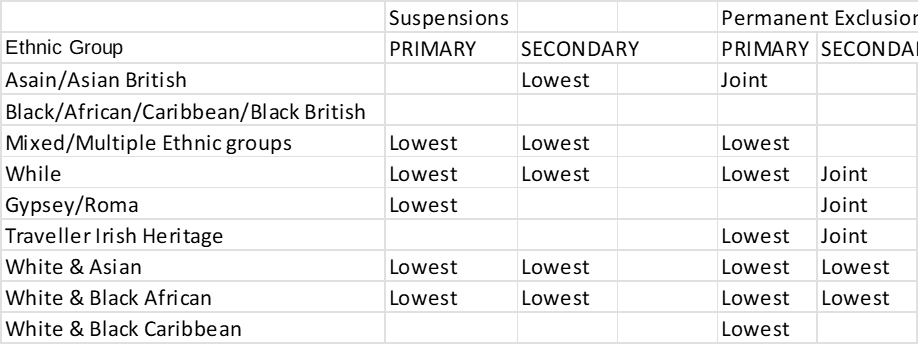
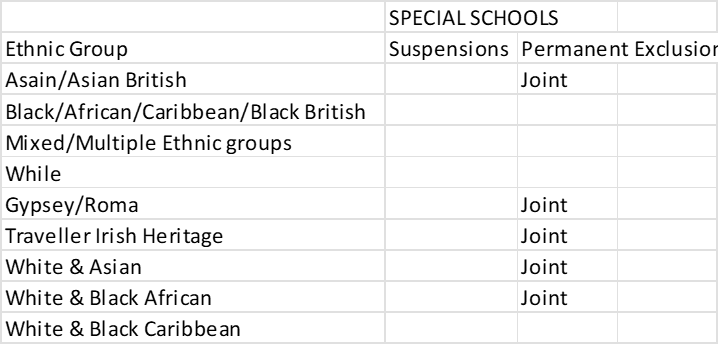
The DfE published the annual data for exclusions and suspensions from schools during the 2023/24 school-year this week. Suspensions and permanent exclusions in England: 2023 to 2024 – GOV.UK Sadly, there are more pupils being excluded than in recent years, and my post from July 2018 Bad news on exclusions | John Howson reflects much , at least at the national level, of what is contained in the latest report on 2023/24. Boys on free school meals, and with SEND, and from a minority group are at highest risk of being excluded, especially when they are in Year 9, and, as ever, the reasons is most likely to have been ‘persistent disruptive behaviour’.

With the worsening recruitment crisis in schools, allied to a challenging financial environment, an increase in exclusions and suspensions was to be expected. What the data doesn’t tell us is whether schools with high exclusion rates are linked to specific academy trusts, and also to high levels of teacher turnover.

I wrote a blog about policies for reducing exclusions in May Reducing exclusions from schools | John Howson and I would hope that if the staffing situation does settle down, so might the number of pupils being banished from school.

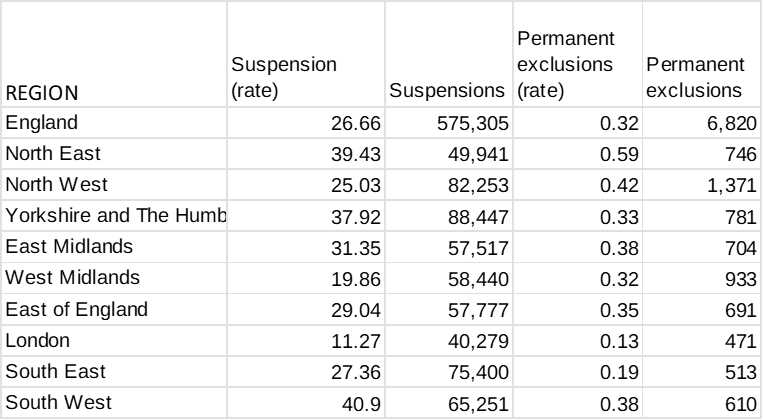
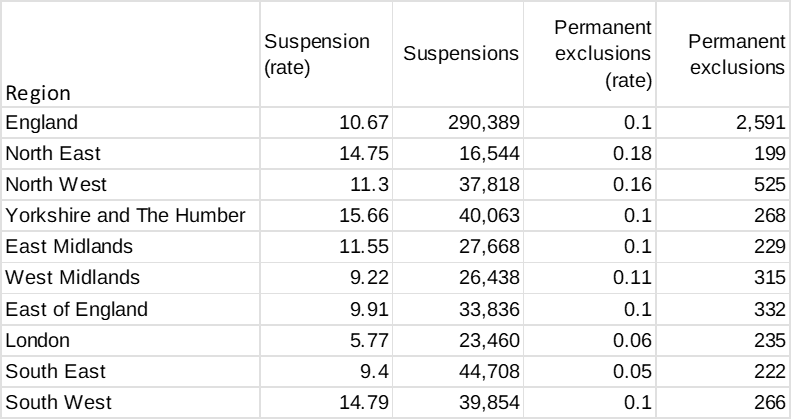
As ever, I am struck by the funding issue. London, the best funded part of England has some of the lowest rates for exclusion and suspensions. There are 17 London boroughs in the list of the 25 local authorities with the lowest rate of suspensions in 2023/24, and 19 in the similar list for secondary exclusions. In the list of ten local authorities with the highest rates of exclusion are five authorities in the North East. I think that there may be something in this data that needs further exploration, especially as I would expect teacher recruitment to be easier in the North East than in London.

Interestingly, in view of the debate about mobile phones in schools, the number of suspensions for ‘inappropriate use of social media or online technology’ only increased from 11,419 to 11,614, an insignificant change between 2022/23 and 2023/24 especially compared with the increase in exclusions for ‘persistent disruptive behaviour’ from 446,676 to 569,921 over the same period. Of course, much comes down t how a decision on which box to tick when the exclusion is being reported and the latter category may hide suspensions that actually belong in one of the other categories. This is the risk when there are too many choices for a school to make.

The increase of around 25,000 in assaults leading to suspensions must be very worrying, although I wonder whether most are ‘common assault’ rather than ‘assault leading to actually bodily harm’ or ’GBH’ to use the criminal code levels of violence against another.

Some numbers are so small it is a wonder that they are still collected. Were only 69 pupils – up from 50 the previous year- permanently excluded for theft. Perhaps schools have nothing worth nicking these days.

I hope that next year, we might read of at least a levelling out of the rates of exclusions and suspensions and perhaps a return to a downward trend, especially if there is a relationship between funding and how schools can cope with disruptive pupils.  

SEND parents need support now

I have written three posts about SEND since I restarted this blog in May, on the override; EOTAs and more generally. As a result, I was going to sit out the present debate about what might happen in the autumn without making any further comments. However, I thought this paragraph by John Crace in the Guardian was the best summary I had seen about where we are one year into this government. Labour picks on kids as Farage reaches for his human punchbag

‘Now, Send is not perfect. The bill is getting bigger by the year, thanks both to better diagnosis and to some parents gaming the system. But it is essential for many children who benefit from education, health and care plans, and parents are worried sick they might lose out. In the absence of any clear direction from the Department for Education, many disability campaigners are fearing the worst. That children will be treated as cost centres to be downsized. That children diagnosed in the future won’t be entitled to the same benefits as children with the same level of disability are now. This one will now run and run well into the autumn.’

It is going to be a worrying summer for many parents, and that isn’t fair on them. I am all for looking at how the system is being gamed – see my blog about EOTAS – in some ways by a few parents, but most parents are genuinely worried. SEND is the only issue I ever saw a parent cry in a cabinet meeting when trying to prevent a reduction in the spending on transport. These parents have a heavy burden of love to bear, and the State should remember that.

However, the elephant in the room, and one John Crace doesn’t mention is the NHS. Afterall EHCPs replaced Statements of SEN Need. One big difference was the addition of the letter ‘H’ for health. So far, all the attention has been on local authorities, and the NHS rarely receives a mention.

Now I think that as soon as it is obvious that a child will need an EHCP, the NHS, whether maternity unit or GP surgery, should always start the process. It should not be left to a primary school headteacher to so often have to begin the process of applying for the EHCP.

At the same time, the NHS might want to look at early screening for conditions affecting early learning, and put in place a much stronger programme than at present.  

SEND is also an area of life where we need to be clear about what we want from the Early Years Sector. The sector has a part to play in early identification of issues in learning, and surely staff need better training to both observe and report these early learning issues. Much has been taken about the transfer from primary to secondary school, but hardly anything about the knowledge transfer into the school system from early years. Of course, where the school has a nursery class, transfer should be straightforward. But what of other children, and especially those that spend most of their early years in the care of relatives or live in isolated in rural areas?

The government seems to like leaks, so how about some positive leaks around SEND? The government must not go on holiday leaving these parents to suffer over the summer.  

Are teachers losing control of classrooms?

A recurrent theme running through the recent DfE’s ‘Working lives of teachers and leaders: wave 3 Summary report November 2024’ Working lives of teachers and leaders: wave 3 – GOV.UK is that teachers seem less happy about pupil behaviour than in the previous reports.

In this report, 44% of leavers from teaching cited pupil behaviour as a reason, up from 32% in the previous study and a statically significant change compared to the 2024 study. Not yet at the level of ‘high workload’, cited by 84% this year, up from 80% last year and the top reason in both years.

Nor is it yet at the 47% level of those citing government initiatives/policy changes, although it is worth noting that eight per cent fewer leavers cited this reason this year compared with last year.

Other pressures and stress are still also at the top of leavers reasons for quitting, but dissatisfaction with pay, never near the top of the list of reasons fell by five per centage points to 34%. No doubt both the government and the professional associations will be looking closely at that figure as will be those advising the School Teachers Review Body. Conditions of service seem more of a concern than pay at this point in time.

The point about pupil behaviour is reinforced in the table showing the views about discipline deteriorating among both teachers and school leaders completing the survey. In the 2022 survey 18% of teachers and 5% of leaders said that pupil behaviour was either ‘poor’ or ‘very poor’.  By the 2024 survey the reporting levels were 27% and 8%,

It would be interesting to know more about his change. Is it across all teachers and leaders; worse in the secondary sector than primary schools and what, if any, role has increased absence rates played in deteriorating views of pupil behaviour?

Perhaps more worrying was the findings that although

“around eight-in-ten (79%) leaders with teaching responsibilities reported that they felt always or mostly supported to deal with disruptive behaviour (consistent with the 80% in 2023 but lower than the 85% in 2022).”

But those bearing the brunt of classroom teaching, teachers with teaching responsibilities were less positive,

 “with 49% reporting feeling always or mostly supported with dealing with disruptive behaviour (lower than the 52% in 2023 and 58% in 2022).”

Not surprisingly, there have been declines in those teachers and school leaders viewing classroom behaviour as very good over the same period.

Is this change a consequence of the deteriorating staffing situation in secondary schools in recent year, or is it a reflection of the debate about mobile phone use in the classroom? It would be interesting to know more about the types of school and ages of the teachers reporting the deterioration in pupil behaviour to see how widespread the decline is among teachers.

At these levels this is certainly a flashing amber light, but not yet a full-blown crisis, but all concerned will need to understand the reasons why classroom behaviour is deteriorating.

A Virtual School for those missing school?

The House of Commons Education Select Committee inquiry into SEND has been in existence for around six months. Such was the volume of evidence submitted to the inquiry that some of the evidence has only just been published. Among the submitted evidence published this week was that from Oxfordshire County Council. committees.parliament.uk/writtenevidence/137147/pdf/

The section of their evidence that interested me most was contained in paras 15-17 about the idea of a virtual school.

Online schooling

15. Oxfordshire County Council’s Virtual School, a service which supports children in our care with a suitable educational placement that meets their needs, has taught the council some valuable lessons in maintaining an educational presence for children.

16. Some children with SEND, especially those for whom education in a school or other education institution is not appropriate, are supported through an ‘Education Other Than At School’ (EOTAS) mechanism. EOTAS provision is usually intended to be short-term, with the goal of finding a more suitable school placement for the young person as soon as possible.

17. We believe it would be worthwhile for the government to explore the creation of a virtual school to support the needs of children with SEND, for whom education in a school setting is not appropriate. This would enable every child to remain on the roll of a school, maintaining funding and visibility for them, and continuing their education whilst a more appropriate long-term placement can be found. Such a school might also be appropriate for other children missing education, such as those arriving with EHCPs mid-year, when no immediate special school places are available. A virtual school would therefore be able to provide continuity of education.

This is an interesting idea that might merit some further discussion as it would clarify the role of the State in educating all children where the parents have entrusted their education to the State.

I wonder whether such a school might also be where excluded pupils could be enrolled if a new school or Alternative Provision has not been found for them. Unlike to present Virtual School for children in care that operates where children are on the role of an actual school, and provides additional support, the New VS would be an actual school, and could require virtual attendance twice a day to help with checks on progress and attendance.

Enrolment in such a VS would also ensure no child was missing school, as too often happens at present when pupils either arrive mid-year into a local authority or are excluded from a school with no new destination.

Such a virtual school might significantly reduce expenditure on private providers as well as ensuring parents did not have to complain to the Local Government Ombudsman that their child had fallen off the radar. Every child in the authority that parents want the State to educate would then be receiving an education every day of the school-year. The school would be free to offer after-school activities and to bring groups of its pupils together where learning in person was appropriate.

The aim should be to manage resources so that children pass through the VS on their way to a learning placement that is suitable for them.  As such, it should replace most packages of ‘education other than at school’ that were never originally designed to be long-term solutions, and too often leave pupils with no check on their development and limited group activities, even on-line where children cannot physically meet together.

Whether the VS could provide all the extras, such as work with animals or other individual sporting instruction in some EHCPs is an interesting area for discussion. Where it clearly aids learning it should be delivered and the volume generated by pupils at the VS should help provide more cost-effective services and coherent local authority wide provision. The VS might also be responsible for monitoring the learning outcomes for pupils where the local authority is paying for pupils to attend fee-paying schools or colleges.