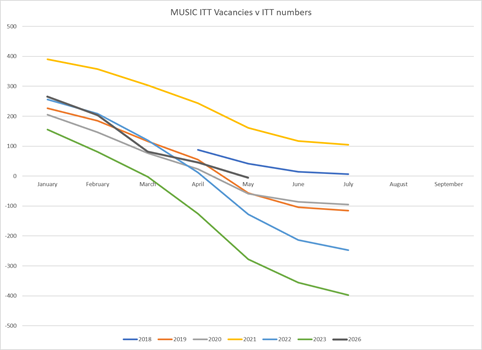
As part of its monthly review of applications by graduates to train as a teacher, this blog has often commented upon the issue of whether there will be sufficient new teachers of music. This blog has also condemned the withdrawal of the bursary for music by the Labour government.
Recent posts include:
Don’t let this government kill off music in state schools. | John Howson July 2026
Music ITT: has the government made a mistake? | John Howson June 2026
Reviving Music Teacher Bursaries: A Necessity | John Howson
These posts are all related to the supply side of the question about how many music teachers are needed each year to staff the state school system in England. The DfE answers that question using the Teacher Supply Model, basically an algorithm using past data that can be problematic when future needs don’t follow past trends.
For most of the period between 2015 and July 2026, I have been tracking actual demand for music teachers in state schools, as recorded through advertisements. Tracking adverts has the added advantage of not only assessing demand for classroom teachers, but also looks at trends for subject leaders in music, and the extent to which they are part of larger groupings of arts and creative subjects. Tracking vacancies can also highlight areas where demand is not being met easily, but highlighting where vacancies are being re-advertised.
I have already posted a couple of blogs so far this year on demand:
Labour market for music teachers: update to end of April 2026 | John Howson
Demand for music teachers: where were the jobs in early 2026? | John Howson
During the summer, I have been working on a report considering a number of factors around the vacancies for music teachers. The report:
The Demand for teachers of music: January to August 2026
Is now available from dataforeducation@gmail.com
Part of the conclusion to the report states that;
‘It will not be known until December 2026 as to whether trainee numbers are sufficient to meet the needs of schools after taking into account the number of returners to teaching. However, the fact that some 20% of posts were readvertised during the survey period does point to some pressure on the pool of possible applicants. There certainly seems to be only a small reserve at best. ‘
Music is an important art of the nation’s cultural heritage and identity, and the State, through schooling, has an important part to play in recognising the breadth and depth of that heritage, and encouraging future generations to continue and develop it in ways never imagined when I was at school.
To ensure a pipeline for the future, especially if university departments continue to axe music degrees, then the music community in schools should consider creating a teaching apprenticeship for those young people that are good at music and might want to become a teacher. Creative thinking about developing future teachers of music is an imperative. Now, who will take the lead? The new National Centre? Unlikely? So, it is up to the community, and perhaps MusicMark to think deeply about the issue of where the next generation of teachers of music will come from in a changing world of higher education. A teaching conservatoire?