Falling rolls -who dictates the outcomes for schools: Parents or planners?

How do you deal with the issue of falling rolls in our schools? A senior politician recently told me that there was no way they would reduce the admission number for a successful school, because the parents wouldn’t stand for it.

Interestingly when Mrs Thatcher widened the concept of parental choice in section 6 of the 1980 Education Act, the civil servants left a ‘get out’ clause allowing local authorities to override their ‘duty to meet the expressed parental preference’ because it was ‘prejudicial to the efficient use of resources’.  Back in those days, the notion of parental power was very much in its early days.

Now the politician I spoke with was only voicing the approach any retailer might take to falling sales; cut out the loss-making branches and strengthen those that make a profit. ‘Let the weakest go to the wall’, a dictum many learnt in school when studying their Skaespeare.

But, should public services operate in the same fashion? It’s worth remembering that parents are required to educate their children, and the State is the default provision for those that don’t, won’t or in most cases cannot do so in any other way.

How the State has responded to that demand from parents for schooling has changed over time. A reader reminded me of the Liberal Democrat position, as expressed by Nick Clegg during the coalition government that perhaps took parent power to the ultimate. I wrote then a blog post entitled Private education, but State Funded? | John Howson This might have been a good idea at the start of a decade of rising school rolls, but does it hold good when rolls are falling?

I guess it depends upon where you live. In a densely packed urban area, with many schools within easy distance of each other, survival of the fittest might seem logical even if the fittest was a Church School and didn’t have many pupils on free School Meals.  However, even in urban areas, change is rarely easy, and often messy, and the current funding formula for schools doesn’t help.

Schools below capacity often run at a deficit, so should academy trusts prop these schools up with cash from other schools that don’t spend all their income?  Perhaps that’s why parent power – or at least parent governors – don’t exist in most academies, in case they rumbled what was happening.

In less urban areas, the issue is more complex. Consider the following case study. Imagine a town and its locality with 5 primary schools where there is little or no house building, and post-covid relatively little movement in the housing market. The current position for one such town

is shown in the table below.

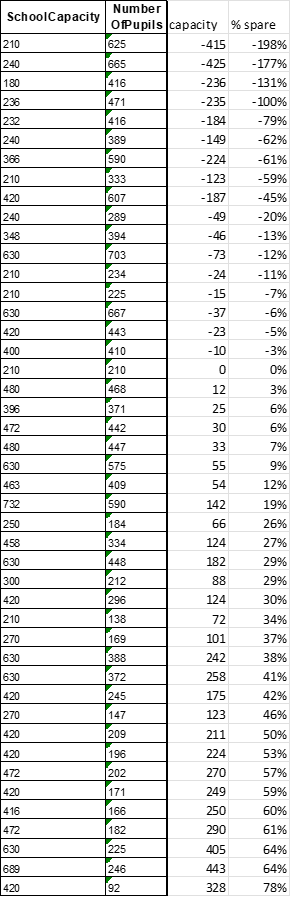
In total, the five schools had 857 pupils on roll, but with a capacity for 1141, so were operating at 75% capacity. Intake for the latest year was lower at 66% of capacity.

 TYPECURRENT ROLLCAPACITY% CAPACITYPlaces offered – latest
SCHOOL 1RC1182105613/30
SCHOOL 2CofE2993159545/45
SCHOOL 3COMMUNITY1782108516/30
SCHOOL 4ACADEMY1301966615/30
SCHOOL 5COMMUNITY1322106318/28

Schools 1-3 are in the town, and schools 4-5 are within easy travelling distance. The obvious answer might be to close one of schools 4-5, but that would create additional transport costs for the local authority; to be paid from Council Tax.

Closing the RC school is not possible, as the exiting pupils cannot be accommodated at the other two schools, as they have insufficient spare capacity, and the need would be for an additional 70 places over the current capacity. Should the RC school numbers fall further to less than 100-110, and intakes not increase at the other two town schools, it would be possible to close the RC school if each of the other two schools in the town could take an extra class. However, the restricted nature of their sites may that possibility unlikely.

What happens if the RC school remains open, and starts to run a deficit budget and, as a consequence, either the diocese eventually decided to turn the school into an academy or it is judged inadequate by ofsted, and forced to become an academy. Could the diocese transfer funds from other schools to keep the school open?

What of the future for schools 4 & 5 if they are faced with the same scenario of starting to operate on deficit budgets, and the risk to the local authority with regard to school 5 at a time of great pressure on the authority’s budget.

Should someone create a plan for the future. If so, who? The local authority, the Regional School Director, the DfE? Or does the desire of the parents for one particular school eventually affect the other four schools, and the market decides? Discuss.

For those that want to consider the issue further, I wrote a play around a school facing falling rolls in its locality to try to tease out some of the issues. You can access it at C:\Users\dataf\OneDrive\Documents\FallingRollsPlay.docx or by requesting a copy by using the comment section

Reader might also like this post from a decade ago. My concern about the future of small schools isn’t new. Are small schools doomed? | John Howson

The Future of Education – a talk from 2024

In the summer of 2024, I was asked to lecture on the future of education. Two years on, it is interesting to see how even more relevant today the content of the talk is. Sadly, there are still no answers to many of the questions posed in my talk.

Thank you for inviting me to talk to you this evening. I arrived in Oxfordshire some 45 years ago, about the same time as the late Sir Tim Brighouse. This was only a couple of years after Prime Minister Sir Jim Callagham’s visit to Oxford, and his famous Ruskin College speech that started The Great Debate about education and schooling in England. A debate that has ultimately led us to where we are today.

Starting this talk with a look back at history reminds me that if this were a sermon, I would start with a text. Perhaps, ‘Acts Chapter 2 Verse 17’. I won’t read it out, as those that want to know what it says can look it up on their phones.

However, what I want to talk briefly about this evening is RATS -I have to say that thankfully you are spared the PowerPoint picture at this point.

However, RATS stands for:

Responsibility

Accountability

Technology

And

Schooling

RATs or ARTS is better, even if the order is wrong.

First Responsibility

Who is responsible for what in education

People still cheerfully talk of ‘Oxfordshire’s schools’ but in reality, as cabinet member, I deal with only a limited number of functions these days:

-Admissions to school, but not in-year admissions to academies

-Transport to school, but not for over 16s, as this is discretionary and there is no cash, despite raising the learning leaving age to 18, except for SEND pupils where we still support those where we can. So, a young person can receive free transport from Years 7-11 and then nothing.

-School building – we have built more new schools in the past decade than the previous 50 years. But as ever this area is highly regulated.

HR for maintained schools – this means small primary schools have to pay the Apprenticeship Levy – a tax by any other name.

School Improvement – although the £400,000 annual DfE grant ends this month and next year we are funding it from Council Tax.

-SEND – and we will spend £20 million more than the government provides us with funds in this area and end this financial year some £60 million overspent.

That overspend lead me nicely into considering Accountability

If there is confusion over responsibility, is there any clarity over accountability for our school system?

As I mentioned, Oxfordshire has overspent on SEND and by 2026 this may be as much as £140 million

Schools receive their budgets calculated on formulas where Oxfordshire as a local authority has no vote, and merely acts as the banker. Schools may end the year in surplus or in deficit

If you look at academy chains in Oxfordshire, several have schools with balances of £1 million and other have deficits nearing the same figure.

Who is accountable for these outcomes and how will they be dealt with?

If the RSD is prepared to accept academies in deficit that they add to each year, why should Oxfordshire as a local authority wipe out deficits on schools transferring to become an academy: perhaps we will explore issuing an IOU to be paid when there are no deficits in the academy sector.

Last year, council tax payer transferred £200,000 for a school becoming an academy to wipe out is deficit: that’s a lot of potholes we could have filled. At the end of this month, I expect deficits in maintained schools to top the £3 million mark: enough to mend most of our roads.

Let’s consider some other accountability issues:

Who is responsible for ensuring there are enough teachers for Oxfordshire schools? Is it schools; MATs and the dioceses; the LA or the government at Westminster?

Who is responsible for school improvement, so when ofsted comes knocking a school can be judged outstanding, as a primary school in the north of the county has been recently.

Who will deal with the digital divide?

This last question is one that that neatly brings me onto the third theme for this evening:

Technology

Since I came to Oxfordshire at the end of the 1970s there have been three waves of new technology

The microprocessor revolution of the late 1970s and early 1980s that brough BBC B, turtles, and eventually the Apple/PC dominance of our interface with IT. Indeed, my MSc thesis in 1980 was the first produced on a word processer for any course at Norham Gardens.

The second technology revolution started in the early 1990s, and became part of our lives in the first decade of this century when we all embraced the internet and started exchanging emails. 

This revolution had a second phase when the phones in our pockets suddenly became mini computers in their own right, and a whole new set of challenges opened up for education. This saw the surge in new social media platforms, and the current heads-down culture that pervades so much of society these days. I won’t ask how many have already googled my suggested text for this talk.

Although schools have made adaptations to accommodate these changes in technology over the past 5 decades, we still rely upon a teaching and learning strategy that has many elements that would be familiar when state education began more than 150 years ago.

In passing, I am sorry that the covid pandemic didn’t allow us to celebrate the 150th anniversary of the 1870 Education Act in a manner that I think would have been fitting.

The 2x4x8 model of learning may not be as rigid as it once was, but secondary school ‘timetablers’ are great fans of it as a strategy.

Anyway, so much for the first two waves of technological change: what of the third and developing wave, currently described by many as the AI revolution?

Does a knowledge rich curriculum meet the needs of a generation that started school last September and possibly won’t retire from employment until the last decade of this century. Those that started school 100 years ago, around the time of the birth of the BBC and radio, retired just as the internet was becoming a viable communication strategy: what will the class of 2024 experience in their lifetimes, and how will we prepare them for adult life?

This is not to decry the role of knowledge in schooling, and especially the building blocks of literacy and numeracy. Technology has almost made handwriting redundant, except as an art form. Can technology help us deal with the learning gap at Key Stage 1 between children on Free School Meals and those whose parents have a higher degree?

If so, to return to my themes of accountability and responsibility, where does the impetus for change lie? At school or Trust level; at local authority level or nationally?

We have seen initiatives such as the Oak Academy created nationally post-covid. We also saw how Oxfordshire as a local authority dealt with covid in acting as a conduit for information.

How will the system take change forward. Who has the vision.

Perhaps parents will dictate change for us as educators?

Home schooling has increased significantly: a passing phase or signs of a new order?

I saw this week suggestions that teachers will need to be paid more if they have to work a five-day week when four days becomes the norm. It is worth noting that teachers, as a group have seen no change in their holiday entitlement over the past 50 years while all other workers have benefitted from increased time off.

So let me conclude by asking whether one might one view a model where technology, and indeed any other approach to teaching and learning, is like a table top resting on the twin legs of responsibility and accountability.

Wobbly legs can mean an insecure platform for learning, and certainly for the development in an orderly manner of how technology can change the landscape of education.

I started with the term ARTS, so my final word must be about schools.

It is right that schools and their staff must be at the heart of the landscape, but the challenge that is currently keeping me awake at night is the relationship between a national funding formula created during a period of increasing school rolls, and the current situation of falling rolls faced by many primary schools.

How will hard decisions on whether all schools survive be taken, if pupil numbers continue to decline? For instance, who decides on whether we keep primary schools in local communities or face competition between schools for pupils to keep their own school open?

What part can technology play in solving this dilemma? I don’t know, but I do know the relationship between falling rolls and school funding is not one we can duck going forward.

But let me finish on a brighter note. This week, I met with three young entrepreneurs interested in working with schools on drone technology. Indeed, they have started a series of books that might be the 21st century version of Thomas the tank engine.

Let me introduce you to Ruby Rescue and the big fire – a tale from Drone City and possible future firefighting techniques.

I started my teaching career in Tottenham with the stewardship of 16 mm projectors; reel to reel tape recorders; an epidiascope, and little other technology but in a certain landscape for schooling.

I don’t want to dream of a past, but rather to challenge us all to set out a vision for the future landscape of education that can work for the good of all.

Thak you for listening.

Are small sixth forms a good idea?

In a post in January, I mused about the issue of how falling rolls might affect schools particularly if it meant less funding, where school funding is based upon a per pupil funding model. Fewer pupils = less cash. Accountability and falling school rolls. Was it different in the past? | John Howson

One of the possible solutions discussed in that post was a reform of post-16 education. In a cash-strapped school system, is it possible to justify schools with small sixth forms? Are such sixth forms in the best interest of the students?

In order to think more deeply about this issue, I have looked at the ‘A’ Level results from one local authority, as published on the DfE’s website. 11-16 schools are excluded, as are schools that will eventually expect to have a sixth form, but aren’t currently at that stage, and also colleges. What’s is left are the details for the outcomes on ‘A’ Level results for 34 schools, as shown in the table below

pupils enteredbest 3 scoreprogress scoreaverage or above
31239.880.2AA
21135.750.08A
12540.77-0.13
11741.680.02A
11031.45-0.30
10733.240.00A
9634.340.00A
9438.30.17AA
9036.330.19AA
8935.51-0.12A
8731.530.08A
8239.150.80AA
8236.420.07A
7934.57-0.33
6929.47-0.21
6635.10.26AA
6632.37-0.10A
6535.640.03A
6433.39-0.15
6235.70.20AA
5934.69-0.09
5732.520.06A
4634.57-0.33
4233.65-0.11A
4131.14-0.46
3014.67-0.69
2836.310.21A
2525.07-0.02
2234.850.70A
1424.52-0.83A
1318.21-0.75
924.52-0.83
937.780.35A

For comparison purposes, the average score for state schools in England was -0.03 for Progress and 35.76 for the best 3 ‘A’ Levels score. There are other measures that could be used, but these are three I chose to use for this blog post.

Nine out of the 34 schools beat the national average for ‘best score’, although another couple of schools narrowly missed the national average, so it might be better to conclude that 14 schools were either close to or exceeded the national average for ‘best score’, leaving 20 schools that were below the national average.

Progress score is a more contentious measure. Here 15 schools did less well than average. The same schools often feature in both lists. Most of these schools entered less than 100 pupils for three subjects at ‘A’ level. Some pupils might have taken either two subjects and a vocational qualification or just two subjects at ‘A’ Level.

Schools that entered more pupils for 3 ‘A’ Levels were more likely to receive an ‘average’ or ‘above average’ grade.

The data forces me to ask the question – is the current arrangements for ‘A’ Level study across these schools producing the best outcomes for students? Two subsidiary questions are; if this is the outcome close to the top of the demographic cycle, what might happen to sixth form sizes in these schools once rolls start to fall in a few years’ time? The second question is, what is the cost of tuition per pupil under the present arrangements.

To answer the latter question, let’s assume a Year 7 class of 30 for mathematics taught by a newly qualified teacher on the bottom of the Main Scale for five period a week for 40 week, and an ‘A’ Level group taught for 5 periods a week by the Head of Department, on the top of the Upper Pay spine, and with a TLR 2A in addition.

The newly qualified teacher teaches 6 classes per week for 40 weeks, while the Head of Department teaches two ‘A’ Level sets, one of which has 10 weeks examination leave in Year 13. In addition, the Head of Department teaches four classes of 30, one of which has exam leave in Year 11.

 Using this data, and ignoring any other time spent on non-teaching duties, the Main Scale Teacher costs work out at 0.91p per pupil, while the Head of Department costs are £2.33p per pupil.

If the ’A’ Level groups were smaller than 15 in each year, as they well might be in some schools, then the cost per pupil increases unless the Head of Department receives a lesser amount in TLR.

In an 11-16 school, where the Head of Department might teach five classes for 40 weeks and one for 30 to allow for examination leave, the cost per pupil for the Head of Department reduces to below £2 per pupil. If the school has only long-serving teachers then the per pupil for teachers increases to nearer £1.50 per pupil.

For small schools with settled staffrooms, the difference in cost between the cost of teaching Years 7-11 and Years 11-13 may be marginal. The issue then becomes one of teaching and learning. Do small sixth forms produce as good examination results as larger sixth forms? The evidence from the table would suggest they are less likely to do so.

What of the student experience? Is it better to be either ‘a big fish in a small pool’ or ‘a small fish in a larger pool’? Has anyone ever asked students their views?

I think that there is a debate to be had about school organisation and size of school sixth forms when rolls fall, especially if school funding comes under pressure from increased government spending on both defence and welfare, and especially if we are in a recession.

As my colleagues in Haringey found out in the 1970s, such debates about changes to sixth forms can be fraught with political pitfalls for anyone suggesting change. But, is that a good enough reason not to at least discuss changes?

Note: I have only used salary costs in the modelling and not included on-costs from National Insurance and Pensions. I have also ignored premises and other staffing costs, as I assumed the to be low in a subject such as mathematics.  

Primary winners (possibly): Secondary losers (certainly)

The Institute for Fiscal Studies and the Nuffield Foundation have published the latest in their series of reports about education spending Annual reports | Institute for Fiscal Studies While the report covers the whole education sector, I am principally interested in the school sector. That sector now overlaps the early years sectors, at the lower age grouping, with many schools taking pupils below the age of five. At the 16-18 age grouping, there is an overlap between the school sector and the further education and skills sector.

The highlights for me from the latest report are: the obvious effect of the explosion of demand for SEND places. I am not sure whether this report fully captures the full cost of the increase, since the transport costs for pupils with SEND aren’t usually a part of the DfE’s budget, and certainly cannot be funded from the Central Services Block or even the High Needs Block of the Dedicated Schools Grant.

The second highlight is the reduced funding for secondary schools. These schools have seen the reduction in 16-18 funding, and a reduction of the gap between their funding and that of primary schools. I suspect the latter, over the long-term, may have been partly affected by the need to fund non-contact time in the primary sector, introduced under the previous Labour government.

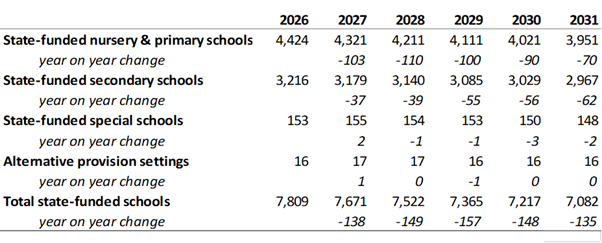
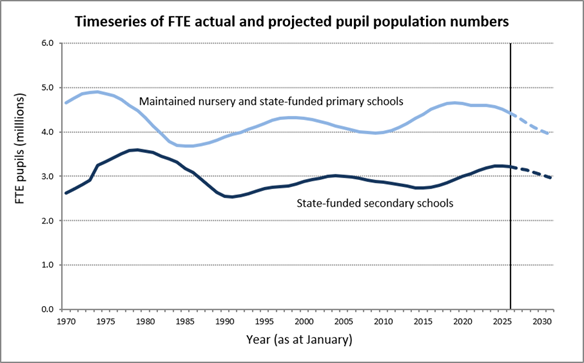
The primary sector is now experiencing falling rolls, while the upper secondary 16-18 sector is still seeing pupil numbers growing. As the report says, there is a policy decision to make about falling rolls. Does government either recoup the cash not needed because there are fewer pupils, and put the consequences on schools, or does it keep the cash in the primary sector and hope to improve outcomes? I wouldn’t bet on the latter.

One element missing from the picture seems to me any discussion on the changes in school reserves. I think it is vital to know how much money is being saved by schools from revenue budgets, and whether the total per pupil is increasing or reducing. With many academy trusts ‘pooling’ reserves so funds can be used for a school in a local authority different from that of the school where the cash was accrued, a picture of trends in this area might reveal the extent of short-term pressures on school budgets. Recently, I came across a special school with a balance of £2.5 million. Is that a good use of public money?

In a graph – sadly the IFS don’t number their graphs or tables in the report: an oversight in my opinion – it sees that early years’ spending has doubled between 2010-11 and 2025-26, and primary school spending has increased by 12% over the same period. All school spending was the same per pupil in each year. This means that secondary school spending per pupil declined by three per cent over the period, and 16-18 spending by 8% – this despite the fact that schools often use their most expensive teachers with this age grouping.

Finally, I note that central spending on academies is now £510 per pupil, double the level in 2016-17. I am not convinced that this is due to a shift towards larger MATs as the report states, as this would imply there were no economies of scale possible.

 I will review this issue further when I look in detail at the 202425 accounts of a selection of MATs once all their accounts are published.

Accountability and falling school rolls. Was it different in the past?

Reading this new report from the Centre for Educational Systems on accountability in systems International Comparative Education Reviews & Resources | CES Centre for Education Systems set me wondering about the accountability of the school system in England at present. To help focus my thinking, I considered one of the key issues facing many policymakers in education at present: declining pupil numbers or ‘falling rolls’ as it is more commonly called.

My starting point was to look at the last time ‘falling rolls’ had a significant effect on the school system in England. The last serious occurrence was at the end of the 1970s, and into the early 1980s. The other periods of declining rolls since then have either been less significant in scale or offset by changes in the learning leaving age, as when it was increased from 16 to 18.

In the late 1970s, as the minority Labour government trundled towards its inevitable fate, education in England was still being described by academics as either ‘a partnership’ or ‘a locally service nationally administered’. In reality, the governance of schooling was on a journey from local decision-making to almost total national policymaking, or more realistically policy interference from the centre in those areas where policymakers at Westminster have an interest. The accountability strand within governance at the ‘macro’ level has been largely overlooked. Accountability of individual institutions, such as ofsted had been the subject of many discussions.

This lack of consideration for accountability relating to policy in the school sector brings me back to ‘falling rolls’ as a case study. At the end of the 1970s, I had just completed almost a decade working in Haringey in North London; from January 1971 to December 1977 as a teacher at Tottenham School (now long disappeared from the scene), and  then from September 1977 to August 1980 as deputy warden of the borough’s teachers’ centre – what would now be called a professional development centre, where such establishment still exist- developing courses mainly for secondary school teachers. Between September 1979, and my resignation in August 1980, I was on secondment – on full pay; those were the days – to study for the MSc in Governance of Education at Oxford University.

My role at the Teachers’ Centre, in an institution at the centre of the borough’s schooling life, allowed me to witness how falling rolls were dealt with from 1977 onwards in Haringey. In passing, it is also worth noting that 1979 was a traumatic year for schooling in Haringey. During the ‘winter of discontent’ the school caretakers went on strike and the schools were closed for a number of weeks. National government showed no interest in how the strike was handled, and ignored trying to enforce the legal requirement that schools remain open for 190 days a year. It was not until a parent, Dr Meade, took Haringey to law that the national government, through the Secretary of State took any interest, and the strike ended.

It is interesting to compare that ‘hands-off’ attitude of the Westminster government in 1979 to what happened in 2020 with the arrival of the covid pandemic, and the actions of the DfE throughout the pandemic in order to see how policymaking has changed. Although, even during covid, the DfE seemed to do little more than set high level policies, and left schools, MATs and local authorities to work out the details on the ground. There seemed to be little consideration of accountability during the pandemic and it will be interesting to see what the Covid Inquiry has to say about how schooling was handled during the pandemic.

But, back to 1977, and ‘falling rolls’ in Haringey. The borough was generally seen as a safe Labour borough at the time, having only run by the Conservatives between 1968 and 1972, following the Labour debacle at the 1968 local elections:  a debacle that current followers of political fortunes might want to revisit ahead of the 2026 elections in London, to be fought on many of the same boundaries.

In the late 1970s, officers in Haringey were aware that when projecting school rolls into the 1980s, there would be too many places, especially in the secondary sector, where a new school, Northumberland Park, had been built on the eastern edge of the borough, even though this was where pupil numbers were likely to fall fastest, as the declining birthrate together with the reduction in Commonwealth immigration, especially from the Caribbean islands, was likely to exacerbate the school population decline.

Officers created a taskforce to review rolls. This may have also been stimulated by an internal survey into sixth form teaching in Haringey’s schools, undertaken by the Borough’s advisory service in 1976 that revealed extremely small sixth form teaching groups in many subjects across the borough. If groups were already small, I expect senior officers were interested in what would happen to secondary schools when rolls fell?

Afterall, the secondary schools in Haringey had only just become fully comprehensive in response to the Wilson government’s Circular 10/65 on the phasing out of selective secondary education.

In the spring of 1977, officers produced what was known as a ‘green ‘paper, setting out options for change, including the naming of schools likely to face closure. In view of previous leaks of confidential documents, it was decided to publish the report in full. In a borough with a lively set of pressure groups ranging from teacher unions, represented on the Education Committee, to a branch of CASE (The Campaign for the Advancement of State Education), not surprisingly a row erupted over the plans.

It is worth noting that the DES (as the DfE was then called) knew about ‘falling rolls’ from the early 1970s onwards. As early as 1971, the part of the DES responsible for the school building programme reduced the number of new primary school places being created, although, as with Northumberland Park, new secondary schools were still being authorised. In 1974, cutbacks in teacher training numbers were announced by the Teacher’s Branch at the DES, but it was only in June 1977, a month after Haringey’s paper was published that the DES issued their first circular on the subject to local authorities, Circular 5/77. Governance of the system as a whole seemed non-existent, even where specialist branches within the Des were making appropriate changes to meet the emerging trends.

The merits of the five different schemes in the Haringey paper does not concern us here. What is more interesting is that it took until 1983 for reorganisation to actually take place in Haringey, and then only after the Secretary of State gave his consent in February 1982 to the revised and more draconian re-organisation plans. By then, nearly six years had elapsed, and the Chief Education Officer had moved on from his position.

What was interesting in the 1970s was the fact that there was planning locally, and also open debate in a borough with a strong set of pressure groups willing to discuss policy in a framework of an Education Committee involving many elected councillors and key un-elected members, including figures from the Church of England and Roman Catholic dioceses, but little apparent oversight from the DES. Clearly, not a ‘partnership’, and realistically not ‘a national system locally administered, except in the widest sense of the phrase.

Compare that climate of relatively open debate with a strong local press, and local decision-making, with the current situation, where the local authority cabinet system puts great power in the hands of one local politician, and the officers, and where the historical issue of the voluntary school sector involvement in planning is further complicated these days by the existence of academies and multi academy trusts.

Governance may be easier today, but to what extent has local input from interest groups been removed from the process? To whom are decision-makers accountable in the 2020s, if they make mistakes? Does the DfE show any more interest in accountability over issues affecting the system, such as ‘falling rolls’ than it did in the 1970s?

Locally, perhaps all council Scrutiny Committees should have an annual review of education provision on their workplan that would allow regular discussions on how place planning was being managed across maintained and academy schools in a locality.

But, with the end of the semblance of ‘partnership’, still seemingly in existence in the 1970s, what role should the government at Westminster play today in ensuring a coherent and cost-effective solution to the falling rolls issue? That question sheds a light on the accountability for the schooling system as a whole in England at the present time.

For some, it seems the accountability of the market still dominates thinking in Whitehall, and there is no place for whole-system planning at any level. Government guidance on dealing with falling rolls, even at the level of ministerial statements might show there was some coherent thinking about problem solving nationally by the present government. How schooling is governed and what accountability measures should exist today, is worthy of debate. I don’t think the present Bill before parliament will add much, if anything, to the debate.  

Primary schools extend their age ranges

Primary schools are no longer the 5-11 schools of yesteryear. Even before the present cycle of falling rolls started affecting schools, especially in London, schools across the primary sector had been extending their age range downwards into what has traditionally been seen as the province of state nursery schools and the private sector.

During our survey of headteacher vacancies for the autumn term of 2025, reported in the post   Recruiting headteachers in 2025 – a mixed picture | John Howson The age range of the school was one of the variables collected as part of the evidence base.

The data from autumn 2025 vacancies has been analysed from some 254 primary schools covering the age range up to age eleven and starting at the age of five or below that age – thus, not including infant schools, as they don’t go up to age eleven.

The table below shows the results

Age range of schoolnumberPercentage of total 
2-113614% 
3-119538% 
4-1110541% 
5-11187% 

 3-11 or 4-11 schools dominated the schools that advertised for a headteacher during autumn 2025, accounting for 80% of the total. Interestingly, there were more adverts for 2-11 schools than for the traditional 5-11 primary schools. Such downward extension of age ranges should help to answer the question, what do primary schools do with children not toilet trained? The answer, as you extend the age range downwards, and the likelihood of such an occurrence increases, must be to put in place expertise to deal with the situation as well as to seek government measures to help parents understand the importance of children being able to cope in social settings such as schools.

As more primary schools face falling rolls, and hence the probability of unused space within the school site, will these schools also extend their age range downwards to become 2-11 schools? If so, and I see no real reason why they wouldn’t do so, what will this do to the private nursery and childminder markets?

Fewer children, more competition, and the ability for families to drop all their children aged between 5-11 in the same place must be a powerful selling point for state primary schools, especially if the additional children recruited to the school roll replace revenue lost to schools from falling rolls, especially at a time when the school funding formula is heavily predicated upon pupil numbers.

Are 2-11 schools evenly distributed across England? The sample of 36 such schools from the autumn term is too small to yet make a definitive judgement. To do so one would need to interrogate the DfE’s database of schools, but the results are interesting. In the 2025 survey, two regions, the North West (10) and the West Midlands (8) account for half of the 2-11 schools that advertised for a new headteacher during the autumn of 2025.

While there was no region without   any adverts from such schools, three regions, London, the East Midlands and the North East only had one school of 2-11 recorded in the survey. The East of England had two schools in the survey, and the South East, three schools. Yorkshire and the Humber and the South West regions each had five schools in the survey from the 2-11 age range.

Might extending their age range downwards be a solution to some schools in London facing possible closure from falling rolls? It is certainly a question worth asking if it can increase the schools’ income to a point where it remains financially viable and able to service its community.  

How might a school react to falling rolls?

visit my LinkedIn post for a view of a play about such a school and what happens over the course of one school-year https://www.linkedin.com/feed/update/urn:li:activity:7394034424864022528/

Is it credible and believable? Let me know in the comments

London secondary school to close this summer

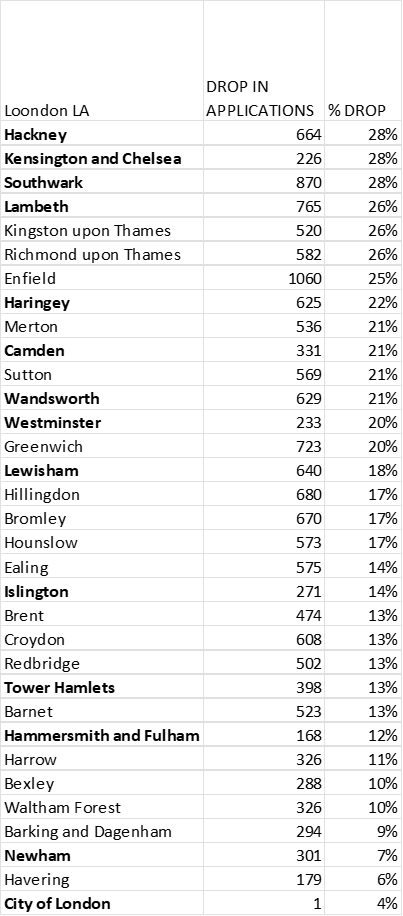
Falling rolls have caused the closure of a secondary school in South London. Despite much of the country still battling with increasing pupil numbers across the secondary school sector, a London secondary school has announced its closure at the end of the summer term.

The statement on the school’s website states that;

The Southwark Diocesan Board of Education, Multi Academy Trust (SDBE MAT)

Due to the significant and ongoing challenges with falling pupil and application numbers in schools across London Local Authorities and the London Borough of Lambeth, and after considerable review subject to a listening period, it has been proposed to close The Archbishop Tenison’s Secondary School, Oval by the end of the academic year (August 2023).  

We understand the importance of continuing education for the students impacted by this decision and are working closely with parents, the school and colleagues at Lambeth Council, who are in the process of providing offer details for pupil placements in the academic year 2023-2024.

This closure will not be the last school closure, and raises important questions, including how soon after the unified admissions date for September entry should any closure be announced? Indeed, should closures be announced ahead of the general admissions date, and a hard date set by the DfE beyond which no state school will close for the following school-year and will be supported, if necessary, by special funding?

There are always issues with examination years and at least in this case:

The priority is for the current year 10 to have as minimal amount of disruption as they move into their final year of GCSEs as possible. The year 10’s will move as a bulk class to St Gabriel’s College which will match the curriculum and recruit some key staff from ATS to support the transition. Year 10 families are entitled to parental choice and to select a different school but we would encourage the move to St Gabriel’s College as it will support the GCSE offer that young people are already studying.

This suggests that planning had been taking place in the background. Fortunately, as this is London, there should be minimal extra transport costs as TfL picks up that bill across the capital.

However, what is the role of The Regional School commissions – this is an academy? The local authority – that much maligned democratically elected body that it seems still plays an important part in state education – and in this case the diocese?

The Diocesan Board of Education has issued a statement including the following;

As one of the longest established schools in London with a rich history of provision in Lambeth, Archbishop Tenison’s leaves behind a great legacy of achievements. Our hope is that students will go on to receive a continued, strong, and positive local education in a ‘good’ OFSTED school.

 The Rt Revd Dr Rosemarie Mallett, Bishop of Croydon and Chair of the Board of Education said: “We hope that every family, every child and every staff member will know that we are praying for them, the situation and for flourishing going forward into the future.”

I am not sure if there is a word missing before ‘flourishing’, but perhaps this is an example of a more secular society shunning church schools. However, it may be the fate of an 11-16 school rated inadequate by Ofsted at their last visit that has succumbed to market forces and been squeezed out of existence by the workings of parental choice in an area with multiple alternative choice of schools and a good transport network.

The London Evening Standard newspaper, where I picked up this story predict that

In an attempt to avoid school closures, Lambeth Council is reducing places at a number of primary schools in the borough from next year and intending to merge eight schools. But the council has limited control over what secondary schools in the borough do, as most are academies like Archbishop Tenison’s and outside of local authority control.

This is, therefore, a warning sign for the DfE that some sensible planning needs to be put in place in a system where many but not all schools are academies and some rationalisation of the system will be needed because of falling rolls and budget deficits as schools struggle to stay open and spend ever more on marketing to attract a declining number of pupils.

Either make all schools academies, and control the distribution of schools at the DfE or give local authorities planning control over all admissions and a say over the number and distribution of schools to meet local needs. Inaction is not an option, especially in urban areas with a plethora of small unitary authorities whatever their actual titles.

Archbishop Tenison’s School – Home (tenisons.com)

South London school forced to shut because it doesn’t have enough pupils (msn.com)

Oasis close an academy in Kent

Hextable Academy in Swanley is to close because of falling rolls. Just when you thought schools needed to expand the Oasis Academy chain has decided to close Hextable Academy in Swanley. The 11-18 school has just fewer than 500 students according to government figures, but could accommodate 1,000 pupils. Those parents and their offspring waiting to hear about 2015 admissions in a fortnight’s time will be especially annoyed, as will the pupils kept at the school to complete their examination courses if teachers decide to quit ahead of the closure. Having worked in a college during a period of run-down prior to closure I know from first experience how little fun such a situation can be for both staff and students. The Academy Trust has at least apparently offered to pay for the new uniform of pupil relocated to another school.

Questions will need to be asked about the future of the site. It would be short-sighted to lose the school from education use if pupil numbers will increase over the next few years. Indeed, one wonders whether it might have been possible to save the school by turning it into a 5-18 all-through school by adding a primary department.

Kent County Council, the local authority, is in something of a difficult situation. They retain the legal responsibility for ensuring an education for all children but have no control over admission numbers in academies and could not have vetoed the decision to shut this school. I hope they will send Oasis a bill for all the extra work required of officers in placing the pupils requiring a new school because of the closure. It would be unfair to expect the council taxpayers of the county to foot the bill either for finding new schools or for any extra travel costs resulting from pupils having to change schools.

Hopefully, the academy chain discussed this closure with both the Education Funding Agency and their Regional Commissioner and explored whether it was worth keeping the school open with additional grant funding until pupil numbers increased again.

This episode, along with the Cuckoo Hall Academy Trust revelations chronicled in a previous post confirm my belief that the next government must sort out governance arrangements once and for all so that there is an overall body responsible for place planning and the effective use of resources across the school estate. I would like it to be the role of local authorities, but it doesn’t have to be if the government at Westminster decides otherwise. But, the present muddle cannot be allowed to last. Unstitching the grant payment for pupils that transfer to secondary schools that are not academies and operate on a different financial year will be just one more headache for officers to deal with.

One thing the DfE and EFA along with the regional commissioners must now do is set a timetable for academies and free school to notify the authorities each year if they are considering closure because of lack of numbers, or indeed for any other foreseeable reason.