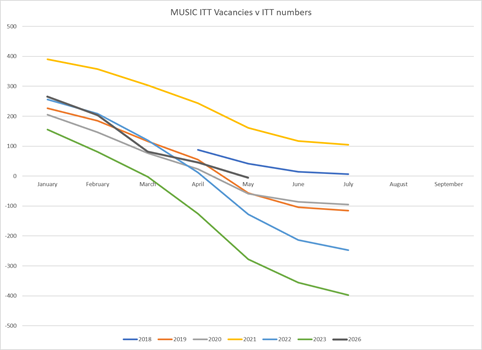
ITT – more applicants doesn’t always mean more offers

In my previous post, I noted the increase of nearly 6,000 I the number of candidates applying for a place on a graduate teacher preparation course. Up from 21,436 in March 2025 to 27,352 in March 2026. This post explores the relationship, both this March and last march, between candidates and places offered to those candidates.

Firstly, the number of candidates and the number of ‘offers’ to candidates in each secondary subject.

candidatesoffers
2025202620252026
BIOLOGY21612044713332
ART&DESIGN9601026451366
MFL18762246821733
PE1988221911491043
PHYSICS33296522825918
COMPUTING12702394341420
GEOGRAPHY1089843476292
OTHERS9261342281310
CLASSICS67623427
D&T661861273295
RE699693255208
MUSIC311275173136
MATHEMATICS4006534612771398
ENGLISH256128301032990
HISTORY11421281592624
BUS STUDIES607923132173
DRAMA336384162176
CHEMISTRY16622207441675

Note, not all subjects have seen increased candidate numbers within the overall increase.

Secondly, the next table shows the percentage of candidates so far ‘offered’ a place for 2026.

20252026Change
BIOLOGY33%16%-17%
ART&DESIGN47%36%-11%
MFL44%33%-11%
PE58%47%-11%
PHYSICS25%14%-11%
COMPUTING27%18%-9%
GEOGRAPHY44%35%-9%
OTHERS30%23%-7%
CLASSICS51%44%-7%
D&T41%34%-7%
RE36%30%-6%
MUSIC56%49%-6%
MATHEMATICS32%26%-6%
ENGLISH40%35%-5%
HISTORY52%49%-3%
BUS STUDIES22%19%-3%
DRAMA48%46%-2%
CHEMISTRY27%31%4%

Only in Chemistry, where because of the reduction in the size of the bursary to those applying for biology courses it seems likely that those with a choice between the two subjects have opted to apply for chemistry with its higher bursary for 2026. As a result, biology, with a 17% fall in offers this March when compared with March 2025, is the big loser.

Despite the change in candidate numbers, the percentages offered places in March 2026 follows a similar ranking to March 2025.

% offered
20252026
MUSIC56%49%
HISTORY52%49%
PE58%47%
DRAMA48%46%
CLASSICS51%44%
ART&DESIGN47%36%
ENGLISH40%35%
GEOGRAPHY44%35%
D&T41%34%
MFL44%33%
CHEMISTRY27%31%
RE36%30%
MATHEMATICS32%26%
OTHERS30%23%
BUS STUDIES22%19%
COMPUTING27%18%
BIOLOGY33%16%
PHYSICS25%14%

Music is such a specialist subject that it generally only attracts candidates likely to be accepted. However, current ‘offer’ levels are still well below those recorded in the first four years of the century when the number accepted ranged between 68% (2001) and 78% (2003). (Source: John Howson’s collection of GTTR Annual Reports). 2003 was after graduates training to be teachers received a training grant and were also exempt from tuition fees.

Of course, the most interesting percentage of ‘offers’ is that for physics, where only 14% of candidates have so far been made an offer. It looks as if the better candidates for biology are those that have opted to apply for chemistry in 2026, resulting in a significant fall in ‘offers’ in biology.

For subjects such as history and physical education, it is wise for candidates to apply early in the recruitment round since places fill quickly.

Finally, is the present system fit for purpose? Should there be a closing date by which all applicants will be considered,  rather than the drip feed approach as a present?

ITT – 9 subjects with fewer offers than March last year

Despite the increase in applicants for secondary ITT courses, from 21,436 in March 2025, to 27,352 this March, ‘offers’ from course providers are down in nine different subjects this March when compared with March 2025. The subjects with fewer offer so far this year are:

SubjectOffer March 2026Offer March 2025% change
Art & Design36645119%
Biology33271353%
Classics273421%
English99010324%
Geography29247639%
Modern Foreign Languages73382111%
Music13617321%
Physical Education104311499%
Religious Education20825518%

 I think one can discount both Physical Education and English from subjects where the declines are of concern. Elsewhere, the changes in bursary support are obviously having an effect. Those biologists that can do so are now applying for Chemistry – where there is still a bursary, and offers are up from 441 last march to 675 this March – but the overall offer across the two subjects are still below last March at 997, compared with 1,154 last March.

It is the arts subjects that seem to have been most badly hit. This is not surprising given the changes to the bursary scheme that saw the bursary axed completely for music and religious education, and reduced for biology from £26,000 to just £5,000, while it increased to £29,000 for chemistry.  French and Spanish also lost their £26,000 bursaries. The reduction in ’offers’ in geography, down by 39% may also be due to the cut in the bursary from £26,000 to just £5,000.

Given the need for fewer teachers in the future, as secondary school rolls start to fall, these changes to bursaries do look like a gamble. How much of a gamble will be clear when the DfE finally announces the ITT training targets. But my hunch is that music and religious education along with geography will join the list of subjects not hitting their targets unless the current global war affects graduate recruitment in the summer. Will there be a late surge of new graduates looking to teaching, similar to that during the early months of the pandemic in 2020? The jury is out for the moment, but such a surge would not surprise me. However, as a precaution, reinstating a scholarship in the arts subjects might be a wise precaution. This might make it look less like a -U- turn than a reinstatement of the bursary.

Elsewhere in the data, candidates form the ‘Rest of the World’ accounted for 30% of all candidates this March, compared with 21% last March.  The DfE really does need to show how this increase affects different subjects and how many of these candidates will be likely to receive a visa to both learn and then teach in England? Can we afford to waste funds on those with no prospect of teaching in England, while depriving potential home candidates of bursaries.

As expected at this time of year, there has been more interest from career changers than university students, with those under 24 showing an increase over last year of just 1,000 compared with an increase of more than 4,900 from those in the 25-39 age groupings.

Overseas applicants boost teacher training numbers

As well as the White Paper, today also saw the publication of the February data on applications to postgraduate teacher preparation courses. Initial teacher training application statistics for courses starting in the 2026 to 2027 academic year – Apply for teacher training – GOV.UK

The headline number of note is the percentage of applications from outside of the United Kingdom. Last February these applicants totalled just over 6,000, accounting for 24% of all applications. This February, the applicants from outside the United Kingdon now total almost 10,500, and account for 33% of all applications.

The key question that the published data does not reveal, but is of great consequence, is whether these extra 4,000 candidates are applying across the board for all subjects, or are concentrated in just a few subjects?

This question is of real importance, as there is now a split between subjects where ‘offers’ are above last year, and those other subjects where, despite rising unemployment in the wider economy, ‘offers’ in February 2026 are below those from February 2025. Many of these latter subjects will likely miss their target once again this year unless there is a dramatic shift in applications during the second half of the recruitment round, such as last seen in 2020, as a result of the covid pandemic.

Doing better than last year with regard to ‘offers’ are: physics; mathematics; history; design & technology; computing; chemistry, drama, and primary sector courses. English is just about holding its own when compared with February 2025.

Doing less well than in February 2025 are: modern languages; art & design; religious education; physical education; music; geography; classics and biology. Of these subjects, the decline in offers for physical education should be of no concern as the number of ‘offers’ is already more than 900 or more than the combined total of ‘offers’ for art & design; drama; music; religious education and ‘other subjects.

Does this government not care about the arts? I have long campaigned for the return of the music bursary. With music ‘offers’ down at just 110 this February, compared with 139 last February, that is a loss of 29 potential teachers of music, and the gap with last year has widened since the January data were published.

So, are there any other worries? Applications from candidates over the age of 25 appear to be rising faster than from newly graduating students. There are only 128 more applications from the youngest age grouping, compared with 208 from the 45 to 49 age group, and more than 2,000 additional applicants this year from the 25 to 29 age group. It would be helpful to know in which age grouping the additional 4,500 applicants from outside the United Kingdom fall, and which subjects they have applied for this year?

With the increase in applications from men, up from 9,561 to 13,654 being proportionally more than the increase in applications from women, up from 15,735 to 18,224, it would also be informative to know which subjects these additional 4,000 male applicants have applied for, and how many fall into applicants from the ‘rest of the world’ group?

While apprenticeships have shown good growth in applications, higher education courses have had to deal with the bulk of the additional applicants, with more than 5,000 additional applicants. My guess would be that the bulk of the new overseas applicants are targeting higher education courses.

We now enter that period of the recruitment round where fewer undergraduates will be applying until after the examination season, so further growth between now and the July data are most likely from career changers rather than undergraduates. This fact might push the proportion of ’rest of the world’ applicants to an even higher percentage than the 33% recorded this month. Perhaps it is now time for the DfE to review how the data are published in order to make it more useful to those interested in the labour market for teachers?

Music teacher shortage: the situation worsens

Regular readers will know that I have been pursuing a return of the ITT bursary for postgraduates enrolling to train as a music teacher on courses starting in the autumn of 2026. This is a very small -U- turn for the government, but a necessary one for the subject, and its future in our schools and universities.

Previous posts on this blog have demonstrated that the removal of the bursary has already affected ‘offers’ to music courses, with a reduction of around 20 ‘offers’ in January 2026 compared with January 2025. Traditionally, any reduction in early-bird offers is not recovered later in the annual application cycle. Music ITT will miss its target: my reasoning | John Howson

This post looks at competition for teachers of music. There are three main areas for teachers to seek work as a teacher of music in a school: the state sector- including sixth form colleges; independent schools in England; private schools across the globe that seek to employ teachers trained in England.

Our starting point this year is the 367 trainees in music identified by the DfE’s annual census taken in December 2025. Add in Teach First and any late arrivals, and the overall total might be 380 – being generous.

Take of 10% for non-completes and those not choosing teaching as a career, and the labour market might have a supply of 342 trainees seeking work.

By mid-February, there had been 100 advertised vacancies by state schools for teachers of music without a TLR – i.e. classroom teacher posts. A well-used job board recorded 15 classroom teacher vacancies from independent schools in England on a single day in mid-February.

On the same date, the same job board, recorded 99 vacancies for teachers of music from schools across the world.  This was made up of 40 vacancies in The Gulf, primarily in Dubai and the other Emirates, but there were 13 vacancies from schools in China, and 46 from schools elsewhere in the world.

Now I don’t expect nearly qualified teachers to apply for these vacancies, but to the extent that these posts are not filled by teachers already working overseas, then these vacancies will take teachers away from schools in England, and create new vacancies.

Assuming only a third of these vacancies are filled by teachers leaving schools in England, and the rest filled in other ways that would be an extra 33 vacancies at present.

Adding together the 100 state school vacancies so far in 2026 to the 15 already recorded private schools in England plus the 33 overseas schools currently seeking a new teacher that might recruit from schools in England that produces a total of 148 vacancies by mid-February, or 43% of the available total of trainees. Increase the take by overseas schools to half of their current vacancies, and not far off half the available pool for September and January could have been offered a job.

Now, some of the vacancies in Egland will be filled by existing teachers changing jobs or returners to the profession, but most experienced teachers will probably be looking for a post with a TLR if seeking a move to another school.

With three months to go to the summer resignation date, and six months until terms start, the pool of available teachers already looks stretched, and this is with trainees that have enjoyed the bursary.

If the lack of a bursary shrinks the 2027 pool, because there are fewer trainees, is removing the bursary a sensible move? In my opinion, it is not, and the government should reintroduce the bursary for trainees starting preparation courses in autumn 2026 to be a teacher of music.

 We will continue to monitor the situation and report back through future blogs as the recruitment round unfolds.

Music teachers: bring back the bursary

Previous posts in this blog have drawn attention to the removal of the bursary for trainee teachers of music starting courses in September 2026.  Music is a subject that is short of qualified teachers. As a result, removing the bursary is not going to increase interest in teaching as a career, especially while the current debate about student loans and repayment issues is raging. As trainee teachers mostly pay fees, this could become an issue for intending teachers.

A previous post has shown that the number of ‘offers’ made in January 2026 to applicants for music teacher preparation courses was down from 91 in January 2025, to just 70 in January 2026 Why Music Teacher Bursaries Matter for Education | John Howson

Now, those teachers recruited for September 2026 courses will enter the teacher labour market in time for appointment as a teacher in September 2027. What is happening in the labour market for teachers now?

An analysis of some 57 vacancies advertised nationally in either the TES or on the DfE job board with a closing date between the 1st January 2026 and the 2nd February 2026, by state secondary schools, revealed a total of 57 posts advertised. Most were for ‘teachers of music’, with a few promoted posts either titled as head/director of music or some similar phraseology. By the 5th February, seven of these posts has already re-appeared with a new closing date: basically, if they were genuine vacancies, then they had not been filled, and were being re-advertised.

Should we be surprised that 14% of vacancies advertised in January were not filled. Perhaps not as it is really too early for most trainees to have commenced their search for a teaching post. However, it also suggests that there is not a pool of ‘returners’ waiting to pounce on a job as soon as it was advertised: at least in some parts of the country.

Perhaps even more disturbing, is that two of the vacancies are for Easter appointment: normally, a rare occurrence. There are also some other vacancies with April 2026 start dates still to reach their closing dates. The presence of these vacancies surprises me, as in the past such advertisements would have been a rare sight.

The data on vacancies, albeit from a small sample so far, suggests a market where some schools are struggling to recruit a teacher of music

This analysis of advertisements doesn’t tell the full picture, as it excludes advertisements by the independent sector schools, special schools and those larger primary schools seeking to appoint a music specialist.  Add those in and the number of vacancies already advertised this year is probably in excess of 100.

Then there are the posts for teachers of music in international schools that will take teachers out of schools in England. I am not sure whether anyone is keeping track of those numbers, but with the Labour government sanctioning a State School to open branches in India and The Gulf, in support of UK plc’s export drive, that factor will need to be taken into consideration when surveying the labour market as a whole.

In my view, there is now more than enough evidence to persuade any rational government to reinstate bursary for trainee teachers of music. But, does this government take rational decisions? Answers please, on a postcard or in the comment section.

Music bursary: a recurring theme

Earlier today, when I was turning out some old papers about teacher supply issues, I came across a draft for a paper I wrote more than 30 years ago on the subject of failing to meet the demand for music teachers.

Interestingly, in the notes, I compared the data for the shortage subject receiving a bursary in 1990 and 1991, with music that wasn’t a bursary subject.

As you might expect, music stood out, even in the early 1990s as an anomaly.

Take Table 31 from the Interim Advisory Committee report of January 1991. This table lists the percentage of unfilled teacher vacancies recorded in a joint union survey.  Music ranked 6th worst in the list. In the DES Press notice on vacancies, issued on 25th August 1991, music was third worst as a percentage of teachers in post, with a vacancy rate of 2.4%. This placed music behind only, ‘other languages’ at 7.2% and German, at 2.5%.

In a DFES document ‘Projecting the Supply and Demand of Techers’, published in December 1990, the Department accepted that projections suggested a shortfall of teachers of music. Interestingly, music was the only subject with a shortfall across all four scenarios modelled in the document. Even so, music did not at that time join the list of subjects entitled to a bursary.

Another DES press notice, of 27th November 1990 (382/90), probably associated with the census of ITT trainees, normally published about that time of year, also showed a deterioration in ITT places filled from 88.9% in 1889, to 71.0% in 1990, although the actual number of trainees had increased from 282 to 340. In 1990, only mathematics, at 63.3% of places filled had a lower percentage of filled places than music.

So, what do I deduce from the data about both recruitment into ITT, and teacher vacancies, from nearly 40 years ago? Perhaps that attitudes in the civil service towards certain subjects in the curriculum don’t change very much.

Maybe the turnover of civil servants with responsibility for ITT bursaries is so frequent that it doesn’t allow for them to start afresh each year in considering the data and trends in each subject.

However, even that approach doesn’t really explain the dropping of the bursary from music for 2026 entry. I think the profession needs an explanation. Otherwise, the axing of the bursary for music can be seen as a cynical ploy to say money in a subject Ministers don’t fully appreciate in terms of its contribution to both society and the growth agenda.

I think that the Arts Council, DCMS, and the music lobby have a right to know why music lost its bursary, and to ask that it be replaced.

 However, having seen how both the DfE and DCMS have recently handled the physical education grants, I am not holing out much hope unless there is a real campaign to reinstate the bursary for music, perhaps with some scholarships provided by private funders. Don’t let us lose music from our state secondary schools.