Labour market for music teachers: update to end of April 2026

Regular readers will know that I am tracking two parts of the labour market for teachers in state schools across England during the 2025-26 school-year: vacancies for headteachers and vacancies for teachers and middle leaders of music.

Regular readers of this blog will also know that one of the reasons that I selected music as my subject to track was the government’s removal of the training bursary for those applying for postgraduate teacher preparation courses starting in the autumn of 2026.

By tracking vacancies this year, I have a baseline for next year, if, as seems likely, the removal of the bursary reduces interest in teaching music. However, the government has also slashed its published number of trainees needed – see ITT Offers – public money being wasted? | John Howson and my more recent post on the situation after the report on April offers was published.

Anyway, back to the update on published vacancies for teachers of music, and how these vacancies compare with the expected output from this year’s preparation courses.

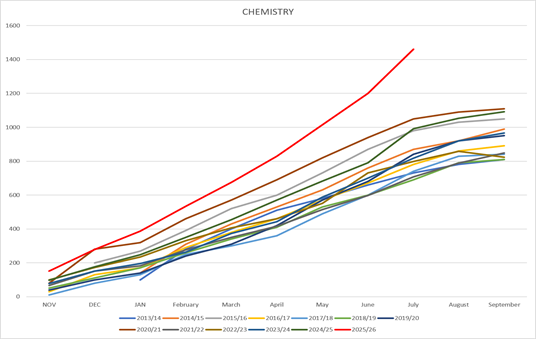
By the end of April, I had recorded some 389 vacancies for teachers of music. 86 of these were for promoted posts, with an allowance attached. It could be assumed that these vacancies were not intended for teachers straight out of their preparation courses. However, in some smaller secondary schools, this might be the only full—time post and include responsibility for choirs, orchestras and ensembles. However, for the purpose of this exercise, such posts have been eliminated.

After removing the promoted posts, this leaves some 303 vacancies suitable for new entrants into the teaching profession advertised between January and the end of April 2026.

The DfE’s ITT census recorded some 367 trainees on preparation courses in December 2025; mostly for entry into the labour market in September 2026. Assuming all 367 entered the labour market for teachers in state schools, there are still sufficient to fill another 64 vacancies.

However, we know that not all trainees last the courses, and of those that complete the course, not all start teaching in state schools. Some entre the private sector; some further education; some music services and some don’t enter teaching at all.

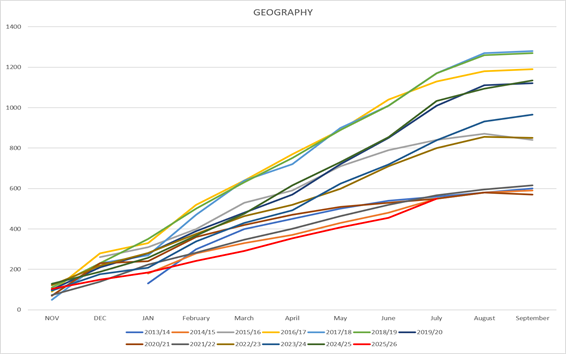
As a result, the chart shows the remaining trainees available if 10% and 20% of trainees aren’t available to state schools. This approach reduces the remaining number of trainees to little more than 50 trainees. With around 75 vacancies a month so far in 2026, if May’s vacancies follow the pattern of the first four months of 2026, then the remaining total of trainees will be exhausted before the end of May, and resignation deadline day.

Of course, not all basic vacancies are filled by new entrants from teacher preparation courses: some are filled by returners – we can ignore school switchers as we can assume that leaving one school to fill a similar vacancy at another school is neutral in terms of jobs. However, if the move is for promotion, the there is a new vacancy.

Returners would need to fill around 30% of vacancies across the whole year – they are generally the only source of teachers for January appointments, so for September it looks as if schools will struggle to fill any late appointment resulting from resignations close to the 31st May deadline.  However, the picture will be clearer at the time of next month’s update.

Finally, although I do not track vacancies posted by private schools, both in England and abroad, I do survey the market. Generally, this market has twice as many vacancies as posted in any one month by schools in England.

One wonders whether the current cohort of new graduates might have missed out on gap year travelling because of the after-shocks from the covid pandemic and might, therefore be more willing to teach overseas? This has the advantage of not losing income to student loan repayment, and the bursary isn’t repayable.

On the negative side, the conflict in the Middle East may well be deterring some teachers from working in that part of the world, and may have increased the number of returners once more seeking a teaching post in England. We shall see.

UK graduates not yet rushing into teaching

There has been a lot of talk about how challenging graduates are finding the job market at present. Is this ‘difficult’ job market for graduates showing up in renewed graduate interest in teaching as a career? The DfE has published the latest (April 2026) data about application to teacher preparation courses as a 20th April 2026. Initial teacher training application statistics for courses starting in the 2026 to 2027 academic year – Apply for teacher training – GOV.UK

While there has been a modest increase in applications to be a teacher for most areas of the United Kingdom – the North East, Northen Ireland and Wales excepted – the biggest increase continues to be from the ‘rest of the world’ grouping, up by a massive 42% on April 2025. Only three regions in England have percentage increases in double figures: the East Midlands, London and the North West. The South East, South West and Yorkshire and The Humber regions have increases in applicants of less than five per cent.

AreaApr-26Apr-25Difference% Diff
EM2427206236515%
EE283126302017%
LON6504571179312%
NE10681108-40-4%
NW4106359551112%
SE397538171584%
SW216720661015%
WM336231202427%
YH28082720883%
292482682924198%
  
EEA582528549%
NI447473-26-6%
RoW122517096515542%
SCOT20319673%
WALES384418-34-9%
UNKNOWN106120-14-13%
139738831514237%

Increases at this level do not yet suggest a significant switch to teaching in large numbers. Indeed, the increase in England as a whole is just 2,419 extra applicants, or 8%.

One significant increase is that of male applicants, up from 13,234 to 18,111. However, it is impossible to know how many of these extra male applicants have come from the ‘Rest of the world’ pool?

There are also large differences in the increases from ‘new 2026’ graduates and older graduate. However, the ‘Rest of the world’ effect may be skewing this data

AgeApr-26Apr-25Difference% Diff
21312629941324%
22425639682887%
23368233693139%
24282826132158%
25-29102877824246324%
30-3467634618214532%
35-3951443899124524%
40-443524286066419%
45-492012175625613%
50-54956919374%
55-59446455-9-2%
60-64158145138%
65+3733411%
unknown47-3-75%
4322335460776318%

Total applicants at 43,221 remains well below the record of 67,269 applicants for similar courses recorded by the UCAS GTTR scheme in the 2009/2010 round during the aftermath of the 2008 economic crisis. To that number must be added those that applied for school-based courses, such s the GTTP that did not recruit through UCAS, as well as the Open University, that also did not recruit through UCAS.

Higher Education – up from 24,028 to 30,104 has borne the brunt of the extra applications. SCITTs have shown little growth, up from 11,293 to 11,544, perhaps because overseas applicants are less familiar with this toute into teaching. This might also explain the lack of any increase in the ‘partner-led’ courses. Apprenticeships are on the increase, up from 4,783 to 7,894, but ‘salaried route remains static at 5,883 compared with 5,389 last year in April 2025.

Even before the DfE announcement of the ‘needs’ numbers for 2026, ‘offers were down at 20th April at 17,880, compared with 18,297 in April 2025.

I have written a separate post about the state of play with regard to ’offers’ in secondary subjects. In the primary phase, applicant numbers are up from 12,502 to 14,797, but ‘offers’ for primary courses are little changed, up from 6,992 to 7,106. However, as the DfE ‘need’ has reduced ‘need’ from 7,650 to just 5,520 for 2026, there are likely to be few if any more offers, as the ‘need’ figure is already some 1,500 below the ‘offer’ number.

So, there is no great rush towards teaching as a career from United Kingdom graduates. Whether that will change over the next couple of months as final examinations are completed, and the reality of the job market hits home, only time will tell. But, for would-be primary teachers, I expect that the  ‘bus has now left the stop’ and it was already fully laden.

Religious Education – the need for qualified teachers

In a recent post on this blog about the DfE’s modelling of trainee teacher needs, I wrote that

‘However, has this re-assessment of need gone too far? Based on … my own current research into vacancies for teachers of music, I think the DfE has been realistic in its approach. ‘

While, I stand by that judgement, I have also been reminded by Deborah Weston, championing on behalf of those concerned with the teaching of religious education in schools that the cutback in trainee numbers probably allows little room for the replacement of the ‘under’ or even ‘un-qualified’ teachers currently teaching religious education in our schools.

Prompted by Deborah, I looked at the trends from the Teacher Workforce surveys concerning the use of those with ‘no qualification in the subject’ teaching religious education over the period between the end of the Blair/Brown Labour government and the end of the Conservative period of government. Of course, recent years have been impacted by the covid pandemic, and its consequences, but there is a clear trend that is observable.

The chart shows the four key types of secondary schools, of which the 11-18 school line is probably the most significant.

At the end of the Labour government, partly I expect as a result of the economic crisis of 2008, the percentage of teachers of religious education with ‘no qualification in the subject’ was reducing. However, the percentage levelled out as school rolls began to increase again, and teacher supply entered into an extended period of years when teacher preparation programmes missed their targets.

There was a brief respite as a result of covid, but in the most recent years, as trainee numbers have fallen, so the percentage of teachers with ‘no qualification in the subject’ has reached levels not seen since well before 2010.

As a result, the question now is, was the DfE right to cut trainee targets for religious education from 780 last year to 450 this year? On the basis that including unfilled places from previous recruitment rounds was a mistake, as I have always maintained, then the answer is clearly, yes, the DfE have taken the correct decision.

However, in subjects such as religious education, where most pupils only study the subject for a limited period of time each week, managing recruitment is easier for schools, if qualified staff are available.

I would add that in my opinion, religious education when taught by well-prepared and knowledgeable teachers can be a really valuable subject, especially at this time in the history of our multi-cultural society, where both many different faiths are practiced, and a growing minority profess to having no faith in religion at all.

If the government cannot see their way to increase the stated need for trainee religious education teachers, providers can always over-recruit, at least to higher education courses, where government funding isn’t an issue.

In addition to pre-entry training, the DfE might also like to consider another approach to the issue of shortage of religious education teachers: upskilling those presently teaching the subject, but without an appropriate qualification.  If it is important that a subject be offered on the curriculum, it beholds government to ensure it is taught properly.  

Spending cash on upskilling will no doubt help retention, and thus save on recruitment and training costs. However, apart from in mathematics and the sciences, it hasn’t really featured as a policy objective for many years: surely that’s a mistake.

I hope that the religious affairs lobby is able to persuade the government that significantly reducing the percentage of inappropriately qualified teachers of religious education should be a key policy objective.

ITT Offers – public money being wasted?

The DfE has today published the April data on postgraduate ITT courses, as at 20th April 2026. Initial teacher training application statistics for courses starting in the 2026 to 2027 academic year – Apply for teacher training – GOV.UK

This is the first month where offers can be compared with the DfE’s required need for each subject for September 2026 courses. I have previously posted about the draconian changes to the demand in many subjects as required by the DfE that have resulted from a different approach to unfilled vacancies. ITT Numbers for 2026 – brutal realism from DfE or big risk? | John Howson

Here is my assessment of possible outcomes for September, when courses commence, based upon current offers and past trends. It will be interesting to see how my view compares with that of Jack Worth at NfER.

SubjectTarget 2026/27offer April 2026DfE identified needFILL?
Chemistry690829-139YES
Biology675398277YES
Mathematics20001752248YES
Design & Technology620382238POSSIBLY
Art & Design605449156YES
Geography685353332POSSIBLY
Classics753639NO
English19801176804PROBABLY
Drama370207163PROBABLY
Business Studies1200224976NO
Music26016199POSSIBLY
Religious Education450339111POSSIBLY
Others20353721663NO
History520736-216YES
Modern Languages1085946139YES
Physics8101140-330YES
Physical Education6551175-520YES
Computing56553926YES

In some subjects, such as history, physics!, physical education and chemistry, providers have already made more offers than required ‘need’.  This demonstrates the danger of leaving it so late in the recruitment cycle to announce estimated demand.

In the past, these numbers used to appear before Christmas. With a rolling offer system in place, rather than a defined closing date, leaving the announcement of ‘need’ until April is likely to cost someone money. Will the DfE pay bursaries to all students offered a place, even if recruitment is above the stated ‘need’? If so, that could be seen as a waste of money.

However, of more concern are the subjects where, even with the new numbers for ‘need’, there are unlikely to be enough applicants to fill all the places. Based on previous trends, classics, business studies and the ’others’ grouping will not meet their ‘need’ number. I think it is time that the ‘other’ category, with 2,035 places is disaggregated into different subjects, after all, it is now by far the largest group in the subject’s table.

I have some concern about where design and technology, geography, music and religious education will produce enough offers to meet the revised ‘need’. However, I can now see why the bursary was removed from music. I still think that was a serious error of judgement, as this is a subject where only those with appropriate subject knowledge are accepted onto courses. Music has one of the highest applications to offer ratios of any subject. Current offers are the second lowest April ‘offer’ number since 2018.

What happens in the wider economy, and graduate job market, will determine the outcome of this recruitment round. I suspect there will be a summer surge in applications, as new graduates discover how tough the job market has become. This should mean a good year for teaching course. However, many applicants may now have found they have left it too late to secure a place for this autumn. This year will really be a case of ‘the early bird that catches the worm’.

I will now delve deeper into the data for another post about the nature of applicants and applications as revealed in this month’s data.

DfE Vacancy site – some more thoughts

The DfE vacancy site has now been in operation since 2018. During that time, it has altered little in appearance. Right from the start of the site, I was critical of its features. I felt then that TeachVac and other sites could have done a better job for much less money. I posted my frustration about the site in both January and March of this year.

After another infuriating day working on the headteacher vacancies listed on the DfE’s vacancy site yesterday, I though I would take a further look at what was on offer in terms of headteacher vacancies.

First off, the DfE site told me there were, in total, 122 vacancies, if I used their pre-defined key word of ‘headteacher’. The vacancies are presented in a list order covering 13 pages. However, there are not 122 vacancies for a headteacher.  10 of the posted vacancies are either for Executive Headships of more than one school (2) or posts below a headship (8 vacancies). Indeed, one vacancy isn’t even a teaching post. So, the real total of headteacher vacancies is 112?

No, sorry, that is not correct either. This is because 10 of the vacancies, including one non-teaching vacancy, appear twice on the site. As a result, the actual number of schools advertising for a new headteacher on the DfE vacancy site at 0900 on the 25th April 2026 was actually 102. That’s 20% below that stated figure.

Now, I have nothing against multiple listings. After all, a person might miss the vacancy the first time it appeared: but why only a few random vacancies? I believe such double listings should either be removed from the site – it just requires a simple piece of coding – or the rules about the same vacancy being listed more than once at the same time should be made clear.

Where I do quibble with the DfE, is with the inclusion of posts not for a headteacher vacancy in the listings under the ‘headteacher’ category, and, as a result, their inclusion in the overall total. This is just mis-leading, and schools should be prevented from uploading such vacancies under the ‘headteacher’ listing. Again, this should not be a difficult coding exercise.

The other question is: does the vacancy site meet the needs of schools and candidates? Well, some schools still advertise their vacancy for a headteacher elsewhere. Local authority job boards for non-academy schools; the ‘tes’ as well, or in a small number of cases instead of the DfE site. Some vacancies also appear on regional websites, such as in the North East or South West.

The DfE vacancy site doesn’t accept vacancies from non-state funded schools. Candidates considering both state and private schools have to look at more than one vacancy site. Is this a good idea? I don’t think it matters at the level of headteacher posts, except perhaps for special needs schools, where the private sector is playing an increasingly important role. However, for entry level jobs, some form of aggregation might be useful, especially as candidates begin to outnumber vacancies for the first time in many years.

Does the DfE have a board or committee that reviews its vacancy site? If not, perhaps the teacher association might ask for a review. After all, they would serve their members better by operating such a site themselves. Not only would they have better data on vacancy trends to argue their case with the STRB, but they could also earn some extra income. When I suggested this to the associations in 2013, when I created TeachVac, sadly they weren’t interested.

The Teacher Supply Model

On Thursday, the DfE published its annual note about the working of the Teacher Supply Model Teacher demand and postgraduate trainee need: 2026 to 2027 – GOV.UK

The Model can be easily described in the DfE’s own diagram

It is interesting to note that the Teacher Supply Model

assumes that as pupil numbers grow, teacher demand will grow too, and vice versa. Additionally, the model assumes that PTRs will grow in line with the historical relationship between pupil numbers and PTRs. Similarly, the model assumes that PTRs will fall if pupil numbers fall. In other words, as pupil numbers grow, the TWM assumes that schools will increase the size of the teacher workforce and allow class sizes to grow a little. 

As a result, the Model finds it challenging to manage changes, such as in the curriculum. One of the best examples was the introduction of citizenship during the Blair/Brown Labour government. Schools didn’t sack teachers to make space for teachers trained in the subject, and with no historical data to underpin the need, estimates had to be made.

The assumptions about pupil teacher ratios are, of course, unable to factor in economic headwinds that might change assumptions about future funding of schools. There was a god example early in this century when, in a budget, the Chancellor announced extra cash to be sent directly to schools. Not surprisingly, the schools went after extra teachers and equilibrium in the labour market was only restored by a hike in teachers’ pay that dampened down demand that had not been anticipated in the Modelling.

I have discussed these points with the overseas governments that I have advised on teacher supply modelling over the years. I also favour including a check on what is currently happening in the labour market by surveys of vacancies. Advances in technology, such as pioneered by TeachVac, way back in 2013, allow current trends to be matched with the data input into the Teacher Supply Model that may be two to three years between data collection and the output of trainees based upon the data joining the labour market.

One increasingly interesting issue that the Teacher Supply Model may need to consider is the growing international labour market for teachers. The Model currently imperfectly accounts for loss from the trainee and existing teacher pools to the private sector in England. In the future, it might need to consider how many trainees opt to work abroad. This will be especially important if more overseas students are offered places on teacher preparation courses. Will they be offered visas to teacher in England, or will they leave the country after completion of their courses? I will try to consider this issue in a later post.

Finally, I am delighted that the statisticians have abandoned what they have called ‘the removal of the need for an adjustment relating to forecasted under-supply’.  Adding back in the number of unfilled places from a previous ITT round to the next year’s total was never a good idea, as I have made clear in a number of my posts on this blog. The decline in Physics ITT places from a high of 2,250 in 2024/25 to just 810 for 2026/27 is a good case in point.

However, has this re-assessment of need gone too far? Based on Timo Hanney’s work on vacancies and my own current research into vacancies for teachers of music, I think the DfE has been realistic in its approach. After all, if they have under-estimated demand, the government can always recruit more teachers from overseas by enticing those trained here to return to England.

Does the DfE care about the arts in schools?

In my previous post, I promised more from the DfE’s publication Teacher demand and postgraduate trainee need: 2026 to 2027 – GOV.UK On closer examination of the text, it is clear that a lot of the data has come from the June 2025 publication of school workforce data, collected in November 2024. The next publication with the 2025 workforce data should appear in June, so I will wait until then to review the trends I didn’t cover on this blog last summer, after the publication of the 2024 data.

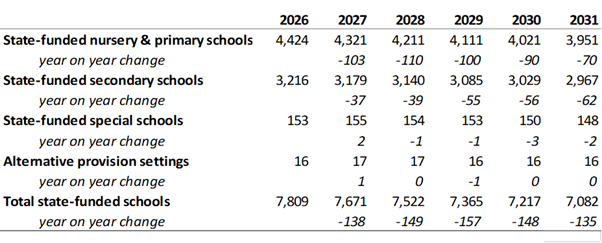
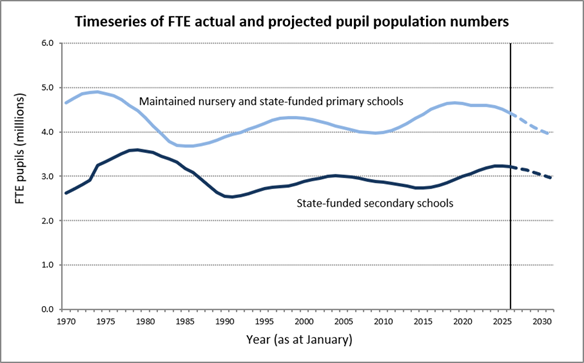
However, there is an interesting table in this release showing changes in the number of teachers per 1,000 pupils. The time series runs from the end of the last Labour government’s decisions on school funding in 2010/11 up to the 2024/25 school-year. This covers a period when school rolls were both falling, and then rising again. For the primary sector, rolls have been falling for some time. In the secondary sector, rolls are reaching their peak and will drop away over the next few years. The extent of the fall will, in reality, depend upon trends post-16, and whether schools either retain pupils or see then depart for further education or apprenticeships.

The number of teachers per 1,000 pupils is, of course, governed by the curriculum. Mathematics and English are taught to all pupils between Years 7-11, whereas few schools teach Classics to any pupils at all. Hence the ratio for mathematics was 8.44 in 2025/26, and has changed little since 2010/11, when it was 8.39 teachers per 1,00 pupils. By contrast, classics come out at a constant 0.09 teachers per 1,00 pupils.

The number of teachers per 1,000 pupils
by secondary subject as published in this publication
Subject2010/112024/25difference% Difference
Computing3.471.77-1.7-49%
Design & Tech5.133.1-2.03-40%
Drama1.751.35-0.4 -23%
Art & design2.812.19-0.62-22%
PE6.254.98-1.27 -20%
Other Sub5.124.08-1.04-20%
Business studies1.911.55-0.36-19%
Modern F L4.643.91-0.73-16%
Music1.671.42-0.25-15%
Biology3.93.41-0.49-13%
All Sec68.0959.77-8.32-12%
RE2.322.2-0.12-5%
Chemistry3.163.08-0.08-3%
Primary48.1747.04-1.13-2%
Classics0.090.0900%
English8.78.700%
Mathematics8.398.440.051%
Physics2.692.720.031%
History3.213.50.299%
Geography2.93.270.3713%
Source: DfE School Workforce data

Interestingly, for a country concerned about ‘growth’, and the decline of the productivity of the economy, the subjects with the largest falls in teacher numbers per 1,000 pupils are computing (down 49%) and design and technology (down 40%). By contrast, the humanities subjects, of history and geography, have seen increases in the number of teachers per thousand pupils. Presumably part of this increase was the inclusion of these subjects in the English Baccalaureate by the previous Conservative government.

The arts have generally not fare very well. This is despite the ease of recruiting teachers in these subjects during much of the period reviewed. It might be assumed that these subjects were the casualties of the government’s views on the curriculum.

The small changes in mathematics and physics, no doubt owe something to the generous bursary and scholarships that have been available to trainee teachers in these subjects.

As noted, part of the change was due to the rise in school rolls. Generally, the Pupil Teacher Ratio in secondary schools has worsened as rolls have risen. This is not surprising. Governments have rarely been able to fully fund bulges in school populations. I suspect that part of the strain has also been felt in the size of ‘option groups’ in Years 10 and 11. However, I also know that class sizes have also increased in Years 7-9, where most teaching is of whole classes.

The other interesting question that arises from the data is the amount of teaching undertaken by those with appropriate qualifications in the subject that they are teaching. Regular readers will know my views on the subject. Teachers should be certified for specific subjects, and receive ‘emergency’ certification if required to teach ‘out of their field’.  The present system allows parents to be blissfully ignorant of whether their offspring are being taught by a teacher with either a degree and training in the subject or some lesser qualification. I wish more parents would ask. It would also be interesting to see research on GCSE results by the qualification of the teacher that taught the group.

With falling rolls, and reduced targets for trainees, we are entering a challenging period for those responsible for training teachers. I doubt the market will look like it does today in a couple of years’ time.  Who will survive and who will no longer be preparing graduates for teaching? Ans what of the alternative routes into the profession? Will they remain as at present? 

ITT Numbers for 2026 – brutal realism from DfE or big risk?

The DfE has today published its comprehensive analysis of the school workforce, including the trainee need for 2026/27 courses. As we know, pupil numbers are falling in the primary sector, and don’t have much further to rise in the secondary sector. As a result of this fact, added to improved take up of teaching as a career, and improved retention, the DfE has significantly adjusted its trainee targets. Teacher demand and postgraduate trainee need: 2026 to 2027 – GOV.UK

I will look at some of the data in more detail in future posts on this blog, but for this post it is just the changes in trainee needs.

Subject/phaseTRAINEE NEED 2021/22TRAINEE NEED 2025/26TRAINEE NEED 2026/27DIFF 26/27 ON 21/2226/27 0N 25/262025 ITT CENSUSNEW TARGET MET?
Art and Design5806806052575872YES
Biology8209856751453101489YES
Business Studies7259001200475300271NO
Chemistry108073069039040864YES
Classics406075351544NO
Computing840895565275330715YES
Design and Technology1475965620855345580POSSIBLY
Drama33062037040250255POSSIBLY
English19801,95019800302069YES
Geography745935685602501035YES
History780790520260270969YES
Mathematics28002,30020008003002588YES
Modern Foreign Languages15051,46010854203751364YES
Music540565260280305367YES
Others19802,520203555485348NO WAY
Physical Education1010725655355701466YES
Physics25301,41081017206001086YES
Religious Education47078045020330483YES
overall TOTAL3103026,92020800102306120
Secondary Total2023019,270152804950399016975
Primary Total108007,650552052802130

In the table I have ignored the primary phase. The total suggested of 5,520 for the postgraduate primary sector will no doubt cause real concern. However, as the DfE helpfully point out, these are not subject to recruitment controls.

In terms of the secondary sector subjects, it is worth pointing out that the DfE has seemingly abandoned the dubious practice of adding unfilled places from the previous year into the new need total. In its place, it has opted for a more nuanced approach. As I have pointed out before, schools start the term in September fully staff, so there are no vacancies, just teachers with sub-optimal qualification teaching pupils. Unless these teachers are sacked, there are no vacancies if too many teachers are trained.

In the final column, using the data from the 2025 ITT census, I have suggested my thoughts about the possible outcome of the current round based on these need numbers. More later

Teacher Turnover- Is England doing better than the USA?

An interesting report crossed my desk a the end of last week. Teacher Turnover in the United States: Who Moves, Who Leaves, and Why | Learning Policy Institute This study, by Tiffany Tan, Wesley Wei, Desiree Carver-Thomas, and Emma García was produced the Learning Policy Institute, and first appeared in mid-March.

Key findings were that;

Teacher turnover remains high nationally. Between 2020–21 and 2021–22, 15.1% of U.S. teachers moved schools or left the profession: 8.0% moved schools, and 7.1% left teaching. Turnover rates have been largely stable over the past 2 decades but are now about 27% higher than in the early 1990s—an increase driven primarily because the rates of teachers leaving the profession increased by more than 50%.

Most teacher turnover was voluntary and preretirement. Nearly 3 in 4 teachers (74%) who moved or left did so voluntarily for reasons other than retirement. This percentage is higher than it was 10 years ago, when 67% of teachers left their schools voluntarily and preretirement.

Nearly half of teachers who moved schools stayed within the same district, and almost 40% of those who left teaching remained in the education sector. Among movers, 36.5% of teachers moved to a different district in the same state, while 17.3% moved to a different state. Of those who left teaching, 31.2% retired, whereas 13.1% took jobs in other sectors.

Teacher turnover rates vary across groups of teachers. 

It is interesting to compare this survey with the NfER’s recent Report on the School Workforce in England

School teacher retention has improved slightly in recent years, with the leaving rate falling from 10.6 per cent in 2016/17 to 9.5 per cent in 2021/22 and nine per cent in the most recent data. This has contributed to lower ITT recruitment targets and increased teacher numbers overall. The exit rate of first-year early career teachers who left within one year between 2023/24 and 2024/25 was 10.3 per cent, the lowest rate since the data began. (page 11)

The NfER conclusion seems much more optimistic than that of the US Report from LPI.

In contrast to previous NFER reports on the teacher workforce, the flows of teachers into and out of the labour market look reasonably healthy for the future of teacher supply. Recruitment is improving, even in some subjects which have seen persistent shortages. Teachers were less likely to leave the workforce last year compared to any year since 2010/11, outside of the pandemic. The early career teacher retention rate is the best on record. Teachers’ working hours are steadily coming down on average and the proportion of teachers who report having an acceptable workload has improved somewhat. Some progress has also been made in the competitiveness of teachers’ pay. Most teachers’ have received a pay increase of at least four per cent for each of the last four years, which has been higher than inflation over the period and even closed the gap – albeit only partially – that had opened up between teacher pay growth and average earnings growth since 2010/11. The increase in job insecurity and slowdown of job opportunities in the wider labour market is also likely to be a key factor driving recent trends (page 24) https://www.nfer.ac.uk/media/idcdsseo/the_school_teacher_workforce_in_england_annual_report_2026.pdf

This may be because the pupil population in England is in decline. The consequences are that there are fewer opportunities for teachers to move to different schools, and more teachers stay put. There is also less pressure on training numbers, so teaching looks like a more competitive occupation. While the economy and technology changes, such as the fear of the AI effect on graduate jobs may also be working to make teaching look more attractive as a career path in a more challenging graduate labour market.

However, I wonder whether many of the issues reported in depth in the LPI Report, such as the higher turnover of Black teachers; more turnover of teachers in certain subjects, and in certain types of school, may also be features of the labour market for teachers in Egland.  Certainly, we know that teachers from ethnic minority backgrounds fare less well in teaching than those from the majority ethnic community, as I have discussed in past posts. I suspect many of the other concerns raised by the LPI Report may also have credence in England were the data to be examined in that level of detail.

For issues around ethnicity and teachers in England, see my previous blog posts

Ethnicity issues remain for new teachers | John Howson

Ethnicity issues remain for new teachers | John Howson

Slow progress on ethnic minority headteacher numbers | John Howson

Free School Meals and headteacher vacancies

This is the third in my series of posts based upon my thoughts on headteacher vacancies that have been posted by state schools in England so far this school year. This post is a bit more speculative than the previous two posts, as it looks at the relationship between re-advertisements of headteacher vacancies and the percentage of children on Free School Meals as recorded on the DfE’s website in the schools that have re-advertised their headship.

I have used data for all the vacancies where free school meals data are available as the baseline. New schools; nursery schools; sixth form colleges and some other schools are excluded as they don’t have free school meals pupils. Thes other schools may be small schools, or just schools that have not recorded the percentage at this point in time.

% RANGE of FSM pupilsALL ADVERTSRE-ADSPERCENTAGE
0-9.91742414%
10-19.92672710%
20-29.91933016%
30-39.91632717%
40-49.91091514%
50-59.973811%
60-69.938411%
70+16638%

I have divided the vacancies into groups in an arbitrary manner. At this stage of the year, many schools that have advertised during February and March will not yet have had time to complete the appointment process, and decide whether or not to make an appointment or to re-advertise. As a result, the data presented in the table are in no way definitive of the current recruitment round. It will not be until January 2027, when the autumn term of 2026 re-advertisements have been added that a definitive report can be produced.

However, it is interesting to see that six of the 16 schools with the highest percentages of children with Free School Meals entitlement have already re-advertised the vacancy for their headship.

What I have yet to do is to look at the national total number of schools in each band, to see whether certain bands have a higher turnover overall. However, there are so many different possible intervening variables that such an exercise will need to wait until the end of the school-year, and possibly the autumn to be worth considering.

Nevertheless, as previous posts have made clear, there are some school types that are likely to have a higher rate of re-advertisement than others, and it will be interesting to see by the end of the recruitment round whether or not there is any correlation within groupings such as, for instance, Roman Catholic Schools in the North West of England or small primary schools in coastal areas and the free school meal percentage of schools that re-advertise their headship.

Is this data of any use to policymakers, and if so, what should be the outcome. In the past, during the coalition government there were suggestions for intervention in helping challenging schools recruit new leaders. Nowadays, I assume that is left to multi-academy trusts and diocese, and those local authorities that still take an interest in schooling to intervene. The other interesting question is, do schools with high levels of free school meals pupils retain headteacher for shorter periods of time than other schools?