Will teachers vote to take industrial action?

The BBC are running a story that suggests a teacher association: the NEU will ask its members about whether they support industrial action that could, presumably, include striking and closing schools? Teachers in England move towards striking over pay – BBC News

My guess is that their members will vote for action: at least in the secondary schools. Whether the larger number of NEU members in primary schools will do so, might be more uncertain. Here’s a link to an early post of this blog, way back from February 2013 February | 2013 | John Howson about what happened then.

Now, we live in different times: a Labour government; many years of pay freezes and pay rises below those in the private sector, but two relatively generous recent settlements, and the possibility of a three-year deal in even more challenging times.

Now factor in, falling rolls leading to job uncertainty in many primary schools, better recruitment to lower targets for new teachers, the need for increased spending on defence and welfare, and an electorate that will judge the government on the length of NHS waiting lists rather than what happens in schools, and the balance between expressing concerns by voting for industrial action, and actually taking action sometime in the autumn, is as the saying goes, a ‘whole different kettle of fish’.

My bet is, shake the big stick now, but think carefully about strike action in the autumn. Or perhaps persuade the government to tweak the pay offer, when it comes from the pay review body, so that both sides can claim victory.

It is interesting that this story is running 100 years after the only real General Strike in British history. This is an anniversary that, unlike Sir David Attenborough’s century, has been largely ignored by the media. I guess nobody wanted to drag it up during a period of local and state elections across the United(!) Kingdom.

One interesting fact from Thursday, is that Labour lost control of Haringey Council. They did so in the 1968 local government debacle. In that period of two-party politics, to the Conservatives. This time the outcome is more complicated. In 1968, the year of revolutions across Europe, Labour in government didn’t sack the Prime minister. Indeed, Harold Wilson led the Party into the 1970 general elections: a much closer race than the 1968 results might have predicted.

The Haringey result is interesting to me, as it meant that in 1971, I started work as a teacher in Tottenham under a Conservative administration. I don’t recall much changing when, in 1972, Labour regained control of the borough. Now the remainder of that decade was a turbulent time in British politics and not only the teachers, but also non-teaching staff. They took industrial action, leading eventually during the ‘Winter of discontent’ in 1979, to all Haringey’s schools being closed, not by the teachers, but by the caretakers going on strike. The Labour administration did not expect anyone, even church schools, to try and break that strike.  These days, with the internet, and remote schooling commonplace, such an outcome in terms of teaching and learning might be much less likely.

For a discussion of the effects in 1979 see my posts from 2020  March | 2020 | John Howson COVID-19 PM’s Suez? | John Howson and The State cannot just abandon children | John Howson and especially from February 2020 Closing schools, but not stopping education | John Howson

Discipline in schools – the latest data around suspensions and exclusions in one area

Now that the local elections are out of the way, it is time to consider other issues – However, I might blog about my thoughts about schooling when all the results have been published and considered.

Earlier this week the DfE published data for exclusion and suspensions by schools for the spring term 202425; i.e. last year. The data came along with time series data for spring terms back to before the covid pandemic, indeed, starting in 2016-2017 school-year; the spring of 2017. Create your own tables on suspensions and permanent exclusions in england – Explore education statistics – GOV.UK

It is worth recalling that during the period under review by the DfE school rolls across the secondary sector have been on the increase, mostly as a result of the earlier rise in the birthrate. Some areas, including the one under consideration have also experienced a significant housebuilding boom for most of the period under review. New housing usually means more pupils.

I looked at the data for both suspensions and exclusions for all the secondary schools in one current local authority area. All but one school are currently academies, and most have been for the whole of the time period. Some schools have changed academy trusts during the time period, and three new schools have opened during the period, and one 14-18 school has closed.

The schools already had noticeable numbers of suspensions before the covid pandemic. Since then, the numbers each year have been much higher, than before the pandemic, as shown in the chart.

The last three years for which data are available witness record numbers of suspensions, although not all schools have increased suspensions at the same rate. The range in the spring term 202425 was from one school with just 6 suspensions, to another with 291, albeit, this was one of the largest schools in the authority. However, it was not an urban school. Eight schools each recorded more than 100 suspensions in the spring term of 202425.

The picture for exclusions is much more encouraging, as can be seen on the following chart. This uses a logarithmic scale to plot both suspensions and exclusions. Exclusions across the authority have rarely exceeded ten in a spring term.

Of course, the total of suspensions for any one school can include multiple suspensions for the same pupil. The length of the spring term can also be affected by the changing date of Easter each year. This factor might have a small effect on each year’s data.

Of course, some pupils may not be ‘excluded’ at all, and hence not feature in these charts, but may be voluntarily removed to ‘home schooling’ by their parents. Whatever happens to pupils suspended or excluded, not being in school is more likely to see them become involved in a life of crime, often more serious crime than if they were in school on a regular basis.

Do some academy trusts have higher rates of suspension than other trusts among their schools? This is a challenging question to answer because it is clear that there is more likely to be a relationship between suspensions and the IDACI group in which the schools sits than the nature of the controlling MAT. However, it is clear than becoming an academy is not a panacea for solving the discipline issue of a school; at least as far as academies in this authority are concerned.  

Are suspension rates now on the way down? I hope so, but an not yet convinced that is the direction of travel. Time will tell.

School Transport- who pays for diesel’s price increases?

Since the start of the conflict in the Middle East, the price of diesel at the pumps has increased from around £1.42 – the average price before the conflict – to £1.90 at the start of May What is happening to UK fuel and petrol prices? – BBC News By comparison, at the height of the concerns over the Ukraine conflict, the price of diesel peaked at just under £2 per litre.

So, could the pump price charged for diesel fuel in 2026 go even higher than the price witnessed in 2022? As I write this, on the 3rd May 2026, it seems quite possible, and even probably that this will be the case: hopefully, I am proved wrong.

The increase in the price of fuel, the rise in the minimum wage, and other cost pressures due to inflation still being above the Bank of England’s target figure of 2%, will be bad news for those local authorities with significant transport bill for conveying pupils to and from schools, either for SEND or because their pupils live in rural areas beyond the two or three mile distance, historically seen as the distance where it is reasonable for parents to pay to ensure children attend their nearest school.  

Although fuel costs are not as high a proportion of total transport costs as are wages, an increase of a third in fuel prices is going to have an impact on transport contracts being negotiated for the new school year starting in September 2026.

A council with a £40 million education transport bill, not unreasonable for a large rural shire county, might see a 5-10% extra charge. This translated to £2-4 million extra across a council’s financial year, and likely even more across a school-year if prices continue to rise further.

 The risk is that some operators might well collapse under the price increase, especially if they are in fixed price contracts with a local authority, leaving a seller’s market, as operators will know that pupils must be transported to school.  Could this outcome drive prices even higher?

How will local authorities cope with these prices increases? Those with reserves, will draw on them until the next round of council tax rate setting in February 2027. However, many local authorities don’t have large reserves, and with local government reorganisation looming for the rural areas, running up a deficit may not be possible.

What remains is either cuts to other services or a government bailout to cover the extra cost of fuel. With social care, and adult social care especially, taking the lion’s share of the budgets of rural counties, there may be few services where cuts are possible, especially since adult social care can involve its own significant fuel costs associated with ‘care in the community’.  

Protecting services such as the youth service and the funding for under-fives could be at risk if local authorities have to bear the brunt of transport related cost increases, especially since the war started just at the wrong time for local government financing, when budgets for 2026-27 were already finalised.

With so many different political parties now in charge, it will be interesting to see how they approach this problem, and who is asked to take the consequences.

Labour market for music teachers: update to end of April 2026

Regular readers will know that I am tracking two parts of the labour market for teachers in state schools across England during the 2025-26 school-year: vacancies for headteachers and vacancies for teachers and middle leaders of music.

Regular readers of this blog will also know that one of the reasons that I selected music as my subject to track was the government’s removal of the training bursary for those applying for postgraduate teacher preparation courses starting in the autumn of 2026.

By tracking vacancies this year, I have a baseline for next year, if, as seems likely, the removal of the bursary reduces interest in teaching music. However, the government has also slashed its published number of trainees needed – see ITT Offers – public money being wasted? | John Howson and my more recent post on the situation after the report on April offers was published.

Anyway, back to the update on published vacancies for teachers of music, and how these vacancies compare with the expected output from this year’s preparation courses.

By the end of April, I had recorded some 389 vacancies for teachers of music. 86 of these were for promoted posts, with an allowance attached. It could be assumed that these vacancies were not intended for teachers straight out of their preparation courses. However, in some smaller secondary schools, this might be the only full—time post and include responsibility for choirs, orchestras and ensembles. However, for the purpose of this exercise, such posts have been eliminated.

After removing the promoted posts, this leaves some 303 vacancies suitable for new entrants into the teaching profession advertised between January and the end of April 2026.

The DfE’s ITT census recorded some 367 trainees on preparation courses in December 2025; mostly for entry into the labour market in September 2026. Assuming all 367 entered the labour market for teachers in state schools, there are still sufficient to fill another 64 vacancies.

However, we know that not all trainees last the courses, and of those that complete the course, not all start teaching in state schools. Some entre the private sector; some further education; some music services and some don’t enter teaching at all.

As a result, the chart shows the remaining trainees available if 10% and 20% of trainees aren’t available to state schools. This approach reduces the remaining number of trainees to little more than 50 trainees. With around 75 vacancies a month so far in 2026, if May’s vacancies follow the pattern of the first four months of 2026, then the remaining total of trainees will be exhausted before the end of May, and resignation deadline day.

Of course, not all basic vacancies are filled by new entrants from teacher preparation courses: some are filled by returners – we can ignore school switchers as we can assume that leaving one school to fill a similar vacancy at another school is neutral in terms of jobs. However, if the move is for promotion, the there is a new vacancy.

Returners would need to fill around 30% of vacancies across the whole year – they are generally the only source of teachers for January appointments, so for September it looks as if schools will struggle to fill any late appointment resulting from resignations close to the 31st May deadline.  However, the picture will be clearer at the time of next month’s update.

Finally, although I do not track vacancies posted by private schools, both in England and abroad, I do survey the market. Generally, this market has twice as many vacancies as posted in any one month by schools in England.

One wonders whether the current cohort of new graduates might have missed out on gap year travelling because of the after-shocks from the covid pandemic and might, therefore be more willing to teach overseas? This has the advantage of not losing income to student loan repayment, and the bursary isn’t repayable.

On the negative side, the conflict in the Middle East may well be deterring some teachers from working in that part of the world, and may have increased the number of returners once more seeking a teaching post in England. We shall see.

Are rainy day savings by schools affecting outcomes?

Is there any relationship between the reserves a school holds and the outcomes for its pupils? One thesis might be that schools that spend more of their revenue budgets, and don’t add to their reserves each year, do better for their pupils than those schools more concerned with ‘saving for a rainy day’ or adding to their reserves for some other reason. Of course, this thesis only really works with a funding model that funds schools appropriately. Nevertheless, it is question worth asking.

This post looks at the evidence around the relationship between the quoted reserves of the primary schools across three multi-academy trusts (MATs) of differing sizes. The schools are in a range of different locations, and have a range of pupil numbers, but are all located within the boundaries of a single local authority.

KS2 achievement Percentage %No of KS2 Pupils 24/25 reserves per KS2 pupil
4230 £        24,333
6916 £        16,313
6422 £        16,273
3625 £        14,480
2711 £        12,364
9111 £        12,249
4715 £        10,600
3429 £        10,172
6913 £        10,077
5016 £          9,375
5016 £          8,688
3327 £          7,667
5645 £          7,267
5648 £          6,896
6916 £          6,813
6939 £          6,692
9315 £          5,933
5831 £          5,484
8318 £          5,287
8211 £          5,091
7218 £          5,000
6531 £          4,258
5022 £          4,182
5531 £          4,129
4821 £          4,098
7359 £          3,847
5028 £          3,536
7315 £          3,467
7528 £          3,214
4827 £          3,111
7061 £          2,738
6758 £          2,535
9123 £          2,531
5657 £          2,509
8323 £          2,087
5944 £          1,864
7131 £          1,677
5770 £          1,614
9212 £          1,362
5260 £              950
7629 £              862
7260 £              700
5618 £              611
4529-£         1,655
8614-£         1,714
7919-£         2,474
5831-£         3,084
867-£         3,295
8938-£         4,756
5315-£         8,667
4825-£       11,040

The range of reserves, as taken from the reserves in the accounts filed at Companies House by the MAT, vary per KS2 pupil from a high of £24,333 per pupil, to £611 for schools with those schools with reserves. Eight schools are shown as having deficits

Leaving aside, at this point for schools with deficits, it is worth comparing the other schools in the table with the average outcome for all pupils in the local authority of 62%.

The schools in the table, are of different sizes. In the schools in the table the range of KS2 pupils extends from schools with just 11 KS2 pupils, to one with 70 KS2 pupils. Where a school has a stable intake, the KS2 reserves per pupil is easy to spread across the schools, although some schools still start pupils, at age 5, many at age 4 and a few even younger and with a nursery class, and this may make a difference to reserves.

In this era of falling rolls, allied to parental choice, some school’s KS2 numbers would overestimate the school population if grossed up across all year groups. For that reason, I have just used the KS2 pupil number for this exercise.

Six of the top 10 schools with the highest reserves per pupil had achievements below the local authority level of 62%. This compares with four of the ten schools with the lowest reserves (not with a deficit).

It is interesting to note that one MAT has 12 schools in the top 15 schools with the largest reserves per KS2 pupil, and 15 in the top 20 schools. Of the other two MATS, one has three schools in the top 20 schools by reserves per KS2 pupil, and the other just two schools.

I suspect that both these MATs more actively work with their schools than the other MAT in terms of making use of their cashflow. All the schools in this latter MAT in the top 20 by reserves are also well above average for performance levels. The position is more mixed for the other smaller MAT, but I suspect its policy is evolving as it has acquired more schools.

How much does parental choice, and falling rolls play a part in determining reserves? Certainly, primary schools that have no spare places across all year groups will do better with a funding model that is weighted towards pupil numbers than schools unable to make full classes even by mixing year groups together. In another post, I will look at school size and reserves.

It would be interesting to conduct this exercise across all schools in a local authority. However, pooling of reserves by some MATs, and a lack of visibility for the reserves of maintained and voluntary schools makes that task effectively impossible.

No doubt the DfE could ask the question about why there is so much difference in reserves per pupil between schools, and could ask if some schools could achieve more for their pupils if they kept less in their reserves? School governors, MAT trustees and the teacher associations, as well as local politicians, might also like to ask this question.

UK graduates not yet rushing into teaching

There has been a lot of talk about how challenging graduates are finding the job market at present. Is this ‘difficult’ job market for graduates showing up in renewed graduate interest in teaching as a career? The DfE has published the latest (April 2026) data about application to teacher preparation courses as a 20th April 2026. Initial teacher training application statistics for courses starting in the 2026 to 2027 academic year – Apply for teacher training – GOV.UK

While there has been a modest increase in applications to be a teacher for most areas of the United Kingdom – the North East, Northen Ireland and Wales excepted – the biggest increase continues to be from the ‘rest of the world’ grouping, up by a massive 42% on April 2025. Only three regions in England have percentage increases in double figures: the East Midlands, London and the North West. The South East, South West and Yorkshire and The Humber regions have increases in applicants of less than five per cent.

AreaApr-26Apr-25Difference% Diff
EM2427206236515%
EE283126302017%
LON6504571179312%
NE10681108-40-4%
NW4106359551112%
SE397538171584%
SW216720661015%
WM336231202427%
YH28082720883%
292482682924198%
  
EEA582528549%
NI447473-26-6%
RoW122517096515542%
SCOT20319673%
WALES384418-34-9%
UNKNOWN106120-14-13%
139738831514237%

Increases at this level do not yet suggest a significant switch to teaching in large numbers. Indeed, the increase in England as a whole is just 2,419 extra applicants, or 8%.

One significant increase is that of male applicants, up from 13,234 to 18,111. However, it is impossible to know how many of these extra male applicants have come from the ‘Rest of the world’ pool?

There are also large differences in the increases from ‘new 2026’ graduates and older graduate. However, the ‘Rest of the world’ effect may be skewing this data

AgeApr-26Apr-25Difference% Diff
21312629941324%
22425639682887%
23368233693139%
24282826132158%
25-29102877824246324%
30-3467634618214532%
35-3951443899124524%
40-443524286066419%
45-492012175625613%
50-54956919374%
55-59446455-9-2%
60-64158145138%
65+3733411%
unknown47-3-75%
4322335460776318%

Total applicants at 43,221 remains well below the record of 67,269 applicants for similar courses recorded by the UCAS GTTR scheme in the 2009/2010 round during the aftermath of the 2008 economic crisis. To that number must be added those that applied for school-based courses, such s the GTTP that did not recruit through UCAS, as well as the Open University, that also did not recruit through UCAS.

Higher Education – up from 24,028 to 30,104 has borne the brunt of the extra applications. SCITTs have shown little growth, up from 11,293 to 11,544, perhaps because overseas applicants are less familiar with this toute into teaching. This might also explain the lack of any increase in the ‘partner-led’ courses. Apprenticeships are on the increase, up from 4,783 to 7,894, but ‘salaried route remains static at 5,883 compared with 5,389 last year in April 2025.

Even before the DfE announcement of the ‘needs’ numbers for 2026, ‘offers were down at 20th April at 17,880, compared with 18,297 in April 2025.

I have written a separate post about the state of play with regard to ’offers’ in secondary subjects. In the primary phase, applicant numbers are up from 12,502 to 14,797, but ‘offers’ for primary courses are little changed, up from 6,992 to 7,106. However, as the DfE ‘need’ has reduced ‘need’ from 7,650 to just 5,520 for 2026, there are likely to be few if any more offers, as the ‘need’ figure is already some 1,500 below the ‘offer’ number.

So, there is no great rush towards teaching as a career from United Kingdom graduates. Whether that will change over the next couple of months as final examinations are completed, and the reality of the job market hits home, only time will tell. But, for would-be primary teachers, I expect that the  ‘bus has now left the stop’ and it was already fully laden.

Religious Education – the need for qualified teachers

In a recent post on this blog about the DfE’s modelling of trainee teacher needs, I wrote that

‘However, has this re-assessment of need gone too far? Based on … my own current research into vacancies for teachers of music, I think the DfE has been realistic in its approach. ‘

While, I stand by that judgement, I have also been reminded by Deborah Weston, championing on behalf of those concerned with the teaching of religious education in schools that the cutback in trainee numbers probably allows little room for the replacement of the ‘under’ or even ‘un-qualified’ teachers currently teaching religious education in our schools.

Prompted by Deborah, I looked at the trends from the Teacher Workforce surveys concerning the use of those with ‘no qualification in the subject’ teaching religious education over the period between the end of the Blair/Brown Labour government and the end of the Conservative period of government. Of course, recent years have been impacted by the covid pandemic, and its consequences, but there is a clear trend that is observable.

The chart shows the four key types of secondary schools, of which the 11-18 school line is probably the most significant.

At the end of the Labour government, partly I expect as a result of the economic crisis of 2008, the percentage of teachers of religious education with ‘no qualification in the subject’ was reducing. However, the percentage levelled out as school rolls began to increase again, and teacher supply entered into an extended period of years when teacher preparation programmes missed their targets.

There was a brief respite as a result of covid, but in the most recent years, as trainee numbers have fallen, so the percentage of teachers with ‘no qualification in the subject’ has reached levels not seen since well before 2010.

As a result, the question now is, was the DfE right to cut trainee targets for religious education from 780 last year to 450 this year? On the basis that including unfilled places from previous recruitment rounds was a mistake, as I have always maintained, then the answer is clearly, yes, the DfE have taken the correct decision.

However, in subjects such as religious education, where most pupils only study the subject for a limited period of time each week, managing recruitment is easier for schools, if qualified staff are available.

I would add that in my opinion, religious education when taught by well-prepared and knowledgeable teachers can be a really valuable subject, especially at this time in the history of our multi-cultural society, where both many different faiths are practiced, and a growing minority profess to having no faith in religion at all.

If the government cannot see their way to increase the stated need for trainee religious education teachers, providers can always over-recruit, at least to higher education courses, where government funding isn’t an issue.

In addition to pre-entry training, the DfE might also like to consider another approach to the issue of shortage of religious education teachers: upskilling those presently teaching the subject, but without an appropriate qualification.  If it is important that a subject be offered on the curriculum, it beholds government to ensure it is taught properly.  

Spending cash on upskilling will no doubt help retention, and thus save on recruitment and training costs. However, apart from in mathematics and the sciences, it hasn’t really featured as a policy objective for many years: surely that’s a mistake.

I hope that the religious affairs lobby is able to persuade the government that significantly reducing the percentage of inappropriately qualified teachers of religious education should be a key policy objective.

DfE Vacancy site – some more thoughts

The DfE vacancy site has now been in operation since 2018. During that time, it has altered little in appearance. Right from the start of the site, I was critical of its features. I felt then that TeachVac and other sites could have done a better job for much less money. I posted my frustration about the site in both January and March of this year.

After another infuriating day working on the headteacher vacancies listed on the DfE’s vacancy site yesterday, I though I would take a further look at what was on offer in terms of headteacher vacancies.

First off, the DfE site told me there were, in total, 122 vacancies, if I used their pre-defined key word of ‘headteacher’. The vacancies are presented in a list order covering 13 pages. However, there are not 122 vacancies for a headteacher.  10 of the posted vacancies are either for Executive Headships of more than one school (2) or posts below a headship (8 vacancies). Indeed, one vacancy isn’t even a teaching post. So, the real total of headteacher vacancies is 112?

No, sorry, that is not correct either. This is because 10 of the vacancies, including one non-teaching vacancy, appear twice on the site. As a result, the actual number of schools advertising for a new headteacher on the DfE vacancy site at 0900 on the 25th April 2026 was actually 102. That’s 20% below that stated figure.

Now, I have nothing against multiple listings. After all, a person might miss the vacancy the first time it appeared: but why only a few random vacancies? I believe such double listings should either be removed from the site – it just requires a simple piece of coding – or the rules about the same vacancy being listed more than once at the same time should be made clear.

Where I do quibble with the DfE, is with the inclusion of posts not for a headteacher vacancy in the listings under the ‘headteacher’ category, and, as a result, their inclusion in the overall total. This is just mis-leading, and schools should be prevented from uploading such vacancies under the ‘headteacher’ listing. Again, this should not be a difficult coding exercise.

The other question is: does the vacancy site meet the needs of schools and candidates? Well, some schools still advertise their vacancy for a headteacher elsewhere. Local authority job boards for non-academy schools; the ‘tes’ as well, or in a small number of cases instead of the DfE site. Some vacancies also appear on regional websites, such as in the North East or South West.

The DfE vacancy site doesn’t accept vacancies from non-state funded schools. Candidates considering both state and private schools have to look at more than one vacancy site. Is this a good idea? I don’t think it matters at the level of headteacher posts, except perhaps for special needs schools, where the private sector is playing an increasingly important role. However, for entry level jobs, some form of aggregation might be useful, especially as candidates begin to outnumber vacancies for the first time in many years.

Does the DfE have a board or committee that reviews its vacancy site? If not, perhaps the teacher association might ask for a review. After all, they would serve their members better by operating such a site themselves. Not only would they have better data on vacancy trends to argue their case with the STRB, but they could also earn some extra income. When I suggested this to the associations in 2013, when I created TeachVac, sadly they weren’t interested.

The Teacher Supply Model

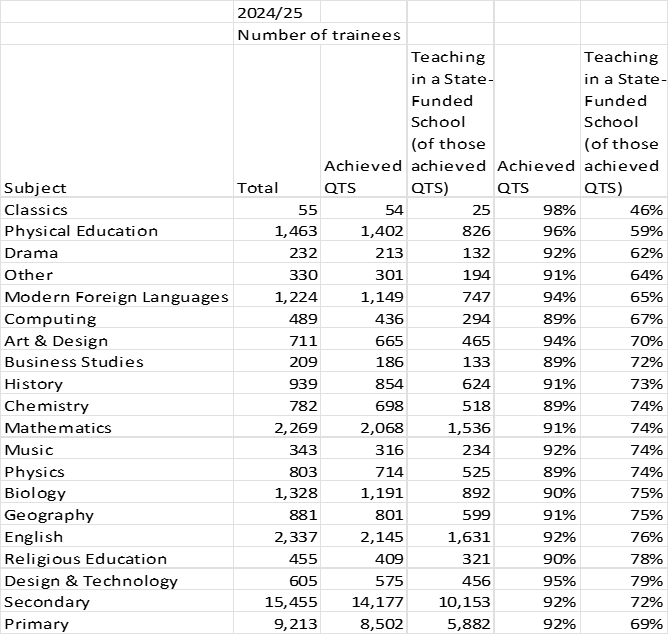
On Thursday, the DfE published its annual note about the working of the Teacher Supply Model Teacher demand and postgraduate trainee need: 2026 to 2027 – GOV.UK

The Model can be easily described in the DfE’s own diagram

It is interesting to note that the Teacher Supply Model

assumes that as pupil numbers grow, teacher demand will grow too, and vice versa. Additionally, the model assumes that PTRs will grow in line with the historical relationship between pupil numbers and PTRs. Similarly, the model assumes that PTRs will fall if pupil numbers fall. In other words, as pupil numbers grow, the TWM assumes that schools will increase the size of the teacher workforce and allow class sizes to grow a little. 

As a result, the Model finds it challenging to manage changes, such as in the curriculum. One of the best examples was the introduction of citizenship during the Blair/Brown Labour government. Schools didn’t sack teachers to make space for teachers trained in the subject, and with no historical data to underpin the need, estimates had to be made.

The assumptions about pupil teacher ratios are, of course, unable to factor in economic headwinds that might change assumptions about future funding of schools. There was a god example early in this century when, in a budget, the Chancellor announced extra cash to be sent directly to schools. Not surprisingly, the schools went after extra teachers and equilibrium in the labour market was only restored by a hike in teachers’ pay that dampened down demand that had not been anticipated in the Modelling.

I have discussed these points with the overseas governments that I have advised on teacher supply modelling over the years. I also favour including a check on what is currently happening in the labour market by surveys of vacancies. Advances in technology, such as pioneered by TeachVac, way back in 2013, allow current trends to be matched with the data input into the Teacher Supply Model that may be two to three years between data collection and the output of trainees based upon the data joining the labour market.

One increasingly interesting issue that the Teacher Supply Model may need to consider is the growing international labour market for teachers. The Model currently imperfectly accounts for loss from the trainee and existing teacher pools to the private sector in England. In the future, it might need to consider how many trainees opt to work abroad. This will be especially important if more overseas students are offered places on teacher preparation courses. Will they be offered visas to teacher in England, or will they leave the country after completion of their courses? I will try to consider this issue in a later post.

Finally, I am delighted that the statisticians have abandoned what they have called ‘the removal of the need for an adjustment relating to forecasted under-supply’.  Adding back in the number of unfilled places from a previous ITT round to the next year’s total was never a good idea, as I have made clear in a number of my posts on this blog. The decline in Physics ITT places from a high of 2,250 in 2024/25 to just 810 for 2026/27 is a good case in point.

However, has this re-assessment of need gone too far? Based on Timo Hanney’s work on vacancies and my own current research into vacancies for teachers of music, I think the DfE has been realistic in its approach. After all, if they have under-estimated demand, the government can always recruit more teachers from overseas by enticing those trained here to return to England.

Does the DfE care about the arts in schools?

In my previous post, I promised more from the DfE’s publication Teacher demand and postgraduate trainee need: 2026 to 2027 – GOV.UK On closer examination of the text, it is clear that a lot of the data has come from the June 2025 publication of school workforce data, collected in November 2024. The next publication with the 2025 workforce data should appear in June, so I will wait until then to review the trends I didn’t cover on this blog last summer, after the publication of the 2024 data.

However, there is an interesting table in this release showing changes in the number of teachers per 1,000 pupils. The time series runs from the end of the last Labour government’s decisions on school funding in 2010/11 up to the 2024/25 school-year. This covers a period when school rolls were both falling, and then rising again. For the primary sector, rolls have been falling for some time. In the secondary sector, rolls are reaching their peak and will drop away over the next few years. The extent of the fall will, in reality, depend upon trends post-16, and whether schools either retain pupils or see then depart for further education or apprenticeships.

The number of teachers per 1,000 pupils is, of course, governed by the curriculum. Mathematics and English are taught to all pupils between Years 7-11, whereas few schools teach Classics to any pupils at all. Hence the ratio for mathematics was 8.44 in 2025/26, and has changed little since 2010/11, when it was 8.39 teachers per 1,00 pupils. By contrast, classics come out at a constant 0.09 teachers per 1,00 pupils.

The number of teachers per 1,000 pupils
by secondary subject as published in this publication
Subject2010/112024/25difference% Difference
Computing3.471.77-1.7-49%
Design & Tech5.133.1-2.03-40%
Drama1.751.35-0.4 -23%
Art & design2.812.19-0.62-22%
PE6.254.98-1.27 -20%
Other Sub5.124.08-1.04-20%
Business studies1.911.55-0.36-19%
Modern F L4.643.91-0.73-16%
Music1.671.42-0.25-15%
Biology3.93.41-0.49-13%
All Sec68.0959.77-8.32-12%
RE2.322.2-0.12-5%
Chemistry3.163.08-0.08-3%
Primary48.1747.04-1.13-2%
Classics0.090.0900%
English8.78.700%
Mathematics8.398.440.051%
Physics2.692.720.031%
History3.213.50.299%
Geography2.93.270.3713%
Source: DfE School Workforce data

Interestingly, for a country concerned about ‘growth’, and the decline of the productivity of the economy, the subjects with the largest falls in teacher numbers per 1,000 pupils are computing (down 49%) and design and technology (down 40%). By contrast, the humanities subjects, of history and geography, have seen increases in the number of teachers per thousand pupils. Presumably part of this increase was the inclusion of these subjects in the English Baccalaureate by the previous Conservative government.

The arts have generally not fare very well. This is despite the ease of recruiting teachers in these subjects during much of the period reviewed. It might be assumed that these subjects were the casualties of the government’s views on the curriculum.

The small changes in mathematics and physics, no doubt owe something to the generous bursary and scholarships that have been available to trainee teachers in these subjects.

As noted, part of the change was due to the rise in school rolls. Generally, the Pupil Teacher Ratio in secondary schools has worsened as rolls have risen. This is not surprising. Governments have rarely been able to fully fund bulges in school populations. I suspect that part of the strain has also been felt in the size of ‘option groups’ in Years 10 and 11. However, I also know that class sizes have also increased in Years 7-9, where most teaching is of whole classes.

The other interesting question that arises from the data is the amount of teaching undertaken by those with appropriate qualifications in the subject that they are teaching. Regular readers will know my views on the subject. Teachers should be certified for specific subjects, and receive ‘emergency’ certification if required to teach ‘out of their field’.  The present system allows parents to be blissfully ignorant of whether their offspring are being taught by a teacher with either a degree and training in the subject or some lesser qualification. I wish more parents would ask. It would also be interesting to see research on GCSE results by the qualification of the teacher that taught the group.

With falling rolls, and reduced targets for trainees, we are entering a challenging period for those responsible for training teachers. I doubt the market will look like it does today in a couple of years’ time.  Who will survive and who will no longer be preparing graduates for teaching? Ans what of the alternative routes into the profession? Will they remain as at present?