Discipline in schools – the latest data around suspensions and exclusions in one area

Now that the local elections are out of the way, it is time to consider other issues – However, I might blog about my thoughts about schooling when all the results have been published and considered.

Earlier this week the DfE published data for exclusion and suspensions by schools for the spring term 202425; i.e. last year. The data came along with time series data for spring terms back to before the covid pandemic, indeed, starting in 2016-2017 school-year; the spring of 2017. Create your own tables on suspensions and permanent exclusions in england – Explore education statistics – GOV.UK

It is worth recalling that during the period under review by the DfE school rolls across the secondary sector have been on the increase, mostly as a result of the earlier rise in the birthrate. Some areas, including the one under consideration have also experienced a significant housebuilding boom for most of the period under review. New housing usually means more pupils.

I looked at the data for both suspensions and exclusions for all the secondary schools in one current local authority area. All but one school are currently academies, and most have been for the whole of the time period. Some schools have changed academy trusts during the time period, and three new schools have opened during the period, and one 14-18 school has closed.

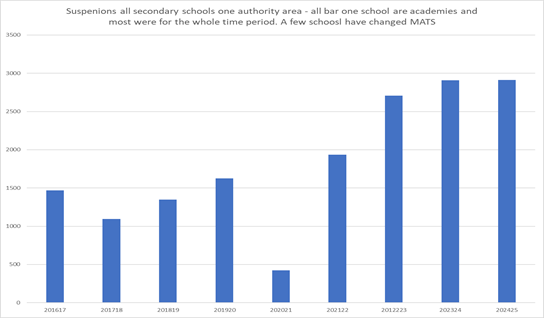
The schools already had noticeable numbers of suspensions before the covid pandemic. Since then, the numbers each year have been much higher, than before the pandemic, as shown in the chart.

The last three years for which data are available witness record numbers of suspensions, although not all schools have increased suspensions at the same rate. The range in the spring term 202425 was from one school with just 6 suspensions, to another with 291, albeit, this was one of the largest schools in the authority. However, it was not an urban school. Eight schools each recorded more than 100 suspensions in the spring term of 202425.

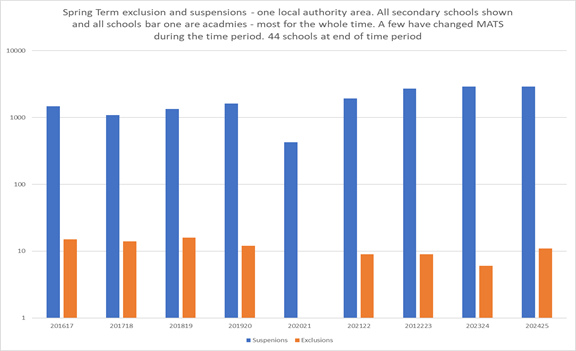
The picture for exclusions is much more encouraging, as can be seen on the following chart. This uses a logarithmic scale to plot both suspensions and exclusions. Exclusions across the authority have rarely exceeded ten in a spring term.

Of course, the total of suspensions for any one school can include multiple suspensions for the same pupil. The length of the spring term can also be affected by the changing date of Easter each year. This factor might have a small effect on each year’s data.

Of course, some pupils may not be ‘excluded’ at all, and hence not feature in these charts, but may be voluntarily removed to ‘home schooling’ by their parents. Whatever happens to pupils suspended or excluded, not being in school is more likely to see them become involved in a life of crime, often more serious crime than if they were in school on a regular basis.

Do some academy trusts have higher rates of suspension than other trusts among their schools? This is a challenging question to answer because it is clear that there is more likely to be a relationship between suspensions and the IDACI group in which the schools sits than the nature of the controlling MAT. However, it is clear than becoming an academy is not a panacea for solving the discipline issue of a school; at least as far as academies in this authority are concerned.  

Are suspension rates now on the way down? I hope so, but an not yet convinced that is the direction of travel. Time will tell.

Falling rolls -who dictates the outcomes for schools: Parents or planners?

How do you deal with the issue of falling rolls in our schools? A senior politician recently told me that there was no way they would reduce the admission number for a successful school, because the parents wouldn’t stand for it.

Interestingly when Mrs Thatcher widened the concept of parental choice in section 6 of the 1980 Education Act, the civil servants left a ‘get out’ clause allowing local authorities to override their ‘duty to meet the expressed parental preference’ because it was ‘prejudicial to the efficient use of resources’.  Back in those days, the notion of parental power was very much in its early days.

Now the politician I spoke with was only voicing the approach any retailer might take to falling sales; cut out the loss-making branches and strengthen those that make a profit. ‘Let the weakest go to the wall’, a dictum many learnt in school when studying their Skaespeare.

But, should public services operate in the same fashion? It’s worth remembering that parents are required to educate their children, and the State is the default provision for those that don’t, won’t or in most cases cannot do so in any other way.

How the State has responded to that demand from parents for schooling has changed over time. A reader reminded me of the Liberal Democrat position, as expressed by Nick Clegg during the coalition government that perhaps took parent power to the ultimate. I wrote then a blog post entitled Private education, but State Funded? | John Howson This might have been a good idea at the start of a decade of rising school rolls, but does it hold good when rolls are falling?

I guess it depends upon where you live. In a densely packed urban area, with many schools within easy distance of each other, survival of the fittest might seem logical even if the fittest was a Church School and didn’t have many pupils on free School Meals.  However, even in urban areas, change is rarely easy, and often messy, and the current funding formula for schools doesn’t help.

Schools below capacity often run at a deficit, so should academy trusts prop these schools up with cash from other schools that don’t spend all their income?  Perhaps that’s why parent power – or at least parent governors – don’t exist in most academies, in case they rumbled what was happening.

In less urban areas, the issue is more complex. Consider the following case study. Imagine a town and its locality with 5 primary schools where there is little or no house building, and post-covid relatively little movement in the housing market. The current position for one such town

is shown in the table below.

In total, the five schools had 857 pupils on roll, but with a capacity for 1141, so were operating at 75% capacity. Intake for the latest year was lower at 66% of capacity.

 TYPECURRENT ROLLCAPACITY% CAPACITYPlaces offered – latest
SCHOOL 1RC1182105613/30
SCHOOL 2CofE2993159545/45
SCHOOL 3COMMUNITY1782108516/30
SCHOOL 4ACADEMY1301966615/30
SCHOOL 5COMMUNITY1322106318/28

Schools 1-3 are in the town, and schools 4-5 are within easy travelling distance. The obvious answer might be to close one of schools 4-5, but that would create additional transport costs for the local authority; to be paid from Council Tax.

Closing the RC school is not possible, as the exiting pupils cannot be accommodated at the other two schools, as they have insufficient spare capacity, and the need would be for an additional 70 places over the current capacity. Should the RC school numbers fall further to less than 100-110, and intakes not increase at the other two town schools, it would be possible to close the RC school if each of the other two schools in the town could take an extra class. However, the restricted nature of their sites may that possibility unlikely.

What happens if the RC school remains open, and starts to run a deficit budget and, as a consequence, either the diocese eventually decided to turn the school into an academy or it is judged inadequate by ofsted, and forced to become an academy. Could the diocese transfer funds from other schools to keep the school open?

What of the future for schools 4 & 5 if they are faced with the same scenario of starting to operate on deficit budgets, and the risk to the local authority with regard to school 5 at a time of great pressure on the authority’s budget.

Should someone create a plan for the future. If so, who? The local authority, the Regional School Director, the DfE? Or does the desire of the parents for one particular school eventually affect the other four schools, and the market decides? Discuss.

For those that want to consider the issue further, I wrote a play around a school facing falling rolls in its locality to try to tease out some of the issues. You can access it at C:\Users\dataf\OneDrive\Documents\FallingRollsPlay.docx or by requesting a copy by using the comment section

Reader might also like this post from a decade ago. My concern about the future of small schools isn’t new. Are small schools doomed? | John Howson

Headteacher vacancies – a changing trend in advertising date?

One of the advantages of studying the same field for more than 40 years is the opportunity to investigate interesting hypotheses.

But first, a bit of background. When I started collecting vacancies for headteacher posts in state schools in England, way back in the 1980s, an advert in the TES was virtually the only source for jobseekers, so data collection was easy. The exception was the 12 months in the 1980s when News International titles, including the TES, were affected by a strike that prevented publication.

From around 2000 onwards, the TES had both print and on-line vacancies to check for headteacher vacancies. These days the main source of data are the DfE vacancy site, at least for headteacher vacancies. Even so, some schools still advertise in the TES, and a few on regional job boards, especially in the North East region.

My first hunch, not really a hypothesis in the 1980s when I started the work of collecting headteacher vacancies was that faith schools had more difficulty recruiting a new headteacher than other schools, based upon the number of such schools re-advertising. An early analysis supported the hunch, and the challenge facing faith schools is still with us in an increasingly secular society.

My next hypothesis was that most vacancies for headteachers came as a result of retirements. For a number of years, the annual study of senior staff vacancies I conducted for the NAHT validated this hypothesis, at least for headteacher vacancies.

In the days when all schools in the state sector were linked with a local authority, headteachers retiring at the end of the school-year might inform their governing bodies of their decision to retire at the last meeting in the autumn term. The result, a rash of advertisements for headteachers in January, and the bulk of vacancies for headteacher posts were either advertised or re-advertised between January 1st and 30th April.  

As a result of the increasing number of schools that are now academies, I have created a new hypothesis. I wonder whether the absence of any real local governing body for each academy might have resulted in headteachers postponing announcement of their retirement to the Trust until a later date in the term starting in January and, as a result, advertisements for headteacher vacancies are now being skewed to the second half of the first quarter of the year, with fewer January advertisements?

Now we are in April, it is possible to consider the data, and compare the data for 2026 with 2006 and 2018 – sadly TeachVac didn’t collect headteacher vacancies in 2016, but at that time just concentrated on classroom teacher vacancies.  

The first thing to note is that there appear to be fewer headteacher vacancies advertised in 2026 compared with either 2006 or 2018.

YearJANUARYFEBRUARYMARCHTOTAL
2006TOTAL5093944421345
2018TOTAL3583803391077
2026FIRST175203289667
2026READVERT132285120
2026Total188225374787

Source Headbase 2006; TeachVac 2018; John Howson 2026

In 2006, the demography of the teaching profession was very different to that of today. Many more headteachers were approaching retirement in 2006, and often decided to retire before reaching the then official retirement age. Nowadays, there is no official retirement age, pension rules have changed significantly, and I suspect the actual number of headteacher retiring each year has decreased.

However, the more interesting piece of data relates to the percentage of vacancies recorded each month. In 2006 and 2018, data collection did not distinguish between first advertisement and re-advertisements during the three months, but counted all but ‘repeat’ vacancies published.

The 2026 data collection exercise I conduct is based upon a collection date, accurate to within three days of a vacancy being published, and a re-advertisement data based upon a new closing date more than four weeks after the original closing date for the vacancy for a headteacher. Re-advertisements with an April closing date have been assigned to March for the purpose of this exercise on the basis of three to four weeks between vacancy being published and closing dates.

YearJANUARYFEBRUARYMARCHtotal
2006TOTAL38%29%33%100%
2018TOTAL33%35%31%100%
2026FIRST26%30%43%100%
2026READVERT11%18%71%
2026Total24%29%48%100%

Source Headbase 2006; TeachVac 2018; John Howson 2026

The data does seem to offer some support for my hypothesis, as January only accounted for 26% of vacancies in 2026 (24% if re-advertisements are included) compared with 38% in 2006, and 33% in 2018, when academies were already a feature of the school landscape.

March 2026 accounted for 48% of headteacher vacancies, compared with 33% in 2026, and 31% in 2018. In a future post, I will delve into the issue of re-advertisements that accounted for five per cent of the vacancies in March 2026.

At some point, I will compare academies and non-academy state schools to see whether their advertising patterns for headteacher vacancies in the first three months of the year vary, and will report my findings in a future post.

Demand for SEND places

Yesterday, I wrote about the forecast decline in primary and secondary school places. In the past, less attention has been paid to the need for places for pupils with SEND. However, possibly as a result of the rapid growth in EHCPs, and hence the demand for specialist provision, the DfE has started trying to forecast what it has termed ‘the Local authority pupil forecasts for ‘Local authority specialist provision for pupils’.

This exercise was always going to be something of a challenge since it is taking place against falling pupil numbers, especially in the primary sector, but increasing demand for EHCPs. However, if demand for EHCPs continues to increase, it won’t necessarily mean a demand for more special school places, because some of the increased demand is likely to be met by specialist provision within schools as ‘specialist bases’ are created, often using the spare capacity arising from falling rolls.

At present the DfE data shows that the current stock of special schools is operating at over-capacity by some 10,000 places. At the top of a demographic cycle, such pressure would not be surprising, as schools often take ‘bulge’ classes for a couple of years using temporary buildings rather than built new schools that might not be needed as rolls fall. Whether that is the correct approach in the present circumstances for the special school sector is unclear from the DfE’s data published yesterday. School capacity in England: academic year 2024 to 2025 – GOV.UK

An analysis of local authority data around provision of specialist provision for the period up to the end of the decade reveals large differences across the country in projected need. At one end of the spectrum, three local authorities are projecting grow of in excess of 1,200 places each in the primary sector. At the other end of the spectrum, twenty-four authorities are predicting a reduction in need, with one ‘Reform’ led county predicating a need for 500 fewer places. Interestingly, the adjacent unitary authority is predicting an increase of over 100 places.

Oxfordshire, whose primary and secondary place forecasts were discussed in my previous post is predicting only a very small increase in the number of primary places.

These significant differences don’t seem to be related to either the underlying pupil population or the trend in pupil numbers in the primary sector. This raises issues about how reliable the current forecasting around the demand for SEND places is for policy-makers. Accurate data are important, because of the cost of provision in the SEND sector.

Data on provision of places are also important in helping identify workforce needs. It seems odd that the DfE doesn’t seem to have a unit that brings together trends in pupil numbers and the demand for both places and people to educate the projected school population.

If the DfE did have such a unit then it might look at the costs of small sixth forms and of central overheads by different MATs. It might also look at the issue of small primary schools, and how they might be protected in rural areas, but possibly amalgamated in urban areas. Is a one-from of entry school viable in London?

Hopefully, the data published yesterday will create some debate around the important, but often overlooked, issue of pupil place planning, and the future shape of schooling in the modern age.

School building boom is over

The DfE has published its latest estimates of school capacity for 2024/25, together with estimates for places needed up to 2029/30 School capacity in England: academic year 2024 to 2025 – GOV.UK

There are two sets of numbers. One looks at both need and places available and calculates what might be regarded as a raw score. This looks at all spare places, regardless of location within the authority and measures that number against expected additional need. The second set just looks at additional need.

During the period between 2025/26 and 2029/30, most additional need is likely to come from changes in the housing stock, with little, if any, growth from the increase in the number of pupils in the relevant age groups. As a result, most local authorities show either no need for additional primary places or only small increases in numbers. Wandsworth is the only Inner London borough with any additional need for primary school places during the period 2025/26 and 2029/30.

The table balancing existing places with additional need shows only a handful of local authorities with a reduction in the spare capacity in the primary sector between 2025/26 and 2029/30. For most authorities, the spare place problem is expected to be worse in 2029/30 than it is in 2025/26

net spare places
OxfordshirePrimarySecondary
2025/26-11,052-6,321
2026/27-11,557-6,449
2027/28-13,117-6,959
2028/29-13,865-7,143
2029/30-14,601-7,336
Change-3,549-1,015

The table shows the estimates for Oxfordshire. Several factors could mean these data are not going to be accurate. In recent years, Oxfordshire has seen significant housebuilding, and if the construction of new housing continues, and attracts families from outside the county, then the spare places may be an overestimate.

Oxfordshire is also home to several military bases for both the army and the RAF. Although defence planning has projected the closure of some of the army bases, the current defence review and increased spending on defence might either slowdown or reverse the closure of some of the bases. If closures slow down, then this might mean pupil numbers don’t fall as expected.

The problem for both the local authority, the dioceses and the academy trusts is that Oxfordshire has many small primary schools located in villages. Often the school is the only facility left in the community. The present funding formula that is heavily biased towards pupil numbers poses a potential problem for small schools. Academy trusts can ‘vire’ funds between schools to help such schools through any temporary downturn in pupil numbers. At present local authorities do not have this ability: they should be given the power to support small village schools in the same way as MATs can.

However, as with many other rural areas, school closures look likely over the next few years if schools are not to run up deficit budgets. Such deficits would be paid off by depriving future pupils of some of their funding. With education spending likely to be squeezed to accommodate the increase in defence spending, and a greater proportion of the school funding going toward SEND pupils, there may well be some hard decisions to make.

With declining interest in established faiths, how will the dioceses react to falling rolls, if their schools are no longer viable?

One certainty is that if any school closures require additional free transport to the next nearest school, the current£20 million Oxfordshire council tax payers contribute to fund mainstream school transport will not be enough, even if fuel and other costs remain stable.

Local government reorganisation may offer a way out for politicians in areas such as Oxfordshire, but politicians in urban areas, and especially in London will not be so lucky. Time to dust off my review of falling rolls in Haringey in the 1970,s and the lessons to be learnt from those battles.

Fine the accountants

Both stand-alone academies and Multi Academy Trusts use private sector accountants to audit their accounts.  Each year, a number of MATs and academies are tardy in publishing their accounts at Companies House, where anyone can view the school or MATs handling of public money.

In my experience, it is the same MATs and schools that keep everyone waiting each year and this delay prevents any useful analysis of how schools are using their funds in particular geographical areas.

As usual, I am still waiting to see the accounts for seven sets of accounts for the schools in the geographical area where I track all non-community schools. These missing accounts are mostly the accounts from the same set of schools that were slow in appearing last year and the year before.

I think it is high time that the DfE, now responsibly directly for the funding of academies after the closure of the EFSA, takes some action to ensure all accounts, save those where there are legitimate queries, are posted by the end of January each year. That’s five months after the end of the accounting year, and should provide sufficient time for all accounts to be prepared.

How to deal with those accountants that don’t file by the required date: fine them. The notion of fining for late delivery of documents is well known and accepted. After all, HMRC will happily fine anyone not delivering their tax return by the due date, so why not fine private sector accountants for not filing these accounts on time.

The consequences would be that either the fine was passed on to the school or MAT or the accountants declined to continue handling the accounts in future years. Either way, the fine should help to instal financial discipline in those schools in the non-community part of the state school sector that are either being ignoring or possibly even flaunted the deadlines at present.

With the recent White Paper once again raising the spectre of all schools becoming academies – one wonders how foundation Schools view that prospect – installing financial discipline from day one should be something the National Audit Office needs to confirm with the DfE is not just a nice thing to have, but a necessity. The NAO might well decide to qualify the DfE’s accounts if it cannot see the accounts for all directly funded state schools within the prescribed time frame.

In my next post, I will consider how salaries for the top earners in MATs within one area have changed between the 2024 and 2025 accounts. With secondary schools now regularly advertising their headship with a starting salary of more than £100,000, and some on even more than £150,000, it is important to know whether Chief Executives of MATs, and executive headteachers are now regularly earning more than the Directors’ of Children’s Service in local authorities.

I guess that they are also earning more than the civil servants that have the ultimate power over the school sector. One wonders what should be the multiple between the salary of the lowest full-time worker in a school and the headteacher? In many case, it cases the multiple is now more than a factor of ten, between the lowest and highest paid staff members in a school: is this too great a gap?

White Paper: bad news for rural primary schools

Tomorrow, Monday, we will see Labour’s White Paper in full. For now, we have copious leaks and SEND and other matters, such as how to tackle the outcome gaps between the most deprived pupils and their more fortunate fellows either sitting alongside them or in other schools to whet our appetite.

The replacement of Free School Meals as a measure of deprivation has been long overdue, but it will be interesting see, as schooling moves from a local service to a national service, administered in a similar fashion to the NHS, whether the civil service will be any better than local politicians at managing the performance of the school system.

Making all schools academies will be the final nail in local government’s interest in schooling. Once SEND is handled nationally, it will just leave admissions, mainly on-line these days, to be removed from local management.

However, the changes already foreshadowed in the leaks mean that there will be winners and losers. Assuming that H M Treasury might fund some of the SEND changes, there is unlikely to be any new money to support schools to improve.

The present Funding Formula is heavily biased towards pupil numbers. Great when rolls are rising, but bad news for small schools when rolls fall. If the formula is altered to move more money towards schools with significant numbers of pupils not achieving expected standards, where will the cash come from?

Might small rural primary schools with good attendance and excellent results see their funding cut in real terms? If so, what are the consequences likely to be?  Trusts will be reluctant to keep schools that cost more to run than they bring in through funding open, and will have no incentive to do so. Afterall, any travel costs will be paid for from the local authority under present arrangements.

I can see the local government organisations saying that if local authorities don’t run schools, then they shouldn’t have to pay any transport costs. Taking £46 million off Oxfordshire County Council’s budget would pay for an awful lot of pothole repairs, not to mention bolstering other services.

For those local authorities currently receiving little funding from central government, removing schooling entirely from local government would be an unexpected bonus. On the other hand, there would, as with the NHS, be no local democratic accountability. Education rarely features during general elections.  

One bonus of a national school system is that the government might feel able to create a universal system for secondary schools, some 61 years after Circular 10/65 and on the 50th Anniversary of the 1976 Education Act.

Without democratic oversigh,t ignoring the 2006 rules about closing small rural primary schools will be much easier. Small one form entry faith schools in urban areas with good results have even less protection. It is worth studying the results for primary schools in Haringey to see the parts of the borough that might be winners and those that might be losers if funding doesn’t increase overall.

As someone that started teaching in Tottenham in 1971, when we had ‘areas of exceptional difficulty’ payments introduced into ‘Education Priority Areas’ it is interesting to see how stark the divide between schools on opposite sides of the railway line north from Kings Cross still remains.

So, will the government close that divide? But will it be at a cost to rural primary schools in Oxfordshire, my current home?

Who controls your teaching career?

For a few years in the 2000s, I wrote a weekly column in the TES answering questions from teachers about their careers. For all the time I have been associated with teachers, teaching and our education system, it has been clear to me that for the most part teachers are on their own when it comes to plotting a career path. Not only do they few places to turn for individual advice and encouragement, but they mostly have to finance any career development out of their earnings.

There is an obvious tension between the needs of a school, and the needs of those working within the organisation. Good employers recognise the need to develop their staff, even if it means losing them to another school. So how would you answer these multiple-choice questions?

Your school recruited a good new teacher of physics in 2024, straight from a PGCE course. In 2026, do you

A] Keep your fingers cross that by the 31st May they haven’t submitted a letter of resignation

B] Tell them they can have a TLR to encourage them to stay at the school

C] Discuss their career ambitions with them, and how long they might stay at the school

D] Ask them to teach some mathematics next year, as the school is short of maths teachers?

Might you answer be different if you were the headteacher of

A] a rural school and the teacher’s partner worked locally

B] An urban school with many other schools in commuting distance of your school

C] A school in an academy trust of several local schools

D] A school with falling rolls

Of course, there are no right answers to these questions.  But, your instinctive attitude to each possible answer may tell you something about your values with regard to pupils, teachers, schools and education in general.

Should teachers have somewhere to turn for advice about their own careers? There are posts on this blog about how far an entrant into teaching at age 30 might progress in their career. How attuned are schools to the needs of their staff. If a young parent wants a bit of flexibility, does the school either find a way to offer that support or just refuse to even consider the issue: think of everyone else on the staff.

Is career advice a role for the Chartered College of Teachers; for the professional associations; for subject and phase membership organisations; or for all of these, plus leadership teams in schools?

In the late 1970s, I worked in a professional development centre, a place where teachers could come and talk about their aims and aspirations. Do we need such space, either real or virtual today.

Am I right to be concerned about the career paths of teachers, or it everything fine out there these days, with social media available for teachers and many other organisations wrapped around schooling? I would be interested in comments from readers.

I became a teacher because of the freedom it offered me, but I knew I had to manage my own career. Thankfully, I did so, even if some of my decisions might have been different with the benefit of hindsight. But, they were my decisions.

2010 and the Case for Change: a look back at what was promised

In November 2010, the Conservative Government, and Michael Gove, as Secretary of State for Education, set out their vision for state education in a document entitled ‘The Case for Change’.

The concluding paragraph said:

Reform should seek to strengthen the recruitment, selection and development of school teachers and leaders. It should strengthen and simplify the curriculum and qualifications, to set high standards, create curriculum coherence and avoid prescription about how to teach. It should increase both autonomy and accountability of schools, and ensure that resources are distributed and used fairy and effectively to incentivise improvement and improve equity.” The Case for Change, DfE, November 2010

Bold claims.

Looking at them in more detail, here are a few thoughts. Other suggestions welcome in the comments

Reform should seek to strengthen the recruitment, selection and development of school teachers and leaders: The move from a higher education led system of ITT to a school-based system failed. There are probably fewer trainees on employment-based routes now, as opposed to SCITTS or higher education routes, than during the Blair government era.

Between 2013 and 2023, the Conservative government presided over the longest period of under-recruitment to ITT, against their own targets for training. This failure to train enough teachers has had a profound effect on schools, ad has not been solved by the present government

should strengthen and simplify the curriculum and qualifications: Decoupling of A/S and A levels in 2015 substantially changed the post-16 landscape. The introduction of the English Baccalaureate weighted the curriculum in favour of traditional academic subjects. The change was never enforced on schools, although it was reported in the data about schools.  

set high standards: I am never quite sure what these are. Examination results improved to a point where exam board were required to change grade boundaries, so fewer entrants received the top grades.

avoid prescription about how to teach: Phonics was the prescribed method of teaching reading. The ITT curriculum was made even more prescriptive

increase both autonomy and accountability of schools: Local authority schools had almost complete autonomy, as their budgets were sacrosanct. Academies were fine if stand alone, but as part of a MAT, their autonomy could be seriously reduced, but their accountability may have increased, although there was no accountability for MATs as they weren’t subject to inspection.

ensure that resources are distributed and used fairy and effectively to incentivise improvement and improve equity: The National Pupil Funding Formula was introduced during a period of rising school rolls, with no consideration as to what would happen when rolls started to fall. A study of PTRs by the author shows London schools with generally better staffing ratios than schools in the north of England throughout the period of the conservative government. The Lib Dem Pupil Premium may have help provide extra resources for pupils on Free School Meals, but the staffing crisis often meant that schools with large number so FSM pupils found recruitment of staff an issue.  

Were the claims met? In many cases not, and the funding for schools in real terms declined during much the period the Conservative were in government making improvements harder to achieve. The failure to address the staffing crisis was, perhaps, the most important failure of the vision set out in 2010.

How easy is it for a mature entrant to become a headteacher?

The recent DfE research into promotions provides some food for thought School leadership in England 2010 to 2020: characteristics and trends

Page 69 of the report contains the following paragraph.

‘Teachers may enter a leadership grade more than one step above their current grade or may enter a leadership grade after being outside the system. These non-sequential promotions make up a significant minority of promotions. In primaries schools, for example, for every 100 senior leaders in 2016 who were heads in 2020, 12 classroom teachers, 12 middle leaders and 11 system entrants also became heads. In secondary schools, for every 100 senior leaders from 2016 who were heads in 2020, 3 classroom teachers, 5 middle leaders and 5 system entrants also became heads. Non-sequential promotions appear to be more common in primary schools, where leadership roles are more limited and ‘linear’ progression may be more difficult.’

Interestingly no mention is made in the text of the position in special schools, a disturbing oversight in view of the current concerns about SEND.

Following on from the text there is a histogram of ‘The Grade occupied by 2020 heads in 2016, split by school phase in 2020, in terms of FTE’.

GradePrimarySecondarySpecial
Head645252
Senior Leader263932
Middle Leader314
Classroom Teacher313
System Entrant369

There is no mention in the text of the fact that in many small primary schools there may be no senior leader, so any internal appointment would inevitably come from either a middle leader or classroom teacher.

What is interesting is the fact that almost one in ten headteachers in special schools in 2020 were system entrants in 2016. Where did these entrants come from, were they from special schools outside the state sector or did they bring other expertise to the post of headteacher.

How long does it take to become a headteacher?

In view of the fact that most headteachers seem to be appointed as a result of ‘linear’ progression through the different grades, especially in secondary schools, how long does it take to reach headship?

Is there an age or length of service by which, if a teacher has not reached assistant head grade, they unlikely to ever make it to a headship? If so, do mature entrants that become teachers after the age of thirty face a promotion ceiling in their careers? Is the position different in primary schools, with their flatter leadership teams, than in secondary schools with assistant, deputy and headteachers roles, often now overseen by an executive head.

The DfE research showed that in 2010, headteachers had a median of 27 years since qualification, and that this reduced to 23 years in 2016 and then rose slightly to 24 years in 2020. The median years of experience of senior leaders reduced from 18 years in 2010 to 17years in 2014 where it remained until 2020. The reduction between the upper quartiles for years since qualification was greatest for senior leaders, 24 years since qualification in 2020 compared with 30 years in 2010. There was virtually no change in the lower quartile between 2010 and 2020, for example, this was 13 years since qualification for senior leaders in both 2010 and 2020.

As this data covers both primary and secondary schools, it is difficult to know whether promotion is faster in the smaller primary schools, if you are lucky with turnover, that in large secondary schools with many more layers of leadership. Clearly, some mature entrants achieve headship, but the message must be that if you want promotion as a mature entrant, start your journey quickly and use the skills you have brought to the profession from your former career. A decade ago, I wrote this blog about the career of Mrs Clarke who went from volunteer to headteacher in the same school. Congratulations Mrs Clarke | John Howson

Sadly, the research is silent about entrants from different subject backgrounds. Do historians and geographers, generally joining smaller department, find progress to a headship easier than teachers of English and mathematics where there may be several grades of middle leadership within the department?

We should encourage mature entrants, but make it clear that those joining after the age of thirty may find career progression more of a challenge, especially where governing bodies value length of service rather than skills and expertise for the role. No doubt MATs with more professionals involved in promotion decisions will be more open to those entering teaching later in life.