Will teachers vote to take industrial action?

The BBC are running a story that suggests a teacher association: the NEU will ask its members about whether they support industrial action that could, presumably, include striking and closing schools? Teachers in England move towards striking over pay – BBC News

My guess is that their members will vote for action: at least in the secondary schools. Whether the larger number of NEU members in primary schools will do so, might be more uncertain. Here’s a link to an early post of this blog, way back from February 2013 February | 2013 | John Howson about what happened then.

Now, we live in different times: a Labour government; many years of pay freezes and pay rises below those in the private sector, but two relatively generous recent settlements, and the possibility of a three-year deal in even more challenging times.

Now factor in, falling rolls leading to job uncertainty in many primary schools, better recruitment to lower targets for new teachers, the need for increased spending on defence and welfare, and an electorate that will judge the government on the length of NHS waiting lists rather than what happens in schools, and the balance between expressing concerns by voting for industrial action, and actually taking action sometime in the autumn, is as the saying goes, a ‘whole different kettle of fish’.

My bet is, shake the big stick now, but think carefully about strike action in the autumn. Or perhaps persuade the government to tweak the pay offer, when it comes from the pay review body, so that both sides can claim victory.

It is interesting that this story is running 100 years after the only real General Strike in British history. This is an anniversary that, unlike Sir David Attenborough’s century, has been largely ignored by the media. I guess nobody wanted to drag it up during a period of local and state elections across the United(!) Kingdom.

One interesting fact from Thursday, is that Labour lost control of Haringey Council. They did so in the 1968 local government debacle. In that period of two-party politics, to the Conservatives. This time the outcome is more complicated. In 1968, the year of revolutions across Europe, Labour in government didn’t sack the Prime minister. Indeed, Harold Wilson led the Party into the 1970 general elections: a much closer race than the 1968 results might have predicted.

The Haringey result is interesting to me, as it meant that in 1971, I started work as a teacher in Tottenham under a Conservative administration. I don’t recall much changing when, in 1972, Labour regained control of the borough. Now the remainder of that decade was a turbulent time in British politics and not only the teachers, but also non-teaching staff. They took industrial action, leading eventually during the ‘Winter of discontent’ in 1979, to all Haringey’s schools being closed, not by the teachers, but by the caretakers going on strike. The Labour administration did not expect anyone, even church schools, to try and break that strike.  These days, with the internet, and remote schooling commonplace, such an outcome in terms of teaching and learning might be much less likely.

For a discussion of the effects in 1979 see my posts from 2020  March | 2020 | John Howson COVID-19 PM’s Suez? | John Howson and The State cannot just abandon children | John Howson and especially from February 2020 Closing schools, but not stopping education | John Howson

David Attenborough at 100

This week the BBC has being paying tribute to Sir David Attenborough, ahead of his 100th birthday later this month. There is no doubting that Sir David has had a great deal of influence on many people through his television documentaries, at first in shades of grey, and then in colours that have improved as television screens have become ever more sophisticated in replicating the colours of the real world.

But who influenced Sir David Attenborough in his choice of career? Way back in 1997, the then Teacher Training Agency decided to commission two cinema advertisements. One, that received all the attention was called ‘talking heads’, and featured head and shoulder shots of a range of celebrities just saying a name to the camera. The trap line at the end was ‘no one forgets a good teacher’.

The other, far less well-known advertisement commissioned by the Teacher Training Agency in 1997 featured a teacher called Horace Lacey and a pupil called David Attenborough. You can see it here. Teacher Training Commercial: Horace Lacey | Catalogue | History of Advertising Trust My thanks to the History of Advertising Trust.

Both adverts were placed in cinemas, and because it was before the general use of websites and urls, postcards were placed in cinema foyers to provide the contact details for anyone interested in teaching. After all, it was impossible to write down a phone number in the dark of a cinema at the time when the advert was actually being played.

At the same time, the agency produced a famous poster with the stap line ‘the dog ate my homework. a phrase that passed into common parlance for a period of time.

After a few years, advertisements for teaching as a career started to reappear on TV screens, albeit at the wrong time of year to make any significant short-term difference to recruitment. I made an oblique comment about the effects of TV advertising in this post Do TV adverts work? | John Howson However, I am afraid the title is a bit of a misnomer.

So, my very best wishes to Sir David Attenborough. I hope that all the publicity surrounding his 100th birthday will help inspire the next generation of young people, and the present generation of undergraduates, to take up teaching as a career.  I also hope that the attention to Sir David’s birthday also encourages us to honour the memory of Horace Lacy, and countless hundreds of thousands of other teachers like him that have inspired their pupils down the generations.

Thank a teacher, it is an inspiring job that is like no other. And, although I may not have inspired many of my pupils, I did recognise those around me, both in school and higher education that changed lives and careers. My personal thanks to them.

DfE Vacancy site – some more thoughts

The DfE vacancy site has now been in operation since 2018. During that time, it has altered little in appearance. Right from the start of the site, I was critical of its features. I felt then that TeachVac and other sites could have done a better job for much less money. I posted my frustration about the site in both January and March of this year.

After another infuriating day working on the headteacher vacancies listed on the DfE’s vacancy site yesterday, I though I would take a further look at what was on offer in terms of headteacher vacancies.

First off, the DfE site told me there were, in total, 122 vacancies, if I used their pre-defined key word of ‘headteacher’. The vacancies are presented in a list order covering 13 pages. However, there are not 122 vacancies for a headteacher.  10 of the posted vacancies are either for Executive Headships of more than one school (2) or posts below a headship (8 vacancies). Indeed, one vacancy isn’t even a teaching post. So, the real total of headteacher vacancies is 112?

No, sorry, that is not correct either. This is because 10 of the vacancies, including one non-teaching vacancy, appear twice on the site. As a result, the actual number of schools advertising for a new headteacher on the DfE vacancy site at 0900 on the 25th April 2026 was actually 102. That’s 20% below that stated figure.

Now, I have nothing against multiple listings. After all, a person might miss the vacancy the first time it appeared: but why only a few random vacancies? I believe such double listings should either be removed from the site – it just requires a simple piece of coding – or the rules about the same vacancy being listed more than once at the same time should be made clear.

Where I do quibble with the DfE, is with the inclusion of posts not for a headteacher vacancy in the listings under the ‘headteacher’ category, and, as a result, their inclusion in the overall total. This is just mis-leading, and schools should be prevented from uploading such vacancies under the ‘headteacher’ listing. Again, this should not be a difficult coding exercise.

The other question is: does the vacancy site meet the needs of schools and candidates? Well, some schools still advertise their vacancy for a headteacher elsewhere. Local authority job boards for non-academy schools; the ‘tes’ as well, or in a small number of cases instead of the DfE site. Some vacancies also appear on regional websites, such as in the North East or South West.

The DfE vacancy site doesn’t accept vacancies from non-state funded schools. Candidates considering both state and private schools have to look at more than one vacancy site. Is this a good idea? I don’t think it matters at the level of headteacher posts, except perhaps for special needs schools, where the private sector is playing an increasingly important role. However, for entry level jobs, some form of aggregation might be useful, especially as candidates begin to outnumber vacancies for the first time in many years.

Does the DfE have a board or committee that reviews its vacancy site? If not, perhaps the teacher association might ask for a review. After all, they would serve their members better by operating such a site themselves. Not only would they have better data on vacancy trends to argue their case with the STRB, but they could also earn some extra income. When I suggested this to the associations in 2013, when I created TeachVac, sadly they weren’t interested.

Celebrating 100,000 Blog Visitors: A Thank You to Readers

Yesterday evening this blog received its 100,000 visitor, according to WordPress statistics. I would like to say a very big thank you to everyone that has read a post on this blog since I started it, way back in early 2013. According to Chat GPT, only 5% of blogs started in that year still survive. This blog not only survives, but is also thriving.

From time to time, WordPress suggest I make a charge to visitors to read previous posts. I have steadfastly ignored those blandishments in favour of open access for all. I am sure that policy has helped gain me extra visitors.

However, writing a blog does take time and effort, and if you know a library that might like to book of the 2013 posts, some of which WordPress no longer allows access to, please suggest they buy the book either as a e-book from Amazon or as a paperback from myself through the email at: dataforeducation@gmail.com

Once this book has covered its costs, I will publish another on the 100 most read posts – with a bit of commentary as to why they might have received so much attention. To date, posts about teachers’ holiday entitlements lead by a long way. It seems like the myth of long holidays is deeply engrained in the public’s psyche.

As someone that failed their English Language examination at age 16, I never thought that I would write a column for the TES between 1997 and 2010, and this blog since 2013. Sub-editors taught me a lot, and on-line software has helped. Interestingly, I have experimented recently with turning the text of a blog post into a webinar conversation. If you ae interested, I will leave you to search the 2026 posts for an example.   

In the past, comments were more frequent that they are these days, although ‘likes’ still seem to crop up from time to time. My thanks to those that ‘like’ every post I write. I am not used to having such a fan base.

My especially thanks to, Janet D, Frank S and Sue B for their many comments. Along with teachingbattleground, they make up the most frequent commentators over the years on my posts. Frank was at school with me, and I still remember his part in TCS plays.

Where now for the blog? Well, I hope to keep it going for some time yet, as there is certainly plenty of material to write about. My special field is the labour market for teachers and, especially, headteachers, where I have more than 40 years of data from my research. Later today, I will post, as my next blog post, about how my findings compare with a report that was published yesterday. AI can do some things, but it still has much to be taught to make it even more useful as a research tool.

So, once again, thank you to my audience, whether you have just read one post, have delved into the archive as part of research for a project, or are one of the small number of regular readers.  

30th April update

A, my thanks to you, the readers for the best April ever for the blog. 2,000 readers over the courses of the month!

Thank you.

Teacher Turnover- Is England doing better than the USA?

An interesting report crossed my desk a the end of last week. Teacher Turnover in the United States: Who Moves, Who Leaves, and Why | Learning Policy Institute This study, by Tiffany Tan, Wesley Wei, Desiree Carver-Thomas, and Emma García was produced the Learning Policy Institute, and first appeared in mid-March.

Key findings were that;

Teacher turnover remains high nationally. Between 2020–21 and 2021–22, 15.1% of U.S. teachers moved schools or left the profession: 8.0% moved schools, and 7.1% left teaching. Turnover rates have been largely stable over the past 2 decades but are now about 27% higher than in the early 1990s—an increase driven primarily because the rates of teachers leaving the profession increased by more than 50%.

Most teacher turnover was voluntary and preretirement. Nearly 3 in 4 teachers (74%) who moved or left did so voluntarily for reasons other than retirement. This percentage is higher than it was 10 years ago, when 67% of teachers left their schools voluntarily and preretirement.

Nearly half of teachers who moved schools stayed within the same district, and almost 40% of those who left teaching remained in the education sector. Among movers, 36.5% of teachers moved to a different district in the same state, while 17.3% moved to a different state. Of those who left teaching, 31.2% retired, whereas 13.1% took jobs in other sectors.

Teacher turnover rates vary across groups of teachers. 

It is interesting to compare this survey with the NfER’s recent Report on the School Workforce in England

School teacher retention has improved slightly in recent years, with the leaving rate falling from 10.6 per cent in 2016/17 to 9.5 per cent in 2021/22 and nine per cent in the most recent data. This has contributed to lower ITT recruitment targets and increased teacher numbers overall. The exit rate of first-year early career teachers who left within one year between 2023/24 and 2024/25 was 10.3 per cent, the lowest rate since the data began. (page 11)

The NfER conclusion seems much more optimistic than that of the US Report from LPI.

In contrast to previous NFER reports on the teacher workforce, the flows of teachers into and out of the labour market look reasonably healthy for the future of teacher supply. Recruitment is improving, even in some subjects which have seen persistent shortages. Teachers were less likely to leave the workforce last year compared to any year since 2010/11, outside of the pandemic. The early career teacher retention rate is the best on record. Teachers’ working hours are steadily coming down on average and the proportion of teachers who report having an acceptable workload has improved somewhat. Some progress has also been made in the competitiveness of teachers’ pay. Most teachers’ have received a pay increase of at least four per cent for each of the last four years, which has been higher than inflation over the period and even closed the gap – albeit only partially – that had opened up between teacher pay growth and average earnings growth since 2010/11. The increase in job insecurity and slowdown of job opportunities in the wider labour market is also likely to be a key factor driving recent trends (page 24) https://www.nfer.ac.uk/media/idcdsseo/the_school_teacher_workforce_in_england_annual_report_2026.pdf

This may be because the pupil population in England is in decline. The consequences are that there are fewer opportunities for teachers to move to different schools, and more teachers stay put. There is also less pressure on training numbers, so teaching looks like a more competitive occupation. While the economy and technology changes, such as the fear of the AI effect on graduate jobs may also be working to make teaching look more attractive as a career path in a more challenging graduate labour market.

However, I wonder whether many of the issues reported in depth in the LPI Report, such as the higher turnover of Black teachers; more turnover of teachers in certain subjects, and in certain types of school, may also be features of the labour market for teachers in Egland.  Certainly, we know that teachers from ethnic minority backgrounds fare less well in teaching than those from the majority ethnic community, as I have discussed in past posts. I suspect many of the other concerns raised by the LPI Report may also have credence in England were the data to be examined in that level of detail.

For issues around ethnicity and teachers in England, see my previous blog posts

Ethnicity issues remain for new teachers | John Howson

Ethnicity issues remain for new teachers | John Howson

Slow progress on ethnic minority headteacher numbers | John Howson

The Future of Education – a talk from 2024

In the summer of 2024, I was asked to lecture on the future of education. Two years on, it is interesting to see how even more relevant today the content of the talk is. Sadly, there are still no answers to many of the questions posed in my talk.

Thank you for inviting me to talk to you this evening. I arrived in Oxfordshire some 45 years ago, about the same time as the late Sir Tim Brighouse. This was only a couple of years after Prime Minister Sir Jim Callagham’s visit to Oxford, and his famous Ruskin College speech that started The Great Debate about education and schooling in England. A debate that has ultimately led us to where we are today.

Starting this talk with a look back at history reminds me that if this were a sermon, I would start with a text. Perhaps, ‘Acts Chapter 2 Verse 17’. I won’t read it out, as those that want to know what it says can look it up on their phones.

However, what I want to talk briefly about this evening is RATS -I have to say that thankfully you are spared the PowerPoint picture at this point.

However, RATS stands for:

Responsibility

Accountability

Technology

And

Schooling

RATs or ARTS is better, even if the order is wrong.

First Responsibility

Who is responsible for what in education

People still cheerfully talk of ‘Oxfordshire’s schools’ but in reality, as cabinet member, I deal with only a limited number of functions these days:

-Admissions to school, but not in-year admissions to academies

-Transport to school, but not for over 16s, as this is discretionary and there is no cash, despite raising the learning leaving age to 18, except for SEND pupils where we still support those where we can. So, a young person can receive free transport from Years 7-11 and then nothing.

-School building – we have built more new schools in the past decade than the previous 50 years. But as ever this area is highly regulated.

HR for maintained schools – this means small primary schools have to pay the Apprenticeship Levy – a tax by any other name.

School Improvement – although the £400,000 annual DfE grant ends this month and next year we are funding it from Council Tax.

-SEND – and we will spend £20 million more than the government provides us with funds in this area and end this financial year some £60 million overspent.

That overspend lead me nicely into considering Accountability

If there is confusion over responsibility, is there any clarity over accountability for our school system?

As I mentioned, Oxfordshire has overspent on SEND and by 2026 this may be as much as £140 million

Schools receive their budgets calculated on formulas where Oxfordshire as a local authority has no vote, and merely acts as the banker. Schools may end the year in surplus or in deficit

If you look at academy chains in Oxfordshire, several have schools with balances of £1 million and other have deficits nearing the same figure.

Who is accountable for these outcomes and how will they be dealt with?

If the RSD is prepared to accept academies in deficit that they add to each year, why should Oxfordshire as a local authority wipe out deficits on schools transferring to become an academy: perhaps we will explore issuing an IOU to be paid when there are no deficits in the academy sector.

Last year, council tax payer transferred £200,000 for a school becoming an academy to wipe out is deficit: that’s a lot of potholes we could have filled. At the end of this month, I expect deficits in maintained schools to top the £3 million mark: enough to mend most of our roads.

Let’s consider some other accountability issues:

Who is responsible for ensuring there are enough teachers for Oxfordshire schools? Is it schools; MATs and the dioceses; the LA or the government at Westminster?

Who is responsible for school improvement, so when ofsted comes knocking a school can be judged outstanding, as a primary school in the north of the county has been recently.

Who will deal with the digital divide?

This last question is one that that neatly brings me onto the third theme for this evening:

Technology

Since I came to Oxfordshire at the end of the 1970s there have been three waves of new technology

The microprocessor revolution of the late 1970s and early 1980s that brough BBC B, turtles, and eventually the Apple/PC dominance of our interface with IT. Indeed, my MSc thesis in 1980 was the first produced on a word processer for any course at Norham Gardens.

The second technology revolution started in the early 1990s, and became part of our lives in the first decade of this century when we all embraced the internet and started exchanging emails. 

This revolution had a second phase when the phones in our pockets suddenly became mini computers in their own right, and a whole new set of challenges opened up for education. This saw the surge in new social media platforms, and the current heads-down culture that pervades so much of society these days. I won’t ask how many have already googled my suggested text for this talk.

Although schools have made adaptations to accommodate these changes in technology over the past 5 decades, we still rely upon a teaching and learning strategy that has many elements that would be familiar when state education began more than 150 years ago.

In passing, I am sorry that the covid pandemic didn’t allow us to celebrate the 150th anniversary of the 1870 Education Act in a manner that I think would have been fitting.

The 2x4x8 model of learning may not be as rigid as it once was, but secondary school ‘timetablers’ are great fans of it as a strategy.

Anyway, so much for the first two waves of technological change: what of the third and developing wave, currently described by many as the AI revolution?

Does a knowledge rich curriculum meet the needs of a generation that started school last September and possibly won’t retire from employment until the last decade of this century. Those that started school 100 years ago, around the time of the birth of the BBC and radio, retired just as the internet was becoming a viable communication strategy: what will the class of 2024 experience in their lifetimes, and how will we prepare them for adult life?

This is not to decry the role of knowledge in schooling, and especially the building blocks of literacy and numeracy. Technology has almost made handwriting redundant, except as an art form. Can technology help us deal with the learning gap at Key Stage 1 between children on Free School Meals and those whose parents have a higher degree?

If so, to return to my themes of accountability and responsibility, where does the impetus for change lie? At school or Trust level; at local authority level or nationally?

We have seen initiatives such as the Oak Academy created nationally post-covid. We also saw how Oxfordshire as a local authority dealt with covid in acting as a conduit for information.

How will the system take change forward. Who has the vision.

Perhaps parents will dictate change for us as educators?

Home schooling has increased significantly: a passing phase or signs of a new order?

I saw this week suggestions that teachers will need to be paid more if they have to work a five-day week when four days becomes the norm. It is worth noting that teachers, as a group have seen no change in their holiday entitlement over the past 50 years while all other workers have benefitted from increased time off.

So let me conclude by asking whether one might one view a model where technology, and indeed any other approach to teaching and learning, is like a table top resting on the twin legs of responsibility and accountability.

Wobbly legs can mean an insecure platform for learning, and certainly for the development in an orderly manner of how technology can change the landscape of education.

I started with the term ARTS, so my final word must be about schools.

It is right that schools and their staff must be at the heart of the landscape, but the challenge that is currently keeping me awake at night is the relationship between a national funding formula created during a period of increasing school rolls, and the current situation of falling rolls faced by many primary schools.

How will hard decisions on whether all schools survive be taken, if pupil numbers continue to decline? For instance, who decides on whether we keep primary schools in local communities or face competition between schools for pupils to keep their own school open?

What part can technology play in solving this dilemma? I don’t know, but I do know the relationship between falling rolls and school funding is not one we can duck going forward.

But let me finish on a brighter note. This week, I met with three young entrepreneurs interested in working with schools on drone technology. Indeed, they have started a series of books that might be the 21st century version of Thomas the tank engine.

Let me introduce you to Ruby Rescue and the big fire – a tale from Drone City and possible future firefighting techniques.

I started my teaching career in Tottenham with the stewardship of 16 mm projectors; reel to reel tape recorders; an epidiascope, and little other technology but in a certain landscape for schooling.

I don’t want to dream of a past, but rather to challenge us all to set out a vision for the future landscape of education that can work for the good of all.

Thak you for listening.

My 2016 post on Geopolitics and macroeconomics

Sometimes it is worth re-posting something I have written before on this blog rather than writing a new post. Recently, I wrote about my thoughts about how education, and schools in particular might be affected by the current global war. In 2016, well before the AI revolution, I wrote a wider-ranging piece about macroeconomics and geopolitics that also considered advancements in technology, without actually referencing AI. I thought it worth re-publishing the post that first appeared on:

So here it is in full and unedited.

Whether the world is a more dangerous place this January isn’t for me to say. However, to balance my short-term views about teacher supply problems I thought it worth thinking about what the combined effects of a downturn in China; tensions in the Middle East; falling oil prices and the possibility of rising interest rates might do to the longer-term teacher supply position.

An analysis of data over the past fifty years suggests teacher supply problems ease when the economy is subdued or in recession. Whether there is a direct link between these two facts may be arguable, but while there is a need to educate children there will be a need for teachers. Again, over the past fifty years, there have been massive strides in technology since the famous BBC programme of the late 1970s ‘The chips are down’ about the microprocessor revolution. Classrooms have adapted to make use of the new technology, but there has been no seismic shift away from traditional patterns of pupil teacher numbers. Indeed, in secondary schools over the past decade, pupil-teacher ratios have even improved, according to DfE data.

The recently reported growth in home schooling may be the first signs of a coming revolution, driven by parents no longer satisfied with the current model of schooling. Tablets, TVs and computers can provide more learning power than any school library of a couple of decades ago. What is needed is the means of instruction and the method of motivation to keep youngsters on task. How much more likely is that in a home environment than when youngsters are faced with the distractions caused by 25 or 30 other children: could learning me more focused and take less time in the home than the classroom?

No doubt, parents would still want children to socialise in order to learn team games, sing together and undertake risky science experiments under the control of a qualified person. However, that might mean only sending your child to school for a couple of days a week. Such a shift might also boost the market for tutors as parents just buy in specific skills where their offspring are facing issues with learning.

As the BBC recently highlighted, the spirit of enterprise is abroad in Britain at the present time. I am sure that there are many developers in both large companies and small start-ups eying what could be a lucrative market that has world-wide potential; some of which will be on display at BETT.

Such a shift in technology from a labour intensive to a technology driven learning process could have a profound effect on both the need for teachers and the spending by the State on education. However, in the short-term, the geopolitical and macroeconomic signals might suggest that if a downturn is coming then teaching might benefit from renewed interest as a career choice.

As I have said at several conferences recently, I am one of the only people that might see benefits from a slowdown in China, even if it only reduces the inflow to that country of UK teachers to work in the growing international school market.

However, with the allocations for 2016 entry into teacher preparation courses set and fewer places available on non-EBacc subjects than in 2015, none of this will matter before 2017 unless, as in 2009, any downturn in the world’s economy bring back greater numbers of returners into teaching: such an effect could dramatically alter the picture of teacher supply, even for 2016, were it to come about.

ITT – 9 subjects with fewer offers than March last year

Despite the increase in applicants for secondary ITT courses, from 21,436 in March 2025, to 27,352 this March, ‘offers’ from course providers are down in nine different subjects this March when compared with March 2025. The subjects with fewer offer so far this year are:

SubjectOffer March 2026Offer March 2025% change
Art & Design36645119%
Biology33271353%
Classics273421%
English99010324%
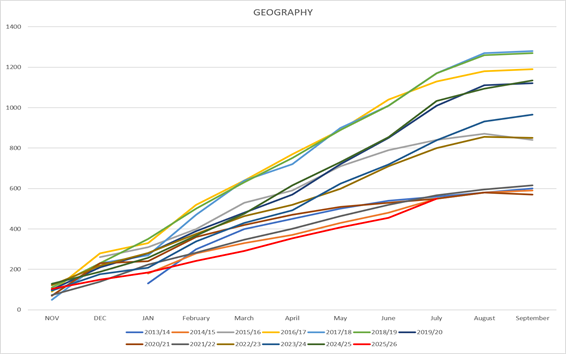
Geography29247639%
Modern Foreign Languages73382111%
Music13617321%
Physical Education104311499%
Religious Education20825518%

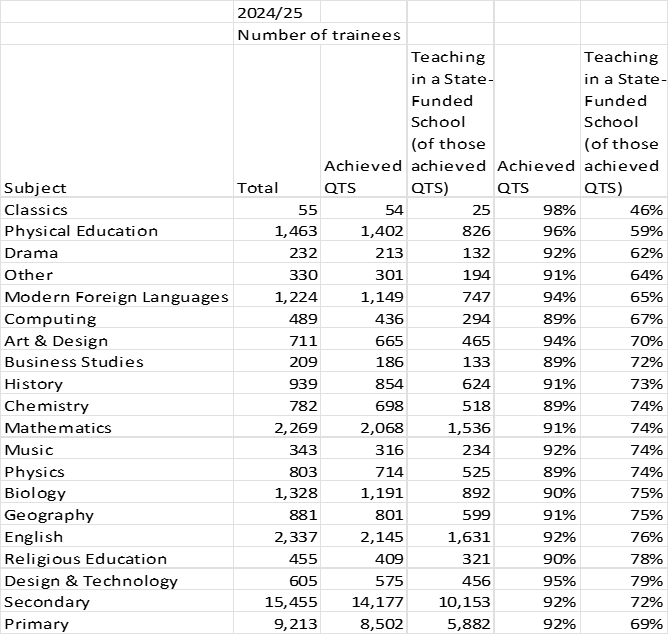
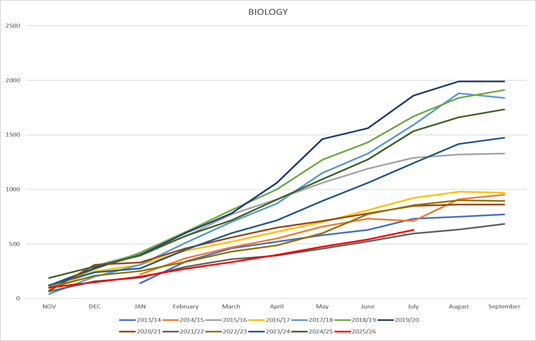
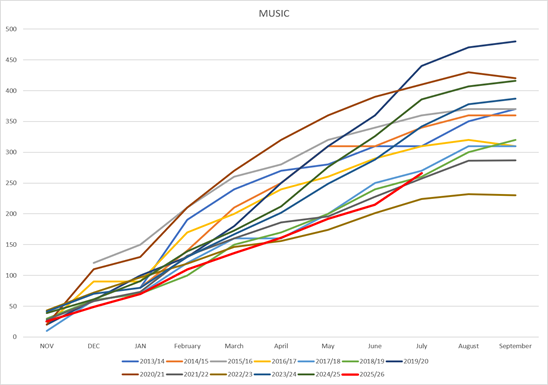
 I think one can discount both Physical Education and English from subjects where the declines are of concern. Elsewhere, the changes in bursary support are obviously having an effect. Those biologists that can do so are now applying for Chemistry – where there is still a bursary, and offers are up from 441 last march to 675 this March – but the overall offer across the two subjects are still below last March at 997, compared with 1,154 last March.

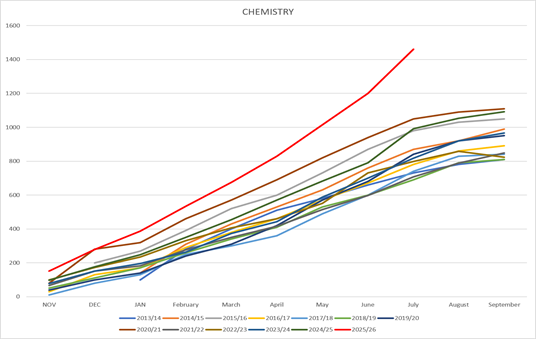
It is the arts subjects that seem to have been most badly hit. This is not surprising given the changes to the bursary scheme that saw the bursary axed completely for music and religious education, and reduced for biology from £26,000 to just £5,000, while it increased to £29,000 for chemistry.  French and Spanish also lost their £26,000 bursaries. The reduction in ’offers’ in geography, down by 39% may also be due to the cut in the bursary from £26,000 to just £5,000.

Given the need for fewer teachers in the future, as secondary school rolls start to fall, these changes to bursaries do look like a gamble. How much of a gamble will be clear when the DfE finally announces the ITT training targets. But my hunch is that music and religious education along with geography will join the list of subjects not hitting their targets unless the current global war affects graduate recruitment in the summer. Will there be a late surge of new graduates looking to teaching, similar to that during the early months of the pandemic in 2020? The jury is out for the moment, but such a surge would not surprise me. However, as a precaution, reinstating a scholarship in the arts subjects might be a wise precaution. This might make it look less like a -U- turn than a reinstatement of the bursary.

Elsewhere in the data, candidates form the ‘Rest of the World’ accounted for 30% of all candidates this March, compared with 21% last March.  The DfE really does need to show how this increase affects different subjects and how many of these candidates will be likely to receive a visa to both learn and then teach in England? Can we afford to waste funds on those with no prospect of teaching in England, while depriving potential home candidates of bursaries.

As expected at this time of year, there has been more interest from career changers than university students, with those under 24 showing an increase over last year of just 1,000 compared with an increase of more than 4,900 from those in the 25-39 age groupings.

It’s a funny old world

On the day when nurses look as if they will join resident doctors in demanding more pay, figures about applications from graduates to train as a secondary school teacher hit decade high levels, even after removing the degree apprenticeship numbers from the totals. This month, according to DfE data, 58,880 candidates have submitted one or more applications to train as a teacher. This compares with 46,696 list July and 45,000 in 2108, before the pandemic. Initial teacher training application statistics for courses starting in the 2025 to 2026 academic year – Apply for teacher training – GOV.UK

This July, there were 36,283 candidates applying to train as a secondary school teacher, compared with 17,997 wanting to train as a primary school teacher.

By comparison in July 2018, 26,060 women had applied, whereas in July 2025 that had increased to 31,439. However, applications from men had increased from 12,680 in 2018 to 18,904 this July

Traditional higher education and SCITT courses still account for the bulk of the routes into teaching selected by candidates. However, candidate numbers on traditional salaried routes were down this July, from 8,927 to 7,636, but that may be partly the 7,332 candidates that have applied for the Postgraduate teaching apprenticeship route, up from 6,433 last July.

The new Teacher Degree Apprenticeship route that has attracted 1,079 candidates so far this year. This is a new route and, presumably isn’t open to graduates.

Although applicant numbers from the ‘rest of the world’ group are down this July, from 9,586 in July 2024, to 8,563 this July – this number still represents nearly 20% of all candidates.

Some subjects, including art, physical education, physics, mathematics and computing have recorded their highest level of ‘offers’ this year since the 2013/14 recruitment round. How many are multiple offers or from candidate’s not able to fulfil visa requirements won’t be known until the courses start in just over a month’s time.  Interestingly, offers for English courses are below the number of offers made in July 2024.

Despite the significant increase in candidate numbers, some subjects will not hit their targets set by the DfE this year. Subjects most likely to miss their targets are business studies, drama, religious education, music and design and technology. In English, it looks touch and go at this moment in time as to whether or not the target will be hit.

In some subjects, such as physical education, where the target is 725, there is a risk of a significant overshoot in offers. Such a situation might leave large numbers of trainees with additional debt and little chance of a teaching post in England next summer. The DfE will need to be alert to this issue, especially if the growth in ‘AI’ changes the labour market for those with degrees in physics and mathematics, so as to make teaching look like an interesting career at current salary levels.

It would be a funny old world if incentives to train as a teacher had to be switched from mathematics and the sciences to English and the arts.