
In the previous post, I considered trends in teacher supply into state secondary schools for three subjects listed as a part of the Prime Minister’s proposed MBacc. If such a qualification is to be rolled out nationally, then there will either need to be more teachers in schools in certain subjects or more young people will need to be diverted into further education, perhaps at 14 rather than 16. However, even that strategy won’t solve the music and performing arts dilemma regarding the number of teachers’ issue. Abolishing the bursary for music looks even more unfortunate in the light of the MBacc announcement.
How about the wider primary and secondary sectors?

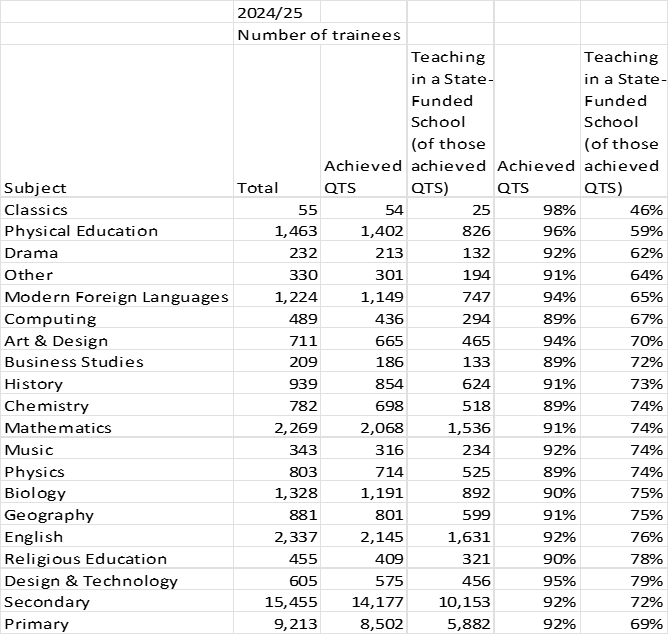
In line with falling pupil numbers, there has been a reduction in trainee numbers in the primary sector. This has resulted in fewer numbers obtaining QTS, and even fewer of those working in the state primary school sector. The 5,882 recorded working in state schools of the 2024/25 cohort should increase as the data is refined, but it is still likely to be only halfthe number of just four years previously, when more than 10,000 new teachers were working in the primary sector at some point in the 16 months after obtaining Qualified Teacher Status (QTS).
Fortunately, those newly qualified teachers not obtaining a teaching post in England, might be able to look overseas for work. With VAT on fees for private school pupils in England, the independent sector is unlikely to offer must of an alternative to the state sector over the next few years; at least until there is some upturn in the birthrate.
I hope that course providers will take note of this data, and not over-recruit to courses in the future, as burdening students with more debt and a restricted chance of securing a teaching post is not really fair on the students.
In the secondary sector, the overall position hides some variations between subjects.

The percentage obtaining QTS among secondary trainees has been falling; from some 95% before covid, to 92-93% in the years since. The overall percentage hides a much greater change in the numbers obtaining QTS, from a Covid high of 19,070 to a low of 12,820 only two years later. Covid may have brought forward the decision to teach that might otherwise have been delayed until a future year.
Fortunately, 2024-2025 saw the number obtaining QTS much closer to pre-Covid levels. With falling rolls, the overall number of trainees, if not the mix within subjects, may be satisfactory for the DfE.
However, post-covid the state school sector lost around five and a half thousand teachers compared with the pre-covid numbers f new teachers entering state schools. To what extend these missing teachers have been replaced by new entrants through the ‘assessment only’ route, isn’t clear from the data.
In the most recent year, 2024-2025, what of the percentages in state schools by secondary subjects?
The low percentage of those qualifying for QTS in Classics instate schools, is perhaps not a surprise given the percentage of state schools that teach the subject. The fact physical education is in second position in the table, with just 59% of those obtaining QTS in state schools should not be a surprise to anyone familiar with the number of trainees recruited and the DfE’s target for the subject.
Only in English and mathematics were there more than 1,000 new teachers working in schools. Given the requirement to teach these subjects to all pupils up to Year 11, and for some in Years 12 & 13, even these numbers may be insufficient. The 234 music, and 133 business studies teachers, and the 321 religious education new entrants, are almost certainly not enough to allow the subjects to thrive in our schools, even before the desire to widen the curriculum to include more MBacc students, and fewer EBacc students.
Alongside the conversation about the curriculum, and the desire of the Prime Minister to make it more relevant for work in the 21st century, there really needs to be a conversation about how the curriculum changes can be properly staffed, so that all pupils receive a high quality education taught by teachers qualified in their subject, and not just a page ahead of the AI generated lesson plan.
Data from: Initial teacher training performance profiles: 2024 to 2025 – GOV.UK
 John Howson
Worth looking at ITT Numbers for 2026 – brutal realism from DfE or big risk? | John Howson to see how far adrift were were in business studies and some other subjects well before the announcement of the EBacc. The cut to music places now look unfortunate, to say the lest