David Attenborough at 100

This week the BBC has being paying tribute to Sir David Attenborough, ahead of his 100th birthday later this month. There is no doubting that Sir David has had a great deal of influence on many people through his television documentaries, at first in shades of grey, and then in colours that have improved as television screens have become ever more sophisticated in replicating the colours of the real world.

But who influenced Sir David Attenborough in his choice of career? Way back in 1997, the then Teacher Training Agency decided to commission two cinema advertisements. One, that received all the attention was called ‘talking heads’, and featured head and shoulder shots of a range of celebrities just saying a name to the camera. The trap line at the end was ‘no one forgets a good teacher’.

The other, far less well-known advertisement commissioned by the Teacher Training Agency in 1997 featured a teacher called Horace Lacey and a pupil called David Attenborough. You can see it here. Teacher Training Commercial: Horace Lacey | Catalogue | History of Advertising Trust My thanks to the History of Advertising Trust.

Both adverts were placed in cinemas, and because it was before the general use of websites and urls, postcards were placed in cinema foyers to provide the contact details for anyone interested in teaching. After all, it was impossible to write down a phone number in the dark of a cinema at the time when the advert was actually being played.

At the same time, the agency produced a famous poster with the stap line ‘the dog ate my homework. a phrase that passed into common parlance for a period of time.

After a few years, advertisements for teaching as a career started to reappear on TV screens, albeit at the wrong time of year to make any significant short-term difference to recruitment. I made an oblique comment about the effects of TV advertising in this post Do TV adverts work? | John Howson However, I am afraid the title is a bit of a misnomer.

So, my very best wishes to Sir David Attenborough. I hope that all the publicity surrounding his 100th birthday will help inspire the next generation of young people, and the present generation of undergraduates, to take up teaching as a career.  I also hope that the attention to Sir David’s birthday also encourages us to honour the memory of Horace Lacy, and countless hundreds of thousands of other teachers like him that have inspired their pupils down the generations.

Thank a teacher, it is an inspiring job that is like no other. And, although I may not have inspired many of my pupils, I did recognise those around me, both in school and higher education that changed lives and careers. My personal thanks to them.

Labour market for music teachers: update to end of April 2026

Regular readers will know that I am tracking two parts of the labour market for teachers in state schools across England during the 2025-26 school-year: vacancies for headteachers and vacancies for teachers and middle leaders of music.

Regular readers of this blog will also know that one of the reasons that I selected music as my subject to track was the government’s removal of the training bursary for those applying for postgraduate teacher preparation courses starting in the autumn of 2026.

By tracking vacancies this year, I have a baseline for next year, if, as seems likely, the removal of the bursary reduces interest in teaching music. However, the government has also slashed its published number of trainees needed – see ITT Offers – public money being wasted? | John Howson and my more recent post on the situation after the report on April offers was published.

Anyway, back to the update on published vacancies for teachers of music, and how these vacancies compare with the expected output from this year’s preparation courses.

By the end of April, I had recorded some 389 vacancies for teachers of music. 86 of these were for promoted posts, with an allowance attached. It could be assumed that these vacancies were not intended for teachers straight out of their preparation courses. However, in some smaller secondary schools, this might be the only full—time post and include responsibility for choirs, orchestras and ensembles. However, for the purpose of this exercise, such posts have been eliminated.

After removing the promoted posts, this leaves some 303 vacancies suitable for new entrants into the teaching profession advertised between January and the end of April 2026.

The DfE’s ITT census recorded some 367 trainees on preparation courses in December 2025; mostly for entry into the labour market in September 2026. Assuming all 367 entered the labour market for teachers in state schools, there are still sufficient to fill another 64 vacancies.

However, we know that not all trainees last the courses, and of those that complete the course, not all start teaching in state schools. Some entre the private sector; some further education; some music services and some don’t enter teaching at all.

As a result, the chart shows the remaining trainees available if 10% and 20% of trainees aren’t available to state schools. This approach reduces the remaining number of trainees to little more than 50 trainees. With around 75 vacancies a month so far in 2026, if May’s vacancies follow the pattern of the first four months of 2026, then the remaining total of trainees will be exhausted before the end of May, and resignation deadline day.

Of course, not all basic vacancies are filled by new entrants from teacher preparation courses: some are filled by returners – we can ignore school switchers as we can assume that leaving one school to fill a similar vacancy at another school is neutral in terms of jobs. However, if the move is for promotion, the there is a new vacancy.

Returners would need to fill around 30% of vacancies across the whole year – they are generally the only source of teachers for January appointments, so for September it looks as if schools will struggle to fill any late appointment resulting from resignations close to the 31st May deadline.  However, the picture will be clearer at the time of next month’s update.

Finally, although I do not track vacancies posted by private schools, both in England and abroad, I do survey the market. Generally, this market has twice as many vacancies as posted in any one month by schools in England.

One wonders whether the current cohort of new graduates might have missed out on gap year travelling because of the after-shocks from the covid pandemic and might, therefore be more willing to teach overseas? This has the advantage of not losing income to student loan repayment, and the bursary isn’t repayable.

On the negative side, the conflict in the Middle East may well be deterring some teachers from working in that part of the world, and may have increased the number of returners once more seeking a teaching post in England. We shall see.

Religious Education – the need for qualified teachers

In a recent post on this blog about the DfE’s modelling of trainee teacher needs, I wrote that

‘However, has this re-assessment of need gone too far? Based on … my own current research into vacancies for teachers of music, I think the DfE has been realistic in its approach. ‘

While, I stand by that judgement, I have also been reminded by Deborah Weston, championing on behalf of those concerned with the teaching of religious education in schools that the cutback in trainee numbers probably allows little room for the replacement of the ‘under’ or even ‘un-qualified’ teachers currently teaching religious education in our schools.

Prompted by Deborah, I looked at the trends from the Teacher Workforce surveys concerning the use of those with ‘no qualification in the subject’ teaching religious education over the period between the end of the Blair/Brown Labour government and the end of the Conservative period of government. Of course, recent years have been impacted by the covid pandemic, and its consequences, but there is a clear trend that is observable.

The chart shows the four key types of secondary schools, of which the 11-18 school line is probably the most significant.

At the end of the Labour government, partly I expect as a result of the economic crisis of 2008, the percentage of teachers of religious education with ‘no qualification in the subject’ was reducing. However, the percentage levelled out as school rolls began to increase again, and teacher supply entered into an extended period of years when teacher preparation programmes missed their targets.

There was a brief respite as a result of covid, but in the most recent years, as trainee numbers have fallen, so the percentage of teachers with ‘no qualification in the subject’ has reached levels not seen since well before 2010.

As a result, the question now is, was the DfE right to cut trainee targets for religious education from 780 last year to 450 this year? On the basis that including unfilled places from previous recruitment rounds was a mistake, as I have always maintained, then the answer is clearly, yes, the DfE have taken the correct decision.

However, in subjects such as religious education, where most pupils only study the subject for a limited period of time each week, managing recruitment is easier for schools, if qualified staff are available.

I would add that in my opinion, religious education when taught by well-prepared and knowledgeable teachers can be a really valuable subject, especially at this time in the history of our multi-cultural society, where both many different faiths are practiced, and a growing minority profess to having no faith in religion at all.

If the government cannot see their way to increase the stated need for trainee religious education teachers, providers can always over-recruit, at least to higher education courses, where government funding isn’t an issue.

In addition to pre-entry training, the DfE might also like to consider another approach to the issue of shortage of religious education teachers: upskilling those presently teaching the subject, but without an appropriate qualification.  If it is important that a subject be offered on the curriculum, it beholds government to ensure it is taught properly.  

Spending cash on upskilling will no doubt help retention, and thus save on recruitment and training costs. However, apart from in mathematics and the sciences, it hasn’t really featured as a policy objective for many years: surely that’s a mistake.

I hope that the religious affairs lobby is able to persuade the government that significantly reducing the percentage of inappropriately qualified teachers of religious education should be a key policy objective.

ITT Offers – public money being wasted?

The DfE has today published the April data on postgraduate ITT courses, as at 20th April 2026. Initial teacher training application statistics for courses starting in the 2026 to 2027 academic year – Apply for teacher training – GOV.UK

This is the first month where offers can be compared with the DfE’s required need for each subject for September 2026 courses. I have previously posted about the draconian changes to the demand in many subjects as required by the DfE that have resulted from a different approach to unfilled vacancies. ITT Numbers for 2026 – brutal realism from DfE or big risk? | John Howson

Here is my assessment of possible outcomes for September, when courses commence, based upon current offers and past trends. It will be interesting to see how my view compares with that of Jack Worth at NfER.

SubjectTarget 2026/27offer April 2026DfE identified needFILL?
Chemistry690829-139YES
Biology675398277YES
Mathematics20001752248YES
Design & Technology620382238POSSIBLY
Art & Design605449156YES
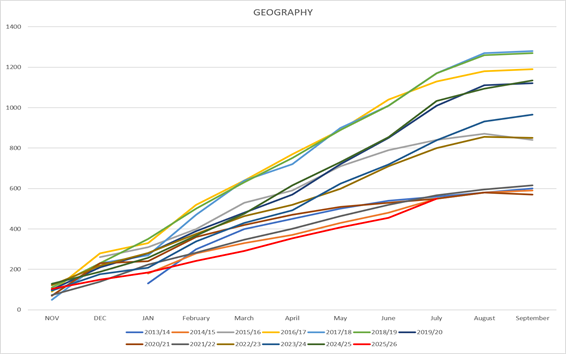
Geography685353332POSSIBLY
Classics753639NO
English19801176804PROBABLY
Drama370207163PROBABLY
Business Studies1200224976NO
Music26016199POSSIBLY
Religious Education450339111POSSIBLY
Others20353721663NO
History520736-216YES
Modern Languages1085946139YES
Physics8101140-330YES
Physical Education6551175-520YES
Computing56553926YES

In some subjects, such as history, physics!, physical education and chemistry, providers have already made more offers than required ‘need’.  This demonstrates the danger of leaving it so late in the recruitment cycle to announce estimated demand.

In the past, these numbers used to appear before Christmas. With a rolling offer system in place, rather than a defined closing date, leaving the announcement of ‘need’ until April is likely to cost someone money. Will the DfE pay bursaries to all students offered a place, even if recruitment is above the stated ‘need’? If so, that could be seen as a waste of money.

However, of more concern are the subjects where, even with the new numbers for ‘need’, there are unlikely to be enough applicants to fill all the places. Based on previous trends, classics, business studies and the ’others’ grouping will not meet their ‘need’ number. I think it is time that the ‘other’ category, with 2,035 places is disaggregated into different subjects, after all, it is now by far the largest group in the subject’s table.

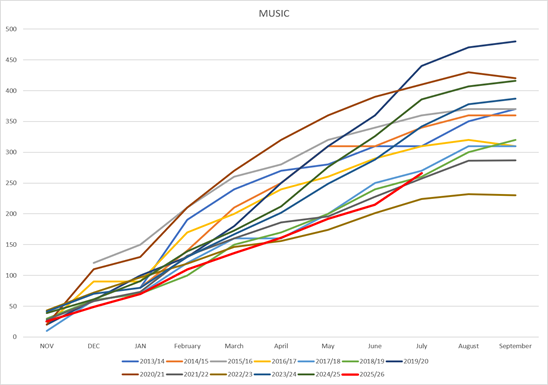
I have some concern about where design and technology, geography, music and religious education will produce enough offers to meet the revised ‘need’. However, I can now see why the bursary was removed from music. I still think that was a serious error of judgement, as this is a subject where only those with appropriate subject knowledge are accepted onto courses. Music has one of the highest applications to offer ratios of any subject. Current offers are the second lowest April ‘offer’ number since 2018.

What happens in the wider economy, and graduate job market, will determine the outcome of this recruitment round. I suspect there will be a summer surge in applications, as new graduates discover how tough the job market has become. This should mean a good year for teaching course. However, many applicants may now have found they have left it too late to secure a place for this autumn. This year will really be a case of ‘the early bird that catches the worm’.

I will now delve deeper into the data for another post about the nature of applicants and applications as revealed in this month’s data.

The Teacher Supply Model

On Thursday, the DfE published its annual note about the working of the Teacher Supply Model Teacher demand and postgraduate trainee need: 2026 to 2027 – GOV.UK

The Model can be easily described in the DfE’s own diagram

It is interesting to note that the Teacher Supply Model

assumes that as pupil numbers grow, teacher demand will grow too, and vice versa. Additionally, the model assumes that PTRs will grow in line with the historical relationship between pupil numbers and PTRs. Similarly, the model assumes that PTRs will fall if pupil numbers fall. In other words, as pupil numbers grow, the TWM assumes that schools will increase the size of the teacher workforce and allow class sizes to grow a little. 

As a result, the Model finds it challenging to manage changes, such as in the curriculum. One of the best examples was the introduction of citizenship during the Blair/Brown Labour government. Schools didn’t sack teachers to make space for teachers trained in the subject, and with no historical data to underpin the need, estimates had to be made.

The assumptions about pupil teacher ratios are, of course, unable to factor in economic headwinds that might change assumptions about future funding of schools. There was a god example early in this century when, in a budget, the Chancellor announced extra cash to be sent directly to schools. Not surprisingly, the schools went after extra teachers and equilibrium in the labour market was only restored by a hike in teachers’ pay that dampened down demand that had not been anticipated in the Modelling.

I have discussed these points with the overseas governments that I have advised on teacher supply modelling over the years. I also favour including a check on what is currently happening in the labour market by surveys of vacancies. Advances in technology, such as pioneered by TeachVac, way back in 2013, allow current trends to be matched with the data input into the Teacher Supply Model that may be two to three years between data collection and the output of trainees based upon the data joining the labour market.

One increasingly interesting issue that the Teacher Supply Model may need to consider is the growing international labour market for teachers. The Model currently imperfectly accounts for loss from the trainee and existing teacher pools to the private sector in England. In the future, it might need to consider how many trainees opt to work abroad. This will be especially important if more overseas students are offered places on teacher preparation courses. Will they be offered visas to teacher in England, or will they leave the country after completion of their courses? I will try to consider this issue in a later post.

Finally, I am delighted that the statisticians have abandoned what they have called ‘the removal of the need for an adjustment relating to forecasted under-supply’.  Adding back in the number of unfilled places from a previous ITT round to the next year’s total was never a good idea, as I have made clear in a number of my posts on this blog. The decline in Physics ITT places from a high of 2,250 in 2024/25 to just 810 for 2026/27 is a good case in point.

However, has this re-assessment of need gone too far? Based on Timo Hanney’s work on vacancies and my own current research into vacancies for teachers of music, I think the DfE has been realistic in its approach. After all, if they have under-estimated demand, the government can always recruit more teachers from overseas by enticing those trained here to return to England.

Does the DfE care about the arts in schools?

In my previous post, I promised more from the DfE’s publication Teacher demand and postgraduate trainee need: 2026 to 2027 – GOV.UK On closer examination of the text, it is clear that a lot of the data has come from the June 2025 publication of school workforce data, collected in November 2024. The next publication with the 2025 workforce data should appear in June, so I will wait until then to review the trends I didn’t cover on this blog last summer, after the publication of the 2024 data.

However, there is an interesting table in this release showing changes in the number of teachers per 1,000 pupils. The time series runs from the end of the last Labour government’s decisions on school funding in 2010/11 up to the 2024/25 school-year. This covers a period when school rolls were both falling, and then rising again. For the primary sector, rolls have been falling for some time. In the secondary sector, rolls are reaching their peak and will drop away over the next few years. The extent of the fall will, in reality, depend upon trends post-16, and whether schools either retain pupils or see then depart for further education or apprenticeships.

The number of teachers per 1,000 pupils is, of course, governed by the curriculum. Mathematics and English are taught to all pupils between Years 7-11, whereas few schools teach Classics to any pupils at all. Hence the ratio for mathematics was 8.44 in 2025/26, and has changed little since 2010/11, when it was 8.39 teachers per 1,00 pupils. By contrast, classics come out at a constant 0.09 teachers per 1,00 pupils.

The number of teachers per 1,000 pupils
by secondary subject as published in this publication
Subject2010/112024/25difference% Difference
Computing3.471.77-1.7-49%
Design & Tech5.133.1-2.03-40%
Drama1.751.35-0.4 -23%
Art & design2.812.19-0.62-22%
PE6.254.98-1.27 -20%
Other Sub5.124.08-1.04-20%
Business studies1.911.55-0.36-19%
Modern F L4.643.91-0.73-16%
Music1.671.42-0.25-15%
Biology3.93.41-0.49-13%
All Sec68.0959.77-8.32-12%
RE2.322.2-0.12-5%
Chemistry3.163.08-0.08-3%
Primary48.1747.04-1.13-2%
Classics0.090.0900%
English8.78.700%
Mathematics8.398.440.051%
Physics2.692.720.031%
History3.213.50.299%
Geography2.93.270.3713%
Source: DfE School Workforce data

Interestingly, for a country concerned about ‘growth’, and the decline of the productivity of the economy, the subjects with the largest falls in teacher numbers per 1,000 pupils are computing (down 49%) and design and technology (down 40%). By contrast, the humanities subjects, of history and geography, have seen increases in the number of teachers per thousand pupils. Presumably part of this increase was the inclusion of these subjects in the English Baccalaureate by the previous Conservative government.

The arts have generally not fare very well. This is despite the ease of recruiting teachers in these subjects during much of the period reviewed. It might be assumed that these subjects were the casualties of the government’s views on the curriculum.

The small changes in mathematics and physics, no doubt owe something to the generous bursary and scholarships that have been available to trainee teachers in these subjects.

As noted, part of the change was due to the rise in school rolls. Generally, the Pupil Teacher Ratio in secondary schools has worsened as rolls have risen. This is not surprising. Governments have rarely been able to fully fund bulges in school populations. I suspect that part of the strain has also been felt in the size of ‘option groups’ in Years 10 and 11. However, I also know that class sizes have also increased in Years 7-9, where most teaching is of whole classes.

The other interesting question that arises from the data is the amount of teaching undertaken by those with appropriate qualifications in the subject that they are teaching. Regular readers will know my views on the subject. Teachers should be certified for specific subjects, and receive ‘emergency’ certification if required to teach ‘out of their field’.  The present system allows parents to be blissfully ignorant of whether their offspring are being taught by a teacher with either a degree and training in the subject or some lesser qualification. I wish more parents would ask. It would also be interesting to see research on GCSE results by the qualification of the teacher that taught the group.

With falling rolls, and reduced targets for trainees, we are entering a challenging period for those responsible for training teachers. I doubt the market will look like it does today in a couple of years’ time.  Who will survive and who will no longer be preparing graduates for teaching? Ans what of the alternative routes into the profession? Will they remain as at present? 

ITT Numbers for 2026 – brutal realism from DfE or big risk?

The DfE has today published its comprehensive analysis of the school workforce, including the trainee need for 2026/27 courses. As we know, pupil numbers are falling in the primary sector, and don’t have much further to rise in the secondary sector. As a result of this fact, added to improved take up of teaching as a career, and improved retention, the DfE has significantly adjusted its trainee targets. Teacher demand and postgraduate trainee need: 2026 to 2027 – GOV.UK

I will look at some of the data in more detail in future posts on this blog, but for this post it is just the changes in trainee needs.

Subject/phaseTRAINEE NEED 2021/22TRAINEE NEED 2025/26TRAINEE NEED 2026/27DIFF 26/27 ON 21/2226/27 0N 25/262025 ITT CENSUSNEW TARGET MET?
Art and Design5806806052575872YES
Biology8209856751453101489YES
Business Studies7259001200475300271NO
Chemistry108073069039040864YES
Classics406075351544NO
Computing840895565275330715YES
Design and Technology1475965620855345580POSSIBLY
Drama33062037040250255POSSIBLY
English19801,95019800302069YES
Geography745935685602501035YES
History780790520260270969YES
Mathematics28002,30020008003002588YES
Modern Foreign Languages15051,46010854203751364YES
Music540565260280305367YES
Others19802,520203555485348NO WAY
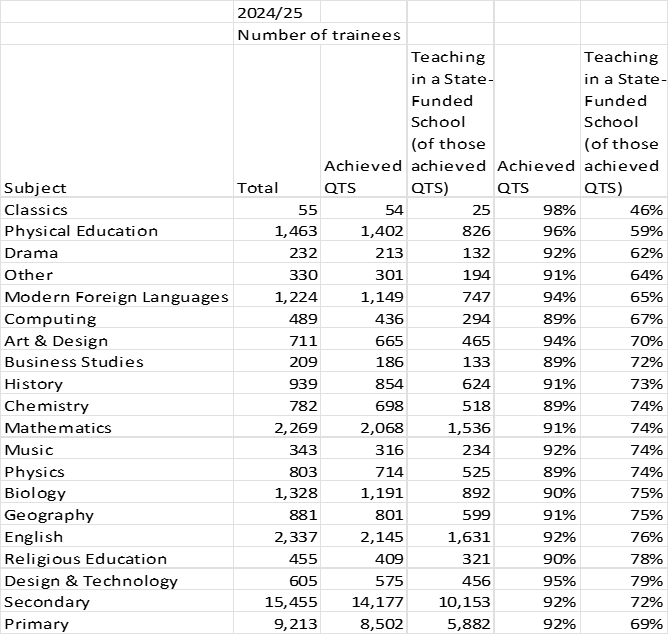
Physical Education1010725655355701466YES
Physics25301,41081017206001086YES
Religious Education47078045020330483YES
overall TOTAL3103026,92020800102306120
Secondary Total2023019,270152804950399016975
Primary Total108007,650552052802130

In the table I have ignored the primary phase. The total suggested of 5,520 for the postgraduate primary sector will no doubt cause real concern. However, as the DfE helpfully point out, these are not subject to recruitment controls.

In terms of the secondary sector subjects, it is worth pointing out that the DfE has seemingly abandoned the dubious practice of adding unfilled places from the previous year into the new need total. In its place, it has opted for a more nuanced approach. As I have pointed out before, schools start the term in September fully staff, so there are no vacancies, just teachers with sub-optimal qualification teaching pupils. Unless these teachers are sacked, there are no vacancies if too many teachers are trained.

In the final column, using the data from the 2025 ITT census, I have suggested my thoughts about the possible outcome of the current round based on these need numbers. More later

Reviving Music Teacher Bursaries: A Necessity

Regular readers of this blog will know of my campaign to see the music bursary restored to graduates training to be teachers of music. Recruitment to ITT is well below the same level as last year, when there was a bursary.

Music teacher shortage: the situation worsens | John Howson and more recently ITT – 9 subjects with fewer offers than March last year | John Howson

I was therefore delighted to see this speech by a Labour peer in a debate in the house of Lords on Thursday.

 Baroness Keeley (Lab) 

The review found that inequalities in music education are substantial, with music showing the widest disadvantage attainment gap of any subject, driven by unequal access to instrumental tuition and wider inequities in school and community resources. I have also raised with Ministers the fact that music teacher supply is a related problem. Since 2010, we have seen persistently high vacancy rates for music teachers. In fact, in 2023-24, that vacancy rate was among the highest of all subjects, and the Department for Education has missed its music teacher recruitment target in 12 of the past 13 years. There was a small increase in recruitment during 2024-25, after the brief return of the £10,000 bursary, but recruitment still reached only around 40% of target.

The conclusion is clear. The music teacher bursary must be restored. The Government’s opportunity mission makes it clear that we want high-quality music and arts education for every child in all state-funded schools. The curriculum review has recentred music and arts as core to a rounded education, not as optional extras, and it has challenged the narrowing of the curriculum that has squeezed music out of timetables, particularly in disadvantaged areas.
Debate: Curriculum and Assessment Review – 26th Mar 2026 my highlighting

I would also welcome the comments in that debate by both Baroness Sue Garden and Tim Clement-Jones, Liberal Democrat Peers.

Despite the pressure on government finances, there really is a need to find a way to attract more graduates into training as music teachers. Any failure to do so will risk a Labour government committing the sin of removing music from out state schools, and leaving the subject residing just in the independent sector and international schools staffed by teachers trained in England.

Not only does music give great pleasure to many, it is also a major expert industry that the government ought to be nurturing. Two good reasons to reintroduce the bursary.

Of course, as Chair of the Oxfordshire Music Service Board, I have an interest to declare, but that interest isn’t contradicted by the evidence of declining enrolment, re-advertised vacancies and an apparent lack of interest in the DfE about the training of teachers of music for state schools. Presumably, they see this as a DCMS issue, since funding for music services is via the Arts Council.

Funding for teachers is, however, very much the brief of the DfE, and if they cannot find the cash for the bursary the they should urgently start work with the Arts Council to devise a scholarship scheme, such as already exists in certain other subjects. To do nothing is not an option if music is to survive in our state schools.

My 2016 post on Geopolitics and macroeconomics

Sometimes it is worth re-posting something I have written before on this blog rather than writing a new post. Recently, I wrote about my thoughts about how education, and schools in particular might be affected by the current global war. In 2016, well before the AI revolution, I wrote a wider-ranging piece about macroeconomics and geopolitics that also considered advancements in technology, without actually referencing AI. I thought it worth re-publishing the post that first appeared on:

So here it is in full and unedited.

Whether the world is a more dangerous place this January isn’t for me to say. However, to balance my short-term views about teacher supply problems I thought it worth thinking about what the combined effects of a downturn in China; tensions in the Middle East; falling oil prices and the possibility of rising interest rates might do to the longer-term teacher supply position.

An analysis of data over the past fifty years suggests teacher supply problems ease when the economy is subdued or in recession. Whether there is a direct link between these two facts may be arguable, but while there is a need to educate children there will be a need for teachers. Again, over the past fifty years, there have been massive strides in technology since the famous BBC programme of the late 1970s ‘The chips are down’ about the microprocessor revolution. Classrooms have adapted to make use of the new technology, but there has been no seismic shift away from traditional patterns of pupil teacher numbers. Indeed, in secondary schools over the past decade, pupil-teacher ratios have even improved, according to DfE data.

The recently reported growth in home schooling may be the first signs of a coming revolution, driven by parents no longer satisfied with the current model of schooling. Tablets, TVs and computers can provide more learning power than any school library of a couple of decades ago. What is needed is the means of instruction and the method of motivation to keep youngsters on task. How much more likely is that in a home environment than when youngsters are faced with the distractions caused by 25 or 30 other children: could learning me more focused and take less time in the home than the classroom?

No doubt, parents would still want children to socialise in order to learn team games, sing together and undertake risky science experiments under the control of a qualified person. However, that might mean only sending your child to school for a couple of days a week. Such a shift might also boost the market for tutors as parents just buy in specific skills where their offspring are facing issues with learning.

As the BBC recently highlighted, the spirit of enterprise is abroad in Britain at the present time. I am sure that there are many developers in both large companies and small start-ups eying what could be a lucrative market that has world-wide potential; some of which will be on display at BETT.

Such a shift in technology from a labour intensive to a technology driven learning process could have a profound effect on both the need for teachers and the spending by the State on education. However, in the short-term, the geopolitical and macroeconomic signals might suggest that if a downturn is coming then teaching might benefit from renewed interest as a career choice.

As I have said at several conferences recently, I am one of the only people that might see benefits from a slowdown in China, even if it only reduces the inflow to that country of UK teachers to work in the growing international school market.

However, with the allocations for 2016 entry into teacher preparation courses set and fewer places available on non-EBacc subjects than in 2015, none of this will matter before 2017 unless, as in 2009, any downturn in the world’s economy bring back greater numbers of returners into teaching: such an effect could dramatically alter the picture of teacher supply, even for 2016, were it to come about.

ITT – more applicants doesn’t always mean more offers

In my previous post, I noted the increase of nearly 6,000 I the number of candidates applying for a place on a graduate teacher preparation course. Up from 21,436 in March 2025 to 27,352 in March 2026. This post explores the relationship, both this March and last march, between candidates and places offered to those candidates.

Firstly, the number of candidates and the number of ‘offers’ to candidates in each secondary subject.

candidatesoffers
2025202620252026
BIOLOGY21612044713332
ART&DESIGN9601026451366
MFL18762246821733
PE1988221911491043
PHYSICS33296522825918
COMPUTING12702394341420
GEOGRAPHY1089843476292
OTHERS9261342281310
CLASSICS67623427
D&T661861273295
RE699693255208
MUSIC311275173136
MATHEMATICS4006534612771398
ENGLISH256128301032990
HISTORY11421281592624
BUS STUDIES607923132173
DRAMA336384162176
CHEMISTRY16622207441675

Note, not all subjects have seen increased candidate numbers within the overall increase.

Secondly, the next table shows the percentage of candidates so far ‘offered’ a place for 2026.

20252026Change
BIOLOGY33%16%-17%
ART&DESIGN47%36%-11%
MFL44%33%-11%
PE58%47%-11%
PHYSICS25%14%-11%
COMPUTING27%18%-9%
GEOGRAPHY44%35%-9%
OTHERS30%23%-7%
CLASSICS51%44%-7%
D&T41%34%-7%
RE36%30%-6%
MUSIC56%49%-6%
MATHEMATICS32%26%-6%
ENGLISH40%35%-5%
HISTORY52%49%-3%
BUS STUDIES22%19%-3%
DRAMA48%46%-2%
CHEMISTRY27%31%4%

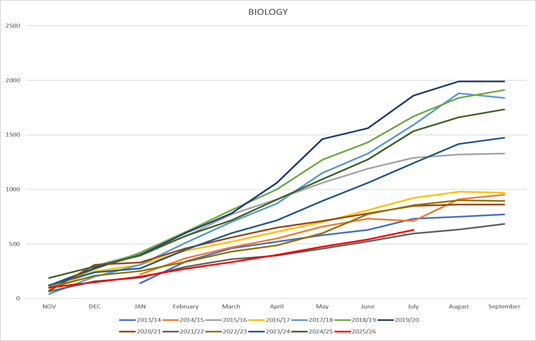
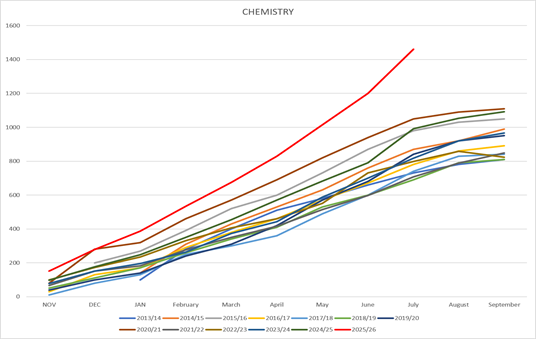
Only in Chemistry, where because of the reduction in the size of the bursary to those applying for biology courses it seems likely that those with a choice between the two subjects have opted to apply for chemistry with its higher bursary for 2026. As a result, biology, with a 17% fall in offers this March when compared with March 2025, is the big loser.

Despite the change in candidate numbers, the percentages offered places in March 2026 follows a similar ranking to March 2025.

% offered
20252026
MUSIC56%49%
HISTORY52%49%
PE58%47%
DRAMA48%46%
CLASSICS51%44%
ART&DESIGN47%36%
ENGLISH40%35%
GEOGRAPHY44%35%
D&T41%34%
MFL44%33%
CHEMISTRY27%31%
RE36%30%
MATHEMATICS32%26%
OTHERS30%23%
BUS STUDIES22%19%
COMPUTING27%18%
BIOLOGY33%16%
PHYSICS25%14%

Music is such a specialist subject that it generally only attracts candidates likely to be accepted. However, current ‘offer’ levels are still well below those recorded in the first four years of the century when the number accepted ranged between 68% (2001) and 78% (2003). (Source: John Howson’s collection of GTTR Annual Reports). 2003 was after graduates training to be teachers received a training grant and were also exempt from tuition fees.

Of course, the most interesting percentage of ‘offers’ is that for physics, where only 14% of candidates have so far been made an offer. It looks as if the better candidates for biology are those that have opted to apply for chemistry in 2026, resulting in a significant fall in ‘offers’ in biology.

For subjects such as history and physical education, it is wise for candidates to apply early in the recruitment round since places fill quickly.

Finally, is the present system fit for purpose? Should there be a closing date by which all applicants will be considered,  rather than the drip feed approach as a present?