
The DfE today published their annual look at trends in the school population. Release home – National pupil projections – Explore education statistics – GOV.UK The school population is principally affected by changes, either upwards of downwards, in the birth rate. Changes in migration also plays a small part, but can be more important in certain locations. Thus, the reduction of the number of families accompanying students will affect some university towns more than the overall numbers.
As these are projections from the DfE are based on data from The Office for National Statistics (ONS), they are the result of considerations of various factors, of which changes in the birth-rates is the most significant. The gloomiest set of predictions are shown in the table below.
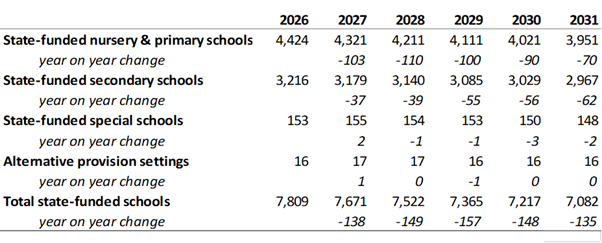
On these assumptions, the primary and secondary school sectors will lose 473,00 and 249,000 pupils respectively between 2026 and 2031. This is a total reduction of more than 700,000 in a school population of 7.8 million at the start of the period. By 2032, the school population may dip below seven million for the first time in a long while.
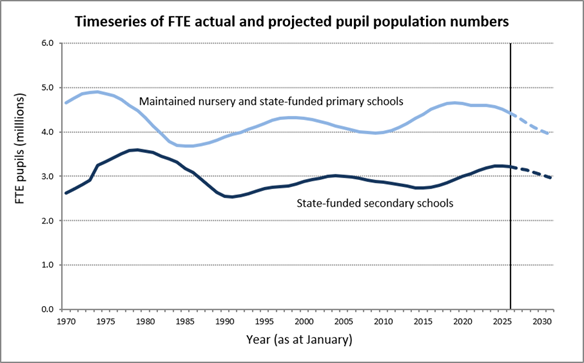
As the chart shows, the school population is heading for its lowest number this century. The key question is whether or not, by the end of the 2030s, the school population will fall back to a level not seen since the mid-1980s. On current trends that outcome seem very likely.
My guess is that HM Treasury will use the ‘population dividend’ to reduce spending on schooling by clawing back the funding for the missing pupils. Over the period to 2031, this might account for some £5billion available for social services and defence, yet still leave a bit over for improving school funding slightly.
Fewer children mean fewer teachers, and we have already seen the DfE slash targets for ITT. This will likely reduce the number of providers at some point, as some providers will be unable to operate effectively, both financially and in terms of group sizes, and will exit the market.
Falling rolls also mean fewer vacancies, if numbers leaving the profession remain at a constant rate in relation to pupil numbers. Falling rolls also likely mean fewer promotion opportunities, so more teachers may stay put in their current post. With the current age profile for the profession, there is also no sign of a retirement boom to help turnover.
Were the falling pupil numbers to mean a wholesale closure of small primary schools, then that might further reduce the promotion opportunities for teachers in the primary sector.
If the sector keeps to government ITT targets, then most trainees should find a teaching post – we will know the latest details for employment rates at the end of the month when provider profile data are released – but in the primary sector, where over-recruitment into ITT has been the norm, and in some secondary subjects, too many teachers may be chasing too few vacancies.
So, is it worth the risk of taking on extra student debt to train as a teacher? Certainly not, if you can find a route that offers a salary, and a better chance of a teaching post after training. Otherwise, there is a risk to assess.
I would advise all potential teachers to quiz providers offering them a place on an ITT course about the provider’s track record of employment for their specific course, and not just the overall rate into employment.
Of course, a teaching qualification can lead to a teaching career anywhere in the world, it might just be harder to find a job in England, and certainly in parts of London.
 John Howson