
Don’t let this government kill off music in state schools.

Regular readers will know that I have been championing the need for more teachers of music in our schools, and the government’s actions in first, cutting the bursary for these trainee teachers, and then halving the target number of trainees that they will fund. Now comes news of yet another year of funds not uprated for inflation that will mean cuts to services. Even more ominously there is talk by civil servants of the need to prepare and ‘exit strategy’.

Last evening, I attended a wonderful performance of pupils from both local state secondary and primary schools across Oxfordshire joining with the world-class Gabrieli Consort & Players to perform Purcell’s Dido and Aeneas in the Silk Hall at Radley College. This is a great example of making elite-level musical experiences genuinely accessible to all children, including those from more disadvantaged backgrounds.


As we know, singing together fosters a profound sense of belonging.
However, as one of the key players behind arranging the event has noted ‘we cannot ignore the stark reality behind the scenes, core revenue funding for music services across local authorities has faced severe real-terms cuts. Children in under-served areas will be the first to lose out and music will once again become an exclusive luxury for the privileged few.’ I absolutely agree.
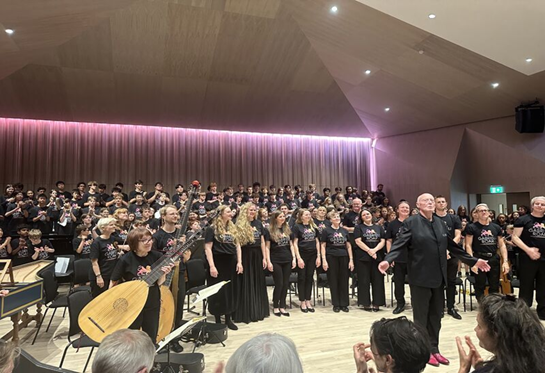
Programs like Gabrieli Roar from the Gabrieli Trust that facilitated the Radley performance, show us what is possible. About Gabrieli Roar – Gabrieli Consort & Players

Let’s celebrate the exceptional performance witnessed at Radley last night, plus the event tonight in Oxford’s Sheldonian Theatre with a different group of young musicians, but let’s also keep fighting for sustained, robust core funding for music education in our schools and with our young people.

Cuts to the ITT bursary for trainee teachers, cuts to teacher training numbers, this despite a shortage of teachers of music teachers in state schools, and the recent grant announcement that once again music funding from government hasn’t increased to cover inflation, all show a government across both DCMS and the DfE that isn’t successfully challenging the Treasury to support music in schools.

The government has an aim to channel cash into after school activities, doing so through music service is a quick win, as the infrastructure for delivery already exists, and there is no battle over a teacher’s 1,265 hours contract.

If you have any influence with policy-makers, please ask them to review and increase funding for music services, with a focus on helping engage disadvantaged groups in society to benefit from music of all genres, through both engaging as players and listeners.

I grew up in Tottenham, where school music thrived in the 1950s, and still does through Haringey’s Music Service. Let’s ensure music can still be for all in the future, and not just for those able to pay to unlock the enjoyment of both singing and playing an instrument.

Music in schools

The DfE carries out regular ‘wave’ surveys of teachers and school leaders in order to discover answers to specific questions about what is happening in schools. The most recent (June 2022) survey can be found at School and college panel: omnibus surveys for 2021 to 2022 – GOV.UK (www.gov.uk)

There are lots of interesting questions in the latest survey, but the one that caught my eye was about music provision in schools. The data from the responses are separated into primary and secondary schools, as well as an overall figure for all schools.

Despite the frequent attacks on funding for music in schools, it is still an activity that takes place in most schools. This may be because Music is a statutory subject in the national curriculum for all children in primary school and for the first years of secondary (from key stage 1 to 3). Although academies don’t have to follow the National curriculum.

Most schools responding to the survey offered musical instrument lessons (89%), singing lessons (85%), and the opportunity to watch a live performance at school (71%). However, it is not clear whether this is to all children or just some.

Other activities that were less commonly offered included providing a space for rehearsals and individual practice (65%), the opportunity to watch a live performance off-site (58%), and a termly school performance (54%). For all activities, schools that were not offering them this academic year were unlikely to have plans to offer them in the future. These were more likely to be provided by secondary schools than primary schools.

Schools with the lowest proportion of Free School Meals (FSM)-eligible pupils were more likely than those with the highest proportion to offer a termly school performance (67% vs. 49%), to provide a space for rehearsals and individual practice (75% vs. 59%), to provide musical instrument lessons (97% vs. 84%), or to provide singing lessons.

This difference is also true for other activities as schools with the lowest proportion of FSM-eligible pupils were more likely than those with the highest proportion to offer singing lessons on a one-to-one basis (28% vs 9%) and small group basis (68% vs. 48%). Meanwhile schools with the highest proportion of FSM-eligible pupils were more likely than those with the lowest proportion to provide them on a whole class basis (81% vs. 68%).

Furthermore, Schools with the lowest proportion of FSM-eligible pupils were more likely than those with the highest proportion to provide musical instrument lessons on a one-to-one basis (77% vs. 39%). While those with the highest proportion of FSM-eligible pupils were more likely than those with the lowest proportion to provide them on a whole class basis (69% vs. 53%).

Schools with higher proportion of FSM-eligible pupils also seemed less likely to offer pupils a chance to play in an orchestra. The survey doesn’t ask whether this is due to such schools having fewer music specialists on the staff than schools with a smaller proportion of FSM-eligible pupils.

Interestingly, there didn’t seem to be any questions about the type of music schools teach and how it might relate to different cultures from around the world? Perhaps that is a series of questions for another survey.

The differences between schools with different levels of FSM eligibility is a disappointing finding and might be worth looking at in relation to the levelling up agenda.

Energy policy for schools

Yesterday, at Oxfordshire’s Cabinet meeting I asked a question about how many maintained schools in the county had renewable energy scheme with either PV or solar panel in place on their roofs? I put this question down a couple of weeks ago before the current protests in London started and I certainly didn’t know that Greta Thunberg, the 16 year-old Swedish climate change campaigner would be in London yesterday.

After some ‘toing and froing’ about who would answer the question, either the Cabinet Member for property or the Cabinet Member for Education, the issue was solved by the absence of the former and the presence of the latter at the meeting.

The formal question and answer are set out below:

Question: “How many maintained schools in Oxfordshire have either solar or photo-voltaic panels on their roofs or elsewhere on school grounds?”

 Answer: ‘The Council does not hold a database with this information, as schools would need to register for the FIT (Feed In Tariff) themselves, information on the installation and/or registration is not readily available. On request at such short notice we have been able to ascertain that 30 of our maintained schools have either solar or photo-voltaic panels on their roofs or elsewhere on school grounds.’

Whether the lack of a database is a result of the collapse of Carillion over a year ago isn’t clear, but I am surprised that the County knows so little about maintained schools. Of course, nobody probably knows about all the secondary schools in the county, as all except one are academies. Then there are a large number of private schools. What their energy policy is, I guess nobody knows as a matter of record.

For this reason, when the school strikes started, I suggested a more positive policy would be for these young people to start an audit of their schools and ask for a policy moving towards cutting carbon emissions. This seemed a more positive approach than missing lessons, even if less dramatic. They could also campaign for more walking and cycling to schools by their fellow students.

My supplementary question yesterday, put at the meeting, was to ask what the Cabinet Member for education would do, especially in encouraging the Anglican and Roman Catholic Diocese to improve the generation of renewable energy by their schools. The Anglican Diocese of Oxford has generally had a very negative attitude to the use of the roofs of their schools to generate electricity. In my view it is time this changed.

I also asked about my own bugbear, school’s playgrounds and outside spaces. For 175 days a year they are largely unused, and for the other 190 days only partly used. Can research help to make them a more productive asset in our quest for cleaner energy?

Finally, I attended a wonderful concert in Oxford’s Sheldonian Theatre last evening. Under the beautiful painted ceiling, first the Oxfordshire County Youth Orchestra played three pieces, and then the Sydney Youth Orchestra completed their UK tour by playing Rachmaninov’s Second Symphony. Those that know this symphony will be aware of how demanding it is to play.

As I left, I pondered on the growth of the aviation industry that had made their tour possible, but is such a threat to or planet. Tacking fuel emissions from jet engines is a much bigger challenge than using school playgrounds to create energy, but both must surely play a part in tacking climate change.