
Regular readers will know that I have been championing the need for more teachers of music in our schools, and the government’s actions in first, cutting the bursary for these trainee teachers, and then halving the target number of trainees that they will fund. Now comes news of yet another year of funds not uprated for inflation that will mean cuts to services. Even more ominously there is talk by civil servants of the need to prepare and ‘exit strategy’.
Last evening, I attended a wonderful performance of pupils from both local state secondary and primary schools across Oxfordshire joining with the world-class Gabrieli Consort & Players to perform Purcell’s Dido and Aeneas in the Silk Hall at Radley College. This is a great example of making elite-level musical experiences genuinely accessible to all children, including those from more disadvantaged backgrounds.
As we know, singing together fosters a profound sense of belonging.
However, as one of the key players behind arranging the event has noted ‘we cannot ignore the stark reality behind the scenes, core revenue funding for music services across local authorities has faced severe real-terms cuts. Children in under-served areas will be the first to lose out and music will once again become an exclusive luxury for the privileged few.’ I absolutely agree.
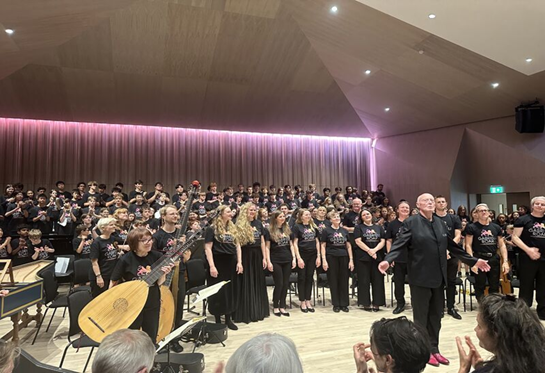
Programs like Gabrieli Roar from the Gabrieli Trust that facilitated the Radley performance, show us what is possible. About Gabrieli Roar – Gabrieli Consort & Players
Let’s celebrate the exceptional performance witnessed at Radley last night, plus the event tonight in Oxford’s Sheldonian Theatre with a different group of young musicians, but let’s also keep fighting for sustained, robust core funding for music education in our schools and with our young people.
Cuts to the ITT bursary for trainee teachers, cuts to teacher training numbers, this despite a shortage of teachers of music teachers in state schools, and the recent grant announcement that once again music funding from government hasn’t increased to cover inflation, all show a government across both DCMS and the DfE that isn’t successfully challenging the Treasury to support music in schools.
The government has an aim to channel cash into after school activities, doing so through music service is a quick win, as the infrastructure for delivery already exists, and there is no battle over a teacher’s 1,265 hours contract.
If you have any influence with policy-makers, please ask them to review and increase funding for music services, with a focus on helping engage disadvantaged groups in society to benefit from music of all genres, through both engaging as players and listeners.
I grew up in Tottenham, where school music thrived in the 1950s, and still does through Haringey’s Music Service. Let’s ensure music can still be for all in the future, and not just for those able to pay to unlock the enjoyment of both singing and playing an instrument.


Pingback: Music Teachers: demand and supply | John Howson