Headteacher vacancies: even in August

More than 40 years ago, I first started counting heads. That’s actually headteacher vacancies, not actual heads. With some spare time on my hands, I thought that I would go back to my roots and look at what is the current state of play this August?

Of course, August is a quiet month, and there are currently fewer than 60 headteacher vacancies listed on the DfE website that is the main go-to place these days, just as the TES was in the 1980s.   

The DfE vacancy website still contains some of the flaws created when it was established. Anyone trying to use modern methods of’ scraping’ jobs will come across the random duplication outcome that has been a feature of the site ever since its inception. I am not sure whether it was deliberate or a fault in the coding, but it always used to annoy me when I was running TeachVac to see the same job repeated in the listing more than once.

The alternative, pioneered by TeachVac was to ‘scrape’ school websites where schools placed their jobs. However, for obvious reasons, not all schools placed headship vacancies on their website. Presumably not to let staff and parents know of the impending departure of their headteacher.

At least with headteacher posts, there is no problem deciding whether the vacancy is a repeat listing or a re-advertisement. Headteacher posts are unique, and thus easy to track.

Anyway, what did I learn from collecting the first 50 vacancies? Special schools were over-represented, with eight such schools looking for a headteacher this August. As a part of the White Paper on SEND, I hope that the government will consider the staffing and training of staff for the special school sector that has long been a Cinderella, and if not bullied by the bigger primary and secondary sectors, it is certainly still in search of a fairy godmother.

There are only two secondary schools in the list, and one is a 10-14 school, and the other a private school. That doesn’t surprise me, as secondary schools usually sort out headship vacancies well before the start of the school year. If there is an unexpected vacancy, then there is often a deputy head that can ‘act up’ until an appropriate time to advertise the vacancy.

Of the 50 or so primary schools, including one First School, 17 were faith schools: ten Roman Catholic; six Church of England and one other Christian faith. These numbers don’t surprise me in the least; indeed, I would have been surprised if there were fewer Roman Catholic schools in the list. All the years I monitored headteacher vacancies, Roman Catholic schools often featured prominently in any listings. 

The relative absence of schools from London and much of the South East is interesting, but I need more data to say anything else than that.

Almost all schools provide a starting salary, either as a point on the scale or as a cash sum. One academy adds 5% to the quoted salary. The indication of a starting salary is an improvement over the time when schools rarely quoted a starting salary for those interested in becoming their headteacher.

Whether I keep us this task will no doubt depend upon how much else I have to do, but it was interesting retracing my footsteps.

.

Less than 400 teachers of physics entered service in 2023/24

As a result of the latest data from the DfE, it is now possible to start to see the consequences arising from the collapse in ITT recruitment to secondary courses in 2023/24.

It is interesting to compare the turnaround from the improvement in recruitment brought about by the covid epidemic with the poor recruitment figures for just three years later.

Year Achieved QTSAchieved QTSDid not achieve QTS% Did not achieve QTS
2017/182549013045
2018/192640213485
2019/202754211914
2020/213070616065
2021/222971522417
2022/232243718408
2023/242121015507

Initial teacher training performance profiles, Academic year 2023/24 – Explore education statistics – GOV.UK

The reduction in numbers achieving QTS (Qualified Teacher Status) from 30,706 in 2002/21 to 21,210 in 2023/24, a reduction of some 8,500, or more than a quarter in just three years, goes some way to demonstrate the depth of the problems with recruitment schools faced in September 2024 and even more so in January 2025.

Hopefully, these numbers represent the lowest point for secondary trainee numbers over the next few years, after adjusting for the changes in targets that result from falling rolls in schools.

The data on the percentage achieving QTS might suggest that when it is difficult to recruit trainees, more marginal candidates are offered a place by training providers, and, as a result, the percentage not achieving QTS increases.

Because the DfE only records those with QTS teaching in a State-Funded ‘school’ it does not count those employed in a Sixth Form College or other further education college and, does not count any teachers from the cohort with QTS working in the private school sector. This latter omission might account for why only 49% of those trained to teach Classics were teaching in a State-Funded school.

SubjectPostgraduate
2023/24
Number of trainees
TotalAchieved QTSTeaching in a State-Funded School (of those achieved QTS)Teaching in a State-Funded School (of those achieved QTS)
Classics69673349%
Physical Education1,4851,43896567%
Primary9,3788,7126,27172%
Business Studies22720114673%
Art & Design40138228675%
Computing41337428275%
Total22,76021,21015,92175%
Modern Foreign Languages1,02497073976%
Other32731023776%
Drama24622717577%
Physics54048537377%
Secondary13,38212,4989,65077%
Geography82277160178%
Chemistry76469154479%
Mathematics1,9001,7621,38579%
Biology88581865280%
Music23722317980%
Design & Technology57654043781%
English2,2102,0621,66181%
History97791974481%
Religious Education27925821282%

It is interesting to note that the percentage of those trained to teach physics teaching in a State-Funded school was the same as the overall average, at 77%. However, that meant that there were only 373 new physic teacher entrants into State-Funded secondary schools from this cohort. It would be interesting to know the routes these 373 took before taking up their initial posts? How many of these 373 were from the PG Salaried High Potential ITT route? (Better known as Teach First).

The relatively small percentage of physical education trainees recorded as working in State-Funded schools may well be a result of the numbers recruited into training compared with the target.

Where trainees are required to pay a tuition fee for a course, what responsibility does the government and the course provider have to the trainee to ensure that there are not way too many trainees for the number of vacancies likely to arise? If this means that the student debt is less likely to be recovered, is this a waste of public money?

In a future post I will explore some other aspects of this dataset.

Windfall profits and SEND

There is no doubt that the rise in demand for special school places over the past few years was neither anticipated nor effectively dealt with by the State. One consequence is that large amount of off-balance sheet debt being carried by many local authorities responsible for schooling in England. Another consequence, highlighted by the Liberal Democrats in a press release issued today, is what might be described as the ‘windfall’ profits being made by a few in the SEND sector. Lib Dems demand cap on SEND providers profits as top firms rake in £100m – Liberal Democrats

When the highest paid director of a company operating both care homes for children and special schools is paid over £300,000, or more than twice the salary of a Director of Children’s Services commissioning the use of places in the schools and homes, it seems sensible to question whether such use of public money should continue.

At this point, I must make clear that I am a capitalist. The 40 years I have traded on my own account and through a company, as well as held a portfolio of investments in other companies. However, there are two issues that concern me. Where should the boundary line between services offered by the State and those run by the private sector be drawn? And how should price be determined?

It is interesting, as I have noted before, that in the USA and many other countries, public transportation is just that: a service run by the State. In England it has become a battleground between the State and private enterprise and the differing political opinions. Most would expect SEND to be a public service.

What often seems to be lacking is a mechanism to regulate the costs of suppliers to the State. When the private sector funds its enterprise by borrowing to provide the services and then expects the State to service that debt with a profit element added, it seems to me like time to take the service out of the private sector, and back into public provision.

In the case of SEND school places, national and local government should work together to prove places in state-run schools that would obviate the need for private sector intervention. This means the State, in this case the DfE, being much more interventionalist than has been the case.

The Liberal Democrats, of which I am a member and activist, noted in their press release that

‘Research commissioned by the party and carried out by the House of Commons Library showed that the top handful of profiting companies each took home tens of millions a year. One Group, operators of 28 special schools, turned over just over £200 million a year, making £44 million in profit – a margin of over 20%. That profit is 150% what the company made in 2022.’

How many more teachers might the £44 million have funded? While we wait for the government to produce a White Paper on SEND, perhaps the Local Government Association should set up a taskforce to remove the need to use the private sector.

I am sure that when John Stuart Mill, the nineteenth century philosopher, said that’ it was the duty of the State to see it citizens were educated, not to educate them itself’ he did not expect the cost to the State to be more than a reasonable amount.

NEETS: Why is London so different to the rest of England?

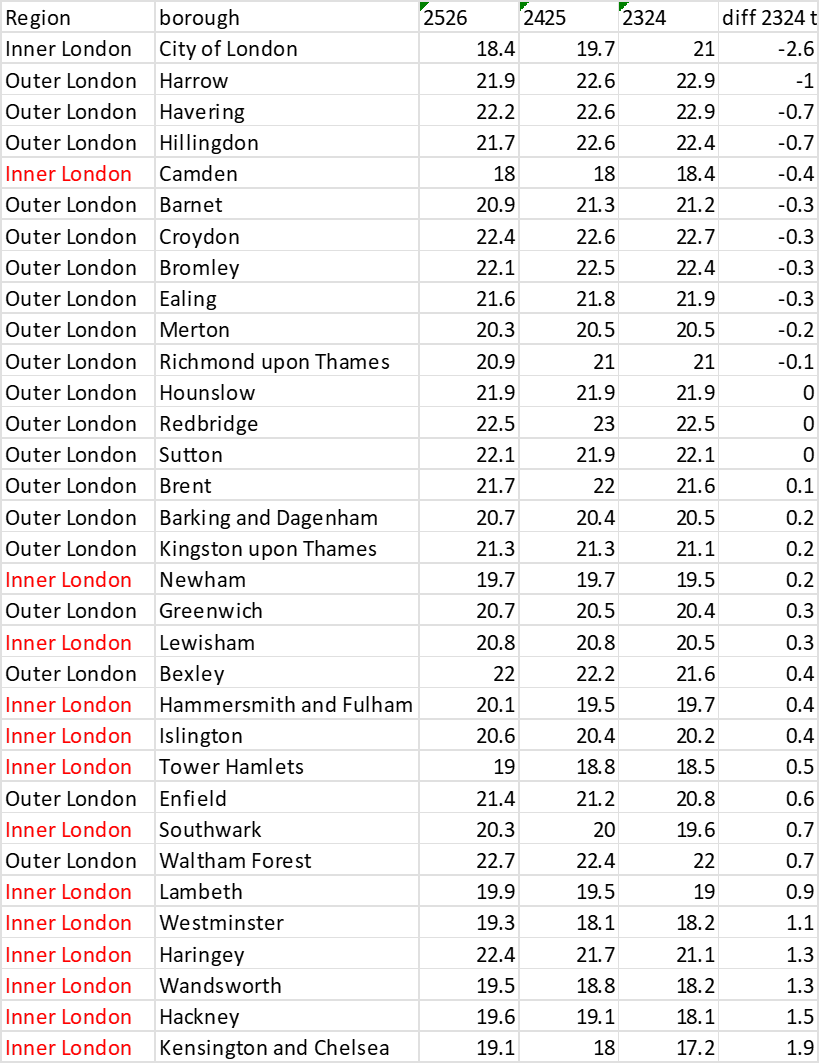
London seems to be a different world to much of the rest of England when it comes to looking at a range of different indicators about education. The latest one where the statistics raise an interesting question is the percentage of 16- and 17-year-olds that are NEETs (Not in Education, Employment or Training).

With the raising of the suggested ‘learning leaving age’ to eighteen (the official age is still sixteen) it is expected that almost all students in what is Years 12 and 13 should be in some form of certified education or training. The DfE asks local authorities for data each year bout the percentage participating in education or training and produces scorecards on-line. I wonder how many local authority scrutiny committees ever see this data? Participation in education, training and NEET age 16 to 17 by local authority, Academic year 2024/25 – Explore education statistics – GOV.UK

The scorecard for Oxfordshire can be found at Oxfordshire_neet_comparator_scorecard.pdf

Looking through the data for all local authorities for both 2019 and 2025 what struck we was there was a definite London effect. 28 London boroughs had higher participation rates in 2025 than in 2019. For the rest of England there were only 37 other local authorities with higher participation rates in 2025 than in 2019.

One explanation is the inclusion of ‘no data’ in the NEETs percentage. As the DfE noted;

 ‘NEET/not known rates at the end of 2024/start of 2025 ranged from 0.0% City of London to 21.5% in Dudley. Dudley’s rate includes 2.4% NEET and 19.1% activity not known.’

So, either London boroughs are better at collecting the data – quite possible, given their relatively small size and close geographical cohesion, or there is something else going on.

On the other hand, only seven ‘shire counties’ had higher participation rates in 2025 than in 2019.  Might the decimation of rural bus services and the effect of a punitive motor tax on those without a no claims bonus be something to do with this change? Could it be that in large counties there are no longer the staff to badger multi-academy trusts (MATs) to provide accurate data about the destination of Year 11 leavers?

I think the DfE data should make clear both the known percentage of NEETs and the percentage of the age group where these is no data available. Perhaps, there might be a scorecard of MATs to identify those that provide high quality data, and those where hard pressed local authorities have to waste time and money chasing the data.

With the job market looking increasingly challenging over the next few years, and fewer incentives for employers to offer jobs with training to school leavers, the percentage of NEETs is an issue that needs more visibility, especially with the rapid growth in EHCPs. Will the significant increase in young people with mental health issues result in more NEETs, and if so, will London be different?

Homelessness and schooling

Is the education of children made homeless well enough safeguarded? Compared with the education of children in some of the world’s worst trouble spots, this may seem like an irrelevant question to ask of society in England. However, as a recent report from a House of Commons Select committee has made clear there is more that we can do in this country for this group of young people. England’s Homeless Children: The crisis in temporary accommodation

I am slightly surprised that the Housing, Communities and Local Government Select Committee didn’t decide to conduct a joint inquiry with their colleagues at the Education Select Committee on this topic, but, perhaps, they initially didn’t think that schooling would be an important feature of their report.

Homlessness almost always means a move from one accommodation to another. For a school-aged child this can have one obvious consequence; their status has changed. This change in status isn’t something the family is likely to share easily with the school, although I suspect sensitive primary school class teachers and heads will notice the change fairly quickly. In secondary schools, unless the class tutor picks up on the change, it may well go unnoticed until it becomes an issue.

The most likely issue for schools is that the change in accommodation may mean a different, and possibly longer route to school. This might mean children that used to arrive on time may now be late through no fault of their own. The temporary accommodation might also not provide adequate space for learning and homework, so that might deteriorate as well. How schools deal with this situation explains a lot about their policies and the values behind them.

In more extreme cases, homelessness means that a child must change school mid-year, with all the attendant bureaucracy that entails. The Select Committee were concerned that there was no requirement to inform schools.

‘Currently, schools are not always notified when a pupil becomes homeless or changes school due to a move into temporary accommodation. This prevents schools from offering additional support which those children may require. Similarly, GPs are often unaware that families are experiencing homelessness, leaving an incomplete picture of the health impacts of homelessness on children’

The Committee recommended that

‘As the Government seeks to establish ‘consistent identifiers’ for children through its Children’s Wellbeing and Schools Bill, it should ensure that these can be used as a formalised notification system, so that a child’s school and GP are alerted when they move into temporary accommodation.’ Page 30

At least the current Bill before parliament will stop academies and Trusts from stonewalling on accepting in-year admissions.

I would go further an require a child moving school to be placed on the roll of a virtual school run by the receiving local authority, if a school place could not be identified within two weeks, regardless as to how long or short the period of homelessness might be. Children need some degree of support and continuity and to see that their schooling is important to those responsible for supporting the family.

Class matters more than ethnicity

The end of the summer term is a curious time to announce an inquiry into White working-class kids in schools. The inquiry seems to be funded by private finance, but with government backing. Members revealed for white working-class kids inquiry

Two former Secretaries of State will be on the board, along with a DfE official, as well as many others representing the great and the good in schooling, but not perhaps either the churches or representatives of the under-fives lobby.

As SchoolsWeek pointed out in their news item, this is not the first such inquiry into the achievements or lack of them, of this group in society.  Indeed, the House of Commons Select Committee has had two goes at the issue, in 2014 and 2020. HC No

As well as the Select Committee’s reports, and the evidence submitted to the Committee, The inquiry might also like to read the DfE’s Report on outcomes by ethnicity Outcomes by ethnicity in schools in England – GOV.UK published before the pandemic.

I am sure the inquiry will focus on what works, and no doubt discuss issues about what is being measured and over-reliance on Free School Meals data. They will also need to discuss the issues around definitions, as society has become much both more complex, and more polarised. The measurement of children – I prefer the term to kids – of mixed heritage has added many more sub-categories to the original list.

However, I cannot help thinking that the focus of the inquiry is wrong. All the evidence suggests that of the three factors of race, gender and class, it is the third one that really matters. Yes, they are often inter-related, but looking at socio-economic data it is often schools in deprived areas, regardless of the ethnicity of their pupils that fare less well in school performance table.

Is this due to the funding arrangements. Some areas, notably London, are better funded than other parts of England. Is it down to teacher deployment and the market system. Do the best teacher seek to work in the most challenging schools or those with the best outcomes. How much does support from home matter. Can poor teaching be overcome with support and tutoring from home. All these were issues considered by the Select Committee. Then there are issues such as school attendance and what happens at the Foundation State if pupils miss vital building blocks in language and mathematics. Does the class teacher system help or hinder these children?

In terms of funding, what effect has the Pupil Premium had on outcomes, and is there any evidence that where academies can pool the funds of all schools and move resources between schools whereas local authorities cannot do so that this arrangement can boost outcomes in traditionally under-performing schools?

I guess one measure is the percentage of pupils on Free School Meals across the country that pass the tests for selective schools. Will the inquiry suggest a fully comprehensive secondary school system? If not, how will it address this injustice.

I am disappointed that it has taken this Labour government a year to start the process of addressing this issue. What were they doing in opposition? After all, the Liberal Democrats pushed the Pupil Premium right for the start of the coalition in 2010, as it had been in their manifesto.  How much does this government really care about those children that don’t achieve their full potential for whatever reason.

1,500 posts and counting

When I wrote my first post on this blog, on the 25th of January 2013, I little though that I would reach 1,500 posts. However, despite stopping posting for 18 months, between the autumn of 2023 and May this year, while I was otherwise occupied as a cabinet member on Oxfordshire County Council the blog has now reached the milestone of 1,500 posts, including 40 so far this year since I started the blog up again this May.

Since one of the features of the blog has been commenting on numbers, here is a bit of self-indulgence. The blog has had 175,983 views since its inception, from 93,875 visitors, and has attracted 1,459 comments. The average length of a post has been between 550-670 words, although there have been a few longer posts in response to consultations and Select Committee inquiries.

How much holiday do teacher have? is the post with the most views – more than 6,500 and rising. Some posts have had no views, but are still an important record of my thoughts. The United Kingdom has been responsible for the most visitors: not a surprise, as most posts are about education in England. However, the USA comes second, with more than 15,000 views. Apart from some former French speaking countries in West Africa, Greenland and Paraguay, almost all other countries have had someone that has viewed the blog at least once.

Later this year, I will be publishing a book of the 2013 posts from the blog, and at that point they will disappear from public view. If you want to register for the book, check on Amazon after August 2025 or email dataforeducation@gmail.com for publication information. Alternatively, ask your favourite bookshop or library to order a copy.

I am sometimes asked about my favourite post. With 1,500 to choose from, that’s difficult, as many haven’t seen the light of day for a decade or so. However, Am I a blob? From 2013, was fun to write, and the posts about Jacob’s Law finally brought about a change in the legislation over admissions in the current bill going through parliament.

Most posts have been written, as this one is, in one session from start to finish, with editing just to tidy up my thoughts. Some are more passionate than others, and many are about teacher supply issues, where I am also researching a book on the subject covering the past 60 years of ‘feast and famine’. Much of the recent history has been well chronicled in this blog.

Thanks for reading, and for the comments. Who would have thought that someone that failed ‘O’ level English six times would end up writing a blog!  Funny old world.

Do better funded schools exclude fewer pupils?

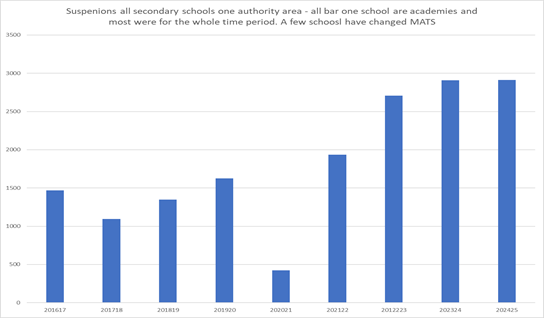
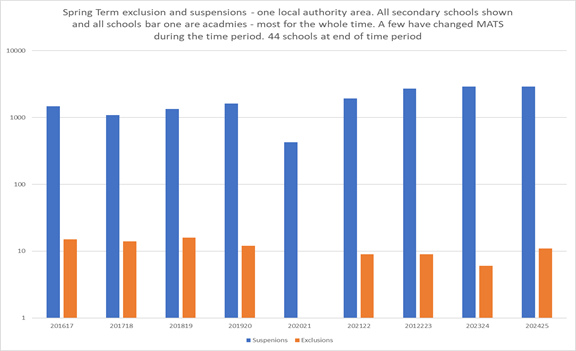
The DfE published the annual data for exclusions and suspensions from schools during the 2023/24 school-year this week. Suspensions and permanent exclusions in England: 2023 to 2024 – GOV.UK Sadly, there are more pupils being excluded than in recent years, and my post from July 2018 Bad news on exclusions | John Howson reflects much , at least at the national level, of what is contained in the latest report on 2023/24. Boys on free school meals, and with SEND, and from a minority group are at highest risk of being excluded, especially when they are in Year 9, and, as ever, the reasons is most likely to have been ‘persistent disruptive behaviour’.

With the worsening recruitment crisis in schools, allied to a challenging financial environment, an increase in exclusions and suspensions was to be expected. What the data doesn’t tell us is whether schools with high exclusion rates are linked to specific academy trusts, and also to high levels of teacher turnover.

I wrote a blog about policies for reducing exclusions in May Reducing exclusions from schools | John Howson and I would hope that if the staffing situation does settle down, so might the number of pupils being banished from school.

As ever, I am struck by the funding issue. London, the best funded part of England has some of the lowest rates for exclusion and suspensions. There are 17 London boroughs in the list of the 25 local authorities with the lowest rate of suspensions in 2023/24, and 19 in the similar list for secondary exclusions. In the list of ten local authorities with the highest rates of exclusion are five authorities in the North East. I think that there may be something in this data that needs further exploration, especially as I would expect teacher recruitment to be easier in the North East than in London.

Interestingly, in view of the debate about mobile phones in schools, the number of suspensions for ‘inappropriate use of social media or online technology’ only increased from 11,419 to 11,614, an insignificant change between 2022/23 and 2023/24 especially compared with the increase in exclusions for ‘persistent disruptive behaviour’ from 446,676 to 569,921 over the same period. Of course, much comes down t how a decision on which box to tick when the exclusion is being reported and the latter category may hide suspensions that actually belong in one of the other categories. This is the risk when there are too many choices for a school to make.

The increase of around 25,000 in assaults leading to suspensions must be very worrying, although I wonder whether most are ‘common assault’ rather than ‘assault leading to actually bodily harm’ or ’GBH’ to use the criminal code levels of violence against another.

Some numbers are so small it is a wonder that they are still collected. Were only 69 pupils – up from 50 the previous year- permanently excluded for theft. Perhaps schools have nothing worth nicking these days.

I hope that next year, we might read of at least a levelling out of the rates of exclusions and suspensions and perhaps a return to a downward trend, especially if there is a relationship between funding and how schools can cope with disruptive pupils.  

What Lib Dems want for SEND pupils and their families

I was delighted to see the Liberal Democrats weighing in on the SEND debate by writing to the Prime minister and setting out five key principles behind any reform of the SEND system. This is what their letter to the Prime minister said:

Our five principles and priorities for SEND reform are as follows:

  1. Putting children and families first Children’s rights to SEND assessment and support must be maintained and the voices of children and young people with SEND and of their families and carers must be at the centre of the reform process.
  2. Boosting specialist capacity and improving mainstream provision Capacity in state special provision must be increased, alongside improvements to inclusive mainstream provision, with investment in both new school buildings and staff training.
  3. Supporting local government Local authorities must be supported better to fund SEND services, including through:
    1. The extension of the profit cap in children’s social care to private SEND provision, where many of the same private equity backed companies are active, and
    2. National government funding to support any child whose assessed needs exceed a specific cost.
  4. Early identification and shorter waiting lists Early identification and intervention must be improved, with waiting times for diagnosis, support and therapies cut.
  5. Fair funding The SEND funding system must properly incentivise schools both to accept SEND pupils and to train their staff in best practice for integrated teaching and pastoral care. Our five principles for SEND reform – Liberal Democrats

These principles come from a motion debated at last year’s Party conference and represent a check list against which specific policies can be measured, such as increasing the supply of educational psychologists to deal with both the annual reviews and initial assessments of EHCPs.

If there is anything missing from the list, it is the role of the NHS, and specifically around mental health and education. This is the area of need where the system has really broken down. Many of the other issues are cost related due to inflation and more young people living longer as well as increased demands from an age range of support than can now reach up to the age of 25. The issue of mental health has swamped the system and the NHS must play a part in helping define what is needed.

With the main opposition at Westminster disinterested in the issues of education that are facing most families, the Lib Dems should be leading from the front. This letter should have been sent at least a week ago.

As my earlier posts of today have shown, the Lib Dems next education campaign can be around securing enough teachers for schools in our more deprived areas. Such a campaign can take on both labour councils and Reform voters to show there is a radical alternative in the Liberal democrats.

Education may not feature very high in polling about issue in elections, but on a day-to-day basis it isn’t far away from the conversations in many households. From mobile phone to AI, funding for school meals to citizenship, Liberal Democrats should be calling the government to account.  

Will the 6,500 new teachers be heading for schools in disadvantaged areas?

Increasing teacher numbers in disadvantaged areas and core subjects. I was very happy when I read this heading in today’s Public Account’s Committee report on ‘Increasing Teacher Numbers’. Increasing teacher numbers: Secondary and further education (HC 825)

However, when I turned to paragraphs 25-29, this section just seemed like an afterthought. How depressing was it to read that

‘Schools and further education colleges are responsible for deciding the staff they need and recruiting their own workforces. Local authorities employ teachers in maintained schools.’ Para 25

There is nothing factually incorrect in the statement, but although local authorities are the de jure employers of teachers in maintained schools, ever since the devolution of budgets in the 1990s, local authorities have had little to do with the hiring policies for teachers in these schools, and nothing to do with the academy sector.

The Committee did acknowledge that

‘Those schools with higher proportions of disadvantaged pupils tend to have higher turnover rates and less experienced teachers. This impacts the government’s mission of breaking down the barriers to opportunity and means disadvantaged children are at risk of being locked out from particular careers.’

Teachers in schools with higher proportions of disadvantaged pupils are also less experienced

‘In 2023–24, 34% of teachers in the most disadvantaged schools had up to five years’ experience (20% in the least disadvantaged schools).’

They cited the examples of computer science and physics

‘In the most disadvantaged areas, 31% of schools do not offer Computer Science A-level, compared to 11% of schools in the least disadvantaged areas, due to a lack of trained teachers. For Physics A-level, this is 9% compared to 1%.’

This will come as no surprise to regular readers of this blog. Here is the link to a post from the 21st July 2023, almost two years ago.

Free School Meals and teacher vacancies | John Howson

Thos who know my background will know that I started teaching in a school in a disadvantaged part of Tottenham in 1971, and this issue has been one that has concerned me throughout my career in education. I was, therefore, disappointed to read that

‘We asked the Department when we could expect there to be less variation between schools in the most and least disadvantaged areas, but it did not commit to a timeframe. Instead, it noted that its retention initiatives providing financial incentives were targeting schools and colleges with the highest proportion of disadvantaged students.’

This seems to me to be as close to a non-answer as one can expect. Indeed, looking in detail at the oral evidence session, this is an area where answers from the senior civil servants in my opinion suggested little hope, and not as much concern for the values implied in the questions that I would have liked to have heard. In reality, past experience tells me that it is falling rolls and fewer job opportunities that will propel teachers towards schools where they would otherwise not take a teaching post. Iti s the economy, not the DfE that will improve the life chances of children in those schools with a high proportion of disadvantaged children. This is at the same time as the lives of their parents may be worsened by unemployment and welfare cuts. It’s a funny old world.