The Future of Education – a talk from 2024

In the summer of 2024, I was asked to lecture on the future of education. Two years on, it is interesting to see how even more relevant today the content of the talk is. Sadly, there are still no answers to many of the questions posed in my talk.

Thank you for inviting me to talk to you this evening. I arrived in Oxfordshire some 45 years ago, about the same time as the late Sir Tim Brighouse. This was only a couple of years after Prime Minister Sir Jim Callagham’s visit to Oxford, and his famous Ruskin College speech that started The Great Debate about education and schooling in England. A debate that has ultimately led us to where we are today.

Starting this talk with a look back at history reminds me that if this were a sermon, I would start with a text. Perhaps, ‘Acts Chapter 2 Verse 17’. I won’t read it out, as those that want to know what it says can look it up on their phones.

However, what I want to talk briefly about this evening is RATS -I have to say that thankfully you are spared the PowerPoint picture at this point.

However, RATS stands for:

Responsibility

Accountability

Technology

And

Schooling

RATs or ARTS is better, even if the order is wrong.

First Responsibility

Who is responsible for what in education

People still cheerfully talk of ‘Oxfordshire’s schools’ but in reality, as cabinet member, I deal with only a limited number of functions these days:

-Admissions to school, but not in-year admissions to academies

-Transport to school, but not for over 16s, as this is discretionary and there is no cash, despite raising the learning leaving age to 18, except for SEND pupils where we still support those where we can. So, a young person can receive free transport from Years 7-11 and then nothing.

-School building – we have built more new schools in the past decade than the previous 50 years. But as ever this area is highly regulated.

HR for maintained schools – this means small primary schools have to pay the Apprenticeship Levy – a tax by any other name.

School Improvement – although the £400,000 annual DfE grant ends this month and next year we are funding it from Council Tax.

-SEND – and we will spend £20 million more than the government provides us with funds in this area and end this financial year some £60 million overspent.

That overspend lead me nicely into considering Accountability

If there is confusion over responsibility, is there any clarity over accountability for our school system?

As I mentioned, Oxfordshire has overspent on SEND and by 2026 this may be as much as £140 million

Schools receive their budgets calculated on formulas where Oxfordshire as a local authority has no vote, and merely acts as the banker. Schools may end the year in surplus or in deficit

If you look at academy chains in Oxfordshire, several have schools with balances of £1 million and other have deficits nearing the same figure.

Who is accountable for these outcomes and how will they be dealt with?

If the RSD is prepared to accept academies in deficit that they add to each year, why should Oxfordshire as a local authority wipe out deficits on schools transferring to become an academy: perhaps we will explore issuing an IOU to be paid when there are no deficits in the academy sector.

Last year, council tax payer transferred £200,000 for a school becoming an academy to wipe out is deficit: that’s a lot of potholes we could have filled. At the end of this month, I expect deficits in maintained schools to top the £3 million mark: enough to mend most of our roads.

Let’s consider some other accountability issues:

Who is responsible for ensuring there are enough teachers for Oxfordshire schools? Is it schools; MATs and the dioceses; the LA or the government at Westminster?

Who is responsible for school improvement, so when ofsted comes knocking a school can be judged outstanding, as a primary school in the north of the county has been recently.

Who will deal with the digital divide?

This last question is one that that neatly brings me onto the third theme for this evening:

Technology

Since I came to Oxfordshire at the end of the 1970s there have been three waves of new technology

The microprocessor revolution of the late 1970s and early 1980s that brough BBC B, turtles, and eventually the Apple/PC dominance of our interface with IT. Indeed, my MSc thesis in 1980 was the first produced on a word processer for any course at Norham Gardens.

The second technology revolution started in the early 1990s, and became part of our lives in the first decade of this century when we all embraced the internet and started exchanging emails. 

This revolution had a second phase when the phones in our pockets suddenly became mini computers in their own right, and a whole new set of challenges opened up for education. This saw the surge in new social media platforms, and the current heads-down culture that pervades so much of society these days. I won’t ask how many have already googled my suggested text for this talk.

Although schools have made adaptations to accommodate these changes in technology over the past 5 decades, we still rely upon a teaching and learning strategy that has many elements that would be familiar when state education began more than 150 years ago.

In passing, I am sorry that the covid pandemic didn’t allow us to celebrate the 150th anniversary of the 1870 Education Act in a manner that I think would have been fitting.

The 2x4x8 model of learning may not be as rigid as it once was, but secondary school ‘timetablers’ are great fans of it as a strategy.

Anyway, so much for the first two waves of technological change: what of the third and developing wave, currently described by many as the AI revolution?

Does a knowledge rich curriculum meet the needs of a generation that started school last September and possibly won’t retire from employment until the last decade of this century. Those that started school 100 years ago, around the time of the birth of the BBC and radio, retired just as the internet was becoming a viable communication strategy: what will the class of 2024 experience in their lifetimes, and how will we prepare them for adult life?

This is not to decry the role of knowledge in schooling, and especially the building blocks of literacy and numeracy. Technology has almost made handwriting redundant, except as an art form. Can technology help us deal with the learning gap at Key Stage 1 between children on Free School Meals and those whose parents have a higher degree?

If so, to return to my themes of accountability and responsibility, where does the impetus for change lie? At school or Trust level; at local authority level or nationally?

We have seen initiatives such as the Oak Academy created nationally post-covid. We also saw how Oxfordshire as a local authority dealt with covid in acting as a conduit for information.

How will the system take change forward. Who has the vision.

Perhaps parents will dictate change for us as educators?

Home schooling has increased significantly: a passing phase or signs of a new order?

I saw this week suggestions that teachers will need to be paid more if they have to work a five-day week when four days becomes the norm. It is worth noting that teachers, as a group have seen no change in their holiday entitlement over the past 50 years while all other workers have benefitted from increased time off.

So let me conclude by asking whether one might one view a model where technology, and indeed any other approach to teaching and learning, is like a table top resting on the twin legs of responsibility and accountability.

Wobbly legs can mean an insecure platform for learning, and certainly for the development in an orderly manner of how technology can change the landscape of education.

I started with the term ARTS, so my final word must be about schools.

It is right that schools and their staff must be at the heart of the landscape, but the challenge that is currently keeping me awake at night is the relationship between a national funding formula created during a period of increasing school rolls, and the current situation of falling rolls faced by many primary schools.

How will hard decisions on whether all schools survive be taken, if pupil numbers continue to decline? For instance, who decides on whether we keep primary schools in local communities or face competition between schools for pupils to keep their own school open?

What part can technology play in solving this dilemma? I don’t know, but I do know the relationship between falling rolls and school funding is not one we can duck going forward.

But let me finish on a brighter note. This week, I met with three young entrepreneurs interested in working with schools on drone technology. Indeed, they have started a series of books that might be the 21st century version of Thomas the tank engine.

Let me introduce you to Ruby Rescue and the big fire – a tale from Drone City and possible future firefighting techniques.

I started my teaching career in Tottenham with the stewardship of 16 mm projectors; reel to reel tape recorders; an epidiascope, and little other technology but in a certain landscape for schooling.

I don’t want to dream of a past, but rather to challenge us all to set out a vision for the future landscape of education that can work for the good of all.

Thak you for listening.

Reviving Music Teacher Bursaries: A Necessity

Regular readers of this blog will know of my campaign to see the music bursary restored to graduates training to be teachers of music. Recruitment to ITT is well below the same level as last year, when there was a bursary.

Music teacher shortage: the situation worsens | John Howson and more recently ITT – 9 subjects with fewer offers than March last year | John Howson

I was therefore delighted to see this speech by a Labour peer in a debate in the house of Lords on Thursday.

 Baroness Keeley (Lab) 

The review found that inequalities in music education are substantial, with music showing the widest disadvantage attainment gap of any subject, driven by unequal access to instrumental tuition and wider inequities in school and community resources. I have also raised with Ministers the fact that music teacher supply is a related problem. Since 2010, we have seen persistently high vacancy rates for music teachers. In fact, in 2023-24, that vacancy rate was among the highest of all subjects, and the Department for Education has missed its music teacher recruitment target in 12 of the past 13 years. There was a small increase in recruitment during 2024-25, after the brief return of the £10,000 bursary, but recruitment still reached only around 40% of target.

The conclusion is clear. The music teacher bursary must be restored. The Government’s opportunity mission makes it clear that we want high-quality music and arts education for every child in all state-funded schools. The curriculum review has recentred music and arts as core to a rounded education, not as optional extras, and it has challenged the narrowing of the curriculum that has squeezed music out of timetables, particularly in disadvantaged areas.
Debate: Curriculum and Assessment Review – 26th Mar 2026 my highlighting

I would also welcome the comments in that debate by both Baroness Sue Garden and Tim Clement-Jones, Liberal Democrat Peers.

Despite the pressure on government finances, there really is a need to find a way to attract more graduates into training as music teachers. Any failure to do so will risk a Labour government committing the sin of removing music from out state schools, and leaving the subject residing just in the independent sector and international schools staffed by teachers trained in England.

Not only does music give great pleasure to many, it is also a major expert industry that the government ought to be nurturing. Two good reasons to reintroduce the bursary.

Of course, as Chair of the Oxfordshire Music Service Board, I have an interest to declare, but that interest isn’t contradicted by the evidence of declining enrolment, re-advertised vacancies and an apparent lack of interest in the DfE about the training of teachers of music for state schools. Presumably, they see this as a DCMS issue, since funding for music services is via the Arts Council.

Funding for teachers is, however, very much the brief of the DfE, and if they cannot find the cash for the bursary the they should urgently start work with the Arts Council to devise a scholarship scheme, such as already exists in certain other subjects. To do nothing is not an option if music is to survive in our state schools.

My 2016 post on Geopolitics and macroeconomics

Sometimes it is worth re-posting something I have written before on this blog rather than writing a new post. Recently, I wrote about my thoughts about how education, and schools in particular might be affected by the current global war. In 2016, well before the AI revolution, I wrote a wider-ranging piece about macroeconomics and geopolitics that also considered advancements in technology, without actually referencing AI. I thought it worth re-publishing the post that first appeared on:

So here it is in full and unedited.

Whether the world is a more dangerous place this January isn’t for me to say. However, to balance my short-term views about teacher supply problems I thought it worth thinking about what the combined effects of a downturn in China; tensions in the Middle East; falling oil prices and the possibility of rising interest rates might do to the longer-term teacher supply position.

An analysis of data over the past fifty years suggests teacher supply problems ease when the economy is subdued or in recession. Whether there is a direct link between these two facts may be arguable, but while there is a need to educate children there will be a need for teachers. Again, over the past fifty years, there have been massive strides in technology since the famous BBC programme of the late 1970s ‘The chips are down’ about the microprocessor revolution. Classrooms have adapted to make use of the new technology, but there has been no seismic shift away from traditional patterns of pupil teacher numbers. Indeed, in secondary schools over the past decade, pupil-teacher ratios have even improved, according to DfE data.

The recently reported growth in home schooling may be the first signs of a coming revolution, driven by parents no longer satisfied with the current model of schooling. Tablets, TVs and computers can provide more learning power than any school library of a couple of decades ago. What is needed is the means of instruction and the method of motivation to keep youngsters on task. How much more likely is that in a home environment than when youngsters are faced with the distractions caused by 25 or 30 other children: could learning me more focused and take less time in the home than the classroom?

No doubt, parents would still want children to socialise in order to learn team games, sing together and undertake risky science experiments under the control of a qualified person. However, that might mean only sending your child to school for a couple of days a week. Such a shift might also boost the market for tutors as parents just buy in specific skills where their offspring are facing issues with learning.

As the BBC recently highlighted, the spirit of enterprise is abroad in Britain at the present time. I am sure that there are many developers in both large companies and small start-ups eying what could be a lucrative market that has world-wide potential; some of which will be on display at BETT.

Such a shift in technology from a labour intensive to a technology driven learning process could have a profound effect on both the need for teachers and the spending by the State on education. However, in the short-term, the geopolitical and macroeconomic signals might suggest that if a downturn is coming then teaching might benefit from renewed interest as a career choice.

As I have said at several conferences recently, I am one of the only people that might see benefits from a slowdown in China, even if it only reduces the inflow to that country of UK teachers to work in the growing international school market.

However, with the allocations for 2016 entry into teacher preparation courses set and fewer places available on non-EBacc subjects than in 2015, none of this will matter before 2017 unless, as in 2009, any downturn in the world’s economy bring back greater numbers of returners into teaching: such an effect could dramatically alter the picture of teacher supply, even for 2016, were it to come about.

ITT – more applicants doesn’t always mean more offers

In my previous post, I noted the increase of nearly 6,000 I the number of candidates applying for a place on a graduate teacher preparation course. Up from 21,436 in March 2025 to 27,352 in March 2026. This post explores the relationship, both this March and last march, between candidates and places offered to those candidates.

Firstly, the number of candidates and the number of ‘offers’ to candidates in each secondary subject.

candidatesoffers
2025202620252026
BIOLOGY21612044713332
ART&DESIGN9601026451366
MFL18762246821733
PE1988221911491043
PHYSICS33296522825918
COMPUTING12702394341420
GEOGRAPHY1089843476292
OTHERS9261342281310
CLASSICS67623427
D&T661861273295
RE699693255208
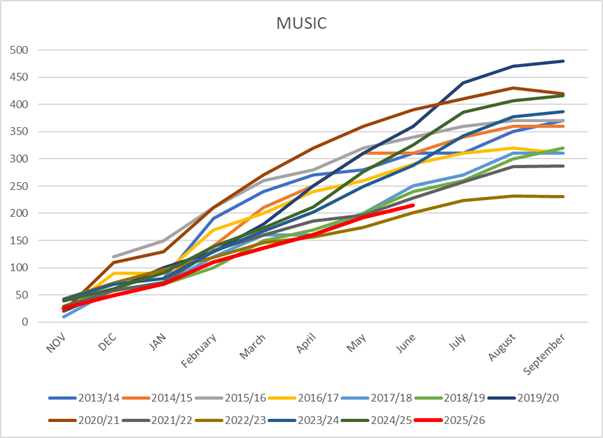
MUSIC311275173136
MATHEMATICS4006534612771398
ENGLISH256128301032990
HISTORY11421281592624
BUS STUDIES607923132173
DRAMA336384162176
CHEMISTRY16622207441675

Note, not all subjects have seen increased candidate numbers within the overall increase.

Secondly, the next table shows the percentage of candidates so far ‘offered’ a place for 2026.

20252026Change
BIOLOGY33%16%-17%
ART&DESIGN47%36%-11%
MFL44%33%-11%
PE58%47%-11%
PHYSICS25%14%-11%
COMPUTING27%18%-9%
GEOGRAPHY44%35%-9%
OTHERS30%23%-7%
CLASSICS51%44%-7%
D&T41%34%-7%
RE36%30%-6%
MUSIC56%49%-6%
MATHEMATICS32%26%-6%
ENGLISH40%35%-5%
HISTORY52%49%-3%
BUS STUDIES22%19%-3%
DRAMA48%46%-2%
CHEMISTRY27%31%4%

Only in Chemistry, where because of the reduction in the size of the bursary to those applying for biology courses it seems likely that those with a choice between the two subjects have opted to apply for chemistry with its higher bursary for 2026. As a result, biology, with a 17% fall in offers this March when compared with March 2025, is the big loser.

Despite the change in candidate numbers, the percentages offered places in March 2026 follows a similar ranking to March 2025.

% offered
20252026
MUSIC56%49%
HISTORY52%49%
PE58%47%
DRAMA48%46%
CLASSICS51%44%
ART&DESIGN47%36%
ENGLISH40%35%
GEOGRAPHY44%35%
D&T41%34%
MFL44%33%
CHEMISTRY27%31%
RE36%30%
MATHEMATICS32%26%
OTHERS30%23%
BUS STUDIES22%19%
COMPUTING27%18%
BIOLOGY33%16%
PHYSICS25%14%

Music is such a specialist subject that it generally only attracts candidates likely to be accepted. However, current ‘offer’ levels are still well below those recorded in the first four years of the century when the number accepted ranged between 68% (2001) and 78% (2003). (Source: John Howson’s collection of GTTR Annual Reports). 2003 was after graduates training to be teachers received a training grant and were also exempt from tuition fees.

Of course, the most interesting percentage of ‘offers’ is that for physics, where only 14% of candidates have so far been made an offer. It looks as if the better candidates for biology are those that have opted to apply for chemistry in 2026, resulting in a significant fall in ‘offers’ in biology.

For subjects such as history and physical education, it is wise for candidates to apply early in the recruitment round since places fill quickly.

Finally, is the present system fit for purpose? Should there be a closing date by which all applicants will be considered,  rather than the drip feed approach as a present?

DfE Vacancy site – some thoughts

A great deal of research can be boring to do. That’s certainly true of my research into the labour market for teachers that I first started way back in the early1980s. Currently, I am tracking advertisements for headteacher vacancies in England.

The DfE is running a series of adverts on platforms such as LinkedIn extolling the virtue of advertising on their free vacancy site and claiming almost complete coverage of vacancies.

It is certainly true that the DfE site contains the majority of the headteacher vacancies in state schools in England, but I am not sure whether it has as complete a coverage as it maintains. One wonders what the Advertising Regulatory Body would make of such an unsubstantiated claim? It certainly would be allowed for beauty products.

The DfE site also has a number of idiosyncrasies. For headteacher vacancies, the most significant is the repetition of certain vacancies, a factor that inflates the total number of vacancies.  For instance, today, the DfE site suggests that there are 185 vacancies listed (1130 on 22.3.26). In reality there are only 160 schools advertising for a headteachers on the site. The other listings are repeats, or in one case a double repeat, with the vacancy appearing three times in all.

Does this repetition matter? It does if anyone is just counting the total of vacancies listed, as that would inflate the turnover of headteachers. Such simple counting would also need to also take into account the length of times each vacancy is listed. This can range from four weeks to a couple of days. Why some vacancies only appear for a short length of time is an interesting question. Do these schools have a candidate in mind, and hence don’t want other applicants?

Then there is the issue of genuine re-advertisements, where a school advertised, but failed to make an appointment. If counting the number of schools seeking a headteacher, then these re-advertisements need to be discarded.  To do so, needs a regular analysis of the whole list of vacancies, as there is no easier way to identify such schools. There is also an irritating practice from some MATs of not identifying the school where the vacancy has occurred. Some MATs also avoid information about the starting salary: I think that this is a mistake, since their idea of generous, may not be the same to MATs as to candidates, and it is embarrassing to find this out at interview stage.  

What of the schools whose headteacher vacancies appear more than once in the same list? Many are newly advertised vacancies; some are re-advertisements, but in each of these groups there seem little logic to the schools listed. At present, there are no schools in either the West Midlands or London regions with double entries. However, of the 25 schools with double entries, six each are in the South East and East of England.  

At the end of the school-year it will be interesting to see whether some MATs, local authorities or dioceses fare worse when it comes to making an appointment of a headteacher. There are some obvious candidates already appearing after just six months of the school-year.

School building boom is over

The DfE has published its latest estimates of school capacity for 2024/25, together with estimates for places needed up to 2029/30 School capacity in England: academic year 2024 to 2025 – GOV.UK

There are two sets of numbers. One looks at both need and places available and calculates what might be regarded as a raw score. This looks at all spare places, regardless of location within the authority and measures that number against expected additional need. The second set just looks at additional need.

During the period between 2025/26 and 2029/30, most additional need is likely to come from changes in the housing stock, with little, if any, growth from the increase in the number of pupils in the relevant age groups. As a result, most local authorities show either no need for additional primary places or only small increases in numbers. Wandsworth is the only Inner London borough with any additional need for primary school places during the period 2025/26 and 2029/30.

The table balancing existing places with additional need shows only a handful of local authorities with a reduction in the spare capacity in the primary sector between 2025/26 and 2029/30. For most authorities, the spare place problem is expected to be worse in 2029/30 than it is in 2025/26

net spare places
OxfordshirePrimarySecondary
2025/26-11,052-6,321
2026/27-11,557-6,449
2027/28-13,117-6,959
2028/29-13,865-7,143
2029/30-14,601-7,336
Change-3,549-1,015

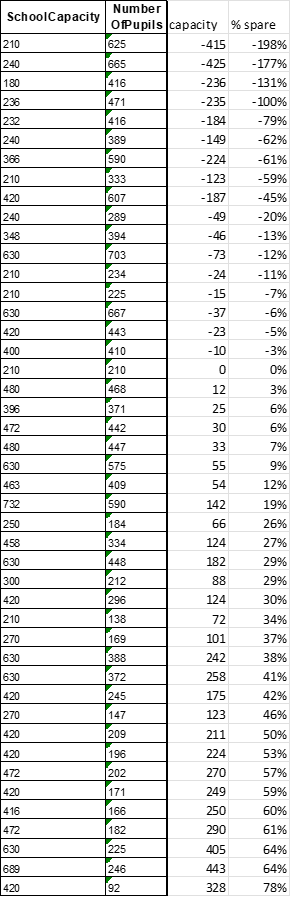
The table shows the estimates for Oxfordshire. Several factors could mean these data are not going to be accurate. In recent years, Oxfordshire has seen significant housebuilding, and if the construction of new housing continues, and attracts families from outside the county, then the spare places may be an overestimate.

Oxfordshire is also home to several military bases for both the army and the RAF. Although defence planning has projected the closure of some of the army bases, the current defence review and increased spending on defence might either slowdown or reverse the closure of some of the bases. If closures slow down, then this might mean pupil numbers don’t fall as expected.

The problem for both the local authority, the dioceses and the academy trusts is that Oxfordshire has many small primary schools located in villages. Often the school is the only facility left in the community. The present funding formula that is heavily biased towards pupil numbers poses a potential problem for small schools. Academy trusts can ‘vire’ funds between schools to help such schools through any temporary downturn in pupil numbers. At present local authorities do not have this ability: they should be given the power to support small village schools in the same way as MATs can.

However, as with many other rural areas, school closures look likely over the next few years if schools are not to run up deficit budgets. Such deficits would be paid off by depriving future pupils of some of their funding. With education spending likely to be squeezed to accommodate the increase in defence spending, and a greater proportion of the school funding going toward SEND pupils, there may well be some hard decisions to make.

With declining interest in established faiths, how will the dioceses react to falling rolls, if their schools are no longer viable?

One certainty is that if any school closures require additional free transport to the next nearest school, the current£20 million Oxfordshire council tax payers contribute to fund mainstream school transport will not be enough, even if fuel and other costs remain stable.

Local government reorganisation may offer a way out for politicians in areas such as Oxfordshire, but politicians in urban areas, and especially in London will not be so lucky. Time to dust off my review of falling rolls in Haringey in the 1970,s and the lessons to be learnt from those battles.

Think Tank weighs in on SEND

Policy Exchange, the Think Tank that describes itself as ‘the UK’s leading think tank’, and ‘an independent, non-partisan educational charity whose mission is to develop and promote new policy ideas that will deliver better public services, a stronger society and a more dynamic economy.’ Has published a new report on SEND, with a foreword by a former Conservative Chancellor of the Exchequer.

The report contains a great deal of interesting evidence, much of which will already be know to anyone that has been involved with the emerging crisis in SEND that was already apparent from well before the covid crisis hit in 2020. Policy Exchange – Out of Control

A telling paragraph in the report lays bare the need for action

The SEND system established by the Children and Families Act 2014 and the 2015 SEND Code of Practice is inefficient, ineffective and has failed to deliver improved outcomes for children with SEND. Fundamental flaws have created perverse incentives for actors in the system. The current SEND regime was designed to support a much smaller number of acute cases. It has failed to adapt to changing social definitions of SEND that have widened demand. Instead, the concentration of resources and bespoke support at the top end of the spectrum has prompted an escalation of needs which has overwhelmed the system and undermined its long term sustainability. (Page 66).

The paragraph leaves one wondering why the Conservative government that was responsible for the 2014 Act didn’t take action to deal with the problem when in office?

In December 2018, I wrote a blog SEND on the agenda again | John Howson drawing attention to a report from the Local Government Association. There was already concern in local government circles about what was happening in SEND. It is worth repeating the key points from the LGA report.

Addressing the points raised in paragraph 17 of the Report would go a long way to creating a sustainable and successful system for young people with SEND.

  1. To create a more sustainable funding settlement going forward there may be merit in considering some key questions around how incentives in the system might be better aligned to support inclusion, meet needs within the local community of schools, and corral partners to use the high needs block to support all young people with SEND as a collective endeavour. These might include
  2. setting much clearer national expectations for mainstream schools;
  3. rethinking how high stakes accountability measures reflect the achievements of schools which make good progress with children and young people with SEND or at risk of exclusion;
  4. correcting the perverse funding incentives that mean that it can be cheaper to pass the cost of an EHCP or a permanent exclusion onto the high needs block than making good quality preventative support available in-school;
  5. looking again at the focus and content of EHCPs to afford greater flexibility to schools in how they arrange and deliver the support needed;
  6. providing ring-fenced investment from government designed explicitly to support new and evidence-based approaches to early intervention and prevention at scale;
  7. providing additional capital investment and flexibility about how that can be deployed by local government;
  8. issuing a national call for evidence in what works for educating children and young people with these needs, backed up by sufficient funding to then take successful approaches to scale and a new focus for teacher training and ongoing professional development;
  9. more specific advice for Tribunals, parents and local authorities on how the test on efficient use of resources can be applied fairly when comparing state and non-state special school placements; and
  10. reaffirming the principle around the equitable sharing of costs between health and education where these are driven by the health needs of the child or young person.   

https://www.local.gov.uk/have-we-reached-tipping-point-trends-spending-children-and-young-people-send-england

Failures by the conservative government up to 2024 to provide enough educational psychologists to meet the growing demand, and to not index-link the basic grant to schools helped produced a system where the explosion in demand broke the system.

While any report with an analysis of the problem and suggestions for how to tackle it, ahead of the present government’s White Paper, is welcome, we should not have reached the current position.  

One final point, the report seems light on the issue of training for all staff from TAs to teachers to school leaders. The lack of an appreciation of the needs of those that work in schools has been another feature of the long period of Conservative government.

I look forward to see what the Labour government’s White Paper will suggest when it appears.

Few successful appeals for infant class places in 2025.

One consequence in the fall in the birth rate seems to have been a downward trend in appeals over admissions to infant classes.  Key Stage 1 classes have been capped at 30 pupils for nearly 30 years now, so it might be expected that parents would be keen to ensure their offspring gained a place at the primary school of their choice. After all, parental choice has been a cornerstone of admissions policy since 1979, regardless of the government in power. The data for 2025 admissions ahs now been added to the tie series by the DfE. Admission appeals in England, Reporting year 2025 – Explore education statistics – GOV.UK

2025
Primary (infant classes)Other primary classesPrimary
Admissions617,802137,153754,955
Admission appeals lodged by parents8,2506,33414,584
Admission appeals lodged by parents (percentage)1.34.61.9
Appeals heard by an appeals panel5,1283,8718,999
Appeals heard by an appeals panel (percentage)0.82.81.2
Successful appeals4991,0961,595
Successful appeals (percentage)9.728.317.7

Of the 617,802 requests for places in infant classes, only 8,250 resulted in an appeal, presumably as the child was not placed in the school of the parent’s choosing at offer day. Some parents either accept another school or a place became available, so 3,122 of these appeals were not proceeded with, leaving just 5,128 appeals heard across the whole of England. Of these appeals, only 499, or 9.7% of the appeals heard were successful, presumably because of the class size limit.

Across the rest of the primary age range, there were only 14,584 appeals, or 1.9% of those either moving children during the Key Stage 2 phase or joining for the first time, perhaps because of the imposition of VAT on private school fees in January 2025. Again, a number of these appeals were not heard, presumably again because a place could be found after the appeal had been lodged. Interestingly, the success rate was much higher for these appeals than for the appeals for admission to infant classes, presumably because there is no mandated maximum class size for Key Stage 2 classes.

In the secondary sector, appeals in 2025 were 4.9% of admissions, around the middle of the 4.5 to 5.5 range of the period between 2016 and 2025. Interestingly, the success rate of these appeals has been falling. In 2025, it was only 19.9%, compared with 26.3% of appeals heard in 2016.

As entry numbers are likely to fall in Year 7 over the next few years, it will be interesting to see whether the percentage of successful appeals rises over the next few years. However, it may well be that popular schools remain attractive to parents, and will still have no spare places creating the need to appeal, especially if siblings are not all granted the place at the same school.

The present Bill before parliament should return in-year admissions for all schools to local authority control. At present academies can opt out of a local system and manage their own in-year admissions. As I have not before (Jacob’s Law) this was especially challenging for children in care needing to find a new school place. Hopefully, their needs will be better appreciated in the future.

Does where you study make a difference to ‘A’ Level outcomes?

Next week, pupils will receive their GCSE results and will then have to decide where to continue their studies. If they are intending to take ‘A’ levels, then the options may be between staying on at the same school or transferring either to another school or to an institution run under further education rules such as either a general further education college or a Sixth Form College, where they exist.

As the tables for this years’ results by type of institution shows, there are different percentage in terms of outcomes.

Centre typeYearPercentage of results at grade A and abovePercentage of results at grade C and above
Independent school including city training colleges (CTCs)202548.40%89.70%
Secondary selective school202543.70%88.20%
Free schools202531.30%80.60%
All state-funded202525.20%76.30%
Sixth form college202524.00%76.20%
Academies202523.10%75.00%
Secondary comprehensive or middle school202522.60%75.20%
Other202516.40%55.80%
Secondary modern school/high school202516.30%64.80%
Further education establishment202514.40%66.30%

Young people across England celebrate exam results – GOV.UK

I don’t think anyone would be surprised to see independent schools with the highest percentage of results at A*-A. But it is important to understand what the policy about entering candidates for the examination is when considering outcomes. Is anyone taking the subject entered or is there a bar to be achieved at ‘mock’ exam time to be allowed to enter.

These results also cannot identify any time candidates spent either on tutoring during the course or cramming during the Easer break before the actual examinations.

I am not sure whether the institutions classified as ‘City Training Colleges’ are actually ‘City Technology Colleges’. If so, it is not clear where UTCs and Studio Schools have been located? Possibly, along with the academies group or do they make up the ‘other group’ and does ‘other’ include special schools.  Why Free Schools merit a separate line under a Labour government is an interesting question.

It is also not clear whether the further education establishments (not Sixth Form Colleges) include entries from adults as well as those that would be in Year 13 if at a school? Certainly, anyone thinking of doing ‘A’ levels at a college might want to ask about the grades achieved by students at the college. The eight per cent gap to a comprehensive school for those gaining the top grades in a further education establishment and the nearly nine per cent gap for Grade C and above merits questions if faced with the choice. However, an earlier post noted, there are differences in the percentage of candidates achieving top grades between different subjects, and that may well be a factor in the outcomes.

This year, boys outperformed girls for the first time since 2018. There have also been different rates of improvement when comparing percentages achieving the top grades by type of institution. Without knowing what types of institution are classified as ‘other’ it is difficult to account for the decline in outcomes for the top grades for these schools.

Provider% difference 2025 on 2023
Free schools4
Secondary modern school/high school2.7
Secondary selective school2.3
Independent school including city training colleges (CTCs)1.9
All state-funded1.7
Academies1.6
Sixth form college1.5
Secondary comprehensive1.3
Further education establishment0.7
Other-2.3

It would also be integrating to compare the different types of intuitions by their outcomes by region.