
More thoughts on the ITT round for 2026

Yesterday, although a bank holiday in England, more people listed as from the United Kingdom than listed as from the United States viewed this blog. It’s been a while since that has happened.

I guess it was because of the post about the May ITT numbers I posted yesterday. Yesterday also looks like a bank holiday that higher education ignores. I am not surprised as there can be too many bank holidays on Mondays in May, and that fact can play havoc with timetabling.

Anyway, thanks for viewing, as, wherever you are from, your support is much appreciated.

After producing my prediction table in yesterday’s post MayDay for some ITT subjects: joy for others? | John Howson
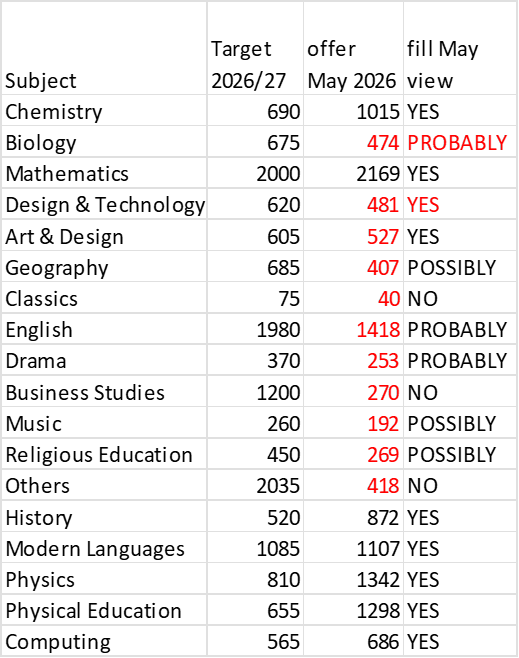
I thought that I would delve a bit more deeply into possible outcomes. Looking at 2025 data between May and September, and ignoring all applicants not from England, there were 11,773 more candidates in 2024 and 13,387 more candidates recorded in 2025 between May and September.

At 18th May 2026, there were 33,344 candidates, so it seems likely that candidate numbers will be up on the past two years in terms of candidates from England. However, as this also contains candidates for the primary sector, that factor needs to be taken into account. This year, with a low ‘target’ for primary, I would be surprised to see many more candidates applying for primary sector courses, as most courses will presumably be showing as ‘full’.  

However, what about the subjects listed as anything other than ‘Yes’ will fill in the previous table? How do they fare?

The following table is based upon ‘offers’ not ‘candidates’ numbers between May and September for 2025.

subjectMay-25Sep-25difference% increase offers May to September
Others4185008220%
Classics44541023%
Physical Education1395177538027%
History832113230036%
Physics1246169845236%
Mathematics2169314297345%
Religious Education34750816146%
English1467216169447%
Drama23434911549%
Music27641614051%
Art & Design709108637753%
Business Studies21232911755%
Geography731113540455%
Modern Languages1089170962057%
Biology1094173363958%
Chemistry682109140960%
Design & Technology46678331768%
Computing53794240575%
  
Total Secondary1353020043651348%

There is no doubt that had the DfE output from the Teacher Supply Model remained the same as I 2025, this table might have looked very different.

I think that I might upgrade Geography from ‘possibly’ to probably’ on this data. As music had a bursary last year, I am not yet prepared to upgrade that subject to ‘probably’, at least until after July numbers, and the applications from 2026 graduates have been taken into account. The same is true for Religious Education.

Another area of uncertainty remains around the sciences. The total target had been reached by the end of May, but biology numbers were below target. Will providers top up with students to make courses viable? My guess is, yes, as there seems to be no penalty to the provider for doing so. The risk is all carried by the trainee.

In the future, I think that the DfE needs to consider disaggregating the 2,035 places listed as for ‘other’ subjects. Not to do so makes the data increasingly meaningless, especially once the fact that more than a third of applicants come from outside of England is also taken into account.

Finally, as we know for the annual DfE’s ITT census, not all offers turn into students counted in the census. I might try and look at what level of over-recruitment might be sensible to ensure 100% of the DfE’s target by the time of the ITT census, after allowing for the fact the TSM target should include a percentage of in-course wastage.

Afterall, the aim is to ensure the labour market has the qualified teachers it needs for all students to be taught by properly qualified teachers.  
NEETs, schools and teachers

The DfE has recently published an analysis of the factors contributing to the risk of a young person becoming a NEET (Not in Education, Employment or Training) at certain ages. Risk factors for becoming NEET: a statistical analysis using linked data

The key conclusion was that

“At each age group, and when controlling for overlapping risk factors, three factors stand out: persistent absence from school during KS4, having an EHCP, and not attaining 5 good GCSEs including English and maths.” Page 20

Two of these risk factors may have been made worse for some pupils by the fact that for the last decade there has been a shortage of qualified teachers in many subjects. Not all schools have suffered equally from staffing shortages, and within schools, not all pupils may have experienced the same degree of teaching from teachers with less than optimum qualifications and experience in the subjects that they were teaching in the secondary sector.

Might less than excellent teaching be a contributory factor to both absence during KS4, and the failure to attain 5 good GCSEs including English and maths? Perhaps the report would have benefitted from some cases studies linked to schools with high risks factors, but low rates of NEET?

Are there regional differences in the risk factors, perhaps associated with local job markets? Might the consequences of AI on the graduate labour market mean that such a study in a few years’ time might have a different set of risk factors?

Has education policy during the past decade, with an emphasis on the subjects in the English Baccalaureate contributed to some pupils becoming NEETs, perhaps because they found the curriculum, however well taught, not interesting at KS4, even though most will have accepted the need to study English and Mathematics.

In terms of in-school factors, I was surprised not to see anything about valued added from year 7 to 11. Can we trace the likelihood of becoming a NEET back to poor attendance in Reception at the start of formal education?

It seems to me that these are the questions we need to ask if policy decisions are to be made that will reduce the possibility of a young person becoming a NEET. By actions within schools.

However, the big challenge is the extent to which schools recognise the societal risk factors, such a being a young carer, having an ECP, moving school in KS4 and experience of being a Looked After Child.  Teachers are generally form the groups with low risk factors, after all they must have achieved 5 good GCSEs and that probably meant good attendance at KS4. It would also be interesting to know how many teachers had declared special needs at secondary school – perhaps Teachers Tapp could ask that question?

With little experience of risk factors, and, I guess, a training curriculum that devotes little time to how to motivate those at a high risk of becoming a NEET, perhaps we ought not to be surprised that the present labour market offers few opportunities for those without qualifications, especially now that hospitality an retail are sectors shedding jobs not offering opportunities.

Higher Education: markets v planning for the sector

I don’t often write about higher education, as, although I spent more than a decade running a large department in a university, and also writing about activity-based costings in higher education, I don’t consider myself well enough briefed to comment regularly.

There are exceptions to my self-imposed rule, and this post is one of those. What persuaded me to write this post was a link to this article Universities on the brink: Decoding the UK higher education funding crisis and the path forward | The Educationist

Now, for most of this century, and indeed the last decade of the previous century, higher education providers have been free to operate in a market, with limited government intervention, except in areas such as teacher education, and providing courses for both doctors and the professions allied to medicine.

As I discovered when running courses for new heads of departments in universities about how higher education funding worked, most academics had limited knowledge and often less interest in the subject when asked to take on running department: at that time; even Deans were often more interested in course quality than the financial health of the departments they headed.

Regardless of the reasons behind the current financial malaise, should the market be left to bring the sector back to financial equilibrium? Of course, the government could just throw money at the problem, but I guess it hasn’t the funds, and anyway, the DfE might put NEETs and SEND above bailing out universities in any priority list.

However, I don’t think the government should leave everything to the market. After all, it is the largest consumer of graduates: 30,000 teachers per year to be trained; NHS staff; the defence forces; the civil service and local government. These are all consumers of graduates in large numbers.

Allowing the market to solve the financial problems might have unintended consequences. A major concern for me is around the mobility of new graduates. Many years ago, I studied where trainee teachers went to study, and there was a correlation between where a first degree or higher-level courses was studied, and where individuals entered teacher preparation courses. Universities without schools of education provided fewer recruits to teaching.

Well, Teach First helped solve that problem, at least in London, but I am concerned that market driven course closures could leave parts of the country without degree courses in some subject areas vital for the public sector.

For this reason alone, I think the government should ensure some form of course planning for the higher education sector, so that there are not areas without say, music courses or philosophy. Both are degree courses important as part of the pipeline for future teachers of music and religious education. As these are also both subjects that already fail to recruit enough graduates into teaching, reducing the number studying them on degree courses even further would endanger that pipeline even more.

The intervention of the government in place planning, even at a broad level, also makes economic sense to me, as moving students from loans to welfare is also not a good use of public money. How to manage the balance between leaving the future for higher education to the market, and an orderly return to fiscal rectitude might at least be worth a discussion amongst politicians and those that advise them.

An ATOL Scheme for MATs, as DfE finally takes action on MAT with a large deficit

SchoolsWeek are running a story about the breakup by the DfE of a multi-academy trust that was seriously in deficit last August, when it closed its account year for 2024-25. Arthur Terry: Trust with £8m deficit to be broken up

 I suppose this is the sort of story that is best released just before a school holiday – what at one time was known as a ’Jo Moore’ story. Now there’s a surprise | John Howson

The fact that the Aruther Terry Learning Partnership (ATLP) can go from a deficit of £4.5mn in August 2024 to a deficit of £8.3mn in August 2025, and who knows what by May 2026, (page 83 of accounts filed at Companies House) raises serious questions about whether abolishing the Funding Agency and brining its functions back into the DfE has worked? THE ARTHUR TERRY LEARNING PARTNERSHIP filing history – Find and update company information – GOV.UK

The ATLP had 25 schools and a teaching hub under its management in August 2025. I make that a deficit of not far short of £320,000 per school.

SchoolsWeek informs readers that the issue has been around the decision to purchase iPads for all 11,000 staff and children. At current retail process that would amount to expenditure of somewhere between £3.6mn and £12mn, including VAT which would be recoverable.

Assuming some form of education discount, say 10%, the bill would be in the region of £2.5mn to £9mn depending upon the model selected. Opting to pay over a couple of years, would reduce the annual bill even more. As a result, although this might be a contributory cause, it doesn’t look like the whole cause of the crisis – unless I have underestimated their spend on additional software and other extras.

This is a MAT where they haven’t been paying excessive salaries to the senior staff. A top salary of £160,000, although more than any local Director of Children’s Services might have been receiving in August 2025, sadly isn’t way out of line for MAT CEOs.

The DFE has decided to wind up the MAT, and presumably force other MATs to take on schools in their localities. I assume, with some guarantee over any losses transferred with the school.

This is scandalous in terms of the oversight of public money. In my mind it demonstrates that lack of local political scrutiny means all the oversight rests with the civil service. Indeed, there is no reason for MATs not to rack up deficits if all that happens is the schools are transferred to another MAT, and the DfE funds the bill – presumably from the funds that might otherwise go to schools that manage to keep their finances in balance each year.

I wonder whether an ATOL type scheme might be appropriate, levied on all MATs, and used to pay off deficits that cause any MAT to become unviable? Of course, it will only work if the DfE is willing to take swift action. Any MAT with a debt amount of x per school should be wound up. The ATOL scheme, lets call in the MBOS (MAT Bail Out scheme) should have a board comprised equally of finance directors of MATs and finance directors of public companies, overseen by a financially astute, but neutral chair.   

Even if this sort of scheme isn’t attractive to government, there does need to be better oversight of MATs finances, especially as falling rolls will put pressure on all school finances. There might even be a similar scheme for local authorities, especially as local government re-organisation might mean the risk of lax internal audit regimes for a couple of years across large swathes of rural England.

UCET’s changing of leadership: a rare event

I have been rather tardy in posting my appreciation of the work of James Noble-Rogers, as executive director of UCET (The Universities Council for the Education of Teachers). James was only the second Executive Director the organisation has had so far, taking over from Mary Russell, its first director, after she had presided over the coming together of UCET and PCET, the universities high education teacher training organisation that merged with the polytechnics and colleges organisation, after those institutions became universities in the 1990s to form UCET as it is currently constructed.

James was recruited to his post at UCET from the civil service. I first knew him when I served at the then Teacher Training Agency between 1996 and 1997, in the role of advisor on teacher supply, an interest I retain until this day. James was working on ITT numbers in the DfE, and was a natural fit to take over from Mayr on her retirement. However, I suspect that many were surprised to see a civil servant, and not an academic, appointed to the role. Appointing James was an inspired move.

Afte leaving the TTA in 1997, I worked closely with UCET, and James, for about a decade while he steered UCET through the problems of firstly, falling interest in teaching as a career, and then the boom after the 2008 economic crisis that lead to, in my view, the mis-guided decision by Ministers to axe the training grant and require the payment of tuition fees for graduates when Michael Gove became Secretary of State. These moves contributed to the teacher supply crisis that I foreshadowed on this blog in my 2013 posts (see Howson: Teachers, Schools and views on Education – available from Amazon as an eBook).

The early years of the coalition were a challenging time for colleagues working higher education preparing new teachers and providing INSET. Some will recall the ‘blob’; others, the issue of recruitment controls that nearly caused several universities to consider pulling out of ITT/ITE.

James remained resolute in supporting the higher education community’s central involvement in teacher preparation and development, the position it still holds today, while recognising the emerging partnership with schools that through SCITTS were providing their own version of teacher preparation. At the same time, Teach First was creating another route into teaching.

The last decade after 2016, brought new changes, the effect of the covid pandemic, plunging interest in teaching from home students and the growth, in recent years, of applicants from around the world.

As I became more involved in local government politics after 2013, I lost regular contact with UCET, and stooped attending their annual conference.

Even to, I am delighted to be able to recall my association with James, and the long service he rendered to UCT over more than a quarter of a century. I hope that as with his predecessor, his work will be acknowledged formally by the State.

I enjoyed the time when I worked with James, and wish him well in the next stage of his life. I am delighted to see that he is still offering his support, advice and knowledge that few others can rival.

Children’s Wellbeing and Schools Act 2026 – misconduct

S52 of the new Act deals has made changes to the scope of teacher misconduct. Three things to note

The term teacher is still not a reserved occupation term: anyone can still call themselves a teacher., but if they do so, they will more likely now be caught by the widened provision, unless that is they are self-employed offering only tutoring. Should such tutors also be covered by misconduct regulations, or just subject to the general criminal law?

Clause 52 of the Children’s Wellbeing and Schools Act 2026 widens the scope of those within the compass of the new section on misconduct as a teacher to include:

“a person who employs or engages a person to teach at an institution within the further education sector, an independent training provider or an online education provider.”

and hence these ‘teachers’ now become liable to be brought before The Teacher Regulation Agency for a hearing into misconduct

The legislation confirms that action outside of employment may trigger a misconduct hearing

“(3A) For the purposes of subsection (1)(a) or (b) it is irrelevant whether the conduct occurred, or the offence was committed, at a time when the person was employed or engaged to carry out teaching work or at some other time.”

That’s pretty draconian, but not surprising in view of the need for child safety.

Of course, if the on-line provider is outside the United Kingdom, then this provision won’t apply to non-British citizens. Will it apply to British citizens working outside the United Kingdom and working for an on-line provider?

Teaching work has been defined as: “teaching work” means work of a kind specified in regulations under this section (and such regulations may make provision by reference to specified activities or by reference to the circumstances in which activities are carried out).”

So now you know. It could mean almost anything. This may be important now the definition of those subject to regulation has widened.

However, the test remains:

  • that it relates to a person who has been employed or engaged to carry out teaching work in England; ……
  • that the alleged conduct is capable of amounting to unacceptable professional conduct, conduct that may bring the teaching profession into disrepute or conviction, at any time, of a relevant offence and that a prohibition order may therefore be appropriate.

Will the relevant offence list be the same for someone teaching in a further education setting as for an early years’ setting? I suspect that it will be, since certification as a teacher or lecturer in further education allows anyone to teach anything to anyone or any age.

In my opinion, this makes the need for a definition of a ‘teacher’ or ‘lecturer’ as a reserved term more important. Government could, for instance. Require anyone ‘teaching’ on-line to hold the appropriate ‘qualified’ status. A new qualification for tutoring, both in person and on-line, could be devised to help regulate the industry, at least as far as UK companies are concerned. It would then be up to parents whether they wanted to use a service on-line from overseas and using unqualified staff.

Will teachers vote to take industrial action?

The BBC are running a story that suggests a teacher association: the NEU will ask its members about whether they support industrial action that could, presumably, include striking and closing schools? Teachers in England move towards striking over pay – BBC News

My guess is that their members will vote for action: at least in the secondary schools. Whether the larger number of NEU members in primary schools will do so, might be more uncertain. Here’s a link to an early post of this blog, way back from February 2013 February | 2013 | John Howson about what happened then.

Now, we live in different times: a Labour government; many years of pay freezes and pay rises below those in the private sector, but two relatively generous recent settlements, and the possibility of a three-year deal in even more challenging times.

Now factor in, falling rolls leading to job uncertainty in many primary schools, better recruitment to lower targets for new teachers, the need for increased spending on defence and welfare, and an electorate that will judge the government on the length of NHS waiting lists rather than what happens in schools, and the balance between expressing concerns by voting for industrial action, and actually taking action sometime in the autumn, is as the saying goes, a ‘whole different kettle of fish’.

My bet is, shake the big stick now, but think carefully about strike action in the autumn. Or perhaps persuade the government to tweak the pay offer, when it comes from the pay review body, so that both sides can claim victory.

It is interesting that this story is running 100 years after the only real General Strike in British history. This is an anniversary that, unlike Sir David Attenborough’s century, has been largely ignored by the media. I guess nobody wanted to drag it up during a period of local and state elections across the United(!) Kingdom.

One interesting fact from Thursday, is that Labour lost control of Haringey Council. They did so in the 1968 local government debacle. In that period of two-party politics, to the Conservatives. This time the outcome is more complicated. In 1968, the year of revolutions across Europe, Labour in government didn’t sack the Prime minister. Indeed, Harold Wilson led the Party into the 1970 general elections: a much closer race than the 1968 results might have predicted.

The Haringey result is interesting to me, as it meant that in 1971, I started work as a teacher in Tottenham under a Conservative administration. I don’t recall much changing when, in 1972, Labour regained control of the borough. Now the remainder of that decade was a turbulent time in British politics and not only the teachers, but also non-teaching staff. They took industrial action, leading eventually during the ‘Winter of discontent’ in 1979, to all Haringey’s schools being closed, not by the teachers, but by the caretakers going on strike. The Labour administration did not expect anyone, even church schools, to try and break that strike.  These days, with the internet, and remote schooling commonplace, such an outcome in terms of teaching and learning might be much less likely.

For a discussion of the effects in 1979 see my posts from 2020  March | 2020 | John Howson COVID-19 PM’s Suez? | John Howson and The State cannot just abandon children | John Howson and especially from February 2020 Closing schools, but not stopping education | John Howson

David Attenborough at 100

This week the BBC has being paying tribute to Sir David Attenborough, ahead of his 100th birthday later this month. There is no doubting that Sir David has had a great deal of influence on many people through his television documentaries, at first in shades of grey, and then in colours that have improved as television screens have become ever more sophisticated in replicating the colours of the real world.

But who influenced Sir David Attenborough in his choice of career? Way back in 1997, the then Teacher Training Agency decided to commission two cinema advertisements. One, that received all the attention was called ‘talking heads’, and featured head and shoulder shots of a range of celebrities just saying a name to the camera. The trap line at the end was ‘no one forgets a good teacher’.

The other, far less well-known advertisement commissioned by the Teacher Training Agency in 1997 featured a teacher called Horace Lacey and a pupil called David Attenborough. You can see it here. Teacher Training Commercial: Horace Lacey | Catalogue | History of Advertising Trust My thanks to the History of Advertising Trust.

Both adverts were placed in cinemas, and because it was before the general use of websites and urls, postcards were placed in cinema foyers to provide the contact details for anyone interested in teaching. After all, it was impossible to write down a phone number in the dark of a cinema at the time when the advert was actually being played.

At the same time, the agency produced a famous poster with the stap line ‘the dog ate my homework.’ a phrase that passed into common parlance for a period of time.

After a few years, advertisements for teaching as a career started to reappear on TV screens, albeit at the wrong time of year to make any significant short-term difference to recruitment. I made an oblique comment about the effects of TV advertising in this post Do TV adverts work? | John Howson However, I am afraid the title is a bit of a misnomer.

So, my very best wishes to Sir David Attenborough. I hope that all the publicity surrounding his 100th birthday will help inspire the next generation of young people, and the present generation of undergraduates, to take up teaching as a career.  I also hope that the attention to Sir David’s birthday also encourages us to honour the memory of Horace Lacy, and countless hundreds of thousands of other teachers like him that have inspired their pupils down the generations.

Thank a teacher, it is an inspiring job that is like no other. And, although I may not have inspired many of my pupils, I did recognise those around me, both in school and higher education that changed lives and careers. My personal thanks to them.

School Transport- who pays for diesel’s price increases?

Since the start of the conflict in the Middle East, the price of diesel at the pumps has increased from around £1.42 – the average price before the conflict – to £1.90 at the start of May What is happening to UK fuel and petrol prices? – BBC News By comparison, at the height of the concerns over the Ukraine conflict, the price of diesel peaked at just under £2 per litre.

So, could the pump price charged for diesel fuel in 2026 go even higher than the price witnessed in 2022? As I write this, on the 3rd May 2026, it seems quite possible, and even probably that this will be the case: hopefully, I am proved wrong.

The increase in the price of fuel, the rise in the minimum wage, and other cost pressures due to inflation still being above the Bank of England’s target figure of 2%, will be bad news for those local authorities with significant transport bill for conveying pupils to and from schools, either for SEND or because their pupils live in rural areas beyond the two or three mile distance, historically seen as the distance where it is reasonable for parents to pay to ensure children attend their nearest school.  

Although fuel costs are not as high a proportion of total transport costs as are wages, an increase of a third in fuel prices is going to have an impact on transport contracts being negotiated for the new school year starting in September 2026.

A council with a £40 million education transport bill, not unreasonable for a large rural shire county, might see a 5-10% extra charge. This translated to £2-4 million extra across a council’s financial year, and likely even more across a school-year if prices continue to rise further.

 The risk is that some operators might well collapse under the price increase, especially if they are in fixed price contracts with a local authority, leaving a seller’s market, as operators will know that pupils must be transported to school.  Could this outcome drive prices even higher?

How will local authorities cope with these prices increases? Those with reserves, will draw on them until the next round of council tax rate setting in February 2027. However, many local authorities don’t have large reserves, and with local government reorganisation looming for the rural areas, running up a deficit may not be possible.

What remains is either cuts to other services or a government bailout to cover the extra cost of fuel. With social care, and adult social care especially, taking the lion’s share of the budgets of rural counties, there may be few services where cuts are possible, especially since adult social care can involve its own significant fuel costs associated with ‘care in the community’.  

Protecting services such as the youth service and the funding for under-fives could be at risk if local authorities have to bear the brunt of transport related cost increases, especially since the war started just at the wrong time for local government financing, when budgets for 2026-27 were already finalised.

With so many different political parties now in charge, it will be interesting to see how they approach this problem, and who is asked to take the consequences.

Labour market for music teachers: update to end of April 2026

Regular readers will know that I am tracking two parts of the labour market for teachers in state schools across England during the 2025-26 school-year: vacancies for headteachers and vacancies for teachers and middle leaders of music.

Regular readers of this blog will also know that one of the reasons that I selected music as my subject to track was the government’s removal of the training bursary for those applying for postgraduate teacher preparation courses starting in the autumn of 2026.

By tracking vacancies this year, I have a baseline for next year, if, as seems likely, the removal of the bursary reduces interest in teaching music. However, the government has also slashed its published number of trainees needed – see ITT Offers – public money being wasted? | John Howson and my more recent post on the situation after the report on April offers was published.

Anyway, back to the update on published vacancies for teachers of music, and how these vacancies compare with the expected output from this year’s preparation courses.

By the end of April, I had recorded some 389 vacancies for teachers of music. 86 of these were for promoted posts, with an allowance attached. It could be assumed that these vacancies were not intended for teachers straight out of their preparation courses. However, in some smaller secondary schools, this might be the only full—time post and include responsibility for choirs, orchestras and ensembles. However, for the purpose of this exercise, such posts have been eliminated.

After removing the promoted posts, this leaves some 303 vacancies suitable for new entrants into the teaching profession advertised between January and the end of April 2026.

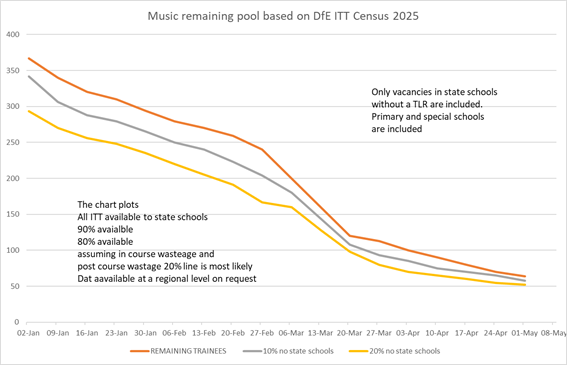
The DfE’s ITT census recorded some 367 trainees on preparation courses in December 2025; mostly for entry into the labour market in September 2026. Assuming all 367 entered the labour market for teachers in state schools, there are still sufficient to fill another 64 vacancies.

However, we know that not all trainees last the courses, and of those that complete the course, not all start teaching in state schools. Some entre the private sector; some further education; some music services and some don’t enter teaching at all.

As a result, the chart shows the remaining trainees available if 10% and 20% of trainees aren’t available to state schools. This approach reduces the remaining number of trainees to little more than 50 trainees. With around 75 vacancies a month so far in 2026, if May’s vacancies follow the pattern of the first four months of 2026, then the remaining total of trainees will be exhausted before the end of May, and resignation deadline day.

Of course, not all basic vacancies are filled by new entrants from teacher preparation courses: some are filled by returners – we can ignore school switchers as we can assume that leaving one school to fill a similar vacancy at another school is neutral in terms of jobs. However, if the move is for promotion, the there is a new vacancy.

Returners would need to fill around 30% of vacancies across the whole year – they are generally the only source of teachers for January appointments, so for September it looks as if schools will struggle to fill any late appointment resulting from resignations close to the 31st May deadline.  However, the picture will be clearer at the time of next month’s update.

Finally, although I do not track vacancies posted by private schools, both in England and abroad, I do survey the market. Generally, this market has twice as many vacancies as posted in any one month by schools in England.

One wonders whether the current cohort of new graduates might have missed out on gap year travelling because of the after-shocks from the covid pandemic and might, therefore be more willing to teach overseas? This has the advantage of not losing income to student loan repayment, and the bursary isn’t repayable.

On the negative side, the conflict in the Middle East may well be deterring some teachers from working in that part of the world, and may have increased the number of returners once more seeking a teaching post in England. We shall see.