Labour market for music teachers: update to end of April 2026

Regular readers will know that I am tracking two parts of the labour market for teachers in state schools across England during the 2025-26 school-year: vacancies for headteachers and vacancies for teachers and middle leaders of music.

Regular readers of this blog will also know that one of the reasons that I selected music as my subject to track was the government’s removal of the training bursary for those applying for postgraduate teacher preparation courses starting in the autumn of 2026.

By tracking vacancies this year, I have a baseline for next year, if, as seems likely, the removal of the bursary reduces interest in teaching music. However, the government has also slashed its published number of trainees needed – see ITT Offers – public money being wasted? | John Howson and my more recent post on the situation after the report on April offers was published.

Anyway, back to the update on published vacancies for teachers of music, and how these vacancies compare with the expected output from this year’s preparation courses.

By the end of April, I had recorded some 389 vacancies for teachers of music. 86 of these were for promoted posts, with an allowance attached. It could be assumed that these vacancies were not intended for teachers straight out of their preparation courses. However, in some smaller secondary schools, this might be the only full—time post and include responsibility for choirs, orchestras and ensembles. However, for the purpose of this exercise, such posts have been eliminated.

After removing the promoted posts, this leaves some 303 vacancies suitable for new entrants into the teaching profession advertised between January and the end of April 2026.

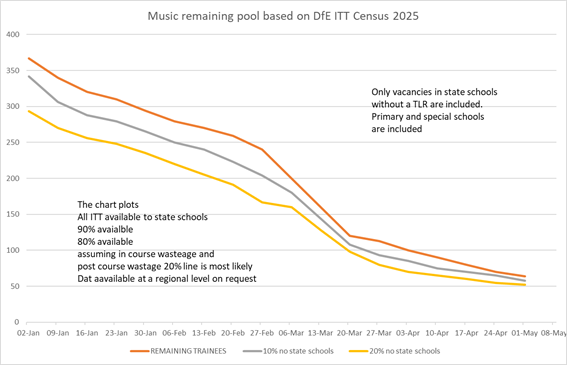
The DfE’s ITT census recorded some 367 trainees on preparation courses in December 2025; mostly for entry into the labour market in September 2026. Assuming all 367 entered the labour market for teachers in state schools, there are still sufficient to fill another 64 vacancies.

However, we know that not all trainees last the courses, and of those that complete the course, not all start teaching in state schools. Some entre the private sector; some further education; some music services and some don’t enter teaching at all.

As a result, the chart shows the remaining trainees available if 10% and 20% of trainees aren’t available to state schools. This approach reduces the remaining number of trainees to little more than 50 trainees. With around 75 vacancies a month so far in 2026, if May’s vacancies follow the pattern of the first four months of 2026, then the remaining total of trainees will be exhausted before the end of May, and resignation deadline day.

Of course, not all basic vacancies are filled by new entrants from teacher preparation courses: some are filled by returners – we can ignore school switchers as we can assume that leaving one school to fill a similar vacancy at another school is neutral in terms of jobs. However, if the move is for promotion, the there is a new vacancy.

Returners would need to fill around 30% of vacancies across the whole year – they are generally the only source of teachers for January appointments, so for September it looks as if schools will struggle to fill any late appointment resulting from resignations close to the 31st May deadline.  However, the picture will be clearer at the time of next month’s update.

Finally, although I do not track vacancies posted by private schools, both in England and abroad, I do survey the market. Generally, this market has twice as many vacancies as posted in any one month by schools in England.

One wonders whether the current cohort of new graduates might have missed out on gap year travelling because of the after-shocks from the covid pandemic and might, therefore be more willing to teach overseas? This has the advantage of not losing income to student loan repayment, and the bursary isn’t repayable.

On the negative side, the conflict in the Middle East may well be deterring some teachers from working in that part of the world, and may have increased the number of returners once more seeking a teaching post in England. We shall see.

Music bursary: a recurring theme

Earlier today, when I was turning out some old papers about teacher supply issues, I came across a draft for a paper I wrote more than 30 years ago on the subject of failing to meet the demand for music teachers.

Interestingly, in the notes, I compared the data for the shortage subject receiving a bursary in 1990 and 1991, with music that wasn’t a bursary subject.

As you might expect, music stood out, even in the early 1990s as an anomaly.

Take Table 31 from the Interim Advisory Committee report of January 1991. This table lists the percentage of unfilled teacher vacancies recorded in a joint union survey.  Music ranked 6th worst in the list. In the DES Press notice on vacancies, issued on 25th August 1991, music was third worst as a percentage of teachers in post, with a vacancy rate of 2.4%. This placed music behind only, ‘other languages’ at 7.2% and German, at 2.5%.

In a DFES document ‘Projecting the Supply and Demand of Techers’, published in December 1990, the Department accepted that projections suggested a shortfall of teachers of music. Interestingly, music was the only subject with a shortfall across all four scenarios modelled in the document. Even so, music did not at that time join the list of subjects entitled to a bursary.

Another DES press notice, of 27th November 1990 (382/90), probably associated with the census of ITT trainees, normally published about that time of year, also showed a deterioration in ITT places filled from 88.9% in 1889, to 71.0% in 1990, although the actual number of trainees had increased from 282 to 340. In 1990, only mathematics, at 63.3% of places filled had a lower percentage of filled places than music.

So, what do I deduce from the data about both recruitment into ITT, and teacher vacancies, from nearly 40 years ago? Perhaps that attitudes in the civil service towards certain subjects in the curriculum don’t change very much.

Maybe the turnover of civil servants with responsibility for ITT bursaries is so frequent that it doesn’t allow for them to start afresh each year in considering the data and trends in each subject.

However, even that approach doesn’t really explain the dropping of the bursary from music for 2026 entry. I think the profession needs an explanation. Otherwise, the axing of the bursary for music can be seen as a cynical ploy to say money in a subject Ministers don’t fully appreciate in terms of its contribution to both society and the growth agenda.

I think that the Arts Council, DCMS, and the music lobby have a right to know why music lost its bursary, and to ask that it be replaced.

 However, having seen how both the DfE and DCMS have recently handled the physical education grants, I am not holing out much hope unless there is a real campaign to reinstate the bursary for music, perhaps with some scholarships provided by private funders. Don’t let us lose music from our state secondary schools.