
Such are the wonders of modern technology that the DfE is now able to publish the monthly ITT data on a bank holiday. The data for May was generated on the 18th May, so is already a week out of date. However, it is good to see civil servants managing to keep to the regular publication date for these statistics, even though it falls on a bank holiday.
With the downgrading by the DfE in their analysis of the Teacher Supply model outputs of requirements for the number of trainees needed in many subjects, some admissions tutors can look for an easy final three months of the current recruitment round.
For others, the remainder of the time until courses start in September will still be take up with encouraging more people into teaching as a career. Worries about AI and graduate careers have not yet seemed to have driven graduates in many subjects towards teaching as a career in larger numbers than in the past.
However, there is a concern, registered by this blog in previous posts, about the dominance of certain subjects in the monthly ‘offers’ table.
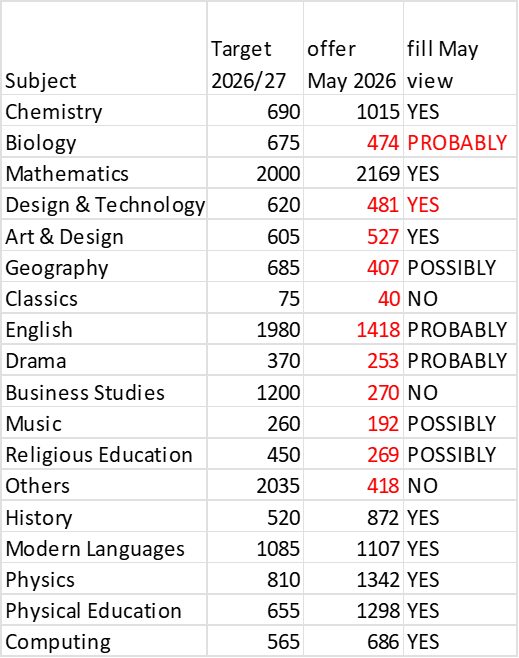
Three subjects, mathematics, physics and computing make up 32% of all the offers in secondary sector subjects on the 18th May. Three other subjects (Classics, Business Studies and ‘other subjects’) have made so few offers that these subjects almost certainly won’t fill all the places available this year, based on the DfE target number for these subjects.
Another three subjects are at risk of not filling places this year unless recruitment improves after graduation in June. (Geography, Music and Religious Education). Although Biology almost certainly will fill the places on offer, I have downgraded it to PROBABLY from YES, as overall science ’offers’ already exceed the target.
The likelihood of those offered places in mathematics, physics and computing actually taking up their places needs to be closely monitored, because of this extreme distortion of the overall data by the number of offers made in these subjects.
Looking at applications, the growth in applications is mostly from career switchers in the 25 to 49 age groups. The under 25 have only seen an increase of 1,078 in applications, compared with 2,465 for the 25-29 age group. Indeed, the youngest age group of new graduates have seen an increase of only 166 on May last year.
There has been a significant increase in male applicants, up from 14,992 to 20,003, when comparing May 2025 with May 2006. This must be the first time in many years that the increase in applications from men has been greater than the increase in applications from women.
So, where has this growth in male applicants come from? It seems likely that the ‘Rest of the World’ grouping has provided many of these applicants, as applications from the ’Rest of the World’ increased from 7,727 in May 2025 to 12,909 in May 2026. London, where the increase has been from 6,708 to 7,534, is the only other region with a significant increase.
Perhaps, surprisingly, considering the wider job market, applications from candidates in the North East, from Wales and from Northern Ireland are all below their May 2025 levels.
The majority of applicants are for secondary subjects, so much so that there are now more than twice as many applicants for secondary subjects as for the primary sector as a whole. Candidates may be perceiving that falling rolls will make finding a post as a primary school teacher more of a challenge, and avoiding that career option.
Higher Education has been the key beneficiary, if you can use that term, of the increase in applications, up from 26,876 candidates in May 2025 to 33,0325 in May 2026. Post graduate apprenticeships, up from 5,505 to 9,184 was the only other route with a significant increase in candidate numbers. Teacher degree apprenticeships increased from 677 candidate in May 2025 to 1,534 in May 2026, not an overwhelming vote of confidence for this route into the profession.
These monthly numbers are becoming so distorted that at the headline level, used by many, they are possibly now misleading. A review of how the data are presented seems overdue.
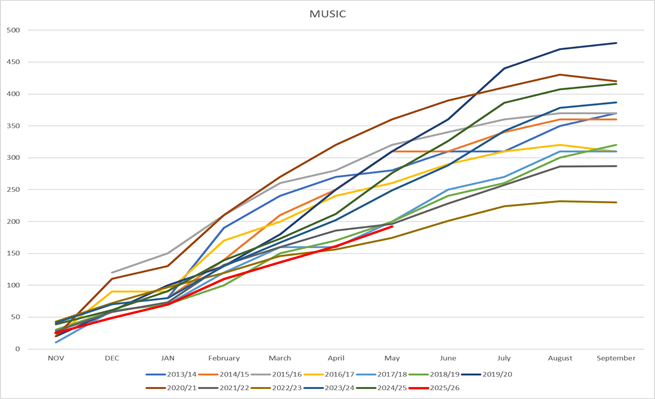
Finally, I still think the removal of the bursary from music was a mistake. The following chart, although busy, shows ‘offers’ over the past decade. This year, is towards the bottom of the range.


Pingback: More thoughts on the ITT round for 2026 | John Howson