Are rainy day savings by schools affecting outcomes?

Is there any relationship between the reserves a school holds and the outcomes for its pupils? One thesis might be that schools that spend more of their revenue budgets, and don’t add to their reserves each year, do better for their pupils than those schools more concerned with ‘saving for a rainy day’ or adding to their reserves for some other reason. Of course, this thesis only really works with a funding model that funds schools appropriately. Nevertheless, it is question worth asking.

This post looks at the evidence around the relationship between the quoted reserves of the primary schools across three multi-academy trusts (MATs) of differing sizes. The schools are in a range of different locations, and have a range of pupil numbers, but are all located within the boundaries of a single local authority.

KS2 achievement Percentage %No of KS2 Pupils 24/25 reserves per KS2 pupil
4230 £        24,333
6916 £        16,313
6422 £        16,273
3625 £        14,480
2711 £        12,364
9111 £        12,249
4715 £        10,600
3429 £        10,172
6913 £        10,077
5016 £          9,375
5016 £          8,688
3327 £          7,667
5645 £          7,267
5648 £          6,896
6916 £          6,813
6939 £          6,692
9315 £          5,933
5831 £          5,484
8318 £          5,287
8211 £          5,091
7218 £          5,000
6531 £          4,258
5022 £          4,182
5531 £          4,129
4821 £          4,098
7359 £          3,847
5028 £          3,536
7315 £          3,467
7528 £          3,214
4827 £          3,111
7061 £          2,738
6758 £          2,535
9123 £          2,531
5657 £          2,509
8323 £          2,087
5944 £          1,864
7131 £          1,677
5770 £          1,614
9212 £          1,362
5260 £              950
7629 £              862
7260 £              700
5618 £              611
4529-£         1,655
8614-£         1,714
7919-£         2,474
5831-£         3,084
867-£         3,295
8938-£         4,756
5315-£         8,667
4825-£       11,040

The range of reserves, as taken from the reserves in the accounts filed at Companies House by the MAT, vary per KS2 pupil from a high of £24,333 per pupil, to £611 for schools with those schools with reserves. Eight schools are shown as having deficits

Leaving aside, at this point for schools with deficits, it is worth comparing the other schools in the table with the average outcome for all pupils in the local authority of 62%.

The schools in the table, are of different sizes. In the schools in the table the range of KS2 pupils extends from schools with just 11 KS2 pupils, to one with 70 KS2 pupils. Where a school has a stable intake, the KS2 reserves per pupil is easy to spread across the schools, although some schools still start pupils, at age 5, many at age 4 and a few even younger and with a nursery class, and this may make a difference to reserves.

In this era of falling rolls, allied to parental choice, some school’s KS2 numbers would overestimate the school population if grossed up across all year groups. For that reason, I have just used the KS2 pupil number for this exercise.

Six of the top 10 schools with the highest reserves per pupil had achievements below the local authority level of 62%. This compares with four of the ten schools with the lowest reserves (not with a deficit).

It is interesting to note that one MAT has 12 schools in the top 15 schools with the largest reserves per KS2 pupil, and 15 in the top 20 schools. Of the other two MATS, one has three schools in the top 20 schools by reserves per KS2 pupil, and the other just two schools.

I suspect that both these MATs more actively work with their schools than the other MAT in terms of making use of their cashflow. All the schools in this latter MAT in the top 20 by reserves are also well above average for performance levels. The position is more mixed for the other smaller MAT, but I suspect its policy is evolving as it has acquired more schools.

How much does parental choice, and falling rolls play a part in determining reserves? Certainly, primary schools that have no spare places across all year groups will do better with a funding model that is weighted towards pupil numbers than schools unable to make full classes even by mixing year groups together. In another post, I will look at school size and reserves.

It would be interesting to conduct this exercise across all schools in a local authority. However, pooling of reserves by some MATs, and a lack of visibility for the reserves of maintained and voluntary schools makes that task effectively impossible.

No doubt the DfE could ask the question about why there is so much difference in reserves per pupil between schools, and could ask if some schools could achieve more for their pupils if they kept less in their reserves? School governors, MAT trustees and the teacher associations, as well as local politicians, might also like to ask this question.

The Future of Education – a talk from 2024

In the summer of 2024, I was asked to lecture on the future of education. Two years on, it is interesting to see how even more relevant today the content of the talk is. Sadly, there are still no answers to many of the questions posed in my talk.

Thank you for inviting me to talk to you this evening. I arrived in Oxfordshire some 45 years ago, about the same time as the late Sir Tim Brighouse. This was only a couple of years after Prime Minister Sir Jim Callagham’s visit to Oxford, and his famous Ruskin College speech that started The Great Debate about education and schooling in England. A debate that has ultimately led us to where we are today.

Starting this talk with a look back at history reminds me that if this were a sermon, I would start with a text. Perhaps, ‘Acts Chapter 2 Verse 17’. I won’t read it out, as those that want to know what it says can look it up on their phones.

However, what I want to talk briefly about this evening is RATS -I have to say that thankfully you are spared the PowerPoint picture at this point.

However, RATS stands for:

Responsibility

Accountability

Technology

And

Schooling

RATs or ARTS is better, even if the order is wrong.

First Responsibility

Who is responsible for what in education

People still cheerfully talk of ‘Oxfordshire’s schools’ but in reality, as cabinet member, I deal with only a limited number of functions these days:

-Admissions to school, but not in-year admissions to academies

-Transport to school, but not for over 16s, as this is discretionary and there is no cash, despite raising the learning leaving age to 18, except for SEND pupils where we still support those where we can. So, a young person can receive free transport from Years 7-11 and then nothing.

-School building – we have built more new schools in the past decade than the previous 50 years. But as ever this area is highly regulated.

HR for maintained schools – this means small primary schools have to pay the Apprenticeship Levy – a tax by any other name.

School Improvement – although the £400,000 annual DfE grant ends this month and next year we are funding it from Council Tax.

-SEND – and we will spend £20 million more than the government provides us with funds in this area and end this financial year some £60 million overspent.

That overspend lead me nicely into considering Accountability

If there is confusion over responsibility, is there any clarity over accountability for our school system?

As I mentioned, Oxfordshire has overspent on SEND and by 2026 this may be as much as £140 million

Schools receive their budgets calculated on formulas where Oxfordshire as a local authority has no vote, and merely acts as the banker. Schools may end the year in surplus or in deficit

If you look at academy chains in Oxfordshire, several have schools with balances of £1 million and other have deficits nearing the same figure.

Who is accountable for these outcomes and how will they be dealt with?

If the RSD is prepared to accept academies in deficit that they add to each year, why should Oxfordshire as a local authority wipe out deficits on schools transferring to become an academy: perhaps we will explore issuing an IOU to be paid when there are no deficits in the academy sector.

Last year, council tax payer transferred £200,000 for a school becoming an academy to wipe out is deficit: that’s a lot of potholes we could have filled. At the end of this month, I expect deficits in maintained schools to top the £3 million mark: enough to mend most of our roads.

Let’s consider some other accountability issues:

Who is responsible for ensuring there are enough teachers for Oxfordshire schools? Is it schools; MATs and the dioceses; the LA or the government at Westminster?

Who is responsible for school improvement, so when ofsted comes knocking a school can be judged outstanding, as a primary school in the north of the county has been recently.

Who will deal with the digital divide?

This last question is one that that neatly brings me onto the third theme for this evening:

Technology

Since I came to Oxfordshire at the end of the 1970s there have been three waves of new technology

The microprocessor revolution of the late 1970s and early 1980s that brough BBC B, turtles, and eventually the Apple/PC dominance of our interface with IT. Indeed, my MSc thesis in 1980 was the first produced on a word processer for any course at Norham Gardens.

The second technology revolution started in the early 1990s, and became part of our lives in the first decade of this century when we all embraced the internet and started exchanging emails. 

This revolution had a second phase when the phones in our pockets suddenly became mini computers in their own right, and a whole new set of challenges opened up for education. This saw the surge in new social media platforms, and the current heads-down culture that pervades so much of society these days. I won’t ask how many have already googled my suggested text for this talk.

Although schools have made adaptations to accommodate these changes in technology over the past 5 decades, we still rely upon a teaching and learning strategy that has many elements that would be familiar when state education began more than 150 years ago.

In passing, I am sorry that the covid pandemic didn’t allow us to celebrate the 150th anniversary of the 1870 Education Act in a manner that I think would have been fitting.

The 2x4x8 model of learning may not be as rigid as it once was, but secondary school ‘timetablers’ are great fans of it as a strategy.

Anyway, so much for the first two waves of technological change: what of the third and developing wave, currently described by many as the AI revolution?

Does a knowledge rich curriculum meet the needs of a generation that started school last September and possibly won’t retire from employment until the last decade of this century. Those that started school 100 years ago, around the time of the birth of the BBC and radio, retired just as the internet was becoming a viable communication strategy: what will the class of 2024 experience in their lifetimes, and how will we prepare them for adult life?

This is not to decry the role of knowledge in schooling, and especially the building blocks of literacy and numeracy. Technology has almost made handwriting redundant, except as an art form. Can technology help us deal with the learning gap at Key Stage 1 between children on Free School Meals and those whose parents have a higher degree?

If so, to return to my themes of accountability and responsibility, where does the impetus for change lie? At school or Trust level; at local authority level or nationally?

We have seen initiatives such as the Oak Academy created nationally post-covid. We also saw how Oxfordshire as a local authority dealt with covid in acting as a conduit for information.

How will the system take change forward. Who has the vision.

Perhaps parents will dictate change for us as educators?

Home schooling has increased significantly: a passing phase or signs of a new order?

I saw this week suggestions that teachers will need to be paid more if they have to work a five-day week when four days becomes the norm. It is worth noting that teachers, as a group have seen no change in their holiday entitlement over the past 50 years while all other workers have benefitted from increased time off.

So let me conclude by asking whether one might one view a model where technology, and indeed any other approach to teaching and learning, is like a table top resting on the twin legs of responsibility and accountability.

Wobbly legs can mean an insecure platform for learning, and certainly for the development in an orderly manner of how technology can change the landscape of education.

I started with the term ARTS, so my final word must be about schools.

It is right that schools and their staff must be at the heart of the landscape, but the challenge that is currently keeping me awake at night is the relationship between a national funding formula created during a period of increasing school rolls, and the current situation of falling rolls faced by many primary schools.

How will hard decisions on whether all schools survive be taken, if pupil numbers continue to decline? For instance, who decides on whether we keep primary schools in local communities or face competition between schools for pupils to keep their own school open?

What part can technology play in solving this dilemma? I don’t know, but I do know the relationship between falling rolls and school funding is not one we can duck going forward.

But let me finish on a brighter note. This week, I met with three young entrepreneurs interested in working with schools on drone technology. Indeed, they have started a series of books that might be the 21st century version of Thomas the tank engine.

Let me introduce you to Ruby Rescue and the big fire – a tale from Drone City and possible future firefighting techniques.

I started my teaching career in Tottenham with the stewardship of 16 mm projectors; reel to reel tape recorders; an epidiascope, and little other technology but in a certain landscape for schooling.

I don’t want to dream of a past, but rather to challenge us all to set out a vision for the future landscape of education that can work for the good of all.

Thak you for listening.

Reviving Music Teacher Bursaries: A Necessity

Regular readers of this blog will know of my campaign to see the music bursary restored to graduates training to be teachers of music. Recruitment to ITT is well below the same level as last year, when there was a bursary.

Music teacher shortage: the situation worsens | John Howson and more recently ITT – 9 subjects with fewer offers than March last year | John Howson

I was therefore delighted to see this speech by a Labour peer in a debate in the house of Lords on Thursday.

 Baroness Keeley (Lab) 

The review found that inequalities in music education are substantial, with music showing the widest disadvantage attainment gap of any subject, driven by unequal access to instrumental tuition and wider inequities in school and community resources. I have also raised with Ministers the fact that music teacher supply is a related problem. Since 2010, we have seen persistently high vacancy rates for music teachers. In fact, in 2023-24, that vacancy rate was among the highest of all subjects, and the Department for Education has missed its music teacher recruitment target in 12 of the past 13 years. There was a small increase in recruitment during 2024-25, after the brief return of the £10,000 bursary, but recruitment still reached only around 40% of target.

The conclusion is clear. The music teacher bursary must be restored. The Government’s opportunity mission makes it clear that we want high-quality music and arts education for every child in all state-funded schools. The curriculum review has recentred music and arts as core to a rounded education, not as optional extras, and it has challenged the narrowing of the curriculum that has squeezed music out of timetables, particularly in disadvantaged areas.
Debate: Curriculum and Assessment Review – 26th Mar 2026 my highlighting

I would also welcome the comments in that debate by both Baroness Sue Garden and Tim Clement-Jones, Liberal Democrat Peers.

Despite the pressure on government finances, there really is a need to find a way to attract more graduates into training as music teachers. Any failure to do so will risk a Labour government committing the sin of removing music from out state schools, and leaving the subject residing just in the independent sector and international schools staffed by teachers trained in England.

Not only does music give great pleasure to many, it is also a major expert industry that the government ought to be nurturing. Two good reasons to reintroduce the bursary.

Of course, as Chair of the Oxfordshire Music Service Board, I have an interest to declare, but that interest isn’t contradicted by the evidence of declining enrolment, re-advertised vacancies and an apparent lack of interest in the DfE about the training of teachers of music for state schools. Presumably, they see this as a DCMS issue, since funding for music services is via the Arts Council.

Funding for teachers is, however, very much the brief of the DfE, and if they cannot find the cash for the bursary the they should urgently start work with the Arts Council to devise a scholarship scheme, such as already exists in certain other subjects. To do nothing is not an option if music is to survive in our state schools.

Attendance and Behaviour Hubs: a DfE initiative

One of the government initiatives that I have just caught up with is the one around attendance and behaviour hubs. The DfE announcement in December when the programme was announced said that:

The regional improvement for standards and excellence (RISE) attendance and behaviour hubs programme is a national initiative designed to support schools in improving pupil attendance and behaviour.

Led by schools with strong practice, it aims to:

  • support school leaders to reflect on current systems
  • share effective practice
  • implement changes

It is aimed at senior leaders with responsibility for attendance and behaviour who are seeking to strengthen their school’s leadership, culture and systems. RISE attendance and behaviour hubs programme – GOV.UK

Yesterday, the DfE updated the list of lead schools, so I took a look at these schools in the South East Region.  Today’s list has five primary and five secondary schools as lead hubs.

The secondary schools are located in:

West Sussex

Milton Keynes

Medway

Slough

Portsmouth

Two of these schools are non-selective schools in a location with selective schools; four schools are under-subscribed, with the fifth school having 1150 pupils against a roll of 1058, and it is a faith school.

The five primary schools are located in

Kent – 2

East Sussex

West Sussex

Medway

All have at rolls of at least 400 pupils, although three of the schools are nowhere near their capacity.

How these schools will spread good practice across the region from Milton Keynes to the Isle of Wight and from Oxfordshire to Bracknell Forest will be an interesting challenge.

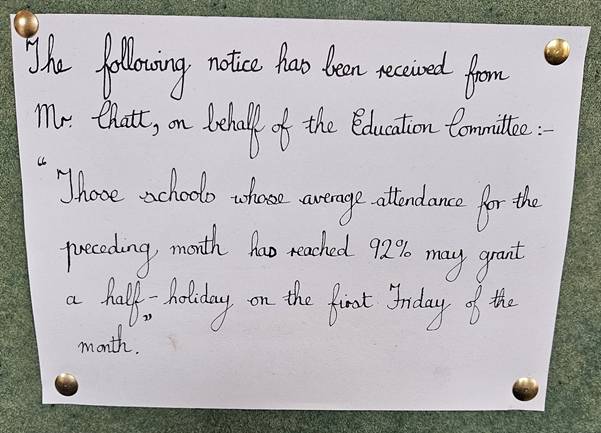
One option not open to them will be the device used in the Durham coalfield in the 19th century and recorded on the noticeboard of the school now housed in the Beamish Living Museum.

The notice reads

The following notice has been received from Mr Chatt, on behalf of the Education Committee: –

“Those schools whose average attendance for the preceding month has reached 92% may grant a half-holiday on the first Friday of the month.”

Looking at the DfE’s data for Oxfordshire, the average attendance from September 2025 to start of February 2026 was 95.1% for primary schools; 91.5% for secondary schools and 88.8% for special schools.

On the basis of that data some primary schools would have qualified for the half-day in at least one month. Possibly some secondary schools might have done so as well.

However, it is worth remembering that the schools receiving the notice were Elementary Schools, taking pupils from 5 to 13 or 14, depending upon the school leaving age at the time of undated message. Attendance by the older pupils was probably as much of a challenge in the 19th century as it is today; albeit for different reasons.

Challenging schools still find keeping a headteacher challenging

Alongside the White Paper, published today by the DfE, The DfE also released a document entitled Schools, school workforce and pupils statistical analysis 2026 Schools, school workforce and pupils statistical analysis 2026

Within this document, I was interested to see a discussion of headteacher turnover by Pupil Premium Decline. This showed that for both primary and secondary schools, but especially for secondary schools, turnover of headteachers was more likely where Pupil Premium levels were higher. Thus, in Band 1, – most deprived – 8.7% of secondary school headteachers changed between November 2024 and November 2025. This compared with just 2.3% of headteacher vacancies in secondary schools in Band 10. The data was taken from the DfE’s own database of teacher records and the School Workforce census.

Readers of my post of yesterday, won’t be surprised by this piece of research Headteacher: recruitment bonus – good value or not? | John Howson

Interestingly, in September 2002, the then NCSL (National College for School Leadership) published a piece of research on headteacher turnover that I conducted for the College. ‘Staying Power: the relationship between headteachers’ length of service and PANDA grades. (PANDA grades were a measure of a school’s performance and schools were graded from A* to E*).

My research looked at secondary schools with either A* or A grades and compared them with schools with E* or E grades.

The research was based upon an analysis of vacancy advertisements for headteacher posts at these schools.

As with today’s research finding, in 2002, A* schools had the greatest percentage of headteachers with more than six years of service, and E* schools the smallest percentage of headteachers with more than six years f service at that school. There were 785 A*/A schools and 780 E*/E schools in the survey.

There was also an association between the PANDA grade and readvertisement rates. 8% of A* vacancies for a headteacher were re-advertised compared with 14% of E* headteacher vacancies, and 49% of schools rated as E.

As headteachers often move from headship into retirement, the age profile of the teaching profession is a factor affecting turnover. A younger profession means fewer headteachers reaching retirement age.

However, the thesis that the more challenging the school, the shorter the term of office of a headteachers, still seems as credible today as it was half a century ago. Whether the government’s policies as foreshadowed in the White Paper will help to change this pattern of turnover and length of service will be interesting to watch.

Music teacher shortage: the situation worsens

Regular readers will know that I have been pursuing a return of the ITT bursary for postgraduates enrolling to train as a music teacher on courses starting in the autumn of 2026. This is a very small -U- turn for the government, but a necessary one for the subject, and its future in our schools and universities.

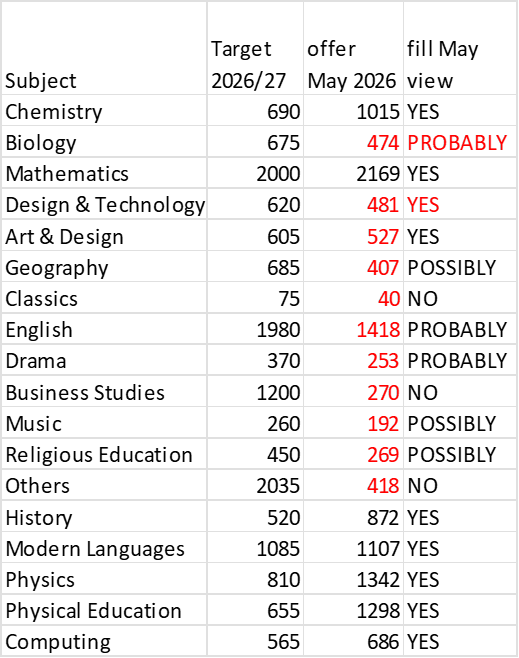
Previous posts on this blog have demonstrated that the removal of the bursary has already affected ‘offers’ to music courses, with a reduction of around 20 ‘offers’ in January 2026 compared with January 2025. Traditionally, any reduction in early-bird offers is not recovered later in the annual application cycle. Music ITT will miss its target: my reasoning | John Howson

This post looks at competition for teachers of music. There are three main areas for teachers to seek work as a teacher of music in a school: the state sector- including sixth form colleges; independent schools in England; private schools across the globe that seek to employ teachers trained in England.

Our starting point this year is the 367 trainees in music identified by the DfE’s annual census taken in December 2025. Add in Teach First and any late arrivals, and the overall total might be 380 – being generous.

Take of 10% for non-completes and those not choosing teaching as a career, and the labour market might have a supply of 342 trainees seeking work.

By mid-February, there had been 100 advertised vacancies by state schools for teachers of music without a TLR – i.e. classroom teacher posts. A well-used job board recorded 15 classroom teacher vacancies from independent schools in England on a single day in mid-February.

On the same date, the same job board, recorded 99 vacancies for teachers of music from schools across the world.  This was made up of 40 vacancies in The Gulf, primarily in Dubai and the other Emirates, but there were 13 vacancies from schools in China, and 46 from schools elsewhere in the world.

Now I don’t expect nearly qualified teachers to apply for these vacancies, but to the extent that these posts are not filled by teachers already working overseas, then these vacancies will take teachers away from schools in England, and create new vacancies.

Assuming only a third of these vacancies are filled by teachers leaving schools in England, and the rest filled in other ways that would be an extra 33 vacancies at present.

Adding together the 100 state school vacancies so far in 2026 to the 15 already recorded private schools in England plus the 33 overseas schools currently seeking a new teacher that might recruit from schools in England that produces a total of 148 vacancies by mid-February, or 43% of the available total of trainees. Increase the take by overseas schools to half of their current vacancies, and not far off half the available pool for September and January could have been offered a job.

Now, some of the vacancies in Egland will be filled by existing teachers changing jobs or returners to the profession, but most experienced teachers will probably be looking for a post with a TLR if seeking a move to another school.

With three months to go to the summer resignation date, and six months until terms start, the pool of available teachers already looks stretched, and this is with trainees that have enjoyed the bursary.

If the lack of a bursary shrinks the 2027 pool, because there are fewer trainees, is removing the bursary a sensible move? In my opinion, it is not, and the government should reintroduce the bursary for trainees starting preparation courses in autumn 2026 to be a teacher of music.

 We will continue to monitor the situation and report back through future blogs as the recruitment round unfolds.

Off to University

Here’s a hear warming story about a student from among the group of most disadvantaged pupils in our education system https://www.oxfordmail.co.uk/news/19162077.traveller-milly-teaches-classics-going-oxford-university/

I would say in our schools, but most traveller and Romany children don’t go to school on a regular basis.

When I joined Oxfordshire’s Education Committee in the early 1990s – some readers may have to look up the term Education Committee in the history books – Oxfordshire had a fully fitted mobile classroom serving this community. Now, these children sometimes don’t even appear on the pupil outcomes data as a group as their outcomes are so far adrift from those of other groups in society.

Fairground children are a distinct group within the wider category, and in rural areas they spend part of the year traveling from market own to market town for the annual street fair.  So, congratulations to Milly on winning a place at University, and to Joe for the work that his organisation does to promote Oxford University with state school pupils.

I wonder whether anyone has thought about traveller children during the lockdown and whether they have had access to on-line learning. I will be asking the question as this group could surely benefit from the learning about remote teaching and learning gained during the pandemic.

I recall visiting a secondary school a couple of years ago where they had children from a mobile home community site for travellers on their roll. They worked hard to ensure the children received an education even though it took up time and resources. The National Funding Formula and per pupil funding don’t provide for the needs of groups where special arrangements are required.

I won’t say ‘Good Luck’ Milly, because I don’t believe she needs good luck. But, I do hope that she enjoys her time at university.