Falling rolls: Are school closures inevitable?

The past month has seen a number of posts on this blog about falling school rolls, and what the impact of pupil-led funding formula might mean for schools.  Now that the DfE has published the data around admissions to schools for September 2026 and the 2026/27 school-year, it is possible to look at the latest trends. Primary and secondary school applications and offers: 2026 – GOV.UK

Thanks for the doctrine of parental choice, pupils may attend a school in a borough other than the one where they actually live, but most primary age pupils will probably attend their nearest school. Exceptions are around faith schools, where the nearest school may be in an adjacent borough. This is more of an issue for the secondary sector than for the primary school sector.

Although Inner London boroughs do feature more amongst the boroughs with the largest decline in applications between 2019/20 and 2026/27 school-years, although four London outer London boroughs are to be found in the top ten boroughs with the largest percentage decline in applications. These four include three boroughs in South London.

Despite the presence of Kingston upon Thames and Richmond upon Thames near the top of the table, boroughs on the outer edge of the capital are more likely to be found towards the foot of the table, with smaller falls in the number of applications over the time period.

It is easy to see from this data why primary schools across London are closing or amalgamating. Indeed, the pressure for further rationalisation of the school estate across the capital is likely to be intense in the next few years. How that pressure is handled will determine the careers of many staff, both teaching and non-teaching, and the fate of pupils.

I wrote a play to demonstrate some of the issue facing staff and parents list year – see (1) Post | Feed | LinkedIn if you are interested.

One of the features of the play is that not all schools are facing the same degree of hardship from falling rolls. To follow up on this point, I looked at two measures for pupil numbers and school capacity primary schools – including separate infant and junior schools – in one outer London borough.

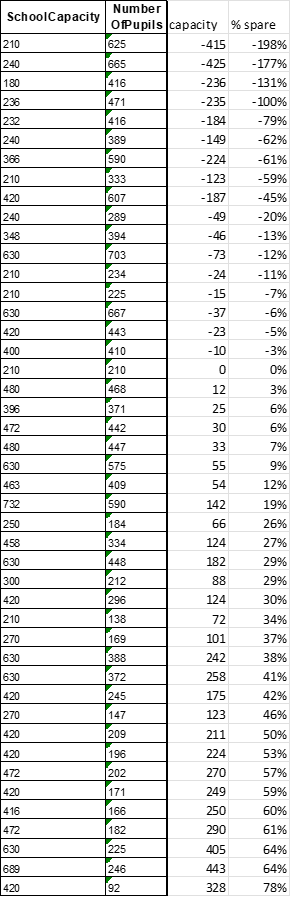
The DfE website information on schools for the borough shows five schools where the roll exceeds the school capacity. However, a more detailed look at capacity and numbers using a different part of the DfE website reveals a more widespread issue in the borough.

I wonder whether the basic information on capacity is actually the capacity based upon the admission number policy and the other on the actual building capacity?

The table for the second indicator reads as below

The data might suggest that some schools are educating children in temporary buildings, assuming the DfE’s data on capacity are up to date. However, if the numbers are correct, then nearly half the schools already have significant spare capacity, and the situation may only become worse.

The key question for both local and national politicians arising from this data, if it is correct, are, ‘Do we let the market solve the problem of falling rolls or do we intervene and manage the capacity in a manner that is best suited to numbers over the next decade?’

Those historians of education that have studied policy decisions will know what happened in the 1970s and early 1980s, a period when there was the last large-scale downturn in pupil numbers. How officers and politicians in Haringey tried to tackle the issue in the late 1970s is an interesting and cautionary tale.

AI – a reminder from 2018

Sometimes it is worth repeating an earlier post. This one about AI and education was from as long ago as 2018. The post dealt with a Report by a House of Lords Committee. The most prescient section was; 

“One witness warned the Committee, “that the idealised world represented on social media “leads to many illnesses including eating disorders … and serious mental illnesses”.   The implication being that schools must put in place strategies to prevent such outcomes among future generations exposed to the perils of the modern world.”

You can read the full post at: AI and education – The view of the House of Lords Committee | John Howson

So, way back before Covid, Westminster was being warned about serious mental illnesses- that might impact schools, my highlighting.

Well, post covid, the SEND demand has not been generated by physical needs. The government seems to have largely ignored the warnings and is now trying to put ‘the stopper back in the bottle’, to use a phrase popular with the BBC this week.

Can we save on defence sending if we use some of the education budget to help the next generation work with the developments created by AI?

As Ukraine and The Gulf have shown, the mental capabilities of the armed forces may be more important than the physical attributes in a defensive war. We won’t be fighting imperial wars again – or I hope not – Iraq should have been the last one, if Afghanistan is seen as punishment campaign not a land grab, but without an endgame strategy that the Americans seem so bad at understanding is an essential part of any military operation or war.

I am not sure that the curriculum Review – remember that damp squib – really took on board the changes AI would bring to society. The Microprocessor revolution that changed the 1980s; the internet revolution of the late 1990s and the Jave Enabled smart phone revolution of the second decade of our century each changed children’s lives. AI has already done so, and will continue to do so in ways someone of my age cannot even imagine.

I have found turning a blog post into a webinar in just minutes awesome. Creating a poster from the same text is improving all the time, and its outcomes can now be regularly seen on LinkedIn and other social media platforms.

We are a tech savvy nation; but not yet a tech savvy education system. Is it time for bodies like The Royal Society to make their voice known, along with those that represent our creative industries, equally affected by AI.

I wrote in another post that ’the market porter of the early 20th century was replaced by the forklift truck driver. They in turn were replaced by the software engineer creating automated warehouses. Now AI will make most software engineers redundant, in the same way as the forklift truck driver has started to disappear as a role in warehousing.

Radical change is necessary in our education system. Do we need a national conversation around what that change should be, and not just a professional curriculum review?

My 2016 post on Geopolitics and macroeconomics

Sometimes it is worth re-posting something I have written before on this blog rather than writing a new post. Recently, I wrote about my thoughts about how education, and schools in particular might be affected by the current global war. In 2016, well before the AI revolution, I wrote a wider-ranging piece about macroeconomics and geopolitics that also considered advancements in technology, without actually referencing AI. I thought it worth re-publishing the post that first appeared on:

So here it is in full and unedited.

Whether the world is a more dangerous place this January isn’t for me to say. However, to balance my short-term views about teacher supply problems I thought it worth thinking about what the combined effects of a downturn in China; tensions in the Middle East; falling oil prices and the possibility of rising interest rates might do to the longer-term teacher supply position.

An analysis of data over the past fifty years suggests teacher supply problems ease when the economy is subdued or in recession. Whether there is a direct link between these two facts may be arguable, but while there is a need to educate children there will be a need for teachers. Again, over the past fifty years, there have been massive strides in technology since the famous BBC programme of the late 1970s ‘The chips are down’ about the microprocessor revolution. Classrooms have adapted to make use of the new technology, but there has been no seismic shift away from traditional patterns of pupil teacher numbers. Indeed, in secondary schools over the past decade, pupil-teacher ratios have even improved, according to DfE data.

The recently reported growth in home schooling may be the first signs of a coming revolution, driven by parents no longer satisfied with the current model of schooling. Tablets, TVs and computers can provide more learning power than any school library of a couple of decades ago. What is needed is the means of instruction and the method of motivation to keep youngsters on task. How much more likely is that in a home environment than when youngsters are faced with the distractions caused by 25 or 30 other children: could learning me more focused and take less time in the home than the classroom?

No doubt, parents would still want children to socialise in order to learn team games, sing together and undertake risky science experiments under the control of a qualified person. However, that might mean only sending your child to school for a couple of days a week. Such a shift might also boost the market for tutors as parents just buy in specific skills where their offspring are facing issues with learning.

As the BBC recently highlighted, the spirit of enterprise is abroad in Britain at the present time. I am sure that there are many developers in both large companies and small start-ups eying what could be a lucrative market that has world-wide potential; some of which will be on display at BETT.

Such a shift in technology from a labour intensive to a technology driven learning process could have a profound effect on both the need for teachers and the spending by the State on education. However, in the short-term, the geopolitical and macroeconomic signals might suggest that if a downturn is coming then teaching might benefit from renewed interest as a career choice.

As I have said at several conferences recently, I am one of the only people that might see benefits from a slowdown in China, even if it only reduces the inflow to that country of UK teachers to work in the growing international school market.

However, with the allocations for 2016 entry into teacher preparation courses set and fewer places available on non-EBacc subjects than in 2015, none of this will matter before 2017 unless, as in 2009, any downturn in the world’s economy bring back greater numbers of returners into teaching: such an effect could dramatically alter the picture of teacher supply, even for 2016, were it to come about.

Challenging schools still find keeping a headteacher challenging

Alongside the White Paper, published today by the DfE, The DfE also released a document entitled Schools, school workforce and pupils statistical analysis 2026 Schools, school workforce and pupils statistical analysis 2026

Within this document, I was interested to see a discussion of headteacher turnover by Pupil Premium Decline. This showed that for both primary and secondary schools, but especially for secondary schools, turnover of headteachers was more likely where Pupil Premium levels were higher. Thus, in Band 1, – most deprived – 8.7% of secondary school headteachers changed between November 2024 and November 2025. This compared with just 2.3% of headteacher vacancies in secondary schools in Band 10. The data was taken from the DfE’s own database of teacher records and the School Workforce census.

Readers of my post of yesterday, won’t be surprised by this piece of research Headteacher: recruitment bonus – good value or not? | John Howson

Interestingly, in September 2002, the then NCSL (National College for School Leadership) published a piece of research on headteacher turnover that I conducted for the College. ‘Staying Power: the relationship between headteachers’ length of service and PANDA grades. (PANDA grades were a measure of a school’s performance and schools were graded from A* to E*).

My research looked at secondary schools with either A* or A grades and compared them with schools with E* or E grades.

The research was based upon an analysis of vacancy advertisements for headteacher posts at these schools.

As with today’s research finding, in 2002, A* schools had the greatest percentage of headteachers with more than six years of service, and E* schools the smallest percentage of headteachers with more than six years f service at that school. There were 785 A*/A schools and 780 E*/E schools in the survey.

There was also an association between the PANDA grade and readvertisement rates. 8% of A* vacancies for a headteacher were re-advertised compared with 14% of E* headteacher vacancies, and 49% of schools rated as E.

As headteachers often move from headship into retirement, the age profile of the teaching profession is a factor affecting turnover. A younger profession means fewer headteachers reaching retirement age.

However, the thesis that the more challenging the school, the shorter the term of office of a headteachers, still seems as credible today as it was half a century ago. Whether the government’s policies as foreshadowed in the White Paper will help to change this pattern of turnover and length of service will be interesting to watch.

Can state services save money for schools?

When I first started writing this blog, back in early 2013, now nearly a decade ago, one of my mistakes was not to create an index. With more than 1,300 posts later, to do so now would be a labour of love that at present I don’t have the time for. The lack of an index means I am largely dependent upon visitors throwing up links to former posts to supplement my own memory of issues such as Jacob’s Law – discussed in the previous post.

Today, I have been reminded of a post from January 2018 about costs and savings in the education system that is relevant to the present economic situation. You can read the full post at Not Full Circle? | John Howson (wordpress.com) but one key paragraph was this:

“…. I wonder whether another stage in the cycle of government contracting is starting to emerge. In the immediate post-war period of central planning, public bodies often ran most services. There was no profit element to consider, but cost controls were of variable quality. The Thatcher era saw a mass transfer of services to private companies, with an expectation that costs would fall. Maybe some did, but others didn’t and some benefitted from the proceeds of technological change that drove down costs, but didn’t create competition and didn’t always drive down prices.”

This 2018 post had built upon an even earlier one from July 2014 Private or public | John Howson (wordpress.com) that dealt with the issue, concerning even then, of the cost of outsourcing children’s services to the private sector with no control over rising costs.

At that time, I was establishing TeachVac www.teachvac. To demonstrate how costs of recruitment advertising could be reduced. I concluded the post with the comment that;

“In a time of cutbacks on government expenditure, as we have witnessed during the past six years, it is inevitable that staffing costs will come under pressure, and the debate between cutting wages or cutting services will rage. Sometimes there is a third way, and a new technology or a different approach, can achieve the same service level for lower costs. Is that what we ought to be striving for in education? The only other alternative to preserve service levels is higher taxes.”

This debate about the profit element, and where the most cost-effective system can be found, is once again a live one as the country faces a new round of coping with living beyond its means and the consequences of a foolish attempt to ‘dash for growth’ when other global factors were pointing towards the need for sound government.

How to make savings in a devolved system such as schooling in England is an interesting question. Perhaps we should start with the role of the DfE. Is it there to provide services on a ‘take it or leave it’ basis, such as their vacancy site or is it there to bring together the different players to work out the best value approach for schools. If the latter, how does it enforce such a best value approach? Perhaps the annual audit report should make a comment to governors about where a school spending exceeds a benchmark?

TeachVac is currently in the process of creating an index on recruitment showing the position that a school sits both locally and nationally. Such an index would provide evidence to show the degree high spending on recruitment was necessary and justified.  

150,000 views

Yesterday, this blog recorded the 150,000th view over the course of its lifetime. Not a huge number, especially when compared with those that bloggers that measure their followers in terms of such numbers and their views in the millions, but a pleasing response to the effort required to write the nearly 1,300 posts over the lifetime of the blog to date.

The blog has widened its scope since its inception in January 2013, when it first appeared. At that time, I was experiencing withdrawal symptoms from no longer facing the discipline required in writing a weekly column for the TES, as I had done for more than ten years. Over time, this blog has become a means of recording my thoughts on what has mattered to me about the changing face of education than just a replaced for that long-departed column.

As regular readers know, I am not a neutral commentator, but an active politician serving the Liberal Democrats as a councillor in Oxfordshire. My political beliefs undoubtedly colour my views on the many topics this blog has covered that have values associated with them. After all, education is not a value free activity, as the challenges of the past two years have so clearly demonstrated to us all.

There is, perhaps, less about the curriculum and assessment in this blog than some might wish and for a few perhaps too much about teachers and the labour market for teachers. However, counting heads and teachers has been something of a lifetime’s work for me. I first started counting headteachers in the early 1980s and apart for the period between 2011 and 2013 have never stopped doing so since then.

My aim has been posts of around 500 words, although a few substantially longer ones, such as my submission to the Carter Review, and transcripts of various talks that I have given, have appeared from time to time. There have also been some shorter posts, although WordPress informs me that the average length has been nearer to 600 than 500 words. Perhaps some of that is down to the manner in which tables and statistics are counted.

So, if you have read this far into this post, my challenge to you, either as a regular reader or someone that has dipped in and out from time to time, is to ask you to put in the comment section the post would most want to highlight.  

And above all thank you for both taking the time to read my posts and to communicate via comments and emails your views to me. I have much appreciated the dialogue.  

There have been times when I thought about stopping this blog, but I would now like to see out a decade of writing and then reassess where the blog goes from there. Podcasts and even videos are now more fashionable that just the written word, but both are technologies I have yet to conquer. Should I bother? There is time to ponder that question.

Bye-bye ESFA: Hello ESFA

Yesterday, the DfE published the outcome of the review into the Education and Skills Funding Agency led by Sir David Bell plus its response to the review and the resulting changes from 1st April 2022.

Review of the Education and Skills Funding Agency – GOV.UK (www.gov.uk)

There are a lot of detailed proposals, but some that struck me of more general interest are these – with the government’s response below the recommendation.

We recommend that further work is done as part of school system reform to create a more strategic and shared understanding of responsibilities between DfE, ESFA, and Ofsted, and that the outcomes of this work are communicated widely

Agreed.

We recommend that the department should have a unified directing voice at a regional level. We have contributed to the current Future DfE project which is bringing together functions in the regional tier, and which will resolve the form and nature of that directing voice

Agreed. Assessing the functions and approach to post-16 regional work will be taken forward as part of developing the Further Education, Higher Education and Employers work set out above and be led by the Director General. We will benefit from learning from the experience of establishing the pre-16 regional tier.

We recommend that, in keeping with our finding that ESFA should focus on funding delivery, the functions in Academies and Maintained Schools Directorate not linked to the funding delivery role, and not required by ESFA’s Accounting Officer to provide assurance, should move to DfE. This means that the non-financial regulatory functions for academies and the functions related to school/trust governance should move to DfE’s pre-16 regional tier, as should new trust and free school activity, UTC engagement, and networking events.

Agreed.

We recommend DfE considers bringing the complaints functions for maintained schools and academies together in a fully centralised complaints system within the department

Agreed.

We recommend that ownership of the Academy Trust Handbook should move to DfE’s School Systems, Academies and Reform Directorate, unless the focus of the Handbook is narrowed back towards a tool for financial management only.

Agreed.

The ESFA had become rather unwieldy over time and these changes will move it back towards its original core function relating to the handling of the financing of the school system.

More interestingly is the re-alignment of the school system with the wider government regional framework. With the levelling up agenda being a cross-department exercise in government, this re-alignment makes sense. However, it doesn’t fit with the boundaries of Headteacher boards and Regional School Commissioners. Could the days of this unelected post be numbered? After all, might there be some cash savings to be made and, if all schools were academies of one sort or another, then one key function would have disappeared.

The DfE still has to work out the 16-18 phase where some students are in the school sector, but more are in the further education sector. There still seems to be room for overlap or avoidance of difficult issues unless the protocol of responsibilities between the directorates is made clear.

One interesting side effect of all schools becoming academies would be the shift in financial year for all schools back to a unified position. However, the financial year would be totally uncoupled from the municipal year, but aligned to the higher education funding rounds.

This review helps sort out the framework for the ‘top’ tier. Now it remains to work out the framework for the middle tier. That will probably be more of a challenge.

Tidying Up

One of the side effects of isolation is the time to do those jobs you have been putting off doing for ages. In my case, this includes tidying up part of my study. However, as I a great believer in ‘creative chaos’ rather than the clean desk method of working, I find it all too easy to become distracted.

The latest distraction has been around two unique books in my collection. Both were given to me as leaving presents. In both cases I had made it clear to colleagues that the normal envelope passed around the staff wasn’t what I wanted. If people wanted to thank me for my time with the organisation, then they need to use their intellectual capital not their cash.

When I left Brookes University in 1996 to join the then Teacher Training Agency as its ‘Chief Professional Adviser on Teacher Supply’ to quote for the press release issued at the time, I asked staff for something that either inspired them in their own education or had been important to them in their career either as a teacher or working in an education establishment. They were kind enough to put the resulting collection to a book, and then to allow me to add some thoughts of my own. I have always wondered whether this might form the basis of an interesting anthology.

The second book was presented to me when I retired from Times Supplements in 2011, just under three years after they had bought my company. My then deputy, crafted a book containing many of the columns that I had written for the TES over the 11 year period when, in one form or another, I churned out a weekly piece, usually about numbers somewhere in the school system. In those days the government produced many more statistics than it seems to do these days.

In the past few years, I have returned to that compendium from time to time, either to check a fact or to reflect how some things have changed and others have stayed the same.

As many regular readers know, I wondered about stopping this blog in January with the 1,000th post. This is the 20th post since then, so that was a New Year resolution that didn’t last. But, looking at the other books, set me thinking whether I should produce two more? Firstly, a collection of the first 1,000 posts on this blog: the good; the bad and the plain indifferent, and secondly a shorter collection of the ‘best’ posts selected by readers?

Do please leave a comment and a suggestion either if you think it a good idea or if you think it a mere vanity project that should be discarded without further ado.

Either way, it is always good to hear from readers and I am still wondering who it was that downloaded every posts on Christmas Day 2019, creating a record score for views on any one day during the history of this blog.


A National Teaching Service?

How much of the White Paper issued in March is now history? Does a change in government mean a change in policy across the board? Two of the proposals contained in the White Paper were for a National Teaching Service and for the creation of free national vacancy website. Where are we  now with both of these suggestions?

I will confess an interest in that I helped establish TeachVac (www.teachvac.co.uk) as a free national job matching service partly because such a service was missing and because schools were spending ever larger sums on recruitment, in some cases to the detriment of spending on teaching and learning. We are already doing what the White Paper suggested alongside the plethora of different regional and local websites maintained by both local authorities and their commercial brethren. In some cases these sites handle teaching and non-teaching posts together, in others they separate them out and they may or may not include local academies and the various range of free schools.

Teachvac has the added advantage over local authority sites of bringing together both state-funded and private school teaching vacancies in one place. This fact allows a view of the overall demand for teachers. Our analysis suggests that the DfE are better at modelling, through the use of the Teacher Supply Model, the demand in subjects such as mathematics and English than they are in some of the less common subjects such as business studies and in subjects with complex demands for different specialisms, such as in design and technology. However although sometimes the modelling may be accurate, but the lack of recruitment into training then affects the supply that doesn’t meet the modelled need.

A national site like TeachVac allows this kind of discussion in a manner not possible before, when the DfE largely had to rely upon the results from the annual School Workforce Census. While useful in some respects, the census lacks the dynamic up to the minute real-time information of a site such as TeachVac. However, it also allows governments to quite truthfully state an opinion at variance with current outcomes in the labour market. I don’t think that is a good enough reason not to consider the advantages of a national site, especially when one already exists and costs nothing to use.

The other initiative mentioned in the White Paper was the National Teaching Service. This is an attempt to help recruit teachers and middle leaders into underperforming schools that may otherwise struggle to recruit able teachers. The recruits from the first round of the pilot programme should have started work in schools this September. However, the expected tender for the further roll-out of a national programme has not, to my knowledge, yet appeared. The development of this type of service is a complex matter and not one to be rushed, especially as schools are now in many cases free to determine individual terms and conditions of service.

With the postponement of the consultation on the National Funding Formula, it is difficult to see the service making great headway until policy is clearer. The same is true for any similar service to place head teachers in challenging schools. Matching supply and demand by intervening in an open market is possible, but not easy. Some readers will remember the Labour government’s attempt with the Fast Track Scheme that briefly flourished around the time of the millennium.

It will be interesting to see how the DfE, having had the summer to think about these issues, takes them forward this autumn. At TeachVac, www.teachvac.co.uk the staff are happy to talk to officials about our experience.

Back to school

There was a paragraph buried in the Statistical Bulletin published last week about the new key Stage 2 assessments that set me thinking. Although school level data won’t be available until the end of the year, and the current outcomes cannot be easily related to previous years, the DfE statisticians were able to say:

We have conducted provisional analysis of school level data (which is not ready to be published and remains subject to change) to examine the correlation between the ranked position of all schools on the percentage achieving level 4b or above in 2014 and 2015 and the percentage reaching the expected standard in 2016 (as for the LA comparisons comparing 2014 final data with 2015 provisional data and 2015 final data with 2016 provisional data). This gave correlation coefficients of 0.56 for 2015 and 2016 data and 0.58 for 2014 and 2015 data. This suggests that we are not seeing greater variability in the data at school level. https://www.gov.uk/government/uploads/system/uploads/attachment_data/file/549432/SFR39_2016_text.pdf

So, do not expect that schools with poor outcomes have suddenly improved, or that those with previously good results have achieved less well in all cases, even though some schools may have improved or deteriorated on an individual basis.

This raises a number of issues for the new government. After all, during the past quarter of a century much of the focus in education has been about improving standards through changing the organisational structure of schools; sweating the assets – mostly teachers – harder and measuring everything in sight, sometimes it seems as often as possible.

Within the structural muddle we currently have within our school system, especially in the primary sector, with a pedagogic revolution from class teaching to the concerns for the outcomes of every child, and too often a blame game by politicians of staff in schools lacking the tools to do the job properly, some good has emerged. We must not now throw that away.

The acceptance of the importance of the early years of a child’s development; the recognition of the importance of early literacy, numeracy and socialisation and at the other end of the system the opening up of higher education to the many and not just treating higher education as a state-funded privilege for the few. This last point is important because, as I argued in a previous post, the knowledge economy needs more educated individuals that an economy based upon brute force and simple tools. However, it rests upon the foundations of a successful start to the education process.

So, here are some areas of concern that I think need resolving though research and development in order to help schools more forward. My shopping list includes:

Identifying common factors associated with children that fall behind at the early stages of literacy and numeracy and creating solutions that work to overcome common issues whether they are above average absence rates; moving schools mid-year when learning patterns for the many are set; the digital divide between home and school; staff development and training for a teaching force a large number of whom are in the early stages of their career; leadership preparation and enthusiasm across all sectors and for all types of school or the often turbulent life of a child in care or on the edge of family breakdown.

So, let’s stop playing the blame game and focus on starting the new school year in a sense of hope for a future geared to improving education for all.