Are small sixth forms a good idea?

In a post in January, I mused about the issue of how falling rolls might affect schools particularly if it meant less funding, where school funding is based upon a per pupil funding model. Fewer pupils = less cash. Accountability and falling school rolls. Was it different in the past? | John Howson

One of the possible solutions discussed in that post was a reform of post-16 education. In a cash-strapped school system, is it possible to justify schools with small sixth forms? Are such sixth forms in the best interest of the students?

In order to think more deeply about this issue, I have looked at the ‘A’ Level results from one local authority, as published on the DfE’s website. 11-16 schools are excluded, as are schools that will eventually expect to have a sixth form, but aren’t currently at that stage, and also colleges. What’s is left are the details for the outcomes on ‘A’ Level results for 34 schools, as shown in the table below

pupils enteredbest 3 scoreprogress scoreaverage or above
31239.880.2AA
21135.750.08A
12540.77-0.13
11741.680.02A
11031.45-0.30
10733.240.00A
9634.340.00A
9438.30.17AA
9036.330.19AA
8935.51-0.12A
8731.530.08A
8239.150.80AA
8236.420.07A
7934.57-0.33
6929.47-0.21
6635.10.26AA
6632.37-0.10A
6535.640.03A
6433.39-0.15
6235.70.20AA
5934.69-0.09
5732.520.06A
4634.57-0.33
4233.65-0.11A
4131.14-0.46
3014.67-0.69
2836.310.21A
2525.07-0.02
2234.850.70A
1424.52-0.83A
1318.21-0.75
924.52-0.83
937.780.35A

For comparison purposes, the average score for state schools in England was -0.03 for Progress and 35.76 for the best 3 ‘A’ Levels score. There are other measures that could be used, but these are three I chose to use for this blog post.

Nine out of the 34 schools beat the national average for ‘best score’, although another couple of schools narrowly missed the national average, so it might be better to conclude that 14 schools were either close to or exceeded the national average for ‘best score’, leaving 20 schools that were below the national average.

Progress score is a more contentious measure. Here 15 schools did less well than average. The same schools often feature in both lists. Most of these schools entered less than 100 pupils for three subjects at ‘A’ level. Some pupils might have taken either two subjects and a vocational qualification or just two subjects at ‘A’ Level.

Schools that entered more pupils for 3 ‘A’ Levels were more likely to receive an ‘average’ or ‘above average’ grade.

The data forces me to ask the question – is the current arrangements for ‘A’ Level study across these schools producing the best outcomes for students? Two subsidiary questions are; if this is the outcome close to the top of the demographic cycle, what might happen to sixth form sizes in these schools once rolls start to fall in a few years’ time? The second question is, what is the cost of tuition per pupil under the present arrangements.

To answer the latter question, let’s assume a Year 7 class of 30 for mathematics taught by a newly qualified teacher on the bottom of the Main Scale for five period a week for 40 week, and an ‘A’ Level group taught for 5 periods a week by the Head of Department, on the top of the Upper Pay spine, and with a TLR 2A in addition.

The newly qualified teacher teaches 6 classes per week for 40 weeks, while the Head of Department teaches two ‘A’ Level sets, one of which has 10 weeks examination leave in Year 13. In addition, the Head of Department teaches four classes of 30, one of which has exam leave in Year 11.

 Using this data, and ignoring any other time spent on non-teaching duties, the Main Scale Teacher costs work out at 0.91p per pupil, while the Head of Department costs are £2.33p per pupil.

If the ’A’ Level groups were smaller than 15 in each year, as they well might be in some schools, then the cost per pupil increases unless the Head of Department receives a lesser amount in TLR.

In an 11-16 school, where the Head of Department might teach five classes for 40 weeks and one for 30 to allow for examination leave, the cost per pupil for the Head of Department reduces to below £2 per pupil. If the school has only long-serving teachers then the per pupil for teachers increases to nearer £1.50 per pupil.

For small schools with settled staffrooms, the difference in cost between the cost of teaching Years 7-11 and Years 11-13 may be marginal. The issue then becomes one of teaching and learning. Do small sixth forms produce as good examination results as larger sixth forms? The evidence from the table would suggest they are less likely to do so.

What of the student experience? Is it better to be either ‘a big fish in a small pool’ or ‘a small fish in a larger pool’? Has anyone ever asked students their views?

I think that there is a debate to be had about school organisation and size of school sixth forms when rolls fall, especially if school funding comes under pressure from increased government spending on both defence and welfare, and especially if we are in a recession.

As my colleagues in Haringey found out in the 1970s, such debates about changes to sixth forms can be fraught with political pitfalls for anyone suggesting change. But, is that a good enough reason not to at least discuss changes?

Note: I have only used salary costs in the modelling and not included on-costs from National Insurance and Pensions. I have also ignored premises and other staffing costs, as I assumed the to be low in a subject such as mathematics.  

Reviving Music Teacher Bursaries: A Necessity

Regular readers of this blog will know of my campaign to see the music bursary restored to graduates training to be teachers of music. Recruitment to ITT is well below the same level as last year, when there was a bursary.

Music teacher shortage: the situation worsens | John Howson and more recently ITT – 9 subjects with fewer offers than March last year | John Howson

I was therefore delighted to see this speech by a Labour peer in a debate in the house of Lords on Thursday.

 Baroness Keeley (Lab) 

The review found that inequalities in music education are substantial, with music showing the widest disadvantage attainment gap of any subject, driven by unequal access to instrumental tuition and wider inequities in school and community resources. I have also raised with Ministers the fact that music teacher supply is a related problem. Since 2010, we have seen persistently high vacancy rates for music teachers. In fact, in 2023-24, that vacancy rate was among the highest of all subjects, and the Department for Education has missed its music teacher recruitment target in 12 of the past 13 years. There was a small increase in recruitment during 2024-25, after the brief return of the £10,000 bursary, but recruitment still reached only around 40% of target.

The conclusion is clear. The music teacher bursary must be restored. The Government’s opportunity mission makes it clear that we want high-quality music and arts education for every child in all state-funded schools. The curriculum review has recentred music and arts as core to a rounded education, not as optional extras, and it has challenged the narrowing of the curriculum that has squeezed music out of timetables, particularly in disadvantaged areas.
Debate: Curriculum and Assessment Review – 26th Mar 2026 my highlighting

I would also welcome the comments in that debate by both Baroness Sue Garden and Tim Clement-Jones, Liberal Democrat Peers.

Despite the pressure on government finances, there really is a need to find a way to attract more graduates into training as music teachers. Any failure to do so will risk a Labour government committing the sin of removing music from out state schools, and leaving the subject residing just in the independent sector and international schools staffed by teachers trained in England.

Not only does music give great pleasure to many, it is also a major expert industry that the government ought to be nurturing. Two good reasons to reintroduce the bursary.

Of course, as Chair of the Oxfordshire Music Service Board, I have an interest to declare, but that interest isn’t contradicted by the evidence of declining enrolment, re-advertised vacancies and an apparent lack of interest in the DfE about the training of teachers of music for state schools. Presumably, they see this as a DCMS issue, since funding for music services is via the Arts Council.

Funding for teachers is, however, very much the brief of the DfE, and if they cannot find the cash for the bursary the they should urgently start work with the Arts Council to devise a scholarship scheme, such as already exists in certain other subjects. To do nothing is not an option if music is to survive in our state schools.

My 2016 post on Geopolitics and macroeconomics

Sometimes it is worth re-posting something I have written before on this blog rather than writing a new post. Recently, I wrote about my thoughts about how education, and schools in particular might be affected by the current global war. In 2016, well before the AI revolution, I wrote a wider-ranging piece about macroeconomics and geopolitics that also considered advancements in technology, without actually referencing AI. I thought it worth re-publishing the post that first appeared on:

So here it is in full and unedited.

Whether the world is a more dangerous place this January isn’t for me to say. However, to balance my short-term views about teacher supply problems I thought it worth thinking about what the combined effects of a downturn in China; tensions in the Middle East; falling oil prices and the possibility of rising interest rates might do to the longer-term teacher supply position.

An analysis of data over the past fifty years suggests teacher supply problems ease when the economy is subdued or in recession. Whether there is a direct link between these two facts may be arguable, but while there is a need to educate children there will be a need for teachers. Again, over the past fifty years, there have been massive strides in technology since the famous BBC programme of the late 1970s ‘The chips are down’ about the microprocessor revolution. Classrooms have adapted to make use of the new technology, but there has been no seismic shift away from traditional patterns of pupil teacher numbers. Indeed, in secondary schools over the past decade, pupil-teacher ratios have even improved, according to DfE data.

The recently reported growth in home schooling may be the first signs of a coming revolution, driven by parents no longer satisfied with the current model of schooling. Tablets, TVs and computers can provide more learning power than any school library of a couple of decades ago. What is needed is the means of instruction and the method of motivation to keep youngsters on task. How much more likely is that in a home environment than when youngsters are faced with the distractions caused by 25 or 30 other children: could learning me more focused and take less time in the home than the classroom?

No doubt, parents would still want children to socialise in order to learn team games, sing together and undertake risky science experiments under the control of a qualified person. However, that might mean only sending your child to school for a couple of days a week. Such a shift might also boost the market for tutors as parents just buy in specific skills where their offspring are facing issues with learning.

As the BBC recently highlighted, the spirit of enterprise is abroad in Britain at the present time. I am sure that there are many developers in both large companies and small start-ups eying what could be a lucrative market that has world-wide potential; some of which will be on display at BETT.

Such a shift in technology from a labour intensive to a technology driven learning process could have a profound effect on both the need for teachers and the spending by the State on education. However, in the short-term, the geopolitical and macroeconomic signals might suggest that if a downturn is coming then teaching might benefit from renewed interest as a career choice.

As I have said at several conferences recently, I am one of the only people that might see benefits from a slowdown in China, even if it only reduces the inflow to that country of UK teachers to work in the growing international school market.

However, with the allocations for 2016 entry into teacher preparation courses set and fewer places available on non-EBacc subjects than in 2015, none of this will matter before 2017 unless, as in 2009, any downturn in the world’s economy bring back greater numbers of returners into teaching: such an effect could dramatically alter the picture of teacher supply, even for 2016, were it to come about.

ITT – more applicants doesn’t always mean more offers

In my previous post, I noted the increase of nearly 6,000 I the number of candidates applying for a place on a graduate teacher preparation course. Up from 21,436 in March 2025 to 27,352 in March 2026. This post explores the relationship, both this March and last march, between candidates and places offered to those candidates.

Firstly, the number of candidates and the number of ‘offers’ to candidates in each secondary subject.

candidatesoffers
2025202620252026
BIOLOGY21612044713332
ART&DESIGN9601026451366
MFL18762246821733
PE1988221911491043
PHYSICS33296522825918
COMPUTING12702394341420
GEOGRAPHY1089843476292
OTHERS9261342281310
CLASSICS67623427
D&T661861273295
RE699693255208
MUSIC311275173136
MATHEMATICS4006534612771398
ENGLISH256128301032990
HISTORY11421281592624
BUS STUDIES607923132173
DRAMA336384162176
CHEMISTRY16622207441675

Note, not all subjects have seen increased candidate numbers within the overall increase.

Secondly, the next table shows the percentage of candidates so far ‘offered’ a place for 2026.

20252026Change
BIOLOGY33%16%-17%
ART&DESIGN47%36%-11%
MFL44%33%-11%
PE58%47%-11%
PHYSICS25%14%-11%
COMPUTING27%18%-9%
GEOGRAPHY44%35%-9%
OTHERS30%23%-7%
CLASSICS51%44%-7%
D&T41%34%-7%
RE36%30%-6%
MUSIC56%49%-6%
MATHEMATICS32%26%-6%
ENGLISH40%35%-5%
HISTORY52%49%-3%
BUS STUDIES22%19%-3%
DRAMA48%46%-2%
CHEMISTRY27%31%4%

Only in Chemistry, where because of the reduction in the size of the bursary to those applying for biology courses it seems likely that those with a choice between the two subjects have opted to apply for chemistry with its higher bursary for 2026. As a result, biology, with a 17% fall in offers this March when compared with March 2025, is the big loser.

Despite the change in candidate numbers, the percentages offered places in March 2026 follows a similar ranking to March 2025.

% offered
20252026
MUSIC56%49%
HISTORY52%49%
PE58%47%
DRAMA48%46%
CLASSICS51%44%
ART&DESIGN47%36%
ENGLISH40%35%
GEOGRAPHY44%35%
D&T41%34%
MFL44%33%
CHEMISTRY27%31%
RE36%30%
MATHEMATICS32%26%
OTHERS30%23%
BUS STUDIES22%19%
COMPUTING27%18%
BIOLOGY33%16%
PHYSICS25%14%

Music is such a specialist subject that it generally only attracts candidates likely to be accepted. However, current ‘offer’ levels are still well below those recorded in the first four years of the century when the number accepted ranged between 68% (2001) and 78% (2003). (Source: John Howson’s collection of GTTR Annual Reports). 2003 was after graduates training to be teachers received a training grant and were also exempt from tuition fees.

Of course, the most interesting percentage of ‘offers’ is that for physics, where only 14% of candidates have so far been made an offer. It looks as if the better candidates for biology are those that have opted to apply for chemistry in 2026, resulting in a significant fall in ‘offers’ in biology.

For subjects such as history and physical education, it is wise for candidates to apply early in the recruitment round since places fill quickly.

Finally, is the present system fit for purpose? Should there be a closing date by which all applicants will be considered,  rather than the drip feed approach as a present?

ITT – 9 subjects with fewer offers than March last year

Despite the increase in applicants for secondary ITT courses, from 21,436 in March 2025, to 27,352 this March, ‘offers’ from course providers are down in nine different subjects this March when compared with March 2025. The subjects with fewer offer so far this year are:

SubjectOffer March 2026Offer March 2025% change
Art & Design36645119%
Biology33271353%
Classics273421%
English99010324%
Geography29247639%
Modern Foreign Languages73382111%
Music13617321%
Physical Education104311499%
Religious Education20825518%

 I think one can discount both Physical Education and English from subjects where the declines are of concern. Elsewhere, the changes in bursary support are obviously having an effect. Those biologists that can do so are now applying for Chemistry – where there is still a bursary, and offers are up from 441 last march to 675 this March – but the overall offer across the two subjects are still below last March at 997, compared with 1,154 last March.

It is the arts subjects that seem to have been most badly hit. This is not surprising given the changes to the bursary scheme that saw the bursary axed completely for music and religious education, and reduced for biology from £26,000 to just £5,000, while it increased to £29,000 for chemistry.  French and Spanish also lost their £26,000 bursaries. The reduction in ’offers’ in geography, down by 39% may also be due to the cut in the bursary from £26,000 to just £5,000.

Given the need for fewer teachers in the future, as secondary school rolls start to fall, these changes to bursaries do look like a gamble. How much of a gamble will be clear when the DfE finally announces the ITT training targets. But my hunch is that music and religious education along with geography will join the list of subjects not hitting their targets unless the current global war affects graduate recruitment in the summer. Will there be a late surge of new graduates looking to teaching, similar to that during the early months of the pandemic in 2020? The jury is out for the moment, but such a surge would not surprise me. However, as a precaution, reinstating a scholarship in the arts subjects might be a wise precaution. This might make it look less like a -U- turn than a reinstatement of the bursary.

Elsewhere in the data, candidates form the ‘Rest of the World’ accounted for 30% of all candidates this March, compared with 21% last March.  The DfE really does need to show how this increase affects different subjects and how many of these candidates will be likely to receive a visa to both learn and then teach in England? Can we afford to waste funds on those with no prospect of teaching in England, while depriving potential home candidates of bursaries.

As expected at this time of year, there has been more interest from career changers than university students, with those under 24 showing an increase over last year of just 1,000 compared with an increase of more than 4,900 from those in the 25-39 age groupings.

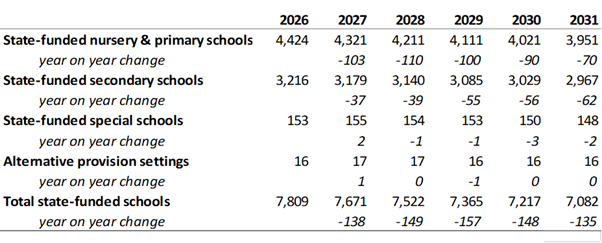
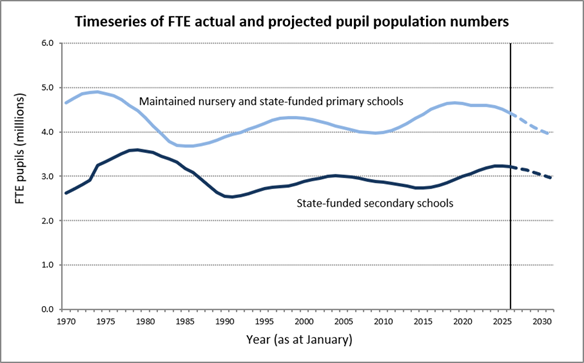
School building boom is over

The DfE has published its latest estimates of school capacity for 2024/25, together with estimates for places needed up to 2029/30 School capacity in England: academic year 2024 to 2025 – GOV.UK

There are two sets of numbers. One looks at both need and places available and calculates what might be regarded as a raw score. This looks at all spare places, regardless of location within the authority and measures that number against expected additional need. The second set just looks at additional need.

During the period between 2025/26 and 2029/30, most additional need is likely to come from changes in the housing stock, with little, if any, growth from the increase in the number of pupils in the relevant age groups. As a result, most local authorities show either no need for additional primary places or only small increases in numbers. Wandsworth is the only Inner London borough with any additional need for primary school places during the period 2025/26 and 2029/30.

The table balancing existing places with additional need shows only a handful of local authorities with a reduction in the spare capacity in the primary sector between 2025/26 and 2029/30. For most authorities, the spare place problem is expected to be worse in 2029/30 than it is in 2025/26

net spare places
OxfordshirePrimarySecondary
2025/26-11,052-6,321
2026/27-11,557-6,449
2027/28-13,117-6,959
2028/29-13,865-7,143
2029/30-14,601-7,336
Change-3,549-1,015

The table shows the estimates for Oxfordshire. Several factors could mean these data are not going to be accurate. In recent years, Oxfordshire has seen significant housebuilding, and if the construction of new housing continues, and attracts families from outside the county, then the spare places may be an overestimate.

Oxfordshire is also home to several military bases for both the army and the RAF. Although defence planning has projected the closure of some of the army bases, the current defence review and increased spending on defence might either slowdown or reverse the closure of some of the bases. If closures slow down, then this might mean pupil numbers don’t fall as expected.

The problem for both the local authority, the dioceses and the academy trusts is that Oxfordshire has many small primary schools located in villages. Often the school is the only facility left in the community. The present funding formula that is heavily biased towards pupil numbers poses a potential problem for small schools. Academy trusts can ‘vire’ funds between schools to help such schools through any temporary downturn in pupil numbers. At present local authorities do not have this ability: they should be given the power to support small village schools in the same way as MATs can.

However, as with many other rural areas, school closures look likely over the next few years if schools are not to run up deficit budgets. Such deficits would be paid off by depriving future pupils of some of their funding. With education spending likely to be squeezed to accommodate the increase in defence spending, and a greater proportion of the school funding going toward SEND pupils, there may well be some hard decisions to make.

With declining interest in established faiths, how will the dioceses react to falling rolls, if their schools are no longer viable?

One certainty is that if any school closures require additional free transport to the next nearest school, the current£20 million Oxfordshire council tax payers contribute to fund mainstream school transport will not be enough, even if fuel and other costs remain stable.

Local government reorganisation may offer a way out for politicians in areas such as Oxfordshire, but politicians in urban areas, and especially in London will not be so lucky. Time to dust off my review of falling rolls in Haringey in the 1970,s and the lessons to be learnt from those battles.

NEETs: A North East crisis?

There is no doubt that although higher than they could be, NEET percentages are lower than before the raising of the learning leaving age in 2013.

However, NEET rates are nowhere near uniform across the country. In Quarter 4 of 2025, the quarter after 16 year olds have decided whether to stay in education, find an apprenticeship or become economically inactive, NEET rate in the North East of England were more than twice the rate of the of those in the South West, according to the government’s Labour Force Survey.

‘NEET and NET Estimates from the LFS’ for 16 to 24 and Q4 for 2025

Q4
EnglandNorth EastNorth WestYorkshire and The HumberEast MidlandsWest MidlandsEast of EnglandLondonSouth EastSouth West
16 to 24Percentage of population NEET13.3%21.0%14.0%15.6%16.5%13.5%11.7%12.0%11.5%9.9%
Confidence interval (95%) for the percentage NEET0.9%4.6%2.7%2.9%3.3%2.8%2.5%2.6%2.1%2.4%

Footnotes

  1. LFS data has been reweighted from January 2019 onwards. There is a discontinuity in the timeseries at this point and comparisons to earlier data should be considered with caution.
  2. All estimates should be viewed alongside associated 95% confidence intervals as shown in the underlying data. Create your own tables on neet age 16 to 24 – Explore education statistics – GOV.UK

It seems likely that the rate for males is higher than that for females, although the recent government decisions that have made working in retail and hospitality more of a challenge than before the tax changes may well be pushing up the female rate of NEETs.

It would be interesting to see whether the move from school to a college is seen as more of a challenge for males than females?

Also of interest, but not identifiable from the data, are whether the rate of NEETs for 16-17 year olds is higher in rural areas with poor transport than in urban areas with excellent public transport to college or workplace?

My hunch is that transport costs play a part in some young people becoming NEETs. I have written elsewhere about the punitive effect of motor insurance tax on young people with no possibility of a no-claims bonus. Perhaps, the tax should not be imposed on those under 18 forced to use their own transport because of where they live?

Raising the age for free transport to school and college from 16 to 18 might also encourage more participation, and would be a small cost to pay, as it would just mean more students on existing transport.

Finally, it would be interesting to see the rate of NEETs for those with EHCPs? Do special schools do a good job for their post-16 students when compared with those with EHCPs in mainstream schools? Are those with an EHCP more likely to become a NEET if they attend an 11-16 or an 11-18 school?

These are interesting questions where it is challenging to find the data to answer the questions that will affect policy decisions.

Music teacher shortage: the situation worsens

Regular readers will know that I have been pursuing a return of the ITT bursary for postgraduates enrolling to train as a music teacher on courses starting in the autumn of 2026. This is a very small -U- turn for the government, but a necessary one for the subject, and its future in our schools and universities.

Previous posts on this blog have demonstrated that the removal of the bursary has already affected ‘offers’ to music courses, with a reduction of around 20 ‘offers’ in January 2026 compared with January 2025. Traditionally, any reduction in early-bird offers is not recovered later in the annual application cycle. Music ITT will miss its target: my reasoning | John Howson

This post looks at competition for teachers of music. There are three main areas for teachers to seek work as a teacher of music in a school: the state sector- including sixth form colleges; independent schools in England; private schools across the globe that seek to employ teachers trained in England.

Our starting point this year is the 367 trainees in music identified by the DfE’s annual census taken in December 2025. Add in Teach First and any late arrivals, and the overall total might be 380 – being generous.

Take of 10% for non-completes and those not choosing teaching as a career, and the labour market might have a supply of 342 trainees seeking work.

By mid-February, there had been 100 advertised vacancies by state schools for teachers of music without a TLR – i.e. classroom teacher posts. A well-used job board recorded 15 classroom teacher vacancies from independent schools in England on a single day in mid-February.

On the same date, the same job board, recorded 99 vacancies for teachers of music from schools across the world.  This was made up of 40 vacancies in The Gulf, primarily in Dubai and the other Emirates, but there were 13 vacancies from schools in China, and 46 from schools elsewhere in the world.

Now I don’t expect nearly qualified teachers to apply for these vacancies, but to the extent that these posts are not filled by teachers already working overseas, then these vacancies will take teachers away from schools in England, and create new vacancies.

Assuming only a third of these vacancies are filled by teachers leaving schools in England, and the rest filled in other ways that would be an extra 33 vacancies at present.

Adding together the 100 state school vacancies so far in 2026 to the 15 already recorded private schools in England plus the 33 overseas schools currently seeking a new teacher that might recruit from schools in England that produces a total of 148 vacancies by mid-February, or 43% of the available total of trainees. Increase the take by overseas schools to half of their current vacancies, and not far off half the available pool for September and January could have been offered a job.

Now, some of the vacancies in Egland will be filled by existing teachers changing jobs or returners to the profession, but most experienced teachers will probably be looking for a post with a TLR if seeking a move to another school.

With three months to go to the summer resignation date, and six months until terms start, the pool of available teachers already looks stretched, and this is with trainees that have enjoyed the bursary.

If the lack of a bursary shrinks the 2027 pool, because there are fewer trainees, is removing the bursary a sensible move? In my opinion, it is not, and the government should reintroduce the bursary for trainees starting preparation courses in autumn 2026 to be a teacher of music.

 We will continue to monitor the situation and report back through future blogs as the recruitment round unfolds.

Music ITT will miss its target: my reasoning

After my last blog post on ITT targets, someone messaged me to ask how I decided which subjects were likely to meet their targets so early in the recruitment round? As I tried to make clear in that post, it isn’t an exact science, but more a guide towards trends in each subject.  

The big assumption, and why the DfE has accused me of ‘scaremongering’ in the past, is that the rest of the recruitment round will follow the pattern set in previous years. There is a rhythm to recruitment that normally goes through three phases.

Phase 1 –November to January.  Early entrants that know they want to be a teacher, and apply early in each recruitment round.

Phase 2 – February to June – final year students tend to be focused on completing their courses, so applications tend to be more likely to come from career switchers into teaching. The behaviour of this group can be closely linked to trends in the wider labour market: lots of graduate redundancies, and there will be more applications to teaching. A buoyant labour market, and fewer may consider teaching as a career. Offers will also depend more on the location of places available, as this group of applicants tends to be more location specific: they may have a partner, and a stake in a local housing market.  Places on national schemes, and local school-based programmes can be important to this group of applicants.

Phase 3 – July until the start of courses. Trends in this phase tends to be linked to the labour market for new graduates. Those graduates that have left job-seeking until after their finals will look to teaching in greater numbers if there are few options elsewhere. In the past male applicants have tended to feature more in this group, especially in some subjects.

Of course, two events can upset the normal rhythm. In 2020, the Covid pandemic created a surge in applications between April and July, possibly because of uncertainty about the wider labour market.

The other event that can shape the ITT market is the actions of government. Changes to the bursary scheme or events, such as the introduction of a Training Grant can make a big difference to applications. By their very nature, they cannot be predicted, but they can be modelled.

 2026 ENTRY TO PG ITT
 MUSIC
2025 TARGET565
OFFERS JANUARY 202670
OFFERS JANUARY 202591
TOTAL OFFERS 2025416
DIFFERENCE 2025 TOTAL AND 2025 January OFFERS325
PROJECTION for 2026395
ESTIMATED SHORTFALL170

In the table is my estimate for the outcome for music in this round, on which I have based my view that the subject will not fill all the ITT places, if the target remains the same as last year. Any increase in the targets makes a shortfall even more likely. At present, the target would need to be reduced more than 100 places to a level not seen in recent years, and not in line with the recent Curriculum Review for the subject to meet its ITT target. Of course, restoring the bursary to music might help increase recruitment this year.

I have experimented with turning this post into a podcast. https://drive.google.com/file/d/1oBFKJw7ucryRK1hNTvHy2gOIdDcJWaOQ/view?usp=drive_web Let me know what you think

More men looking to teach

Today, the DfE published their first round of statistics about applications to train as a teacher on courses starting in the autumn of 2026. Generally, one has to be cautious about data from ‘applications’ and ‘offer’ statistics published in November, as this is very early in the application round.

However, with more than 20 years of data underpinning my remarks, I think it possible to say something.

Firstly, applications – and candidates may submit more than one – are up from 13,159 last November to 15,572 this year. Applications from men are up from 5,072 to 6,580, while those from women are up from 7,978 to 9,031. That equates to 1,052 more women applying, or an increase of 13%, but 1,508 more men; an increase of 30%. I cannot recall a time when the rate of increase in applications from men last outpaced those from women.

Part of this increase is probably down to the large increases in applications for mathematics, up from 1,657 last year to 1,929 this year. In computing, the applications are up from 509 to 841, and in physics from 1,694 to a staggering 3,277. All these are subjects that tend to attract more male than female candidates.

Aword of warning, before one becomes too carried away; applications from the Rest of the World are up from 3,540 last November to 5,120 this November. Might this account for part of the increase in male applicant in these subjects? Sadly, that cannot be determined from the published data.

Final year undergraduates are not yet swarming into teaching. No obvious concerns about loss of graduate jobs to AI from the 21 and under age group, where applications are actually down by 34 from 1,276 to 1,242. Presumably, studies still take precedence over job hunting.

However, there is a big increase in the 22-24 age group applying for teaching: up from 3,349 to 3,658 with nearly 200 of this increase from 22 year olds. Maybe summer 2025 graduates that are still job hunting are turning to teaching? There is little difference in interest in teaching from those over 45 years old. However, there has been a big jump (210) in interest from the 40-44 age group.

SCITTs is the only route to have seen fewer applications than in November 2025. This may reflect the fact that the SCITT route maty be less well-known to overseas applicants. Both teacher degree apprenticeships and PG teaching apprenticeships have seen significant increases in applications. It would be interesting to see this table by phase and subject.

On ‘offers’, it much depends upon how providers handle early applications. However, there is a trend with mathematics, computing, chemistry and physics all recording the highest ‘offer’ levels since 2013/14, whereas music has the lowest offer level since 2020/21. Most other subjects are close to where they would be expected to be, although biology, PE and geography are below where they might expect to be. PE probably over-recruited to current courses, and I would expect more caution there this year.

So, overall, a good start that should presage a good recruitment round unless something unforeseen happens.