
Dear Secretary of State – updated

Two years ago, after the general election, I posted this open letter to the new Secretary of State. With the possibility of a cabinet reshuffle following the arrival of a new Prime Minister, I though it was worth taking a second look at my thoughts of two years ago, and what has changed.

Posted on July 6, 2024

At this important time in our history, I thought that I would post my views for the new Secretary of State for Education

An Open Letter to the Secretary of State for Education

Dear Secretary of State,

You have a tough job ahead of you. Firstly, you need to clear up problems resulting from the campaign promise of 6,000 extra teachers. Those of us in the know, are aware that this September, as for the past few years, all the training places for new secondary school teachers are not being filled. Those gaps need to be filled before you can start on adding 6,000 new teachers to the total.

We don’t have 6,000 more teachers, and training targets have been cut in many subjects, so reaching what you and I might have thought of as 6,000 extra teachers seems unlikely, and the pledge will be subject to a sleight of hand to show it has been achieved.

Don’t think of an easy way out, such as upgrading some teaching assistants to teachers, because it is teachers for the secondary schools that we need, not more teachers for primary schools.

And then, there is the state of our school buildings. Even before the concrete crisis, many of our primary schools were time expired, and many are more than 150 years old. There needs to be a programme of replacement and, for those that will remain, a programme to help make them carbon neutral or even sources of renewable energy. After all, school playgrounds are not being used for their key purpose for 95% of the year. How can we make them earn their keep for the rest of the year, by being sources of renewable power?

Some progress on buildings, but not much, and no real policy advocacy around renewables.

Don’t get me started on funding for 16-19 year olds. That’s a battle with the Treasury you must win. At the same time, you could increase the upper age for free transport for young people in rural areas from 16 up to the de facto if not de jure leaving age of 18 from where it now stops at 16. Start by offering it this September to those staying in the same school. This is a levelling up programme for rural areas.

Rural transport, and indeed, 16-18 transport has been ignored. This is despite the fact it may contribute to NEET numbers in rural areas. I have suggested reviewing motor insurance tax for 16-18s where there is no public transport to school or college, and extending free transport to 18 for those that receive it up to age 16. No sign government understands this issue.

AI and technology are important to our country’s future, and we need to work out how they impact on our education system. Are we training new and existing teachers in a curriculum and teaching style for the future, not the past? Do we need a research body for teaching and learning in schools?

Much more to be done here; especially in training new teachers. New teachers entering preparation courses this September at age 22, might not retire until 2063. In the past 40 years we have seen, the microprocessor revolution; the internet and social media sensation, and now AI. How have we responded to this revolution, every bit as significant as the arrival of printing more than 500 years ago: we have banned mobile phones from schools.

I am sure you will have much to say about early years, and perhaps you could reverse the name change Mr Gove announced when he had your job in 2010.  Bring back the Department for Children Education and Families.

Hopefully, early years will be a success story, but outcomes need monitoring especially for those children that fall behind when they reach school. Do you favour schools having an on-site nursery? What about a qualified workforce?

There are other issues, such as higher education, private schools and the consequences of VAT on fees, and the relationship between local authorities and the academies sector, not least for children in care that you will have to deal with, but solving the teacher supply crisis is the number one priority.

Well, we have VAT on school fees and it has shaken the tree for some of the weaker schools that were also suffering from falling rolls. However, there are still not enough teachers for state schools, and private schools can attract teachers where there are shortages leaving more challenging schools with less well qualified staff. What’s the policy to deal with this problem?

The dual regime of democratically controlled local authorities nominally responsible for maintained schools and the academy sector responsible to Whitehall and with no local democratic accountability is a blot on your copybook. Following the Blair/Brow government’s line on ducking the issue of selective schools for some and comprehensive schools for others is a waste of a big majority, especially as most Labour MPs represent areas with comprehensive schools.

You could take a leaf out of David Blunkett’s approach in 1997, and pay the fees of all trainee teachers studying as postgraduates to enter the profession. Paying them all a training salary, as his successor introduced, and the coalition removed, would be another step forward. This year, it should be possible to pay the bills from the unfilled training places where the money has already been allocated by H M Treasury plus the VAT receipts from private school fees.

Training to be a teacher is still expensive in debt terms for many. Working abroad after qualification can bring higher income, and no fee repayments while abroad.

If the government is serious about education, then now is the time for action. Good luck in your first 100 days in the job.

However, will you still be in post after the arrival of the new Prime Minister? Of will we have to start all over again?
Lucy Heller: Thank you

I suppose it was inevitable that Lucy heller would eventually leave he role in leading ARK as an organisation and its schools. Interview: Lucy Heller, CEO of Ark Schools | Tes I commend this interview with the TES magazine to anyone interested in schooling in England, and how the system works. Lucy Heller discusses many of the issues this blog has mentioned over the past 13 of the 22 years that Lucy has headed up ARK.

It is, of course, fitting that Lucy Heller should give an interview to the TES, as it was while she was working there that I first met with her, when she was running the paper, and I was writing my weekly column on some aspect of data. At that time, I was also advising those running the TES abut the implications for their business model of the switch from print to on-line recruitment advertising, and the threat to their whole way of life. The rest, as they say, is history.

Lucy Heller went to ARK schools when they had a small part to play in the education scene, and has overseen both its growth and its reputation as an organisation, not least its reputation for hiring those that have subsequently helped shape the whole system of schooling.

Regular readers will know of my preference for a local democratic involvement in the organisation and development of state-schooling. That preference does not blind me to the fact that local government these days is more concerned with children’s social services than with education, and that most of our leaders and thinkers about schools and education are now leading multi-academy trusts.

Politicians not in power, and those not running schools, each have more freedom to be more open in what they say than those that are actually operating the system, so, even though we have had to wait until her departure, Lucy Heller’s interview marks an important point in the discourse about our school system.

I entirely agree with Lucy Heller’s comment in the interview that;

There has always been a tension between the narrative politicians have leaned into about headteachers being at the centre of the system and central government’s desire to manage the detail of school life,” she says. “It is a very hard balance to strike – it would be good if government spent less time thinking about how schools should be run day to day and more about how they manage the system as a whole.

As a nation we are not good about both system leadership and understanding the role of government in policy-making. MATs can play an important role in helping keep governments aware of policy outcomes: a role once fulfilled by local authorities and their chief education officers. Lucy Heller had played that role with vision, and without seeking the limelight others might have sought.

I hope that Lucy’s public service will be appropriately recognised, and I am sure that there is more to come as Lucy moves on to the next challenge.  It has been privileged to have known Lucy Heller, and I wish her well for the future.

Exporting education: still a success story

The DfE has published the latest annual report in the success of education as a contributor to the nation’s wealth through exporting educational goods and services. This includes both selling and providing services , and the provision of services within the United Kingdom. Of the latter, UK Higher Education is the major earner.

I have written about trends from previous reports, but not for some time.  Making money from Education | John Howson In 2021 the DfE changed the methodology for collecting the data. This year, in the report figures for 2021 and onwards are presented using the new methodology only. Release home – UK revenue from education related exports and transnational education activity – Explore education statistics – GOV.UK

The latest data are for the year 2024. The report notes that

‘total UK education related exports and TNE activity was estimated to be £36.7 billion in 2024, an increase of £7.2 billion in nominal terms since 2021. Over the same period, in nominal terms, education related exports have increased by £5.8 billion while TNE activity has increased by £1.4 billion.’

This is a good news story, although not all sectors have performed as well as in the past. Both further education and English Language training recorded improvements over the previous year, although further education fee income was down on the previous year, and both sectors had much higher earnings a decade ago, before covid.

As the report notes: ‘Higher education exports grew by £0.1 billion (0.5%) from £26.4 billion to £26.6 billion between 2023 and 2024. The low growth rate in HE exports can partly be attributed to the reduction in international HE student enrolments since 2022/23.’

This low growth rate must be a worry for the future as this has traditionally been such a key source of income from both fees and living costs.

 Between 2023 and 2024, schools’ exports grew by £0.1 billion (7.4%). This is good news for the economy, but a concern for state-funded schools if it diverts scarce teaching resources in subjects such as physics and mathematics away from upskilling pupils in state-funded schools to educate elites elsewhere in the world or in UK boarding schools.

Elsewhere, equipment sales grew from £0.20 Bn in 2021 to £0.37bn in 2024. During the same period, publishing income rose from £2.31bn to £3.15bn, and earnings from qualification awarding bodies, from £0.36bn to £0.51bn.

No doubt there is room for further growth along the lines of the export strategy Exports good, but the poor won’t be able to afford them | John Howson However, as I pointed out in my earlier post, there is also the contribution to development aid to consider alongside the income from exporting education goods and services. Sadly, as a nation we seem less interested in development aid these days.

What of the future? How will AI affect export opportunities, and will the nation’s attitude to those who are not natives cause a reduction in the significant higher education income if overseas students decide to go elsewhere to study. If that happens, will universities take their product overseas, or just retrench? How will our relationship with Europe affect education exports in the future, especially if there is a growth in Erasmus type programmes?

Finally, we do need to do more to help aspiring entrepreneurs starting out selling goods and services in the education field.

How about a university course for those wanting to start out in this field?

Oxfordshire and the defence dilemma

Defence* and education are both important public services in Oxfordshire. The county plays home to Brize Norton – the largest RAF base in Britain; RAF Benson; Dalton and Vauxhall Barracks, plus MOD Bicester, and for good measure a University OTC plus cadet forces that also include naval elements.

There is also Shrivenham, the national Defence Academy, plus elements of the reserve forces. So, a real presence from our armed forces, even if not as significant as in West Surrey, Hampshire and Wiltshire.

Apart from its schools and colleges, both state -funded and private, the county hosts two universities and lots of enterprises selling into the education market, including a thriving publishing sector.

As a result, of the county’s engagement with both sectors, today’s announcement of shortfall in defence funding may well have implications for the education sector across the county if the gap in funding defence spending is to be closed by raiding the budgets of other government departments.

The government already has a win with falling pupil numbers. This decline will release funding from education if the remaining pupils and students remain funded only at their present levels, even if inflation is taken into account.

However, there will be other implications for the education sector if the defence funding gap is to be closed, and possibly even more funding to be found for that sector, the announcement of new rules for CEOs pay in academy trusts Government plans NHS-style rules for academy CEO pay will be a shot across the bows of many MATs. I have written about this issue several times on this blog. See The pay of senior staff in academies | John Howson as an example.

I would go further and ask why there are so many MATs, each with a CEO. In Oxfordshire, the 2025 accounts for MATs operating schools in the county revealed a salary bill for the highest paid -excluding large national MATs with outrageous salary bills – of some £3.9mn for the highest paid employee of each Trust. Cut the number of trusts to say, 5, the equivalent of the former 5 divisional directors under local authority management of schools, and perhaps more than £1mn might be saved. Multiply that across England and the saving mounts up.

Then there is small sixth forms. I wrote about this issue earlier this year in a post Are small sixth forms a good idea? | John Howson This is a hard area to tackle, but with falling rolls is the current arrangements in a county such as Oxfordshire best for both the country’s finances and the outcomes for students, especially if we need more cash for our defence?

If sixth forms eat up cash, what about small schools? I favour keeping schools, and especially primary schools, in their communities. Oxfordshire has been excellent at supporting village schools, but could rationalisation save money or would the additional transport costs outweigh the savings?

However, the big transfer of cash from education to defence would be due to decisions on the pay of those working in the education sector and the funding of the sector as a whole that are taken at the national level.

Will funding return measures, such as Pupil Teacher Ratios, return to levels last seen 50 years ago when spending on defence was a higher proportion of GDP than today. What that might mean across England was laid out in my review of PTRS. (PDF) PTRS OVER TIME: A REVIEW OF PUPIL TEACHER RATIOS BETWEEN 1974 AND 2024 AND TWO PERIODS OF LOCAL GOVERNMENT RE-ORGANISATION PTRS OVER TIME: A REVIEW OF PUPIL TEACHER RATIOS

It is difficult to see anything other than challenging times ahead for education in Oxfordshire if the government is serious about more funding for defence.

 Of course, the government could just put up taxes.

*Defense for those with a Ministry of War

Hope over expectation: my view of today’s report on white working class children

How good are the recommendations into today’s report on the education of White working-class children? Based on my analysis of this one recommendation from the report; not universally very good The Inquiry into White Working Class Educational Outcomes Here is one specific recommendation:

“Government should encourage and support more deliberate action to ensure that the highest performing primary and secondary schools admit and support a fair share of disadvantaged pupils, particularly in areas with significant white working class populations. Too often, the highest performing schools within local areas serve intakes that are significantly less disadvantaged than the communities around them. This should include clearer guidance and encouragement for schools and trusts to prioritise disadvantaged pupils within existing admissions rules, alongside stronger expectations that high-performing schools demonstrate how they are contributing to inclusion and fair access locally. Local authorities should also play a stronger role in supporting fair access, admissions coordination and inclusive place planning, building on their existing statutory responsibilities in this area.”

‘more deliberate action’ – What does this mean, since it doesn’t spell out any actions? Obviously, it means support for selective schools, as they are the highest performing secondary schools, and nowhere are they mentioned, so is the report endorsing the status quo. A selective school currently seeking a new headteacher has less than 7% of its pupils on free school meals according to the DfE website.

‘admit and support a fair share of disadvantaged pupils’ – What is being recommended for school with entry tests? And what is a fair share? Similar to the balance of the catchment area? But the location of schools is often based on history rather than current place concerns?

And for non-selective schools, how do you override parental preference and faith-based requirements?  Probably, through the school funding mechanism to encourage change in admissions criteria.

I would have liked to see some specific recommendations. A case study of how a successful school has already used the admissions rules would have been insightful.

‘stronger expectations that high-performing schools demonstrate how they are contributing to inclusion and fair access locally.’  Everyone knows what schools do to ‘expectations from government’.

‘Local authorities should also play a stronger role in supporting fair access, admissions coordination’ Ha, Ha, ha. It has taken two years of a Labour government to get local authorities the ability to control in-year admissions for academies and free schools (Clause 52 of 2026 Act). Will government back closure of faith schools if it is the best outcome for place planning: we shall see.

And what of transport in rural areas? At present transport to selective schools is not free in most areas outside London and the other conurbations, as it is seen as a parental choice, something I campaigned about in the 2024 general election in Weald of Kent and raised in Castle Point about schools on Canvey Island during the previous General Election.

I would have liked a much more radical approach to policy recommendations, as in the section on teachers, where a revision of the apprenticeship system is advocated. Trainees should also understand what teaching in schools in working lass areas is like. Of course, if the recommendation above is actioned, some schools will look very different, as some might lose successful pupils to selective schools and be even less educationally comprehensive. Will teachers want to teach in such schools without more incentives?

Sadly, with an Education Act passed in the last session of parliament, even a new Prime Minister may find it difficult to fsecure time for more reforms, so what will happen will probably only be within the current rules and framework.

I wonder what changes we will see by the end of this parliament: I am not holding my breath, at least for the secondary school sector. In the Early Years field, I am much more hopeful because there is an acceptance that closing chidrens’ centres a decade ago was not a wise policy move.  

Still, any report that puts these issues back on the table for a little while and creates discussion cannot be all bad.

Tell me the old, old story: the working class and schools

With the publication later today of the Star Academy Trust commissioned report into outcomes for ‘white working-class boys’, I thought I would look at what I posted when the inquiry was announced last year. Class matters more than ethnicity | John Howson

“However, I cannot help thinking that the focus of the inquiry is wrong. All the evidence suggests that of the three factors of race, gender and class, it is the third one that really matters. Yes, they are often inter-related, but looking at socio-economic data, it is often schools in deprived areas, regardless of the ethnicity of their pupils that fare less well in school performance table.”

Way back in 1982, nearly 50 years ago, I used some evidence from a book published in 1926 by Kenneth Lindsay, and entitled ‘Social Progress and Educational Waste’ about the wide variations in the percentages of children obtaining secondary education – not mandatory for all until 19944 – to discuss differences in provision for schooling across England. (Variations in Local Authority Provision of Education Oxford Review of education, Volume 8, Number 2, 1982). Lindsay, in his book, found one school in Lewisham that won as many scholarships to secondary school as the whole inner city area of Bermondsey out together.’ Differences in education by social class were commonplace.

In the 1960s, The Plowden Report into primary education found that ‘the boroughs in which expenditure [on schooling] was generally low were very much the same in 1960-61 as they were in 1950-51.’ Later that decade another report Half our Future looked at the children leaving school at 15. I celebrated its 50th anniversary with this blog post Half Our Future: A tribute | John Howson both Reports revealed the differences in outcomes for different social classes and how those gaps might be reduced.

Finally, in terms of evidence of the different education outcomes for different groups in society, it is worth reading the Oxfordshire County Council report to Education Scrutiny Committee of 16th October 2014 ESC_OCT1614R05 Educational Attainment of White Working Class Boys.pdf

So, don’t expect anything new, today, but I would like this report to be linked to the speech by Andy Burnham, also to be given today that should speak about the importance of ‘place’ and devolution in our society.  

Both Lindsay and Plowden wrote when schooling was a devolved activity, sometime described, at the time, as ‘a local service nationally administered’. Since then, the administration of schooling has become more site -based with schools operating their own budgets, but more nationally controlled from Westminster. This shift in ‘place’ doesn’t seem to have done much for the educational achievements of white working-class boys.

So, will a shift back to more local or regional decision-making move on the dial for outcomes? Much, I think depends on the interplay of the 4 ‘P’s of Education power

Parents

Premises

People

Purpose

And how they operate together.

The Conservatives, after the 2010 general election had ideas, but they didn’t work for those not wanting to go on to high education. Interestingly, although academies were free from following the National Curriculum, few looked at whether it was appropriate as a curriculum for their communities.

However, what is common to all places is the vital need to engage with effective early learning. If all young people achieve successful early in life, then, with the building blocks firmly in place, more can be achieved later. Fail early, fail often in schooling, and with failure comes disillusion and a lack of engagement.  

So, let’s continue the battle to achieve success in education for all, but it won’t be easy, and will need a view of ‘place’ that incorporates local, regional and national policy-making that supports communities and their schools.

So where does parental choice fit into this model of support? More importantly, where does a selective secondary school system fit into the thinking about the issued raised in today’s report?

“

DfE Vacancy website: two irritations

For years one of the features of the DfE’s vacancy website that has irritated me is the seemingly random repeating of vacancies. The example below, seen this morning, is an extreme example of this tendency, with the two adverts for the same vacancy appearing next to each other on the same page. I never know whether this is either a coding glitch that has existed since the site became active or a deliberate attempt to ensure some vacancies are repeated in case viewers missed them on their first appearance in the listing or search. Either way, putting the two versions next to each other doesn’t seem to me to be sensible.

Headteacher

Bordesley Green Girls’ School & Sixth Form, Birmingham, B9 4TR

Full-time equivalent salary

L33 to L39

School type

Local authority maintained school, ages 11 to 18

Working pattern

Full time

Closing date

30 June 2026 at 9am

Visa sponsorship

Visas cannot be sponsored

Headteacher

Bordesley Green Girls’ School & Sixth Form, Birmingham, B9 4TR

Pay scale

L33 to L39

School type

Local authority maintained school, ages 11 to 18

Working pattern

Full time

Closing date

30 June 2026 at 9am

Visa sponsorship

Visas cannot be sponsored

Another irritation of the DfE vacancy site, as far as I am concerned, is that a search on the term ‘headteacher’ can result in random vacancies for other posts appearing in the search, such as this on today for an ‘assistant principal’. This is not an issue at this time of year when there are few vacancies on the site, but is more of an issue when there are a couple of hundred vacancies to consider.

Assistant Principal – Behaviour and Alternative Provision

More than one location, Archway Learning Trust

Full-time equivalent salary

From £67,898 to £75,049 per annum

School type

1 academy, None, ages 11 to 19

Working pattern

Full time

Closing date

6 July 2026 at 9am

Visa sponsorship

Visas cannot be sponsored

Both the issues mentioned here may cause problems for AI generated searches aimed at counting the number of vacancies for particular post.  The search mechanism would need to be very sophisticated to cope with such anomalies.

This is the reason why, at present, I still spend a couple of hours a week studying the list of vacancies. I would be delighted if anyone would provide me with a foolproof automated regime to collect vacancies, because forty years of collecting headteacher vacancies has taught me that it is not a straightforward exercise.

Later next month, when I come to write my annual report of the 2025/26 school-year and headteacher vacancies, I will discuss some of those issues in more detail, including ‘what is an Executive headteacher’ and do we need a definition?

Meanwhile, I have collected data on just under 1,400 nursery, primary, secondary and special schools that are state-funded and located in England and have advertised for a head teacher since 1st August 2025.

Since January, I have also been collecting data about vacancies for teachers of music in state-funded secondary schools. Next year, I might expand that to include private schools so that I can understand the completion for teachers across both sectors.

Watch our for the report that will be published either in Late July or August this year.

Is the DfE’s Teacher Supply Model outdated?

For most of my adult life, the government department responsible for the supply of teachers, whether it was called the DfE, DES, DfEE or by another name, has used a version of the Teacher Supply Model to calculate future teacher needs, and presumably to ensure the government doesn’t waste money training too many teachers.

Training too few teachers, not as a result of the Model, but because of under-recruitment into training, has been a problem for the Teacher Supply Model (TSM) during periods of teacher shortage. Do you either add the under-recruitment to the TSM target in any one year to the next year’s TSM total, thus making it even harder to reach, or do you accept every school starts each new school year in September fully staffed, so there are no vacancies to be filled, even if additional trainees just happened to be recruited. Over the past forty years, both approaches have been tried: neither really works.

I first came across the TSM in the late 1980s when, in response to a Select Committee Report, a technical document explaining the working of the TSM at that time was published. Between the late 1980s, and a seminal announcement, also to a Select committee, by David Laws when he was the Minister of State that the TSM would be part of open government, the TSM remained largely secret, apart from one other document published in the late 1990s in repose to yet another two Select Committee reports.

Why were successive government keen to keep the TSM under wraps? Possibly because the workings allowed for an understanding of future government policy. There are three obvious areas where changes in policy can have consequences for schools and society that might create political debate: reactions to future pupil numbers, whether up or down; changes in education funding that might allow more or less funds for schools; policy changes such as extending the learning leaving age or the introduction of a new subject, such as citizenship or computing. All impact on the TSM

Governments often don’t want to signal policy changes ahead of time, especially if they might be controversial. In the first decade of this century, the secrecy around the TSM almost caught out the ITT sector when falling rolls together with improved ITT recruitment made a reduction in ITT numbers inevitable for secondary subjects, especially as there was no policy around improving staffing levels in the secondary sector, partly because of the decision over the introduction of non-contact time in the primary sector.

Planning is an essential too of any organisation, including governments, whatever extreme free-market thinkers may say. After years of following the consequences of the TSM decisions on the outcomes for the teacher labour market, I have some concerns about what happens when the TSM has been run for any particular year. The elements of the TSM have changed over the years, as explained above in relation to under-recruitment as an example. That’s not an issue for me, although the discussions with the sector may have helped prevent some changes to the TSM in mor recent times.

What is at the core of my concerns about the TSM is the length of time between the collection of the data for input into the TSM and the consequences for the real-time labour market for any September recruitment round, let alone the needs for teachers to fill any January vacancies.

I acknowledge that improved and faster data collection over time thanks to better computing capabilities has helped reduce the time taken between data collection and the effect on the labour market of the TSM output for any recruitment round. Currently, data from the 2025 School Workforce Survey, collected in November 2025, will probably influence the TSM run for the 2027 entry into training, and hence, the 2028 labour market.

At least with most trainees now on a one-year postgraduate training route, there is no longer the issue of a four-year undergraduate course to add into the mix. The November 2025 data collected, if such courses were still a significant part of the ITT scene, would not affect the labour market until 2031. A lot can happen in the intervening years.

Even with the shorter training period, there is still a time lag between data collection and the consequences of that data on the labour market.

My question is, should a further check be added once the TSM has been used to calculate ITT targets, in order to allow the comparison between the TSM target and the current reality of the labour market?

The DfE now has excellent data from several years of operating its own vacancy platform, and there are also private operators monitoring the labour market with useful vacancy data in real time. This data can be compared with the TSM output target to allow a discussion about the validity of the TSM target to current labour market needs.

Now, it may well be that the TSM number is the best fit for training needs, but as my previous post that considered the labour market data for teachers of music alongside the ITT target cut that presumably emerged from the TSM output has suggested, the addition of vacancy data does allow for a debate about whether the TSM target under or over estimates demand. Music ITT: has the government made a mistake? | John Howson

Such use of vacancy data also allows for a consideration of policy changes, such as how schools react to a change in a market where QTS still allows any teacher to teach any subject to any child, and ‘permits the use of unqualified staff. where nobody with QTS is either available or considered sufficiently expert at delivering the curriculum.  

The TSM isn’t outdated, just, in my opinion, no longer enough by itself to ensure an orderly labour market for teachers.

Why is this important, it is because the market does play a part in determining how shortages are dealt with. Where are the qualified teachers of physics teaching? How much more do schools with high levels of free school meals have to spend on recruitment than a school with fewer such pupils? Important questions around the staffing of the nation’s schools.

I read the Fed report on education issued yesterday National Education Report 2026 – FED and believe that the supply of teachers and school leaders is still at the heart of any effective system of education.

How any government determines teacher supply is a vital decision affecting the lives of many young people. Ensuring every child has the best possible teachers throughout their whole school-life is equally as important as whether or not they are banned from social media, but much less often discussed.

I think that teacher supply issues should be much higher up the education agenda, but I would, wouldn’t I, having spent a career worrying about teacher supply matters.   

Music ITT: has the government made a mistake?

New entrants to postgraduate teacher preparation courses in music in 2026 will not receive a bursary. Instead, they will be need to rely upon either student loans or other funding. How has this change affected applications to train as a music teacher?

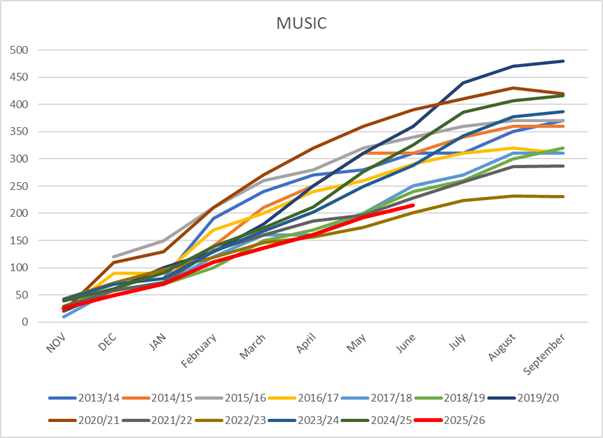
The news is not good. The June data for applications is the second worst number since the 2013/14 round more than a decade ago. Only the 2023/23 round post covid that was a terrible round across all subjects, has recorded a lower figure for applications than June 2025. In context, the June number of offers, a better measure than applications, is not far short of half the level seen in the covid year of 202/2, and around 25% below what might be expected in a usual round.

Worry, not because the government has decided that falling rolls over the next few years will mean fewer teachers of music need to be trained. Reducing the target from a requirement of 565 teachers of music in 2024/25 to just a requirement of 260 new trainees in 2025/26 suggests either the previous targets were way out of line or a need to justify the removal of the bursary by setting a target that can be met. After all, it would be unfortunate to remove the bursary as unnecessary, but still miss the target.

So, what of demand from state schools for music? Since January, and the start of the recruitment round for September 2026, I have recorded some 530 schools advertising for a teacher or music. Allowing for the fact that perhaps 100 had a TLR attached, so were not ideal for newly qualified teachers, this suggests 400 posts for newly qualified teachers so far. Add in perhaps another 100 autumn term vacancies and overall demand might be in the range of 400-500 posts or 500-600 posts overall.

The DfE expects about half of vacancies to be taken by existing teachers or returners each year. The exact number depends upon where the demand is and how it relates to supply. But, sticking with the 50% figure means a demand for around 250 to 300 new entrants each year.

Now, with falling rolls be might reduce that number by 10% to 225 to 270 as a requirement. On the face of it, the new target of 260 look risky but manageable. However, it must include two assumptions: all those that are offered eventually complete their courses and of ‘completers’, all join the state secondary school sector.

Both, based upon past trends are unrealistic assumptions. Being generous, 90% of those offered places complete the course. This suggests an output of 236 against a target of 260. Rounding up to 240 new entrants, this mean the new target is still not way of demand.

However, not all ‘completer’s join state schools. Some don’t enter teaching at all; some join Sixth Form Colleges or primary schools; some join the independent sector and some may decide to work overseas in the growing international school market. The 2025 data Less than 400 teachers of physics entered service in 2023/24 | John Howson based upon 2023/24 entry patterns showed that 80% of those gaining a QTS on a music ITT course entered teaching in a state-funded school. This includes both primary, secondary and special schools.

Assuming the 80% as a baseline – the next set of data should be out next month – our total of 240 reduced to less than 200. That number is starting to look as if the cut to music ITT places has been too savage.

A cynic might suggest, but I never could, the target was reduced to ensure it would be met and to save face over the removal of the bursary.

Whatever the reason, the DfE has now risked demand continuing to outstrip supply and this to affect the teaching of music in the nation’s secondary schools. With the recent announcement of the programme to ensure ‘Every child to get access to enriching activities to build skills and confidence for life’, the new target looks even less sensible  Every child to get access to enriching activities to build skills and confidence for life – GOV.UK.

I haven’t seen any campaign from the sector asking the government to revisit the target, but perhaps there should be in light of these numbers unless falling rolls are going to affect the demand for teachers of music more than I have calculated.

I would welcome any comments on the data.

ITT: subjects recruiting from UK graduates still in trouble

The DfE’s June data on the current round of applications and offers for postgraduate ITT courses still revels that the 2026 round is separating into two distinct sections. Subjects where applications are likely to come from anywhere in the world are either already meeting their Teacher Supply Model target for 2026 entry, or should do so on the current trajectory. Subjects where home recruitment is likely to dominate applications seem more at risk of missing their targets.

SubjectTarget 2026/27offer May 2026Fill: May viewJune offersFill: June view
Chemistry6901015YES1199YES
Biology675474PROBABLY542POSSIBLY
Mathematics20002169YES2495YES
Design & Technology620481YES562YES
Art & Design605527YES601YES
Geography685407POSSIBLY455NO
Classics7540NO43NO
English19801418PROBABLY1586POSSIBLY
Drama370253PROBABLY283PROBABLY
Business Studies1200270NO301NO
Music260192POSSIBLY215PROBABLY
Religious Education450269POSSIBLY308NO
Others2035418NO456NO
History520872YES974YES
Modern Languages10851107YES1214YES
Physics8101342YES1466YES
Physical Education6551298YES1405YES
Computing565686YES794YES

Based upon ‘offer’ recorded in the June update from the DfE, and with just three more reports to come before courses commence, I have made four downgrades and one upgrade to my expected outcomes for the current recruitment round.

I have downgraded expected outcomes for, biology, geography, English and Religious Education, including reducing Religious Education to a ‘No’. however, I am aware that there is a vigorous advertising campaign currently underway by the Religious Education sector, reminiscent of the RETRI initiative led by Dr John Gay a quarter of a century ago. Success in attracting new applicants could mean that it would be possible to hit the target for Religious Education. I do wonder why more subject groups don’t invest in advertising the benefits of becoming a teacher.

If science graduates discover there is space for those with some biology, then that subject might reach its target. Music looks likely to meet the target, but that target, in my opinion, has been set far too low to meet demand from schools, especially with the DfE’s latest initiative on extra-curricular activities for all, including within the scope, music. It will be difficult to achieve success in music without more teachers. However, meeting the low target will justify the removal of the bursary for music ITT.

Applications from outside of the United Kingdom represented 25% of all applications this June compared with 18% in the data for June 2025. If all non-Uk applicants had applied for secondary sector courses, then they would currently account for more than a third of applicants across all subjects, compared with a quarter in June 2025.

More evidence of the lack of interest in teaching from hone-based students comes from the fact that the number of graduates in the age group ’21 and under’ applying for courses is only 115 higher this June at 3,685 compared with an increase in applications of nearly 2,000 from the ’30 to 34’ age grouping.

The increasing interest in teaching from men continues, with applications up from 16,796 in June 2025 to 21,774 this June! It would be useful to know more about where this increase is focussed, and what the implications might be for the sector.

As ever, the DfE continues not to share ethnicity data with the sector. With so many overseas applicants at present, is that a helpful omission from the dataset?

Higher Education continues to bear the brut of the increase in applications, with ‘partner led’ and ‘salaried’ routes static, and only a small increase in applications to SCITT courses. However, PG teaching apprenticeships have seen a healthy increase in applications from 6,328 to 10, 493. However, offers are little changed at 1,066, compared with 966 in June 2025.

Perhaps because of the arrival of the postgraduate apprenticeship route, offers for the ‘salaried route was only 266 this June, compared with 518 in June 2025. Mr Gove’s brave new world of 15 years ago now looks like a distant dream, as higher education continues to take the bulk of applications, proving the resilience of the sector in the face of determined onslaughts during the coalition government to remove its dominance from the training of new graduate teachers.

With the end of the school term rapidly approaching, the next three months traditionally see relatively few new offers: will this year be any different, especially given the press comments about graduates unable to find work, or does teaching still look like an unattractive carer to debt strapped UK graduates?

With falling rolls affecting job prospects after training  and the acquisition of more student debt, and a possible below inflation pay settlement, the signs for increased interest in teaching as a career during the rest of the recruitment round are not good.