Religious Education – the need for qualified teachers

In a recent post on this blog about the DfE’s modelling of trainee teacher needs, I wrote that

‘However, has this re-assessment of need gone too far? Based on … my own current research into vacancies for teachers of music, I think the DfE has been realistic in its approach. ‘

While, I stand by that judgement, I have also been reminded by Deborah Weston, championing on behalf of those concerned with the teaching of religious education in schools that the cutback in trainee numbers probably allows little room for the replacement of the ‘under’ or even ‘un-qualified’ teachers currently teaching religious education in our schools.

Prompted by Deborah, I looked at the trends from the Teacher Workforce surveys concerning the use of those with ‘no qualification in the subject’ teaching religious education over the period between the end of the Blair/Brown Labour government and the end of the Conservative period of government. Of course, recent years have been impacted by the covid pandemic, and its consequences, but there is a clear trend that is observable.

The chart shows the four key types of secondary schools, of which the 11-18 school line is probably the most significant.

At the end of the Labour government, partly I expect as a result of the economic crisis of 2008, the percentage of teachers of religious education with ‘no qualification in the subject’ was reducing. However, the percentage levelled out as school rolls began to increase again, and teacher supply entered into an extended period of years when teacher preparation programmes missed their targets.

There was a brief respite as a result of covid, but in the most recent years, as trainee numbers have fallen, so the percentage of teachers with ‘no qualification in the subject’ has reached levels not seen since well before 2010.

As a result, the question now is, was the DfE right to cut trainee targets for religious education from 780 last year to 450 this year? On the basis that including unfilled places from previous recruitment rounds was a mistake, as I have always maintained, then the answer is clearly, yes, the DfE have taken the correct decision.

However, in subjects such as religious education, where most pupils only study the subject for a limited period of time each week, managing recruitment is easier for schools, if qualified staff are available.

I would add that in my opinion, religious education when taught by well-prepared and knowledgeable teachers can be a really valuable subject, especially at this time in the history of our multi-cultural society, where both many different faiths are practiced, and a growing minority profess to having no faith in religion at all.

If the government cannot see their way to increase the stated need for trainee religious education teachers, providers can always over-recruit, at least to higher education courses, where government funding isn’t an issue.

In addition to pre-entry training, the DfE might also like to consider another approach to the issue of shortage of religious education teachers: upskilling those presently teaching the subject, but without an appropriate qualification.  If it is important that a subject be offered on the curriculum, it beholds government to ensure it is taught properly.  

Spending cash on upskilling will no doubt help retention, and thus save on recruitment and training costs. However, apart from in mathematics and the sciences, it hasn’t really featured as a policy objective for many years: surely that’s a mistake.

I hope that the religious affairs lobby is able to persuade the government that significantly reducing the percentage of inappropriately qualified teachers of religious education should be a key policy objective.

ITT Offers – public money being wasted?

The DfE has today published the April data on postgraduate ITT courses, as at 20th April 2026. Initial teacher training application statistics for courses starting in the 2026 to 2027 academic year – Apply for teacher training – GOV.UK

This is the first month where offers can be compared with the DfE’s required need for each subject for September 2026 courses. I have previously posted about the draconian changes to the demand in many subjects as required by the DfE that have resulted from a different approach to unfilled vacancies. ITT Numbers for 2026 – brutal realism from DfE or big risk? | John Howson

Here is my assessment of possible outcomes for September, when courses commence, based upon current offers and past trends. It will be interesting to see how my view compares with that of Jack Worth at NfER.

SubjectTarget 2026/27offer April 2026DfE identified needFILL?
Chemistry690829-139YES
Biology675398277YES
Mathematics20001752248YES
Design & Technology620382238POSSIBLY
Art & Design605449156YES
Geography685353332POSSIBLY
Classics753639NO
English19801176804PROBABLY
Drama370207163PROBABLY
Business Studies1200224976NO
Music26016199POSSIBLY
Religious Education450339111POSSIBLY
Others20353721663NO
History520736-216YES
Modern Languages1085946139YES
Physics8101140-330YES
Physical Education6551175-520YES
Computing56553926YES

In some subjects, such as history, physics!, physical education and chemistry, providers have already made more offers than required ‘need’.  This demonstrates the danger of leaving it so late in the recruitment cycle to announce estimated demand.

In the past, these numbers used to appear before Christmas. With a rolling offer system in place, rather than a defined closing date, leaving the announcement of ‘need’ until April is likely to cost someone money. Will the DfE pay bursaries to all students offered a place, even if recruitment is above the stated ‘need’? If so, that could be seen as a waste of money.

However, of more concern are the subjects where, even with the new numbers for ‘need’, there are unlikely to be enough applicants to fill all the places. Based on previous trends, classics, business studies and the ’others’ grouping will not meet their ‘need’ number. I think it is time that the ‘other’ category, with 2,035 places is disaggregated into different subjects, after all, it is now by far the largest group in the subject’s table.

I have some concern about where design and technology, geography, music and religious education will produce enough offers to meet the revised ‘need’. However, I can now see why the bursary was removed from music. I still think that was a serious error of judgement, as this is a subject where only those with appropriate subject knowledge are accepted onto courses. Music has one of the highest applications to offer ratios of any subject. Current offers are the second lowest April ‘offer’ number since 2018.

What happens in the wider economy, and graduate job market, will determine the outcome of this recruitment round. I suspect there will be a summer surge in applications, as new graduates discover how tough the job market has become. This should mean a good year for teaching course. However, many applicants may now have found they have left it too late to secure a place for this autumn. This year will really be a case of ‘the early bird that catches the worm’.

I will now delve deeper into the data for another post about the nature of applicants and applications as revealed in this month’s data.

DfE Vacancy site – some more thoughts

The DfE vacancy site has now been in operation since 2018. During that time, it has altered little in appearance. Right from the start of the site, I was critical of its features. I felt then that TeachVac and other sites could have done a better job for much less money. I posted my frustration about the site in both January and March of this year.

After another infuriating day working on the headteacher vacancies listed on the DfE’s vacancy site yesterday, I though I would take a further look at what was on offer in terms of headteacher vacancies.

First off, the DfE site told me there were, in total, 122 vacancies, if I used their pre-defined key word of ‘headteacher’. The vacancies are presented in a list order covering 13 pages. However, there are not 122 vacancies for a headteacher.  10 of the posted vacancies are either for Executive Headships of more than one school (2) or posts below a headship (8 vacancies). Indeed, one vacancy isn’t even a teaching post. So, the real total of headteacher vacancies is 112?

No, sorry, that is not correct either. This is because 10 of the vacancies, including one non-teaching vacancy, appear twice on the site. As a result, the actual number of schools advertising for a new headteacher on the DfE vacancy site at 0900 on the 25th April 2026 was actually 102. That’s 20% below that stated figure.

Now, I have nothing against multiple listings. After all, a person might miss the vacancy the first time it appeared: but why only a few random vacancies? I believe such double listings should either be removed from the site – it just requires a simple piece of coding – or the rules about the same vacancy being listed more than once at the same time should be made clear.

Where I do quibble with the DfE, is with the inclusion of posts not for a headteacher vacancy in the listings under the ‘headteacher’ category, and, as a result, their inclusion in the overall total. This is just mis-leading, and schools should be prevented from uploading such vacancies under the ‘headteacher’ listing. Again, this should not be a difficult coding exercise.

The other question is: does the vacancy site meet the needs of schools and candidates? Well, some schools still advertise their vacancy for a headteacher elsewhere. Local authority job boards for non-academy schools; the ‘tes’ as well, or in a small number of cases instead of the DfE site. Some vacancies also appear on regional websites, such as in the North East or South West.

The DfE vacancy site doesn’t accept vacancies from non-state funded schools. Candidates considering both state and private schools have to look at more than one vacancy site. Is this a good idea? I don’t think it matters at the level of headteacher posts, except perhaps for special needs schools, where the private sector is playing an increasingly important role. However, for entry level jobs, some form of aggregation might be useful, especially as candidates begin to outnumber vacancies for the first time in many years.

Does the DfE have a board or committee that reviews its vacancy site? If not, perhaps the teacher association might ask for a review. After all, they would serve their members better by operating such a site themselves. Not only would they have better data on vacancy trends to argue their case with the STRB, but they could also earn some extra income. When I suggested this to the associations in 2013, when I created TeachVac, sadly they weren’t interested.

The Teacher Supply Model

On Thursday, the DfE published its annual note about the working of the Teacher Supply Model Teacher demand and postgraduate trainee need: 2026 to 2027 – GOV.UK

The Model can be easily described in the DfE’s own diagram

It is interesting to note that the Teacher Supply Model

assumes that as pupil numbers grow, teacher demand will grow too, and vice versa. Additionally, the model assumes that PTRs will grow in line with the historical relationship between pupil numbers and PTRs. Similarly, the model assumes that PTRs will fall if pupil numbers fall. In other words, as pupil numbers grow, the TWM assumes that schools will increase the size of the teacher workforce and allow class sizes to grow a little. 

As a result, the Model finds it challenging to manage changes, such as in the curriculum. One of the best examples was the introduction of citizenship during the Blair/Brown Labour government. Schools didn’t sack teachers to make space for teachers trained in the subject, and with no historical data to underpin the need, estimates had to be made.

The assumptions about pupil teacher ratios are, of course, unable to factor in economic headwinds that might change assumptions about future funding of schools. There was a god example early in this century when, in a budget, the Chancellor announced extra cash to be sent directly to schools. Not surprisingly, the schools went after extra teachers and equilibrium in the labour market was only restored by a hike in teachers’ pay that dampened down demand that had not been anticipated in the Modelling.

I have discussed these points with the overseas governments that I have advised on teacher supply modelling over the years. I also favour including a check on what is currently happening in the labour market by surveys of vacancies. Advances in technology, such as pioneered by TeachVac, way back in 2013, allow current trends to be matched with the data input into the Teacher Supply Model that may be two to three years between data collection and the output of trainees based upon the data joining the labour market.

One increasingly interesting issue that the Teacher Supply Model may need to consider is the growing international labour market for teachers. The Model currently imperfectly accounts for loss from the trainee and existing teacher pools to the private sector in England. In the future, it might need to consider how many trainees opt to work abroad. This will be especially important if more overseas students are offered places on teacher preparation courses. Will they be offered visas to teacher in England, or will they leave the country after completion of their courses? I will try to consider this issue in a later post.

Finally, I am delighted that the statisticians have abandoned what they have called ‘the removal of the need for an adjustment relating to forecasted under-supply’.  Adding back in the number of unfilled places from a previous ITT round to the next year’s total was never a good idea, as I have made clear in a number of my posts on this blog. The decline in Physics ITT places from a high of 2,250 in 2024/25 to just 810 for 2026/27 is a good case in point.

However, has this re-assessment of need gone too far? Based on Timo Hanney’s work on vacancies and my own current research into vacancies for teachers of music, I think the DfE has been realistic in its approach. After all, if they have under-estimated demand, the government can always recruit more teachers from overseas by enticing those trained here to return to England.

Does the DfE care about the arts in schools?

In my previous post, I promised more from the DfE’s publication Teacher demand and postgraduate trainee need: 2026 to 2027 – GOV.UK On closer examination of the text, it is clear that a lot of the data has come from the June 2025 publication of school workforce data, collected in November 2024. The next publication with the 2025 workforce data should appear in June, so I will wait until then to review the trends I didn’t cover on this blog last summer, after the publication of the 2024 data.

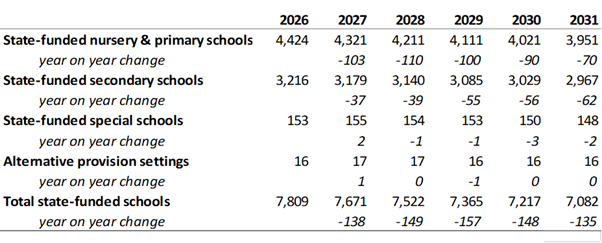
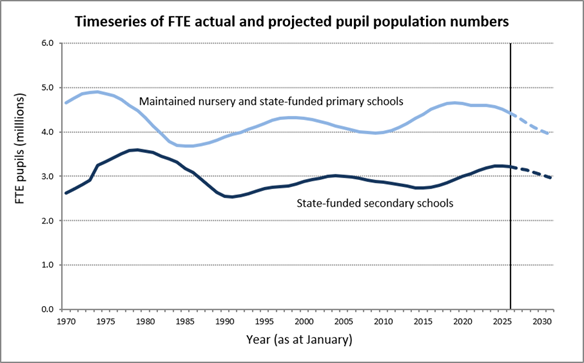
However, there is an interesting table in this release showing changes in the number of teachers per 1,000 pupils. The time series runs from the end of the last Labour government’s decisions on school funding in 2010/11 up to the 2024/25 school-year. This covers a period when school rolls were both falling, and then rising again. For the primary sector, rolls have been falling for some time. In the secondary sector, rolls are reaching their peak and will drop away over the next few years. The extent of the fall will, in reality, depend upon trends post-16, and whether schools either retain pupils or see then depart for further education or apprenticeships.

The number of teachers per 1,000 pupils is, of course, governed by the curriculum. Mathematics and English are taught to all pupils between Years 7-11, whereas few schools teach Classics to any pupils at all. Hence the ratio for mathematics was 8.44 in 2025/26, and has changed little since 2010/11, when it was 8.39 teachers per 1,00 pupils. By contrast, classics come out at a constant 0.09 teachers per 1,00 pupils.

The number of teachers per 1,000 pupils
by secondary subject as published in this publication
Subject2010/112024/25difference% Difference
Computing3.471.77-1.7-49%
Design & Tech5.133.1-2.03-40%
Drama1.751.35-0.4 -23%
Art & design2.812.19-0.62-22%
PE6.254.98-1.27 -20%
Other Sub5.124.08-1.04-20%
Business studies1.911.55-0.36-19%
Modern F L4.643.91-0.73-16%
Music1.671.42-0.25-15%
Biology3.93.41-0.49-13%
All Sec68.0959.77-8.32-12%
RE2.322.2-0.12-5%
Chemistry3.163.08-0.08-3%
Primary48.1747.04-1.13-2%
Classics0.090.0900%
English8.78.700%
Mathematics8.398.440.051%
Physics2.692.720.031%
History3.213.50.299%
Geography2.93.270.3713%
Source: DfE School Workforce data

Interestingly, for a country concerned about ‘growth’, and the decline of the productivity of the economy, the subjects with the largest falls in teacher numbers per 1,000 pupils are computing (down 49%) and design and technology (down 40%). By contrast, the humanities subjects, of history and geography, have seen increases in the number of teachers per thousand pupils. Presumably part of this increase was the inclusion of these subjects in the English Baccalaureate by the previous Conservative government.

The arts have generally not fare very well. This is despite the ease of recruiting teachers in these subjects during much of the period reviewed. It might be assumed that these subjects were the casualties of the government’s views on the curriculum.

The small changes in mathematics and physics, no doubt owe something to the generous bursary and scholarships that have been available to trainee teachers in these subjects.

As noted, part of the change was due to the rise in school rolls. Generally, the Pupil Teacher Ratio in secondary schools has worsened as rolls have risen. This is not surprising. Governments have rarely been able to fully fund bulges in school populations. I suspect that part of the strain has also been felt in the size of ‘option groups’ in Years 10 and 11. However, I also know that class sizes have also increased in Years 7-9, where most teaching is of whole classes.

The other interesting question that arises from the data is the amount of teaching undertaken by those with appropriate qualifications in the subject that they are teaching. Regular readers will know my views on the subject. Teachers should be certified for specific subjects, and receive ‘emergency’ certification if required to teach ‘out of their field’.  The present system allows parents to be blissfully ignorant of whether their offspring are being taught by a teacher with either a degree and training in the subject or some lesser qualification. I wish more parents would ask. It would also be interesting to see research on GCSE results by the qualification of the teacher that taught the group.

With falling rolls, and reduced targets for trainees, we are entering a challenging period for those responsible for training teachers. I doubt the market will look like it does today in a couple of years’ time.  Who will survive and who will no longer be preparing graduates for teaching? Ans what of the alternative routes into the profession? Will they remain as at present? 

ITT Numbers for 2026 – brutal realism from DfE or big risk?

The DfE has today published its comprehensive analysis of the school workforce, including the trainee need for 2026/27 courses. As we know, pupil numbers are falling in the primary sector, and don’t have much further to rise in the secondary sector. As a result of this fact, added to improved take up of teaching as a career, and improved retention, the DfE has significantly adjusted its trainee targets. Teacher demand and postgraduate trainee need: 2026 to 2027 – GOV.UK

I will look at some of the data in more detail in future posts on this blog, but for this post it is just the changes in trainee needs.

Subject/phaseTRAINEE NEED 2021/22TRAINEE NEED 2025/26TRAINEE NEED 2026/27DIFF 26/27 ON 21/2226/27 0N 25/262025 ITT CENSUSNEW TARGET MET?
Art and Design5806806052575872YES
Biology8209856751453101489YES
Business Studies7259001200475300271NO
Chemistry108073069039040864YES
Classics406075351544NO
Computing840895565275330715YES
Design and Technology1475965620855345580POSSIBLY
Drama33062037040250255POSSIBLY
English19801,95019800302069YES
Geography745935685602501035YES
History780790520260270969YES
Mathematics28002,30020008003002588YES
Modern Foreign Languages15051,46010854203751364YES
Music540565260280305367YES
Others19802,520203555485348NO WAY
Physical Education1010725655355701466YES
Physics25301,41081017206001086YES
Religious Education47078045020330483YES
overall TOTAL3103026,92020800102306120
Secondary Total2023019,270152804950399016975
Primary Total108007,650552052802130

In the table I have ignored the primary phase. The total suggested of 5,520 for the postgraduate primary sector will no doubt cause real concern. However, as the DfE helpfully point out, these are not subject to recruitment controls.

In terms of the secondary sector subjects, it is worth pointing out that the DfE has seemingly abandoned the dubious practice of adding unfilled places from the previous year into the new need total. In its place, it has opted for a more nuanced approach. As I have pointed out before, schools start the term in September fully staff, so there are no vacancies, just teachers with sub-optimal qualification teaching pupils. Unless these teachers are sacked, there are no vacancies if too many teachers are trained.

In the final column, using the data from the 2025 ITT census, I have suggested my thoughts about the possible outcome of the current round based on these need numbers. More later

Holiday advice – no use for teachers

Teachers are returning to school after the pupils’ Easter Break. I doubt whether most teachers will have enjoyed a completely school-free break, and some may even have been running revision classes for their Year 11 and Year 13 pupils. However, the break is a period for some down time away from the routine of classroom life. Perhaps some teachers will also have been told how fortunate they are to have such long holidays, and what a ’cushy’ job they have.

As I pointed out in my most popular blog post ever, teacher don’t have long holidays, and they don’t have control over them either. How much holiday do teachers have? | John Howson

Additionally, teachers’ terms and conditions, with regard to holiday entitlement, have not really changed since I started teaching way back in 1971.

As a result, this extract from a news site would rile me if I were still a teacher.

The Government states on the website : “If a bank holiday is on a weekend, a ‘substitute’ weekday becomes a bank holiday, normally the following Monday. Your employer does not have to give you paid leave on bank or public holidays. Bank holidays might affect how and when your benefits are paid.”

So, if you want to swindle extra time off, booking December 29-31 off work will result in 10 days off in 2026, with just three days booked as holiday. Across 2026, careful planning allowed workers to turn 28 days of annual leave into as many as 63 days off by aligning bookings with weekends and bank holidays

These leave strategies are becoming increasingly popular among employees, particularly as more workers look to maximise rest without exceeding their allowance. The key, however, is acting early. UK will get a 3-day working week at the end of the year – here’s when and why

None of this advice is of any use to teachers or their support staff colleagues on term-time only contracts. Now they are not alone in have fettered holiday times, but I think the days when large numbers of workers had to take their annual holiday during ‘wakes weeks’ has declined over time, as a manufacturing base has become a less important part of national life.

I have long believed that at some point there will need to be a review of teachers’ pay and working conditions. This will become more urgent if AI doesn’t remove jobs from the workplace, but allows exiting workers to work fewer hours each week.

Of course, teachers that don’t like the current contracts can either look for work overseas or turn to tutoring where one’s working hours are very much a matter of personal choice: easier to do if you are a mathematics teacher, possibly less so if you teach history?

If I was a union rep in a school, I might ask about the holidays the professional staff of the Association are entitled to, and compare it with my own experience.  

Teacher Turnover- Is England doing better than the USA?

An interesting report crossed my desk a the end of last week. Teacher Turnover in the United States: Who Moves, Who Leaves, and Why | Learning Policy Institute This study, by Tiffany Tan, Wesley Wei, Desiree Carver-Thomas, and Emma García was produced the Learning Policy Institute, and first appeared in mid-March.

Key findings were that;

Teacher turnover remains high nationally. Between 2020–21 and 2021–22, 15.1% of U.S. teachers moved schools or left the profession: 8.0% moved schools, and 7.1% left teaching. Turnover rates have been largely stable over the past 2 decades but are now about 27% higher than in the early 1990s—an increase driven primarily because the rates of teachers leaving the profession increased by more than 50%.

Most teacher turnover was voluntary and preretirement. Nearly 3 in 4 teachers (74%) who moved or left did so voluntarily for reasons other than retirement. This percentage is higher than it was 10 years ago, when 67% of teachers left their schools voluntarily and preretirement.

Nearly half of teachers who moved schools stayed within the same district, and almost 40% of those who left teaching remained in the education sector. Among movers, 36.5% of teachers moved to a different district in the same state, while 17.3% moved to a different state. Of those who left teaching, 31.2% retired, whereas 13.1% took jobs in other sectors.

Teacher turnover rates vary across groups of teachers. 

It is interesting to compare this survey with the NfER’s recent Report on the School Workforce in England

School teacher retention has improved slightly in recent years, with the leaving rate falling from 10.6 per cent in 2016/17 to 9.5 per cent in 2021/22 and nine per cent in the most recent data. This has contributed to lower ITT recruitment targets and increased teacher numbers overall. The exit rate of first-year early career teachers who left within one year between 2023/24 and 2024/25 was 10.3 per cent, the lowest rate since the data began. (page 11)

The NfER conclusion seems much more optimistic than that of the US Report from LPI.

In contrast to previous NFER reports on the teacher workforce, the flows of teachers into and out of the labour market look reasonably healthy for the future of teacher supply. Recruitment is improving, even in some subjects which have seen persistent shortages. Teachers were less likely to leave the workforce last year compared to any year since 2010/11, outside of the pandemic. The early career teacher retention rate is the best on record. Teachers’ working hours are steadily coming down on average and the proportion of teachers who report having an acceptable workload has improved somewhat. Some progress has also been made in the competitiveness of teachers’ pay. Most teachers’ have received a pay increase of at least four per cent for each of the last four years, which has been higher than inflation over the period and even closed the gap – albeit only partially – that had opened up between teacher pay growth and average earnings growth since 2010/11. The increase in job insecurity and slowdown of job opportunities in the wider labour market is also likely to be a key factor driving recent trends (page 24) https://www.nfer.ac.uk/media/idcdsseo/the_school_teacher_workforce_in_england_annual_report_2026.pdf

This may be because the pupil population in England is in decline. The consequences are that there are fewer opportunities for teachers to move to different schools, and more teachers stay put. There is also less pressure on training numbers, so teaching looks like a more competitive occupation. While the economy and technology changes, such as the fear of the AI effect on graduate jobs may also be working to make teaching look more attractive as a career path in a more challenging graduate labour market.

However, I wonder whether many of the issues reported in depth in the LPI Report, such as the higher turnover of Black teachers; more turnover of teachers in certain subjects, and in certain types of school, may also be features of the labour market for teachers in Egland.  Certainly, we know that teachers from ethnic minority backgrounds fare less well in teaching than those from the majority ethnic community, as I have discussed in past posts. I suspect many of the other concerns raised by the LPI Report may also have credence in England were the data to be examined in that level of detail.

For issues around ethnicity and teachers in England, see my previous blog posts

Ethnicity issues remain for new teachers | John Howson

Ethnicity issues remain for new teachers | John Howson

Slow progress on ethnic minority headteacher numbers | John Howson

The Future of Education – a talk from 2024

In the summer of 2024, I was asked to lecture on the future of education. Two years on, it is interesting to see how even more relevant today the content of the talk is. Sadly, there are still no answers to many of the questions posed in my talk.

Thank you for inviting me to talk to you this evening. I arrived in Oxfordshire some 45 years ago, about the same time as the late Sir Tim Brighouse. This was only a couple of years after Prime Minister Sir Jim Callagham’s visit to Oxford, and his famous Ruskin College speech that started The Great Debate about education and schooling in England. A debate that has ultimately led us to where we are today.

Starting this talk with a look back at history reminds me that if this were a sermon, I would start with a text. Perhaps, ‘Acts Chapter 2 Verse 17’. I won’t read it out, as those that want to know what it says can look it up on their phones.

However, what I want to talk briefly about this evening is RATS -I have to say that thankfully you are spared the PowerPoint picture at this point.

However, RATS stands for:

Responsibility

Accountability

Technology

And

Schooling

RATs or ARTS is better, even if the order is wrong.

First Responsibility

Who is responsible for what in education

People still cheerfully talk of ‘Oxfordshire’s schools’ but in reality, as cabinet member, I deal with only a limited number of functions these days:

-Admissions to school, but not in-year admissions to academies

-Transport to school, but not for over 16s, as this is discretionary and there is no cash, despite raising the learning leaving age to 18, except for SEND pupils where we still support those where we can. So, a young person can receive free transport from Years 7-11 and then nothing.

-School building – we have built more new schools in the past decade than the previous 50 years. But as ever this area is highly regulated.

HR for maintained schools – this means small primary schools have to pay the Apprenticeship Levy – a tax by any other name.

School Improvement – although the £400,000 annual DfE grant ends this month and next year we are funding it from Council Tax.

-SEND – and we will spend £20 million more than the government provides us with funds in this area and end this financial year some £60 million overspent.

That overspend lead me nicely into considering Accountability

If there is confusion over responsibility, is there any clarity over accountability for our school system?

As I mentioned, Oxfordshire has overspent on SEND and by 2026 this may be as much as £140 million

Schools receive their budgets calculated on formulas where Oxfordshire as a local authority has no vote, and merely acts as the banker. Schools may end the year in surplus or in deficit

If you look at academy chains in Oxfordshire, several have schools with balances of £1 million and other have deficits nearing the same figure.

Who is accountable for these outcomes and how will they be dealt with?

If the RSD is prepared to accept academies in deficit that they add to each year, why should Oxfordshire as a local authority wipe out deficits on schools transferring to become an academy: perhaps we will explore issuing an IOU to be paid when there are no deficits in the academy sector.

Last year, council tax payer transferred £200,000 for a school becoming an academy to wipe out is deficit: that’s a lot of potholes we could have filled. At the end of this month, I expect deficits in maintained schools to top the £3 million mark: enough to mend most of our roads.

Let’s consider some other accountability issues:

Who is responsible for ensuring there are enough teachers for Oxfordshire schools? Is it schools; MATs and the dioceses; the LA or the government at Westminster?

Who is responsible for school improvement, so when ofsted comes knocking a school can be judged outstanding, as a primary school in the north of the county has been recently.

Who will deal with the digital divide?

This last question is one that that neatly brings me onto the third theme for this evening:

Technology

Since I came to Oxfordshire at the end of the 1970s there have been three waves of new technology

The microprocessor revolution of the late 1970s and early 1980s that brough BBC B, turtles, and eventually the Apple/PC dominance of our interface with IT. Indeed, my MSc thesis in 1980 was the first produced on a word processer for any course at Norham Gardens.

The second technology revolution started in the early 1990s, and became part of our lives in the first decade of this century when we all embraced the internet and started exchanging emails. 

This revolution had a second phase when the phones in our pockets suddenly became mini computers in their own right, and a whole new set of challenges opened up for education. This saw the surge in new social media platforms, and the current heads-down culture that pervades so much of society these days. I won’t ask how many have already googled my suggested text for this talk.

Although schools have made adaptations to accommodate these changes in technology over the past 5 decades, we still rely upon a teaching and learning strategy that has many elements that would be familiar when state education began more than 150 years ago.

In passing, I am sorry that the covid pandemic didn’t allow us to celebrate the 150th anniversary of the 1870 Education Act in a manner that I think would have been fitting.

The 2x4x8 model of learning may not be as rigid as it once was, but secondary school ‘timetablers’ are great fans of it as a strategy.

Anyway, so much for the first two waves of technological change: what of the third and developing wave, currently described by many as the AI revolution?

Does a knowledge rich curriculum meet the needs of a generation that started school last September and possibly won’t retire from employment until the last decade of this century. Those that started school 100 years ago, around the time of the birth of the BBC and radio, retired just as the internet was becoming a viable communication strategy: what will the class of 2024 experience in their lifetimes, and how will we prepare them for adult life?

This is not to decry the role of knowledge in schooling, and especially the building blocks of literacy and numeracy. Technology has almost made handwriting redundant, except as an art form. Can technology help us deal with the learning gap at Key Stage 1 between children on Free School Meals and those whose parents have a higher degree?

If so, to return to my themes of accountability and responsibility, where does the impetus for change lie? At school or Trust level; at local authority level or nationally?

We have seen initiatives such as the Oak Academy created nationally post-covid. We also saw how Oxfordshire as a local authority dealt with covid in acting as a conduit for information.

How will the system take change forward. Who has the vision.

Perhaps parents will dictate change for us as educators?

Home schooling has increased significantly: a passing phase or signs of a new order?

I saw this week suggestions that teachers will need to be paid more if they have to work a five-day week when four days becomes the norm. It is worth noting that teachers, as a group have seen no change in their holiday entitlement over the past 50 years while all other workers have benefitted from increased time off.

So let me conclude by asking whether one might one view a model where technology, and indeed any other approach to teaching and learning, is like a table top resting on the twin legs of responsibility and accountability.

Wobbly legs can mean an insecure platform for learning, and certainly for the development in an orderly manner of how technology can change the landscape of education.

I started with the term ARTS, so my final word must be about schools.

It is right that schools and their staff must be at the heart of the landscape, but the challenge that is currently keeping me awake at night is the relationship between a national funding formula created during a period of increasing school rolls, and the current situation of falling rolls faced by many primary schools.

How will hard decisions on whether all schools survive be taken, if pupil numbers continue to decline? For instance, who decides on whether we keep primary schools in local communities or face competition between schools for pupils to keep their own school open?

What part can technology play in solving this dilemma? I don’t know, but I do know the relationship between falling rolls and school funding is not one we can duck going forward.

But let me finish on a brighter note. This week, I met with three young entrepreneurs interested in working with schools on drone technology. Indeed, they have started a series of books that might be the 21st century version of Thomas the tank engine.

Let me introduce you to Ruby Rescue and the big fire – a tale from Drone City and possible future firefighting techniques.

I started my teaching career in Tottenham with the stewardship of 16 mm projectors; reel to reel tape recorders; an epidiascope, and little other technology but in a certain landscape for schooling.

I don’t want to dream of a past, but rather to challenge us all to set out a vision for the future landscape of education that can work for the good of all.

Thak you for listening.

Are small sixth forms a good idea?

In a post in January, I mused about the issue of how falling rolls might affect schools particularly if it meant less funding, where school funding is based upon a per pupil funding model. Fewer pupils = less cash. Accountability and falling school rolls. Was it different in the past? | John Howson

One of the possible solutions discussed in that post was a reform of post-16 education. In a cash-strapped school system, is it possible to justify schools with small sixth forms? Are such sixth forms in the best interest of the students?

In order to think more deeply about this issue, I have looked at the ‘A’ Level results from one local authority, as published on the DfE’s website. 11-16 schools are excluded, as are schools that will eventually expect to have a sixth form, but aren’t currently at that stage, and also colleges. What’s is left are the details for the outcomes on ‘A’ Level results for 34 schools, as shown in the table below

pupils enteredbest 3 scoreprogress scoreaverage or above
31239.880.2AA
21135.750.08A
12540.77-0.13
11741.680.02A
11031.45-0.30
10733.240.00A
9634.340.00A
9438.30.17AA
9036.330.19AA
8935.51-0.12A
8731.530.08A
8239.150.80AA
8236.420.07A
7934.57-0.33
6929.47-0.21
6635.10.26AA
6632.37-0.10A
6535.640.03A
6433.39-0.15
6235.70.20AA
5934.69-0.09
5732.520.06A
4634.57-0.33
4233.65-0.11A
4131.14-0.46
3014.67-0.69
2836.310.21A
2525.07-0.02
2234.850.70A
1424.52-0.83A
1318.21-0.75
924.52-0.83
937.780.35A

For comparison purposes, the average score for state schools in England was -0.03 for Progress and 35.76 for the best 3 ‘A’ Levels score. There are other measures that could be used, but these are three I chose to use for this blog post.

Nine out of the 34 schools beat the national average for ‘best score’, although another couple of schools narrowly missed the national average, so it might be better to conclude that 14 schools were either close to or exceeded the national average for ‘best score’, leaving 20 schools that were below the national average.

Progress score is a more contentious measure. Here 15 schools did less well than average. The same schools often feature in both lists. Most of these schools entered less than 100 pupils for three subjects at ‘A’ level. Some pupils might have taken either two subjects and a vocational qualification or just two subjects at ‘A’ Level.

Schools that entered more pupils for 3 ‘A’ Levels were more likely to receive an ‘average’ or ‘above average’ grade.

The data forces me to ask the question – is the current arrangements for ‘A’ Level study across these schools producing the best outcomes for students? Two subsidiary questions are; if this is the outcome close to the top of the demographic cycle, what might happen to sixth form sizes in these schools once rolls start to fall in a few years’ time? The second question is, what is the cost of tuition per pupil under the present arrangements.

To answer the latter question, let’s assume a Year 7 class of 30 for mathematics taught by a newly qualified teacher on the bottom of the Main Scale for five period a week for 40 week, and an ‘A’ Level group taught for 5 periods a week by the Head of Department, on the top of the Upper Pay spine, and with a TLR 2A in addition.

The newly qualified teacher teaches 6 classes per week for 40 weeks, while the Head of Department teaches two ‘A’ Level sets, one of which has 10 weeks examination leave in Year 13. In addition, the Head of Department teaches four classes of 30, one of which has exam leave in Year 11.

 Using this data, and ignoring any other time spent on non-teaching duties, the Main Scale Teacher costs work out at 0.91p per pupil, while the Head of Department costs are £2.33p per pupil.

If the ’A’ Level groups were smaller than 15 in each year, as they well might be in some schools, then the cost per pupil increases unless the Head of Department receives a lesser amount in TLR.

In an 11-16 school, where the Head of Department might teach five classes for 40 weeks and one for 30 to allow for examination leave, the cost per pupil for the Head of Department reduces to below £2 per pupil. If the school has only long-serving teachers then the per pupil for teachers increases to nearer £1.50 per pupil.

For small schools with settled staffrooms, the difference in cost between the cost of teaching Years 7-11 and Years 11-13 may be marginal. The issue then becomes one of teaching and learning. Do small sixth forms produce as good examination results as larger sixth forms? The evidence from the table would suggest they are less likely to do so.

What of the student experience? Is it better to be either ‘a big fish in a small pool’ or ‘a small fish in a larger pool’? Has anyone ever asked students their views?

I think that there is a debate to be had about school organisation and size of school sixth forms when rolls fall, especially if school funding comes under pressure from increased government spending on both defence and welfare, and especially if we are in a recession.

As my colleagues in Haringey found out in the 1970s, such debates about changes to sixth forms can be fraught with political pitfalls for anyone suggesting change. But, is that a good enough reason not to at least discuss changes?

Note: I have only used salary costs in the modelling and not included on-costs from National Insurance and Pensions. I have also ignored premises and other staffing costs, as I assumed the to be low in a subject such as mathematics.