SEND parents need support now

I have written three posts about SEND since I restarted this blog in May, on the override; EOTAs and more generally. As a result, I was going to sit out the present debate about what might happen in the autumn without making any further comments. However, I thought this paragraph by John Crace in the Guardian was the best summary I had seen about where we are one year into this government. Labour picks on kids as Farage reaches for his human punchbag

‘Now, Send is not perfect. The bill is getting bigger by the year, thanks both to better diagnosis and to some parents gaming the system. But it is essential for many children who benefit from education, health and care plans, and parents are worried sick they might lose out. In the absence of any clear direction from the Department for Education, many disability campaigners are fearing the worst. That children will be treated as cost centres to be downsized. That children diagnosed in the future won’t be entitled to the same benefits as children with the same level of disability are now. This one will now run and run well into the autumn.’

It is going to be a worrying summer for many parents, and that isn’t fair on them. I am all for looking at how the system is being gamed – see my blog about EOTAS – in some ways by a few parents, but most parents are genuinely worried. SEND is the only issue I ever saw a parent cry in a cabinet meeting when trying to prevent a reduction in the spending on transport. These parents have a heavy burden of love to bear, and the State should remember that.

However, the elephant in the room, and one John Crace doesn’t mention is the NHS. Afterall EHCPs replaced Statements of SEN Need. One big difference was the addition of the letter ‘H’ for health. So far, all the attention has been on local authorities, and the NHS rarely receives a mention.

Now I think that as soon as it is obvious that a child will need an EHCP, the NHS, whether maternity unit or GP surgery, should always start the process. It should not be left to a primary school headteacher to so often have to begin the process of applying for the EHCP.

At the same time, the NHS might want to look at early screening for conditions affecting early learning, and put in place a much stronger programme than at present.  

SEND is also an area of life where we need to be clear about what we want from the Early Years Sector. The sector has a part to play in early identification of issues in learning, and surely staff need better training to both observe and report these early learning issues. Much has been taken about the transfer from primary to secondary school, but hardly anything about the knowledge transfer into the school system from early years. Of course, where the school has a nursery class, transfer should be straightforward. But what of other children, and especially those that spend most of their early years in the care of relatives or live in isolated in rural areas?

The government seems to like leaks, so how about some positive leaks around SEND? The government must not go on holiday leaving these parents to suffer over the summer.  

The other crisis facing schools

In my experience, editors usually have September, and the national annual ‘return to school’ event, as a time to ask journalists to look for a school centred story. This follows on from the useful two-week period in August when there are examination results to cover in the month when there is often little news from the political scene.

This year, editors and their journalists didn’t have to work very hard, if at all, for their ‘return to school’ story. RAAC, and the school buildings saga, was a gift send. Would the story have topped the bill at any other time of year? Who knows, as it is an important issue, but more important say that a reshuffle?

What is clear, is that by focussing just on the school buildings issue, editors are missing the opportunity to take a wider look at the health of our schools. Had there not been RAAC, and the still largely hidden asbestos issue, might the staffing of our schools have been the main story this September?

This is a much more difficult story to sell, as except in rare cases such as a special school reported to the DfE in the summer, schools don’t send children home for a lack of teachers. Instead, they cut subjects from the curriculum – I have been told of a school that is no longer offering languages in the sixth from this September; increase class sizes; reduce non-contact time for teachers and, most commonly, employ what might be considered as under-qualified teachers to teach some groups.

Because anyone with Qualified Teacher Status can teach anything on the curriculum, it isn’t easy to identify the problem, as schools, quite rightly, don’t advertise any shortcomings in the staffing of their timetable. However, extrapolating from the last School Workforce Census that provided a baseline, and adding in the results of new entrants being below the targets set by the DfE through the Teacher Supply Model, it seems clear that some schools are not properly staff this September.

Does this matter? Like the lack of a schools’ database on building issues, we don’t know whether some young people are missing grades in those public examinations we celebrate each August because of staffing issues last year or even earlier in their school lives.

This blog has charted re-advertisements of teaching post against free school meal rates in schools. I wrote a blog on this issue last month, just before the exam results season started Are we levelling up? | John Howson (wordpress.com) I won’t bother to repeat what I said then, but it would be interesting to look at examination results in specific subjects at different centres with different levels of staff turnover for a period of three to five years, to see if there is any measurable effect of staff turnover on outcomes, including entry policies.

My hunch is that it is difficult to create a ‘normal’ distribution curve for results subjects such as ‘A’ level physics if many schools cannot offer the subject, and those that do only enter those likely to be successful candidates.

Editors might like to pencil in a story for January 2024, when secondary schools facing unexpected vacancies will find recruitment even more of a challenge than for this September. What might be the effects on their results in Summer 2024 of an unexpected vacancy, especially if they started the school year this September with both a RAAC and a staffing crisis?

RAAC and asbestos: threats to school buildings

The interview that former Permanent Secretary at the DfE, Jonathan Slater gave to the BBC’s today programme this morning was both revealing and disturbing. Replacing school buildings rather than providing new schools to meet ‘rooves over heads’, where pupils don’t have a school, has long been the policy of the DfE and its predecessors.

Mr Slater’s revelation of the role of HM Treasury in funding school buildings should not come as a surprise, since the DfE doesn’t have income to pay for education, it is always reliant upon the Chancelor and the team at the Treasury and their policies.

The past decade has seen an upswing in the pupil population, so it is not surprising that new schools for new housing estates and other areas of substantial population growth have headed the school building list, leaving little cash for replacement schools, especially where developers can be persuaded to pay for the new school through the planning procedures.  

As Mr Stalter said, the determination to push through the Free Schools policy may also have reduced interest on the part of Ministers in rebuilding our maintained schools, as that task didn’t fit the political narrative of the day.  Interestingly, the capital expenditure brief currently lies with the DfE’s Minister in the house of Lords, Baroness Barran. Perhaps this shows where the thinking about the importance of capital investment lies in the pecking order within the DfE?

In 2017 the Public Accounts Committee (PAC) conducted an inquiry into school building. Here is an extract from their published report

2Condition of school buildings

The state of the estate

19.Between 2012 and 2014 the Department for Education (the Department) carried out a property data survey to examine the condition of school buildings. Based on the survey, the Department estimated that it would cost £6.7 billion to return all school buildings to satisfactory or better condition, and a further £7.1 billion to bring parts of school buildings from satisfactory to good condition.37 Common defects include problems with electrics and external walls, windows and doors. The survey was limited to assessing the condition of buildings and did not assess their safety or suitability.38

20.Some 60% of the school estate was built before 1976.39 The Chairman of EBDOG noted that ‘“system” buildings (a method of construction that uses prefabricated components) from this period were definitely coming to the end of their useful lives.40 The Department said that it had some concerns about these types of school buildings and so had started “destructive testing” as it knocked down buildings to assess how much life similar buildings had left.41 It expects that the cost of dealing with major defects will double between 2015–16 and 2020–21, even with current levels of investment, as many buildings near the end of their useful lives.42 The Chairman of EBDOG illustrated the scale of the challenge by telling us that his own local authority, Hampshire, needed £370 million to repair its school buildings but received only £18 million from the Department each year.43 (indication of references numbers retainedCapital funding for schools – Committee of Public Accounts – House of Commons (parliament.uk)

Here were two of the PAC recommendations:

Recommendation: The Department should set out a plan by December 2017 for how it will fill gaps in its knowledge about the school estate in areas not covered by the property data survey. Specifically it needs to understand the prevalence, condition and management of asbestos, and know more about the general suitability and safety of school buildings.

Recommendation: The Department should use information, including from the property data survey, to develop a robust approach for holding local authorities and academy trusts to account for maintaining their school buildings, including how it will intervene if they are not doing so effectively. It should also assess whether schools can afford the level of maintenance necessary given the real-terms reductions in funding per pupil.

At that time, it was asbestos in school buildings that was the main concern, and possibly still should be in terms of how widespread the issue in schools might be. However, it would be interesting to know whether RAAC concrete was included in the ‘destructive testing’ mentioned in paragraph 19 of the PAC’s report?

Perhaps more should have been done to follow up the Department’s progress on school building replacement through the scrutiny process, especially with the warning that ‘many buildings near the end of their useful lives’. Should this have produced a Red RAG rating somewhere on a risk register?

In July 2023, the PAC started an inquiry into school buildings. The responses to Questions 6-9 from the current Permanent Secretary at the DfE are worth a look for what was said about RAAC. committees.parliament.uk/oralevidence/13508/pdf/ However, even in that session asbestos as an issue seemed to be regarded are more of a concern than RAAC by many. Is that still a ticking time bomb waiting to explode?

This blog has celebrated that period between 1968-1972, when the then Ministry had a plan to replace pre-1906 primary schools. Many are still in use, and with the concerns about RAAC and asbestos seem likely to head towards their second century serving the nation’s children in many places.

Are we levelling up?

England has a teacher supply crisis in its secondary schools. Not, please note in most areas in its primary schools. Years of missed targets for trainee numbers must have an effect on the labour market unless other sources of teacher supply can be found.

From today the effect of missed targets on examination results will also start to become clear. Will those young people most likely to stay in the local economy have fared less well than those that will disappear off to a university, and then who knows where (likely London in many cases) after graduation, rather returning to their local area where they were brought up. If so, what are the consequences for those local economies?

As the latest in my series on the what happened in the labour market for teachers, as measured by advertisements tracked by TeachVac between January and the end of July 2023, I have managed a quick calculation of number of advertisements for teachers by the Free School Meal percentage of schools. This measurement might suggest whether schools with higher percentages of FSM pupils have more staff turnover?

This is a crude measure because it doesn’t standardise for school size. A better measure is for turnover measured after taking pupil numbers into account and matching the resultant outcome against the percentage of FSM pupils. I haven’t yet had time to do that calculation.

Adverts by school>1010-2021-3031-4041+Total schools
FSM
0-10201162562813460
11-204153231603655989
21-303102551206360808
31-40162150803437463
41-509789502715278
51-603432144589
60+5410111
total122410154811921863098
40+136125653121378
Adverts by school>1010-2021-3031-4041+
FSM
0-1044%35%12%6%3%100%
11-2042%33%16%4%6%100%
21-3038%32%15%8%7%100%
31-4035%32%17%7%8%100%
41-5035%32%18%10%5%100%
51-6038%36%16%4%6%100%
60+45%36%9%0%9%100%
total40%33%16%6%6%100%
40+36%33%17%8%6%100%
Source: TeachVac

There is some evidence from the tables that schools with lower percentages of pupils on Free School Meals do have a lower turnover of staff, and that schools with a higher percentage of such pupil do experience did experience high numbers of advertisements for teaching staff during the January to July 2023 period.

This type of analysis is important because too often the focus is on the student: attendance rates; previous history of examination taking and other factor such as free school meals, but these are not linked to school factors.

Thus, today, BBC Radio 4 has been worrying about the performance of students in the North East compared to students in London. Nick Gibb, The Minister, on the world at One on Radio 4, (I don’t often agree with him), but I do in this instance, suggested it was more a London and the rest of the country difference. However, The Minister didn’t say that there are more independent schools in the south than the north, and that the ability to recruit staff might be a factor in the widening gap in outcomes between those regarded as ‘disadvantaged’ and other pupils.

To ignore staff turnover, is to miss an important component in a system that has failed to train sufficient teachers in many subjects for nearly a decade now. Such shortfall in a market-based recruitment system must surely have consequences?

Becoming a primary school teacher: worth the risk?

Classroom Teachers and promoted posts

Primary Sector

The primary sector during 2023 has been noticeable for a decline in advertised vacancies across England in both the private and state school sectors.

January to July each year
Primary Classroom & promoted posts
2022
Count of URNColumn Labels 
Row LabelsIndependentStateGrand Total
East Midlands5321832236
East of England21430523266
London52930193548
North East7257264
North West6321982261
South East39246635055
South West10627242830
West Midlands5320782131
Yorkshire & the Humber6220752137
Grand Total14792224923728
Primary Classroom & promoted posts
2023
Row LabelsIndependentStateGrand Total
East Midlands2516421667
East of England11622542370
London31623362652
North East7608615
North West3916071646
South East24032403480
South West9220892181
West Midlands5016741724
Yorkshire & the Humber3413161350
Grand Total9191676617685
Difference between 2022 and 2023
Row Labels
East Midlands-28-541-569
East of England-98-798-896
London-213-683-896
North East0351351
North West-24-591-615
South East-152-1423-1575
South West-14-635-649
West Midlands-3-404-407
Yorkshire & the Humber-28-759-787
Grand Total-560-5483-6043
Percentage difference
East Midlands-53%-25%-25%
East of England-46%-26%-27%
London-40%-23%-25%
North East0%137%133%
North West-38%-27%-27%
South East-39%-31%-31%
South West-13%-23%-23%
West Midlands-6%-19%-19%
Yorkshire & the Humber-45%-37%-37%
Grand Total-38%-25%-25%
Source: TeachVac

The one region where the data shows a different pattern is the North East and reasons for that difference will be explored in more detail later.

Leaving the outcome for the North East aside, the other regions all recorded declines of between 19% (West Midlands) and 37% (Yorkshire and The Humber), with the average for the England (including the North East) being a decline of 25% for all classroom teachers and promoted posts in the primary sector across England for the January to July months in 2023 when compared with the same period in 2022.

The data for the North East looks less out of line when compared over a longer period of time

North East
 201820192020202120222023
January462946131734
February38315081145
March78591013426102
April88243712544118
May80295218347206
June3610536822102
July75130228
Total373187352431189615
Source: TeachVac

It may be that a change in data collection affected the 2022 data. Many of the local authorities in the North East post the vacancies in their primary schools on a regional job board. However, at this point in time the actual reason for the change must be speculation.

Leadership Vacancies

The leadership Scale comprises three grades: assistant head; deputy head and headteacher (some times written as head teacher). The first two grades are less common in the primary sector than in the secondary sector. However, with the larger number of schools in the primary sector, the number of headship vacancies each year is larger than in the secondary sector.

Primary Leadership
2022
GradeIndependentStateGrand Total
Assistant Head27776803
Deputy Head48891939
Head teacher1514691484
Grand Total9031363226
2023
GradeIndependentStateGrand Total
Assistant Head13586599
Deputy Head37723760
Head teacher1912591278
Grand Total6925682637
Difference
GradeIndependentStateGrand Total
Assistant Head-14-190-204
Deputy Head-11-168-179
Head teacher4-210-206
Grand Total-21-568-589
GradeIndependentStateGrand Total
Assistant Head-52%-24%-25%
Deputy Head-23%-19%-19%
Head teacher27%-14%-14%
Grand Total-23%-18%-18%
Source: TeachVac

As will classroom teacher vacancies, a reduction in leadership vacancies was recorded for the first seven months of 2023 when compared with the same period in 2022.

TeachVac’s data coverage of the primary sector in the private school market is not complete, so the changes here must be regarded with caution. The numbers are also small in some cells, further reducing the usefulness of the data.

Coverage of the state-funded primary school sector by TeachVac has been more comprehensive. The largest fall is in the assistant headship grade. This is not unexpected in a sector that is facing falling rolls. Although the use of the assistant head grade has increased in recent years in the primary sector, it is still less common to see such vacancies than for deputy head or headteacher posts.

London and the South East remain the two regions where assistant headteacher vacancies are most commonly to be found. This year, these two regions accounted for 220 or the 586 state-sector assistant headteacher vacancies recorded between January and July 2023 compared with 257 of the 776 vacancies at this grade recorded in the first seven months of 2022.

The decline in headteacher vacancies recorded in 2023 may be partly down to a reduction in re-advertisements of headteacher vacancies in 2023. As many re-advertisements for these posts only appear in September, the exact position is not certain at this point in the year. However, the decline in headteacher advertisements in the first seven months of 2023, when compared with the same period in 2022, was less than that recorded in the other two leadership grades for posts in the primary sector.       

 On the basis of this data, is primary school teaching a good choice of career at the present moment in time? For those required to pay full tuition fees to train as a teacher, there must be a question mark about the accumulation of an increased debt at the end of the training course and the risk of not finding a teaching post. There are vacancies, but probably not enough to provide a guarantee of a teaching post for every trainee and returner.

Additionally, the implications of the two-year Early Career Framework may make it more likely that schools will either recruit returners over new entrants to the profession or use schemes such as the Graduate Apprenticeship Scheme to train their own teachers.

Further posts will explore the secondary sector data in more detail.

For the first part of this series see: A tale of two markets | John Howson (wordpress.com)

A tale of two markets

The Labour Market for Teachers in England – January to July 2023 (part one) overview

The months between January and July each year witness the majority of the advertisements for teachers each year. This is because the labour market is skewed towards appointments for the start of the school-year in September.

In a normal year, not affected by factors such as a pandemic, around three quarters to 80% of vacancies are advertised during the first seven months of the year, with the largest number of advertisements being placed during the three months between March and May; with the peak usually occurring some weeks after the Easter holidays.

TeachVac has been recording vacancies advertised by schools through their websites since 2014. The decade can be separated out into three phases; from 2014 to 2019; 2020 and 2021, the covid years, and 2022 and 2023. The last two years have seen a significant change in the volume of vacancies advertised. This trend will be discussed in more detail later.

The demand for teachers depends upon a number of different factors, and that demand can be satisfied in a number of different ways. The most important factor is the school population. Increasing pupil numbers require more teachers, unless teaching groups are to increase in size. Obviously, falling rolls mean less demand, and in extreme cases can even lead to teacher redundancies.

The level of funding of schools also plays a part. Increased resources for schools can result in an increased demand for teaching staff; restrictions on funding can reduce demand for replacements when staff leave. Within the funding envelope, the cost of the salary bill can have a significant bearing on staffing levels. For instance, an under-funded pay settlement can reduce demand for staff as more funds are spent on paying the existing staffing complement. For the private school sector, the demand for places and the payment of fees has the same effect. More demand for places means there is likely to be a demand for more teachers

The third key factor affecting the level of advertisements is the state of the market. A good supply of teachers means most vacancies will be filled at first advertisement or event these days without an advertisement at all. However, if there is a challenging labour market, perhaps because of a shortage of either new entrants or returners, or an increase in departures from teaching in schools in England, then these factors can result in an increase in advertisements, as vacancies not filled are re-advertised. This may be one the factors behind the increase in vacancies recorded in 2022, because in many secondary subjects the numbers entering the profession from training were less than required by the DfE’s Teacher Supply Model.

So, what of the first seven months of 2023? The tables below show the record of vacancies as measured by advertisements for schools in England

2022       
 PrimarySecondaryOverall
IndepStateTotalIndepStateTotalTotal
Classroom119117449186405056349013995758597
Promoted post198166418621655119211357615438
Assistant Head2777680382136814502253
Deputy head488919391237628851824
Head teacher1514691484323653971881
Grand Total147922249237286948493175626579993
2023PrimarySecondaryOverall
IndepStateTotalIndepStateTotalTotal
Classroom79615409162054410384324284259047
Promoted post123135714801266136341490016380
Assistant Head1358659967134614132012
Deputy head37723760957678621622
Head teacher1912591278293583871665
Grand Total98819334203225867545376040480726
PrimarySecondaryOverall
IndepStateTotalIndepStateTotalTotal
Change 2023 on 2022-491-2915-3406-108152204139733
% change-33%-13%-14%-16%11%7%1%
Source: TeachVac

Source: TeachVac

The key feature to note is that there was little change between 2022 and 2023. Overall, the number of vacancies, as measured by advertisements, increased by one per cent in 2023 when compared with 2022. This was an overall increase of 733 advertisements from 79,993 to 80726.

However, the overall total hides two very different picture for the different sectors. Advertisements for teachers and school leaders in the primary sector fell from 23,728 in the first seven months of 2022 to20,322 in the same period of 2023: a fall of 14%.

The fall in the primary sector affected vacancies at all levels except for headteachers in the independent sector, where a small increase in advertisements was recorded in 2023 when compared with 2022.

Advertised vacancies for classroom teachers declined from 18,640 in 2022 to 16,205 in 2023, with both the state and independent school sectors recording a fall in advertisements.

In the secondary sector, the position was very different. Overall, the recorded number of advertisements increased from 56,265 in 2022 to 60,404 in the first seven months of 2023. Within the secondary sector, the increase was not universal. The independent school sector recorded a fall in advertisements for most posts, whereas state sector secondary schools recorded an increase for classroom teachers and promoted posts, but little change in the number of vacancies for leadership posts.

Further posts will explore the different categories in more detail.

Death of the arts

The grim news from the July data on recruitment to ITT postgraduate courses starting this autumn is that most arts subjects are recording offer levels below those of last year. Initial teacher training application statistics for courses starting in the 2023 to 2024 academic year – Apply for teacher training – GOV.UK (apply-for-teacher-training.service.gov.uk)

The 2022 recruitment round was the worst for many years, and while some subjects have recovered from the disastrous offer levels of last year, the arts subjects have continued their downward trend in offers in most cases. This is grim news for schools wanting to recruit for September 2024, as the data in the table below makes clear.

Subjects where offers are below the July 2022 and July 2021 levels

Art

Religious Education

Physical Education

Music

History

Subjects where offers are above the July 2022 abut below July 2021 levels

Languages

Mathematics

Computing

Chemistry

Business Studies

Subjects where offers are above the July 2022 and July 2021 levels

Physics

Geography

English

Design & Technology

Biology

Subjects where offers are below the July 2022 levels

Drama

Classics

‘Other’ subjects

Subjects in italics are those where it seems likely that the 2023 target will not be met even if ‘offers’ are better this year.

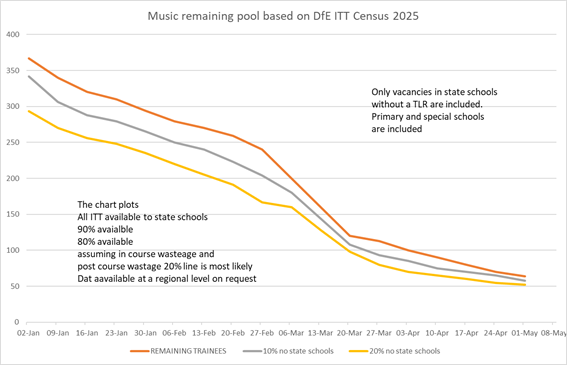
Both art and music are subjects where offers are down this year compared with 2022. In the case of art from 910 in July 2021 to just 478 this July. For music, the fall during the same period has been from 410 offers to just 224 offers this July. Drama is down from 364 offers last July to 275 this July. Offers at this level, even if all candidates turn up, will not produce enough trainees to meet the needs of schools next year.

The good news, such as it appears to be, is in subjects such as English, languages (other than classics) and geography. These are subjects where the level of applications has been large enough to allow offer levels to mean that the target should be met for the year.

However, a word of warning. Recruited numbers in four regions, including both London and the South East are below the number recorded in July 2022. Overall ‘recruited’ total is 3,395 down on July 2022, of 3,911. Also, those with ‘conditions pending’ are down by 124 on last year, creating a net loss across these two categories. There must, therefore be some uncertainty about the outcome of the recruitment round in terms of trainee numbers that will turn up in September.

Numbers of applicants in the youngest age categories are still below those for July 2022, whereas applications from candidates in the older age groupings continue to be above the levels seen in 2022.

The number of rejected applications has increased from 31,124 in July 2022 to 52,350 in July 2023. Lat year that represented 31.5% of applications. This July, it represented 40% of applications. Whether or not this increase is related to the origins of the applications is impossible to tell from the data. However, it would not surprise me if many of those rejected were in the ‘rest of the world’ category.

Barring any last-minute change next month, and with many school-based schemes not actively recruiting now, it seems likely that 2024 with be another grim year for schools recruiting teachers, especially, but not exclusively in some of the art subjects that the independent sector values more highly that the government seems to do.

Sad end to term

It is now more than nine years since a teacher died after being stabbed in her classroom by a pupil. The news today from Tewksbury reminds us that although rare, and nowhere near as common as such incidents in the USA, teaching is not an entirely risk-free activity, as I know from personal experience.

My thoughts and best wishes are with the stabbed teacher, their family and any pupils that witnessed the attack. I hope the teacher was no badly hurt. Below, is the post I wrote when the teacher was stabbed to death in her classroom in 2014.

Condolences | John Howson (wordpress.com)

Condolences

Posted on April 28, 2014

The news of the stabbing to death of a teacher in Leeds is both truly shocking and saddening at the same time. Fortunately, such deaths in schools are rare in the United Kingdom, and it is no small irony that this fatality happened in a Roman Catholic school in a challenging area just as the death nearly 20 years ago of head teacher Philip Lawrence did in north Westminster. We may live in a post-Christian society, but the Churches still offer education in many of the more disadvantaged areas of our country.

My thoughts and condolences are with the family and friends of the teacher, as well as the pupils and those that work at the school, and the wider local community. Nearly 40 years ago, I was the victim of a classroom stabbing by an intruder that could in different circumstances have ended in a fatality. As a result, I can understand something of the grief such an unexpected event give rise to. Fortunately, unlike in my day, there will no doubt be extensive counselling offered to all concerned. I don’t know the circumstances of this stabbing, except that the news bulletin says that it was a female teacher in her 60s who presumably had been at the school for some time. More will no doubt come out over the next few days and then at the subsequent trial.

The Court of Appeal has recently taken a tough stand on the carrying of knives, and rightly so if we are to reduce the incidence of violence still further in society. But, despite all the draconian laws it is impossible to entirely prevent attacks where there is a will to do violence to another.

Finally, perhaps the Secretary of State might consider a memorial in the new offices for the DfE after they move to Whitehall in 2017* that recognises the sacrifice of the small band of teachers that have given their lives to their profession. There may not be many of them, but they deserve not to be forgotten.

*Such a move never took place, but the idea of a memorial might still be worth considering.

One law for parents …

‘School sends children home because of a lack of staff’. The BBC have been running a story about a special school, part of a multi-academy trust that has been sending children home on certain days because of a lack of staff. Oxford pupils miss school amid special needs staff shortage – BBC News

The shortage of staff in the special school sector is nothing new. Indeed, I commented upon the use of unqualified teachers in that sector in a previous post. However, should any school be allowed to send pupils home because of staff shortages?

In 2017, (how time flies) the Supreme Court discussed the responsibilities of parents that contract with the State to provide schooling for their children for free. The case was Isle of Wight Council v Platt and the judgement can be read at Isle of Wight Council (Appellant) v Platt (Respondent) (supremecourt.uk)

The highest court in the land imposed a heavy burden on parents with regard to school attendance – paragraphs 31 onwards set out their reasons for doing so. In reaching their judgement, the court went further than the previous decision made in the 1930s, and placed even more restrictive reasons for parents being allowed not to send a child to school.

The court did not consider the opposite scenario of the responsibility of the State to parents that trust their child to the State to educate.  Lord Denning did discuss this in Meade v Haringey in 1979 at the end of the Winter of Discontent, but that case never came to trial as the strike ended and schools re-opened.  

Lord Denning’s comments in the case can be read at Meade v Haringey London Borough Council – Case Law – VLEX 793965949 The paragraph relevant to the present situation is in paragraph 3.

As I read the statute, it was and is the duty of the Borough Council – not only to provide the school buildings – but also to provide the teachers and other staff to run the schools – and furthermore to keep the schools open at all proper times for the education of the children. If the Borough Council were to order the schools to close for a term – or for a half-term – or even for one week, without just cause or excuse, it would be a breach of their statutory duty. If any of the teachers should refuse to do their work, the Borough Council ought to get others to replace them – and not pay the defaulters. Likewise if the caretakers refuse to open the schools – and keep the keys – the Borough Council ought to demand the return of the keys and open up the schools themselves if need be. For this simple reason: It is the statutory duty of the Borough Council to keep the schools open. If they should fail to do so, without just cause or excuse, it is a breach of their statutory duty.

These days, one must assume that either mutli-academy trust trustees have assumed the responsibilities formerly with local authorities in 1979 or that Regional School Commissioners acting on behalf of the DfE have responsibility for academies under their remit. Whoever is responsible, unless either a court rules otherwise or the law has been changed since 1979, it would seem that there is a statutory duty to open schools, and by implication to staff them during a school term. Of course, fire, plague or pestilence might cause temporary closure, but, as during the covid pandemic, schools were required to stay open for certain children.  

I guess that a parent will need to bring either a judicial review or a case against a school that sent children home. Judicial Review is an expensive process, so perhaps a Council, acting as a corporate parent, could bring the case on behalf of all parents.

It would be interesting to see how the Supreme Court balanced the rights and responsibilities of parents with the duties of the State in providing education. I am reminded that in the late 1940s the then Minister of Education summoned a Council because a school lacking a hall after bomb damage was not offering a daily act of corporate worship. What might that Labour Minister have made of schools sending children home due to staff shortages?

Labour’s style over substance

I woke up this morning to news that the Labour Party had some new proposals to end the teacher supply crisis. Strangely, the press release section of their national website hasn’t posted anything, so I am reliant on what the BBC has said for the following thoughts. Labour plan to give teachers £2,400 to stop them quitting – BBC News

In passing, the Labour Party website generally doesn’t seem to be up with events, something that surprised me for a national Party aiming for government. But there are some issues, such their relationship with other political parties, and stories of suspensions and expulsions of members that I am sure they would want to bury. Still, that is all for another day and another place.

What are Labour suggesting and why do I say that it is style over substance? Firstly, there is nothing to ease the pain of training. No fee payments, as agreed when Tuition Fees were introduced by Tony Blair’s government. This would have been an excellent opportunity for a headline along the lines -well it’s not up to me to do Labour’s work for them.

Instead of targeting trainees and entrants, we get a survivor bonus according to the BBC story

The plans to improve retention rates, announced by Labour’s shadow education secretary Bridget Phillipson on Sunday, would see new incentive payments awarded once teachers had completed a training programme known as the Early Career Framework, which covers their first two years in the classroom.

Apparently, the payment would be £2,400 or only between a gross one-off five to ten per cent payment of what a teacher would be earning at that point in time, before tax, national insurance and pension deductions. Less, with a £30,000 starting salary. Paying this to all survivors, regardless of the help or salary they received during training would according to Labour cost £50 million. I wonder what paying fees and a training salary to make all trainees equal, and it easier for career changers to become a teacher, would cost?

Labour’s other key promise is welcome, but even more hollow when you burrow down into what it means in reality.

The [Labour} party says it would also make it compulsory for new teachers to have a formal teaching qualification or be working towards one – a requirement scrapped by the coalition in 2012.

Sure, Gove made a headline announcement that academies did not need to employ qualified teachers: and most academies ignored this freedom, as they often did with the freedom to pay classroom teachers different salaries. However, it hasn’t stopped all schools employing unqualified teachers when they cannot find a qualified one to fill a post. After all, it was the Labour government that changed the name of these staff from ‘instructors’ that clearly demonstrated that they were not qualified teachers, to the more positive term ‘unqualified teachers’, and also created a pay scale for them.

Curiously, there were fewer unqualified teachers by headcount working in schools last Novermber (2022) than in November 2010, the first census after the end of the last Labour government – 14,389 in 2022 compared with 15,892 in November 2010 according to the DfE’s Workforce Census.

Ensuring all teachers are qualified, and qualified in teaching their subject or phase, something the Labour announcement doesn’t offer, must be a requirement. However, Labour doesn’t say what schools, faced with a vacancy, should do if a qualified teacher isn’t available: send children home? The lack of a credible answer to this question makes the policy no more than idle rhetoric about trainee teachers not about solving the teacher supply crisis.

I would offer emergency certification with a required training programme from day one for unqualified teachers, including those not qualified in the subject that they are teaching.

Labour final policy on staff development is again good in principle; this area has been neglected by the present government, despite the limited experience of much of the teaching force. However, the policy lacks detail, and detailing who will be responsible for implementing and paying for it?

Taking tax breaks away from private schools would probably affect the special school sector, where local authorities mostly pay the fees, more than schools where parents are responsible for the fees. Such saving would also probably be stretched thinly to pay for all the mooted changes.

Retention can be cheaper than recruitment, but by making training more attractive for all, there is more chance that schools currently unable to recruit teachers would fill their vacancies. All too often these schools are situated in the more deprived areas. These are the schools any policy should be tested against: does it improve the education of children in these schools?

For those that don’t know, I am a Liberal Democrat County Councillor in Oxfordshire