Teaching a global profession? What do the physics ITT numbers tell us?

My previous post contained the good news for the government in the headline data about their annual census of those on teacher preparation courses. Digging down into the details of the census, there is at least one worrying trend. https://www.gov.uk/government/statistics/initial-teacher-training-trainee-number-census-2025-to-2026

The percentage of accepted ITT candidates within each nationality group for selected subjects for 2024/25 and 2025/26

Percentage of accepted candidates
UK and Irish nationalEEA nationalOther nationality
2024/252025/262024/252025/262024/252025/26
Total88%86%5%5%8%9%
Primary94%94%2%3%4%3%
Secondary84%82%6%6%10%13%
STEM Subjects76%74%5%5%19%22%
Physics43%32%3%2%54%66%
English93%93%3%2%4%5%
Mathematics81%81%5%5%13%14%
  1. High Potential ITT (HPITT) route and undergraduate routes are not included in this data.
  2. Subject-level candidate totals will not sum to the total candidate number due to duplication caused by candidates applying for multiple subjects.

The footnote about undergraduate routes should not be of concern as there are relatively few such courses for secondary subjects, and the numbers on primary undergraduate courses have been declining over the longer-term.

Of much more concern is the decline in percentage of accepted candidates for physics from the UK and Ireland, down from 43% last year to 32% this year. This has been balanced by and increase from 54% to 66% for candidates from outside the UK and EEA areas.

As there has bene a dramatic increase in the numbers of trainees in physics, does this matter?

On these percentages, the increase in UK and Irish trainees has been from only around 185 last year to 220 this year. That seems like a very small number and worth investigating to see if I am correct?

If I am correct, then the key issue is, where will the trainees from the rest of the world be able to teach? Will the present government’s stricter policies on immigration mean that they won’t be able to teach in England, or as graduates earning a good salary will they be given visas?

Of course, they may choose to teach in the new British state sponsored selective school being established in both India and the UAE that was recently approved by the Labour government.

British Education is a global export, regardless of the PISA scores of home students, and the destination of trainees, both within the state and private systems, as well as overseas, is an important piece of information Minister should pay more attention to than they do at present.

The number of Uk trainees is likely to be boosted in physics by those training through the High Potential route (Formerly known as Teach First), However, the data for those candidates is not included in the census this year.

No doubt there is room for some interesting parliamentary questions about trainee teachers and where they come from and where they go on to teach, especially for those that receive bursaries and other financial support from the State.

Too many teachers?

Earlier today the DfE published their Annual Census of ITT trainees. Published each December, the census identifies the numbers on the various teacher perpetration routes and some background information about their gender, ethnicity, degree class and routes into teaching. Initial teacher training: trainee number census 2025 to 2026 – GOV.UK

The census provides a helpful indication to schools about the labour market for the following September recruitment. In this case, September 2026.

In recent years, apart for during 2020 and the response to the pandemic, trainees number in many secondary subjects have been lees than the DfE predicted numbers needed to fill vacancies. In the primary sector, falling rolls and erratic recruitment numbers have meant there has been less of a coherent pattern about the balance between supply and likely demand for teachers. Of course, much depends upon assumptions about the turnover in the labour market, and the behaviour of possible ‘returners’ to teaching when reviewing recruitment patterns.

So, what of the current 2025/26 cohort?

subject2024/252025/26
Percentage of Target at census date%%
Physical Education213202
Biology116151
Art & Design64128
Primary88126
History116125
Chemistry62118
Mathematics72113
Geography91111
English99106
Modern Languages4493
All Secondary6188
Computing3780
Physics3077
Classics24573
Design & Technology4070
Music4065
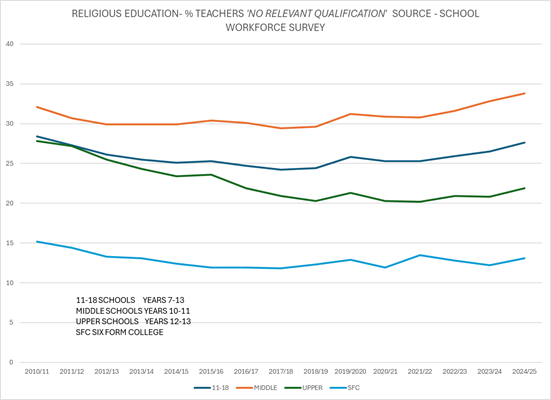
Religious Education7962
Drama4741
Business Studies1530
Other1514

The government can be pleased with some of the best recruitment levels to their targets in almost a generation – covid years excepted – but challenges still remain. Nine secondary subjects didn’t meet their target number, with business studies still recruiting poorly to teaching, along with drama and religious studies where the target was missed by a larger percentage than last year.

On the good news side, mathematic exceeded its target for the first time in a long while, and the increase to 77% of target in physics teachers is very welcome news.

There will be too many primary school teachers looking for jobs come September, and although course providers will be happy to have recruited 202% of the target for physical education trainees, this over-recruitment does beg the question as to whether recruitment controls should be once again considered as a deterrent to such significant over-recruitment?

Taken with the news, highlighted in my previous post, about attitudes to pay by serving teachers, the government can probably stop worrying abut teacher recruitment for the first time since 2012.

However, all is not good news, if the Curriculum Review is to be implemented in full, attention to recruitment in some subjects will be needed. In that respect, as already suggested by this blog in a previous post, removing the bursary from music seems like a daft idea. Yes, there was a 25% increase in outcome against target, but that still left a third of places unfilled. Music departments in schools are often small and cannot be easily covered by non-specialists, such as the spare PE teachers. Time to think again on the basis of these figures.

More men looking to teach

Today, the DfE published their first round of statistics about applications to train as a teacher on courses starting in the autumn of 2026. Generally, one has to be cautious about data from ‘applications’ and ‘offer’ statistics published in November, as this is very early in the application round.

However, with more than 20 years of data underpinning my remarks, I think it possible to say something.

Firstly, applications – and candidates may submit more than one – are up from 13,159 last November to 15,572 this year. Applications from men are up from 5,072 to 6,580, while those from women are up from 7,978 to 9,031. That equates to 1,052 more women applying, or an increase of 13%, but 1,508 more men; an increase of 30%. I cannot recall a time when the rate of increase in applications from men last outpaced those from women.

Part of this increase is probably down to the large increases in applications for mathematics, up from 1,657 last year to 1,929 this year. In computing, the applications are up from 509 to 841, and in physics from 1,694 to a staggering 3,277. All these are subjects that tend to attract more male than female candidates.

Aword of warning, before one becomes too carried away; applications from the Rest of the World are up from 3,540 last November to 5,120 this November. Might this account for part of the increase in male applicant in these subjects? Sadly, that cannot be determined from the published data.

Final year undergraduates are not yet swarming into teaching. No obvious concerns about loss of graduate jobs to AI from the 21 and under age group, where applications are actually down by 34 from 1,276 to 1,242. Presumably, studies still take precedence over job hunting.

However, there is a big increase in the 22-24 age group applying for teaching: up from 3,349 to 3,658 with nearly 200 of this increase from 22 year olds. Maybe summer 2025 graduates that are still job hunting are turning to teaching? There is little difference in interest in teaching from those over 45 years old. However, there has been a big jump (210) in interest from the 40-44 age group.

SCITTs is the only route to have seen fewer applications than in November 2025. This may reflect the fact that the SCITT route maty be less well-known to overseas applicants. Both teacher degree apprenticeships and PG teaching apprenticeships have seen significant increases in applications. It would be interesting to see this table by phase and subject.

On ‘offers’, it much depends upon how providers handle early applications. However, there is a trend with mathematics, computing, chemistry and physics all recording the highest ‘offer’ levels since 2013/14, whereas music has the lowest offer level since 2020/21. Most other subjects are close to where they would be expected to be, although biology, PE and geography are below where they might expect to be. PE probably over-recruited to current courses, and I would expect more caution there this year.

So, overall, a good start that should presage a good recruitment round unless something unforeseen happens.

6500 new teachers: wasn’t that a manifesto pledge?

The DfE has today published the annual Education and Training Statistics for the whole of the United Kingdom.  Education and training statistics for the UK, Reporting year 2025 – Explore education statistics – GOV.UKAs ever, there is a wealth of material and the devil is in the details.

The full-time equitant number of teachers in England increased between 2023/24 and 2024/25. The data for schools in England isn’t new, as it was first reported in June 2025 School workforce in England, Reporting year 2024 – Explore education statistics – GOV.UK

However, it is worth discussing the data again, as it will provide the basis against which any claims about increased teacher numbers will be judged.

Phase201920202021202122202223202324202425
Non-maintained mainstreamTotal769757731071695732557524074100
NurseryTotal119511601100106510751060
PrimaryTotal219960221365221230220265217460214575
SecondaryTotal204715209835213630216075217565219000
SpecialTotal242802502526005271402824029150
TotalTotal530800538415537285541690543930542355
Total maintainedTotal453820461105465590468435468690468260

The changes over one year and the whole of the time period are shown in this table

Totalchange on 202324change on 201920
Non-maintained mainstreamTotal-1140-2875
NurseryTotal-15-135
PrimaryTotal-2885-5385
SecondaryTotal143514285
SpecialTotal9104870
TotalTotal-157511555
Total maintainedTotal-43014440

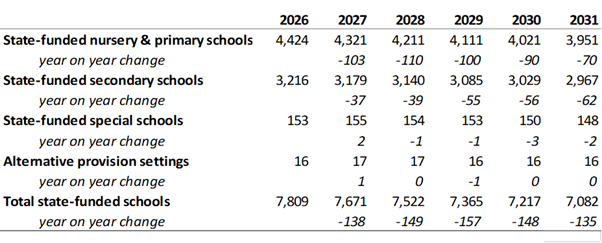
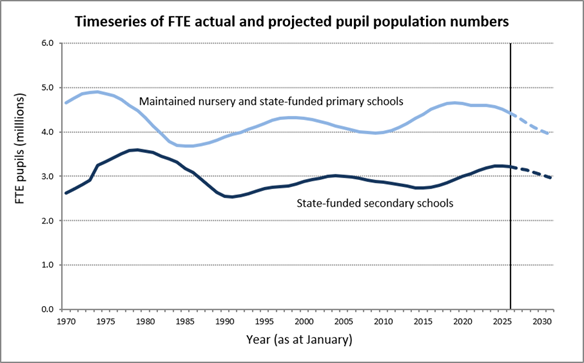
It is worth noting that as the school population increased, so did the number of teachers in state-maintained schools. Thus, between 2019/2020 and 2024/2025 teacher numbers increased by 14,440, although the decline in teachers in the nursery and primary schools had already started.

However, by 2024/25 the total teacher workforce was some 14,440 FTEs larger than it had been in 2019/2020 as a result of the increase in the number of secondary and special school teachers.

Between 2023/24 and 2024/25, teacher numbers in England continued to increase across both the secondary and special school sectors, but the decline in the primary sector teacher numbers continued. The nursey sector showed little change, but employs few teachers in state nursery schools as opposed to nursery classes in primary schools.

There is a message here for anyone considering a career as a primary school teacher. Before accepting a place on a teacher peroration course; do some homework on job possibilities in the area of the country where you would like to teach, especially if it is not where you are training.

I doubt that we have yet seen the end of the decline in teacher numbers in the primary sector, and it will be a buyer’s market, even in 2027 when those applying for courses starting next September will enter the labour market in large numbers.

In the past, under such conditions, schools have preferred to employ experienced teachers leaving new entrants to look for posts in schools for which they may not have been trained. Often the jobs will either be in schools with a higher deprivation index score or small schools with mixed age classes. Neither of these teaching situations may have been encountered during a one-year teacher preparation course, and can be challenging for new teachers if not adequately supported.   

Don’t be afraid to ask about job prospects at interview, especially if you are paying your own tuition fees.

Classroom teacher turnover in London needs watching

Historically, the turnover rate for classroom teachers in London has tended to be higher than elsewhere in England

YearInner LondonOuter London
2016/1714.9%12.5%
2017/1813.1%11.9%
2018/1912.8%11.4%
2019/209.9%8.4%
2020/2111.1%9.6%
2021/2212.8%11.1%
2022/2312.3%10.7%
2023/2412.5%10.7%

Source DfE evidence to STRB October 2025 Data annex

In 2016/17, turnover for classroom teachers in the Inner London boroughs reached 14.9%, or around one in seven classroom teachers either leaving the profession or moving school. Three years later, in the year where covid disrupted the summer term, turnover rates dropped below 10% for the only time in the last eight years. Once the pandemic subsided, turnover quickly returned to over 12%, or one in eight teachers.

In Outer London turnover rates have followed a similar pattern to those in Inner London, but a couple of percentage points lower than in the Inner London boroughs.

By way of contrast, in the North East, during 2023/24 turnover for classroom teachers was just 7.7%, some 4.8% lower than in Inner London schools.

Leaving aside the two years where covid affected the recruitment round (2019/20 and 2020/21), the national turnover rate for all levels of posts (classroom, leadership and headship) has generally been between 9-10%, but has been falling. In 2023/24 it was 9% compared with 10.6% in 2016/17.

Rates of turnover for assistant head and deputy heads probably reflect demand side issues more than what is happening on the supply side. When school rolls are rising, new schools may be created increasing demand: falling rolls may mean posts are cutback, and demand reduced, so less turnover.

Headship turnover is very closely linked to the age profile of headteachers. When a cohort of new younger headteachers has replaced a generation that has retired, turnover is likely to fall for a few years. However, turnover tends to be within a narrow range of between 9.5-10.5% per year. There is now no discernible London effect on headteacher turnover, as there used to be many years ago when headteacher salaries were more tightly controlled.

Might we now be entering a period of stability, with lower turnover rates for classroom teachers , especially should the possible upheaval in the graduate job market created by the AI revolution coincide with the period of stable rolls in the secondary secto,r and falling rolls in the primary sector?

YearPrimarySecondarySTEM subjectsNon-STEMAll Teachers
2016/1786.3583.1%81.2%84.5%84.9%
2023/2490.0%89.4%88.0%90.2% 89/7%

The table taken from various tables in the DfE evidence to the STRB shows a consistent trend of improved retention for teachers at the end of the first year of service. However, the same tables show that there is still a job to be done to retain these teachers in larger numbers beyond their first few years of service. The government needs to be aware that teaching is now a global career, and teachers from England can easily find work overseas.

DfE confirms secondary ITT shortfall in evidence to STRB

The DfE’s evidence to the STRB (pay review body for teachers) contains some useful information about the state of the teaching profess, and changes over the past decade and a half since the DfE moved the teacher census from January to November each year. Much has remained the same, across the whole time period. But, before delving into the past, it is worth looking at the table for offers on secondary subjects for 2025 that I created for an earlier post, but now with the data from Table FD4-FD6 of the STRB evidence Evidence to the STRB: 2026 pay award for teachers and leaders – GOV.UK

Interestingly, the DfE doesn’t seem to have included the offers against targets that might have help the STRB to see where shortfalls are likely once the ITT census is published in December.

SubjectTarget2025/26% increase Sept on Juneaccepted Sept 25 FD6 DfE to STRBover/under target
Total Secondary19,27026%16843-2,427
Primary7,65034%98802,230
Chemistry73049%909179
Biology98536%1397412
Mathematics2,30035%2617317
Design & Technology96533%678-287
Art & Design68033%902222
Geography93533%98146
Classics6032%42-18
English1,95031%1760-190
Drama62030%273-347
Business Studies90029%235-665
Music56528%343-222
Religious Education78028%418-362
Others2,52025%360-2,160
History79023%936146
Modern Languages1,46021%1428-32
Physics1,41019%1313-97
Physical Education72517%1491766
Computing8955%761-134

As I suggested in my previous post, despite the renewed attraction of teaching for new graduates, there are still some subjects that won’t meet their target. Interestingly, the target for recruiting primary teachers is likely to be massively exceeded this year. Whether all those trainees will find jobs next summer is an interesting question.

With the continued shortfall against targets, where do schools find their staff from, and are they appropriately qualified? The answer to the second part of the question seems to be it depends on whether the school is in Pupil Premium decile 1 or decile 10. (Table D7) The data in this table suggests that schools in decline 1 have higher teacher wastage rates; higher percentages of unqualified teachers; higher percentages of teachers with less experience of teaching and a higher percentage of lesson taught by teachers not seen as qualified in the subject they are teaching. None of this is very surprising, but if the government wants to do something to level up outcomes, then they should pay attention to these percentages.

As to where schools find their teachers to ensure they are fully staffed if there are shortfalls in the numbers emerging from training, there has been a shift in the number of teachers coming from the old dominions, and an increase in those from other members of the Commonwealth. I will discuss these changes in more detail in another blog, as well as trends in recruitment for Europe.

Finally, it is worth noting that the secondary school teacher population expressed as Full Time equivalents (FTEs) barely changed between November 2010 and November 2020, increasing by just 265 FTEs, from 218,736 to 219,001. By contrast, the primary teacher FTEs in the same period increased from 196,258 to 215,632 by November 2024, although this was below the 225,537 FTEs recorded in November 2020, before pupil numbers began to fall.

Labour’s determination to recruit new teachers doesn’t include music

‘Now, when I think back to my school days, when I think of the happy memories. It was all about the teachers I had along the way. 

The ones who helped me succeed are the ones who made me feel like I belonged. 

That’s why I am determined to help you recruit and retain more great teachers in your schools.  

And to encourage more people to get into the profession, what’s why we have set out today the new initial teacher training incentive. 

I want more great teachers in our schools, working their magic. 

And it really is magic – what they do, what you do. 

Don’t ever let anyone tell you otherwise. 

And I certainly won’t let anyone tell me otherwise. 

You have the wonderful power to transform lives. 

To give to children the knowledge and skills they need to succeed, not just in work, but in life too. 

Extract from Secretary of State for Education’s speech at RISE Attainment Conference.’ Education Secretary speech at RISE attainment conference – GOV.UK

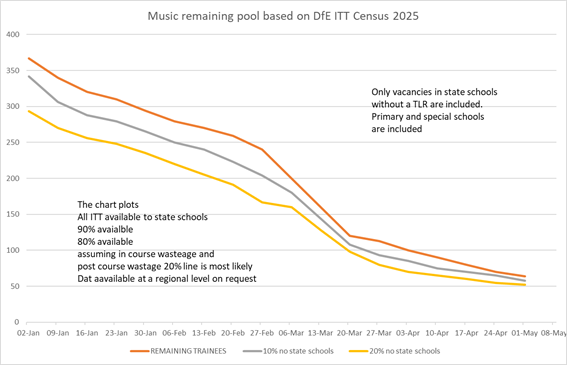
With respect, Secretary of State, what about Music teachers? The bursary for the subject has been removed for those applying to train in 2026. This is despite the likelihood of the number of entrants to ITT courses this autumn not meeting the ITT target set by the DfE. With the cuts in music courses at universities, competition of the remaining graduates is likely to intensify as the arts sector continues to contribute to increasing the national wealth.

It is not as if missing the ITT target in music is something new.

ITT census% of target recruited
2019/2080
2020/21122
2021/2271
2022/2362
2023/2427
2024/2540
2025/2565

Source: DfE ITT censuses

Presumably, the DfE is hoping that the AI revolution that will remove many existing graduate entry level jobs, will create a similar situation to the covid pandemic that drove graduates back to choosing teaching as a career. Will this be true? Only if the universities are producing the same number of new graduates, since potential career changers may already be in jobs less threatened by AI?

The text of this 2024 article suggests that new graduates in music may be harder to find than in the past Full scale of university arts cuts emerges – Arts Professional

My message is simple, the bursary should not have been removed for music, and possibly other arts subjects as well. However, the DfE should monitor applications for September 2026 training and, if by February, they are showing a failure to meet the target again in 2026, then the bursary should be reintroduced.

By the way, I have a simple formula for monitoring applications against target that I used for over a decade when UCAS managed the ITT application process. I might start using it again when the 2026 applications are revealed each month.

My reason for picking on music for this post is that I have just been invited to take over the role of Chair of Oxfordshire’s Music Hub Board.

Is Labour making mistakes on ITT bursaries?

Yesterday, the government announced the bursaries for trainee graduate teachers and support for school training through the Post Graduate Apprenticeship route (PGTA). As might be expected, the subjects covered by these inducements to train as a teacher are mostly STEM subjects, plus some other subjects, but not the arts and humanities subjects, except for geography for some reason.

SubjectBursaryScholarship
Biology£5,000
Chemistry£29,000£31,000
Computing£29,000£31,000
Design and technology£20,000
Geography£5,000
Languages£20,000£22,000
(French, German and Spanish only)
Languages£20,000
(all other languages, including ancient languages)                          
Maths£29,000
Physics£29,000£31,000

Teacher training bursaries | Get Into Teaching GOV.UK

The bursaries are paid for by the government, and the scholarships mostly by the subject associations. While I can understand the government’s desire to increase training numbers up to target in these subjects, the list does raise two important questions about what seems like a continuation of the policy of the previous Conservative government.

Firstly, are these now the subjects where targets will not be met in 2025 when the ITT census is published in December. If there are other subjects not likely to meet their ITT target, why are they not included in the list?

I produced this table for an earlier blog, but it is worth repeating here.

SubjectTarget2025/26% increase Sept on Juneaccepted Sept 25over/under target
Total Secondary19,27026%16843-2,427
Primary7,65034%98802,230
Chemistry73049%909179
Biology98536%1397412
Mathematics2,30035%2617317
Design & Technology96533%678-287
Art & Design68033%902222
Geography93533%98146
Classics6032%42-18
English1,95031%1760-190
Drama62030%273-347
Business Studies90029%235-665
Music56528%343-222
Religious Education78028%418-362
Others2,52025%360-2,160
History79023%936146
Modern Languages1,46021%1428-32
Physics1,41019%1313-97
Physical Education72517%1491766
Computing8955%761-134

Why are subjects such business studies – a perennial ITT target failure – and music and religious education not included in the bursary list? Does a Labour government not believe these subjects are worth supporting?

The second issue is around whether there will be the jobs available for trainees recruited into training in September 2026, and entering the labour market in September 2027, if on a traditional course. The more the PGTA route is funded, the fewer advertised vacancies there may be if the schools convert PGTA trainees into qualified teachers doing the same job.

The government announcement contains no discussion about the labour market for teachers, and whether ITT trainees, faced with a secondary sector where pupil numbers will be at best flat, and at worst in decline, if the decline in the birthrate together with government policies on immigration or even the threat of them help to reduce the secondary school population.

From my perspective, this announcement like a sloppy piece of work by the DfE, in what could be a rapidly changing labour market, if the intention is to ensure all subjects receive sufficient new entrants into the labour market in 2026.

However, if there is a rapid decline in graduate level entry posts as a result of AI, then the government’s stance may be vindicated, even if says nothing about equality of opportunity.

Are men returning to teaching as a career?

Further delving into the DfE research into school leadership brough to light two more interesting facts. The first is the fact that Headteachers in the secondary sector are more likely to have a Level 7 qualification than head teachers in the primary sector. 76.8% of secondary heads have a Level 7 qualification compared with 41.6% of headteachers in the primary sector.

This difference should not surprise anyone with a sense of history, as many primary headteachers trained when the undergraduate route into primary teaching was still almost as common as the post graduate route. What is more surprising is that the PGCE is classified as a Level 7 qualification. In terms of level of content, I would assume it was actually a Level 6 qualification.

In reality, with more school-based trainees, including those that completed the Teach First route, this will not be a very useful statistic in the future.

The other nugget in the data doesn’t concern leadership statistics, but men in primary classrooms. In order to account for the data on leadership, many of the tables also contain information about classroom teachers and middle and senior leaders not headteachers.

The percentage of classroom teachers in the primary school sector that are male was on the increase between 2010 and 2020, whereas in secondary schools the percentage has continued to decline.

Year% Male classroom teacher in primary sectorTotal classroom teachers
201011,3%130,800
201613.9%142,800
202014.0%144,900
Year% Male classroom teacher in secondary sectorTotal classroom teachers
201035.7%117.100
201634.3%103,900
202033.8%106,000

Data from pages 26,27 and 73 School leadership in England 2010 to 2020: characteristics and trends

Because male teachers are less likely to have a break in service than female teachers, even with maternity leave of one year, there are still higher percentages of males as headteacher in the primary sector than the percentage of male classroom teachers. However, the percentage of male headteachers has been declining, from 29% of primary sector heads in 2010 to 26.2% in 2020.

In the secondary sector, the percentage of male headteachers declined from 62.1% in 2010 to 59.9% in 2020, suggesting that the glass ceiling is still proving difficult to breakthrough after an initial growth in the percentage of female head teachers during the first decade of the century.

Looking back in history, in both 1989 and 1996 male applicants accounted for 36% of PGCE applicants in both years. This was down from 43% of applicants recorded in 1983. In 1995 men accounted for just 16.1% of applicants to primary PGCE courses (Source Howson, Education Review, Summer 1996, Volume 10 Number 1 pp 36-40)

According to the latest DfE data for applications to postgraduate ITT training in the 2024-25 round, released in September 2025, male candidates made up 44% of all applicants, up from 39% the previous year.  However, the DfE do not release gender data for either sectors or subjects, as was the case with the GTTR data. Nevertheless, the 2024-25 percentage of 44% male applicants is very similar to the 43% recorded in 1983.

It would be interesting to know whether male candidates receive offers at the same rate as female candidates, especially if only candidates domiciled in England are considered. However, that data isn’t in the monthly releases from the DfE.

Perhaps the low point in male interest in primary school teaching has been reached, but with training numbers on the decline, the balance between applications and offers does need to be monitored, and preferably shared with the sector to ensure discussion about any future trends.  

Has teaching become an attractive career again: Part 2

Following on from my initial analysis of September’s data on postgraduate teacher preparation course applications and offers, outlined in the previous post, I have now looked at the data in more detail.

The table below looks at the DfE target for entry into courses in autumn 2025 plus the increase in ‘offers’ made between the June and September data runs this year. The number shown as ‘accepted’ in September is then compared with the ‘target to show any possible over-recruitment or ‘shortfall’ there might be in each subject and phase. The latter would be bad news for schools seeking to recruit into those subjects both next September, and in January 2027.

SubjectTarget2025/26% increase in Offers Sept on Juneaccepted Sept 25over/under target
Total Secondary19,27026%16843-2,427
Primary7,65034%98802,230
Chemistry73049%909179
Biology98536%1397412
Mathematics2,30035%2617317
Design & Technology96533%678-287
Art & Design68033%902222
Geography93533%98146
Classics6032%42-18
English1,95031%1760-190
Drama62030%273-347
Business Studies90029%235-665
Music56528%343-222
Religious Education78028%418-362
Others2,52025%360-2,160
History79023%936146
Modern Languages1,46021%1428-32
Physics1,41019%1313-97
Physical Education72517%1491766
Computing8955%761-134

The data is interesting. There has indeed been a surge in ‘offers’ made in many subjects between June and September. Chemistry leads the way, with a 49% increase in ‘offers’ between June and September. This is followed by Biology (36%), mathematics (35%) and art and design (33%)

Other art subjects have seen significant increases in ‘offers’ of between 28-33%, but that has not been enough to ensure targets will be met this year.  In some subject, notably history and geography, targets were close to being met by June, so few new offers have been made. This is not seemingly the case in PE, the targets had been met by June, but 17% more offers have been made between June and September. Overall, this suggests a late surge in interest in teaching as a career.

Of more concern is the situation in Classics, English, drama, business studies and music, plus religious education and the catch-all ‘other subject’s where targets will be missed, even though ‘offers’ have increased significantly for the time of year. The DfE needs to assess how the market is changing in regard of who wants to be a teacher.

Because of the complication of applications from outside of the United Kingdom, it won’t be until the ITT Census is published in December that the full picture on recruitment into ITT will emerge.

However, civil servants cannot assume, ‘more of the same’ is what is needed in what may be a changing market, where for some teaching now looks more attractive as a career.

In changing times, the amount of data available can be helpful in assessing what is happening. In the previous post, I suggested some data points that it would be useful to have regional and provider level data during the recruitment round, especially in relation to the probability, based on previous years’ data, of those applying from outside of the United Kingdom taking up a place if offered one.