A review of headteacher turnover in state funded schools between 1st August 2025 and 31st July 2026.
Data collected from DfE Vacancy site and other job boards.
1,407 schools recorded as advertising for a headteacher.
1,639 advertisements including re-advertisements, a similar number to a decade ago.
1,008 Primary Sector; 291 Secondary Sector and 107 Special Sector schools were recorded as advertising for a headteacher.
6% of Primary Sector; 8% of Secondary Sector and 10% of Special Sector schools were recorded as advertising for a headteacher.
Yorkshire & The Humber and East of England Regions recorded the highest percentage of secondary sector headteacher vacancies re-advertised. No re-advertisements for a secondary school headteacher were recorded in the North East Region.
More than 100 secondary schools offered a starting salary in excess of £100,000.
The East of England, East Midlands and South West regions recorded the highest rates of primary sector headteacher vacancies re-advertised.
This year, thirty-one primary schools and two nurseries had a salary range starting below £60,000.
Re-advertisement rates for special schools were higher than in the other two sectors.
Faith schools were more likely to readvertise a headteacher vacancy than non-faith schools. This is not a new finding.
Vacancies advertised between August and November are most likely to be re-advertised.
For a full copy of the report, email: dataforeducation@gmail.com
What does it take to ensure all training places for graduates wanting to be a teacher are filled. The best chance of sufficient trainees is when the school population is in decline, the job market is challenging for graduates – especially new graduates – and existing teachers are not exiting the profession at the same rate as previously.
The current ITT position is governed by the fact that school rolls are falling, so fewer new teachers are needed; the graduate job market is beginning to feel the consequences of AI, or it may be for graduates in some subjects, such as computing. Although teachers leaving the profession, net of returners, has not changed much, the opportunities for teachers to work outside of England and not pay back their student loans is probably still increasing.
The 2026 targets for trainee numbers were cut by the DfE. We won’t know until the ITT census in December what the overall picture looks like, but the table below shows the position if all ‘accepted’ for courses covered by the DfE’s monthly statistics of numbers accepted were to turn up and be recorded in the 2026 ITT census.
Subject Target 2026/27 August offers Fill: August view August Accepted Fill on Accepted August Chemistry 690 1530 YES 1362 YES Biology 675 679 PROBABLY 492 NO Mathematics 2000 3141 YES 2720 YES Design & Technology 620 741 YES 659 YES Art & Design 605 756 YES 624 YES Geography 685 589 NO 496 NO Classics 75 47 NO 39 NO English 1980 1900 POSSIBLY 1587 NO Drama 370 338 POSSIBLY 279 NO Business Studies 1200 379 NO 283 NO Music 260 283 YES 238 NO Religious Education 450 367 NO 308 NO Others 2035 527 NO 424 NO History 520 1166 YES 995 YES Modern Languages 1085 1409 YES 1201 YES Physics 810 1649 YES 1434 YES Physical Education 655 1608 YES 1359 YES Computing 565 1041 YES 876 YES
Despite the cuts to training places, some subjects are still unlikely to meet their reduced target, even though they have more trainees accepted than last year. However, the effect of AI may be seen in the increase in numbers accepted in computing.
The focus now should be on recruitment into the arts and social sciences, where some subjects only beat the target number by a very small margin, and others missed even the reduced requirement. Can the DfE afford to offer bursaries in these subjects without cutting the bursary elsewhere and risking a yo-yo effect of no bursary, a slump in applications.
Personally, I think al trainees should be treated equally, and that the DfE should not try to pick winners and losers. However, with funding tight, I cannot see that happening, even with a Secretary of State more likely to be sympathetic to teachers than some of her predecessors.
In passing, it is worth noting that applications from those in their 50s are below the numbers in the last cycle. All other groups have recorded increases, but for the ‘21 and under’ new graduates grouping, this is just 106 more applicants. For the 22-25 age groups it is just over 600 more application out a total of over 15,000.
The large increase in applications is for secondary courses, up from 38,169 in the last cycle to 43,365 this year. However, much of that increase has been fuelled by an increase in applicants from the ‘Rest of the world’ – up from 8,777 in the last cycle to 14,049 in this cycle, now accounting for more than 25% of applicants once those from the EEA are included in the total.
The September DfE data will be confirmatory, and few changes are expected that is unless those from overseas that have been ‘accepted’ fall foul of the government’s visa rules.
What of the class of 2027/28? With falling rolls, and the increasing effect of AI on jobs for new graduates, it seems likely a new golden age for teacher training may be dawning. However, this will result in casualties among providers: not all will survive.
This blog called the start of the supply crisis in 2013, and was condemned by the DfE for doing so. Perhaps it might be rewarded for charting what has happened over the next 13 years, and its predication for the future? But somehow I doubt it.
This is the latest of my August holiday posts. Somehow, even on holiday on the other side of the world, education stories worth commenting upon still appear. Last Monday (17TH August), The Sydney Morning Herald carried an opinion piece headed, ’Good education ideas need the right execution’.
Interestingly, the story was about the success of the Multi Academy Programme in raising education standards in England. The author of the piece stated that ‘A key enabler of England’s progress has been the Multi-Academy Trust (MAT). He added that ‘Rather than every school running its own back office, finance, HR and administration those functions are shared across the group’.
The author concluded that the creation of MATs allows teachers to spend more time on teaching and learning, and, hence on raising standards. In essence, this is a critique of the Thatcher government’s 1987 education reforms that took responsibility for schools away from democratically accountable local councils and, by devolving budgets to individual schools, made each school a small business in its own right.
I don’t disagree with Gant Rule’s basic thesis in his Sydney Morning Telegraph opinion piece that schools are better run as part of a larger organisation than as a small business. Where we part company is over the matter of local democratic oversight of schools.
Interestingly, opposite Mr Rules opinion piece in the newspaper is a full page advert placed by The McKinnon organisation that aims to ‘to strengthen the standard of political leadership and improve how our country is governed’.
It seems odd to me that an organisation championing such views about governance should sanction an opinion piece that seems to be in direct opposition to its stated values. This is because in England, MATs are subject to no local political control.
Additionally, a MAT might well have schools spread across the country and thus be in competition with other MATs for pupils and staff with no local accountability for any of its schools.
Indeed, regular readers of my blog will know of the campaign I supported to bring in-year admissions back into a single system rather than allowing MATs to drive a coach and horses through any sensible local planning. That privilege was certainly not in the spirit of improving how England’s education system was governed and was especially harmful for children taken into care and forced to change school mid-year (search for Jacob’s Law om johnohowson.wordpress for more details). The 2026 Education Act in England has returned all in-year admissions to the oversight of local authorities, a bonus for local democracy.
As a former county councillor, and cabinet member for Children’s Services, I am not unbiased in the discussions about who should run schools in England.
However, I find it interesting that a newspaper can publish an. opinion piece by Mr Rule opposite a full-page advertisement from the organisation Mr Rule co-founded. Perhaps the declaration that the piece is part of a partnership between the Herald newspaper and McKinnon makes it alright.
Unlike Mr Rule, I believe that schools should serve their local communities, and that MATs rarely recognise that fact. Councillors can be voted out of office: CEOs of MATs are safe from local scrutiny. There must be some discussion about how democratic the MAT model of school governance is and how it fits into the McKinnon’s vision for the health of any democracy, either in England or Australia?
The latest data, plus the data for the previous year are shown in the table.
However, the percentage of non-White trainees dropped from 75% of the total in 2023/24, to 72% of the 2024/25 trainee total.
The percentages teaching in state schools within 16 months of obtaining QTS dropped for all groups, but the decrease was largest, in percentage terms, for the Black/African/Caribbean Group, down from 74% to 67%. This is a real disappointment, and merits further investigation as to where the decline has occurred? This is a group of graduates that have regularly found obtaining a place on a teaching course more challenging than for graduates from other ethnic groups, and especially the ‘White’ majority grouping.
Despite the much larger number of White trainees, they achieved a higher percentage teaching in state schools than for any ethnic group, once again, in the latest data.
Numbers not obtaining qualified teacher Statues (QTS) also increased for all groups. Was this due to increased numbers dropping out of their course or an increase in trainees being failed at the end of the course?
The ethnicity of the teaching profession is an area the new Secretary of State might want to ask officials to investigate. The diversity of our student population should be matched by a similar diversity in the teaching workforce, as I am sure it is among the non-teaching staff in our schools.
At the same time, it would be worth asking whether it is harder for men from ethnic minorities than for women from these groups to enter teaching?
As an aside, it would be helpful if ethnicity was added to gender data in the DfE’s monthly statistics on applications to train as a teacher by graduates.
In the previous post, I considered trends in teacher supply into state secondary schools for three subjects listed as a part of the Prime Minister’s proposed MBacc. If such a qualification is to be rolled out nationally, then there will either need to be more teachers in schools in certain subjects or more young people will need to be diverted into further education, perhaps at 14 rather than 16. However, even that strategy won’t solve the music and performing arts dilemma regarding the number of teachers’ issue. Abolishing the bursary for music looks even more unfortunate in the light of the MBacc announcement.
How about the wider primary and secondary sectors?
In line with falling pupil numbers, there has been a reduction in trainee numbers in the primary sector. This has resulted in fewer numbers obtaining QTS, and even fewer of those working in the state primary school sector. The 5,882 recorded working in state schools of the 2024/25 cohort should increase as the data is refined, but it is still likely to be only halfthe number of just four years previously, when more than 10,000 new teachers were working in the primary sector at some point in the 16 months after obtaining Qualified Teacher Status (QTS).
Fortunately, those newly qualified teachers not obtaining a teaching post in England, might be able to look overseas for work. With VAT on fees for private school pupils in England, the independent sector is unlikely to offer must of an alternative to the state sector over the next few years; at least until there is some upturn in the birthrate.
I hope that course providers will take note of this data, and not over-recruit to courses in the future, as burdening students with more debt and a restricted chance of securing a teaching post is not really fair on the students.
In the secondary sector, the overall position hides some variations between subjects.
The percentage obtaining QTS among secondary trainees has been falling; from some 95% before covid, to 92-93% in the years since. The overall percentage hides a much greater change in the numbers obtaining QTS, from a Covid high of 19,070 to a low of 12,820 only two years later. Covid may have brought forward the decision to teach that might otherwise have been delayed until a future year.
Fortunately, 2024-2025 saw the number obtaining QTS much closer to pre-Covid levels. With falling rolls, the overall number of trainees, if not the mix within subjects, may be satisfactory for the DfE.
However, post-covid the state school sector lost around five and a half thousand teachers compared with the pre-covid numbers f new teachers entering state schools. To what extend these missing teachers have been replaced by new entrants through the ‘assessment only’ route, isn’t clear from the data.
In the most recent year, 2024-2025, what of the percentages in state schools by secondary subjects?
The low percentage of those qualifying for QTS in Classics instate schools, is perhaps not a surprise given the percentage of state schools that teach the subject. The fact physical education is in second position in the table, with just 59% of those obtaining QTS in state schools should not be a surprise to anyone familiar with the number of trainees recruited and the DfE’s target for the subject.
Only in English and mathematics were there more than 1,000 new teachers working in schools. Given the requirement to teach these subjects to all pupils up to Year 11, and for some in Years 12 & 13, even these numbers may be insufficient. The 234 music, and 133 business studies teachers, and the 321 religious education new entrants, are almost certainly not enough to allow the subjects to thrive in our schools, even before the desire to widen the curriculum to include more MBacc students, and fewer EBacc students.
Alongside the conversation about the curriculum, and the desire of the Prime Minister to make it more relevant for work in the 21st century, there really needs to be a conversation about how the curriculum changes can be properly staffed, so that all pupils receive a high quality education taught by teachers qualified in their subject, and not just a page ahead of the AI generated lesson plan.
Number for three key subjects are limited, as the table makes clear
Achieved QTS and teaching in a state school within 16 months of QTS
ITT Year
Business Studies
Design & Technology
Music
Total
2017/18
106
240
220
566
2018/19
134
236
212
582
2019/2020
125
341
224
690
2020/21
225
454
337
1016
2021/22
199
292
289
780
2022/23
155
346
227
728
2023/24
135
441
171
747
2024/25
133
456
234
823
Numbers have increased over recent years, and may still increase further as more data is accumulated for the most recent years. However, apart from the covid bounce, they still remain low as a percentage of state schools.
With more than 500 vacancies for teachers of music this year, even if half are filled by returners, there would not be enough trainees in any years, except for the ‘covid years’ to cover vacancies.
I hesitate to couple together Andy Burnham, our new Prime Minster, and Mrs Thatcher, one of most marmite Prime Minsters’, but they do both seem to have an interest in the role of education in preparing young people for work.
In 1982, Mrs Thatcher introduced a new scheme in what has been described in the following terms by a researcher:
The Technical Vocational Education Initiative (TVEI) was intended to instil a significant element of vocational and technical education into the curricula of mainstream schools and colleges (Williams and Yeomans, 1994). It was the first major initiative by central Government in curriculum development. The pilot was announced by then Prime Minister Margaret Thatcher in the House of Commons on 12th November 1982. Learning from the past Paper No. 6
The new initiative by Andy Burnham initiative is described in the following terms:
Mayor of Greater Manchester Andy Burnham said:
“For too long the English education system has been built around the needs of just a third [sic] of young people who go to university. That means that every year, thousands go through school without a clear path into a good career.
Our answer is the MBacc – a game-changing new plan for technical education. We’re using our devolved powers to reset the scales and give young people a clear line of sight to good jobs and the steps that will take them there.
If we don’t make this change now, it could be the single biggest barrier to future growth – and to the life chances of young people here. The needs of our economy are changing, and right now the system is not capable of keeping pace and meeting the needs of businesses or the ambitions of the next generation.”
Interestingly, Burnham lists the following subject as part of the MBacc.
Engineering
Design & Technology
Business Studies
Drama
Music
Performing Arts
Regular readers of this blog will know that many of these are subjects that have difficult in recruiting new entrants into teaching. In the case of music, this is a subject where the DfE has slashed the ITT target. Engineering doesn’t have a target, so is probably in ‘other subjects’. Design and Technology is only filing its places as, like music, the target has been reduced
Subject
Target 2026/27
July offers
Fill: July view
July Accepted
Fill on accepted
Chemistry
690
1460
YES
1302
YES
Biology
675
629
PROBABLY
466
POSSIBLY
Mathematics
2000
2953
YES
2567
YES
Design & Technology
620
701
YES
630
YES
Art & Design
605
709
YES
590
YES
Geography
685
549
N
466
NO
Classics
75
45
NO
37
NO
English
1980
1835
POSSIBLY
1535
POSSIBLY
Drama
370
318
POSSIBLY
263
NO
Business Studies
1200
357
NO
267
NO
Music
260
266
YES
220
YES
Religious Education
450
349
NO
294
NO
Others
2035
508
NO
414
NO
History
520
1112
YES
952
YES
Modern Languages
1085
1363
YES
1172
YES
Physics
810
1600
YES
1438
YES
Physical Education
655
1551
YES
1326
YES
Computing
565
961
YES
808
YES
Andy Burnham must be careful not to announce a policy he cannot deliver nationally without a strategy for teacher supply, otherwise the very schools he seeks to help may be the ones that cannot recruit the teachers in a market where supply nowhere near meets demand on a national scale.
Manchester is blessed, as is the North West as a whole, with more ITT places than most of the rest of England. The test of any Prime Minister is whether he can scale up a local initiative into a credible national policy? The first step would be for Lucy Powell to take ownership of the policy.
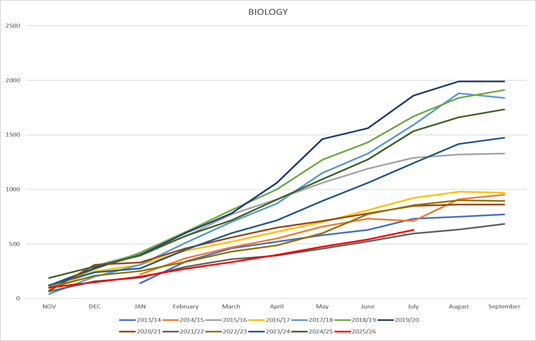
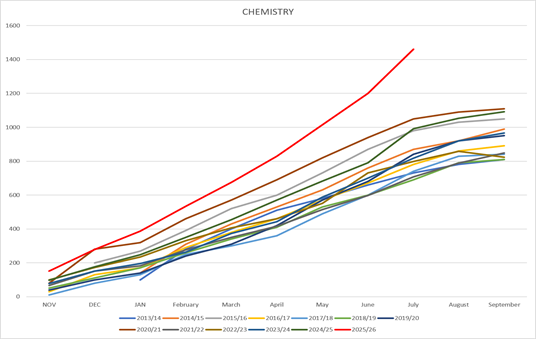
The difference this year is stark: Record offers in chemistry, and the second lowest since 2013/14 cycle for offers in biology. This suggests the presence or absence of a bursary may affect the choice of subject by some scientists that is related to the presence and amount of a bursary.
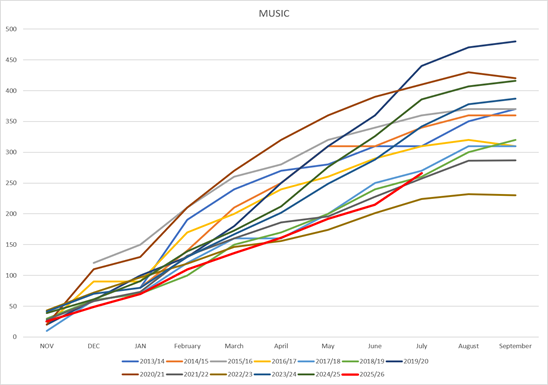
Music is a subject where the removal of the bursary has reduced the number of offers being made, although there was a slight uptick this month. Fortunately, the significant cut to the target means that there should still be enough applicants to meet the target.
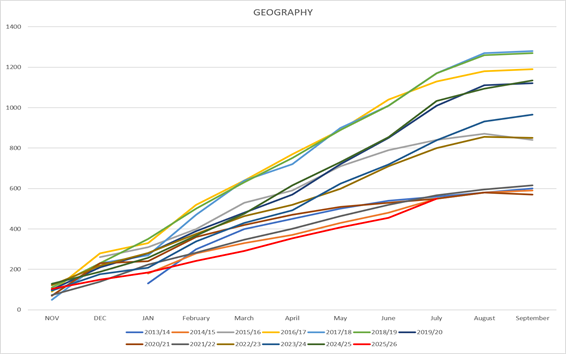
Finally, geography is another subject where the target won’t be met this year. The chart shows why very clearly.
If the aim of the government is to ensure that ITT targets are met in every subject, and not just selected subjects, then there needs to be a rethink about the bursary system.
However, the bursary system is unfair to those studying other subjects in a manner that the public sector does not apply to other areas of recruitment and training.
It is time to bring teacher preparation into the 21st century: pay all trainees a living wage, and prevent over-recruitment in some subjects and the associated pressure on the Student Loan Fund.
What do geography and classic have in common? Based on the July data on numbers accepted for places on postgraduate teacher preparation courses, there won’t be enough applicants to meet the DfE target in these subjects. These two subjects are joined, in my estimation, by drama, business studies, religious education, and the catchall ‘other subjects’.
The table shows my views about outcomes, based upon the July 2026 data for numbers accepted by subject. I haven’t included primary, because I don’t think there will be an issue with that sector, where acceptances for ‘general’ primary courses are up from 10,359 in July 2025 to 10,481 this July.
Subject
Target 2026/27
July offers
Fill: July view
July Accepted
Fill on accepted
Chemistry
690
1460
YES
1302
YES
Biology
675
629
PROBABLY
466
POSSIBLY
Mathematics
2000
2953
YES
2567
YES
Design & Technology
620
701
YES
630
YES
Art & Design
605
709
YES
590
YES
Geography
685
549
NO
466
NO
Classics
75
45
NO
37
NO
English
1980
1835
POSSIBLY
1535
POSSIBLY
Drama
370
318
POSSIBLY
263
NO
Business Studies
1200
357
NO
267
NO
Music
260
266
YES
220
YES
Religious Education
450
349
NO
294
NO
Others
2035
508
NO
414
NO
History
520
1112
YES
952
YES
Modern Languages
1085
1363
YES
1172
YES
Physics
810
1600
YES
1438
YES
Physical Education
655
1551
YES
1326
YES
Computing
565
961
YES
808
YES
The late announcement of the ITT targets may have had some effect on provider outcomes. Acceptances are down in all age groupings, save for the 22 year-olds, where the increase is a mere five more acceptances than in July last year – this difference may be down to the date the report was run: the 20th July this year.
Overall acceptances are down from 25,422 in July 2025 to 24,048 this July, a reduction of more than 1,400.
Previous posts have discussed the significant percentage of applicants listed as from the ‘Rest of the world’. This month the number accepted from the ‘Rest of the world’ group was 1,662 compared with 1,657 last July. Because of the increase in applications from this group, the percentage ‘accepted’ has dropped from 19% of the group last July, to 12% in July 2026.
Growth in the number of applications from students in the home regions, apart from London, has remained sluggish, and has actually fallen in two regions (North East and Yorkshire & The Humber).
Taken as a whole, these are a mixed set of outcomes. July is sufficiently far through the recruitment cycle to make predictions about outcomes, as already highlighted.
Despite fears of graduate unemployment, the post finals period doesn’t seem to have resulted in a significant increase in home student applicants. Home students remain the key to ensuring all subjects are able to fill their target number of places. Even with the reduction is places in some subjects, as a result of ‘falling rolls’, as indicated earlier, not all subjects will hit their targets in this cycle.
The previous Secretary of State seemed to pay little attention to teacher supply issues. I hope that the present office holder will ask her civil servants, ‘what do we need to do to assure sufficient trainees across the board, but not far too many in history and physical education; and why is there such variation from year to year in the biology and chemistry numbers, even if, this year there might be enough to fill all the ‘science’ places’.
Finally, it may be that applicants are starting to vote with their feet in favour of routes into teaching that don’t require the acquisition of further debt.
Applications by route
2026 cycle
2025 cycle
difference
Accepted July 2026
Partner Led
17419
17977
-558
4162
SCITT
16812
16867
-55
6315
HE
33719
33723
-4
11692
Salaried
8169
7634
535
311
Degree apprenticeships
1935
1079
856
1342
Apprenticeships
11944
7335
4609
234
All applications
89998
84615
5383
However, the sector has not been able to respond to this trend, and courses incurring additional debt still dominate the routes into teaching. It is time for this to change. Incidentally, the government must now concede that higher educations till plays the dominant role in teacher preparation, something the recently appointed UCET leaders will no doubt be keen to remind the new Secretary of State about.
I know the Secretary of State for Education has only been in post for less than a week, and is obviously learning the ropes, so perhaps the following appeared in her predecessor’s red box for sign off. Nevertheless, it doesn’t look like a good start.
Publishing a ‘conditions of grant’ information to ITT providers on the 23rd July for courses starting this September seems a very poor piece of management. I know this is not a new grant, but there seem to be new demands that might involve re-arranging elements of courses at extremely short notice.
Now, you can argue, ITT providers should have already incorporated these elements into their courses, and I am not aware if any warning was given to providers of the changes ahead. No doubt someone can tell me in the comments.
The cash is also small beer compared with the fees for training, but for larger providers wanting to claim in excess of £40,000 the audit requirement do seem a bit onerous. Fortunately, smaller provider can self-certify, but must keep full records, adding to their burden.
These seem like sensible requirements, so the real issue is the timing. Do civil servants not understand the rhythm of the school year? Have these same civil servants considered how courses are planned, and the need to work in partnership between the ITT provider, whether school, university or private provider. Each and every school being used will need to see trainees practice adheres to the new requirements.
This will be challenging enough for secondary schools, but at least many will be back at work by the time the exam results season comes round in mid-August. However, I suspect making adjustments will be more of a challenge for primary schools involved in ITT placements. Of course, trainees won’t be in school on day one in September, but making changes at the very busy start of the school-year is not ideal.
Perhaps the new Secretary of State could consider an embargo on any new changes for the school-year being introduced more than a month before the end of the summer term or after the 30th June, whichever comes first.
It would be a shame to see any ITT provider threatened with de-accreditation for failing to meet the requirements of a grant only notified to them less than six weeks before the start of their courses, and during the middle of the key employer-driven flexitime period, when most are required to take annual leave.
Civil servants can take leave at any time, teachers and ITT staff cannot, and the DfE should respect that fact. Placing any extra requirements on schools and ITT staff at this time of year is poor policy-making in practice.
Hopefully, the Secretary of State will listen to the concerns about timing raised by schools and the ITT sector, and make sure grant requirements are not imposed during the summer holiday period, unless absolutely necessary; I don’t think this change is in that category, and the DfE should make clear any changes do not need to come into force until January 2027, allowing reasonable time for planning.