
Why the ITT Census should never be a surprise

How early in the annual ITT recruitment cycle can you confidentially predict the outcome? I asked myself this question when, earlier today, someone looked up a post on the blog that I wrote in February 2022. Not much of a Christmas Present | John Howson

Based on the data from the end of January 2022 for courses starting that autumn, I wrote the following

‘In summary, there is a degree of caution about the data in this monthly release, but there is almost certainly work still to be done to avoid another year of under-recruitment and a tight labour market for schools in 2023’

This was my cautious way of saying that a further year of trouble lay ahead. Even I, at that time, could not have predicted how far away from the targets the outcome for that year’s recruitment was to be. Of course, the targets may well have been too high, just as the current year’s targets may well be too low in some subjects. Nevertheless, recruitment outcomes were brutal. See STEM subjects ‘late recruiters’? | John Howson and More on the ITT census | John Howson as well as a number of other posts during December 2022 discussing the ITT census and its findings.

Over the course of more than 25 years studying monthly trends in recruitment, I believe that by the end of February in a normal year – Covid pandemic years being an unforeseen exception – it is possible to predict trends from that month’s data. This is because, by then, applications from final year undergraduates and discontented new graduates are in decline as finalists concentrate on exams and final coursework to be replaced for the next six month much more by career switchers.

Crucially, in Jue and July  new graduates that haven’t found a job may swell the number of applicants when there is a tight graduate labour market. If there are plenty of graduate jobs, and the application rate until June has been subdued, a late bounce is unlikely.

In the past three years, application data has been made more challenging to interpret because of the large influx of applicants from ‘the rest of the world’. These applicants may account for as much as 25% of the total number of applicants. Even if they are made ‘offers’ will they obtain the necessary visa to come to England, and then will they be allowed to teacher here? So far, this is an issue in some subjects, but not across the board.

Should the DfE react to poor recruitment data? An interesting question. They did react in 2013 in July when I ventured to suggest some subjects would not hit their targets. You can read what happened in my book ‘teachers, schools and their vies on education’ available either n Amazon or directly from myself via the comments section.

Suffice to say, I think that was a face-saving exercise, but the substantive point remains. Can and should the government intervene in a cycle to help recruitment. Hopefully, with falling rolls and the threat of AI, they won’t need to. However, it is worth remembering that the Training Grant was announced in a March, and had an immediate effect upon recruitment.
Poetry please

Today is National Poetry Day. As some readers might recall, 2026 is the Year for Reading, so a day celebrating poetry, a form of language that can be both read and spoken ought to be celebrated. Sadly, I fear that isn’t the case today in England.

In the past, when I have celebrated National Poetry Day on this blog, I have offered a poem I have written. One was about war, and sacrifice of young lives; another was about departure, in that case leaving a loved one at an airport.

Sadly, I note the latter of these was in a post more than a decade ago, in 2015. It has been remiss of me not to have highlighted poetry on this blog since then.

For today, I thought that I would offer one from a collection about Oxford, where I have lived for almost 50 years now: since 1979.

The Oxford Canal. (revised July 2024)

Work water now departed:

Leisure flows instead.

Gone barges pulling butties;

As tourist labour locks.

Only residents line banks,

Washing, sitting, growing,

Where dogs stand guard,

Cats enjoy stern sun.

Few walk that path

Horses once trampled.

Clear line unseen ‘neath

Dense overgrown takeover.

See solitude of wooden bridge.

Sentinel in skyline waiting.

Pulling rope restoring purpose:

Vertical to horizontal shift.

While silent lock’s door

Spills excess, seeking release

Granting access now, as narrowboat,

Cruiser, paddle board, gather height.

To silent reach, kingfisher domain,

Voles burrow bank, and vivid

Dragonflies skim blue and green,

Grey heron muting nature’s palate.

Man’s art intrudes, littering

Casually, disfiguring permanently.

Heming sides with barrack blocks.

Building canyons; cutting vistas.

As rural pubs welcomed

Bargee’s evening halt.

Mooring space now tethers

Holiday rentals.

Still canals survive.

Flagging future rails and

Concrete motorway routes.

Slowly amongst the haste

I have chosen this poem partly because I pass the end of the canal almost every time I walk into the city centre, but also because when I was Chair of the county council, during covid, not being able to have the usual fundraising dinner, I walked along the canal from Oxford to Banbury, alone, as a fund raiser for the charities I supported that year. The walk was a distance of around 26 miles, so not far oof the only marathon distance I have ever walked.

I am delighted to say that we have a Poetry Library in Oxford that runs workshops and activities with schools. I know from local book fairs that there are also a number of poetry circles in the city, at least in the west. I celebrate all their activities to help make this word form relevant to modern life.

So, three cheers for National Poetry Day, and please post your favourite poem in the comments.

Finally, for those that know Oxford and the saga of the buses and the Botley Road bridge, this reworking of Alfred Godley and his 1914 poem might strike a chord. For years growing up in London, I wondered what buses were doing ‘in the corn’ on arrival in Oxford it became obvious

Behold the bus

Processing like some affair of State

Not one, but, two, four, six or eight

Lumbering convoys rutting roads with weight

Clean engine, passengers, and double deck create.

Fares please: no cash, but mobile, card or pass

These days. Machines talk, as humans mute remain.

Card accepted; green light flashes, pass along the car.

Seat forward, backward, even sideways, or stand downstairs.

Along the Botley Road they rattle,

Down the High they trundle,

Creep slowly through the Cowley cycles

Rush headlong twenty miles along St Giles.

Deep in phones, passengers miss the engine roar

As fingers fly, while bus patiently pauses, absorbing

New influx of riders, whose hands held out,

Supplicated, is there space for us aboard your omnibus?

Of course, no longer implet in the Corn they are,

But still we see, Copia Motorum Borum.

But no longer is the cry! Domine, defende nos
Contra hos Motores Bos!

With apologies to Alfred Godley and his 1914 poem

Teacher shortages are commonplace across the globe

OECD has today published the 2026 edition of ‘Education Indicators At a glance’. Education at a Glance 2026 | OECD The section on teacher shortages has already received several comments on LinkedIn and elsewhere. I though I might look in some detail about the United Kingdom section in the ’country report’ about teacher shortages.

On the face of it, the UK fares well compared with other countries. Apparently, only 2.9% of teachers in state schools are not fully qualified. I wonder what the percentage would be for Further Education?

Teacher shortages

  • Shortages of skilled workers have affected many sectors across the OECD in recent years, and the teaching profession is no exception. Teacher shortages manifest in different ways across education systems: in some countries, a lack of fully qualified teachers is reflected in a higher share of non-fully qualified staff, while in others a significant number of teaching positions remain unfilled.
  • Non-fully qualified teachers refer to teachers who do not yet meet all the requirements to be recognised as fully qualified teachers under national regulations. In most countries, they either possess the required academic qualifications but lack mandatory certification or teacher training, have completed the required teacher training but do not hold the required academic qualifications, or lack both. In England, 2.9% of all primary and secondary teachers in public institutions were not fully qualified in 2024/25, below the OECD average of 9.1% (Figure 1).
  • Countries use two main approaches to measuring teacher shortages. The first approach estimates shortages before or at the start of the school year based on projected recruitment needs. The second approach measures shortages by counting the number of positions that remain vacant at the start of the school year or shortly after it begins. England uses the second approach, and 0.6% of all teaching positions in public secondary education were unfilled at or shortly before the start of the 2024/25 school year (Table 2). Education at a Glance 2026: United Kingdom

However, it is important to delve into what’ ‘Qualified’ actually means.

In England, possession of QTS allows teachers, not, interestingly, a reserved occupation term, to teach anything to anyone at any level. For the past 25 years, I have been asking for QTS to be linked to phase and subject studied in ITT. However, apart from in the Liberal Democrat Manifesto in 20025, there has been no political appetite to limit QTS in any way. I still think that is a mistake. The over-supply of PE and history teachers has helped keep school fully staffed during the recruitment crisis that started way back in 2013, but may now be coming to an end.

It is also worth pointing out that schools can be fully staffed in England by adjusting the curriculum, and dropping subjects they cannot staff. The other alternative, as OECD noted, is using less well-qualified staff. The figures on combined versus separate science at Key Stage 4 between different types of school are stark. The former can be staffed with teachers with less subject knowledge than the latter. If you don’t pass the 11+, you probably won’t study Physics as a subject by KS4 | John Howson

I was surprised that OECD appears to have accepted the DfE data at face value and not to have a definition that would deal with the fact that QTS is so broad as to be meaningless at both primary and secondary school levels.

No song for Labour?

Traditionally, the Labour Party conference used to end in song. Historically, it was the Red Fag that was belted out by delegates, many of whom had learn to sing both in school and in church, chapel or other place of worship. Go to a funeral or a wedding these days, and singing is often either desultory or non-existent, except for a few brave souls. Partly, this is down to the decline in attendance at organised worship, but partly, especially for weddings, it may be down to the decline in music teaching in schools.

Yesterday, I was told of an initiative to revive school choirs https://www.cloreduffield.org.uk/clore-school-choirs-and-singing-programme

However, it will take more than a few philanthropic gestures to revive music in our schools. The subject has now reached a crisis point in state schools across England. I don’t expect the number of new trainees to meet the DfE’s target this autumn. Sadly, It is not as if missing the ITT target in music is something new.

ITT census% of target recruited
2019/2080
2020/21122
2021/2271
2022/2362
2023/2427
2024/2540
2025/2565

My expectation for the 2025/26 outcome is somewhere between 80-85% based upon September acceptance numbers through the DfE recruitment to ITT portal data published yesterday – see my previous two posts for more details.

The improvement to around 80% is because the target for this September has been reduced by the DfE from a high of 820 trainees needed in 2024/25, to a new low of 260 two years later for the 2026/27 intake.

ITT target2021/222022/232023/242024/252025/262026/27
Music540470790820565260

In part, the reduction in the target is the result of not adding unfilled places in one year to the target for the next year. That was a policy I have always said, since it was tried in the 1990s, was a mistake. Schools cannot absorb more than a certain number of teachers each year, and they always start the autumn term fully staffed for the timetable that they have produced.

Change the timetable, and cut an examination subject, and a school is unlikely to offer it the following year in its options package, especially if it might not recruit a teacher needed to teach the subject, and someone else might need to make way for the restoration of the subject to the timetable. Once gone, it is hard to recover without a change in policy.

Of course, falling rolls will mean a reduction in demand for teachers, assuming school funding doesn’t improve – quite likely, and that retention remains at current levels – also likely with a faltering graduate job market. But is the cut to 260 places for music, a cut that would certainly justify the removal of the bursary sensible? The DfE seem to think so, after having run the Teacher Supply Model, based upon current input data. I am less sure.

So far in 2026, there have been over 500 vacancies for teachers of music and heads of department, so by year-end in December that total might have increased to somewhere between 550-600 vacancies across the year in state schools.

How does that compare to possible supply? In 2025/26 the ITT census recorded 367 music trainees. Allowing for wastage, both in-course and post-course that might reduce the available number to less than 300 or about 50% of vacancies, leaving the other 300 to be filled from returners or other sources.

MusicITT census
2013/14380
2014/15375
2015/16355
2016/17355
2017/18295
2018/19300
2019/20320
2020/21483
2021/22390
2022/23301
2023/24214
2024/25345
2025/26367
estimate2026/27240

With the reduced target of 260, the likely outcome, based on the September offer number is for around 230 trainees at the end of the year, with less than 200 available to work in the state sector in 2027, based on past trends.

Vacancies would need to fall by around 200 in 2027 for that number of new teachers to take up half the vacancies. If vacancies were to remain at 600, admittedly an upper estimate, then new entrants to the labour market might only be able to fill a third of vacancies. This would be grim news, and leaves me with two conclusions

The Teacher Supply Model has cut targets too far too soon

The removal of the bursary has affected recruitment, but the effect has been masked by the cut to the ITT target.

In the real world, unless I am wrong, fewer children will study music from September 2027/28 onwards – that’s the next school-year.

Is that what the government wants? I don’t know, but I do know that there is a risk of music disappearing as an examination subject unless more music teachers are recruited.

I was told, an unverified number, of just 190 entries in the North East Region for music at A level this summer. How many of those were from private schools? I will see what I can find out from the published statistics.

Music is changing, but that change won’t happen nor will music continue to support growth in the economy through orchestras, popular music and other trends if we let music die in the majority of state schools.

A world where music is created by Artificial Intelligence and not by humans, will be a less enjoyable place in which to live.

The ITT Census versus September acceptances

In my previous post, I said at the end of the post that  I would look at what any differences between the August ITT acceptance data issued by the DfE earlier today, and the ITT census to be issued in December 2026 might be, by looking at the difference between those accepted in September 2025 and the ITT Census of December 2025.

In reality, this task has proved something more  of a challenge that I had expected. This is mostly because of the late announcement of the targets for September 2026. These were not announced until April 2026, by which time many subjects had already made offers in excess of the new, and lower, targets. The fact that the targets for 2026 were in many subjects drastically reduced has made the analysis almost impossible.

Because of the reduction in the targets, it is possible that the outcome of the 2026 ITT Census could be the best year in terms of hitting targets since 2012, especially once Teach First and any other non-DfE portal recruitment is factored into the census.

However, there are a few subjects that rely almost entirely upon the DfE portal for recruitment that we now know are very unlikely to meet even the revised target for September 2026.

These are: Business Studies; Classics, Drama; Religious Education and the catch-all ‘Other’ that includes media and communication studies, social studies, citizenship and psychology.

Although how the ‘other’ subjects grouping reaches a target of 2,035 places remains a bit of a mystery. As I have advocated elsewhere, it is now time to breakdown the ’other category’ into its component subject targets to allow for meaningful discussions about teacher supply. With around one in eight places in the ‘other’ category and the category recruiting very poorly it is time for a more meaningful discussion about the classifications used by the DfE for its IIT targets.

A reminder of how the targets have changed this year when compared to the previous year

2025/262026/27
Total26,92020,800
PrimaryTotal7,650 5,520
SecondaryTotal19,270 15,280
Art and Design680605
Biology985675
Business Studies9001,200
Chemistry730690
Classics6075
Computing895565
Design and Technology965620
Drama620370
English1,9501,980
Geography935685
History790520
Mathematics2,3002,000
Modern Foreign Languages1,4601,085
Music565260
Others2,5202,035
Physical Education725655
Physics1,410810
Religious Education780450

 Some years ago, the total was nearer 40,000 trainees, so this has been a dramatic reduction.

When were secondary trainee targets last as low as 15,280? Not for some time. I will do  a search and see if I can find out the last time the targets were this low for both primary and secondary trainees. As these targets now include almost all routes, it will be interesting to see whether when they were last this low were there no ‘off target’ numbers such as the former employment-based routes?  

Mixed results across the ITT targets this September

Earlier this year, (in April) the DfE slashed the targets for new trainee teachers, citing falling rolls. In some case, this won’t have made a difference because either the new target was still unattainable or those in ITT had already exceeded the new target, and presumably couldn’t or wouldn’t withdraw offers already made.

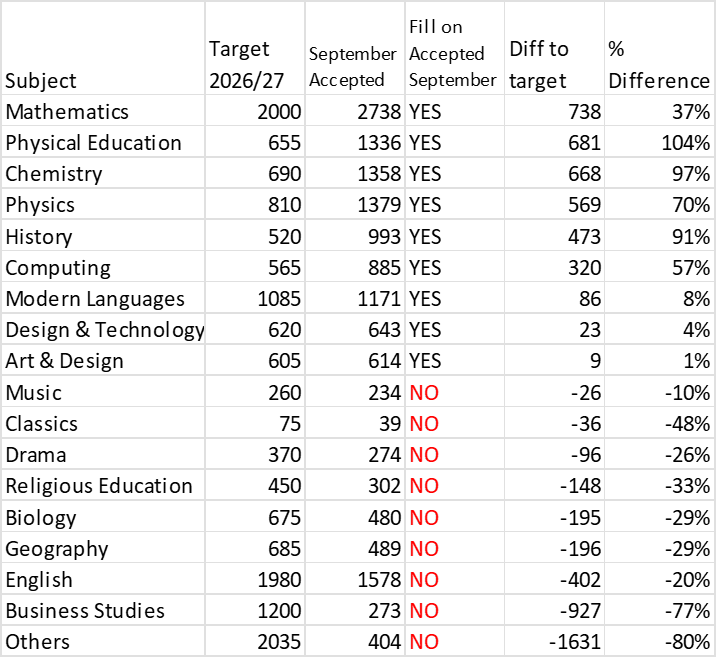
So, what does the landscape look like this September, now that the DfE has released the data that will be close to the final outcomes for courses, at least those recruiting through the DfE portal. The Teach First, and other such programmes must be added to the data. However, before the ITT census there will undoubtedly be some dropouts or no-shows to courses. As a result, the September numbers accepted should provide a good idea of the basis for calculating the number of new teachers emerging onto the state school labour market for September 2027. (Take of 6% for in-course-wastage, and then 15-20% of the remainder for those not wanting to teaching state schools – these are conservative percentages). This means there may well be shortages in some subjects, especially the arts that Labour seemed to want to espouse, as the table shows.

The final percentages for mathematics and physics may well depend upon how many overseas students can obtain a visa, firstly to study and then to work in England?

It really is time to open up what the DfE means by ‘others’, and include some more actual subjects in the list. Computing may be the first subject to be benefitting from concern over the loss of jobs to AI.

I very much doubt  whether the total for music, biology, religious education, design and technology, geography and English will be enough to meet the needs of schools in 2027. Rolls across the country just are not falling that fast, whatever is happening in London.

I am not sure what the DfE has calculated for the effects oof VAT on the private school sector, but if numbers fell in that sector, the sector would need to recruit fewer teachers. This would only have an impact if it was a reduction in overseas student numbers, as, presumably, home students would transfer into the state system, requiring more teachers, even at the worse pupil-teacher ratio of the state sector.

Where are acceptances down on last year?

Applications submitted were 62,633 this year, compared with 55,637 last year. However, accepted numbers were down from 26,714 to 24,850 meaning an increase of more than 4,000                                           applicants rejected.

The number of acceptances fell across all age groups, larger falls were in the age-groups normally associated with career switchers, and there were relatively small falls for new graduates. This is encouraging news for the long-term health of the profession, as younger trainees that stay the course should provide for the cadre of future leaders.

Most of the fall in acceptances were of females: down from 17,918 to 16,189, with males just declining from 8,516 to 8,382. This may reflect the greater number of females that apply for primary sector courses.

More worrying is the fact that while acceptances from ‘rest of the world’ applicants remained steady at 1,440 this year compared with 1,428 last year, most UK regions witnessed a decline in acceptances.  There were 9,661 acceptances for primary phase courses compared with 9,887 last year, while secondary phase acceptances declined from 16,829 to 15,190.

Apprenticeships bucked the trend, witnessing more acceptances (1,453 against 1,310 for PG and 261 against 198 for degree apprenticeships). Salaried route acceptances slumped from 618 to just 304, presumably as a result of the apprenticeship route, which may be cheaper for schools.

Finally, all training provider regions witnessed a decline in acceptances, with fewer than 1,000 trainees across the North East region being accepted ( 911 compared with 1,078 last year).

If I have time, I will compare the 2026 September acceptances with   census to measure whether there is any significant amount of change between the two datasets.

Vocational education: Closing doors or widening opportunities?

The education of young people has had quite an airing over the past week. At the Liberal Democrats conference, Munira Wilson MP, the Party’s Education spokesperson at Westminster, gave a platform speech that foreshadowed the announcement by Lucy Powell, the Secretary of State, about post-14 vocational education.

You can see Munira’s speech on YouTube. I suggest starting at 1 hour 38 minutes into the video lib dem conference 2026 autumn saturday afternoon session – Search

In her speech, Munira raised one of the key dilemmas of education. How to promote ambition without encouraging many young people to leave their communities to seek to achieve their ambitions? Many that leave our rural and coastal communities (the source of another debate at the conference) to fulfil an educational ambition, often at university, never return.

I believe that governments should be encouraging these young people to return and set up businesses in rural and coastal communities as part of regeneration schemes.

Labour’s,  Lucy Powell’s, focus was one the perennial issue within the British education system: how to resolve classroom and practical subjects at examination level in terms of parity of esteem? Labour answer is to recreate courses for 14-16 year olds in practical subjects, such as construction, care and business. New Vocational GCSEs unveiled in major shake-up to hands-on learning for teens – GOV.UK

In 2003, I wrote a paper for the Liberal Democrats entitled ‘No child left behind’ – a phrase borrowed from US President Bush – in which I advocated a 14-18 sector. I recognised that many young people at 14 were disillusioned with school, but might be brought back into education if they were offered courses more aligned with their career ambitions. Now, I understand Munira’s point that at 14 she wanted to be a teacher, but as a graduate went into a different career. Munira no doubt already wanted to go to university at 14.

But, what of those, the Newsom 50%, Half Our Future: A tribute to Sir John Newsom’s Report | John Howson  that don’t aspire to stay in education. At what age should we help them on the path to a working life? In 2003, I suggested links with further education, and its more grown- up approach and better facilities than many schools can provide for practical courses.

Labour’s announcement this week, ahead of their conference, seemed a bit rushed. Nothing about where to find the staff to teach  these new vocational subjects in schools? Nothing about the issue of ‘norm’ referencing in examinations. How do you ‘norm reference’ the building of a wall in a construction class or the creation of a meal in a hospitality course? Trying to create national standards will be a real challenge.

Both Munira, and then Lucy Powell, did speak about the need for more work experience in schools. Again, this is something that I support wholeheartedly, but again how do we deal with the limited opportunities in our rural and coastal communities? As so often in education, it will come down to who will pay for the transport?

However, NEETs are not just an education issue. Any government that is responsible for an economy that is not producing jobs for either young people of those made redundant in their 40s and 50s, has two choices, either benefits or some form of education and training provision, if it wants to keep down the numbers unemployed. With AI likely to recreate the job scene in a new format, the issue of the relationship between education and employment isn’t going to go away anytime soon.

Schools in rural and coastal areas: issues and concerns

Today was the first day of the Liberal Democrats annual conference. This year it is being held in Brighton. A motion today was about rural and coastal education and the need to recognise the issues children and young people living in these areas face.

I was privileged to be call to speak in the debate. What follows is the text of my speech: for what I actually said, please go to the recording at: Autumn Conference 2026 – Saturday Morning – YouTube at 1:22:10 for the next 4 minutes.

Rural & Coastal Education

Conference, I have sympathy with this motion but, while like all of you I know what ‘rural’ means, I am less sure about what ‘coastal’ means. Does the term include cities such as Liverpool, Hull and Brighton, and are they markedly different to Manchester, Sheffield and Birmingham? As a one-time geography teacher, I need to think carefully about what are the locations such a place-based policy might exclude.

Sadly, the motion doesn’t have much our MPs can campaign on. So, here’s three ideas linked to the spirit of the motion for them to campaign upon and that voters will understand.

Raise the free Home to school transport age  to 18 to bring it into line with the learning leaving age. This will end the cliff edge at 16. Ensure everyone can get to college to study the course they want. Raising the £1 fare maximum age from 16 to 21 would be a start.

Importantly, revise the 2006 Education Act to include Academies or watch Academy Trusts close schools without any controls.

Look at taxation, such as motor insurance tax for those in rural and coastal areas forced by a lack of public transport to use a moped or car, but too young to have any ‘no claims bonus’. This tax is a penalty on learning for these young people, and a real disincentive to study.

Finally, much of both local authority and parent’s school transport cash goes back to the government in taxation. Urban authorities don’t pay this fuel tax, and neither should rural areas.

Living in a rural area should not mean a tax on learning for young people. Ater all, they don’t have a choice.

Conference on education, The message is simple, the message is clear, the message is from the Liberal Democrats:

Equal access to Education for Everyone.

Please support the motion.

The motion was passed both by the audience in the hall and the delegates following on-line.

Is the Teachers’ Pay Award fully funded or not?

Earlier this week, the Secretary of State wrote to the National Education Union(NEU)  about funding for the Teachers Pay Settlement. I cannot find the text of the letter on the DfE’s website, but the NEU helpfully stated that:

The NEU has secured through negotiations with the Secretary of State for Education a fully funded pay increase for all teachers throughout England. This is a significant step. In a letter to the General Secretary of the NEU Lucy Powell outlined her proposals for funding alongside a willingness to address issues around accountability, workload, and well-being. NEU secures from Government full funding for teacher pay offer | National Education Union

Since then, doubts have been cast upon whether there is enough money for a ‘fully funded’ pay rise for all teachers. Given that the NEU was considering industrial action over pay, this statement looked like a real win for the Union.

However, this announcement was never likely to create produce a ‘fully funded’ pay increase because of the manner in which the National Funding Formula for schools operates. Schools have different mixes of staff salaries, some have many inexperienced teachers near the bottom of the main scale, whereas other schools have many long-serving teachers at the top of the Upper Pay Spine. Schools also differ in how they reward additional activities with Teaching and Learning responsibility points (TLRs). The Formula cannot take these differences into account.

Asa result, some schools would be more than fully funded and other left still needing to find the rest of the pay award.

Subsequently, it seems that the DfE assumed that the funding for the pay award will come for the saving schools experience as a result of the reduction in the employer’s contribution to the non-teaching staff pension scheme: the LGPS. That seems like wishful thinking to many commentators, including myself.

First there are a number of LGPS Pools, with different outcomes, and hence different rates of employer contribution. As a result, a school with a high percentage of staff at the top of the Upper Pay Spine, few support staff and located in an LGPS fund with one of the higher contribution rates will fare far less well  from this announcement than a school with the opposite profile.

Also, making an announcement in September mean that every school budget is already set, and the only spare cash is in any ‘contingency’ line on the budget. The DfE should know that fact. As a result, this announcement looks like either something of a face-saving act or another of the Labour government’s gross miscalculations. Either way, it seems likely many schools, if not most, will have given only a faint cheer on hearing the announcement, if they managed to raise a cheer at all.

I am told that the DfE clawed back the savings from reductions in employers’ contributions to the Teachers Pension Scheme. Unlike LGPS, where there are real schemes, with investments than can go up and down, the TPS, like the Civil Service Pension Fund, doesn’t actually exist as a fund, but is held by The Treasury as a notional fund.

70 Up

Like many of my generation, I watched 70 Up on TV last night with very mixed feelings. I first came across what was originally an ITV World in Action documentary called ‘7 UP’ when lecturing to trainee teachers at Oxford Polytechnic, as Oxford Brookes University then was, in the 1980s. The film was part of a module called ‘Societal Issues in Education’. The original documentary was about the lives and aspirations of 20 different children selected by the producer from schools across England. Eventually, it became  series, revisiting the group every seven years.

Looking at the first part of 70 UP, the final two-part episode that both recalled the past lives of those willing to participate every seven years, and caught up with them for a final time at age 70, I was struck by what was missing from the series. No child with a visible disability, only a nod to even the possibility of multi-cultural Britian, as it already was becoming in 1964, when the original programme first aired. A group of children both very different from those that might be selected today, but in many ways a group still to be found in many schools today.

We have been privileged to share the lives of this particular group, and one must thank them for taking part in such a public recording of many aspects of their personal lives. Some played to the camera, and obviously enjoyed the experience; others didn’t, and dropped out, while others, while not enjoying the experience still participated.

What is striking, and heartwarming in the first part of 70 UP is the nature of relationships the group formed. Some survived, some didn’t. That’s not surprising, as the past 60 years have seen great changes in both divorce laws and the fluidity of relationships at all ages.

Every participant was a star. For many, the boy from the children’s home that went on to not only make a family with his partner, but also to foster 170 children in care, was a real star. Fostering demands real respect, as I know from my time as a county councillor just how difficult it is to recruit carers. If 70 UP persuades just one family to contact their local authority and offer to become carers it will have been worthwhile.

Not all the episodes were easy to watch, especially those filmed in the 1970s when teenagers were finding their feet. It is worth noting how many went to Oxford University, and that says much about the sampling, especially of the original participants from private schools.

The women in the group joined 7 UP before the equal opportunity’s legislation of the 1970s, and it shows in those that worked rather than had careers. There were also fewer of them, again I suspect a sign of the times and attitudes in the early 1960s, before the sexual revolution and the ‘swinging sixties’.

Next week, there will be the final part of the series. 70 UP had a new producer, the previous, and only other producer, died after 63 UP was produced. Not surprisingly, not all the original participants survived to 70.

Indeed, I worry, that the treatment of the death of one of the original group of participants reveals both the best and worst of television in its mission to entertain; inform and educate its viewers.