
Teacher shortages are commonplace across the globe

OECD has today published the 2026 edition of ‘Education Indicators At a glance’. Education at a Glance 2026 | OECD The section on teacher shortages has already received several comments on LinkedIn and elsewhere. I though I might look in some detail about the United Kingdom section in the ’country report’ about teacher shortages.

On the face of it, the UK fares well compared with other countries. Apparently, only 2.9% of teachers in state schools are not fully qualified. I wonder what the percentage would be for Further Education?

Teacher shortages

  • Shortages of skilled workers have affected many sectors across the OECD in recent years, and the teaching profession is no exception. Teacher shortages manifest in different ways across education systems: in some countries, a lack of fully qualified teachers is reflected in a higher share of non-fully qualified staff, while in others a significant number of teaching positions remain unfilled.
  • Non-fully qualified teachers refer to teachers who do not yet meet all the requirements to be recognised as fully qualified teachers under national regulations. In most countries, they either possess the required academic qualifications but lack mandatory certification or teacher training, have completed the required teacher training but do not hold the required academic qualifications, or lack both. In England, 2.9% of all primary and secondary teachers in public institutions were not fully qualified in 2024/25, below the OECD average of 9.1% (Figure 1).
  • Countries use two main approaches to measuring teacher shortages. The first approach estimates shortages before or at the start of the school year based on projected recruitment needs. The second approach measures shortages by counting the number of positions that remain vacant at the start of the school year or shortly after it begins. England uses the second approach, and 0.6% of all teaching positions in public secondary education were unfilled at or shortly before the start of the 2024/25 school year (Table 2). Education at a Glance 2026: United Kingdom

However, it is important to delve into what’ ‘Qualified’ actually means.

In England, possession of QTS allows teachers, not, interestingly, a reserved occupation term, to teach anything to anyone at any level. For the past 25 years, I have been asking for QTS to be linked to phase and subject studied in ITT. However, apart from in the Liberal Democrat Manifesto in 20025, there has been no political appetite to limit QTS in any way. I still think that is a mistake. The over-supply of PE and history teachers has helped keep school fully staffed during the recruitment crisis that started way back in 2013, but may now be coming to an end.

It is also worth pointing out that schools can be fully staffed in England by adjusting the curriculum, and dropping subjects they cannot staff. The other alternative, as OECD noted, is using less well-qualified staff. The figures on combined versus separate science at Key Stage 4 between different types of school are stark. The former can be staffed with teachers with less subject knowledge than the latter. If you don’t pass the 11+, you probably won’t study Physics as a subject by KS4 | John Howson

I was surprised that OECD appears to have accepted the DfE data at face value and not to have a definition that would deal with the fact that QTS is so broad as to be meaningless at both primary and secondary school levels.
No song for Labour?

Traditionally, the Labour Party conference used to end in song. Historically, it was the Red Fag that was belted out by delegates, many of whom had learn to sing both in school and in church, chapel or other place of worship. Go to a funeral or a wedding these days, and singing is often either desultory or non-existent, except for a few brave souls. Partly, this is down to the decline in attendance at organised worship, but partly, especially for weddings, it may be down to the decline in music teaching in schools.

Yesterday, I was told of an initiative to revive school choirs https://www.cloreduffield.org.uk/clore-school-choirs-and-singing-programme

However, it will take more than a few philanthropic gestures to revive music in our schools. The subject has now reached a crisis point in state schools across England. I don’t expect the number of new trainees to meet the DfE’s target this autumn. Sadly, It is not as if missing the ITT target in music is something new.

ITT census% of target recruited
2019/2080
2020/21122
2021/2271
2022/2362
2023/2427
2024/2540
2025/2565

My expectation for the 2025/26 outcome is somewhere between 80-85% based upon September acceptance numbers through the DfE recruitment to ITT portal data published yesterday – see my previous two posts for more details.

The improvement to around 80% is because the target for this September has been reduced by the DfE from a high of 820 trainees needed in 2024/25, to a new low of 260 two years later for the 2026/27 intake.

ITT target2021/222022/232023/242024/252025/262026/27
Music540470790820565260

In part, the reduction in the target is the result of not adding unfilled places in one year to the target for the next year. That was a policy I have always said, since it was tried in the 1990s, was a mistake. Schools cannot absorb more than a certain number of teachers each year, and they always start the autumn term fully staffed for the timetable that they have produced.

Change the timetable, and cut an examination subject, and a school is unlikely to offer it the following year in its options package, especially if it might not recruit a teacher needed to teach the subject, and someone else might need to make way for the restoration of the subject to the timetable. Once gone, it is hard to recover without a change in policy.

Of course, falling rolls will mean a reduction in demand for teachers, assuming school funding doesn’t improve – quite likely, and that retention remains at current levels – also likely with a faltering graduate job market. But is the cut to 260 places for music, a cut that would certainly justify the removal of the bursary sensible? The DfE seem to think so, after having run the Teacher Supply Model, based upon current input data. I am less sure.

So far in 2026, there have been over 500 vacancies for teachers of music and heads of department, so by year-end in December that total might have increased to somewhere between 550-600 vacancies across the year in state schools.

How does that compare to possible supply? In 2025/26 the ITT census recorded 367 music trainees. Allowing for wastage, both in-course and post-course that might reduce the available number to less than 300 or about 50% of vacancies, leaving the other 300 to be filled from returners or other sources.

MusicITT census
2013/14380
2014/15375
2015/16355
2016/17355
2017/18295
2018/19300
2019/20320
2020/21483
2021/22390
2022/23301
2023/24214
2024/25345
2025/26367
estimate2026/27240

With the reduced target of 260, the likely outcome, based on the September offer number is for around 230 trainees at the end of the year, with less than 200 available to work in the state sector in 2027, based on past trends.

Vacancies would need to fall by around 200 in 2027 for that number of new teachers to take up half the vacancies. If vacancies were to remain at 600, admittedly an upper estimate, then new entrants to the labour market might only be able to fill a third of vacancies. This would be grim news, and leaves me with two conclusions

The Teacher Supply Model has cut targets too far too soon

The removal of the bursary has affected recruitment, but the effect has been masked by the cut to the ITT target.

In the real world, unless I am wrong, fewer children will study music from September 2027/28 onwards – that’s the next school-year.

Is that what the government wants? I don’t know, but I do know that there is a risk of music disappearing as an examination subject unless more music teachers are recruited.

I was told, an unverified number, of just 190 entries in the North East Region for music at A level this summer. How many of those were from private schools? I will see what I can find out from the published statistics.

Music is changing, but that change won’t happen nor will music continue to support growth in the economy through orchestras, popular music and other trends if we let music die in the majority of state schools.

A world where music is created by Artificial Intelligence and not by humans, will be a less enjoyable place in which to live.

The ITT Census versus September acceptances

In my previous post, I said at the end of the post that  I would look at what any differences between the August ITT acceptance data issued by the DfE earlier today, and the ITT census to be issued in December 2026 might be, by looking at the difference between those accepted in September 2025 and the ITT Census of December 2025.

In reality, this task has proved something more  of a challenge that I had expected. This is mostly because of the late announcement of the targets for September 2026. These were not announced until April 2026, by which time many subjects had already made offers in excess of the new, and lower, targets. The fact that the targets for 2026 were in many subjects drastically reduced has made the analysis almost impossible.

Because of the reduction in the targets, it is possible that the outcome of the 2026 ITT Census could be the best year in terms of hitting targets since 2012, especially once Teach First and any other non-DfE portal recruitment is factored into the census.

However, there are a few subjects that rely almost entirely upon the DfE portal for recruitment that we now know are very unlikely to meet even the revised target for September 2026.

These are: Business Studies; Classics, Drama; Religious Education and the catch-all ‘Other’ that includes media and communication studies, social studies, citizenship and psychology.

Although how the ‘other’ subjects grouping reaches a target of 2,035 places remains a bit of a mystery. As I have advocated elsewhere, it is now time to breakdown the ’other category’ into its component subject targets to allow for meaningful discussions about teacher supply. With around one in eight places in the ‘other’ category and the category recruiting very poorly it is time for a more meaningful discussion about the classifications used by the DfE for its IIT targets.

A reminder of how the targets have changed this year when compared to the previous year

2025/262026/27
Total26,92020,800
PrimaryTotal7,650 5,520
SecondaryTotal19,270 15,280
Art and Design680605
Biology985675
Business Studies9001,200
Chemistry730690
Classics6075
Computing895565
Design and Technology965620
Drama620370
English1,9501,980
Geography935685
History790520
Mathematics2,3002,000
Modern Foreign Languages1,4601,085
Music565260
Others2,5202,035
Physical Education725655
Physics1,410810
Religious Education780450

 Some years ago, the total was nearer 40,000 trainees, so this has been a dramatic reduction.

When were secondary trainee targets last as low as 15,280? Not for some time. I will do  a search and see if I can find out the last time the targets were this low for both primary and secondary trainees. As these targets now include almost all routes, it will be interesting to see whether when they were last this low were there no ‘off target’ numbers such as the former employment-based routes?  

Mixed results across the ITT targets this September

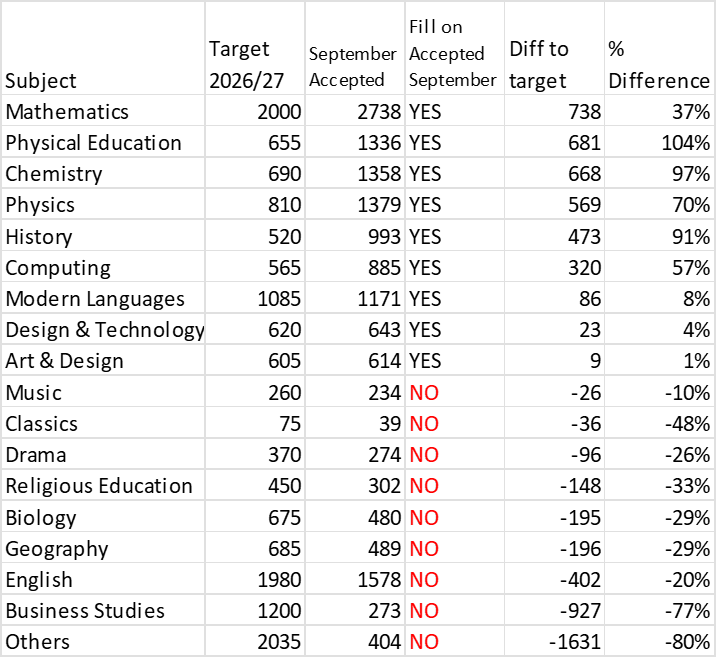
Earlier this year, (in April) the DfE slashed the targets for new trainee teachers, citing falling rolls. In some case, this won’t have made a difference because either the new target was still unattainable or those in ITT had already exceeded the new target, and presumably couldn’t or wouldn’t withdraw offers already made.

So, what does the landscape look like this September, now that the DfE has released the data that will be close to the final outcomes for courses, at least those recruiting through the DfE portal. The Teach First, and other such programmes must be added to the data. However, before the ITT census there will undoubtedly be some dropouts or no-shows to courses. As a result, the September numbers accepted should provide a good idea of the basis for calculating the number of new teachers emerging onto the state school labour market for September 2027. (Take of 6% for in-course-wastage, and then 15-20% of the remainder for those not wanting to teaching state schools – these are conservative percentages). This means there may well be shortages in some subjects, especially the arts that Labour seemed to want to espouse, as the table shows.

The final percentages for mathematics and physics may well depend upon how many overseas students can obtain a visa, firstly to study and then to work in England?

It really is time to open up what the DfE means by ‘others’, and include some more actual subjects in the list. Computing may be the first subject to be benefitting from concern over the loss of jobs to AI.

I very much doubt  whether the total for music, biology, religious education, design and technology, geography and English will be enough to meet the needs of schools in 2027. Rolls across the country just are not falling that fast, whatever is happening in London.

I am not sure what the DfE has calculated for the effects oof VAT on the private school sector, but if numbers fell in that sector, the sector would need to recruit fewer teachers. This would only have an impact if it was a reduction in overseas student numbers, as, presumably, home students would transfer into the state system, requiring more teachers, even at the worse pupil-teacher ratio of the state sector.

Where are acceptances down on last year?

Applications submitted were 62,633 this year, compared with 55,637 last year. However, accepted numbers were down from 26,714 to 24,850 meaning an increase of more than 4,000                                           applicants rejected.

The number of acceptances fell across all age groups, larger falls were in the age-groups normally associated with career switchers, and there were relatively small falls for new graduates. This is encouraging news for the long-term health of the profession, as younger trainees that stay the course should provide for the cadre of future leaders.

Most of the fall in acceptances were of females: down from 17,918 to 16,189, with males just declining from 8,516 to 8,382. This may reflect the greater number of females that apply for primary sector courses.

More worrying is the fact that while acceptances from ‘rest of the world’ applicants remained steady at 1,440 this year compared with 1,428 last year, most UK regions witnessed a decline in acceptances.  There were 9,661 acceptances for primary phase courses compared with 9,887 last year, while secondary phase acceptances declined from 16,829 to 15,190.

Apprenticeships bucked the trend, witnessing more acceptances (1,453 against 1,310 for PG and 261 against 198 for degree apprenticeships). Salaried route acceptances slumped from 618 to just 304, presumably as a result of the apprenticeship route, which may be cheaper for schools.

Finally, all training provider regions witnessed a decline in acceptances, with fewer than 1,000 trainees across the North East region being accepted ( 911 compared with 1,078 last year).

If I have time, I will compare the 2026 September acceptances with   census to measure whether there is any significant amount of change between the two datasets.

Social mobility and the far right

The announcement that that Social Mobility Commission is to be abolished was announced when I was on holiday. As a result, I have only just caught up with news of its demise – one of the few QUANGOs to escape previous culls. While the term ‘class’ for its replacement within the civil service may be more ‘in your face’ than ‘social mobility’, I suppose it fits better with the debate about ‘White working class boys’ that has featured in many discussions about educational attainment during the past decade.

I am sad to see the Commission abolished. Taking work back into government departments inevitably makes policy discussion less transparent, and places greater emphasis on the work of think tanks. The Commission has had something of a chequered history, as might be expected given its role and the fact that rt worked under a Conservative government for most of its life. I documented one such event in this blog post from 2017 Social Mobility Commission | John Howson that interestingly also mentioned AI, and the risk of the rise of the ‘far right’.

‘With the IT revolution once again picking up speed, and predications of massive job losses from the growth in Artificial Intelligence awakening the Luddite mentality in many of us, the Commission must act not only as the government’s conscience on social mobility, but also as a source of genuine new policies that are radical and forward thinking. More of the same just won’t work.

We have seen in Germany that the failure to ensure the success of the economy across the whole country has inevitably led to the rise of the far right in politics. Social mobility is important, but we cannot ignore those left behind. They must not become the poor relations kept, for ever, out of sight.’ Social Mobility Commission | John Howson Still, it is sad to see a Labour government abolish it.

I had a number of discussions with officials at the commission over the years, most notably about teacher supply matters. The following post followed the publication of one of the Commission’s reports in 2019  We cannot ignore those left behind | John Howson and also shows that, even under Conservative control, those of us from all political parties concerned about the issue of deprivation and education were able to have our voice heard: such is the value of good quality scrutiny.

One of the key outputs from the Social Mobility Commission was its annual State of the Nation Report. It will be a disappointment to lose that scrutiny, and I hope civil servants will either want to continue it or ask The Office for National Statistics to take it over. Here are a couple of links to my blog posts about the report:

Class rules: not OK | John Howson

Industrial revolutions alter a country’s geography | John Howson

Birds of a feather | John Howson

As I write this on a Sunday morning, I am reminded of the phrase in Matthew’s gospel at Chapter 26 and Verse 11: ‘The poor you will always have with you.’

That statement is not an admission of defeat, but a call to arms’. Abolishing the Social Mobility Commission must not weaken our mission for a more equal society. Now, I wonder where that advocation will feature any policy resulting from the spending of the £76 million pounds received by a political party this week?

Music Teachers: demand and supply

As part of its  monthly review of applications by graduates to train as a teacher, this blog has often commented upon the issue of whether there will be sufficient new teachers of music. This blog has also condemned the withdrawal of the bursary for music by the Labour government.

Recent posts include:

Don’t let this government kill off music in state schools. | John Howson July 2026

Music ITT: has the government made a mistake? | John Howson June 2026

Reviving Music Teacher Bursaries: A Necessity | John Howson

These posts are all related to the supply side of the question about how many music teachers are needed each year to staff the state school system in England. The DfE answers that question using the Teacher Supply Model, basically an algorithm using past data that can be problematic when future needs don’t follow past trends.

For most of the period between 2015 and July 2026, I have been tracking actual demand for music teachers in state schools, as recorded through advertisements. Tracking adverts has the added advantage of not only assessing demand for classroom teachers, but also looks at trends for subject leaders in music, and the extent to which they are part of larger groupings of arts and creative subjects. Tracking vacancies can also highlight areas where demand is not being met easily, but highlighting where vacancies are being re-advertised.

I have already posted a couple of blogs so far this year on demand:

Labour market for music teachers: update to end of April 2026 | John Howson

Demand for music teachers: where were the jobs in early 2026? | John Howson

During the summer, I have been working on a report considering a number of factors around the vacancies for music teachers. The report:

The Demand for teachers of music: January to August 2026

Is now available from dataforeducation@gmail.com

Part of the conclusion to the report states that;

‘It will not be known until December 2026 as to whether trainee numbers are sufficient to meet the needs of schools after taking into account the number of returners to teaching. However, the fact that some 20% of posts were readvertised during the survey period does point to some pressure on the pool of possible applicants. There certainly seems to be only a small reserve at best. ‘

Music is an important art of the nation’s cultural heritage and identity, and the State, through schooling, has an important part to play in recognising the breadth and depth of that heritage, and encouraging future generations to continue and develop it in ways never imagined when I was at school.

To ensure a pipeline for the future, especially if university departments continue to axe music degrees, then the music community in schools should consider creating a teaching apprenticeship for those young people that are good at music and might want to become a teacher. Creative thinking about developing future teachers of music is an imperative. Now, who will take the lead? The new National Centre? Unlikely? So, it is up to the community, and perhaps MusicMark to think deeply about the issue of where the next generation of teachers of music will come from in a changing world of higher education. A teaching conservatoire?

Teacher retention versus recruitment: not just a matter of economics

This week, the Education Policy Institute (EPI), a think tank with left leanings, published another report about the value of ensuring teachers don’t leave the profession compared with trying to boost recruitment. Their latest report is called Retain or Recruit? Microsoft Word – EPI_RetrainRecruit_September2026 and follows on from their earlier report on a similar topic, reviewed in my blog post from 2022, ‘Keeping Science Teachers in Schools Keeping science teachers in schools | John Howson Both EPI reports were supported by The Gatsby Foundation, a body that has a long and honourable history of supporting research in this field.

The latest EPI report makes three recommendations:

Fund a specialist-equivalent retraining programme

Close the data gaps on completion, post-programme teaching, and demand

Add retraining alongside bursary policy, not in place of it

Microsoft Word – EPI_RetrainRecruit_September2026 page 53.

I am all in favour of re-training, if there are the teachers with sufficient knowledge, skills and desire to retrain to do so located in the schools that need them. After all, with an open labour market for teachers, using price as a mechanism for attracting teachers to work in schools without teachers capable of delivering physics at an advanced level hasn’t worked.

However, the EPI  report does need to be set into the current context of falling pupil numbers that will eventually affect the size of sixth forms. As I demonstrated in an earlier post, Are small sixth forms a good idea? | John Howson small sixth forms often don’t perform well. Is it worth making sure any first tranche of retrained teachers would be in schools with a viable future, and the possibility of a credible ‘A’ Level programme? However, this is a much wider issue than just teaching  physics to ‘A’ level that a future government may need to deal with at some stage.

I am all in favour of ensuring we know who teachers what to whom, and indeed what isn’t being taught in some schools because of the lack of a qualified teacher. I wonder whether this information already exists within the School Workforce database? If not, some sampling of schools might be useful. The 1999 study that I participated in showed that ‘Teaching ‘A’ Level physics was an important driver in retention of early career teachers. I guess it might also be for those retrained.  We know for ‘A’ Level entries the schools not currently entering any candidates for the subject.

It is also worth recalling the EPI previously visited this issue in 2018, as I noted in my blog post Pay physics teachers more than history teachers? | John Howson when the issue of differential pay was discussed. Mechanisms around recruitment and retention incentives and equal pay for jobs of equal worth can bedevil that debate.

Finally, it is worth considering whether programme such as Teach First have a better rate of retention than other ITT routes, including apprenticeships and salaried schemes.

We all want more teachers of physics, so I hope that decision-makers consider the EPI approach seriously, as they did with pre-ITT course subject enhancement courses.

PISA 2025: Teachers still matter

The recent release of the 2025 international PISA study results has already received a lot of comment. PISA publications | OECD. This section of the OECD’s PISA Study report caught my eye, as you might imagine if would do, if you are a regular reader of this blog.

How is school life in the United Kingdom? PISA 2025 Results (Volume I): United Kingdom

Perceived shortages of human and material resources

  • In 2025, 48% of students in the United Kingdom were in schools whose principals reported that instruction was hindered, at least to some extent, by a perceived lack of teaching staff (OECD average: 39%); the corresponding share for a perceived lack of assisting staff was 39% (OECD average: 39%). The prevalence of perceived teaching staff shortages in the United Kingdom did not change significantly compared to 2022. However, principals’ concerns about inadequate or poorly qualified teaching staff increased from 19% in 2022 to 31% in 2025 (OECD average: 25% in both years).
  • PISA 2025 data reveal that perceived shortages of material resources remain a concern in most countries and economies. Some 24% of students in the United Kingdom attended schools whose principals reported that a lack of educational material (e.g. textbooks, IT equipment, library or laboratory material) hindered instruction, at least to some extent, and 34% were in schools where a lack of physical infrastructure (e.g. buildings, grounds, heating/cooling systems, lighting and acoustic systems) was perceived to hinder instruction. In 2022, the corresponding shares were 13% and 24%, respectively. PISA 2025 Results (Volume I): United Kingdom

So, the United Kingdom as a whole had a percentage of principals reporting that ‘instruction was hindered, at least to some extent, by a perceived lack of teaching staff (OECD average: 39%)’. I wonder what the figure might have been for just England? The difference between the United Kingdom and the OECD average was 9%. Interestingly, there was no difference for what OECD called ‘assisting staff’.

The issue became even worse when principals were asked about ‘inadequate or poorly trained staff’.  Here the concerns rose from 29% in the 2022 survey, to 31% in 2025. This compared to an OECD average of 25% in both surveys.

Does the fact that the United Kingdom has a free market for teachers, with  most vacancies advertised, and any teacher able to apply for any post  make any difference to the scores? Assuming the PISA survey has a representative sample of schools across the United Kingdom, then the presence of a significant number of private schools in England, able to recruit qualified teachers more easily that state funded schools may skew the distribution of scare resources, such as physics teachers.

By chance the Education Policy Institute has just produced a report on recruitment versus retention of teachers. Recruit or Retain. Microsoft Word – EPI_RetrainRecruit_September2026

I will discuss that report in another post.

I think the obvious outcome of the PISA findings, is that the  effect of a long period of teacher shortages. In the case of England,  from between 2014 and 2025 in some subjects, is now being recognised in international surveys, such as PISA.

Hopefully, falling rolls, a changing labour market for graduates and better pay for teachers might mean the position improves in terms of teaching by specialist teachers by the next PISA study. However, it might take longer in an open labour market to close the gap between different types of schools and schools serving different socio-economic areas.

An analysis of headteacher vacancies across state schools in England between 1st August 2025 and 31st July 2026.

Author: John Howson of dataforEducation

Executive Summary

  • A review of headteacher turnover in state funded schools between 1st August 2025 and 31st July 2026.
  • Data collected from DfE Vacancy site and other job boards.
  • 1,407 schools recorded as advertising for a headteacher.
  • 1,639 advertisements including re-advertisements, a similar number to a decade ago.
  • 1,008 Primary Sector; 291 Secondary Sector and 107 Special Sector schools were recorded as advertising for a headteacher.
  • 6% of Primary Sector; 8% of Secondary Sector and 10% of Special Sector schools were recorded as advertising for a headteacher.
  • Yorkshire & The Humber and East of England Regions recorded the highest percentage of secondary sector headteacher vacancies re-advertised. No re-advertisements for a secondary school headteacher were recorded in the North East Region.
  • More than 100 secondary schools offered a starting salary in excess of £100,000.
  • The East of England, East Midlands and South West regions recorded the highest rates of primary sector headteacher vacancies re-advertised.
  • This year, thirty-one primary schools and two nurseries had a salary range starting below £60,000.
  • Re-advertisement rates for special schools were higher than in the other two sectors.
  • Faith schools were more likely to readvertise a headteacher vacancy than non-faith schools. This is not a new finding.
  • Vacancies advertised between August and November are most likely to be re-advertised.

For a full copy of the report, email: dataforeducation@gmail.com

ITT crisis not yet over

What does it take to ensure all training places for graduates wanting to be a teacher are filled. The best chance of sufficient trainees is when the school population is in decline, the job market is challenging for graduates – especially new graduates – and existing teachers are not exiting the profession at the same rate as previously.

The current ITT position is governed by the fact that school rolls are falling, so fewer new teachers are needed; the graduate job market is beginning to feel the consequences of AI, or it may be for graduates in some subjects, such as computing. Although teachers leaving the profession, net of returners, has not changed much, the opportunities for teachers to work outside of England and not pay back their student loans is probably still increasing.

The 2026 targets for trainee numbers were cut by the DfE. We won’t know until the ITT census in December what the overall picture looks like, but the table below shows the position if all ‘accepted’ for courses covered by the DfE’s monthly statistics of numbers accepted were to turn up and be recorded in the 2026 ITT census.

Subject Target 2026/27 August offers Fill: August view August Accepted Fill on Accepted August
Chemistry 690 1530 YES 1362 YES
Biology 675 679 PROBABLY 492 NO
Mathematics 2000 3141 YES 2720 YES
Design & Technology 620 741 YES 659 YES
Art & Design 605 756 YES 624 YES
Geography 685 589 NO 496 NO
Classics 75 47 NO 39 NO
English 1980 1900 POSSIBLY 1587 NO
Drama 370 338 POSSIBLY 279 NO
Business Studies 1200 379 NO 283 NO
Music 260 283 YES 238 NO
Religious Education 450 367 NO 308 NO
Others 2035 527 NO 424 NO
History 520 1166 YES 995 YES
Modern Languages 1085 1409 YES 1201 YES
Physics 810 1649 YES 1434 YES
Physical Education 655 1608 YES 1359 YES
Computing 565 1041 YES 876 YES

The column to consider is the final one for the number accepted by August 17th 2026 in the DfE monthly published statistics. Initial teacher training application statistics for courses starting in the 2025 to 2026 academic year – Apply for teacher training – GOV.UK

Despite the cuts to training places, some subjects are still unlikely to meet their reduced target, even though they have more trainees accepted than last year. However, the effect of AI may be seen in the increase in numbers accepted in computing.

The focus now should be on recruitment into the arts and social sciences, where some subjects only beat the target number by a very small margin, and others missed even the reduced requirement. Can the DfE afford to offer bursaries in these subjects without cutting the bursary elsewhere and risking a yo-yo effect of no bursary, a slump in applications.

Personally, I think al trainees should be treated equally, and that the DfE should not try to pick winners and losers. However, with funding tight, I cannot see that happening, even with a Secretary of State more likely to be sympathetic to teachers than some of her predecessors.

In passing, it is worth noting that applications from those in their 50s are below the numbers in the last cycle. All other groups have recorded increases, but for the ‘21 and under’ new graduates grouping, this is just 106 more applicants. For the 22-25 age groups it is just over 600 more application out a total of over 15,000.

The large increase in applications is for secondary courses, up from 38,169 in the last cycle to 43,365 this year. However, much of that increase has been fuelled by an increase in applicants from the ‘Rest of the world’ – up from 8,777 in the last cycle to 14,049 in this cycle, now accounting for more than 25% of applicants once those from the EEA are included in the total.

The September DfE data will be confirmatory, and few changes are expected that is unless those from overseas that have been ‘accepted’ fall foul of the government’s visa rules.

What of the class of 2027/28? With falling rolls, and the increasing effect of AI on jobs for new graduates, it seems likely a new golden age for teacher training may be dawning. However, this will result in casualties among providers: not all will survive.

This blog called the start of the supply crisis in 2013, and was condemned by the DfE for doing so. Perhaps it might be rewarded for charting what has happened over the next 13 years, and its predication for the future? But somehow I doubt it.