Is the DfE’s Teacher Supply Model outdated?

For most of my adult life, the government department responsible for the supply of teachers, whether it was called the DfE, DES, DfEE or by another name, has used a version of the Teacher Supply Model to calculate future teacher needs, and presumably to ensure the government doesn’t waste money training too many teachers.

Training too few teachers, not as a result of the Model, but because of under-recruitment into training, has been a problem for the Teacher Supply Model (TSM) during periods of teacher shortage. Do you either add the under-recruitment to the TSM target in any one year to the next year’s TSM total, thus making it even harder to reach, or do you accept every school starts each new school year in September fully staffed, so there are no vacancies to be filled, even if additional trainees just happened to be recruited. Over the past forty years, both approaches have been tried: neither really works.

I first came across the TSM in the late 1980s when, in response to a Select Committee Report, a technical document explaining the working of the TSM at that time was published. Between the late 1980s, and a seminal announcement, also to a Select committee, by David Laws when he was the Minister of State that the TSM would be part of open government, the TSM remained largely secret, apart from one other document published in the late 1990s in repose to yet another two Select Committee reports.

Why were successive government keen to keep the TSM under wraps? Possibly because the workings allowed for an understanding of future government policy. There are three obvious areas where changes in policy can have consequences for schools and society that might create political debate: reactions to future pupil numbers, whether up or down; changes in education funding that might allow more or less funds for schools; policy changes such as extending the learning leaving age or the introduction of a new subject, such as citizenship or computing. All impact on the TSM

Governments often don’t want to signal policy changes ahead of time, especially if they might be controversial. In the first decade of this century, the secrecy around the TSM almost caught out the ITT sector when falling rolls together with improved ITT recruitment made a reduction in ITT numbers inevitable for secondary subjects, especially as there was no policy around improving staffing levels in the secondary sector, partly because of the decision over the introduction of non-contact time in the primary sector.

Planning is an essential too of any organisation, including governments, whatever extreme free-market thinkers may say. After years of following the consequences of the TSM decisions on the outcomes for the teacher labour market, I have some concerns about what happens when the TSM has been run for any particular year. The elements of the TSM have changed over the years, as explained above in relation to under-recruitment as an example. That’s not an issue for me, although the discussions with the sector may have helped prevent some changes to the TSM in mor recent times.

What is at the core of my concerns about the TSM is the length of time between the collection of the data for input into the TSM and the consequences for the real-time labour market for any September recruitment round, let alone the needs for teachers to fill any January vacancies.

I acknowledge that improved and faster data collection over time thanks to better computing capabilities has helped reduce the time taken between data collection and the effect on the labour market of the TSM output for any recruitment round. Currently, data from the 2025 School Workforce Survey, collected in November 2025, will probably influence the TSM run for the 2027 entry into training, and hence, the 2028 labour market.

At least with most trainees now on a one-year postgraduate training route, there is no longer the issue of a four-year undergraduate course to add into the mix. The November 2025 data collected, if such courses were still a significant part of the ITT scene, would not affect the labour market until 2031. A lot can happen in the intervening years.

Even with the shorter training period, there is still a time lag between data collection and the consequences of that data on the labour market.

My question is, should a further check be added once the TSM has been used to calculate ITT targets, in order to allow the comparison between the TSM target and the current reality of the labour market?

The DfE now has excellent data from several years of operating its own vacancy platform, and there are also private operators monitoring the labour market with useful vacancy data in real time. This data can be compared with the TSM output target to allow a discussion about the validity of the TSM target to current labour market needs.

Now, it may well be that the TSM number is the best fit for training needs, but as my previous post that considered the labour market data for teachers of music alongside the ITT target cut that presumably emerged from the TSM output has suggested, the addition of vacancy data does allow for a debate about whether the TSM target under or over estimates demand. Music ITT: has the government made a mistake? | John Howson

Such use of vacancy data also allows for a consideration of policy changes, such as how schools react to a change in a market where QTS still allows any teacher to teach any subject to any child, and ‘permits the use of unqualified staff. where nobody with QTS is either available or considered sufficiently expert at delivering the curriculum.  

The TSM isn’t outdated, just, in my opinion, no longer enough by itself to ensure an orderly labour market for teachers.

Why is this important, it is because the market does play a part in determining how shortages are dealt with. Where are the qualified teachers of physics teaching? How much more do schools with high levels of free school meals have to spend on recruitment than a school with fewer such pupils? Important questions around the staffing of the nation’s schools.

I read the Fed report on education issued yesterday National Education Report 2026 – FED and believe that the supply of teachers and school leaders is still at the heart of any effective system of education.

How any government determines teacher supply is a vital decision affecting the lives of many young people. Ensuring every child has the best possible teachers throughout their whole school-life is equally as important as whether or not they are banned from social media, but much less often discussed.

I think that teacher supply issues should be much higher up the education agenda, but I would, wouldn’t I, having spent a career worrying about teacher supply matters.   
Music ITT: has the government made a mistake?

New entrants to postgraduate teacher preparation courses in music in 2026 will not receive a bursary. Instead, they will be need to rely upon either student loans or other funding. How has this change affected applications to train as a music teacher?

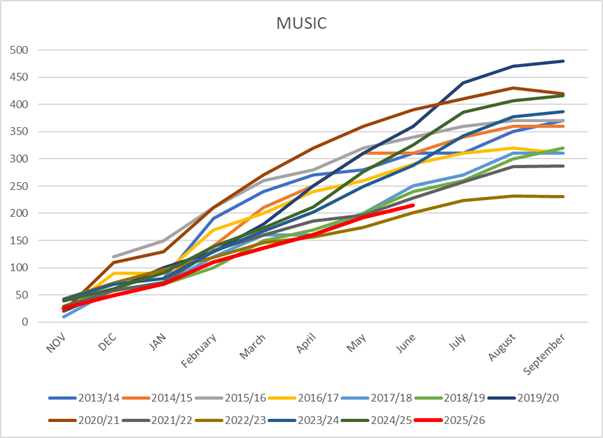
The news is not good. The June data for applications is the second worst number since the 2013/14 round more than a decade ago. Only the 2023/23 round post covid that was a terrible round across all subjects, has recorded a lower figure for applications than June 2025. In context, the June number of offers, a better measure than applications, is not far short of half the level seen in the covid year of 202/2, and around 25% below what might be expected in a usual round.

Worry, not because the government has decided that falling rolls over the next few years will mean fewer teachers of music need to be trained. Reducing the target from a requirement of 565 teachers of music in 2024/25 to just a requirement of 260 new trainees in 2025/26 suggests either the previous targets were way out of line or a need to justify the removal of the bursary by setting a target that can be met. After all, it would be unfortunate to remove the bursary as unnecessary, but still miss the target.

So, what of demand from state schools for music? Since January, and the start of the recruitment round for September 2026, I have recorded some 530 schools advertising for a teacher or music. Allowing for the fact that perhaps 100 had a TLR attached, so were not ideal for newly qualified teachers, this suggests 400 posts for newly qualified teachers so far. Add in perhaps another 100 autumn term vacancies and overall demand might be in the range of 400-500 posts or 500-600 posts overall.

The DfE expects about half of vacancies to be taken by existing teachers or returners each year. The exact number depends upon where the demand is and how it relates to supply. But, sticking with the 50% figure means a demand for around 250 to 300 new entrants each year.

Now, with falling rolls be might reduce that number by 10% to 225 to 270 as a requirement. On the face of it, the new target of 260 look risky but manageable. However, it must include two assumptions: all those that are offered eventually complete their courses and of ‘completers’, all join the state secondary school sector.

Both, based upon past trends are unrealistic assumptions. Being generous, 90% of those offered places complete the course. This suggests an output of 236 against a target of 260. Rounding up to 240 new entrants, this mean the new target is still not way of demand.

However, not all ‘completer’s join state schools. Some don’t enter teaching at all; some join Sixth Form Colleges or primary schools; some join the independent sector and some may decide to work overseas in the growing international school market. The 2025 data Less than 400 teachers of physics entered service in 2023/24 | John Howson based upon 2023/24 entry patterns showed that 80% of those gaining a QTS on a music ITT course entered teaching in a state-funded school. This includes both primary, secondary and special schools.

Assuming the 80% as a baseline – the next set of data should be out next month – our total of 240 reduced to less than 200. That number is starting to look as if the cut to music ITT places has been too savage.

A cynic might suggest, but I never could, the target was reduced to ensure it would be met and to save face over the removal of the bursary.

Whatever the reason, the DfE has now risked demand continuing to outstrip supply and this to affect the teaching of music in the nation’s secondary schools. With the recent announcement of the programme to ensureEvery child to get access to enriching activities to build skills and confidence for life’, the new target looks even less sensible  Every child to get access to enriching activities to build skills and confidence for life – GOV.UK.

I haven’t seen any campaign from the sector asking the government to revisit the target, but perhaps there should be in light of these numbers unless falling rolls are going to affect the demand for teachers of music more than I have calculated.

I would welcome any comments on the data.

ITT: subjects recruiting from UK graduates still in trouble

The DfE’s June data on the current round of applications and offers for postgraduate ITT courses still revels that the 2026 round is separating into two distinct sections. Subjects where applications are likely to come from anywhere in the world are either already meeting their Teacher Supply Model target for 2026 entry, or should do so on the current trajectory. Subjects where home recruitment is likely to dominate applications seem more at risk of missing their targets.

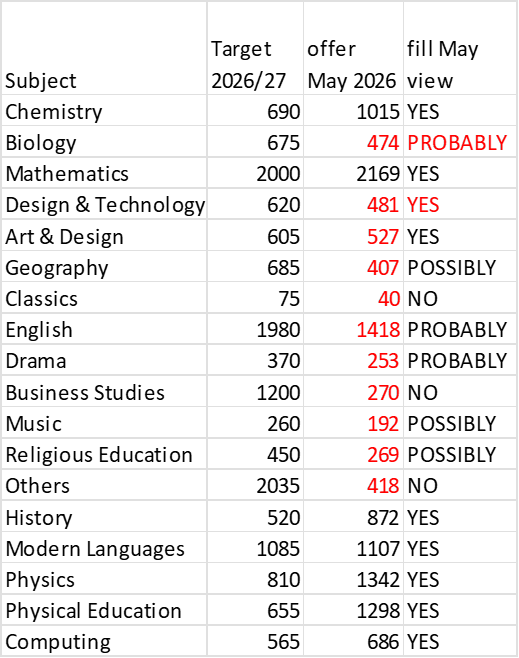
SubjectTarget 2026/27offer May 2026Fill: May viewJune offersFill: June view
Chemistry6901015YES1199YES
Biology675474PROBABLY542POSSIBLY
Mathematics20002169YES2495YES
Design & Technology620481YES562YES
Art & Design605527YES601YES
Geography685407POSSIBLY455NO
Classics7540NO43NO
English19801418PROBABLY1586POSSIBLY
Drama370253PROBABLY283PROBABLY
Business Studies1200270NO301NO
Music260192POSSIBLY215PROBABLY
Religious Education450269POSSIBLY308NO
Others2035418NO456NO
History520872YES974YES
Modern Languages10851107YES1214YES
Physics8101342YES1466YES
Physical Education6551298YES1405YES
Computing565686YES794YES

Based upon ‘offer’ recorded in the June update from the DfE, and with just three more reports to come before courses commence, I have made four downgrades and one upgrade to my expected outcomes for the current recruitment round.

I have downgraded expected outcomes for, biology, geography, English and Religious Education, including reducing Religious Education to a ‘No’. however, I am aware that there is a vigorous advertising campaign currently underway by the Religious Education sector, reminiscent of the RETRI initiative led by Dr John Gay a quarter of a century ago. Success in attracting new applicants could mean that it would be possible to hit the target for Religious Education. I do wonder why more subject groups don’t invest in advertising the benefits of becoming a teacher.

If science graduates discover there is space for those with some biology, then that subject might reach its target. Music looks likely to meet the target, but that target, in my opinion, has been set far too low to meet demand from schools, especially with the DfE’s latest initiative on extra-curricular activities for all, including within the scope, music. It will be difficult to achieve success in music without more teachers. However, meeting the low target will justify the removal of the bursary for music ITT.

Applications from outside of the United Kingdom represented 25% of all applications this June compared with 18% in the data for June 2025. If all non-Uk applicants had applied for secondary sector courses, then they would currently account for more than a third of applicants across all subjects, compared with a quarter in June 2025.

More evidence of the lack of interest in teaching from hone-based students comes from the fact that the number of graduates in the age group ’21 and under’ applying for courses is only 115 higher this June at 3,685 compared with an increase in applications of nearly 2,000 from the ’30 to 34’ age grouping.

The increasing interest in teaching from men continues, with applications up from 16,796 in June 2025 to 21,774 this June! It would be useful to know more about where this increase is focussed, and what the implications might be for the sector.

As ever, the DfE continues not to share ethnicity data with the sector. With so many overseas applicants at present, is that a helpful omission from the dataset?

Higher Education continues to bear the brut of the increase in applications, with ‘partner led’ and ‘salaried’ routes static, and only a small increase in applications to SCITT courses. However, PG teaching apprenticeships have seen a healthy increase in applications from 6,328 to 10, 493. However, offers are little changed at 1,066, compared with 966 in June 2025.

Perhaps because of the arrival of the postgraduate apprenticeship route, offers for the ‘salaried route was only 266 this June, compared with 518 in June 2025. Mr Gove’s brave new world of 15 years ago now looks like a distant dream, as higher education continues to take the bulk of applications, proving the resilience of the sector in the face of determined onslaughts during the coalition government to remove its dominance from the training of new graduate teachers.

With the end of the school term rapidly approaching, the next three months traditionally see relatively few new offers: will this year be any different, especially given the press comments about graduates unable to find work, or does teaching still look like an unattractive carer to debt strapped UK graduates?

With falling rolls affecting job prospects after training  and the acquisition of more student debt, and a possible below inflation pay settlement, the signs for increased interest in teaching as a career during the rest of the recruitment round are not good.

Demand for music teachers: where were the jobs in early 2026?

This post follows on from my previous post, written yesterday, and looks in more detail at the vacancies for music teachers tracked since January 1st 2026. Music teachers: labour market update | John Howson

Due to further data cleansing, the numbers may slightly differ from yesterday in some respects after mis-allocations in certain fields have been corrected.

Vacancies are generally either for a main scale/Upper Pay Spine post or for a promoted post.

In terms of the ratio of promoted posts with a TLR, or in a few cases a Leadership Scale offer, to posts without any additional allowance, the East Midlands region tops the list at 37% of advertised posts with a TLR.  At the other end of the scale, no promoted posts have been recorded for the North East. It may be that schools in the North East use regional job boards for promoted posts. Those boards are currently out of scope of my survey.

The East of England region also had a lower-than-average percentage of promoted posts in the total of advertised vacancies. However, this may be partly due to the larger than average number of posts advertised without any additional pay supplement dragging down the percentage of promoted posts.

Most promoted post are TLRs advertised as a 2b.

In terms of the need to re-advertise vacancies for teachers of music, there are three clear regional groups: the East Midland and East of England with well above average levels of schools re-advertising; Yorkshire and The Humber region where, to date, no re-advertisements have been recorded, along with the West Midlands, North East and South West, regions with well below average levels of re-advertisements.

The remaining regions have re-advertisement rates broadly in line with the national average. Of course, there is still time for other schools to re-advertise before the end of the summer term. However, as they would only be attracting ITT completers or returners, this might be something of a futile exercise, only worthwhile if at no cost, such as using the DfE vacancy website.

Interesting questions that arise from the data are: how well does ITT provision map with demand and are there any characteristics of schools that re-advertise vacancies – high free school meal percentages; excellent music departments; high-cost housing areas; long distance from ITT provision no recent history of schools being used by trainees?

Other interesting questions to research include: the balance of full-time versus part-time vacancies and between permanent and temporary vacancies; and how many of the latter are as a result of a teacher taking maternity leave? Fortunately this data has been collected along with whether or not the school is an academy and if the post is eligible for visa sponsorship: most are not.

If I have the time, I will try and address some of these questions in the round-up after the end of the summer term in August. Meantime, any views would be welcome in the comments section.

Music teachers: labour market update

One of the leitmotifs of this blog has been around the labour market for teachers, from numbers entering training, through vacancies for teachers, to the numbers of teachers that are in-service.

This academic year, I have been tracking the data on vacancies for headteachers – a study started more than 40 years ago – and vacancies for teachers of music. This is as a part of my campaign to see the bursary returned to trainee teachers of music, after the Labour government axed it an act of cultural vandalism that I might have expected from other political parties, but not from Labour.

Anyway, enough of my rant. Does the data support my thesis that there are not enough music trainees this year, even with the bursary, and that any reduction in trainee numbers will affect the 2027 labour market, making it more difficult for schools, and especially secondary schools in challenging circumstances, to recruit music teachers? For earlier discussions on this point see:  Music teachers: bring back the bursary | John Howson and Reviving Music Teacher Bursaries: A Necessity | John Howson

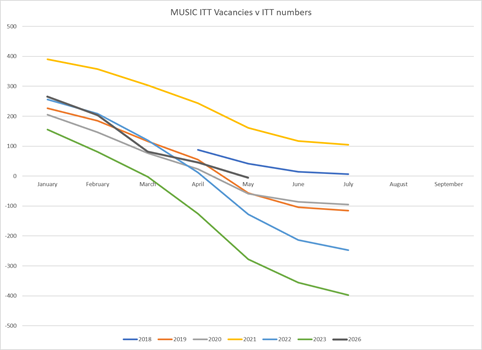
The graph in this post shows recorded 2026 vacancies for main scale teachers of music (no TLR) advertised since the start of January2026, and recorded from both the DfE vacancy site and the tes job board. The 2026 data have been plotted against previous years data, collected by TeachVac from school websites and local authority job boards.

The plotted line is the residual, reached after subtracting the recorded vacancies from number of trainees contained in the DfE’s ITT census published in the December 2025. By Friday 29th May 2026 the residual number had just turned negative; meaning more vacancies recorded than trainees possibly available to enter the labour market.

Two caveats are required at this point: not all trainees will complete their course, and of those that do, not all will enter teaching in state schools – some with not teach, others will teach in Sixth Form Colleges, and yet other will teach in the independent sector that now comprises a significant proportion of ‘A’ Music level entries. The second caveat is that in addition to trainees, there will be other entrants into the music teacher labour market. Some other entrants will be switching schools, but possibly most will be doing for a teaching job with a TLR. Then there will be those returning to state school teaching either from other jobs or a career break. This group will become increasingly important for the job market as the rest of 2026 unfolds, and the new entrants into teaching either find a teaching post in a state school of opt to work elsewhere.

For various reasons TeachVac stopped collecting data in 2023, so the data for 2024 and 2025 is missing. Comparing 2026 with earlier years, shows a trend worse than before covid, but better than in 2022, and the disastrous 2023, when poor recruitment into ITT in 2022 and the number of new schools opening in response to the increase in the secondary school population ensured a higher-than-normal demand for teachers. However, here was my analysis in June 2023 TeachVac’s index shows depth of teacher recruitment crisis | John Howson

For the current market outcome, if you discount the ITT 2025 census total by either 10% or 20%, for numbers in the census not likely to enter mainstream school teaching in the secondary sector, then the current negative residual at the end of May 2026, of -5, worsens to either -41 or -78.

This number assumes that vacancies tracked cover the whole market and that regional or other job boards, such as within large MATs, that are not counted in my survey have not seen many vacancies not placed on either the DfE or tes site.

Some schools may have offered trainees working in their schools a job, and saved on advertising costs. However, without more detailed surveys, such jobs would be difficult to account for.

One issue overcome by direct verification of the DfE and tes sites, is the thorny question of re-advertisements and repeat advertisements. The data used in this report ignores any second or subsequent advertisement by a school for a teacher of music unless it is significantly different to any previous advertised vacancy. Examples include a part-time post when the previous vacancy was for a full-time teachers and a maternity leave temporary post following one for a permanent appointment.

In a future post, I will look into the characteristics of schools that have re-advertised a vacancy.

After weighing the data on vacancies so far, and trends in ITT recruitment – see More thoughts on the ITT round for 2026 | John Howson – I think the removal of the bursary by the DfE was a risk, and that it may damage the future of music in state secondary schools in the future. I look forward to being proved wrong.

More thoughts on the ITT round for 2026

Yesterday, although a bank holiday in England, more people listed as from the United Kingdom than listed as from the United States viewed this blog. It’s been a while since that has happened.

I guess it was because of the post about the May ITT numbers I posted yesterday. Yesterday also looks like a bank holiday that higher education ignores. I am not surprised as there can be too many bank holidays on Mondays in May, and that fact can play havoc with timetabling.

Anyway, thanks for viewing, as, wherever you are from, your support is much appreciated.

After producing my prediction table in yesterday’s post MayDay for some ITT subjects: joy for others? | John Howson

I thought that I would delve a bit more deeply into possible outcomes. Looking at 2025 data between May and September, and ignoring all applicants not from England, there were 11,773 more candidates in 2024 and 13,387 more candidates recorded in 2025 between May and September.

At 18th May 2026, there were 33,344 candidates, so it seems likely that candidate numbers will be up on the past two years in terms of candidates from England. However, as this also contains candidates for the primary sector, that factor needs to be taken into account. This year, with a low ‘target’ for primary, I would be surprised to see many more candidates applying for primary sector courses, as most courses will presumably be showing as ‘full’.  

However, what about the subjects listed as anything other than ‘Yes’ will fill in the previous table? How do they fare?

The following table is based upon ‘offers’ not ‘candidates’ numbers between May and September for 2025.

subjectMay-25Sep-25difference% increase offers May to September
Others4185008220%
Classics44541023%
Physical Education1395177538027%
History832113230036%
Physics1246169845236%
Mathematics2169314297345%
Religious Education34750816146%
English1467216169447%
Drama23434911549%
Music27641614051%
Art & Design709108637753%
Business Studies21232911755%
Geography731113540455%
Modern Languages1089170962057%
Biology1094173363958%
Chemistry682109140960%
Design & Technology46678331768%
Computing53794240575%
  
Total Secondary1353020043651348%

There is no doubt that had the DfE output from the Teacher Supply Model remained the same as I 2025, this table might have looked very different.

I think that I might upgrade Geography from ‘possibly’ to probably’ on this data. As music had a bursary last year, I am not yet prepared to upgrade that subject to ‘probably’, at least until after July numbers, and the applications from 2026 graduates have been taken into account. The same is true for Religious Education.

Another area of uncertainty remains around the sciences. The total target had been reached by the end of May, but biology numbers were below target. Will providers top up with students to make courses viable? My guess is, yes, as there seems to be no penalty to the provider for doing so. The risk is all carried by the trainee.

In the future, I think that the DfE needs to consider disaggregating the 2,035 places listed as for ‘other’ subjects. Not to do so makes the data increasingly meaningless, especially once the fact that more than a third of applicants come from outside of England is also taken into account.

Finally, as we know for the annual DfE’s ITT census, not all offers turn into students counted in the census. I might try and look at what level of over-recruitment might be sensible to ensure 100% of the DfE’s target by the time of the ITT census, after allowing for the fact the TSM target should include a percentage of in-course wastage.

Afterall, the aim is to ensure the labour market has the qualified teachers it needs for all students to be taught by properly qualified teachers.  

UCET’s changing of leadership: a rare event

I have been rather tardy in posting my appreciation of the work of James Noble-Rogers, as executive director of UCET (The Universities Council for the Education of Teachers). James was only the second Executive Director the organisation has had so far, taking over from Mary Russell, its first director, after she had presided over the coming together of UCET and PCET, the universities high education teacher training organisation that merged with the polytechnics and colleges organisation, after those institutions became universities in the 1990s to form UCET as it is currently constructed.

James was recruited to his post at UCET from the civil service. I first knew him when I served at the then Teacher Training Agency between 1996 and 1997, in the role of advisor on teacher supply, an interest I retain until this day. James was working on ITT numbers in the DfE, and was a natural fit to take over from Mayr on her retirement. However, I suspect that many were surprised to see a civil servant, and not an academic, appointed to the role. Appointing James was an inspired move.

Afte leaving the TTA in 1997, I worked closely with UCET, and James, for about a decade while he steered UCET through the problems of firstly, falling interest in teaching as a career, and then the boom after the 2008 economic crisis that lead to, in my view, the mis-guided decision by Ministers to axe the training grant and require the payment of tuition fees for graduates when Michael Gove became Secretary of State. These moves contributed to the teacher supply crisis that I foreshadowed on this blog in my 2013 posts (see Howson: Teachers, Schools and views on Education – available from Amazon as an eBook).

The early years of the coalition were a challenging time for colleagues working higher education preparing new teachers and providing INSET. Some will recall the ‘blob’; others, the issue of recruitment controls that nearly caused several universities to consider pulling out of ITT/ITE.

James remained resolute in supporting the higher education community’s central involvement in teacher preparation and development, the position it still holds today, while recognising the emerging partnership with schools that through SCITTS were providing their own version of teacher preparation. At the same time, Teach First was creating another route into teaching.

The last decade after 2016, brought new changes, the effect of the covid pandemic, plunging interest in teaching from home students and the growth, in recent years, of applicants from around the world.

As I became more involved in local government politics after 2013, I lost regular contact with UCET, and stooped attending their annual conference.

Even to, I am delighted to be able to recall my association with James, and the long service he rendered to UCT over more than a quarter of a century. I hope that as with his predecessor, his work will be acknowledged formally by the State.

I enjoyed the time when I worked with James, and wish him well in the next stage of his life. I am delighted to see that he is still offering his support, advice and knowledge that few others can rival.

UK graduates not yet rushing into teaching

There has been a lot of talk about how challenging graduates are finding the job market at present. Is this ‘difficult’ job market for graduates showing up in renewed graduate interest in teaching as a career? The DfE has published the latest (April 2026) data about application to teacher preparation courses as a 20th April 2026. Initial teacher training application statistics for courses starting in the 2026 to 2027 academic year – Apply for teacher training – GOV.UK

While there has been a modest increase in applications to be a teacher for most areas of the United Kingdom – the North East, Northen Ireland and Wales excepted – the biggest increase continues to be from the ‘rest of the world’ grouping, up by a massive 42% on April 2025. Only three regions in England have percentage increases in double figures: the East Midlands, London and the North West. The South East, South West and Yorkshire and The Humber regions have increases in applicants of less than five per cent.

AreaApr-26Apr-25Difference% Diff
EM2427206236515%
EE283126302017%
LON6504571179312%
NE10681108-40-4%
NW4106359551112%
SE397538171584%
SW216720661015%
WM336231202427%
YH28082720883%
292482682924198%
  
EEA582528549%
NI447473-26-6%
RoW122517096515542%
SCOT20319673%
WALES384418-34-9%
UNKNOWN106120-14-13%
139738831514237%

Increases at this level do not yet suggest a significant switch to teaching in large numbers. Indeed, the increase in England as a whole is just 2,419 extra applicants, or 8%.

One significant increase is that of male applicants, up from 13,234 to 18,111. However, it is impossible to know how many of these extra male applicants have come from the ‘Rest of the world’ pool?

There are also large differences in the increases from ‘new 2026’ graduates and older graduate. However, the ‘Rest of the world’ effect may be skewing this data

AgeApr-26Apr-25Difference% Diff
21312629941324%
22425639682887%
23368233693139%
24282826132158%
25-29102877824246324%
30-3467634618214532%
35-3951443899124524%
40-443524286066419%
45-492012175625613%
50-54956919374%
55-59446455-9-2%
60-64158145138%
65+3733411%
unknown47-3-75%
4322335460776318%

Total applicants at 43,221 remains well below the record of 67,269 applicants for similar courses recorded by the UCAS GTTR scheme in the 2009/2010 round during the aftermath of the 2008 economic crisis. To that number must be added those that applied for school-based courses, such s the GTTP that did not recruit through UCAS, as well as the Open University, that also did not recruit through UCAS.

Higher Education – up from 24,028 to 30,104 has borne the brunt of the extra applications. SCITTs have shown little growth, up from 11,293 to 11,544, perhaps because overseas applicants are less familiar with this toute into teaching. This might also explain the lack of any increase in the ‘partner-led’ courses. Apprenticeships are on the increase, up from 4,783 to 7,894, but ‘salaried route remains static at 5,883 compared with 5,389 last year in April 2025.

Even before the DfE announcement of the ‘needs’ numbers for 2026, ‘offers were down at 20th April at 17,880, compared with 18,297 in April 2025.

I have written a separate post about the state of play with regard to ’offers’ in secondary subjects. In the primary phase, applicant numbers are up from 12,502 to 14,797, but ‘offers’ for primary courses are little changed, up from 6,992 to 7,106. However, as the DfE ‘need’ has reduced ‘need’ from 7,650 to just 5,520 for 2026, there are likely to be few if any more offers, as the ‘need’ figure is already some 1,500 below the ‘offer’ number.

So, there is no great rush towards teaching as a career from United Kingdom graduates. Whether that will change over the next couple of months as final examinations are completed, and the reality of the job market hits home, only time will tell. But, for would-be primary teachers, I expect that the  ‘bus has now left the stop’ and it was already fully laden.

Religious Education – the need for qualified teachers

In a recent post on this blog about the DfE’s modelling of trainee teacher needs, I wrote that

‘However, has this re-assessment of need gone too far? Based on … my own current research into vacancies for teachers of music, I think the DfE has been realistic in its approach. ‘

While, I stand by that judgement, I have also been reminded by Deborah Weston, championing on behalf of those concerned with the teaching of religious education in schools that the cutback in trainee numbers probably allows little room for the replacement of the ‘under’ or even ‘un-qualified’ teachers currently teaching religious education in our schools.

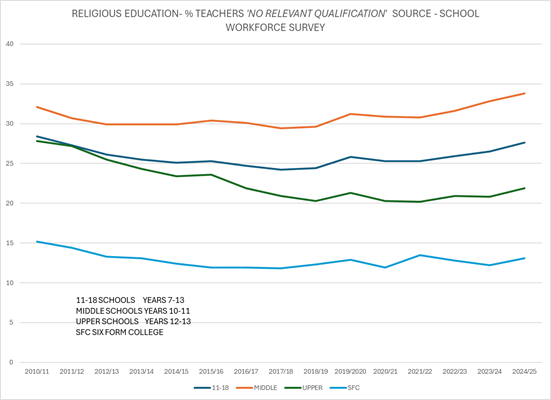
Prompted by Deborah, I looked at the trends from the Teacher Workforce surveys concerning the use of those with ‘no qualification in the subject’ teaching religious education over the period between the end of the Blair/Brown Labour government and the end of the Conservative period of government. Of course, recent years have been impacted by the covid pandemic, and its consequences, but there is a clear trend that is observable.

The chart shows the four key types of secondary schools, of which the 11-18 school line is probably the most significant.

At the end of the Labour government, partly I expect as a result of the economic crisis of 2008, the percentage of teachers of religious education with ‘no qualification in the subject’ was reducing. However, the percentage levelled out as school rolls began to increase again, and teacher supply entered into an extended period of years when teacher preparation programmes missed their targets.

There was a brief respite as a result of covid, but in the most recent years, as trainee numbers have fallen, so the percentage of teachers with ‘no qualification in the subject’ has reached levels not seen since well before 2010.

As a result, the question now is, was the DfE right to cut trainee targets for religious education from 780 last year to 450 this year? On the basis that including unfilled places from previous recruitment rounds was a mistake, as I have always maintained, then the answer is clearly, yes, the DfE have taken the correct decision.

However, in subjects such as religious education, where most pupils only study the subject for a limited period of time each week, managing recruitment is easier for schools, if qualified staff are available.

I would add that in my opinion, religious education when taught by well-prepared and knowledgeable teachers can be a really valuable subject, especially at this time in the history of our multi-cultural society, where both many different faiths are practiced, and a growing minority profess to having no faith in religion at all.

If the government cannot see their way to increase the stated need for trainee religious education teachers, providers can always over-recruit, at least to higher education courses, where government funding isn’t an issue.

In addition to pre-entry training, the DfE might also like to consider another approach to the issue of shortage of religious education teachers: upskilling those presently teaching the subject, but without an appropriate qualification.  If it is important that a subject be offered on the curriculum, it beholds government to ensure it is taught properly.  

Spending cash on upskilling will no doubt help retention, and thus save on recruitment and training costs. However, apart from in mathematics and the sciences, it hasn’t really featured as a policy objective for many years: surely that’s a mistake.

I hope that the religious affairs lobby is able to persuade the government that significantly reducing the percentage of inappropriately qualified teachers of religious education should be a key policy objective.

ITT Offers – public money being wasted?

The DfE has today published the April data on postgraduate ITT courses, as at 20th April 2026. Initial teacher training application statistics for courses starting in the 2026 to 2027 academic year – Apply for teacher training – GOV.UK

This is the first month where offers can be compared with the DfE’s required need for each subject for September 2026 courses. I have previously posted about the draconian changes to the demand in many subjects as required by the DfE that have resulted from a different approach to unfilled vacancies. ITT Numbers for 2026 – brutal realism from DfE or big risk? | John Howson

Here is my assessment of possible outcomes for September, when courses commence, based upon current offers and past trends. It will be interesting to see how my view compares with that of Jack Worth at NfER.

SubjectTarget 2026/27offer April 2026DfE identified needFILL?
Chemistry690829-139YES
Biology675398277YES
Mathematics20001752248YES
Design & Technology620382238POSSIBLY
Art & Design605449156YES
Geography685353332POSSIBLY
Classics753639NO
English19801176804PROBABLY
Drama370207163PROBABLY
Business Studies1200224976NO
Music26016199POSSIBLY
Religious Education450339111POSSIBLY
Others20353721663NO
History520736-216YES
Modern Languages1085946139YES
Physics8101140-330YES
Physical Education6551175-520YES
Computing56553926YES

In some subjects, such as history, physics!, physical education and chemistry, providers have already made more offers than required ‘need’.  This demonstrates the danger of leaving it so late in the recruitment cycle to announce estimated demand.

In the past, these numbers used to appear before Christmas. With a rolling offer system in place, rather than a defined closing date, leaving the announcement of ‘need’ until April is likely to cost someone money. Will the DfE pay bursaries to all students offered a place, even if recruitment is above the stated ‘need’? If so, that could be seen as a waste of money.

However, of more concern are the subjects where, even with the new numbers for ‘need’, there are unlikely to be enough applicants to fill all the places. Based on previous trends, classics, business studies and the ’others’ grouping will not meet their ‘need’ number. I think it is time that the ‘other’ category, with 2,035 places is disaggregated into different subjects, after all, it is now by far the largest group in the subject’s table.

I have some concern about where design and technology, geography, music and religious education will produce enough offers to meet the revised ‘need’. However, I can now see why the bursary was removed from music. I still think that was a serious error of judgement, as this is a subject where only those with appropriate subject knowledge are accepted onto courses. Music has one of the highest applications to offer ratios of any subject. Current offers are the second lowest April ‘offer’ number since 2018.

What happens in the wider economy, and graduate job market, will determine the outcome of this recruitment round. I suspect there will be a summer surge in applications, as new graduates discover how tough the job market has become. This should mean a good year for teaching course. However, many applicants may now have found they have left it too late to secure a place for this autumn. This year will really be a case of ‘the early bird that catches the worm’.

I will now delve deeper into the data for another post about the nature of applicants and applications as revealed in this month’s data.