
Unknown's avatar

About John Howson

Former county councillor in Oxfordshire and sometime cabinet member for children services, education and youth.

ITT – more applicants doesn’t always mean more offers

In my previous post, I noted the increase of nearly 6,000 I the number of candidates applying for a place on a graduate teacher preparation course. Up from 21,436 in March 2025 to 27,352 in March 2026. This post explores the relationship, both this March and last march, between candidates and places offered to those candidates.

Firstly, the number of candidates and the number of ‘offers’ to candidates in each secondary subject.

candidatesoffers
2025202620252026
BIOLOGY21612044713332
ART&DESIGN9601026451366
MFL18762246821733
PE1988221911491043
PHYSICS33296522825918
COMPUTING12702394341420
GEOGRAPHY1089843476292
OTHERS9261342281310
CLASSICS67623427
D&T661861273295
RE699693255208
MUSIC311275173136
MATHEMATICS4006534612771398
ENGLISH256128301032990
HISTORY11421281592624
BUS STUDIES607923132173
DRAMA336384162176
CHEMISTRY16622207441675

Note, not all subjects have seen increased candidate numbers within the overall increase.

Secondly, the next table shows the percentage of candidates so far ‘offered’ a place for 2026.

20252026Change
BIOLOGY33%16%-17%
ART&DESIGN47%36%-11%
MFL44%33%-11%
PE58%47%-11%
PHYSICS25%14%-11%
COMPUTING27%18%-9%
GEOGRAPHY44%35%-9%
OTHERS30%23%-7%
CLASSICS51%44%-7%
D&T41%34%-7%
RE36%30%-6%
MUSIC56%49%-6%
MATHEMATICS32%26%-6%
ENGLISH40%35%-5%
HISTORY52%49%-3%
BUS STUDIES22%19%-3%
DRAMA48%46%-2%
CHEMISTRY27%31%4%

Only in Chemistry, where because of the reduction in the size of the bursary to those applying for biology courses it seems likely that those with a choice between the two subjects have opted to apply for chemistry with its higher bursary for 2026. As a result, biology, with a 17% fall in offers this March when compared with March 2025, is the big loser.

Despite the change in candidate numbers, the percentages offered places in March 2026 follows a similar ranking to March 2025.

% offered
20252026
MUSIC56%49%
HISTORY52%49%
PE58%47%
DRAMA48%46%
CLASSICS51%44%
ART&DESIGN47%36%
ENGLISH40%35%
GEOGRAPHY44%35%
D&T41%34%
MFL44%33%
CHEMISTRY27%31%
RE36%30%
MATHEMATICS32%26%
OTHERS30%23%
BUS STUDIES22%19%
COMPUTING27%18%
BIOLOGY33%16%
PHYSICS25%14%

Music is such a specialist subject that it generally only attracts candidates likely to be accepted. However, current ‘offer’ levels are still well below those recorded in the first four years of the century when the number accepted ranged between 68% (2001) and 78% (2003). (Source: John Howson’s collection of GTTR Annual Reports). 2003 was after graduates training to be teachers received a training grant and were also exempt from tuition fees.

Of course, the most interesting percentage of ‘offers’ is that for physics, where only 14% of candidates have so far been made an offer. It looks as if the better candidates for biology are those that have opted to apply for chemistry in 2026, resulting in a significant fall in ‘offers’ in biology.

For subjects such as history and physical education, it is wise for candidates to apply early in the recruitment round since places fill quickly.

Finally, is the present system fit for purpose? Should there be a closing date by which all applicants will be considered,  rather than the drip feed approach as a present?
ITT – 9 subjects with fewer offers than March last year

Despite the increase in applicants for secondary ITT courses, from 21,436 in March 2025, to 27,352 this March, ‘offers’ from course providers are down in nine different subjects this March when compared with March 2025. The subjects with fewer offer so far this year are:

SubjectOffer March 2026Offer March 2025% change
Art & Design36645119%
Biology33271353%
Classics273421%
English99010324%
Geography29247639%
Modern Foreign Languages73382111%
Music13617321%
Physical Education104311499%
Religious Education20825518%

 I think one can discount both Physical Education and English from subjects where the declines are of concern. Elsewhere, the changes in bursary support are obviously having an effect. Those biologists that can do so are now applying for Chemistry – where there is still a bursary, and offers are up from 441 last march to 675 this March – but the overall offer across the two subjects are still below last March at 997, compared with 1,154 last March.

It is the arts subjects that seem to have been most badly hit. This is not surprising given the changes to the bursary scheme that saw the bursary axed completely for music and religious education, and reduced for biology from £26,000 to just £5,000, while it increased to £29,000 for chemistry.  French and Spanish also lost their £26,000 bursaries. The reduction in ’offers’ in geography, down by 39% may also be due to the cut in the bursary from £26,000 to just £5,000.

Given the need for fewer teachers in the future, as secondary school rolls start to fall, these changes to bursaries do look like a gamble. How much of a gamble will be clear when the DfE finally announces the ITT training targets. But my hunch is that music and religious education along with geography will join the list of subjects not hitting their targets unless the current global war affects graduate recruitment in the summer. Will there be a late surge of new graduates looking to teaching, similar to that during the early months of the pandemic in 2020? The jury is out for the moment, but such a surge would not surprise me. However, as a precaution, reinstating a scholarship in the arts subjects might be a wise precaution. This might make it look less like a -U- turn than a reinstatement of the bursary.

Elsewhere in the data, candidates form the ‘Rest of the World’ accounted for 30% of all candidates this March, compared with 21% last March.  The DfE really does need to show how this increase affects different subjects and how many of these candidates will be likely to receive a visa to both learn and then teach in England? Can we afford to waste funds on those with no prospect of teaching in England, while depriving potential home candidates of bursaries.

As expected at this time of year, there has been more interest from career changers than university students, with those under 24 showing an increase over last year of just 1,000 compared with an increase of more than 4,900 from those in the 25-39 age groupings.

DfE Vacancy site – some thoughts

A great deal of research can be boring to do. That’s certainly true of my research into the labour market for teachers that I first started way back in the early1980s. Currently, I am tracking advertisements for headteacher vacancies in England.

The DfE is running a series of adverts on platforms such as LinkedIn extolling the virtue of advertising on their free vacancy site and claiming almost complete coverage of vacancies.

It is certainly true that the DfE site contains the majority of the headteacher vacancies in state schools in England, but I am not sure whether it has as complete a coverage as it maintains. One wonders what the Advertising Regulatory Body would make of such an unsubstantiated claim? It certainly would be allowed for beauty products.

The DfE site also has a number of idiosyncrasies. For headteacher vacancies, the most significant is the repetition of certain vacancies, a factor that inflates the total number of vacancies.  For instance, today, the DfE site suggests that there are 185 vacancies listed (1130 on 22.3.26). In reality there are only 160 schools advertising for a headteachers on the site. The other listings are repeats, or in one case a double repeat, with the vacancy appearing three times in all.

Does this repetition matter? It does if anyone is just counting the total of vacancies listed, as that would inflate the turnover of headteachers. Such simple counting would also need to also take into account the length of times each vacancy is listed. This can range from four weeks to a couple of days. Why some vacancies only appear for a short length of time is an interesting question. Do these schools have a candidate in mind, and hence don’t want other applicants?

Then there is the issue of genuine re-advertisements, where a school advertised, but failed to make an appointment. If counting the number of schools seeking a headteacher, then these re-advertisements need to be discarded.  To do so, needs a regular analysis of the whole list of vacancies, as there is no easier way to identify such schools. There is also an irritating practice from some MATs of not identifying the school where the vacancy has occurred. Some MATs also avoid information about the starting salary: I think that this is a mistake, since their idea of generous, may not be the same to MATs as to candidates, and it is embarrassing to find this out at interview stage.  

What of the schools whose headteacher vacancies appear more than once in the same list? Many are newly advertised vacancies; some are re-advertisements, but in each of these groups there seem little logic to the schools listed. At present, there are no schools in either the West Midlands or London regions with double entries. However, of the 25 schools with double entries, six each are in the South East and East of England.  

At the end of the school-year it will be interesting to see whether some MATs, local authorities or dioceses fare worse when it comes to making an appointment of a headteacher. There are some obvious candidates already appearing after just six months of the school-year.

Demand for SEND places

Yesterday, I wrote about the forecast decline in primary and secondary school places. In the past, less attention has been paid to the need for places for pupils with SEND. However, possibly as a result of the rapid growth in EHCPs, and hence the demand for specialist provision, the DfE has started trying to forecast what it has termed ‘the Local authority pupil forecasts for ‘Local authority specialist provision for pupils’.

This exercise was always going to be something of a challenge since it is taking place against falling pupil numbers, especially in the primary sector, but increasing demand for EHCPs. However, if demand for EHCPs continues to increase, it won’t necessarily mean a demand for more special school places, because some of the increased demand is likely to be met by specialist provision within schools as ‘specialist bases’ are created, often using the spare capacity arising from falling rolls.

At present the DfE data shows that the current stock of special schools is operating at over-capacity by some 10,000 places. At the top of a demographic cycle, such pressure would not be surprising, as schools often take ‘bulge’ classes for a couple of years using temporary buildings rather than built new schools that might not be needed as rolls fall. Whether that is the correct approach in the present circumstances for the special school sector is unclear from the DfE’s data published yesterday. School capacity in England: academic year 2024 to 2025 – GOV.UK

An analysis of local authority data around provision of specialist provision for the period up to the end of the decade reveals large differences across the country in projected need. At one end of the spectrum, three local authorities are projecting grow of in excess of 1,200 places each in the primary sector. At the other end of the spectrum, twenty-four authorities are predicting a reduction in need, with one ‘Reform’ led county predicating a need for 500 fewer places. Interestingly, the adjacent unitary authority is predicting an increase of over 100 places.

Oxfordshire, whose primary and secondary place forecasts were discussed in my previous post is predicting only a very small increase in the number of primary places.

These significant differences don’t seem to be related to either the underlying pupil population or the trend in pupil numbers in the primary sector. This raises issues about how reliable the current forecasting around the demand for SEND places is for policy-makers. Accurate data are important, because of the cost of provision in the SEND sector.

Data on provision of places are also important in helping identify workforce needs. It seems odd that the DfE doesn’t seem to have a unit that brings together trends in pupil numbers and the demand for both places and people to educate the projected school population.

If the DfE did have such a unit then it might look at the costs of small sixth forms and of central overheads by different MATs. It might also look at the issue of small primary schools, and how they might be protected in rural areas, but possibly amalgamated in urban areas. Is a one-from of entry school viable in London?

Hopefully, the data published yesterday will create some debate around the important, but often overlooked, issue of pupil place planning, and the future shape of schooling in the modern age.

School building boom is over

The DfE has published its latest estimates of school capacity for 2024/25, together with estimates for places needed up to 2029/30 School capacity in England: academic year 2024 to 2025 – GOV.UK

There are two sets of numbers. One looks at both need and places available and calculates what might be regarded as a raw score. This looks at all spare places, regardless of location within the authority and measures that number against expected additional need. The second set just looks at additional need.

During the period between 2025/26 and 2029/30, most additional need is likely to come from changes in the housing stock, with little, if any, growth from the increase in the number of pupils in the relevant age groups. As a result, most local authorities show either no need for additional primary places or only small increases in numbers. Wandsworth is the only Inner London borough with any additional need for primary school places during the period 2025/26 and 2029/30.

The table balancing existing places with additional need shows only a handful of local authorities with a reduction in the spare capacity in the primary sector between 2025/26 and 2029/30. For most authorities, the spare place problem is expected to be worse in 2029/30 than it is in 2025/26

net spare places
OxfordshirePrimarySecondary
2025/26-11,052-6,321
2026/27-11,557-6,449
2027/28-13,117-6,959
2028/29-13,865-7,143
2029/30-14,601-7,336
Change-3,549-1,015

The table shows the estimates for Oxfordshire. Several factors could mean these data are not going to be accurate. In recent years, Oxfordshire has seen significant housebuilding, and if the construction of new housing continues, and attracts families from outside the county, then the spare places may be an overestimate.

Oxfordshire is also home to several military bases for both the army and the RAF. Although defence planning has projected the closure of some of the army bases, the current defence review and increased spending on defence might either slowdown or reverse the closure of some of the bases. If closures slow down, then this might mean pupil numbers don’t fall as expected.

The problem for both the local authority, the dioceses and the academy trusts is that Oxfordshire has many small primary schools located in villages. Often the school is the only facility left in the community. The present funding formula that is heavily biased towards pupil numbers poses a potential problem for small schools. Academy trusts can ‘vire’ funds between schools to help such schools through any temporary downturn in pupil numbers. At present local authorities do not have this ability: they should be given the power to support small village schools in the same way as MATs can.

However, as with many other rural areas, school closures look likely over the next few years if schools are not to run up deficit budgets. Such deficits would be paid off by depriving future pupils of some of their funding. With education spending likely to be squeezed to accommodate the increase in defence spending, and a greater proportion of the school funding going toward SEND pupils, there may well be some hard decisions to make.

With declining interest in established faiths, how will the dioceses react to falling rolls, if their schools are no longer viable?

One certainty is that if any school closures require additional free transport to the next nearest school, the current£20 million Oxfordshire council tax payers contribute to fund mainstream school transport will not be enough, even if fuel and other costs remain stable.

Local government reorganisation may offer a way out for politicians in areas such as Oxfordshire, but politicians in urban areas, and especially in London will not be so lucky. Time to dust off my review of falling rolls in Haringey in the 1970,s and the lessons to be learnt from those battles.

NEETs: A North East crisis?

There is no doubt that although higher than they could be, NEET percentages are lower than before the raising of the learning leaving age in 2013.

However, NEET rates are nowhere near uniform across the country. In Quarter 4 of 2025, the quarter after 16 year olds have decided whether to stay in education, find an apprenticeship or become economically inactive, NEET rate in the North East of England were more than twice the rate of the of those in the South West, according to the government’s Labour Force Survey.

‘NEET and NET Estimates from the LFS’ for 16 to 24 and Q4 for 2025

Q4
EnglandNorth EastNorth WestYorkshire and The HumberEast MidlandsWest MidlandsEast of EnglandLondonSouth EastSouth West
16 to 24Percentage of population NEET13.3%21.0%14.0%15.6%16.5%13.5%11.7%12.0%11.5%9.9%
Confidence interval (95%) for the percentage NEET0.9%4.6%2.7%2.9%3.3%2.8%2.5%2.6%2.1%2.4%

Footnotes

  1. LFS data has been reweighted from January 2019 onwards. There is a discontinuity in the timeseries at this point and comparisons to earlier data should be considered with caution.
  2. All estimates should be viewed alongside associated 95% confidence intervals as shown in the underlying data. Create your own tables on neet age 16 to 24 – Explore education statistics – GOV.UK

It seems likely that the rate for males is higher than that for females, although the recent government decisions that have made working in retail and hospitality more of a challenge than before the tax changes may well be pushing up the female rate of NEETs.

It would be interesting to see whether the move from school to a college is seen as more of a challenge for males than females?

Also of interest, but not identifiable from the data, are whether the rate of NEETs for 16-17 year olds is higher in rural areas with poor transport than in urban areas with excellent public transport to college or workplace?

My hunch is that transport costs play a part in some young people becoming NEETs. I have written elsewhere about the punitive effect of motor insurance tax on young people with no possibility of a no-claims bonus. Perhaps, the tax should not be imposed on those under 18 forced to use their own transport because of where they live?

Raising the age for free transport to school and college from 16 to 18 might also encourage more participation, and would be a small cost to pay, as it would just mean more students on existing transport.

Finally, it would be interesting to see the rate of NEETs for those with EHCPs? Do special schools do a good job for their post-16 students when compared with those with EHCPs in mainstream schools? Are those with an EHCP more likely to become a NEET if they attend an 11-16 or an 11-18 school?

These are interesting questions where it is challenging to find the data to answer the questions that will affect policy decisions.

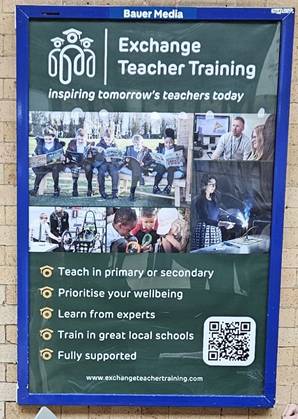
ITT: What the poster doesn’t say

I saw several of these posters on York railway station this weekend.

The station seems like a good place to advertise, as York has a large number of university students passing through the station, but I hope the course organisers managed to negotiate a good deal, given the number of posters I saw in and around the station.

I thought the poster lacked a ‘call to action’. Just adding a QR code isn’t enough for me. Why not an arrow to the QR code with ‘click here for more details?’ As it is, the QR code is just sitting there, not doing much.

If I saw the poster, as a possible teacher, two things I might want to know, but are not told, are ‘how much does the training cost’ and ‘will I be guaranteed a job if I am successful?’

I guess the answers to both questions might be so off-putting as to be sensible to leave off the poster. However, as this was York, the starting salary and some idea of what top salaries in teaching are these days might have been a pull factor.

The DfE is currently spending money – not sure how much – promoting their vacancy website as the place to go to for teaching jobs. Might they also want to create a generic poster for railways stations in other university towns to encourage graduates to think about teaching as a career, rather that leaving it ITT providers to do so?

Finally, I am now sure about the strap line of ‘inspiring tomorrow’s teachers today’. It is certainly a catchy phrase, but it doesn’t do much for me.

While in York, this past weekend, I summated one of the amendments to the Lib Dem conference motion on tuition fees. The amendment called for student debt forgiveness for those that work in the public sector for ten years. In my speech, I also suggested the idea of Tuition Fee credits for student on Free School Meals for the whole of their secondary school career.

Sadly, I didn’t have time to remind conference that between 1997 and 2010, graduates training to be a teacher on programmes such as those run by Exchange Teacher Training had their tuition paid by the government. Personally, I believe that both trainee teachers and medics should have their fees for post first degree study paid by the government or at least repaid as soon as they start work in state-funded locations. After all, we pay army offices during their training, why not teachers and medics?

Gender expectations: alive and well in T Level courses?

The DfE has released data about entrants to ‘T Level’ courses starting in 2025. T Level and T Level foundation year entrant data 2025 to 2026 – GOV.UK

What is striking about the data are the gender disparities between different courses, and how much work among this group of young people and their families may still need to be undertaken if stereotypes are to be confronted.

For instance, 95.6% of those starting the Education and Early Years course were female, whereas 96.9% of those starting the Building Services Engineering for Construction course were males. Males also dominated the three digital courses, whereas the craft and design course participants were 90.4% female. Males made up two thirds of the Agriculture Land Management and Production, but only 19.7% of the Animal care and Management

There was more parity in courses such as Media Broadcast and Production, the Science courses and, interestingly, the overall total ended up 49.3% female and 50.7% male!

The DfE note that 27,446 learners started T Levels in the 2025 to 2026 academic year, up from 25,508 in the 2024 to 2025 academic year. This represents a 7.6% increase in entrant numbers. From the time series data, it looks as if more women are now taking these qualifications.

Table 3: T Level entrants split by T Level pathway and legal sex, 2024 to 2025 academic year

RoutePathwayFemaleMale
Agriculture Environmental and Animal CareAgriculture Land Management and Production35.8%64.2%
Agriculture Environmental and Animal CareAnimal care and Management80.3%19.7%
Business and AdministrationManagement and Administration42.7%57.3%
ConstructionBuilding Services Engineering for Construction3.1%96.9%
ConstructionDesign Surveying and Planning for Construction17.5%82.5%
ConstructionOnsite Construction (discontinued)6.9%93.1%
Creative and DesignCraft and Design90.4%9.6%
Creative and DesignMedia Broadcast and Production43.8%56.2%
DigitalDigital Data Analytics (formerly Digital Business Services)12.9%87.1%
DigitalDigital Software Development (formerly Digital Production Design and Development)12.0%88.0%
DigitalDigital Support and Security (formerly Digital Support Services)8.0%92.0%
Education and Early YearsEducation and Early Years95.6%4.4%
Engineering and ManufacturingDesign and Development for Engineering and Manufacturing9.2%90.8%
Engineering and ManufacturingEngineering Manufacturing Processing and Control12.0%88.0%
Engineering and ManufacturingMaintenance Installation and Repair for Engineering and Manufacturing9.7%90.3%
Health and ScienceHealth91.8%8.2%
Health and ScienceScience53.4%46.6%
Health and ScienceHealthcare Science72.1%27.9%
Legal Finance and AccountingAccounting34.5%65.5%
Legal Finance and AccountingFinance22.6%77.4%
Legal Finance and AccountingLegal Services64.6%35.4%
Total 49.3%50.7%

There are now going to be ‘V Levels’ to add to the mix of qualifications that young people can study for after the age of sixteen. Should we be more worried about the gender split in courses more closely linked to careers than for academic subjects, or doesn’t it matter at all?  

Personally, after thirty years of trying to change attitudes to career choices, I find this data somewhat disheartening, especially as the majority of classroom teachers in secondary schools are now women. It seems as if teachers cannot override stereotyping, and we need to do more careers and work experience to challenge entrenched attitudes.

Highest paid staff in academies: one LA area

Each year academies and MATs are required to publish their accounts. These accounts include a table showing the salary bands for staff paid more than £60,000. Each year, I track the changes for academies and MATs across one geographical area. Sadly, the table isn’t complete for 2025, as a small number of schools and MATs still have not seen their account for 2024/25 published at Companies House.

MAThighest salary band in annual accounts
 SALARIES 20242025difference
1£90,000£100,000£10,00011%
2£140,000£151,000£11,0008%
3£140,000£160,000£20,00014%
4£180,000£00%
5£260,000£270,000£10,0004%
6£110,000£120,000£10,0009%
7£90,000£00%
8£120,000£140,000£20,00017%
9£130,000£130,000£00%
10£170,000£250,000£80,00047%
11£90,000£100,000£10,00011%
12£150,000£170,000£20,00013%
13£90,000£110,000£20,00022%
14£120,000£120,000£00%
15£130,000£150,000£20,00015%
16£140,000£00%
17£160,000£190,000£30,00019%
18£120,000£00%
19£190,000£200,000£10,0005%
20£90,000£00%
21£120,000£00%
22£130,000£120,000-£10,000-8%
23£140,000£00%
24£140,000£150,000£10,0007%
25£190,000£210,000£20,00011%
26£150,000£160,000£10,0007%

In 2023/24 the bands for highest paid staff member in an academy or MAT in this group of academies ranged from £90-100,00 to £260,000-£270,000. In 2024/25 the range, so far, is from £100,000-£110,000 to £270,000-£280,000.

Ten of the 26 reporting bodies (there were 17 with details for both years) saw an increase of more than 10% in the band in which their highest earner was placed. This took at least six of the reporting bodies into a band above that of the salary of the Director of Children’s Services in the authority.

Of course, the salary does not reveal the number and size and complexity of schools within the MAT, not all of which are within the geographical area of the local authority where the schools studied are located. However, there does seem to be an element of the Wild West and Frontierland in general around the issue of salaries for senior leaders.

This lack of control over public spending by the DfE mirrors a long-standing refusal to grasp the nettle of what is an Executive Headteacher, and how should they be remunerated.

If the direction of travel, foreshadowed in the recent White Paper comes about, and all schools become academies, then the DfE will be directly responsible for all schools. If such a situation comes about, then there will need to be clear rules about how much freedom over the spending of public money should be allowed.

Regiments don’t bid up the pay of their colonels, and the salaries for most public sector jobs are not subject to the vagaries of the market: it’s time to look again at how senior staff in the school sector are paid.

Is it justifiable to pay Chief Executives of MATs more than Directors of Children’s Services? Should there be a book of some colour that Trustees of MATs should consult when deciding pay and conditions, and other employment matters. Or should the market remain the deciding factor in deciding the employment rights of the leaders of our state schools in England?

Fine the accountants

Both stand-alone academies and Multi Academy Trusts use private sector accountants to audit their accounts.  Each year, a number of MATs and academies are tardy in publishing their accounts at Companies House, where anyone can view the school or MATs handling of public money.

In my experience, it is the same MATs and schools that keep everyone waiting each year and this delay prevents any useful analysis of how schools are using their funds in particular geographical areas.

As usual, I am still waiting to see the accounts for seven sets of accounts for the schools in the geographical area where I track all non-community schools. These missing accounts are mostly the accounts from the same set of schools that were slow in appearing last year and the year before.

I think it is high time that the DfE, now responsibly directly for the funding of academies after the closure of the EFSA, takes some action to ensure all accounts, save those where there are legitimate queries, are posted by the end of January each year. That’s five months after the end of the accounting year, and should provide sufficient time for all accounts to be prepared.

How to deal with those accountants that don’t file by the required date: fine them. The notion of fining for late delivery of documents is well known and accepted. After all, HMRC will happily fine anyone not delivering their tax return by the due date, so why not fine private sector accountants for not filing these accounts on time.

The consequences would be that either the fine was passed on to the school or MAT or the accountants declined to continue handling the accounts in future years. Either way, the fine should help to instal financial discipline in those schools in the non-community part of the state school sector that are either being ignoring or possibly even flaunted the deadlines at present.

With the recent White Paper once again raising the spectre of all schools becoming academies – one wonders how foundation Schools view that prospect – installing financial discipline from day one should be something the National Audit Office needs to confirm with the DfE is not just a nice thing to have, but a necessity. The NAO might well decide to qualify the DfE’s accounts if it cannot see the accounts for all directly funded state schools within the prescribed time frame.

In my next post, I will consider how salaries for the top earners in MATs within one area have changed between the 2024 and 2025 accounts. With secondary schools now regularly advertising their headship with a starting salary of more than £100,000, and some on even more than £150,000, it is important to know whether Chief Executives of MATs, and executive headteachers are now regularly earning more than the Directors’ of Children’s Service in local authorities.

I guess that they are also earning more than the civil servants that have the ultimate power over the school sector. One wonders what should be the multiple between the salary of the lowest full-time worker in a school and the headteacher? In many case, it cases the multiple is now more than a factor of ten, between the lowest and highest paid staff members in a school: is this too great a gap?