
The past month has seen a number of posts on this blog about falling school rolls, and what the impact of pupil-led funding formula might mean for schools. Now that the DfE has published the data around admissions to schools for September 2026 and the 2026/27 school-year, it is possible to look at the latest trends. Primary and secondary school applications and offers: 2026 – GOV.UK
Thanks for the doctrine of parental choice, pupils may attend a school in a borough other than the one where they actually live, but most primary age pupils will probably attend their nearest school. Exceptions are around faith schools, where the nearest school may be in an adjacent borough. This is more of an issue for the secondary sector than for the primary school sector.
Although Inner London boroughs do feature more amongst the boroughs with the largest decline in applications between 2019/20 and 2026/27 school-years, although four London outer London boroughs are to be found in the top ten boroughs with the largest percentage decline in applications. These four include three boroughs in South London.
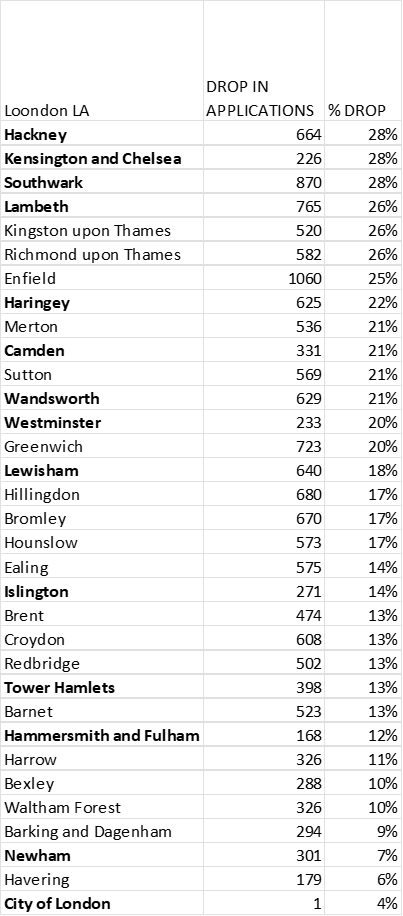
Despite the presence of Kingston upon Thames and Richmond upon Thames near the top of the table, boroughs on the outer edge of the capital are more likely to be found towards the foot of the table, with smaller falls in the number of applications over the time period.
It is easy to see from this data why primary schools across London are closing or amalgamating. Indeed, the pressure for further rationalisation of the school estate across the capital is likely to be intense in the next few years. How that pressure is handled will determine the careers of many staff, both teaching and non-teaching, and the fate of pupils.
I wrote a play to demonstrate some of the issue facing staff and parents list year – see (1) Post | Feed | LinkedIn if you are interested.
One of the features of the play is that not all schools are facing the same degree of hardship from falling rolls. To follow up on this point, I looked at two measures for pupil numbers and school capacity primary schools – including separate infant and junior schools – in one outer London borough.
The DfE website information on schools for the borough shows five schools where the roll exceeds the school capacity. However, a more detailed look at capacity and numbers using a different part of the DfE website reveals a more widespread issue in the borough.
I wonder whether the basic information on capacity is actually the capacity based upon the admission number policy and the other on the actual building capacity?
The table for the second indicator reads as below
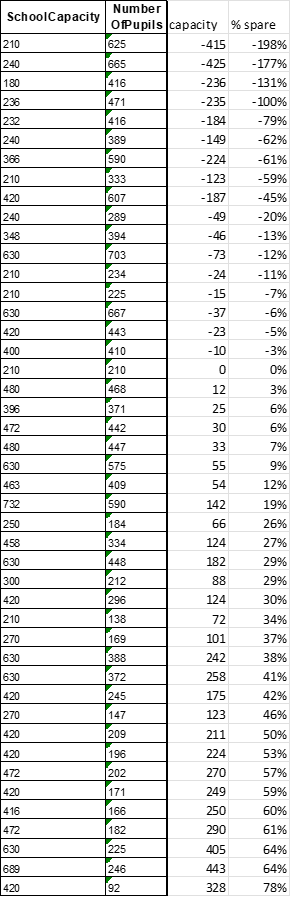
The data might suggest that some schools are educating children in temporary buildings, assuming the DfE’s data on capacity are up to date. However, if the numbers are correct, then nearly half the schools already have significant spare capacity, and the situation may only become worse.
The key question for both local and national politicians arising from this data, if it is correct, are, ‘Do we let the market solve the problem of falling rolls or do we intervene and manage the capacity in a manner that is best suited to numbers over the next decade?’
Those historians of education that have studied policy decisions will know what happened in the 1970s and early 1980s, a period when there was the last large-scale downturn in pupil numbers. How officers and politicians in Haringey tried to tackle the issue in the late 1970s is an interesting and cautionary tale.
 John Howson