
Attendance and Behaviour Hubs: a DfE initiative

One of the government initiatives that I have just caught up with is the one around attendance and behaviour hubs. The DfE announcement in December when the programme was announced said that:

The regional improvement for standards and excellence (RISE) attendance and behaviour hubs programme is a national initiative designed to support schools in improving pupil attendance and behaviour.

Led by schools with strong practice, it aims to:

  • support school leaders to reflect on current systems
  • share effective practice
  • implement changes

It is aimed at senior leaders with responsibility for attendance and behaviour who are seeking to strengthen their school’s leadership, culture and systems. RISE attendance and behaviour hubs programme – GOV.UK

Yesterday, the DfE updated the list of lead schools, so I took a look at these schools in the South East Region.  Today’s list has five primary and five secondary schools as lead hubs.

The secondary schools are located in:

West Sussex

Milton Keynes

Medway

Slough

Portsmouth

Two of these schools are non-selective schools in a location with selective schools; four schools are under-subscribed, with the fifth school having 1150 pupils against a roll of 1058, and it is a faith school.

The five primary schools are located in

Kent – 2

East Sussex

West Sussex

Medway

All have at rolls of at least 400 pupils, although three of the schools are nowhere near their capacity.

How these schools will spread good practice across the region from Milton Keynes to the Isle of Wight and from Oxfordshire to Bracknell Forest will be an interesting challenge.

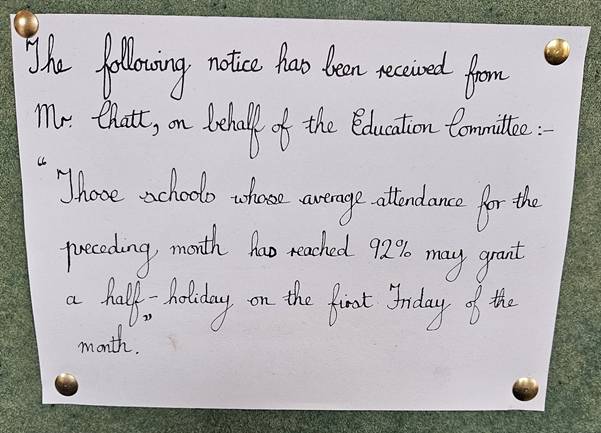
One option not open to them will be the device used in the Durham coalfield in the 19th century and recorded on the noticeboard of the school now housed in the Beamish Living Museum.

The notice reads

The following notice has been received from Mr Chatt, on behalf of the Education Committee: –

“Those schools whose average attendance for the preceding month has reached 92% may grant a half-holiday on the first Friday of the month.”
Looking at the DfE’s data for Oxfordshire, the average attendance from September 2025 to start of February 2026 was 95.1% for primary schools; 91.5% for secondary schools and 88.8% for special schools.

On the basis of that data some primary schools would have qualified for the half-day in at least one month. Possibly some secondary schools might have done so as well.

However, it is worth remembering that the schools receiving the notice were Elementary Schools, taking pupils from 5 to 13 or 14, depending upon the school leaving age at the time of undated message. Attendance by the older pupils was probably as much of a challenge in the 19th century as it is today; albeit for different reasons.

Time to review funding for trainee teachers

It has been interesting to watch the current debate about higher education, and the level of debt incurred by students studying for a degree. Throughout the recent debate, I don’t think I have seen any reference to the 2019 Auger Committee report Independent panel report to the Review of Post-18 Education and Funding set up by Theresa May when she was Prime Minster. Interestingly, I wrote a blog about the report after it was published, and you can read it here. Lower Fees: a threat to teacher education? | John Howson

My major concern at the time, back in 2019, was the Committee’s recommendation to reduce tuition fees to a maximum of £7,500 per year, and what that reduction might do to the funding of teacher preparation courses.

The recent debate about higher education funding has been around repayment levels and student debt, and Auger had a great deal to say about both that issue and the balance between the needs of the individual and the funding of higher education by the State. Suffice to say, the Committee ducked the issue of RPI versus CPI – leaving the decision to the Treasury. Had they had a crystal ball about the future direction of inflation, one wonders whether they might have been more assertive for a change?

However, their recommendation that interest not be calculated during a period of study, although the principal amount of the loan should still be increased in real terms, in order to reflect inflation, would have helped reduce repayments.

The recommendation of a cap on repayments would also have been useful in making clear how much the State would recover. However, the Committee did recognise that the system favoured well-paid graduates, as the sooner the loan was paid off, the lower the interest charges incurred.

As the Committee noted on page 174 of their Report.

“In the words of the Treasury Select Committee Report into student loans: “…the civil servant, the teacher and the accountant pay broadly similar amounts for their loan, but a graduate joining a “magic circle” law firm pays less, owing to rapid pay growth in the early stages of their career.”  House of Commons Treasury Committee (2018) Student Loans: Seventh Report of Session 2017-19, p15.

Regular readers will know that I have always maintained that making many, but not all, trainee teachers incur a fourth year of student debt, not required of other public servants has been a mistake, and a drag on recruitment into teaching and thus a damper on the economy of the country, as too many pupils fail to fulfil their full potential when taught by less than fully qualified teachers in certain subjects.

For several months now, I have been advocating the return of a bursary for trainee music teachers, to help stem the falling recruitment in that subject.

Realistically, I believe all teacher preparation courses should be debt-free. I also endorse Auguer’s recommendation that student debt should not carry interest payments while a person is studying an approved course.

The present debate about student funding will have alerted many would-be teachers to the fact that they will be paying interest on their loans while training to be a teacher, and also paying interest on the student loans for their teacher preparation courses. With starting salaries for teachers above the threshold for repayments, teaching doesn’t look like a worthwhile investment, and many are still not signing up to become teachers.

I would urge the government to look into the current funding model for trainee teachers, and to make it a level playing field for all, with no new debt, and no additional interest on undergraduate loans while studying to be a teacher.

Challenging schools still find keeping a headteacher challenging

Alongside the White Paper, published today by the DfE, The DfE also released a document entitled Schools, school workforce and pupils statistical analysis 2026 Schools, school workforce and pupils statistical analysis 2026

Within this document, I was interested to see a discussion of headteacher turnover by Pupil Premium Decline. This showed that for both primary and secondary schools, but especially for secondary schools, turnover of headteachers was more likely where Pupil Premium levels were higher. Thus, in Band 1, – most deprived – 8.7% of secondary school headteachers changed between November 2024 and November 2025. This compared with just 2.3% of headteacher vacancies in secondary schools in Band 10. The data was taken from the DfE’s own database of teacher records and the School Workforce census.

Readers of my post of yesterday, won’t be surprised by this piece of research Headteacher: recruitment bonus – good value or not? | John Howson

Interestingly, in September 2002, the then NCSL (National College for School Leadership) published a piece of research on headteacher turnover that I conducted for the College. ‘Staying Power: the relationship between headteachers’ length of service and PANDA grades. (PANDA grades were a measure of a school’s performance and schools were graded from A* to E*).

My research looked at secondary schools with either A* or A grades and compared them with schools with E* or E grades.

The research was based upon an analysis of vacancy advertisements for headteacher posts at these schools.

As with today’s research finding, in 2002, A* schools had the greatest percentage of headteachers with more than six years of service, and E* schools the smallest percentage of headteachers with more than six years f service at that school. There were 785 A*/A schools and 780 E*/E schools in the survey.

There was also an association between the PANDA grade and readvertisement rates. 8% of A* vacancies for a headteacher were re-advertised compared with 14% of E* headteacher vacancies, and 49% of schools rated as E.

As headteachers often move from headship into retirement, the age profile of the teaching profession is a factor affecting turnover. A younger profession means fewer headteachers reaching retirement age.

However, the thesis that the more challenging the school, the shorter the term of office of a headteachers, still seems as credible today as it was half a century ago. Whether the government’s policies as foreshadowed in the White Paper will help to change this pattern of turnover and length of service will be interesting to watch.

Overseas applicants boost teacher training numbers

As well as the White Paper, today also saw the publication of the February data on applications to postgraduate teacher preparation courses. Initial teacher training application statistics for courses starting in the 2026 to 2027 academic year – Apply for teacher training – GOV.UK

The headline number of note is the percentage of applications from outside of the United Kingdom. Last February these applicants totalled just over 6,000, accounting for 24% of all applications. This February, the applicants from outside the United Kingdon now total almost 10,500, and account for 33% of all applications.

The key question that the published data does not reveal, but is of great consequence, is whether these extra 4,000 candidates are applying across the board for all subjects, or are concentrated in just a few subjects?

This question is of real importance, as there is now a split between subjects where ‘offers’ are above last year, and those other subjects where, despite rising unemployment in the wider economy, ‘offers’ in February 2026 are below those from February 2025. Many of these latter subjects will likely miss their target once again this year unless there is a dramatic shift in applications during the second half of the recruitment round, such as last seen in 2020, as a result of the covid pandemic.

Doing better than last year with regard to ‘offers’ are: physics; mathematics; history; design & technology; computing; chemistry, drama, and primary sector courses. English is just about holding its own when compared with February 2025.

Doing less well than in February 2025 are: modern languages; art & design; religious education; physical education; music; geography; classics and biology. Of these subjects, the decline in offers for physical education should be of no concern as the number of ‘offers’ is already more than 900 or more than the combined total of ‘offers’ for art & design; drama; music; religious education and ‘other subjects.

Does this government not care about the arts? I have long campaigned for the return of the music bursary. With music ‘offers’ down at just 110 this February, compared with 139 last February, that is a loss of 29 potential teachers of music, and the gap with last year has widened since the January data were published.

So, are there any other worries? Applications from candidates over the age of 25 appear to be rising faster than from newly graduating students. There are only 128 more applications from the youngest age grouping, compared with 208 from the 45 to 49 age group, and more than 2,000 additional applicants this year from the 25 to 29 age group. It would be helpful to know in which age grouping the additional 4,500 applicants from outside the United Kingdom fall, and which subjects they have applied for this year?

With the increase in applications from men, up from 9,561 to 13,654 being proportionally more than the increase in applications from women, up from 15,735 to 18,224, it would also be informative to know which subjects these additional 4,000 male applicants have applied for, and how many fall into applicants from the ‘rest of the world’ group?

While apprenticeships have shown good growth in applications, higher education courses have had to deal with the bulk of the additional applicants, with more than 5,000 additional applicants. My guess would be that the bulk of the new overseas applicants are targeting higher education courses.

We now enter that period of the recruitment round where fewer undergraduates will be applying until after the examination season, so further growth between now and the July data are most likely from career changers rather than undergraduates. This fact might push the proportion of ’rest of the world’ applicants to an even higher percentage than the 33% recorded this month. Perhaps it is now time for the DfE to review how the data are published in order to make it more useful to those interested in the labour market for teachers?

Schools: the end of local authority involvement?

When I first started studying the governance of education, way back in 1979, there at that time two popular saying about the school system in England. One was that it was, ‘a partnership between local and national governments’ and the other that it was ‘a national system locally administered.’ A typical examination question was to ask how valid either of these statements were?

That was half a century ago; difficult for me to believe, but true nevertheless. I have witnessed a lot of changes during in the intervening years. Indeed, one of my few academic articles I have published was entitled ‘Variations in local authority provision of education’ and appeared in the Oxford Review of Education way back in the early 1980s. Interestingly, during the Labour government of the period between 1974-79, closing the gap in funding between the best and worst local authorities was a matter of academic interest. Anyone wanting to know more could do worse than read’ Depriving the Deprived’, written by Tunley, Travers and Platt, published in 1979, as it is about the funding of schooling across one London borough over one year.

For a comparison over a longer time period, my review of 50 years of pupil teacher ratios, published last summer and available for download on researchgate at (PDF) PTRS OVER TIME: A REVIEW OF PUPIL TEACHER RATIOS BETWEEN 1974 AND 2024 AND TWO PERIODS OF LOCAL GOVERNMENT RE-ORGANISATION PTRS OVER TIME: A REVIEW OF PUPIL TEACHER RATIOS

During the 50 years between local government reorganisation in 1974 and 2024, school funding decisions have been removed from local authorities, and nationalised; Education Committees have been abolished, in favour of cabinet government; teacher training and new schemes to prepare teachers have been taken over by Westminster; schools have been persuaded to become academies outwith local authority control, but still under church control if faith schools – if the white Paper leaks are correct all schools will now have to become an academy or free school; further and higher education were liberated from local authority oversight and funding in the early 1990s; ultimate control over place planning has remained with the DfE as only the DfE can sanction new schools being built.

What’s left for local authorities? SEND for a couple more years; admissions- including in-year admissions once the current Bill becomes law – and transport. Frankly, I cannot see local authorities, especially newly reorgnised upper tier authorities, wanting either of these functions in the future. And why would they, as these services can often be poisoned chalices.

So, are we moving to an NHS style system for schooling in England, with little local democratic oversight, and few routes for parents to complain about the education their child is receiving. I fear so.

Does it matter? That’s a matter of opinion. The world of 2026 is vastly different to that of sixty years ago, and it should be easier to produce a more level playing field with all the levers of funding and control being exercise from Westminster.

But I remain sceptical. Westminster has been unable to control issues such as MAT chief executive’s pay and the level of school reserves. At present it isn’t equipped to be a fully functioning operational department along the lines of the NHS of MoD.  It will be interesting to see what, if anything, the White Paper has to say about governance when it is published tomorrow.

White Paper: bad news for rural primary schools

Tomorrow, Monday, we will see Labour’s White Paper in full. For now, we have copious leaks and SEND and other matters, such as how to tackle the outcome gaps between the most deprived pupils and their more fortunate fellows either sitting alongside them or in other schools to whet our appetite.

The replacement of Free School Meals as a measure of deprivation has been long overdue, but it will be interesting see, as schooling moves from a local service to a national service, administered in a similar fashion to the NHS, whether the civil service will be any better than local politicians at managing the performance of the school system.

Making all schools academies will be the final nail in local government’s interest in schooling. Once SEND is handled nationally, it will just leave admissions, mainly on-line these days, to be removed from local management.

However, the changes already foreshadowed in the leaks mean that there will be winners and losers. Assuming that H M Treasury might fund some of the SEND changes, there is unlikely to be any new money to support schools to improve.

The present Funding Formula is heavily biased towards pupil numbers. Great when rolls are rising, but bad news for small schools when rolls fall. If the formula is altered to move more money towards schools with significant numbers of pupils not achieving expected standards, where will the cash come from?

Might small rural primary schools with good attendance and excellent results see their funding cut in real terms? If so, what are the consequences likely to be?  Trusts will be reluctant to keep schools that cost more to run than they bring in through funding open, and will have no incentive to do so. Afterall, any travel costs will be paid for from the local authority under present arrangements.

I can see the local government organisations saying that if local authorities don’t run schools, then they shouldn’t have to pay any transport costs. Taking £46 million off Oxfordshire County Council’s budget would pay for an awful lot of pothole repairs, not to mention bolstering other services.

For those local authorities currently receiving little funding from central government, removing schooling entirely from local government would be an unexpected bonus. On the other hand, there would, as with the NHS, be no local democratic accountability. Education rarely features during general elections.  

One bonus of a national school system is that the government might feel able to create a universal system for secondary schools, some 61 years after Circular 10/65 and on the 50th Anniversary of the 1976 Education Act.

Without democratic oversigh,t ignoring the 2006 rules about closing small rural primary schools will be much easier. Small one form entry faith schools in urban areas with good results have even less protection. It is worth studying the results for primary schools in Haringey to see the parts of the borough that might be winners and those that might be losers if funding doesn’t increase overall.

As someone that started teaching in Tottenham in 1971, when we had ‘areas of exceptional difficulty’ payments introduced into ‘Education Priority Areas’ it is interesting to see how stark the divide between schools on opposite sides of the railway line north from Kings Cross still remains.

So, will the government close that divide? But will it be at a cost to rural primary schools in Oxfordshire, my current home?

Youth Custody: an update

Following on from my last blog post about an incidence of knife crime in a school in Wales, I thought that I would look again at the latest statistics regarding youth custody for uder18s in England and Wales.  Youth justice statistics: 2024 to 2025 – GOV.UK

The table below is abstracted from Table 7.2: Youth custody population, year on year monthly trends (under 18s only), years ending March 2001 to 2025 omitting the data for the years before 2014/15

Financial YearAprJulOctJanFebMarAverage monthly population
2014/15         1,078         1,111         1,033            976            988         1,002         1,031
2015/16            999         1,003            997            921            877            881            946
2016/17            906            857            872            862            863            858            870
2017/18            910            914            898            874            865            922            897
2018/19            938            882            853            806            827            832            856
2019/20            795            811            791            751            770            737            776
2020/21            664            563            535            532            536            516            558
2021/22            493            479            449            426            414            422            447
2022/23            432            457            434            437            467            452            447
2023/24            457            443            429            397            411            410            425
2024/25            427            437            400            406            398            402            412

The decline in custody numbers even during the period between 2-014/15 and 2024/25 is significant, especially taking into account the growth in the number of young people in the older age groups 11-18 during the period under review.

In April 2014, there were 1,078 under-18s in custody. In March 2024 that number had reduced to 402. This was just five above the lowest number in recent history, recorded in January 2024.

For girls, the average number in custody in 2025 was just 10, compared with 42 in 2015. So, the girl convicted of stabbing teachers in Wales really does join a very small number of other girls in custody.  

The most worrying number within the 402 is the number on remand. This number stood at 183 in March 2025, some 44% of the total. This compared with just 23% in March 2015. The backlog of trails post-Covid is well known. There is surely a case for fast tracking cases for those under-18s on remand. No child of school-age should be locked up a day longer than necessary. A backlog of trials is not a good enough reason to leave a young person languishing in custody.

Violence against the person offences, offences that would include attempted murder – the offence the girl in Wales was sentenced to custody for – now account for 68% of the primary offences for young people under-18 in custody, compared to just 31% of those in custody in 2015. One should always be wary of using percentages, since the absolute numbers have declined from 317 in March 2014 to 284 in March 2025. It is just that custody for other offences, especially for both domestic burglary and robbery producing custodial sentences have declined even faster than custody for offences of violence against the person.

One concern about the decline in custody is that under-18s in Young Offenders Institutions may now be serving sentences or on remand further from home than in the past, as the number of institutions in use reduces with the reduction in the custody population. This is an issue that policymakers may wish to address. When Cabinet Member in Oxfordshire, I did my best to keep young offenders out of Feltham YOI, but acknowledged that the alternative YOIs were further away., should there have been no alternative to that form of custody.

The use of custody for undr-18s has come a long way since the bleak days of the Blair government and police targets, when August 2006 saw more than 3,000 under-18s in custody. Even with this massive reduction, I think we are less violent society, despite some headlines in the press and on social media. 

Music teacher shortage: the situation worsens

Regular readers will know that I have been pursuing a return of the ITT bursary for postgraduates enrolling to train as a music teacher on courses starting in the autumn of 2026. This is a very small -U- turn for the government, but a necessary one for the subject, and its future in our schools and universities.

Previous posts on this blog have demonstrated that the removal of the bursary has already affected ‘offers’ to music courses, with a reduction of around 20 ‘offers’ in January 2026 compared with January 2025. Traditionally, any reduction in early-bird offers is not recovered later in the annual application cycle. Music ITT will miss its target: my reasoning | John Howson

This post looks at competition for teachers of music. There are three main areas for teachers to seek work as a teacher of music in a school: the state sector- including sixth form colleges; independent schools in England; private schools across the globe that seek to employ teachers trained in England.

Our starting point this year is the 367 trainees in music identified by the DfE’s annual census taken in December 2025. Add in Teach First and any late arrivals, and the overall total might be 380 – being generous.

Take of 10% for non-completes and those not choosing teaching as a career, and the labour market might have a supply of 342 trainees seeking work.

By mid-February, there had been 100 advertised vacancies by state schools for teachers of music without a TLR – i.e. classroom teacher posts. A well-used job board recorded 15 classroom teacher vacancies from independent schools in England on a single day in mid-February.

On the same date, the same job board, recorded 99 vacancies for teachers of music from schools across the world.  This was made up of 40 vacancies in The Gulf, primarily in Dubai and the other Emirates, but there were 13 vacancies from schools in China, and 46 from schools elsewhere in the world.

Now I don’t expect nearly qualified teachers to apply for these vacancies, but to the extent that these posts are not filled by teachers already working overseas, then these vacancies will take teachers away from schools in England, and create new vacancies.

Assuming only a third of these vacancies are filled by teachers leaving schools in England, and the rest filled in other ways that would be an extra 33 vacancies at present.

Adding together the 100 state school vacancies so far in 2026 to the 15 already recorded private schools in England plus the 33 overseas schools currently seeking a new teacher that might recruit from schools in England that produces a total of 148 vacancies by mid-February, or 43% of the available total of trainees. Increase the take by overseas schools to half of their current vacancies, and not far off half the available pool for September and January could have been offered a job.

Now, some of the vacancies in Egland will be filled by existing teachers changing jobs or returners to the profession, but most experienced teachers will probably be looking for a post with a TLR if seeking a move to another school.

With three months to go to the summer resignation date, and six months until terms start, the pool of available teachers already looks stretched, and this is with trainees that have enjoyed the bursary.

If the lack of a bursary shrinks the 2027 pool, because there are fewer trainees, is removing the bursary a sensible move? In my opinion, it is not, and the government should reintroduce the bursary for trainees starting preparation courses in autumn 2026 to be a teacher of music.

 We will continue to monitor the situation and report back through future blogs as the recruitment round unfolds.

Music teachers: bring back the bursary

Previous posts in this blog have drawn attention to the removal of the bursary for trainee teachers of music starting courses in September 2026.  Music is a subject that is short of qualified teachers. As a result, removing the bursary is not going to increase interest in teaching as a career, especially while the current debate about student loans and repayment issues is raging. As trainee teachers mostly pay fees, this could become an issue for intending teachers.

A previous post has shown that the number of ‘offers’ made in January 2026 to applicants for music teacher preparation courses was down from 91 in January 2025, to just 70 in January 2026 Why Music Teacher Bursaries Matter for Education | John Howson

Now, those teachers recruited for September 2026 courses will enter the teacher labour market in time for appointment as a teacher in September 2027. What is happening in the labour market for teachers now?

An analysis of some 57 vacancies advertised nationally in either the TES or on the DfE job board with a closing date between the 1st January 2026 and the 2nd February 2026, by state secondary schools, revealed a total of 57 posts advertised. Most were for ‘teachers of music’, with a few promoted posts either titled as head/director of music or some similar phraseology. By the 5th February, seven of these posts has already re-appeared with a new closing date: basically, if they were genuine vacancies, then they had not been filled, and were being re-advertised.

Should we be surprised that 14% of vacancies advertised in January were not filled. Perhaps not as it is really too early for most trainees to have commenced their search for a teaching post. However, it also suggests that there is not a pool of ‘returners’ waiting to pounce on a job as soon as it was advertised: at least in some parts of the country.

Perhaps even more disturbing, is that two of the vacancies are for Easter appointment: normally, a rare occurrence. There are also some other vacancies with April 2026 start dates still to reach their closing dates. The presence of these vacancies surprises me, as in the past such advertisements would have been a rare sight.

The data on vacancies, albeit from a small sample so far, suggests a market where some schools are struggling to recruit a teacher of music

This analysis of advertisements doesn’t tell the full picture, as it excludes advertisements by the independent sector schools, special schools and those larger primary schools seeking to appoint a music specialist.  Add those in and the number of vacancies already advertised this year is probably in excess of 100.

Then there are the posts for teachers of music in international schools that will take teachers out of schools in England. I am not sure whether anyone is keeping track of those numbers, but with the Labour government sanctioning a State School to open branches in India and The Gulf, in support of UK plc’s export drive, that factor will need to be taken into consideration when surveying the labour market as a whole.

In my view, there is now more than enough evidence to persuade any rational government to reinstate bursary for trainee teachers of music. But, does this government take rational decisions? Answers please, on a postcard or in the comment section.

2010 and the Case for Change: a look back at what was promised

In November 2010, the Conservative Government, and Michael Gove, as Secretary of State for Education, set out their vision for state education in a document entitled ‘The Case for Change’.

The concluding paragraph said:

Reform should seek to strengthen the recruitment, selection and development of school teachers and leaders. It should strengthen and simplify the curriculum and qualifications, to set high standards, create curriculum coherence and avoid prescription about how to teach. It should increase both autonomy and accountability of schools, and ensure that resources are distributed and used fairy and effectively to incentivise improvement and improve equity.” The Case for Change, DfE, November 2010

Bold claims.

Looking at them in more detail, here are a few thoughts. Other suggestions welcome in the comments

Reform should seek to strengthen the recruitment, selection and development of school teachers and leaders: The move from a higher education led system of ITT to a school-based system failed. There are probably fewer trainees on employment-based routes now, as opposed to SCITTS or higher education routes, than during the Blair government era.

Between 2013 and 2023, the Conservative government presided over the longest period of under-recruitment to ITT, against their own targets for training. This failure to train enough teachers has had a profound effect on schools, ad has not been solved by the present government

should strengthen and simplify the curriculum and qualifications: Decoupling of A/S and A levels in 2015 substantially changed the post-16 landscape. The introduction of the English Baccalaureate weighted the curriculum in favour of traditional academic subjects. The change was never enforced on schools, although it was reported in the data about schools.  

set high standards: I am never quite sure what these are. Examination results improved to a point where exam board were required to change grade boundaries, so fewer entrants received the top grades.

avoid prescription about how to teach: Phonics was the prescribed method of teaching reading. The ITT curriculum was made even more prescriptive

increase both autonomy and accountability of schools: Local authority schools had almost complete autonomy, as their budgets were sacrosanct. Academies were fine if stand alone, but as part of a MAT, their autonomy could be seriously reduced, but their accountability may have increased, although there was no accountability for MATs as they weren’t subject to inspection.

ensure that resources are distributed and used fairy and effectively to incentivise improvement and improve equity: The National Pupil Funding Formula was introduced during a period of rising school rolls, with no consideration as to what would happen when rolls started to fall. A study of PTRs by the author shows London schools with generally better staffing ratios than schools in the north of England throughout the period of the conservative government. The Lib Dem Pupil Premium may have help provide extra resources for pupils on Free School Meals, but the staffing crisis often meant that schools with large number so FSM pupils found recruitment of staff an issue.  

Were the claims met? In many cases not, and the funding for schools in real terms declined during much the period the Conservative were in government making improvements harder to achieve. The failure to address the staffing crisis was, perhaps, the most important failure of the vision set out in 2010.