
Gender expectations: alive and well in T Level courses?

The DfE has released data about entrants to ‘T Level’ courses starting in 2025. T Level and T Level foundation year entrant data 2025 to 2026 – GOV.UK

What is striking about the data are the gender disparities between different courses, and how much work among this group of young people and their families may still need to be undertaken if stereotypes are to be confronted.

For instance, 95.6% of those starting the Education and Early Years course were female, whereas 96.9% of those starting the Building Services Engineering for Construction course were males. Males also dominated the three digital courses, whereas the craft and design course participants were 90.4% female. Males made up two thirds of the Agriculture Land Management and Production, but only 19.7% of the Animal care and Management

There was more parity in courses such as Media Broadcast and Production, the Science courses and, interestingly, the overall total ended up 49.3% female and 50.7% male!

The DfE note that 27,446 learners started T Levels in the 2025 to 2026 academic year, up from 25,508 in the 2024 to 2025 academic year. This represents a 7.6% increase in entrant numbers. From the time series data, it looks as if more women are now taking these qualifications.

Table 3: T Level entrants split by T Level pathway and legal sex, 2024 to 2025 academic year

RoutePathwayFemaleMale
Agriculture Environmental and Animal CareAgriculture Land Management and Production35.8%64.2%
Agriculture Environmental and Animal CareAnimal care and Management80.3%19.7%
Business and AdministrationManagement and Administration42.7%57.3%
ConstructionBuilding Services Engineering for Construction3.1%96.9%
ConstructionDesign Surveying and Planning for Construction17.5%82.5%
ConstructionOnsite Construction (discontinued)6.9%93.1%
Creative and DesignCraft and Design90.4%9.6%
Creative and DesignMedia Broadcast and Production43.8%56.2%
DigitalDigital Data Analytics (formerly Digital Business Services)12.9%87.1%
DigitalDigital Software Development (formerly Digital Production Design and Development)12.0%88.0%
DigitalDigital Support and Security (formerly Digital Support Services)8.0%92.0%
Education and Early YearsEducation and Early Years95.6%4.4%
Engineering and ManufacturingDesign and Development for Engineering and Manufacturing9.2%90.8%
Engineering and ManufacturingEngineering Manufacturing Processing and Control12.0%88.0%
Engineering and ManufacturingMaintenance Installation and Repair for Engineering and Manufacturing9.7%90.3%
Health and ScienceHealth91.8%8.2%
Health and ScienceScience53.4%46.6%
Health and ScienceHealthcare Science72.1%27.9%
Legal Finance and AccountingAccounting34.5%65.5%
Legal Finance and AccountingFinance22.6%77.4%
Legal Finance and AccountingLegal Services64.6%35.4%
Total 49.3%50.7%

There are now going to be ‘V Levels’ to add to the mix of qualifications that young people can study for after the age of sixteen. Should we be more worried about the gender split in courses more closely linked to careers than for academic subjects, or doesn’t it matter at all?  

Personally, after thirty years of trying to change attitudes to career choices, I find this data somewhat disheartening, especially as the majority of classroom teachers in secondary schools are now women. It seems as if teachers cannot override stereotyping, and we need to do more careers and work experience to challenge entrenched attitudes.
Highest paid staff in academies: one LA area

Each year academies and MATs are required to publish their accounts. These accounts include a table showing the salary bands for staff paid more than £60,000. Each year, I track the changes for academies and MATs across one geographical area. Sadly, the table isn’t complete for 2025, as a small number of schools and MATs still have not seen their account for 2024/25 published at Companies House.

MAThighest salary band in annual accounts
 SALARIES 20242025difference
1£90,000£100,000£10,00011%
2£140,000£151,000£11,0008%
3£140,000£160,000£20,00014%
4£180,000£00%
5£260,000£270,000£10,0004%
6£110,000£120,000£10,0009%
7£90,000£00%
8£120,000£140,000£20,00017%
9£130,000£130,000£00%
10£170,000£250,000£80,00047%
11£90,000£100,000£10,00011%
12£150,000£170,000£20,00013%
13£90,000£110,000£20,00022%
14£120,000£120,000£00%
15£130,000£150,000£20,00015%
16£140,000£00%
17£160,000£190,000£30,00019%
18£120,000£00%
19£190,000£200,000£10,0005%
20£90,000£00%
21£120,000£00%
22£130,000£120,000-£10,000-8%
23£140,000£00%
24£140,000£150,000£10,0007%
25£190,000£210,000£20,00011%
26£150,000£160,000£10,0007%

In 2023/24 the bands for highest paid staff member in an academy or MAT in this group of academies ranged from £90-100,00 to £260,000-£270,000. In 2024/25 the range, so far, is from £100,000-£110,000 to £270,000-£280,000.

Ten of the 26 reporting bodies (there were 17 with details for both years) saw an increase of more than 10% in the band in which their highest earner was placed. This took at least six of the reporting bodies into a band above that of the salary of the Director of Children’s Services in the authority.

Of course, the salary does not reveal the number and size and complexity of schools within the MAT, not all of which are within the geographical area of the local authority where the schools studied are located. However, there does seem to be an element of the Wild West and Frontierland in general around the issue of salaries for senior leaders.

This lack of control over public spending by the DfE mirrors a long-standing refusal to grasp the nettle of what is an Executive Headteacher, and how should they be remunerated.

If the direction of travel, foreshadowed in the recent White Paper comes about, and all schools become academies, then the DfE will be directly responsible for all schools. If such a situation comes about, then there will need to be clear rules about how much freedom over the spending of public money should be allowed.

Regiments don’t bid up the pay of their colonels, and the salaries for most public sector jobs are not subject to the vagaries of the market: it’s time to look again at how senior staff in the school sector are paid.

Is it justifiable to pay Chief Executives of MATs more than Directors of Children’s Services? Should there be a book of some colour that Trustees of MATs should consult when deciding pay and conditions, and other employment matters. Or should the market remain the deciding factor in deciding the employment rights of the leaders of our state schools in England?

Fine the accountants

Both stand-alone academies and Multi Academy Trusts use private sector accountants to audit their accounts.  Each year, a number of MATs and academies are tardy in publishing their accounts at Companies House, where anyone can view the school or MATs handling of public money.

In my experience, it is the same MATs and schools that keep everyone waiting each year and this delay prevents any useful analysis of how schools are using their funds in particular geographical areas.

As usual, I am still waiting to see the accounts for seven sets of accounts for the schools in the geographical area where I track all non-community schools. These missing accounts are mostly the accounts from the same set of schools that were slow in appearing last year and the year before.

I think it is high time that the DfE, now responsibly directly for the funding of academies after the closure of the EFSA, takes some action to ensure all accounts, save those where there are legitimate queries, are posted by the end of January each year. That’s five months after the end of the accounting year, and should provide sufficient time for all accounts to be prepared.

How to deal with those accountants that don’t file by the required date: fine them. The notion of fining for late delivery of documents is well known and accepted. After all, HMRC will happily fine anyone not delivering their tax return by the due date, so why not fine private sector accountants for not filing these accounts on time.

The consequences would be that either the fine was passed on to the school or MAT or the accountants declined to continue handling the accounts in future years. Either way, the fine should help to instal financial discipline in those schools in the non-community part of the state school sector that are either being ignoring or possibly even flaunted the deadlines at present.

With the recent White Paper once again raising the spectre of all schools becoming academies – one wonders how foundation Schools view that prospect – installing financial discipline from day one should be something the National Audit Office needs to confirm with the DfE is not just a nice thing to have, but a necessity. The NAO might well decide to qualify the DfE’s accounts if it cannot see the accounts for all directly funded state schools within the prescribed time frame.

In my next post, I will consider how salaries for the top earners in MATs within one area have changed between the 2024 and 2025 accounts. With secondary schools now regularly advertising their headship with a starting salary of more than £100,000, and some on even more than £150,000, it is important to know whether Chief Executives of MATs, and executive headteachers are now regularly earning more than the Directors’ of Children’s Service in local authorities.

I guess that they are also earning more than the civil servants that have the ultimate power over the school sector. One wonders what should be the multiple between the salary of the lowest full-time worker in a school and the headteacher? In many case, it cases the multiple is now more than a factor of ten, between the lowest and highest paid staff members in a school: is this too great a gap?

The war: bad news for schools?

The longer the current conflict, centred around Iran, continues, the more anxiety there must be within the DfE. After all, the DfE is the second largest spending department, after spending on the NHS and Social Care. The Ministry of Defence (MoD) ranks as the third largest spending department.

Recent trends within the DfE have included increased expenditure on special needs, and post 16 schemes to reduce the number of NEETS. I assume there is also monitoring the implications of falling rolls in the school sector under way.

I guess that there might have been some hope that one trend – more spending on SEND – might be balanced by less spending on the core school grant as a result of falling rolls. By abolishing a separate High Needs Block, the additional SEND spending could disappear into the core grant, leaving schools to sort out the mess on the ground.

This is not the post to discuss the relationship between DfE and NHS spending on SEND, and how the 2014 Act, unless amended, could be used by parents to hobble school’s discretion on how they meet the education requirements of pupils with EHCPs, especially if the Tribunal Service remains as it currently is. Suffice to say, there will become a point where SEND funding starts to impact on the rest of the DfE’s budget that is, if the total spend doesn’t increase.

Digression aside, my main concern is the extent to which increased spending on defence could hit the DfE’s budget? Spending on schools’ accounts for the lion’s share of the DfE’s budget, and I cannot see how it can remain unaffected as spending on the MoD increases, as it now inevitably will do, however short-lived the current war is.

There are also pressures from within the school system as a result of the White Paper’s non-SEND initiatives to be taken into account. I don’t know whether anyone has worked out the full cost of every school becoming an academy. But replacing 150 with 160+ local authorities after local government reorganisation, with perhaps ten times than number of academy trusts won’t come cheap.

Using civil servants to administer the system will be more expensive than using local government officers. One only has to look at the £38mn it cost to run the EFSA, and the £14mn it costs to run the Teacher Regulation Agency to wonder whether anyone in Whitehall has done the maths on full academisation of schools?

However, it is the military situation that must be the real concern for schools. Let’s assume that going forward the MoD needs an extra £15bn per year in expenditure in order to meet is 5% target of government expenditure: possibly even more if conscription is again on the agenda, after being through ruled out during the 2024 election campaign.

Increase defence spending, and unless the government has spare revenue to play with, and it seems likely that other budgets will be hit. Ring fence SEND spending, and what might be the consequences?

As staffing is the biggest item in any school’s budget, in the end any further slowdown in spending may well leave schools facing a choice between cutting low paid non-teaching staff or high paid teachers, burdened with student loan debt.

So, what might we see.

MATs closing schools that cost more to run than they bring in from funding steams and ‘unofficial’ parent support. At present, any transport costs will be incurred by local authorities, so that won’t deter closures.

Schools axing courses that cost more to run than the share of pupil funding they generate. On the wider scale, this might affect small sixth forms. After all, these are often staffed by the most expensive teachers, and can be a financial drain on the resources for Key Stages 3 and 4.

Will MATs be more ruthless than local authorities when it comes to closing small sixth forms, because they have no councillors worried about re-election demanding a school retain its sixth from? This is likely to be a real issue for Reform in the south of England where 11-18 schools are the norm. If Reform want a return to selective schools that also will come at a price.

If SEND spending is ring-fenced, and demand for EHCPs for mental health issues continues to grow, at some point it will eat into the funding for other pupils. At what point will there be a pushback?

Of course, a quick war, and peace in the Middle East, plus a less bellicose Russia, might mean there will be no threat to funding for schools. And government income might rise to cover the extra spending. Who knows, but it is better to hope for the best, and plan for the worst.

If I use Pupi Teacher Ratios as a measure of what might happen, then the unwinding of the benefits of the peace dividend since the late 1990s might have a more profound effect on the primary school sector than on secondary schools, although my guess is that neither sector will be unaffected. (PDF) PTRS OVER TIME: A REVIEW OF PUPIL TEACHER RATIOS BETWEEN 1974 AND 2024 AND TWO PERIODS OF LOCAL GOVERNMENT RE-ORGANISATION PTRS OVER TIME: A REVIEW OF PUPIL TEACHER RATIOS

The other interesting question is what will happened to salaries, and how far the outcome of national salary discussions will fetter schools spending choices? Perhaps one for another blog to discuss in more detail.

Attendance and Behaviour Hubs: a DfE initiative

One of the government initiatives that I have just caught up with is the one around attendance and behaviour hubs. The DfE announcement in December when the programme was announced said that:

The regional improvement for standards and excellence (RISE) attendance and behaviour hubs programme is a national initiative designed to support schools in improving pupil attendance and behaviour.

Led by schools with strong practice, it aims to:

  • support school leaders to reflect on current systems
  • share effective practice
  • implement changes

It is aimed at senior leaders with responsibility for attendance and behaviour who are seeking to strengthen their school’s leadership, culture and systems. RISE attendance and behaviour hubs programme – GOV.UK

Yesterday, the DfE updated the list of lead schools, so I took a look at these schools in the South East Region.  Today’s list has five primary and five secondary schools as lead hubs.

The secondary schools are located in:

West Sussex

Milton Keynes

Medway

Slough

Portsmouth

Two of these schools are non-selective schools in a location with selective schools; four schools are under-subscribed, with the fifth school having 1150 pupils against a roll of 1058, and it is a faith school.

The five primary schools are located in

Kent – 2

East Sussex

West Sussex

Medway

All have at rolls of at least 400 pupils, although three of the schools are nowhere near their capacity.

How these schools will spread good practice across the region from Milton Keynes to the Isle of Wight and from Oxfordshire to Bracknell Forest will be an interesting challenge.

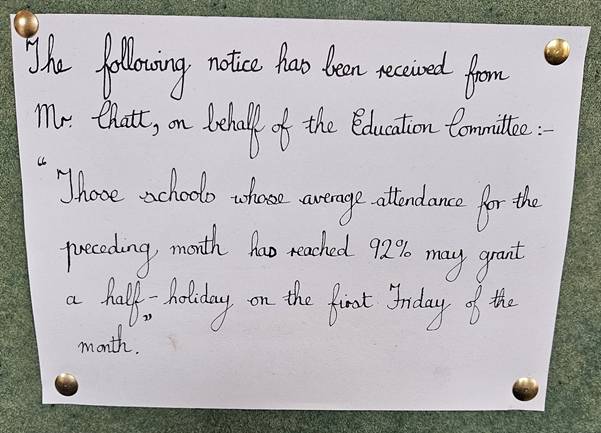
One option not open to them will be the device used in the Durham coalfield in the 19th century and recorded on the noticeboard of the school now housed in the Beamish Living Museum.

The notice reads

The following notice has been received from Mr Chatt, on behalf of the Education Committee: –

“Those schools whose average attendance for the preceding month has reached 92% may grant a half-holiday on the first Friday of the month.”

Looking at the DfE’s data for Oxfordshire, the average attendance from September 2025 to start of February 2026 was 95.1% for primary schools; 91.5% for secondary schools and 88.8% for special schools.

On the basis of that data some primary schools would have qualified for the half-day in at least one month. Possibly some secondary schools might have done so as well.

However, it is worth remembering that the schools receiving the notice were Elementary Schools, taking pupils from 5 to 13 or 14, depending upon the school leaving age at the time of undated message. Attendance by the older pupils was probably as much of a challenge in the 19th century as it is today; albeit for different reasons.

Time to review funding for trainee teachers

It has been interesting to watch the current debate about higher education, and the level of debt incurred by students studying for a degree. Throughout the recent debate, I don’t think I have seen any reference to the 2019 Auger Committee report Independent panel report to the Review of Post-18 Education and Funding set up by Theresa May when she was Prime Minster. Interestingly, I wrote a blog about the report after it was published, and you can read it here. Lower Fees: a threat to teacher education? | John Howson

My major concern at the time, back in 2019, was the Committee’s recommendation to reduce tuition fees to a maximum of £7,500 per year, and what that reduction might do to the funding of teacher preparation courses.

The recent debate about higher education funding has been around repayment levels and student debt, and Auger had a great deal to say about both that issue and the balance between the needs of the individual and the funding of higher education by the State. Suffice to say, the Committee ducked the issue of RPI versus CPI – leaving the decision to the Treasury. Had they had a crystal ball about the future direction of inflation, one wonders whether they might have been more assertive for a change?

However, their recommendation that interest not be calculated during a period of study, although the principal amount of the loan should still be increased in real terms, in order to reflect inflation, would have helped reduce repayments.

The recommendation of a cap on repayments would also have been useful in making clear how much the State would recover. However, the Committee did recognise that the system favoured well-paid graduates, as the sooner the loan was paid off, the lower the interest charges incurred.

As the Committee noted on page 174 of their Report.

“In the words of the Treasury Select Committee Report into student loans: “…the civil servant, the teacher and the accountant pay broadly similar amounts for their loan, but a graduate joining a “magic circle” law firm pays less, owing to rapid pay growth in the early stages of their career.”  House of Commons Treasury Committee (2018) Student Loans: Seventh Report of Session 2017-19, p15.

Regular readers will know that I have always maintained that making many, but not all, trainee teachers incur a fourth year of student debt, not required of other public servants has been a mistake, and a drag on recruitment into teaching and thus a damper on the economy of the country, as too many pupils fail to fulfil their full potential when taught by less than fully qualified teachers in certain subjects.

For several months now, I have been advocating the return of a bursary for trainee music teachers, to help stem the falling recruitment in that subject.

Realistically, I believe all teacher preparation courses should be debt-free. I also endorse Auguer’s recommendation that student debt should not carry interest payments while a person is studying an approved course.

The present debate about student funding will have alerted many would-be teachers to the fact that they will be paying interest on their loans while training to be a teacher, and also paying interest on the student loans for their teacher preparation courses. With starting salaries for teachers above the threshold for repayments, teaching doesn’t look like a worthwhile investment, and many are still not signing up to become teachers.

I would urge the government to look into the current funding model for trainee teachers, and to make it a level playing field for all, with no new debt, and no additional interest on undergraduate loans while studying to be a teacher.

Challenging schools still find keeping a headteacher challenging

Alongside the White Paper, published today by the DfE, The DfE also released a document entitled Schools, school workforce and pupils statistical analysis 2026 Schools, school workforce and pupils statistical analysis 2026

Within this document, I was interested to see a discussion of headteacher turnover by Pupil Premium Decline. This showed that for both primary and secondary schools, but especially for secondary schools, turnover of headteachers was more likely where Pupil Premium levels were higher. Thus, in Band 1, – most deprived – 8.7% of secondary school headteachers changed between November 2024 and November 2025. This compared with just 2.3% of headteacher vacancies in secondary schools in Band 10. The data was taken from the DfE’s own database of teacher records and the School Workforce census.

Readers of my post of yesterday, won’t be surprised by this piece of research Headteacher: recruitment bonus – good value or not? | John Howson

Interestingly, in September 2002, the then NCSL (National College for School Leadership) published a piece of research on headteacher turnover that I conducted for the College. ‘Staying Power: the relationship between headteachers’ length of service and PANDA grades. (PANDA grades were a measure of a school’s performance and schools were graded from A* to E*).

My research looked at secondary schools with either A* or A grades and compared them with schools with E* or E grades.

The research was based upon an analysis of vacancy advertisements for headteacher posts at these schools.

As with today’s research finding, in 2002, A* schools had the greatest percentage of headteachers with more than six years of service, and E* schools the smallest percentage of headteachers with more than six years f service at that school. There were 785 A*/A schools and 780 E*/E schools in the survey.

There was also an association between the PANDA grade and readvertisement rates. 8% of A* vacancies for a headteacher were re-advertised compared with 14% of E* headteacher vacancies, and 49% of schools rated as E.

As headteachers often move from headship into retirement, the age profile of the teaching profession is a factor affecting turnover. A younger profession means fewer headteachers reaching retirement age.

However, the thesis that the more challenging the school, the shorter the term of office of a headteachers, still seems as credible today as it was half a century ago. Whether the government’s policies as foreshadowed in the White Paper will help to change this pattern of turnover and length of service will be interesting to watch.

Overseas applicants boost teacher training numbers

As well as the White Paper, today also saw the publication of the February data on applications to postgraduate teacher preparation courses. Initial teacher training application statistics for courses starting in the 2026 to 2027 academic year – Apply for teacher training – GOV.UK

The headline number of note is the percentage of applications from outside of the United Kingdom. Last February these applicants totalled just over 6,000, accounting for 24% of all applications. This February, the applicants from outside the United Kingdon now total almost 10,500, and account for 33% of all applications.

The key question that the published data does not reveal, but is of great consequence, is whether these extra 4,000 candidates are applying across the board for all subjects, or are concentrated in just a few subjects?

This question is of real importance, as there is now a split between subjects where ‘offers’ are above last year, and those other subjects where, despite rising unemployment in the wider economy, ‘offers’ in February 2026 are below those from February 2025. Many of these latter subjects will likely miss their target once again this year unless there is a dramatic shift in applications during the second half of the recruitment round, such as last seen in 2020, as a result of the covid pandemic.

Doing better than last year with regard to ‘offers’ are: physics; mathematics; history; design & technology; computing; chemistry, drama, and primary sector courses. English is just about holding its own when compared with February 2025.

Doing less well than in February 2025 are: modern languages; art & design; religious education; physical education; music; geography; classics and biology. Of these subjects, the decline in offers for physical education should be of no concern as the number of ‘offers’ is already more than 900 or more than the combined total of ‘offers’ for art & design; drama; music; religious education and ‘other subjects.

Does this government not care about the arts? I have long campaigned for the return of the music bursary. With music ‘offers’ down at just 110 this February, compared with 139 last February, that is a loss of 29 potential teachers of music, and the gap with last year has widened since the January data were published.

So, are there any other worries? Applications from candidates over the age of 25 appear to be rising faster than from newly graduating students. There are only 128 more applications from the youngest age grouping, compared with 208 from the 45 to 49 age group, and more than 2,000 additional applicants this year from the 25 to 29 age group. It would be helpful to know in which age grouping the additional 4,500 applicants from outside the United Kingdom fall, and which subjects they have applied for this year?

With the increase in applications from men, up from 9,561 to 13,654 being proportionally more than the increase in applications from women, up from 15,735 to 18,224, it would also be informative to know which subjects these additional 4,000 male applicants have applied for, and how many fall into applicants from the ‘rest of the world’ group?

While apprenticeships have shown good growth in applications, higher education courses have had to deal with the bulk of the additional applicants, with more than 5,000 additional applicants. My guess would be that the bulk of the new overseas applicants are targeting higher education courses.

We now enter that period of the recruitment round where fewer undergraduates will be applying until after the examination season, so further growth between now and the July data are most likely from career changers rather than undergraduates. This fact might push the proportion of ’rest of the world’ applicants to an even higher percentage than the 33% recorded this month. Perhaps it is now time for the DfE to review how the data are published in order to make it more useful to those interested in the labour market for teachers?

Headteacher: recruitment bonus – good value or not?

Following suggestions that the DfE might pay a £15,000 recruitment bonus/golden hello to encourage people to take the role of headteacher in a challenging school, I though I would look at the most recent data regarding schools failing to appoint a new headteacher at their first attempt.

The data covers 789 schools that have advertised for a headteacher between 1st August 2025 and the 20th February 2026 on their the DfE vacancy platform or since 1st January 2026, the tes jobsite as well.

Of course, some schools still have active vacancies that have yet to reach their closing date, so the data are probably an underestimate.  The 789 is lower than might be expected number of vacancies from looking at historical data. Is it possible that some MATs no longer advertise headteacher vacancies nationally?

Anyway, there have been 80 schools that have so far readvertised their headteacher vacancy. Of these schools,

50 were primary schools

14 were secondary schools

16 were special schools

13 were Roman Catholic Schools

17 Church of England

  2 other faiths

48 Not faith school

Regionally, the picture is as shown in the table.

REGIONREADVERTADVERT% READ
SE5896%
SW6917%
WM81018%
YH101089%
NW1210711%
EM108112%
L129213%
EE139713%
NE42218%
ENGLAND8078910%

The North East data shows how percentages can be misleading as two of the four schools are special schools. Without those two schools, the percentage drops to a below average 9%.

A bonus of £15,000 might look attractive to someone thinking of a headteacher post in a primary school, but with many secondary headteacher vacancies being advertised with a starting salary in six figures, would £15,000 be enough to attract candidates to apply for the vacancy? How does it compare with subject bonuses for working in such schools?

A review of the 14 secondary schools for percentage pass at Grade 5 in English and mathematics from the DfE website, shows a range of outcomes

22.8
27.0
32.9
33.5
38.5
39.5
40.2
43.7
49.8
51.3
51.5
62.3
64.6
83.5

However, it would suggest that re-advertising secondary schools do appear to have below average outcomes.  However, four of the schools posted their vacancy just before Christmas, and that might be more of reason for the re-advertisement than their GCSE score, that is unless the school has to re-advertise for a second time after an early 2026 re-advert.

Special schools do seem to have difficulty attracting a head teacher, so a bonus there could potentially be useful as an inducement, especially as taking such a headship often involves a house move.

Overall, if the scheme just covered secondary and special schools, it might cost the DfE around £1 million a year. Add in primary schools, and the cost could be much higher.

However, it does seem clear that a school’s results may not be the only barrier to a school recruiting a headteacher easily.

There needs to be certainty that there are sufficient candidates willing, able and experienced enough to move into headship. There the DfE certainly has a role to play.

White Paper: bad news for rural primary schools

Tomorrow, Monday, we will see Labour’s White Paper in full. For now, we have copious leaks and SEND and other matters, such as how to tackle the outcome gaps between the most deprived pupils and their more fortunate fellows either sitting alongside them or in other schools to whet our appetite.

The replacement of Free School Meals as a measure of deprivation has been long overdue, but it will be interesting see, as schooling moves from a local service to a national service, administered in a similar fashion to the NHS, whether the civil service will be any better than local politicians at managing the performance of the school system.

Making all schools academies will be the final nail in local government’s interest in schooling. Once SEND is handled nationally, it will just leave admissions, mainly on-line these days, to be removed from local management.

However, the changes already foreshadowed in the leaks mean that there will be winners and losers. Assuming that H M Treasury might fund some of the SEND changes, there is unlikely to be any new money to support schools to improve.

The present Funding Formula is heavily biased towards pupil numbers. Great when rolls are rising, but bad news for small schools when rolls fall. If the formula is altered to move more money towards schools with significant numbers of pupils not achieving expected standards, where will the cash come from?

Might small rural primary schools with good attendance and excellent results see their funding cut in real terms? If so, what are the consequences likely to be?  Trusts will be reluctant to keep schools that cost more to run than they bring in through funding open, and will have no incentive to do so. Afterall, any travel costs will be paid for from the local authority under present arrangements.

I can see the local government organisations saying that if local authorities don’t run schools, then they shouldn’t have to pay any transport costs. Taking £46 million off Oxfordshire County Council’s budget would pay for an awful lot of pothole repairs, not to mention bolstering other services.

For those local authorities currently receiving little funding from central government, removing schooling entirely from local government would be an unexpected bonus. On the other hand, there would, as with the NHS, be no local democratic accountability. Education rarely features during general elections.  

One bonus of a national school system is that the government might feel able to create a universal system for secondary schools, some 61 years after Circular 10/65 and on the 50th Anniversary of the 1976 Education Act.

Without democratic oversigh,t ignoring the 2006 rules about closing small rural primary schools will be much easier. Small one form entry faith schools in urban areas with good results have even less protection. It is worth studying the results for primary schools in Haringey to see the parts of the borough that might be winners and those that might be losers if funding doesn’t increase overall.

As someone that started teaching in Tottenham in 1971, when we had ‘areas of exceptional difficulty’ payments introduced into ‘Education Priority Areas’ it is interesting to see how stark the divide between schools on opposite sides of the railway line north from Kings Cross still remains.

So, will the government close that divide? But will it be at a cost to rural primary schools in Oxfordshire, my current home?