Wearable glasses: a need for a new school rule?

This post on LinkedIn caught my eye recently. It adds yet another challenge to schools trying to keep pupils and staff safe in an ever-changing world, where technology is continually throwing up new challenges.

A small request as the new academic year begins. As Meta glasses and other wearable technologies become more common, ‘covert’ recording in classrooms is going to become increasingly easy. I get that it happens, maybe it shouldn’t but it does.

Personally, I really don’t mind being recorded; if a student genuinely thinks having a recording of part of a session will help them revisit an explanation or support their learning, I’m pretty relaxed about it. ,Indeed, if the reason was genuine, I’d probably be quite happy that there’s another way for you to digest the information I’m trying to deliver.

But please ask first.

Ater reading this post, and considering the debate around mobile phones in schools, I wonder if I can see a new school rule being developed, perhaps along the following lines:

Any pupils, staff and visitors wanting to wear glasses on school premises must register a photograph of those glasses with the school office, and notify the school office of any change.

Pupils and visitors should be aware that cameras at entry points and classroom doors check anyone entering the school wearing glasses to ensure that they are of the registered design.

The rule is to protect everyone (pupils and staff) from the use of unregistered recordings within the school premises. It is just an extension of the current photo pass rules, but adapted to cope with new technology.

If we are going to be wiped out as a species by AI, sometime before my 90th birthday, then is this issue worth worrying about. I don’t know, but I do know keeping vulnerable young people safe is an essential role for the State, and its agents, as well as private sector organisations that offer services to young people and vulnerable adults.

I would be interested to hear what others think? Over-reaction, as I think knife arches are in schools, or a sensible approach to a possible problem? What degree of risk are we willing to accept? I don’t want knife arches in schools | John Howson

It was the mass killing of pupils 30 years ago in Dunblane  that started the drive to ensure the safety of those in schools. So far, compared with what is happening around the world, especially in countries where guns are commonplace, England has avoided large scale attacks, but, as I know from personal experience, one attack is one too many.

Teacher retention versus recruitment: not just a matter of economics

This week, the Education Policy Institute (EPI), a think tank with left leanings, published another report about the value of ensuring teachers don’t leave the profession compared with trying to boost recruitment. Their latest report is called Retain or Recruit? Microsoft Word – EPI_RetrainRecruit_September2026 and follows on from their earlier report on a similar topic, reviewed in my blog post from 2022, ‘Keeping Science Teachers in Schools Keeping science teachers in schools | John Howson Both EPI reports were supported by The Gatsby Foundation, a body that has a long and honourable history of supporting research in this field.

The latest EPI report makes three recommendations:

Fund a specialist-equivalent retraining programme

Close the data gaps on completion, post-programme teaching, and demand

Add retraining alongside bursary policy, not in place of it

Microsoft Word – EPI_RetrainRecruit_September2026 page 53.

I am all in favour of re-training, if there are the teachers with sufficient knowledge, skills and desire to retrain to do so located in the schools that need them. After all, with an open labour market for teachers, using price as a mechanism for attracting teachers to work in schools without teachers capable of delivering physics at an advanced level hasn’t worked.

However, the EPI  report does need to be set into the current context of falling pupil numbers that will eventually affect the size of sixth forms. As I demonstrated in an earlier post, Are small sixth forms a good idea? | John Howson small sixth forms often don’t perform well. Is it worth making sure any first tranche of retrained teachers would be in schools with a viable future, and the possibility of a credible ‘A’ Level programme? However, this is a much wider issue than just teaching  physics to ‘A’ level that a future government may need to deal with at some stage.

I am all in favour of ensuring we know who teachers what to whom, and indeed what isn’t being taught in some schools because of the lack of a qualified teacher. I wonder whether this information already exists within the School Workforce database? If not, some sampling of schools might be useful. The 1999 study that I participated in showed that ‘Teaching ‘A’ Level physics was an important driver in retention of early career teachers. I guess it might also be for those retrained.  We know for ‘A’ Level entries the schools not currently entering any candidates for the subject.

It is also worth recalling the EPI previously visited this issue in 2018, as I noted in my blog post Pay physics teachers more than history teachers? | John Howson when the issue of differential pay was discussed. Mechanisms around recruitment and retention incentives and equal pay for jobs of equal worth can bedevil that debate.

Finally, it is worth considering whether programme such as Teach First have a better rate of retention than other ITT routes, including apprenticeships and salaried schemes.

We all want more teachers of physics, so I hope that decision-makers consider the EPI approach seriously, as they did with pre-ITT course subject enhancement courses.

NEETS: the journey starts at six not sixteen

In my previous post, I looked at the PISA survey comments about teachers. I am sure that there is a degree of correlation between high-quality teaching on the one hand, and student outcomes at the end of each transition stage in a young person’s education journey on the other hand. Inputs affect outputs.

However, the equation is not as simple as that. For the most part, learners need to engage to succeed. I came across this interesting paragraph about NEETs, in a briefing note written by the Confederation of School Trusts.

‘The larger lesson is therefore that NEET should not principally be understood as a status to be

remedied after the event. It is better understood as the possible end-point of a progressive

weakening of the connections between a young person and the institutions that should carry

them from childhood into adult economic and civic life.’ Preventing young people from becoming NEET – 2026-09-01.pdf – Google Drive

While I am not a fan of academies, mainly because of the absence of local democratic involvement, it doesn’t mean that I don’t respect the work many within that sector undertake.

This briefing note is one example of what I think is a great summary of how the risk of becoming a NEET starts on day one of schooling. Along with Sir Nick Clegg when he was Deputy Prime Minister and concerned about progress of under-fives, I would also argue that the risk of a journey to becoming a NEET begins even earlier. It is interesting to re-read a blog post written more than a decade ago in January 2015.  Ending child illiteracy by 2025 | John Howson

The closure of Sure Start centres was, in retrospect, one of the worst decisions of the coalition government. Sadly, like the Academies Act 2010 that produced the ‘hell for leather’ race to academisation, I wonder if the Liberal Democrat part of the Coalition Government could, perhaps, have fought harder to prevent both outcomes.

My two current suggestions are: monitor absence from day one of school or nursery and identify where any undue amount of absence starts to affect the acquisition of the fundamental building blocks of learning to read, write (if still considered necessary) and learn the basics of numeracy.

The primary system of teacher and class-based progress allied to an aim of measuring outcomes by eleven and transfer to secondary school might be worth re-considering. What percentage of those that fall behind with the basics ever catch up? How successful are interventions and the use of support staff, or are many of them just childminding? Of course, both won’t have immediate results, but we have to do more than firefighting when someone reaches sixteen.

In one of my earliest posts on this blog, in 2013, Quality Assurance v Quality Control | John Howson I discussed the issue of how you deal with failure to reach an expected standard in terms of making cars. Some of those industrial techniques apply to the learning process. Don’t wait until measurement points to remediate, but diagnose where the block to progress is taking place and intervene effectively at that point.  NEETs mostly don’t want to be NEETs, and we need to find ways after 150 years of state education to ensure all that have the capability to success can do so.

The problem of ensuring enough jobs for all is someone ese’s problem. Let’s make sure the state school system no longer produces NEETs that are not capable of entering adult life and the workplace.  

An analysis of headteacher vacancies across state schools in England between 1st August 2025 and 31st July 2026.

Author: John Howson of dataforEducation

Executive Summary

  • A review of headteacher turnover in state funded schools between 1st August 2025 and 31st July 2026.
  • Data collected from DfE Vacancy site and other job boards.
  • 1,407 schools recorded as advertising for a headteacher.
  • 1,639 advertisements including re-advertisements, a similar number to a decade ago.
  • 1,008 Primary Sector; 291 Secondary Sector and 107 Special Sector schools were recorded as advertising for a headteacher.
  • 6% of Primary Sector; 8% of Secondary Sector and 10% of Special Sector schools were recorded as advertising for a headteacher.
  • Yorkshire & The Humber and East of England Regions recorded the highest percentage of secondary sector headteacher vacancies re-advertised. No re-advertisements for a secondary school headteacher were recorded in the North East Region.
  • More than 100 secondary schools offered a starting salary in excess of £100,000.
  • The East of England, East Midlands and South West regions recorded the highest rates of primary sector headteacher vacancies re-advertised.
  • This year, thirty-one primary schools and two nurseries had a salary range starting below £60,000.
  • Re-advertisement rates for special schools were higher than in the other two sectors.
  • Faith schools were more likely to readvertise a headteacher vacancy than non-faith schools. This is not a new finding.
  • Vacancies advertised between August and November are most likely to be re-advertised.

For a full copy of the report, email: dataforeducation@gmail.com

Are teachers better paid?

Way back in 2014 I wrote a post that attracted a significant number of views Be a teacher: earn £12-15 per hour? | John Howson (More than 1,500 in the month it appeared, and many more since).

As August is often a slack time for new data, I thought it would be interesting to see how teachers have fared financially since I originally wrote that post in 2014.

Interestingly, the government view of teachers no doubt helps to define the profession in the public mind, and that of some journalists and commentators, as one that doesn’t need to work very hard to earn a living. Hence the following statement for ‘Employee Earnings in the UK: 2025’

  1. Full-time is defined as employees working more than 30 paid hours per week (or 25 or more for the teaching professions). Employee earnings in the UK – Office for National Statistics

I don’t find that helpful, even though it is the minimum and it flies in the face of the DfE’s own diary research. See Working lives of teachers and leaders wave 4: qualitative report – GOV.UK and Working lives of teachers and leaders wave 4 research report page 24 that contains the following:

Hours worked

Teachers and leaders both reported working fewer hours on average in their most recent full week of work in 2025 compared with all previous years (Figure 3.1).

Average weekly working hours were as follows:

• leaders: 55.5 hours, down from 56.6 in 2024, 57.4 in 2023 and 56.8 in 2022

• teachers: 46.9 hours, down from 48.1 in 2024, 49.4 in 2023 and 48.7 in 2022

Among leaders, this pattern was driven by those working full time in particular (56.5 hours vs. 57.6 in 2024, 58.2 in 2023 and 57.5 in 2022), while for teachers, average hours were lower among both those working full time and those working part time.

The good news is teachers, and school leaders, are working fewer hours; the bad news is that they are still working nearly a 10-hour day during term-time. Why should the government still set the starting benchmark for a full-time teacher at 25 hours?

Anyway, assuming teachers work for 195 days a year (190 with pupils and 5 other statutory working days) and ten hours a day, to include the weekends, and that make 50 hours a week, close enough to the 46.9 hours of the diary study.

In September 2026, a teacher at the bottom of the scale, on M,1 will be paid £34,069 if working outside the London pay zone. This equates to £17.60p per hour for the 1950 hours.  Now assume that the average teacher does some ‘work’ in the remaining 13 weeks. School trips, CPD, preparation for next year, turning up at school on two exam results days, reading the tes or schoolsweek each week in order to keep informed, all adds up to work. Assuming seven weeks of work at an average of two hours per day, add an extra 70 hours to the total, bringing it to 2060 hours, and a rate of £16.60 per hour. That leaves six week for holidays, similar to most other public servants if you include public holidays.

Now the minimum hourly wage in England for an adult has been £12.71p since the 1st April 2026. So, a new teacher, at the bottom of the scale starts at around £4 per hour above the minimum wage. I assume the Low Pay Commission that recommends the minimum wage likely doesn’t take into account repayment of student debt when calculating the rate for the Minimum Wage. Teachers will, in many cases have accrued four years of student debt thy need to service straightaway at the starting salary of £34,069p. For those on Plan 5, this could reduce their income by around 40-50p per hour, reducing the hourly rate to just over £16.00p.

Is it time to review the Teachers’ Pay and Conditions to make much clearer what teachers being paid to do, and what they should either expect additional payments for undertaking the work, or genuine time off in lieu. No longer can teaching operate some unofficial form of ‘employer-driven flexitime’ that is little changed from when I joined the profession as a teacher in 1971.

Finally, anyone being pay on the Unqualified Teacher rate at the bottom of the scale, might be receiving a salary much closer to the Minimum Way. If they have an annual contract that means they need to work similar hours to their qualified colleagues, then they might even be being paid below the Minimum Wage: perish the thought.

So, enjoy August and ask yourself, are you being paid for the time you are spending on school work and furthering your career? How much might you charge per hour for tutoring?

Fewer ethnic minority graduates achieved QTS

The absolute number of postgraduate trainee teachers from a non-white background is slowly creeping up.  Release home – Initial teacher training performance profiles – Explore education statistics – GOV.UK

The latest data, plus the data for the previous year are shown in the table.

However, the percentage of non-White trainees dropped from 75% of the total in 2023/24, to 72% of the 2024/25 trainee total.

The percentages teaching in state schools within 16 months of obtaining QTS dropped for all groups, but the decrease was largest, in percentage terms, for the Black/African/Caribbean Group, down from 74% to 67%. This is a real disappointment, and merits further investigation as to where the decline has occurred? This is a group of graduates that have regularly found obtaining a place on a teaching course more challenging than for graduates from other ethnic groups, and especially the ‘White’ majority grouping.

Despite the much larger number of White trainees, they achieved a higher percentage teaching in state schools than for any ethnic group, once again, in the latest data.

Numbers not obtaining qualified teacher Statues (QTS) also increased for all groups. Was this due to increased numbers dropping out of their course or an increase in trainees being failed at the end of the course?

More than thirty years ago, I highlighted the issues faced by graduates from minority ethnic groups desirous of entering teaching, and I have written several blogs on the topic, including  Ethnic minority trainee teachers: still huge regional differences in trainee numbers | John Howson

The ethnicity of the teaching profession is an area the new Secretary of State might want to ask officials to investigate. The diversity of our student population should be matched by a similar diversity in the teaching workforce, as I am sure it is among the non-teaching staff in our schools.

At the same time, it would be worth asking whether it is harder for men from ethnic minorities than for women from these groups to enter teaching?

As an aside, it would be helpful if ethnicity was added to gender data in the DfE’s monthly statistics on applications to train as a teacher by graduates.

Mbacc a pipedream without the teachers

In the previous post, I considered trends in teacher supply into state secondary schools for three subjects listed as a part of the Prime Minister’s proposed MBacc. If such a qualification is to be rolled out nationally, then there will either need to be more teachers in schools in certain subjects or more young people will need to be diverted into further education, perhaps at 14 rather than 16. However, even that strategy won’t solve the music and performing arts dilemma regarding the number of teachers’ issue. Abolishing the bursary for music looks even more unfortunate in the light of the MBacc announcement.

How about the wider primary and secondary sectors?

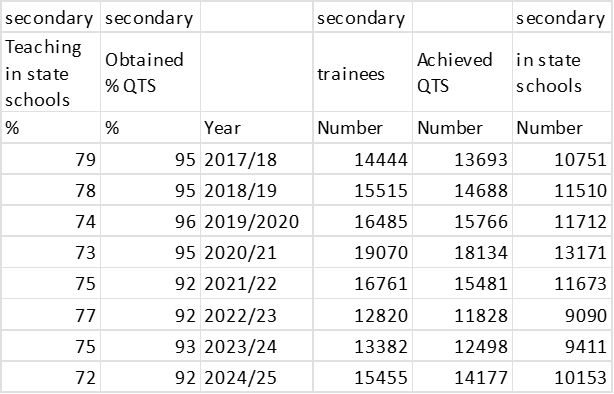
 In line with falling pupil numbers, there has been a reduction in trainee numbers in the primary sector. This has resulted in fewer numbers obtaining QTS, and even fewer of those working in the state primary school sector. The 5,882 recorded working in state schools of the 2024/25 cohort should increase as the data is refined, but it is still likely to be only halfthe number of just four years previously, when more than 10,000 new teachers were working in the primary sector at some point in the 16 months after obtaining Qualified Teacher Status (QTS).

Fortunately, those newly qualified teachers not obtaining a teaching post in England, might be able to look overseas for work. With VAT on fees for private school pupils in England, the independent sector is unlikely to offer must of an alternative to the state sector over the next few years; at least until there is some upturn in the birthrate.

I hope that course providers will take note of this data, and not over-recruit to courses in the future, as burdening students with more debt and a restricted chance of securing a teaching post is not really fair on the students.

In the secondary sector, the overall position hides some variations between subjects.

The percentage obtaining QTS among secondary trainees has been falling; from some 95% before covid, to 92-93% in the years since. The overall percentage hides a much greater change in the numbers obtaining QTS, from a Covid high of 19,070 to a low of 12,820 only two years later. Covid may have brought forward the decision to teach that might otherwise have been delayed until a future year.

Fortunately, 2024-2025 saw the number obtaining QTS much closer to pre-Covid levels. With falling rolls, the overall number of trainees, if not the mix within subjects, may be satisfactory for the DfE.

However, post-covid the state school sector lost around five and a half thousand teachers compared with the pre-covid numbers f new teachers entering state schools. To what extend these missing teachers have been replaced by new entrants through the ‘assessment only’ route, isn’t clear from the data.

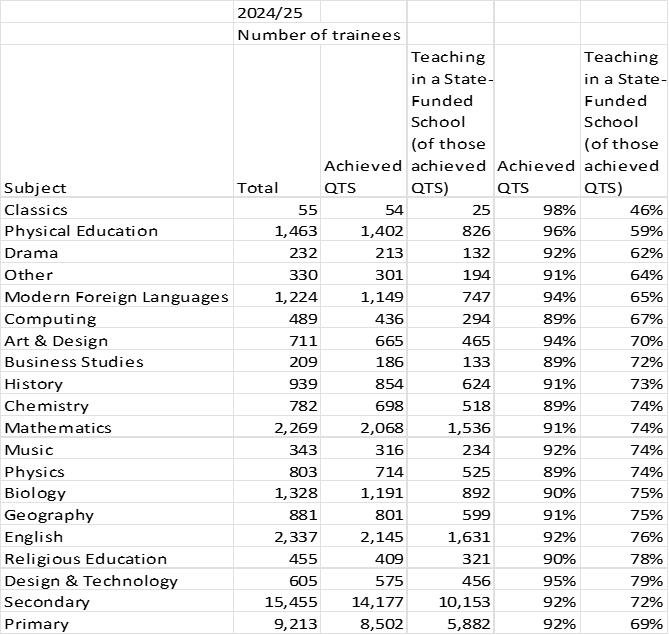
In the most recent year, 2024-2025, what of the percentages in state schools by secondary subjects?

The low percentage of those qualifying for QTS in Classics instate schools, is perhaps not a surprise given the percentage of state schools that teach the subject. The fact physical education is in second position in the table, with just 59% of those obtaining QTS in state schools should not be a surprise to anyone familiar with the number of trainees recruited and the DfE’s target for the subject.

Only in English and mathematics were there more than 1,000 new teachers working in schools. Given the requirement to teach these subjects to all pupils up to Year 11, and for some in Years 12 & 13, even these numbers may be insufficient. The 234 music, and 133 business studies teachers, and the 321 religious education new entrants, are almost certainly not enough to allow the subjects to thrive in our schools, even before the desire to widen the curriculum to include more MBacc students, and fewer EBacc students.

Alongside the conversation about the curriculum, and the desire of the Prime Minister to make it more relevant for work in the 21st century, there really needs to be a conversation about how the curriculum changes can be properly staffed, so that all pupils receive a high quality education taught by teachers qualified in their subject, and not just a page ahead of the AI generated lesson plan.

Data from: Initial teacher training performance profiles: 2024 to 2025 – GOV.UK

MBacc and teacher supply

The DfE ITT performance tables issued today allow me to write a quick post about the MBacc and the supply of newly qualified teachers over the past few year. Initial teacher training performance profiles: 2024 to 2025 – GOV.UK

Number for three key subjects are limited, as the table makes clear

Achieved QTS and teaching in a state school within 16 months of QTS

ITT YearBusiness StudiesDesign & TechnologyMusicTotal
2017/18106240220566
2018/19134236212582
2019/2020125341224690
2020/212254543371016
2021/22199292289780
2022/23155346227728
2023/24135441171747
2024/25133456234823

 Numbers have increased over recent years, and may still increase further as more data is accumulated for the most recent years. However, apart from the covid bounce, they still remain low as a percentage of state schools.

With more than 500 vacancies for teachers of music this year, even if half are filled by returners, there would not be enough trainees in any years, except for the ‘covid years’ to cover vacancies.

TVEI and the Manchester Bacc: same problem, same solution?

I hesitate to couple together Andy Burnham, our new Prime Minster, and Mrs Thatcher, one of most marmite Prime Minsters’, but they do both seem to have an interest in the role of education in preparing young people for work.

In 1982, Mrs Thatcher introduced a new scheme in what has been described in the following terms by a researcher:

The Technical Vocational Education Initiative (TVEI) was intended to instil a significant element of vocational and technical education into the curricula of mainstream schools and colleges (Williams and Yeomans, 1994). It was the first major initiative by central Government in curriculum development. The pilot was announced by then Prime Minister Margaret Thatcher in the House of Commons on 12th November 1982. Learning from the past Paper No. 6

The new initiative by Andy Burnham initiative is described in the following terms:

Mayor of Greater Manchester Andy Burnham said: 

“For too long the English education system has been built around the needs of just a third [sic] of young people who go to university. That means that every year, thousands go through school without a clear path into a good career. 

Our answer is the MBacc – a game-changing new plan for technical education. We’re using our devolved powers to reset the scales and give young people a clear line of sight to good jobs and the steps that will take them there. 

If we don’t make this change now, it could be the single biggest barrier to future growth – and to the life chances of young people here. The needs of our economy are changing, and right now the system is not capable of keeping pace and meeting the needs of businesses or the ambitions of the next generation.” 

Unlike the English Baccalaureate, which is geared towards the subjects top universities value, each MBacc gateway will guide young people to the subjects and qualifications most valued by the city-region’s employers. The gateways draw on the latest labour market data and provide a clear line of sight to high quality jobs in Greater Manchester’s growing economy. There will also be clear MBacc pathways for those who want careers in the emergency services or the Bee Network.  Andy Burnham unveils plan to turbocharge growth in Greater Manchester with new technical education route, the Greater Manchester Baccalaureate – Greater Manchester Combined Authority Accessed 29th  July 2026 0955

Interestingly, Burnham lists the following subject as part of the MBacc.

Engineering 

Design & Technology 

Business Studies 

Drama 

Music 

Performing Arts 

Regular readers of this blog will know that many of these are subjects that have difficult in recruiting new entrants into teaching. In the case of music, this is a subject where the DfE has slashed the ITT target. Engineering doesn’t have a target, so is probably in ‘other subjects’. Design and Technology is only filing its places as, like music, the target has been reduced

SubjectTarget 2026/27July offersFill: July viewJuly AcceptedFill on accepted
Chemistry6901460YES1302YES
Biology675629PROBABLY466POSSIBLY
Mathematics20002953YES2567YES
Design & Technology620701YES630YES
Art & Design605709YES590YES
Geography685549N466NO
Classics7545NO37NO
English19801835POSSIBLY1535POSSIBLY
Drama370318POSSIBLY263NO
Business Studies1200357NO267NO
Music260266YES220YES
Religious Education450349NO294NO
Others2035508NO414NO
History5201112YES952YES
Modern Languages10851363YES1172YES
Physics8101600YES1438YES
Physical Education6551551YES1326YES
Computing565961YES808YES

Andy Burnham must be careful not to announce a policy he cannot deliver nationally without a strategy for teacher supply, otherwise the very schools he seeks to help may be the ones that cannot recruit the teachers in a market where supply nowhere near meets demand on a national scale.

Manchester is blessed, as is the North West as a whole, with more ITT places than most of the rest of England. The test of any Prime Minister is whether he can scale up a local initiative into a credible national policy? The first step would be for Lucy Powell to take ownership of the policy.

ITT: Do bursaries work?

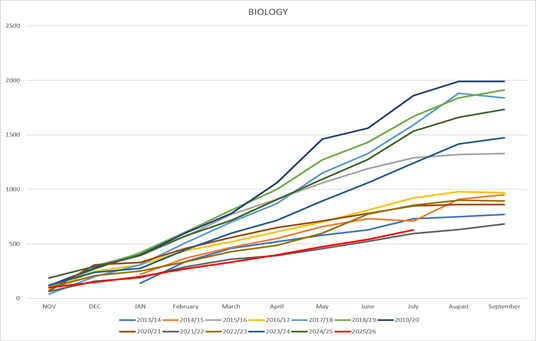
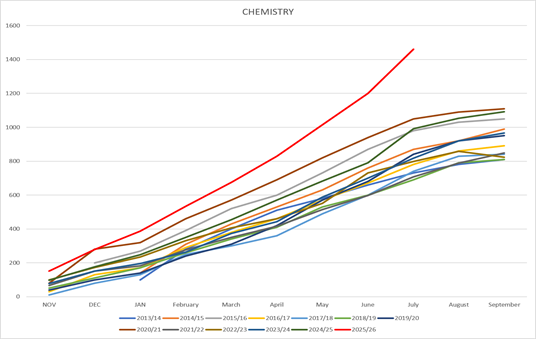
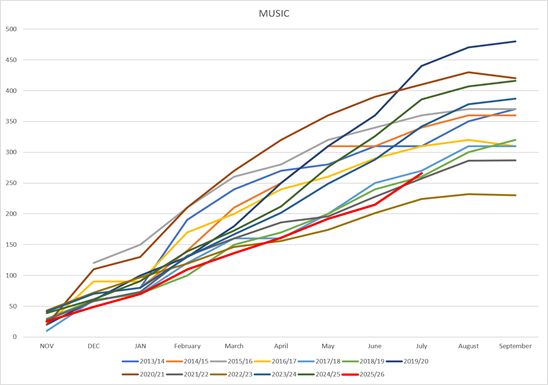
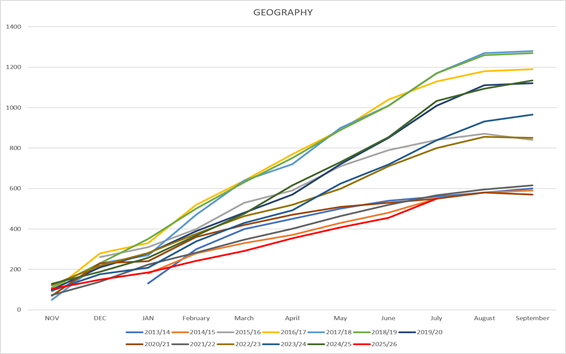
Following on from the July data on postgraduate ITT preparation courses, Initial teacher training application statistics for courses starting in the 2026 to 2027 academic year – Apply for teacher training – GOV.UK  I thought that I would publish a few charts showing the number of offers made over time for key subjects. The first two are biology and chemistry

The difference this year is stark: Record offers in chemistry, and the second lowest since 2013/14 cycle for offers in biology. This suggests the presence or absence of a bursary may affect the choice of subject by some scientists that is related to the presence and amount of a bursary.

Music is a subject where the removal of the bursary has reduced the number of offers being made, although there was a slight uptick this month. Fortunately, the significant cut to the target means that there should still be enough applicants to meet the target.

Finally, geography is another subject where the target won’t be met this year. The chart shows why very clearly.

If the aim of the government is to ensure that ITT targets are met in every subject, and not just selected subjects, then there needs to be a rethink about the bursary system.

However, the bursary system is unfair to those studying other subjects in a manner that the public sector does not apply to other areas of recruitment and training.

It is time to bring teacher preparation into the 21st century: pay all trainees a living wage, and prevent over-recruitment in some subjects and the associated pressure on the Student Loan Fund.