Serendipity Part 2

I mentioned in my previous post that yesterday I had been reading a random volume of the TES in a library and had found comments about special needs and the transfer of funding to schools after the 1988 Education Reform Act. I am grateful to the Chief Finance Officer at a leading MAT who straightaway sent me an article about funding of schools in Edmonton, Alberta in 1990. Thanks for the article, and for reading my blog.

In the same volume of the TES, I also discovered, again quite by accident, an article I had written and sent to the TES. I think it was my earliest contribution to the TES, and one I had completely forgotten about.

I have reproduced it here so I once again have it my collection, and also because of the up-coming budget in November that might be one for growth rather than business, and if so,  might the Chancellor risk overlooking any consequences for teachers and other public sector workers in any dash for growth?

Bad business for teaching

Chancellor Lamont’s budget for business is bad news for teachers. Like many public sector workers they will be reflecting that the new share option schemes and the 6p off the basic rate of tax which can now be earned through profit-related pay schemes will benefit their friends in the private sector without offering any incentives to them. However, if these changes help to bring down the level of basic pay settlements in the private sector then they will directly affect the level at which next year’s pay settlement for teachers is fixed; teachers could find themselves losers all round.

As consumers of large amounts of in-service training, teachers might have expected to benefit from the new tax relief on vocational training. But the present proposals only refer to national vocational qualification awards and will be of no use to the many teachers who currently pay for their own studies. This will particularly affect married women seeking to return to teaching who often need to finance further studies before they can regain a teaching post. This clause needs urgent consideration during the passage of the Finance Bill to ensure teachers are not seriously disadvantaged as an occupational group.

Finally, the increase in petrol duty and the associated rise in VAT may well have serious consequences for the already fragile labour market for teachers. Many schools are some distance from public transport, in housing estates or rural villages with only one bus a week. The increase in petrol prices may make it more difficult to attract teachers to work in these schools.

If Kenneth Clarke [then SoS for Education] saw the drift of the budget proposals before last week’s Cabinet meeting then he must accept responsibility for their effect on the teaching profession. Undoubtedly, however, our archaic system of placing the Chancellor on ice for a period before he delivers his budget has probably meant that in their enthusiasm for delivering a ‘budget for business’ the Treasury team has ignored the effect of their changes on those who work in the public sector, and particularly in education.

These days there is much more transparency about possible budget proposals, so fewer rabbits are pulled out of the hat on budget day. However, the bus that ran once a week, probably disappeared many years ago, but petrol duty hasn’t risen in line with inflation, and electric cars now offer an alternative. By the way, how many schools have EV charging points in their car parks, and do MATs offer a salary sacrifice scheme to help with the purchase of an electric vehicle? Is there an electric mini-bus schools can purchase? And I didn’t write the headline.

Views on behaviour in schools worsened in latest survey

It is rare for the DfE to publish research on a Saturday. This week it did so, presumably to allow the Secretary of State to do the rounds of the Sunday morning political shows. National Behaviour Survey: findings from academic year 2023 to 2024 The focus from Labour with the media seems initially to have been on attendance rather than behaviour, but that has changed with the announcement of behaviour and attendance hubs.

The reason may well be the deterioration in views about behaviour in schools reported in the last survey data collected in May 2024 when compared with the March 2023 data. It is difficult to remember that the data from May 2024 was collected under the previous Conservative government. (Figures in the table are percentages.)

QUESTIONGROUPMar-23Dec-23Mar-24May-24
MY SCHOOL CALM & ORDERLYLeadership84938581
Teachers57716053
SAFE PLACE FOR PUPILSTeachers95999696
Leadership82938885
PUPILS RESPECT EACH OTHERLeadership88969088
PUPILS ENJOY SCHOOLALL PUPILS75817673
FEEL SAFEALL PUPILS57656157
BELONGALL PUPILS43455349
PUPIL BEHAVIOUR VG or GLeadership82908172
Teachers55695546
Pupils43433540

In many key questions, such as whether the school is orderly and calm, and whether pupil behaviour is good or very good, the positive percentages have seen significant declines. It is not surpassing that leaders see pupils as better behaved than either their teachers or their pupils. It would be interesting to see how long those school leaders concerned about pupil behaviour had been in post. I doubt many long serving leaders would admit to anything other than schools where pupil behaviour is good.

It would also be interesting to know whether the 12% of pupils that said’ things were thrown in ‘mist lesson’, (albeit not aggressively) were being taught in schools were behaviour was perceived as not ‘good’ or ‘very good’.

Why might views on behaviour have dropped in the last year of the Conservative government? Might the issues with teacher shortages have finally begun to have an effect? Was any effect from teacher shortages compounded by deteriorating staffing levels and greater pupil numbers in secondary schools? Again, it would have been interesting to see some breakdown of the data by school types; free school meal percentages and number of pupils with EHCP. If the behaviour hubs are to have any effects, these are the types of questions that need to be asked.

A question might also be asked about the wisdom of axing Teaching Schools. The current government could do with a comprehensive and cost-effective professional development policy rather than leaving it to individual schools and those MATs that see it as a priority.

Earlier this month I wrote a post about discipline in schools Is discipline worse in schools? | John Howson The evidence for that post came from exclusions. As a result, I wasn’t unduly worried. This new data raises more cause for concern.

Dear Prime Minister

Would you like some good news? On your return from Birmingham, you will no doubt be asking Ministers how their departments can save money. Here is one suggestion. I am not unbiased in making this suggestion, as it could benefit TeachVac, the job board that I chair. However, TeachVac was in existence before the DfE started its own version and has consistently shown how to achieve a low-cost approach to vacancy listing as our accounts at Companies House will confirm. Reviewing the DfE site could also save the government money.

We suggested originally that the DfE need only provide a page pointing those seeking teaching posts to available sites in the private sector, and another for schools showing the relative costs of using different sites. However, in response to the Public Accounts Committee, the DfE decided on a more costly intervention and created its own job board.

TeachVac is currently offering secondary schools a deal of 12 months of unlimited matches for just £250 and a mere £50 for primary schools. How much per vacancy does the DfE cost to provide?

Reproduced below is a post from 2020 that further makes the case for saving money on the DfE’s job board. Our monitoring since then suggests that the DfE site has gained little traction in the market and may be losing ground in terms of teaching vacancies uploaded.

DfE and Teacher Vacancies: Part Two

Posted on April 3, 2021

The DfE is spending more money supporting their latest venture into the teacher recruitment market. SchoolsWeek has uncovered the latest moves by the government to challenge existing players in this market https://schoolsweek.co.uk/dfe-leans-on-mats-to-boost-teacher-job-vacancies-website-take-up/ in an exclusive report.

The current DfE foray into the recruitment market follows the failure of the Fast Track Scheme of two decades ago and the Schools Recruitment Service that fizzled out a decade ago. The present attempt also came on the heels of the fiasco around a scheme to offer jobs in challenging schools in the north of England that never progressed beyond the trial phase.

The present DfE site rolled out nationally two years ago this month. How successful it has been was the subject of a SchoolsWeek article earlier this year. https://schoolsweek.co.uk/dfes-teacher-job-website-carries-only-half-of-available-positions/  This blog reviewed the market for vacancy sites for teachers last December, in a post entitled Teacher Vacancy Platforms: Pros and Cons that was posted on December 7, 2020.

In that December post, I looked at the three key sites for teacher vacancies in England. TeachVac; the DfE Vacancy site and the TES. As I pointed out, this was not an unbiased look, because I am Chair of the company that owns TeachVac. Indeed, I said, it might be regarded as an advertisement, and warned readers to treat it in that way.

There is an issue with how much schools spend on recruitment of teachers. After all, that was why TeachVac was established eight years ago. The DfE put the figure in their evidence to the STRB this year at around £75 million; a not insubstantial figure.

Will TeachVac be squeezed out in a war between the DfE backed by unlimited government funding and the TES with a big American backer? At the rate TeachVac is currently adding new users, I don’t think so. After all, the DfE site doesn’t cover independent schools, and in the present market I believe that most teachers want a site that allows access to all teaching jobs and not just some. That benefits both TeachVac and the TES as well as other players in the market, such as The Guardian and SchoolsWeek, as well as recruitment agencies.

How much the DfE will need to spend on ensuring they cover the whole of the state-funded job market in terms of acquiring vacancies by the ‘school entering vacancies’ method is another interesting question? As is, how much will it also cost to drive teachers to using the DfE site and not TeachVac or the TES?

A view of TeachVac’s account reveals that TeachVac provides access to more jobs for teachers at less than the DfE is going to spend on promoting their site over the next few months. Such spending only makes good commercial sense if you want to remove a player from the market.

So, here’s a solution. Hire TeachVac to promote the DfE site and use the data TeachVac already generates to monitor the working of the labour market. After all, that was also one of the suggestions from the Public Accounts Committee Report that spurred the DfE into action and the creation of their present attempt at running a vacancy site.

Minister’s business experience useful?

Will schools in financial difficulties receive the Flybe treatment from Kelly Tolhurst MP, the new Minister of State for Education? In her career the Minister has served as a PUS – or first rank of the ministerial ladder – across three departments, plus a couple of months over this summer in the Whip’s Office, where she had previously served in a junior role in 2018. Kelly Tolhurst, MP for Rochester and Strood in Kent is possibly best remembered for being the Minister sent out explain the refusal to bail out the airline Flybe when it ran into turbulent financial conditions at the start of the covid pandemic.

“Unfortunately, in a competitive market, companies do fail, and it is not the role of Government to prop them up.

Given the time of year, the nature of Flybe’s business and fleet, and the routes that it flies, sufficient alternative transport arrangements should be available, either with other airlines or by road and rail.”

Hansard 5th March 2020

Hopefully, the new minister will be more understanding about the financial position of schools as they wrestle with the present financial crisis. As her role at the in the Business Department involved responsibility for small businesses, the MP should be well aware of the challenges that schools will face. As a supporter of the free market, she may well want to see whether the Department is spending its cash wisely on issues such as teacher recruitment and SEND.

As I mentioned in a previous post, the constraints of a national Funding Formula that can be ignored when times are good may also need to be something to be considered, especially the differences between maintained schools and academies when it comes to shifting cash around.

As an MP for Rochester, Kelly Tohurst will know of the stark differences between the town’s schools, where some are comprehensives that are operating alongside selective schools, and will as a businesswomen understand both the costs of re-organising the system nationally to benefit the few rather than the many, and the links between the school system and the need for a modern skilled workforce, something some of her predecessors may have seemed less concerned about.

As in other areas with selective schools, private secondary schools are thin on the ground in the Rochester area of Medway Council and that should be a warning to any government thinking of expanding selective education. The cost to the state of parents switching from private education to state selective schooling should be enough to dissuade any government from taking our school system back to the nineteenth Century as means of creating a twenty first century growth economy.

The Secretary of State should be familiar with issues such as youth offending and the variations between different groups and their schooling. I would hope that this will be a serious consideration for the new residents of Sanctuary Buildings, perhaps more so than under recent inhabitants.

Finally, I would again make my please for Jacob’s Law, whereby children in care are guaranteed a school pace within 14 days of the State taking over parental responsibility. This needs the promised change in the administration of in-year admissions and would befit the education of these children often taken from their families with no say in the matter and dumped in a different part of the country.

Bring Back Circular 1 each year?

Recently, I wrote a post about a Schoolsweek’s story about the DfE and the need to manage ‘sufficiency’ ITT review: DfE forms ‘sufficiency’ group amid places fears (schoolsweek.co.uk) by creating a new group than most people either didn’t seem to be aware of or didn’t know who comprised the membership. ITT places need a review: but not behind closed doors | John Howson (wordpress.com)

Anyway, I was thinking about what the Group might consider if its aim is to ensure that as many schools as possible are able to recruit the most appropriately qualified teachers to fill their vacancies.

Of course, apart from cutting the numbers of trainees to keep them in line with the predictions from the Teacher Supply Model, the Group could decide to do nothing, and just let the current market-based system continue with vacancies advertised, and teachers applying and the private sector making £40,000,000 or more per year from recruitment. (n.b. I am Chair at TeachVac, the job board).

At the other end of the intervention spectrum, the DfE could follow the actions of their predecessors in the Ministry of Education and return to publishing circular 1. This told local authorities each year how many new entrants from training they could employ. If they wanted more teachers, then there were either returners or teachers moving schools or unqualified staff that could be employed. This draconian approach no doubt worked well in the total planning economy of the immediate post-World War Two years, but probably wouldn’t work now, especially with the disparate system of school governance and the lack of a coherent middle tier in schooling that currently exists across England.

However, a variation on that theme would be to create all teachers as government employees and assign them to schools, as happens in some other countries. My guess is that model won’t work with a government pledged to reduce the civil service by some 90,000 employees.  Creating teachers as civil servants might seem to send out the wrong message about the power of the state.

So how else might the government manage the distribution of the ‘sufficient’ new teachers they are aiming to train to help reduce the inequalities currently in the system? Two possible solutions are, either tighten up on QTS by first making it a requirement for academies to ‘normally’ only hire teachers with QTS, and then segment QTS so it is aligned with the preparation course a person undertakes. This would mean those on primary sector courses would not have QTS to teach in the secondary sector, and visa versa. At present, any teacher with QTS can teach anything to any child at any level. In the secondary sector, QTS might become subject specific.

To deal with ‘shortages’ emergency certification could be provided for a limited period, with CPD to allow for full certification if the teachers was going to be employed teaching in that area permanently. This would also show where shortages were affecting schools and make effective use of the CPD budget.

The other alternative is to expand the Opportunity Area scheme by providing certain schools with additional cash to compete in the market to hire teachers in shortage subjects. However, without caping the spending of other schools, this approach just risks developing a race to see who can pay the most for their teachers. Good news for teachers, especially in shortage subjects, but possibly not the best use of resources.

With a significant number of career changers thinking of teaching as a career, a training salary might be a useful tool ensure these would-be teachers can make the switch into teaching. At the same time, ensuring a job for every successful trainee in the September after their course ends is worth considering. At present, those teachers needed to fill January appointment can find themselves without a job during the autumn term; a waste of talent and a loss of skills. Taking such teachers on as supernumeraries, paid from central funds, on the understanding that they are applying for posts would be worth considering.

Of course, none of these initiatives may be necessary if the recession throws up lots more returners to teaching that are the right mix of skills and in the right locations.  

To make decisions about any such scheme to consider needs high quality up to the minute knowledge of the labour market for teachers and school leaders, as well as the ability to understand the data and its implications. Fortunately, in NfER and our higher education sector, the government has the skills available to it to help answer these questions.

But it could abandon levelling up and just leave it to the market for teachers that is now not local, nor national, but global, in its reach for the high-quality teachers produced through the current teacher preparation system in England.

Their Lordships 1: DfE 0

If the Schools Bill brought before parliaments soon after the state Opening this spring was a football match that might be the current score line. Today the Minister, Baroness Barron, The Under-Secretary of State for Education has written to all members of the House of Lords announcing major changes to the Bill as first presented to parliament. as a copy has bene placed in the House of Lords library, I feel able to comment on its contents.

 The government still wants an all-academy system, but more of that later. The Minister has said that

The Government has carefully considered the views of the House and as such intends to remove Clauses 1-4 and Schedule 1 from the Bill. Noting that amendments have been tabled to oppose that Clauses 1,3 and 4 stand part of the Bill, the Government intends to support the removal of these Clauses, and table further amendments to remove Clause 2 and Schedule 1, which also form part of the measure.

There have also been concerns on the Academy Trust Termination and Intervention powers (Clauses 5-18 and Schedule 2). This concern is reflected in the amendments that have been tabled to oppose that these Clauses and Schedule 2 stand part of the Bill. I can confirm that is also the Government’s intention to support these amendments.

The Government will support these amendments at this stage and bring forward revised proposals in the House of Commons.  Extract from letter to Members of The House of Lords

I am not sure when I can last recall such a comprehensive review by a government on a Bill of this nature.

The survival of the Bill now depends upon the wider political scene. If there were to be an autumn general election, called by the Prime Minister as a result of a combination of changes in the Labour Party and the Prime Minister taking the view that a general election was less of a problem than a Standards Committee Inquiry, and any consequences resulting from such an inquiry, then the return of the Bill might depend upon whether there was sufficient parliamentary time in what is known as the ‘wash-up’ to see the Bill through all its stages before parliament was prorogued.

Of course, if there isn’t a general election there will be plenty of time to create an all-academy school system with no local democratic scrutiny of schooling.  Presumably, so long as the faith communities can be dealt with to their satisfaction, no other groups will matter.

However, it is to be hoped that the importance of ‘place’ in the delivery of an education system will be recognised. Whether local authorities will want to put the same effort into managing admissions and transport under the new arrangements will be an interesting set of questions.

Uphill struggle for an all academy system

The DfE has now published the data on governance of schools in England as part of the background to both the recent White Paper and the Schools bill currently before the House of Lords. Opportunity for all: strong schools with great teachers for your child – GOV.UK (www.gov.uk) and Excel spreadsheet the fourth item on the page.

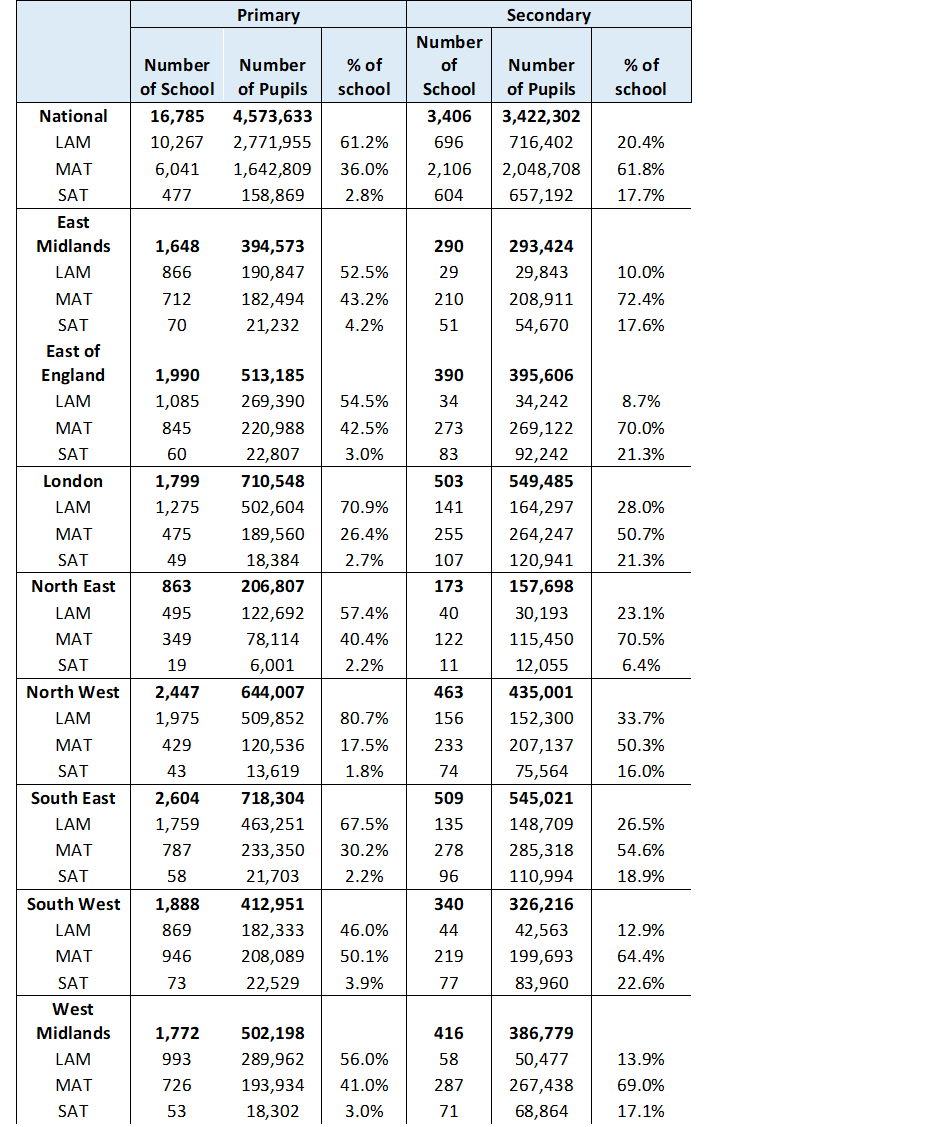
While academisation, whether Stand Alone academies (SAT) or schools in multi-academy trusts or committee (MATs) has taken hold in the secondary sector, the majority of primary schools are still not academies.

GovernancePrimarySecondary
Primary schools% of primary schoolsSecondary schools% of secondary schools
All schools (state-funded)LA maintained10,61563%74722%
MAT5,67534%2,05059%
SAT5013%66119%
Of which faith schoolsLA maintained4,21568%21835%
MAT1,77729%29347%
SAT1923%11719%
Source: DfE

According to the DfE figures, 63% of primary schools are still LA maintained schools and that increases to 68% of faith schools despite some diocese having created local MAT/MACs. However, the vast majority of secondary schools are now academies of one sort or another.

However, a third of faith schools in the secondary sector are not yet academies. It would seem that it is the diocese rather than the local authorities that the DfE should be talking to about how to reach an all-academy school system.

There are also clearly regional differences, with primary schools in the North West still largely LA Maintained schools whereas only eight per cent of secondary schools in the East of England are not academies.

These differences are important in relation to issue such as in-year admissions, a topic this blog has pursued for several years now. I hope the difference arrangements between maintained and academies will be addressed in the Bill before parliament.

Bye-bye ESFA: Hello ESFA

Yesterday, the DfE published the outcome of the review into the Education and Skills Funding Agency led by Sir David Bell plus its response to the review and the resulting changes from 1st April 2022.

Review of the Education and Skills Funding Agency – GOV.UK (www.gov.uk)

There are a lot of detailed proposals, but some that struck me of more general interest are these – with the government’s response below the recommendation.

We recommend that further work is done as part of school system reform to create a more strategic and shared understanding of responsibilities between DfE, ESFA, and Ofsted, and that the outcomes of this work are communicated widely

Agreed.

We recommend that the department should have a unified directing voice at a regional level. We have contributed to the current Future DfE project which is bringing together functions in the regional tier, and which will resolve the form and nature of that directing voice

Agreed. Assessing the functions and approach to post-16 regional work will be taken forward as part of developing the Further Education, Higher Education and Employers work set out above and be led by the Director General. We will benefit from learning from the experience of establishing the pre-16 regional tier.

We recommend that, in keeping with our finding that ESFA should focus on funding delivery, the functions in Academies and Maintained Schools Directorate not linked to the funding delivery role, and not required by ESFA’s Accounting Officer to provide assurance, should move to DfE. This means that the non-financial regulatory functions for academies and the functions related to school/trust governance should move to DfE’s pre-16 regional tier, as should new trust and free school activity, UTC engagement, and networking events.

Agreed.

We recommend DfE considers bringing the complaints functions for maintained schools and academies together in a fully centralised complaints system within the department

Agreed.

We recommend that ownership of the Academy Trust Handbook should move to DfE’s School Systems, Academies and Reform Directorate, unless the focus of the Handbook is narrowed back towards a tool for financial management only.

Agreed.

The ESFA had become rather unwieldy over time and these changes will move it back towards its original core function relating to the handling of the financing of the school system.

More interestingly is the re-alignment of the school system with the wider government regional framework. With the levelling up agenda being a cross-department exercise in government, this re-alignment makes sense. However, it doesn’t fit with the boundaries of Headteacher boards and Regional School Commissioners. Could the days of this unelected post be numbered? After all, might there be some cash savings to be made and, if all schools were academies of one sort or another, then one key function would have disappeared.

The DfE still has to work out the 16-18 phase where some students are in the school sector, but more are in the further education sector. There still seems to be room for overlap or avoidance of difficult issues unless the protocol of responsibilities between the directorates is made clear.

One interesting side effect of all schools becoming academies would be the shift in financial year for all schools back to a unified position. However, the financial year would be totally uncoupled from the municipal year, but aligned to the higher education funding rounds.

This review helps sort out the framework for the ‘top’ tier. Now it remains to work out the framework for the middle tier. That will probably be more of a challenge.

White flag or shifting the blame

There is a saying that one should beware of unexpected guests. For reasons obvious to those that know the saying, it is clear why I prefer to compare it with the other saying of ‘not looking a gift horse in the mouth’ – should that be looking an electric car in the battery these days – but without using the actual expression. No matter, what does matter is whether or not local authorities will be able to form and run Multi Academy Trusts/Committees?

Ever since Mr Gove raced the 2010 Academies Act through parliament in the period before the summer break that year, and less than three months after the 2010 General Election, the Conservatives have wanted all schools to become academies. At that time, local authorities were beyond the pale, and a model with no local democratic involvement, similar to that of the NHS, seemed on the cards for education. Peter Downes a former Cambridgeshire Lib Dem councillor and long time secondary head led the Lib Dem charge at their 2010 September Conference, an event where delegates made their support for local democratic involvement in education very clear to Nick Clegg and David Laws.

Over the ensuing decade, most secondary schools have either opted or been forced to become an academy. All new schools are required to become an academy. However, except in a few parts of the country, academisation of the primary sector schools has been slow and patchy. Many primary schools only became academies are a visit from ofsted resulted in compulsory academisation.

The picture that has emerged around the county is of an expensive mess that could make the reputation of a Secretary of State if change is handled properly with a view to the longer-term effectiveness of the school sector.

There are now noises in the press suggesting that the next White Paper from the DfE might allow local authorities to establish and run Multi Academy Trusts or Committees or some new structure such as a Multi Academy Board might be created. Such a suggestion would effectively be a change of direction on the part of central government. Is it either a white flag or preparing the ground to shift the blame for a period of challenge that will face the primary sector where most maintained schools are still to be found?

There is a third possibility. This is that civil servants have been so impressed by how some local authorities have handled the covid crisis that they now recognise their value as part of the middle tier, especially in handling the large number of small primary schools spread across rural England. Certainly, the work by the local authority team in Oxfordshire, where I am a county councillor, has resulted in an email from a headteacher of a private school expressing thanks for the work of local authority staff. Not something you receive every day.

Allowing or even forcing local authorities to take all schools not already academies into a LAB or Local Academy Board would allow the government to tell the public that all schools were now academies. It would allow local authorities to feel that they might be back in the game of education politics and it would allow for more coherent planning for the primary sector less hampered by the legislation on closing rural schools. This may be important should the National Funding Formula create the need to rationalise the school estate.

Attendance Group must address in-year admissions issue

I recently caught up with news about the DfE’s Attendance Group, and the Minutes of its December meeting.  Attendance Action Alliance January meeting notes: 9 December 2021 (publishing.service.gov.uk)

I am delighted to discover the high-profile nature of membership the Group and that the Secretary of State has taken an interest, as owner of the work. However, although the Group discussed the question of a register for home educated children and the concerns over those children just missing school on a regular basis, I didn’t find any emphasis on ensuring that children taken into care are offered a school palace as swiftly as possible and within set time limits. The same standards also need to be put in place for children with special needs whose parents move to a new location during the school year and need a new school placement.

Taking a new job should not be conditional on whether there is a special school place available for your child.

In a previous post on this blog, calling for a ‘Jacob’s Law’, I laid out the case for in-year admissions to academies not to be held up by such schools not wanting to admit such children. The 2016 Education White Paper: Education Excellence Everywhere recognised there was an issue with in-year admissions to academies because local authorities had no powers to over-rule the decision of a school not to admit a pupil. This was why Jacob was out of school when he died. Time for Jacob’s Law | John Howson (wordpress.com)

Sadly, nothing significant has changed since 2016. I hope that the Attendance Group will consider the issue of in-year admissions at a future meeting, and not just focus on the parents that don’t send their children to school. The system must work for the benefit of all and not just those that are easy to educate. The same is the case of children with SEND requiring in-year admission to a school.

These young people must not be ignored, and just offering tutoring is not the same as admission to a school. Home tutoring doesn’t provide the same social interaction that being in a school provides however good the ‘virtual school’ is at its job.

Of course, there are risks where the school community is hostile to incomers and many schools could well look to improve the transfer experience for in-year admissions that can be even worse than that experienced by pupils transferring at the start of the school-year.

Being taken into care as a school-age child is a traumatic experience, and we owe it to these children to make sure that their education is affected as little as possible. So, it is my hope that the Attendance Group will as a minimum endorse the 2016 White Paper suggestions and, if possible, go further and set time limits for school places to be offered to children taken into care and requiring a new school placement. For most, it wasn’t their fault that they have ended up in the care of the local authority where all the secondary schools are academies.