Feedback welcome through the comments section. Voices are US because of the platform used, and a free version, so that may jar with some listeners, but not with others.
The podcast is nearly 15 minutes long from a blog of less than 600 words. Does it read too much into the blog? Does it make explicit issues that are implicit in the blog. Genuinely interested in whether it adds to what I wrote or takes it over and makes it something different, and not authored by me.
After my last blog post on ITT targets, someone messaged me to ask how I decided which subjects were likely to meet their targets so early in the recruitment round? As I tried to make clear in that post, it isn’t an exact science, but more a guide towards trends in each subject.
The big assumption, and why the DfE has accused me of ‘scaremongering’ in the past, is that the rest of the recruitment round will follow the pattern set in previous years. There is a rhythm to recruitment that normally goes through three phases.
Phase 1 –November to January. Early entrants that know they want to be a teacher, and apply early in each recruitment round.
Phase 2 – February to June – final year students tend to be focused on completing their courses, so applications tend to be more likely to come from career switchers into teaching. The behaviour of this group can be closely linked to trends in the wider labour market: lots of graduate redundancies, and there will be more applications to teaching. A buoyant labour market, and fewer may consider teaching as a career. Offers will also depend more on the location of places available, as this group of applicants tends to be more location specific: they may have a partner, and a stake in a local housing market. Places on national schemes, and local school-based programmes can be important to this group of applicants.
Phase 3 – July until the start of courses. Trends in this phase tends to be linked to the labour market for new graduates. Those graduates that have left job-seeking until after their finals will look to teaching in greater numbers if there are few options elsewhere. In the past male applicants have tended to feature more in this group, especially in some subjects.
Of course, two events can upset the normal rhythm. In 2020, the Covid pandemic created a surge in applications between April and July, possibly because of uncertainty about the wider labour market.
The other event that can shape the ITT market is the actions of government. Changes to the bursary scheme or events, such as the introduction of a Training Grant can make a big difference to applications. By their very nature, they cannot be predicted, but they can be modelled.
2026 ENTRY TO PG ITT
MUSIC
2025 TARGET
565
OFFERS JANUARY 2026
70
OFFERS JANUARY 2025
91
TOTAL OFFERS 2025
416
DIFFERENCE 2025 TOTAL AND 2025 January OFFERS
325
PROJECTION for 2026
395
ESTIMATED SHORTFALL
170
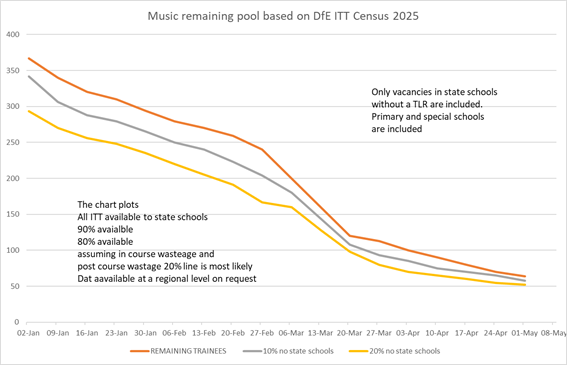
In the table is my estimate for the outcome for music in this round, on which I have based my view that the subject will not fill all the ITT places, if the target remains the same as last year. Any increase in the targets makes a shortfall even more likely. At present, the target would need to be reduced more than 100 places to a level not seen in recent years, and not in line with the recent Curriculum Review for the subject to meet its ITT target. Of course, restoring the bursary to music might help increase recruitment this year.
By the 19th January 2026, there had been applications from 26,217 candidates. This compared with 20,771 at the January data point in 2025. Candidates applying for primary courses were up from 7,283 to 8,676: a modest increase.
For secondary courses candidate numbers this year were, 19,232 compared with 14,862 at last January’s datapoint. That looks like very good news, perhaps worthy of a Statement in Parliament.
However, it is worth delving a bit deeper into the data before putting out too much bunting. Applications from the ‘Rest of the world’ account for 8,353 of this January’s total, compared with 5,088 last January. That means that this group now account for a whopping 30% of candidates. This compares with 23% of candidates from this grouping in last January’s data.
Of even more concern, is that the numbers of candidates from the United Kingdom haven’t kept pace with the growth in overseas applicants. The growth in applicant numbers from the North of England has been especially weak; only 90 more compared with last year from the Yorkshire and The Humber region, and only 71 more from the North East.
Admittedly, the North West has seen an increase of over 400 applicants, and London, over 500 more. However, the South East only has around 140 more applicants than last year. This is around 7% more, but this percentage pales into insignificance compared to the more than two thirds increase in applicants for ‘the Rest of the World’.
The dominance of the ‘Rest of the World’ applicants as a share of the total makes commenting upon the data challenging. Normally at this time of year, I might be happy to predict those subjects likely to miss their ITT targets, based upon more than 30 years of data collection. Not knowing how the ‘Rest of the world’ applicants are spread both between primary and secondary phase, and within secondary phase by subjects adds a unique challenge to any predictions this year.
However, based upon ‘offers’, and the outcome of the 2025 ITT census, and assuming no significant change in the pattern of applications over the rest of the cycle – such as a significant weakening of the demand for new graduates or another pandemic – I am happy to make some suggestions for the outcomes based upon current trends.
I expect that Religious Education, Modern Foreign Languages, Music, Classics and the ‘other’ group will all miss their target this year.
I am not sure about biology, where offers are down by 194, but the subject reached 151% of target last year. I am also, as yet, uncertain about Geography, where offers are down, but the subject surpassed its target last year.
Despite the increase in offers, I still don’t expect Physics, Design & Technology, Business Studies and Drama to meet their targets, although on this showing they might do better than last year, assuming those with offers actually turn up when courses start: always a worry this early in the recruitment round.
On the current data, Physical Education and History, as ever, will surpass their targets. Mathematics, computing and Chemistry, should also meet their targets. I am unsure about English, where offers are down, and the subject only just beat its target in 2025.
Overall, I think that the DfE needs to consider how the statistics are presented, if a nearly a third of applicants might need a visa to train. How does this fit in with other government policies? Perhaps we can set up training courses overseas, so that these new would-be teachers from the ‘Rest of the world’ can work in the new State Schools to be established as a part of the DfE’s export drive, announced last week.
Today, Sunday 25th January 2026, marks the 14th birthday of this blog, so thanks for taking the time to read what I have written since January 2013.
Copilot tells me that 96% of blogs started in January 2013 have fallen by the wayside by 2026: but can you believe everything AI tells you?
Sadly, WordPress doesn’t publish such statistics, but it would be interesting to know how many have persevered with what is now a somewhat outdated form of communication. Unlike others, I haven’t switched to creating a podcast, although I did experiment with one way back in 2007; but that’s another story, as is the online chatroom, pioneered with the TES back in 2003.
By the time of its 14th birthday, this blog has had over 180,00 views by more than 97,000 visitors according to WordPress of the 1,59 posts that I have written since the blog started in 2013.
The most popular has been the one on ‘how much holiday do teachers really have’, with more than 6,100 views since it first appeared on the 20th May 2022.
Of course, at the opposite end of the scale, there are many posts where I have been the only person to have read what I wrote, according to WordPress. However, on Christmas Day, 2022, someone downloaded all the posts up to that date: hopefully, they also read them.
Between October 2023 and May 2025, while I was the Cabinet Member for Children’s Services on Oxfordshire County Council, I took a holiday from posting on the blog,
Since, I started writing posts again in May of 2025, after ceasing to be an elected politician, readership has been slowly increasing, to now reach double what it was at its low point. This is mostly thanks to readers from around the world once again deciding to view what I write.
So, what do I write about? Mostly education; frequently teacher supply matters – a research interest of mine for more than 40 years, if you start when I began counting vacancies for headteachers. My interest in ITT data goes back to 1987, when as a new senior leader in a School of Education I was faced with dealing with the consequences of an 100% over-recruitment on a primary PGCE.
I am most proud of the wok on Jacob’s Law, to ensure all children have a school place even if they move home mid-year, as often happens when a child is taken into care. No school with spare places should ever refuse such a child a place. What to do if they are bright enough for a grammar school place when moving from a comprehensive system is a question the government still needs to address.
The blog will continue into its next year, but as I approach my 80th birthday in 2027, perhaps the blog won’t make its 20th birthday: who knows. And, finally another reason for not producing a podcast; you cannot see the data tables, include din many of the posts.
Just over a decade ago, it seemed possible that higher education might no longer have a future in teacher training. The talk was all about schools, and training teachers where they were needed, rather than on university campuses that weren’t necessarily located in the places where teachers were required by schools.
Indeed, even as long ago as the mid-1990s, when School Centred Initial Teacher Training (SCITT) first rally started, many of the early SCITTS were located where higher education provision was lacking, such as along the north bank of the Thames estuary.
Looking back to 2013, and you can find this post in my Book*, there seemed a real threat to the future of higher education continuing with ITT. Sadly, we lost the Open University, with its mature entrant focus, and a couple of other providers at that time.
Fortunately, the decision by Ministers to ignore the Teacher Supply Model targets in 2013, and overinflate the number of ITT places allocated, compared with the predicted need for teachers by schools, offered higher education a lifeline, while a rethink took place behind the scenes.
Fast forward to the present day, and we have seen postgraduate routes now dominate both secondary and primary ITT. Despite the High Potential route (think Teach First) and the salaried schemes that replaced the former Employment-based route of the GTTP, fee-based training still dominates the landscape for ITT.
What will happen in the future for ITT if the present murmuring about graduate debt becomes an issue, and graduate reject the idea of adding a fourth year of debt at high interest rates to their ‘graduate tax’, is an issue for another post.
What is interesting is the present balance between higher education and SCITTS in the postgraduate fee-paying ITT market. Helpfully, the DfE has some data in the annual ITT census.
202223
202324
202425
202526
increase candidates
% increase candidates
in cycle accept rate
PG fee-funded
HEI
58%
46%
41%
43%
PG fee-funded
SCITT
47%
41%
45%
47%
candidates
PG fee-funded HEI
31,020
36,514
39,910
41,170
10,150
33%
PG fee-funded SCITT
16,334
19,056
20,547
21,827
5,493
34%
There are several interesting points about this Table. Both routes have seen an increase in candidates between the 2022/23 cycle and the 2025/26 cycle – the present group of postgraduate trainees currently preparing to be a teacher.
On the face of it, acceptance rates in higher education have fallen significantly, from 58% in 2022/23 to 43%, for the current group of trainees, while SCITT acceptance rates have increased. It is worth saying, in passing that had acceptance rates not increased, the flow of new teachers into schools would have been even worse than it has been post-covid.
Is there an explanation for the fall in HEI in-cycle acceptance rates. Clearly more candidates might mean more choice, but whereas for SCITTs more candidates meant more acceptances, for HEIs it has meant the opposite. One reason for this might be the increase in overseas applicants. Such applicants might be more familiar with higher education courses rather than SCITTs, so may have disproportionally applied to universities, and that may well have affected acceptance rates. I will try to consider the data around this issue in another post.
Wha t s clear, from the data, is that unless Ministers revise their policy when falling rolls means fewer training places over the next few years, the fee-paying ITT sector for postgraduate courses will see a place for higher education. This was not the outcome many feared might be the case.
However, it will be the attitude of students to debt levels that may influence the future shape of postgraduate, and indeed all ITT, over the next few years.
If would-be trainees refuse to take on more debt, perhaps we might even see the return of the training grant, phased out in 2010 in favour of bursaries and scholarships.
If I was a policy-maker, I would be watching the signs carefully about student’s attitude to debt, especially among current undergraduates.
*Teachers, Schools and views on Education by John Howson. Available from Amazon as an e-book for £9, or as a paperback
The Institute for Fiscal Studies and the Nuffield Foundation have published the latest in their series of reports about education spending Annual reports | Institute for Fiscal Studies While the report covers the whole education sector, I am principally interested in the school sector. That sector now overlaps the early years sectors, at the lower age grouping, with many schools taking pupils below the age of five. At the 16-18 age grouping, there is an overlap between the school sector and the further education and skills sector.
The highlights for me from the latest report are: the obvious effect of the explosion of demand for SEND places. I am not sure whether this report fully captures the full cost of the increase, since the transport costs for pupils with SEND aren’t usually a part of the DfE’s budget, and certainly cannot be funded from the Central Services Block or even the High Needs Block of the Dedicated Schools Grant.
The second highlight is the reduced funding for secondary schools. These schools have seen the reduction in 16-18 funding, and a reduction of the gap between their funding and that of primary schools. I suspect the latter, over the long-term, may have been partly affected by the need to fund non-contact time in the primary sector, introduced under the previous Labour government.
The primary sector is now experiencing falling rolls, while the upper secondary 16-18 sector is still seeing pupil numbers growing. As the report says, there is a policy decision to make about falling rolls. Does government either recoup the cash not needed because there are fewer pupils, and put the consequences on schools, or does it keep the cash in the primary sector and hope to improve outcomes? I wouldn’t bet on the latter.
One element missing from the picture seems to me any discussion on the changes in school reserves. I think it is vital to know how much money is being saved by schools from revenue budgets, and whether the total per pupil is increasing or reducing. With many academy trusts ‘pooling’ reserves so funds can be used for a school in a local authority different from that of the school where the cash was accrued, a picture of trends in this area might reveal the extent of short-term pressures on school budgets. Recently, I came across a special school with a balance of £2.5 million. Is that a good use of public money?
In a graph – sadly the IFS don’t number their graphs or tables in the report: an oversight in my opinion – it sees that early years’ spending has doubled between 2010-11 and 2025-26, and primary school spending has increased by 12% over the same period. All school spending was the same per pupil in each year. This means that secondary school spending per pupil declined by three per cent over the period, and 16-18 spending by 8% – this despite the fact that schools often use their most expensive teachers with this age grouping.
Finally, I note that central spending on academies is now £510 per pupil, double the level in 2016-17. I am not convinced that this is due to a shift towards larger MATs as the report states, as this would imply there were no economies of scale possible.
I will review this issue further when I look in detail at the 202425 accounts of a selection of MATs once all their accounts are published.
In my previous post, I mentioned the DfE’s new export drive Strategy to boost UK education abroad in major £40bn growth drive – GOV.UK This release was no doubt carefully timed to coincide with the annual BETT Show, where the best of UK technology in education, and ideas for the future, are on show.
The DfE’s announcement covered both higher education and schools. About the expansion of the latter, the release said that,
“A new Education Sector Action Group will work with the International Education Champion, UK universities, colleges and schools to help unblock barriers to trade to expand overseas.”
And
“This strategy goes further by backing providers to expand overseas and ensure top students around the world can access a world-class UK education on their own doorsteps.”
Whilst much of the press notice is about universities and higher education in general, as a part of the export drive, further education, and the former stable of English language courses, don’t rate a mention.
Is expanding English-style schooling overseas part of the aim “to ensure top students around the world can access a world-class UK education on their own doorsteps”? It would be good to know what specifically the DfE is thinking in this regard about schools.
Should the DfE be considering what further strain on the labour market for teachers any expansion of fee-paying export-driven English schools either overseas or at home might place on the home labour market for teachers that has yet to recover from a decade of serious under-recruitment in several curriculum areas.
Might a start be a census, even in broad terms, of how many teachers trained in England are working in British schools overseas. There will also be other such teachers in other international schools, but let’s just start with the easy bit.
Does The Association of British Schools Overseas, the DfE recognised partner for overseas schools, already collect this data. If not, would it be willing to support an anonymous survey of its members, to see how many teachers trained in England are already working overseas, and what expansion in staffing these schools expect over the next few years?
A demand for 50 more physical education teachers would not be a problem for the home market to absorb, but recruiting 50 more physics teachers for schools overseas might well create problems for schools in England.
If the DfE is serious about exports, should any schools’ committee on the proposed Sector Action Group ask the DfE to consider adding an additional element to the DfE’s Teacher Supply Model to take account of the needs of the export drive by schools?
With demand for teacher training in England from some parts of the world growing significantly over the past couple of years, perhaps these overseas trainees could be licensed only to teach outside the United Kingdom in overseas schools?
Exports are good for the economy, but not if they deprive students in England of the same quality of education. Historians remember the challenges faced by the 1945 Labour government in restricting home demand to allow for exports in order to bring in much needed cash after the war.
I am sure the DfE would not want create a similar situation in schooling 80 years later.
Yesterday, I went to listen to Monica Harding MP, the Liberal Democrat spokesperson on international development discuss the importance of our overseas aid budget, and the manner in which successive Conservative and Labour governments have reduced the share spent on aid from 0.7% of the government’s budget, agreed during the coalition government, to 0.3% under present Labour government.
Interestingly, on the same day, The Department for Education announced its new ‘International Education Strategy’ Strategy to boost UK education abroad in major £40bn growth drive – GOV.UK The new strategy doesn’t seem to pay more than lip service to the development budget. Instead, it is firmly and proudly announced “a clear ambition to grow the value of education exports to £40 billion a year by 2030, backing providers to deliver UK education overseas in new and expanding market.”
This will be music to the ears of UK universities, especially if it means more can open overseas campuses backed by government support. One only has to drive around Education City in Dubai to already see the logos of many overseas universities, including some well-known UK names.
The press notice tries to balance fears of further inward migration – music to the ears of Reform – with the explicit encouragement to open campuses overseas.
“Unlike the previous strategy released in 2019, this approach removes targets on international student numbers in the UK and, while continuing to welcome international students, shifts the focus towards growing education exports overseas by backing UK providers to expand internationally, build partnerships abroad and deliver UK education in new markets.
This strategy goes further by backing providers to expand overseas and ensure top students around the world can access a world-class UK education on their own doorsteps.”
All this is a long-way from 1996, and my attempts to interest Oxford Brookes University in an idea to set up courses in a centre in what was then still known as Bangalore and like other cities in India has now adopted its local name, of Bengaluru. Incidentally, I believe that we corrupted the name of the city to create the word ‘bungalow’.
In 1996, Brookes had links with an international school in the city and the Business School was also interested in expanding overseas. Sadly, I left the university before anything could come of the project. However, our vision also included home students being offered the chance to take semesters in India.
The idea of two-way traffic doesn’t seem to be feature much the current export drive, with just a brief mention of both the Turing and Erasmus Schemes in the final paragraph, although the full text does have a section about student exchanges.
That’s a shame, because exposing UK students to international experiences is also good for long-term trade, as I know from my time at university in the 1960s, when I joined, and later ran, the international exchange organisation, AIESEC, bringing business and economics students together from more than 50 countries.
As a result of my own experiences, I applaud the export drive in principle, and will discuss the UK school’s element of it in another post, but also believe the DfE’s should have an international policy that at the same time reflects how the UK education sector can also contribute to the development aid budget.
This is going to be one of my ‘nerdier’ posts. Children missing education are a small but important group of young people. In the autumn term of 2025/26, the DfE estimated that there were around 34,700 such pupils in England – down for 39,200 in the previous autumn term of 2024/25. Across the whole year 2024/25, some 143,000 children were estimated by the DfE as missing education at some point in the year. Children missing education: methodology – Explore education statistics – GOV.UK
The DfE relies upon local authorities for the collection of the data. The re-organisation of the shire counties over the next few years may well affect data quality, where new ‘unitary authorities’ are created and new teams will need to be assembled. So, how are ‘missing children’ defined?
Definition of children missing education
CME does include children of compulsory school age who are not registered at a school and are not receiving suitable education elsewhere, even if these children:
• Are in the process of applying for a school place, even children within the first 15 days of the application process
• Have been offered a school place for a future date but have not yet started
• Are receiving EHE, if this education is unsuitable
• Have been recorded as CME for an extended period: for example, where their whereabouts is unclear or unknown4 When EHE should be deemed CME An EHE child whose education is deemed unsuitable should no longer be classified as an EHE child and should be classified as CME.
Section 436A of the Education Act 1996, is a duty on local authorities to make arrangements to try and identify children of compulsory school age who are not registered pupils at schools and are not receiving suitable education otherwise than at a school. Although there is no legal obligation on local authorities to classify a child as CME at a particular stage of the statutory process under sections 436A and 437 of the Act, we would expect a local authority classify a child as CME once they have deemed that the child is not receiving suitable education (which would include having insufficient information to reach such a conclusion). If local authorities have not had an opportunity to assess whether a child is receiving suitable education, that does not mean that the child should automatically be classified as not receiving suitable education. Not knowing does not mean the child is not being suitably educated, though the local authority may ultimately reach this conclusion if they have asked for information and not received satisfactory responses. Elective Home Education and Children Missing Education
How assiduous are local authorities at collecting this information? Difficult to say, but it is interesting that 11 of the 33 London boroughs have a rate of 0.1%, the best possible. This is along with six local authorities in the North East, and five counties. However, no local authority in the East of England features in those LAs with a 0.1% return, the best being 0.3 and the worst 1.0%.
Overall, the average autumn term rate fell from 0.5% in 2023/24 – the first year of collection to 0.4% in 2025/26.
Why does the issue of children missing education concern me. My posts on Jacob’s Law shows why I thinking understanding the problem is important Time for Jacob’s Law | John Howson
My suggestion last summer was for a virtual school for all such children otherwise classified as missing education A Virtual School for those missing school? | John Howson This could be especially important for young people with SEND awaiting a school place as well as those that move into an area mid-year when all school places in their year group are full.
I would encourage local politicians to check their percentage of missing children, and how well officers track such children. It was an Ombudsman’s report that originally sparked my interest in this issue. Education is a fundamental Human Right | John Howson
The original paper to Oxfordshire’s Scrutiny Committee in 2019 highlighted 9,600 records that were incomplete at that time and the exercise Oxfordshire officers took to update their records! aebhdfh I wonder how many local authorities have conducted such a thorough examination of their records.
Hopefully, now the DfE is collecting data, more attention is being paid to children that might slip though the net.
One should never look a gift horse in the mouth, and today’s DfE announcement of CPD worth £200 million for:
“new courses available to all teaching staff will deepen knowledge of how to adapt their teaching to meet a wide range of needs in the classroom, including visual impairments and speech and language needs.
Teachers will learn about the things we know can transform how children access education, such as using assistive technology like speech to text dictation tools and building awareness of additional needs amongst all pupils, so every child can go on to succeed. “ £200 million landmark SEND teacher training programme – GOV.UK
Is clearly to be welcomed.
If the aim by the DfE is to reach half the teaching force, plus a percentage of non-teaching staff, such as teaching assistants, the figure of £200 million might work out at around £1,000 per person per course.
Now, I guess you can get a lot of on-line self-assessed delivery for that price, but add in face-to-face tuition, with travel and ‘cover’ costs to be taken into consideration, and £1,000 per person doesn’t seem as useful a sum. So, perhaps the government only want to reach say, a quarter of the profession? The news release is silent on such matters.
I am always sceptical when a news item is released on a Friday; a good day for burying news with awkward questions attached. Unless, the White Paper on SEND, when it appears, mandates a qualification necessary to work with SEND, and an advance qualification to work in a special school or unit, these schools may still have a disproportional number of under-qualified teachers.
Is it better either to create a programme to upgrade all teachers (as in this announcement) or to focus on the training needs of those teaching children and young people in special settings, along with upgrading the diagnostic tools to identify as early as possible children that will need additional support.
As with all policies, it is a judgement call. This government has opted for the ‘spread it thin’ approach, with an eye-catching headline amount. Incidentally, is the £200mn for one year or spread over several years? I am sure a journalist will ask.
So, thanks for something, but where is the cash coming from? Will other CPD be cut, or is this new money from HM Treasury: an unlikely proposition in the current cash-strapped climate faced by government.
The other question still to be addressed is around who will deliver the programme, and how will procurement ensure that the DfE obtains best value for the money?